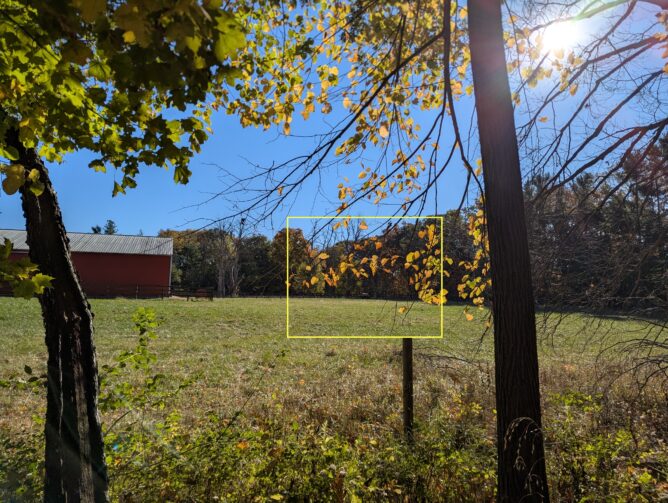
A pasture with a barn, with a barely visible horse in the distance, highlighted with a yellow rectangle

My father was great. This post isn’t really about all that, though. It’s about one (or two) specific things my dad did that have proven to be very beneficial to me.

One was that my dad was big on looking at things. I assume this mostly came from his being an ornithologist, which to a great extent involves looking at little tiny things some distance away.

He was always encouraging me to look for and look at things in the distance. On long car trips he’d often encourage me to watch for things like the water towers with the names of each town we were approaching. I’m sure part of that was just to keep me occupied with something other than complaining about being in the car, but part of it was getting me good at watching for things coming over the horizon, a skill that has proven itself of great value, even though I’m not a fighter pilot, or a lookout in a ship’s crows nest.

The other thing, closely related, was my father’s enthusiasm for praising specific things, of which this was one. Anytime I’d spot something early—especially if it was earlier than he did—he’d say, “Good eye!” He did that a lot when I was a boy, but he never really stopped. I remember just a few years before he died, I spotted a Hooded Warbler outside the house where he was living in Kalamazoo and drew a “Good eye!”

Even though I don’t have kids, I try to do this with other folks around me. A little praise never hurt anyone, and being able to spot things in the distance is always useful.

See the horse in the picture at the top? Maybe this will help a little:
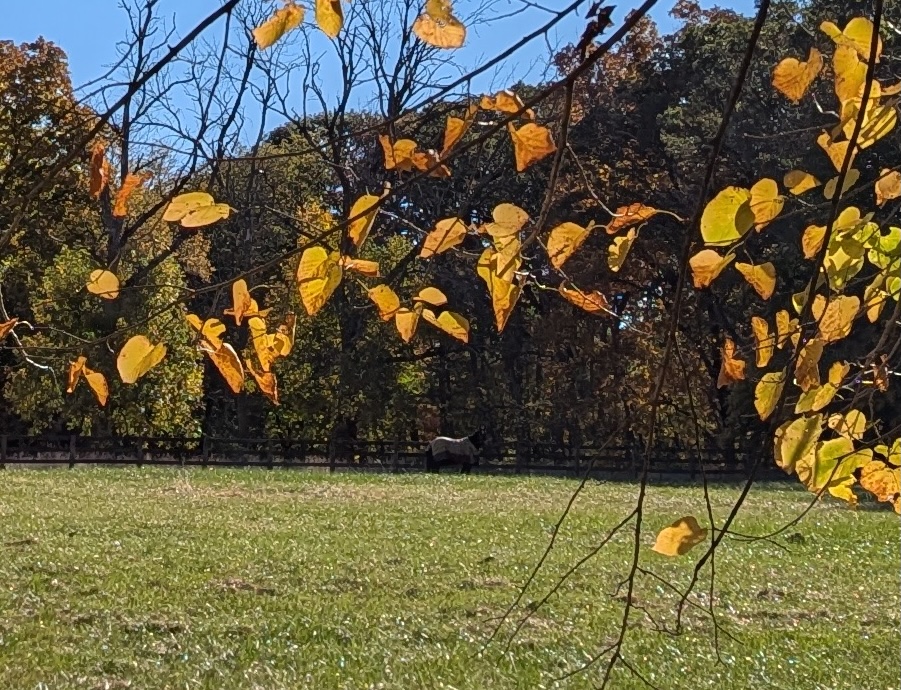
View of a pasture zoomed in to see the horse in the distance.

About three weeks ago, just a few days before heading out on our vacation, I noticed a black spot in the vision of my right eye, modestly to the right of the center of my vision.

I hustled to the optometrist, who dilated my eyes, looked inside, and said, “Yep, I can see a thing that matches what you describe.”

Two things I already knew:

  • Your eye ball is filled with a fluid called vitreous humour,
  • that fluid shrinks as you age.

But in my brain that fluid is rather more liquidy than it apparently is in reality. In my actual eyeball, that fluid is so gelatinous that it is attached to the retina with strands of connective tissue. My vitreous had shrunk enough that one of those strands pulled free, and the strand (connected to my vitreous and no longer connected to my retina) is what I’m seeing. Or rather, the shadow of that strand is what I’m seeing.

They call it a floater, but this one is unlike other floaters I’ve had. The other ones floated—that is, they moved around. This one is fixed in place. The others were also translucent, whereas this one was black. Looking out was rather like using a screen with a few dead pixels.

The prognosis is good. The black spot should become less noticeable, through both my immune system scavenging up the no-longer needed connective tissue and my brain learning that there’s no information in the black spot and filling in with detail from my other eye. (The spot is already turning browner and translucent.) There’s a slightly increased risk of retinal tears and detachment, not from the floater itself but from the shrunken vitreous.

I asked if there was anything I could do to encourage the vitreous to regain it’s original size, but apparently there isn’t anything known to help with that. The doctor said that it was often recommended that people refrain from heavy lifting, and I actually did quit lifting during the couple of days before the trip and the duration of the trip itself, but I’m certainly not going to give up lifting.

Because of my tendency to worry about such things, it was kind of daunting to have this happen right before our long drive, but in actual event was a non-issue. I’ll update if anything more comes of it.