
Walking the dog at sunrise this morning, I paused while walking down the high road through the prairie to capture this photo.
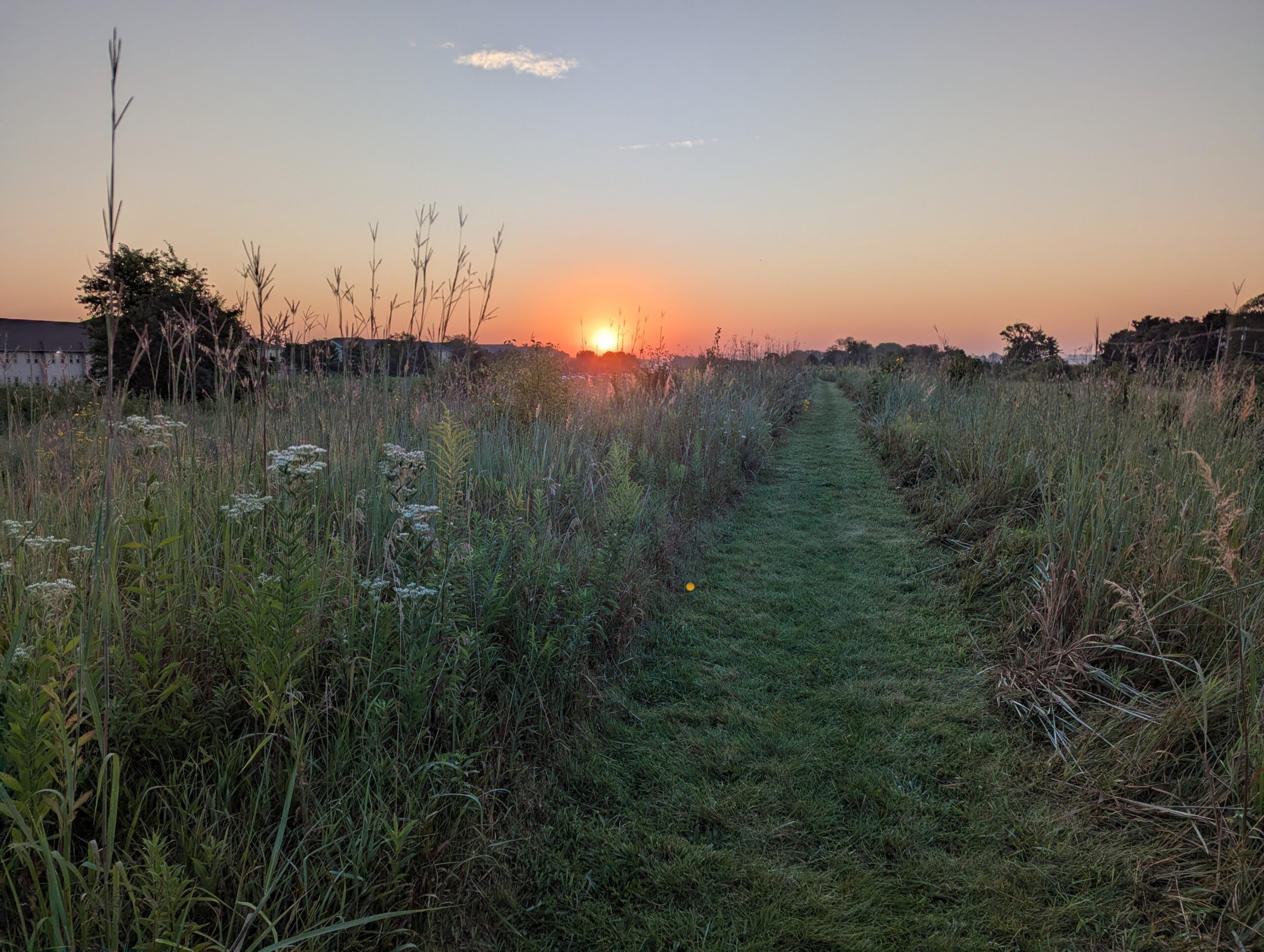

Walking the dog at sunrise this morning, I paused while walking down the high road through the prairie to capture this photo.

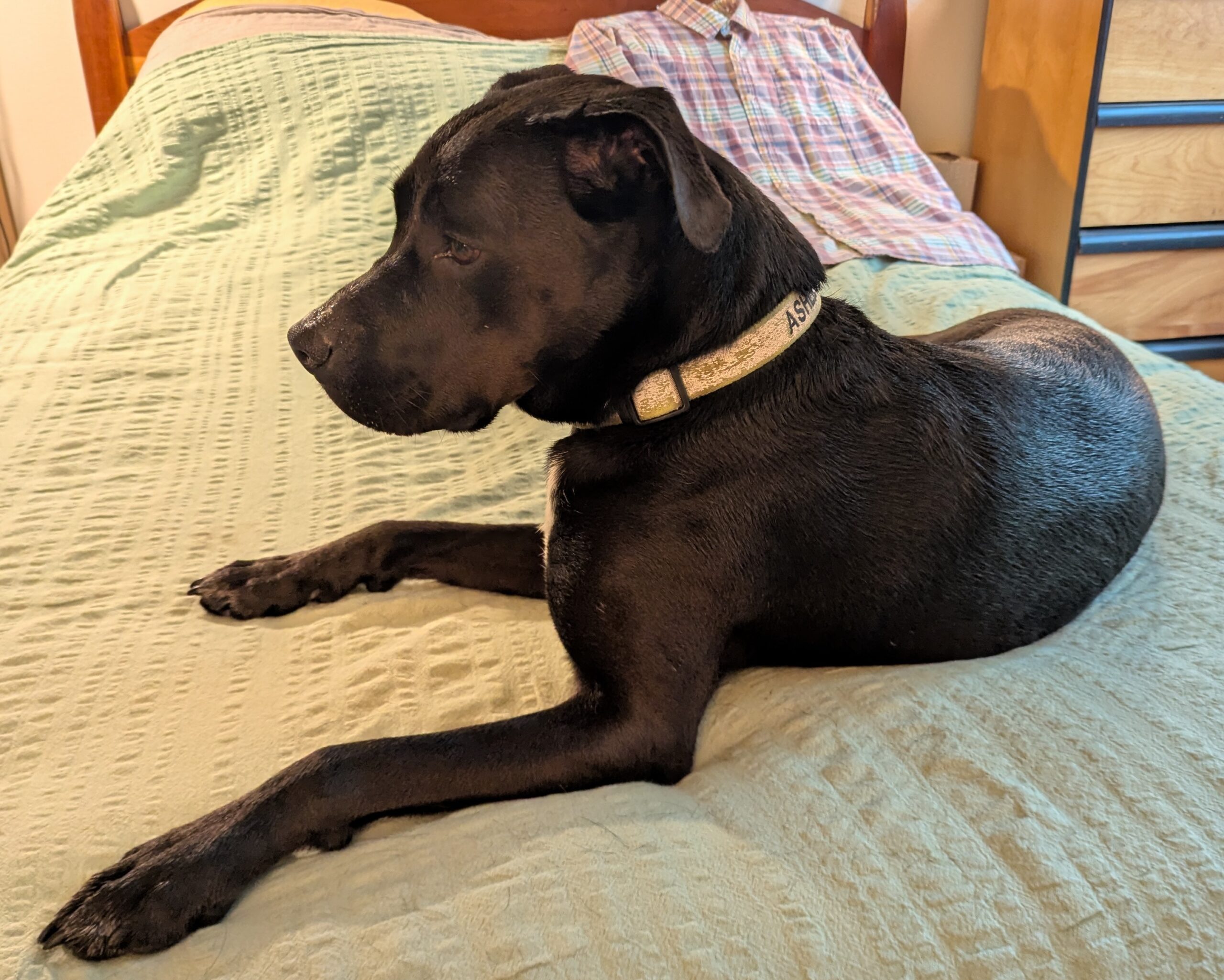
It rained yesterday, but not all the time. I was able to get Ashley out in the gaps pretty well. After raining all night, it seemed it was going to rain all morning as well.
I offered Ashley a chance to go out on the patio, and she declined. A bit later, after she indicated that she really wanted to go out. I put on my raincoat and put the leash on her and tried to take her out the front door, but she wasn’t having it. Just a few minutes later, she came and told me she needed to go out, so I tried again, and this time I actually dragged out out the door, into the rain. But No. She went about three feet out the door, then solid turned around and headed right back.
It was a classic case of Ashley wanting to go outside, but not to the outside that actually existed. She wanted me to take her to some other outside.
So I went back to my laptop and my third coffee (twice set aside, but still warm enough) and waited for the rain to let up a little. And it did let up a little, and I got Ashley out then.
We saw an opossum! He was a Very Handsome fellow, with a white face, a naked pink tail, and sleek counter-shading on his body, (I think the sleekness may have come from being very wet.)
Ashley, of course, wanted to play with the possum, and we chased it back and forth (the possum going through the shrubs next to the building, and us going around the shrubs). At some point the possum managed to get out of sight long enough for me to drag Ashley away.
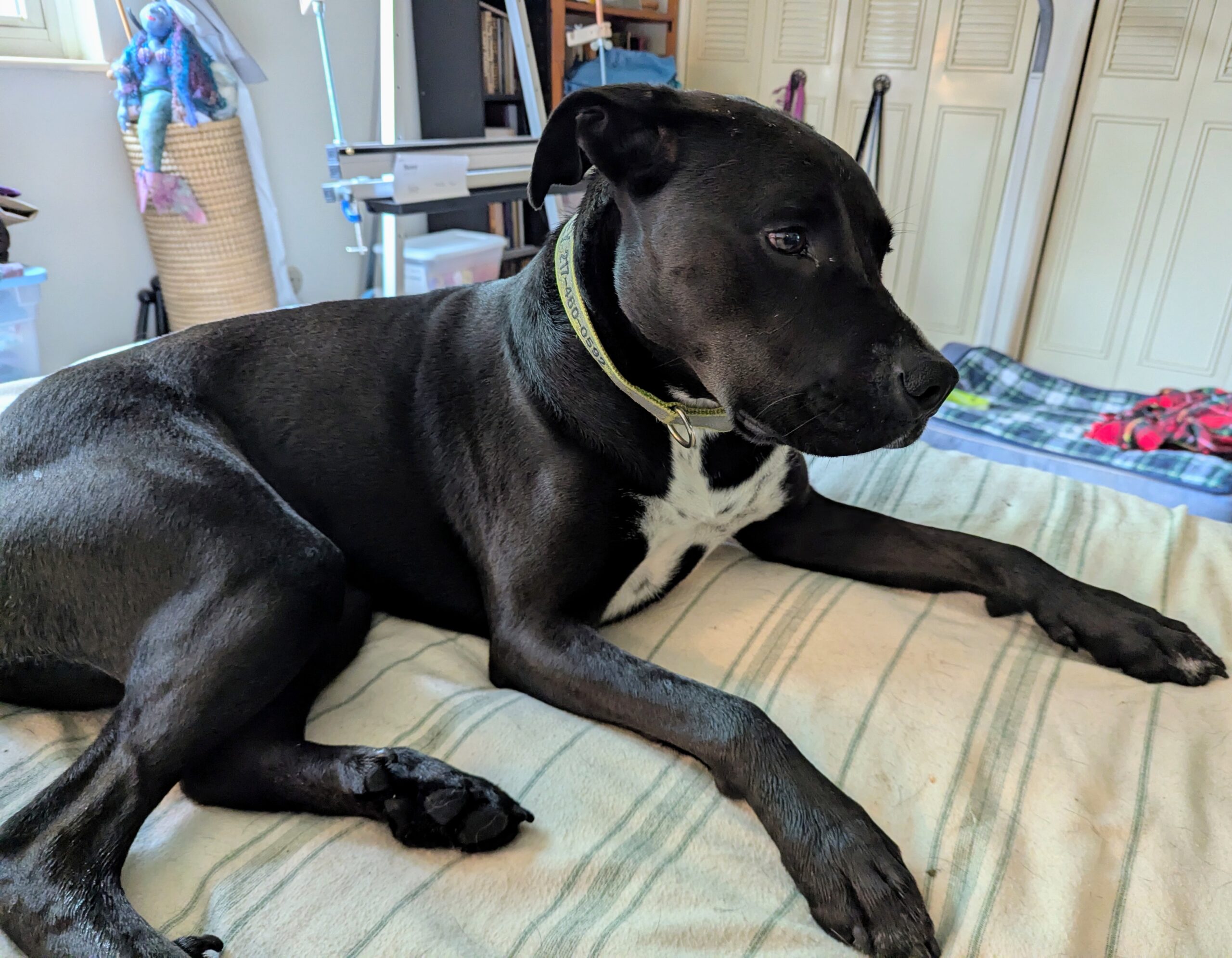
By then the rain had gotten hard again, so Ashley let me take her home, where I did my best to dry her off. But as you can see, my efforts were only partially successful.
There is a flood warning. I’m always a little amused by flood warnings in Central Illinois, because it is so, so flat here. Yes, it is flooding. The little creek is over its banks, sorta. But as soon as it gets over the top of its banks, the water just spreads out. Before it could get high enough to threaten my house (a few feet above creek level), the water would have to flood literally thousands of acres all around us.
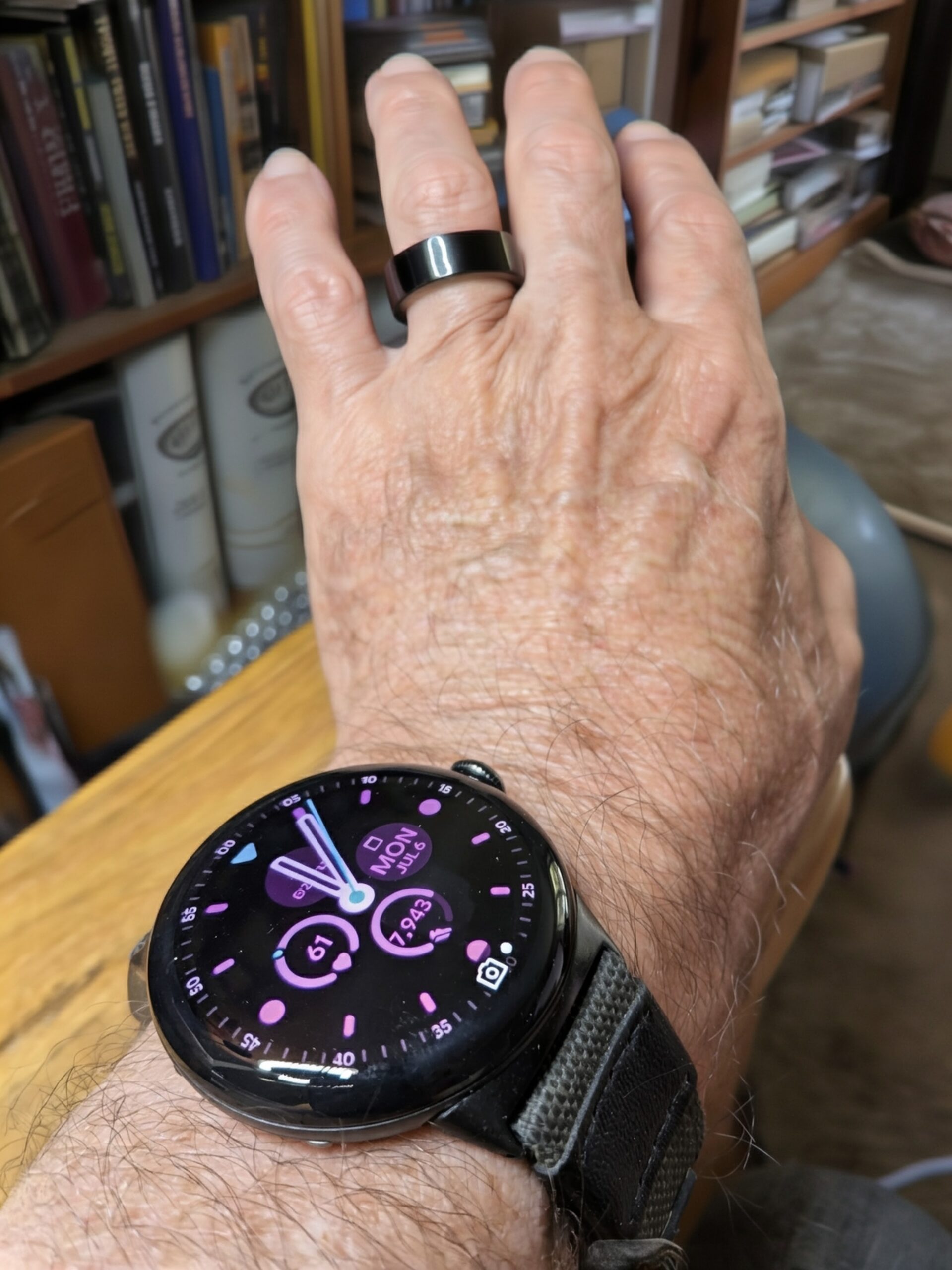
Do you use an activity tracker? I have an Oura ring, a Google Pixel watch, and a phone which runs Google Fit. All of those count my steps, and each one does some additional activity or sleep tracking. I find them all fun and interesting, so I’m always amused when yet another article comes out warning of the dangers of activity tracking.
The article at the moment is this one, sent by my brother: Five hidden pitfalls of fitness tracking, by Sahar Bakr.
I mean, sure. If you’re really foolish, you can be seriously led astray by one of these. But you’d have to be really foolish. It’s like the early days of GPS map software, where they’d be giving you directions and say, “Turn left!” but if you turned left you’d end up in a creek. Sure, you could do that, but all you had to do was look where you were going, and you could avoid it pretty easily.
Although the article has five items, there are, I think, two fundamental issues that Bakr is warning about. The larger one is outsourcing our good sense to some external device. The smaller is an excessive focus on step-count as the measure of fitness activity.
Letting a device tell you to push hard when you’re feeling crappy is just stupid. (It is perhaps somewhat less stupid to let a device tell you to take it easy when you feel great. I have several times decided to push hard because I felt great, even though one of my devices was warning me that I wasn’t fully recovered. More than once when I did that, I ended up having a crappy workout, because the device was right and I was wrong.)
With their fixation on steps (because that’s easy for a device to measure), devices have a pretty limited insight into the full scope of your movement practice. This means that they’re never going to know if your strength training is covering all the major muscle groups, or if your volume and intensity are on point. But that’s not really different from training without a device. Really, it only makes things worse if you’re so foolish as to imagine that it’s got some insight into stuff other than your steps and heart rate (or whatever else its measuring). Just like it doesn’t know enough about your strength training to provide useful advice there, it also doesn’t know much about your skills training or your flexibility training.
A lot of my training is focused on specifically increasing the sort of fitness I need for my HEMA practice. None of my devices even tries to guide me as to whether I should do less lunging practice in favor of overhead pressing practice or vice versa. (And if they did, I wouldn’t pay much attention, unless they’d started getting me to upload my sparring footage. And maybe not then.)
Getting back to the fixation on steps, the device makers want to pretend that step counts gives them some sort of deep insight into a human’s movement practice, with a one-size-fits-all target of 10,000 steps.
Weirdly, I don’t think that’s crazy. I mean, steps are by no means the only aspect of a human’s movement practice that’s important, but it’s actually not a bad proxy.
Over an evolutionarily long period, walking and running have been critical to human success. Running and walking were key to our successes in both hunting and gathering, and probably led directly to our big brains.
All three of my devices count steps. All three track walking and running. (They all try to track other activity—cycling, swimming, gardening, housework—but do so pretty poorly. Walking and running, though, they pretty much have nailed.)
In my mid-20s I was working in an office, but getting out to hike at every opportunity, which didn’t come frequently enough. I remember thinking, “If only I could get out and hike a few miles every day! I’d be in great shape!” That turns out not to be true, but it’s not completely false either.
My point here is simply that step counts are by no means a terrible proxy for one’s overall activity level, and 10,000 steps is by no means a stupid target—it’s mildly ambitious, without being out of reach for anyone with a reasonable level of fitness and some spare time. (I admit that I might well think this because I’m a weird outlier. I’m a walker from way back. I’m retired, so I have all the time in the day to walk if I want to. And I have a dog who likes to walk a lot. The upshot is, my daily steps hit 15,000 nearly every day.)
All of which is to say that I find these devices useful. In particular, they’re good at observing that I’m not fully recovered, meaning I should take it easy, even if I’m feeling okay. I find them (mildly) motivating, in that I pretty much never fail to hit 10,000 steps (unless I’m sick, the dog is sick, or the weather is terrible). I find them somewhat entertaining, especially when their praise is so for stuff I consider pretty minimal. (“You’ve met your activity goal for the day!” My Oura ring will say at 10:00 AM.)
In any case, I find them quite harmless. They don’t make me feel anxious or shamed. I’ve seen no sign that they are prompting disordered eating. I’m amused by their fixation on step counts, but not troubled by it. (I occasionally miss my 10,000 steps, usually when I’ve spent the day sitting in a plane, train, or car. I am not bothered when my devices observe that this is the case.) I care deeply about getting in my mobility work and my strength work, even if the devices don’t track it adequately. I take great joy in my movement—click any of the tags over there with “movement” in the name and find yourself taken to dozens of places where I’ve celebrated my movement practice, starting from before I had any devices, and continuing to this day. Finally, I am merely amused if my device dings me for not doing enough, as my Oura ring does if I sit for more than 50 minutes. (In fact though, these past few years, I can only barely sit still that long anyway.)
The key paragraph from the article:
For users, the first shift is to treat tracking as information rather than instruction. A watch can tell you what it has measured. It cannot tell you what your body needs today.
I mean, I know I’m a movement weirdo, but really? Who would do anything else?
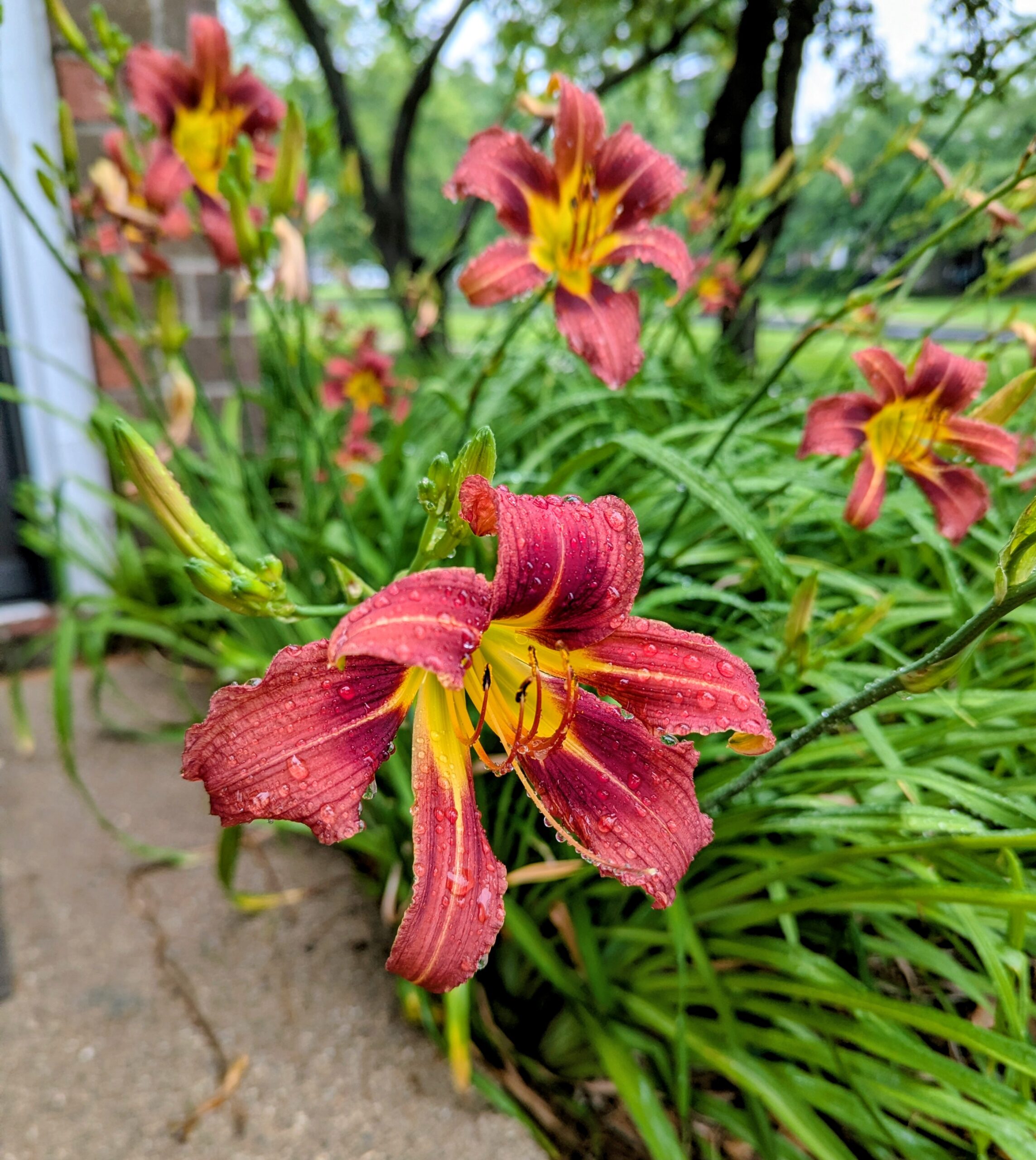
Appreciate these day lily flowers with rain drops, and this wet dog (which smells like a wet dog, but that is not captured in the photo).
I was out walking Ashley this morning when I saw this painting on top of the recycling bins near my house in Winfield Village.
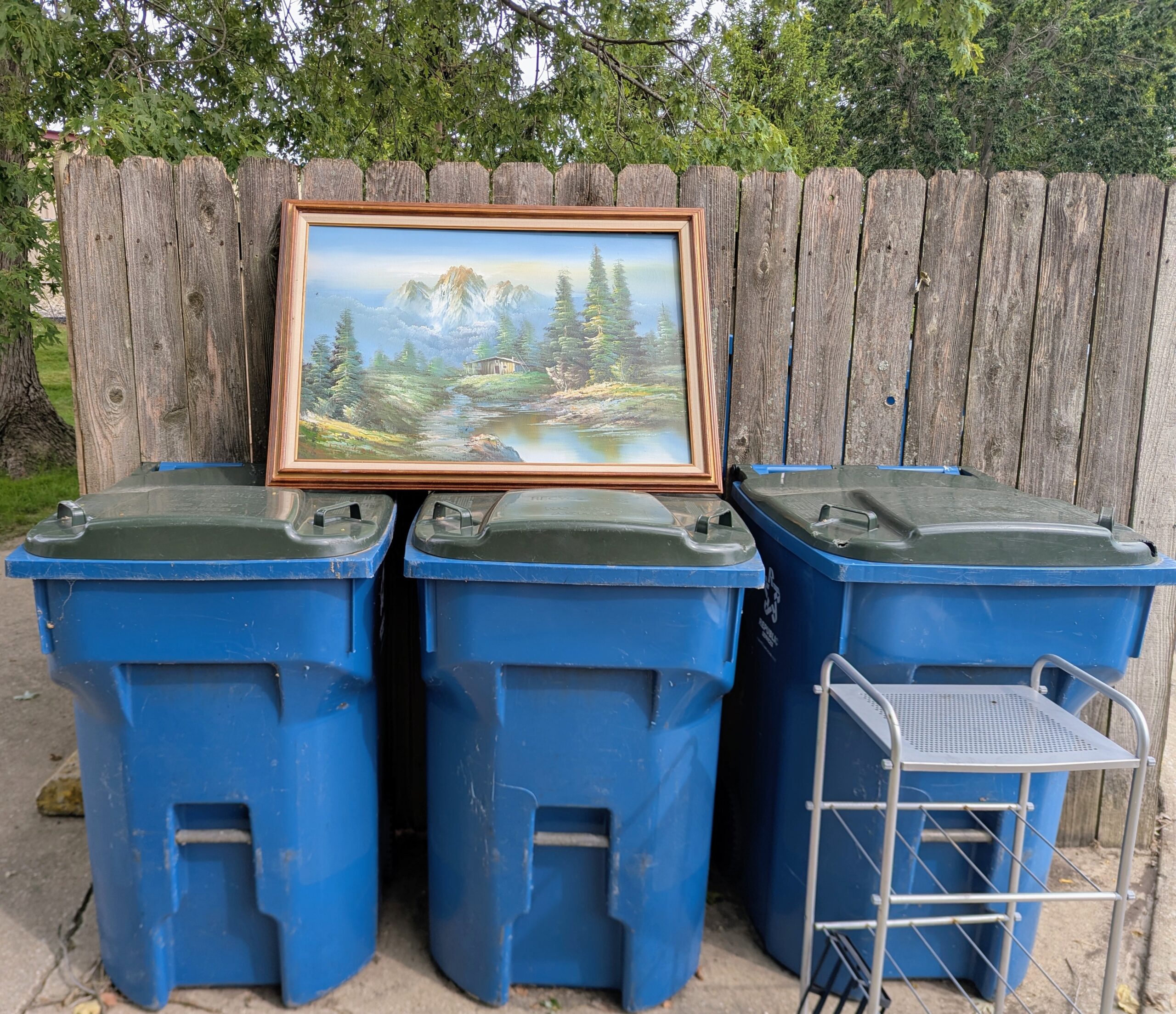
I immediately thought of a guy (probably this guy) who would buy thrift-store landscape paintings and then add a monster to them.
I shared the image above with Steven, who immediately thought of the same guy. (Steven was the one who found that link, before I was even home from walking the dog.)
Isn’t that little lake just begging for a sea monster of some sort standing in it? Or maybe some little cryptids lurking in the trees?
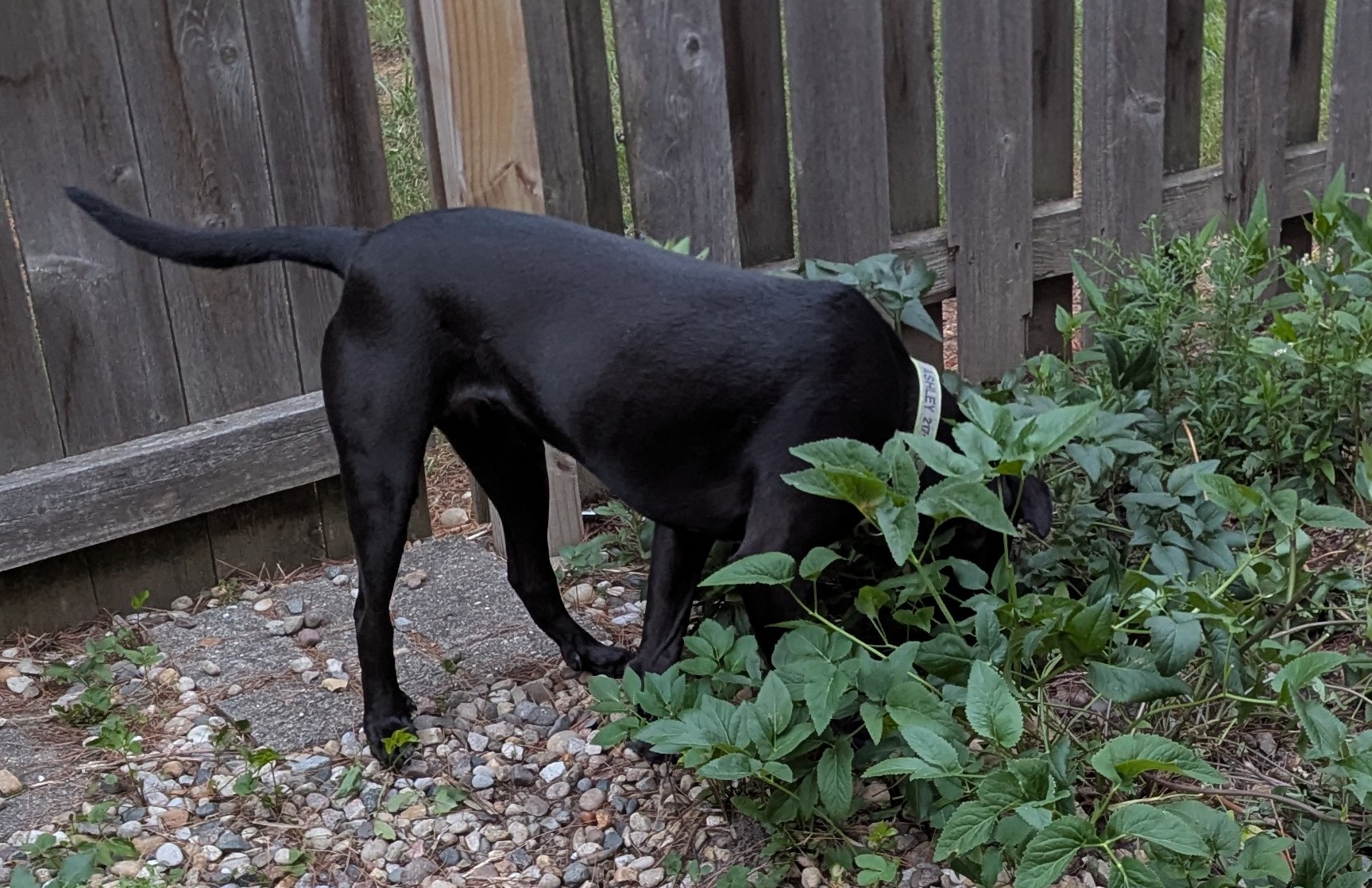
Steven commented while he was visiting on how much fun vole-watching on my patio was.
Ashley thinks so too.
Ashley has caught three voles that I know of (because she was on-leash when she caught them). She may have caught some others on the patio when she was out there off-leash.
One thing that surprised me, because it is so different from our boxers when I was young, was how gentle her mouth is.
Our boxers would promptly dispatch whatever they caught—groundhogs, even raccoons. One shake of the boxer’s head and whatever it had captured in its powerful jaws was dead.
That is not Ashley’s modus operandi. Two of the voles that Ashley captured were released unharmed, after I told Ashley “drop it.” (The third got eaten before I got organized to tell Ashley not to.)
In addition to the three voles, Ashley has caught both one (rather stupid) squirrel, and one (rather immature) robin fledgling. Both of those were released unharmed as well.
I’m not quite sure why. I know some retrievers have very soft mouths, so they can bring back a dead fowl without ruining it. Maybe there’s a gene for that, and Ashley has it? Or maybe it’s just that she was rewarded repeatedly for being very gentle when she took treats from people’s hands?
Whatever it is, I like both aspects of my li’l pupper: truly a mighty hunter, but also a gentle one.
I mentioned a few weeks ago that I’d made two changes to my morning routine: I had quit wearing my earbuds (and listening to podcasts) during my first two walks in the morning, and had started sitting down to write as soon as I got home from the second walk.
I am pleased to report that these changes are working great. I’ve done at least some fiction writing every single day for over three weeks now. Most of it was on a long-form project that I’m pressing ahead with, but I briefly paused to work on a short story (a flash piece?), that made use of one idea from my long-form project that I really liked, but that wasn’t working in the story.
I’ve gotten back to writing regularly, for the first time in too long. I’ve made two changes to my daily routine to make this happen.
The first is that I’m avoiding listening to podcasts during my first two dog walks. This lets me use that time walking outdoors to get into the headspace of whatever story I’m working on.
The second is that I’m going ahead and sitting down to write, right after the second dog walk. I’ve known for a very long time that I have to get started writing early, if I’m going to be successful. After second walk is perhaps not idea—earlier might be better—but it’s been working these past few days.

I had been using that time to get started on my morning exercises. But that leads into doing a workout, and by the time I’m done with that the dog is ready for her third walk, and then it’s time for lunch. And that is why I hadn’t been getting any writing done.
Slotting in a session of writing before I exercise is cutting into my exercise time, but maybe that’s okay. Delaying my workout for an hour (or, hopefully soon, an hour and a half) is certainly okay occasionally, and so far I’ve been getting in a reasonable amount of exercise anyway.
Sorry not to have gotten a picture of the dog.
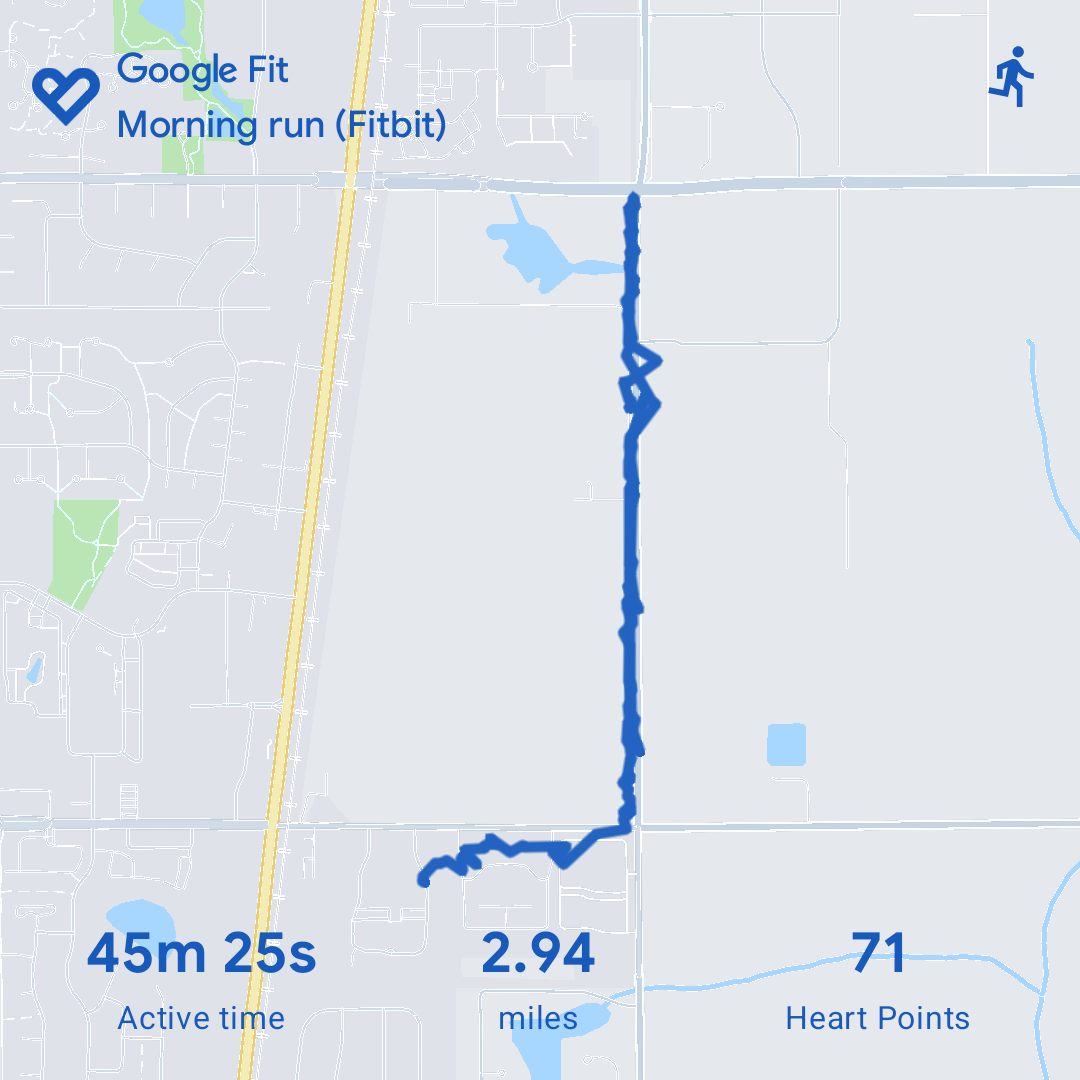
Run was 2.94 miles. Kinda slow, even for me. (That is, I’m a very slow runner, but running with the dog I’m even slower, because she needs to stop and sniff, and stop and pee.)
Still, very pleasant, and no doubt good cardio.
I have been meaning for a while to write about how I seem to need more recovery from exercise now than I did five or six years ago. Back in 2020 I could do a hard workout one day, take one rest day, and then come back and do another hard workout. This year I seem to need more rest days to recover. A couple of times recently, I seemed to need six days to recover from a hard lifting session or a long run.
When I mentioned this to my family I got back a chorus of variations on “Getting old sucks.” And it is entirely possible that my recovery capability took a dramatic hit between age 60 and 66. But I didn’t want to just assume that it was aging. I wanted to see if I could figure out if that was actually true.
(I mean, I know that there are a bunch of other changes between than and now that might make a difference in how much recovery time I need. One is that I walk my dog a lot. Although I don’t count those walks as “workouts,” they are still physical activity that requires some amount of recovery. I didn’t have a dog in 2020. I walked plenty then too, but I didn’t go for a long walk every day. Probably only once a week did I walk as far as I do almost every day now. Another is that now I’m trying to train for sword fighting. Those training sessions aren’t usually extremely intense, but sometimes they are, and they’re also somewhat unpredictable, meaning I can’t always line those sessions up with days when I’m ready for a hard workout. Plus, they’re fun—which makes it much easier to end up overdoing it.)
Fortunately, I have my workout logs from 2020—starting right before the pandemic, when I rediscovered the fact that consistency beats intensity when it comes to exercise, and then from the couple of years after that, when the ongoing pandemic meant that I didn’t have to do anything else, and could just exercise as much as I wanted.
I have at least two ideas about things I might do to analyze this:
So, I did take a first look at those logs, looking to see how much exercise I was doing for the first 30 or so weeks starting right before the pandemic, and how much recovery I was getting. I remember thinking at the time that I should aim for a workout every other day, accepting the reality that I’d occasionally miss a day, and end up hitting about three times a week, which seemed like a good goal. It turns out that, during this period of initial consistency, I was getting in almost three workouts per week as intended: 2.89 ± 0.83 workouts. The numbers showed a slight upward trend, with a few weeks with 4 workouts and almost none with just 2 in the last few weeks.
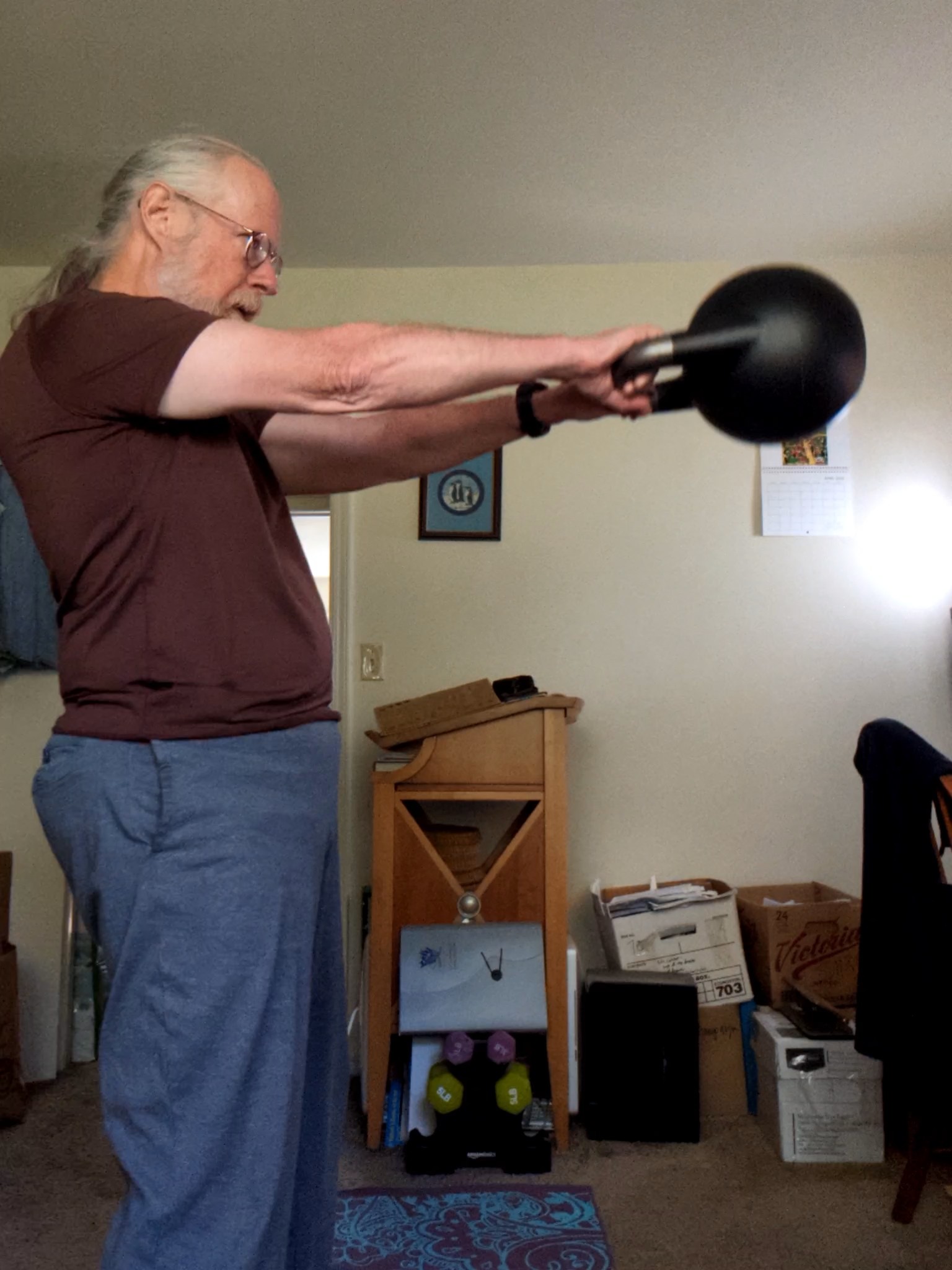
So that’s a first thing to try: Exercising roughly every other day, rather than overdoing it for several days and then needing several days to recover.
Every-other-day isn’t the only good workout schedule. Since I like working out, I kind of like exercising almost every day. Separately from that test, maybe I can come up with a six-day-a-week schedule that doesn’t overdo it: Just one or two exercises per day, focusing on different muscles, different body parts, and different energy systems from one day to the next.
I have so many things to try! (Along with trying not to overdo it.)