I am (just barely) old enough to remember the Black Panthers in the 1960s, when a group of black people tried to carry legal firearms to protect themselves, before they were mostly murdered by the police, the FBI, and one another.
I also remember the 1980s, when the NRA was trying to convince all marginalized groups (blacks, women, lesbians, gays, socialists, etc.), that arming themselves was a great idea. The NRA was sincere, I think—they just wanted more people to have guns.
Most people, especially black people, were well aware of the fact that walking around armed would make it much more likely that they’d be killed by the police. (They remembered what happened to the Black Panthers, presumably better than I did.)
Over the last couple of years, and especially over the last few days, I think perspectives are changing. First, a lot of white people are walking around armed, and even killing people, with minimal consequences. Second, the increasingly fascist police have been killing unarmed people at increasing rates, and looking like they’ll not only get away with it, but looking like they’re glorying in it.
This article, which had a really annoying headline, turns out to have some really great thinking.
In particular, the political perspective it is describing has more than a little overlap with the stuff I was writing about in my articles at Wise Bread.
An economic vision that … encompasses antimonopoly policies, right to repair and regulatory changes to smooth the path for people to start businesses, buy and work land, even build their own houses and invent things.
Steven suggested that I should revisit my Wise Bread posts. There’s a lot of useful stuff there. It was stuff that had seemed a bit less relevant over the last few years (I started writing in June of 2007, right at the start of the Great Financial Crisis, and carried on for 10 years.) But with government having gone all-in on fascism, racism, and gangsterism this year, a lot of those themes are feeling much more on point than they had for a while.
So I think I’ll do that. A lot of my Wise Bread posts still feel just right. On a few, my perspective has changed a bit. I’ll write some new posts to talk about what’s changed.
The apartment complex where we live was built over the course of a decade or so, back in the 1960s. I don’t know what the building code and zoning rules said about things like building spacing, but I imagine that they left quite a bit up to the builder.
Without rules that had to be followed, the builders built the complex with an eye toward maximizing their profit. If you put more units on a piece of property, you can bring in rent from more tenants. But at some point adding more units leads to diminishing returns—adding more buildings makes the space feel sufficiently cramped or crowded that potential tenants view the place as a downscale complex and they won’t pay as much. For a while that can still be profitable—you gain more from the extra units than you lose to lower rents. But squeezing yet another building in won’t just cut the rent on those units, it’ll cut the rent on all the other units as well. Eventually you reach the point where you lose more in rent than you gain from having extra units, so you stop and don’t build that building.
Zoning regulations can change the dynamic. Currently, there are rules in Champaign that limit apartment builders from jamming ever more buildings into a complex.
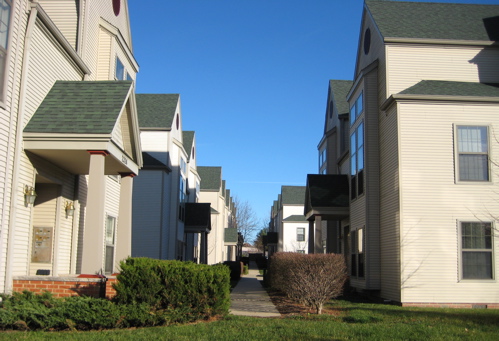
Apartment complex near where we live
This picture is from a newer complex just a few blocks from where we live. The buildings are crammed so close together, it seems to me that you might just as well be living in the same building as your neighbors, as far as noise and privacy go. (This picture shows them face-to-face. Side-to-side they’re even closer.)
Again, I don’t know, but I assume that the buildings are built as close together as zoning regulations allow. That’s the pernicious side-effect of having that sort of rule.
Because, see, there isn’t just one answer to the question of how closely packed buildings can be before they begin to feel downscale. It depends on other stuff. It depends on what people are used to. It depends on what alternatives are available.
When you create a rule, some fraction of the builders are going to aim for the bottom—just meet the rule. Those units aren’t going to be upscale, but there’ll be some people who will rent them.
If there were no rules, of course, some builders might build complexes where the buildings were even closer together than that, but those complexes would seem especially downscale. When you set a minimum, though, everybody who was thinking of someplace in that neighborhood will tend to aim for that same point.
Obviously the people who would have aimed more downscale would be prohibited from doing so. But the people who would have aimed for just slightly better will also be drawn downward. If there were a wide range of densities, builders would see advantages to being just slightly more upscale than the next guy. But with rules setting a lower limit, we don’t see the full range. Instead, we tend to see a binary division between the downscale units that are at the maximum density permitted, versus the upscale units that offer a sufficiently lower density to stand out. The legally mandated minimum becomes normalized (because so many complexes build to that standard) and ends up being a standard, rather than a minimum.
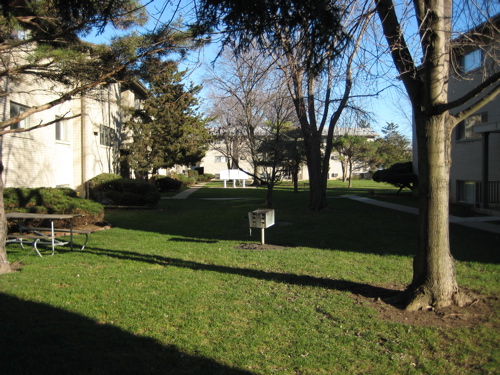
Courtyard outside our apartment
The courtyard outside our apartment is a common area that is actually used by us and our neighbors. There are picnic tables and grills. The space is comfortable. It’s big enough that we don’t feel like we’re sitting right outside our neighbor’s apartments, but not so big that we feel lost in a vast space.
The space outside the nearby complex, though, feels wretched to me. With the buildings so close together, the space between becomes just a dark corridor. It’s not inviting, which is just as well because there’s no room to do anything there anyway.
In one sense, it doesn’t really matter to me. Our complex exists at its present density, and I can’t imagine that it would make any sense to try find find a way to pack in more buildings. But it makes me sad to see all the other, higher-density, complexes going up. It means that we aren’t getting new options.
The rules that set “reasonable minimums” instead are producing a binary distribution, where our only choices are downscale apartments crammed together or high-priced luxury apartments, where tenants get a reasonable density, but are stuck paying for other amenities that we don’t care about. It’s the downside of reasonable rules.