I had my physical this week. (Pending anything surprising from the blood work, I seem to be in good health.)

The doctor noted that I’d continued to lose weight, and I observed that he’d lost weight as well.

Over the course of seeing him once or twice a year for several years now, I’d noticed that my doctor struggled just a bit with his own weight. He was a runner, and kept his weight under control when he was able to run. When something (injury, weather, schedule pressures) kept him from running, he tended to gain weight. As this has been my own experience as well, I figured we understood one another a bit better than we otherwise might.

When I mentioned his own weight loss, he said that he’d thought a lot about weight problems, and had decided that the right perspective to address excess weight was that of addiction.

This makes sense to me. At least, I have no doubt that the dopamine pathways involved in other sorts of addictions are involved in people’s poor eating choices.

Continuing, my doctor went on to point out that it’s pretty well accepted that addicts can’t just choose to use whatever substance they’re addicted to moderately. Someone who’s not a smoking addict might be able to choose to smoke tobacco a few times a year, but a smoker cannot. Someone who’s not addicted to alcohol can choose to have a drink or two without going on to drink way too much, but an alcoholic cannot.

I agreed with his analysis, but pointed out that it’s very tough to address overeating with the same strategy. “You can’t go cold turkey on food—you’ll just die.”

“Ah,” my doctor said. “But you can go cold turkey on the foods that you’re addicted to.”

He went on to provide a short list of foods that, if he ate them, he’d overeat—chips, cake, burgers, etc. Instead, he said, you could choose to eat only foods that didn’t trigger those addictive behaviors, and he provided a short list. It started with vegetables and fruits. I forget the next few items—but I immediately recognized the main differentiator. The foods that were safe to eat were foods. The items that were dangerous to eat were industrially manufactured food-like edible substances.

So I told him about Michael Pollan and his book In Defense of Food, and suggested a quick rule of thumb: Things you eat shouldn’t have ingredients; they should be ingredients. Certainly, they shouldn’t have any ingredients that your grandmother wouldn’t recognize.

Without saying that I buy into my doctor’s take completely, I think there’s a lot there that’s of interest. The principles of addiction management had always seemed valid—but not applicable to overeating, because you have to eat. The idea that you’re only addicted to those foods that kick those dopamine reward pathways into overdrive . . . . Maybe that is an insight into how to take the things we’ve learned about managing addiction and apply it to overeating.

(Let me add a disclaimer here, that I’ve grabbed a few sentences that my doctor said and run with them—quite possibly farther and in a different direction than my doctor would have. This post is my response to things he said, not a report of what he said.)
Years ago, my dad pointed me to the seminal article by K. Anders Ericsson The Role of Deliberate Practice in the Acquisition of Expert Performance. From 1993, it’s the ur-text for all the later popularizers of the idea that it takes 10,000 hours of practice to get really good at something.

Of course, if you read the actual article, that’s not what it says at all. What it says is that it takes 10,000 hours of “deliberate practice” to acquire expert performance.

A friend of mine once objected strenuously to Ericsson’s term “deliberate practice,” on the grounds that we already have a perfectly good term for this set of activities: practice. If you weren’t doing what Ericsson called deliberate practice—if you weren’t monitoring your performance, evaluating your success, and trying to figure out how to do it better—then you weren’t practicing, you were just dicking around.

That being the case, you will not be surprised to learn that there was nothing new for me in Debunking the Myth of the 10,000-Hours Rule: What It Actually Takes to Reach Genius-Level Excellence. If, on the other hand, you have fallen into the popularizer’s trap, and started to imagine that spending 10,000 hours dicking around with something would make you an expert, there may be quite a bit for you to learn.

Having dug up my copy of the original paper and looked through it again as I was writing this post, I’m glad I did. It’s a great paper, and it’s good to be reminded of what practice really is.

I often figure that the time I spend writing is practice for getting better at writing—and sometimes it is. Sometimes I do monitor my performance, evaluate my success, and try to write a sentence or paragraph better. But, of course, that’s not the fun part. The fun part of writing is when you get immersed in the world of the story and the words just flow effortlessly—and any thought of monitoring, evaluating, and improving is deferred to some future editing phase.

And, unsurprisingly, Ericsson was there ahead of me:

Recent analyses of inherent enjoyment in adults reveal an enjoyable state of “flow,” in which individuals are completely immersed in an activity (Csikszentmihalyi, 1990). Similarly, analyses of reported “peak experiences” in sports reveal an enjoyable state of effortless mastery and execution of an activity (Ravizza, 1984). This state of diffused attention is almost antithetical to focused attention required by deliberate practice to maximize feedback and information about corrective action.

In contrast to play, deliberate practice is a highly structured activity, the explicit goal of which is to improve performance. Specific tasks are invented to overcome weaknesses, and performance is carefully monitored to provide cues for ways to improve it further. We claim that deliberate practice requires effort and is not inherently enjoyable. Individuals are motivated to practice because practice improves performance.

Yeah. Exactly.

And yet, there can be a certain kind of enjoyment in practice.

When I’m writing and I’m not in flow state, but rather am struggling—trying over and over again to get something right—that’s practice. And, granted, that’s not much fun—except that pretty often I do manage to get something just right. (Or at least, get something that’s better than I can do on an average day.) That’s fun.

It is perhaps even more obvious in my taiji practice, especially the qigong practice, where we do simpler moves than the movements of the taiji form, and where we do the same move over and over again. Those exercises are (or at least can be) practice. Doing the same movement a dozen times, watching how the instructor does it, trying to match his form—that’s practice. Creating a small variation with a goal of improving some specific aspect—that’s practice. And yet, it can be fun, too, if approached with a playful attitude. (Today I tried to do some of my single-leg standing practice with my eyes closed. I picked the easiest of the various single-leg standing exercises that we do, and still wasn’t very successful—I almost toppled over a couple of times. But it was amusing in a way—and in the course of just a few minutes, I became perceptibly better at standing on one leg with my eyes closed. That was fun.)

Practice. It’s not just for getting to Carnegie Hall.

I’ve been waiting to post about how successful my new daily routine has been until I’ve had at least one day where I actually followed it in each particular, and today was that day.

In fact, just aiming at my new routine has been enough to increase my productivity quite a bit. I’ve had at least one writing session nearly every day, and I’ve gotten some sort of exercise nearly every day, and most days have had plenty of both.

So, the new daily routine has been at least a modest success so far.

Today:

  • I wrote early.
  • I went to the Fitness Center and lifted weights.
  • I came back and wrote some more.
  • I had a light lunch.
  • I went out and experimented with combining Zombies, Run! and Ingress. (It seemed to work okay, as long as I paused Zombies before trying to Ingress.)
  • I came back home and put a final polish on a Wise Bread post I’d written a few days ago, then shared it with the editors.

Having accomplished all that stuff, figure I’m free to do whatever I want for the rest of the day.

By the way, here’s my zombie-ingress outing as tracked by Zombies, Run. I went 3.61 km (which works out to 2.24 miles) in 1:28:22. That would be a very slow run, but it was fine for a walk where I was spent many minutes standing around at portals. (I left the program in kilometers rather than miles, only because Ingress does everything in kilometers. I’ll probably change it, though. I think in miles when I run.)

I’ve been practicing taiji for more than 4 years now. Jackie and I started with a 16-week class at OLLI, after which we continued studying with the same teacher, Mike Reed, at the Savoy Recreation center.

philip-brewer-ji
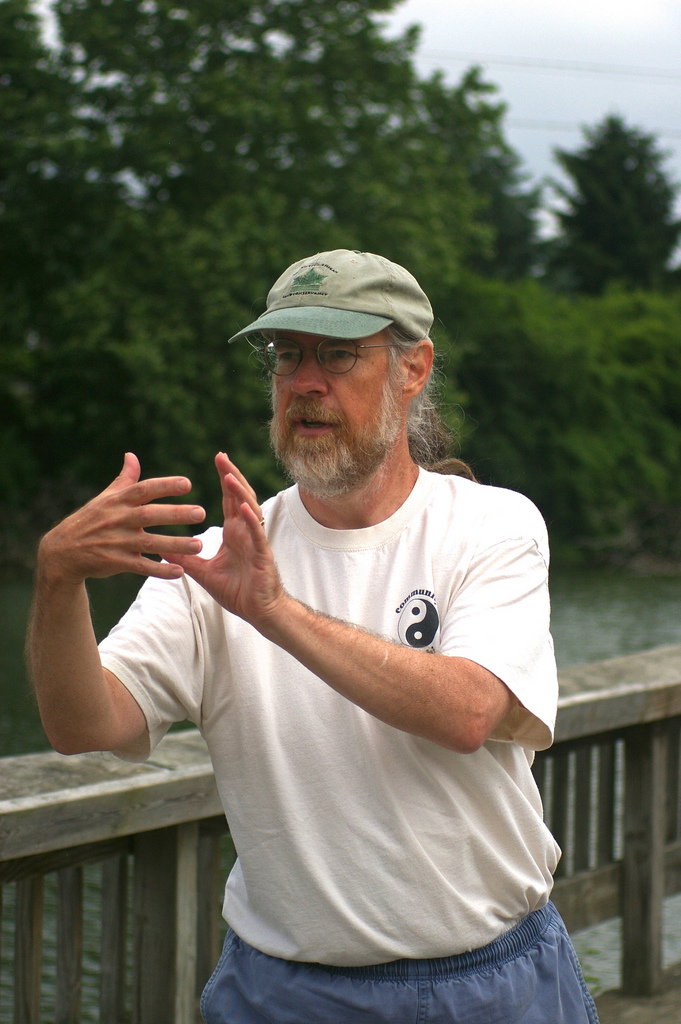
Me teaching the summer Park District class. Photo by Steven D. Brewer, used with permission.

The OLLI class taught an 8-movement form, the same form I taught my students when I taught a taiji class for the Champaign Park District this summer. We continued to do that form in the Savoy Rec classes, but also started learning a form that consisted of the first 12 of the Chen 48-movement form. Fairly early on, Mike proceeded to teach us the second 12 movements, so that we had a 24-movement form.

We stuck with that 24-movement form for a long time—I think we went most of a year without adding any new movements.

Jackie and I and a couple of other students bugged Mike about adding more movements, but he resisted. I think I now understand the reasons. The first 24 movements are pretty easy to do. That is, learning the whole sequence takes a while, and doing them exactly right may be difficult, but no individual piece of any of the movements is physically very challenging. Starting early in the second half of the 48, there are a number of movements that are considerably more challenging: Hops, jumps, kicks, and pivots—sometimes in combinations—that Mike hesitated to try to teach to a class where I’m the youngest guy there.

Eventually, after maybe a year, we wore him down. A year and a half ago, we got through the third 12 movements (somewhat modified, to reduce the aggressiveness of some of the jump-kicks and hopping pivots). This fall, we’ve learned the final 12 movements, doing the last two last week.

Today, for the first time, we did the whole 48-movement form from beginning to end.

I still have a lot to learn, even about the first movements—and, of course, I barely know the last few. But that’s okay. One of the first things I learned in taiji—that I should have learned from my previous studies of martial arts, but somehow didn’t—is that taiji isn’t something that you learn: it’s something that you do.

Now I can do a bit more. That’s all. And yet, it’s kind of a big deal to me.

I have a pair of problems, that I’m hoping to turn into solutions for one another.

The first is that I hate running on treadmills. I’ve tried all manner of things to distract myself from the fact that I’m running on a treadmill—music, audiobooks, podcasts, TV. Any of these can work, but none of them has worked reliably.

The other is that I’ve found it hard to expand my meditation practice from the modest group practice that happens in tai chi.

A while ago, it occurred to me that these might be solutions for one another: Perhaps, instead of trying to distract myself from my treadmill running, I could pay attention to my treadmill running.

There are a lot of different ideas about what meditation actually is, but my current take on it is that meditation is paying attention to what’s actually happening. Many forms of meditation suggest a finer focus—paying attention to your breathing or to a repeated mantra or to an ordered relaxation of body parts—but I view all these as tools for helping you pay attention to what’s actually happening (rather than thinking or planning or worrying or all the other things that are not meditation).

Today was my first attempt at this, and it went okay. I just ran for 10 minutes, which is not much of a test—I’ve always been able to tolerate 10 minutes on the treadmill; it was just when I tried to push beyond 20 or so that I found it intolerable. But 10 minutes is about as long as I ever meditate, so I thought I’d start there and expand gradually. Also, this was my first run since I hurt my ankle back in late September, so I didn’t want to run further until I verified that my ankle could handle a short run without hurting the next day.

If I can work up to 20 minutes or so, and feel like the time counts as both running and meditation, I’ll be very pleased. If I can do it three times a week (or nearly), I’ll both maintain an adequate fitness base to get back to running quickly in the spring and substantially expand my meditation practice.

Oh, and a side benefit: my attempts to run on the treadmill without paying attention have always seemed a little dangerous. I’ve known several people who’ve had treadmill accidents resulting in broken collarbones and broken teeth. Paying attention felt a lot safer.

For about six weeks now, I’ve been playing Ingress.

It’s a game. You could almost call it a video game—you see what’s happening on a video screen—but to play you have to go outside: The action of the game happens at specific places in the real world.

The conceit of the game is that matter from another dimension is intruding into our world via portals. In our world, these portals appear as works of public art or unique architecture. Via the game (running on an Android phone or tablet), you can locate and manipulate these portals.

I’ve been having a great time. I’m working with a half-dozen or so local Resistance players, some new like me, others already at level 8 and mainly providing support (since they’re no longer working to level up themselves).

The structure of the game encourages team play—building a powerful portal requires multiple high-level players to work together. But the team play doesn’t need to be simultaneous, just somewhat coordinated. Lower-level players can make faster progress if they play with a higher-level player, but it’s not necessary.

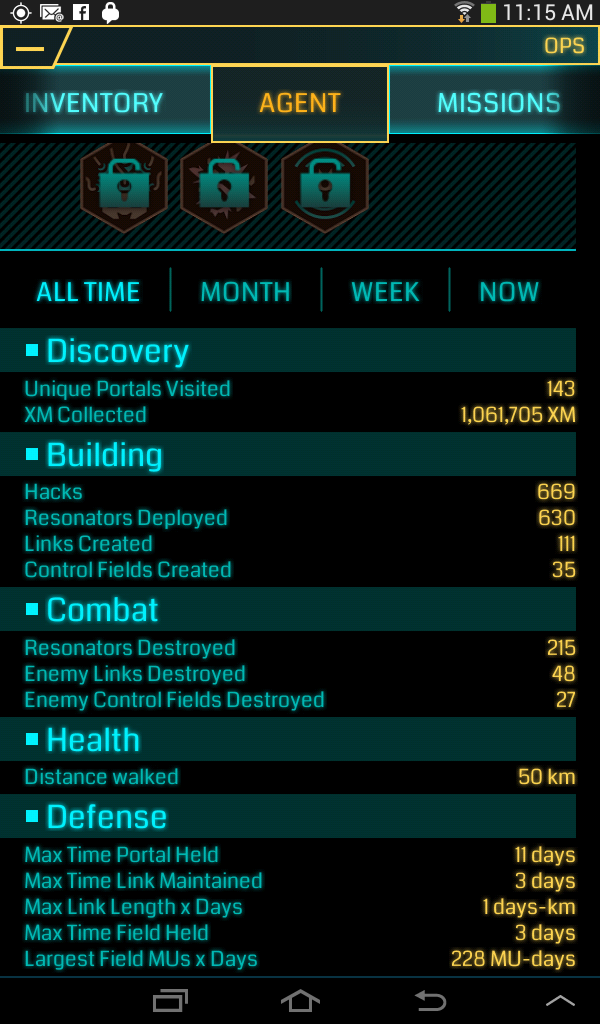
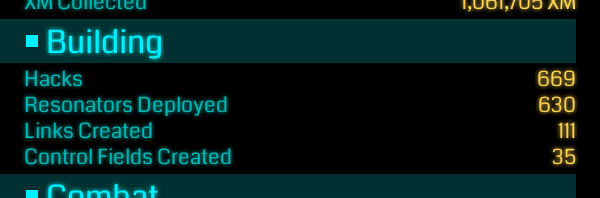
Screenshot_2013-11-01-11-15-12Besides the pleasures of loosely integrated, minimal-pressure teamwork, the other great thing about the game is that, because it takes place in the real world, to play it you have to go out in the real world. The game reports on how far you’ve walked in the course of playing it—for me, 50 km in the past six weeks. (See “Distance walked” in screenshot.) I credit that walking with helping me maintain my weight even though I haven’t been able to run for the past month.

I’m also really into the public art aspect of the game. I was already a huge fan of public art, but the game has made me connect with individual works in a way that I hadn’t. I’m aware of individual pieces in a whole new way—how they relate in space with one another and with other aspects of the community. (Although it is a different experience now to go for a walk downtown. Even when I’m not playing, I’m aware that certain works that are portals in the game. I have to remember that most people are not.)

Anyway, Ingress is now in open beta. If you have an Android device, you can just download the game and go.

I recommend it.

If you’re local and play, get in touch. I’d be glad to help you level up.

I hurt my ankle last month, and had to quit running.

There was no injury event. In late September I had two weeks of very modest running and fairly modest walking—and then one night (after a rest day!) turning over in bed made my ankle hurt bad enough that it woke me up.

It didn’t seem bad. I quit running and waited for it to get better. Except it turned out to be easily reinjured. (It seemed especially prone to reinjury related to bus riding. Three different times I hurt it that way—once running to catch a bus, once stepping down from the bus and landing hard on that foot, and once just stepping up into the bus pushing off with that foot.)

After about three weeks, I began to think that maybe it was a stress fraction or some other injury that might need more than just rest to get better. (Spoiler alert: It wasn’t, and it didn’t.)

I went to see my doctor, who ordered x-rays and a podiatry consult. The podiatrist I saw was an orthopedic surgeon, who had quit doing surgery to do this instead.

According to my orthopedic surgeon/podiatrist, there was no sign of a stress fracture—but it almost didn’t matter anyway, because stress fractures of the ankle and leg (except at the head of the femur) very rarely dislocate. The treatment for almost any injury of this sort is just to rest it until it gets better.

My formal diagnosis was peroneal tendonitis.

My ankle seems to finally be about all better. Yesterday I (once again) carelessly ran for the bus—and this time it didn’t hurt! However, Jackie has several tasks for me to accomplish over the next few days, and doesn’t want me to be unable to accomplish them because I’m hobbling around. So I’ve agreed to hold off on running for one more week.

My orthopedic surgeon/podiatrist is also a runner, and he sounds just like a runner. Jackie asked if my having switched to minimalist shoes the previous summer might have put me at more risk for injury. The doctor didn’t seem to think so, and mentioned that he had started wearing five-finger shoes for his short training runs. He had liked them well enough, that when it came time for his half-marathon, he’d abruptly decided to wear them for the race, even though he hadn’t been wearing them for his long training runs. Said it worked out fine for him.

I expect the same will be true of me. I’ll resolve to be more careful about adding distance next year, but I doubt if my resolution will make much difference. Long runs feel too good.

As Steven says, “Running is great exercise between injures.”

My only real hope is to do a better job of maintaining a base level of fitness over the winter, and I have a plan for doing so.

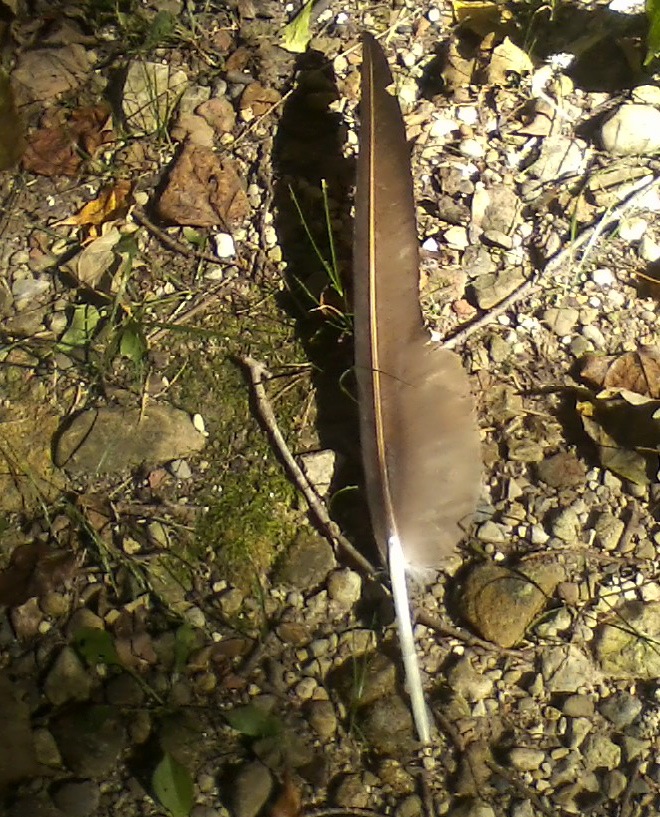
Turkey vulture feather

Jackie’s Spinners and Weavers guild had an event at Forest Glen today. It’s an annual event called Dye Day, where they mix up half a dozen pots with natural dyes and all the members can bring in some fiber to dye with walnut husks or goldenrod or cochineal or indigo or whatever.

Because we were going to be at Forest Glen, I seized the opportunity to go for a trail run.

It was a great run. I ran a section of the same backpacking trail Jackie and I had walked back in July, beginning at the same point (near the Gannett Center). My plan was to run out on the trail for 30 minutes, then turn around and run back. That was probably a bit ambitious, given that it’s my first trail run of the year, and that I’ve only had about three runs so far this summer that hit the 60 minute mark, but I was pretty sure it was doable, and that as long as I didn’t try to hurry, I’d probably be fine.

And, in fact, I was.

I saw two deer—or very possibly the same deer twice. At any rate, he looked very annoyed when, having run off after catching sight of me, I came at him from another direction when my trail took me around behind a hill and then right up to the very spot where he’d run off to.

I also saw a stufflebeam, who galumphed at a reasonably high rate of speed back into the underbrush when I threatened to get between him and that safety.

But the best thing I saw was a large flock of turkey vultures, that were all roosting together in a big tree that overhangs the trail.

Turkey vulture feather

Like the deer and the stufflebeam, the vultures were not happy to have a runner come upon them suddenly. As I passed under their tree, first one and then another leapt from their branch and took off into the air, beating their wings with a power that isn’t so apparent when they’re soaring.

But there weren’t just two or three vultures. As I slowed, startled by the first birds’ explosive launches, they continued taking flight, no longer one at a time, now taking flight in groups of two or three at a time. At least twenty very large birds took off from that tree in the 5 or 10 seconds it took me to pass under it.

It was spectacular.

It was early enough in my run that I didn’t want to stop and gawk, even to see the birds climb into the air to join their fellows who were already soaring, although I enjoyed what I could see of it.

It was hard to beat that little adventure, although the deer and Mr. Stufflebeam did their best, as did the forest scenery and the trail itself.

The backpacking trail is only marked to be followed in the forward direction, so it’s easy to get off track if you try to follow it in reverse, and I did go off course for a bit as I tried to return. After a few minutes of bushwhacking I saw where I’d gone wrong and worked back just enough to get back on track.

Running the trail as an out-and-back meant that I passed once again under the vulture-roosting tree—and it turned out that quite a few vultures had decided that 9:00 AM was too early to be up soaring, and had returned to roost some more. Once again, they launched themselves into the air. This time I slowed down to watch, and finally stopped near the trunk of the tree.

One vulture, either lazier or more confident of his safety up on a branch maybe 20 feet above the trail, decided not to bother taking off, giving me a good look at his red head and vulturous posture.

Roughly under him, I found the feather pictured above, which I assume based on its location and size is a turkey vulture feather. From the shape, I’m assuming it’s a primary flight feather (although I don’t know my feather morphology as well as all that).

I picked it up and carried it a short distance to a sunny spot where I could get a good photo with my phone. (I hadn’t brought my good camera.)

From there it was less than a mile back to the trail head.

According to my GPS thingy, I ran 4.523 miles in 1:14:44, giving me a 16:39 pace. My old GPS thingy—a first generation Timex Bodylink—isn’t nearly as good as a modern GPS device, and tends to have trouble maintaining a satellite lock under a forest canopy, so it doesn’t get as many waypoints as it might. That tends to cheat me out of credit for my full mileage. (The device assumes that I’ve run a straight line between one fix and the next. When the device fails to get a lock for many seconds at a time, it treats my run as cutting a straight line, even though I was following a twisty path.) Still, 4.523 miles is the best number I’ve got, so that’s what I’m going with.

I headed back to the Spinners and Weaver’s guild event, got out my folding chair, and sat down to rehydrate. Turkey vultures—almost certainly the same ones I’d startled into the air—were circling overhead. One of Jackie’s guildmates turned to me and said, “I guess they’ve figured out we’re dying down here.”

Great to be out on the trails again. I will have to find a way to run more trails before the end of the season.

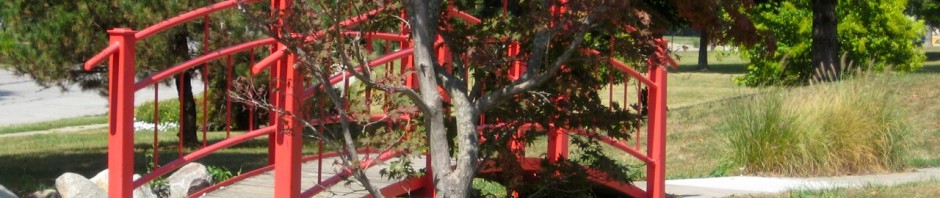
Red bridge in a Japanese Garden

Jackie and I did another of our very long walks yesterday, going 18.25 miles. We hope to go even farther in a walk in a couple of weeks (we’re tentatively thinking 20 miles), but that will probably be the last time this year that we do a new longest walk ever, simply due to limited daylight as the year winds down.

Like the last couple of very long walks, we stuck with Milo’s as our lunch destination. If you go the shortest way possible, it’s about 14 miles there and back. We were aiming for a bit over 17, so we had to add some short side trips to get the length up. We went by way of the research park and had coffee at the iHotel, went through Meadowbrook Park, and then after lunch briefly visited Crystal Lake Park as well.

I’ve brought my camera on almost all of these walks, but have hardly taken any pictures. This time, I took some pictures.

We’d walked through Meadowbrook Park on a couple of our previous walks, but usually after lunch. This time we did Meadowbrook Park before lunch—and we walked the prairie path, rather than taking the paved paths through the sculpture garden.

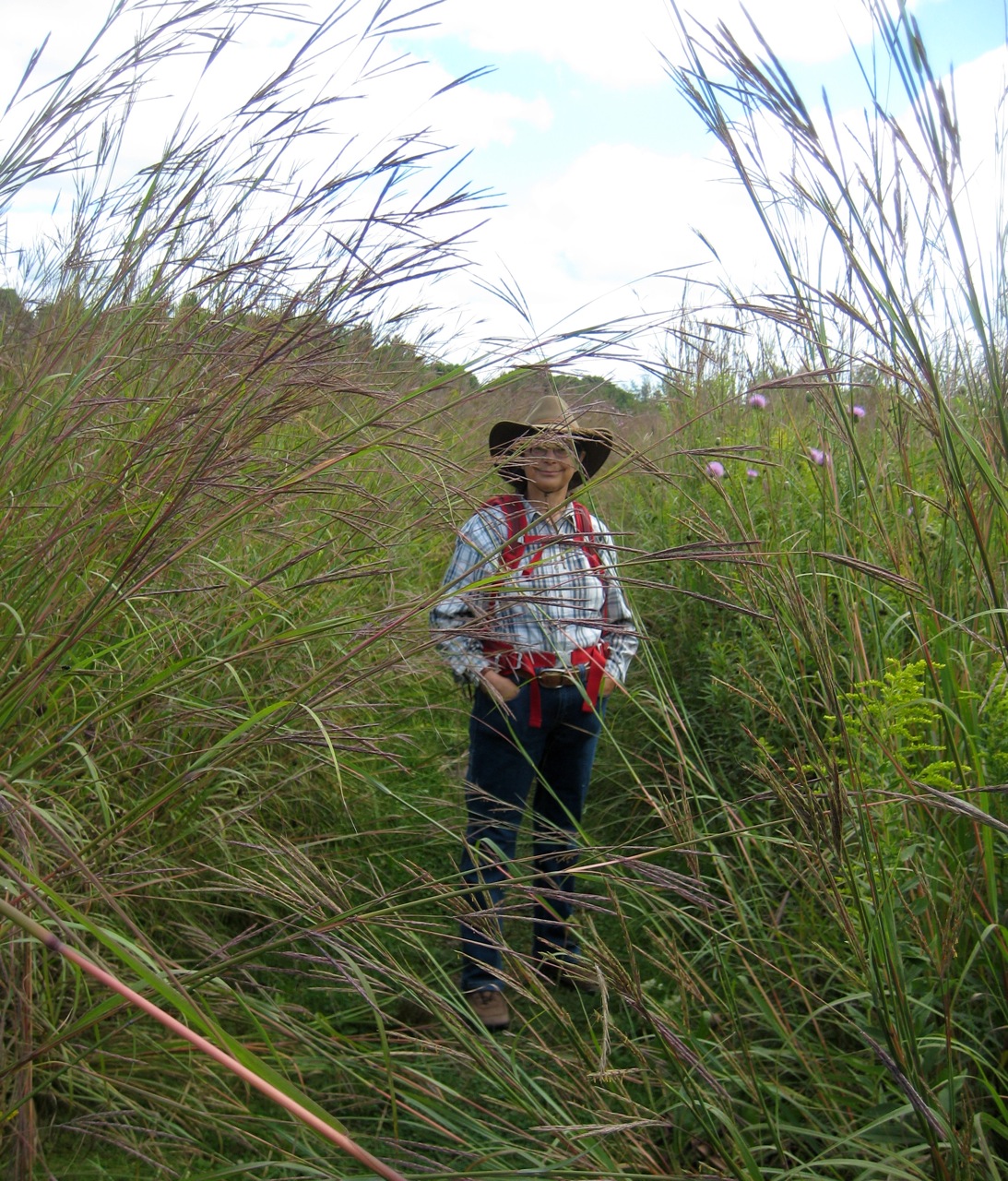
It was fun to see Jackie through the big bluestem.

Jackie standing amidst big bluestem
Jackie in the prairie at Meadowbrook Park

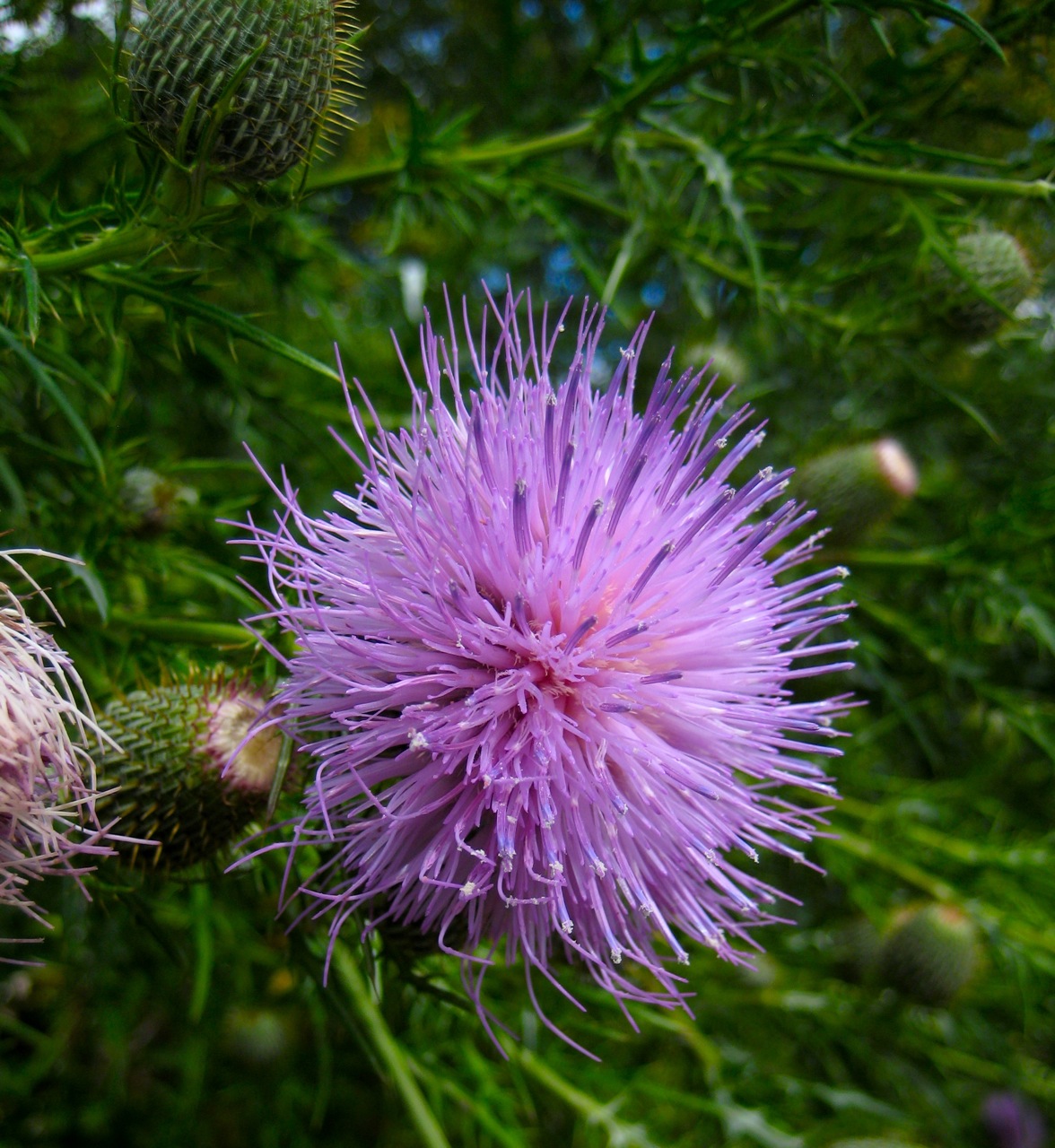
I was also pretty pleased with this picture of a thistle flower, taken just a few yards further down the path.

Thistle Flower
Thistle flower in the prairie at Meadowbrook Park

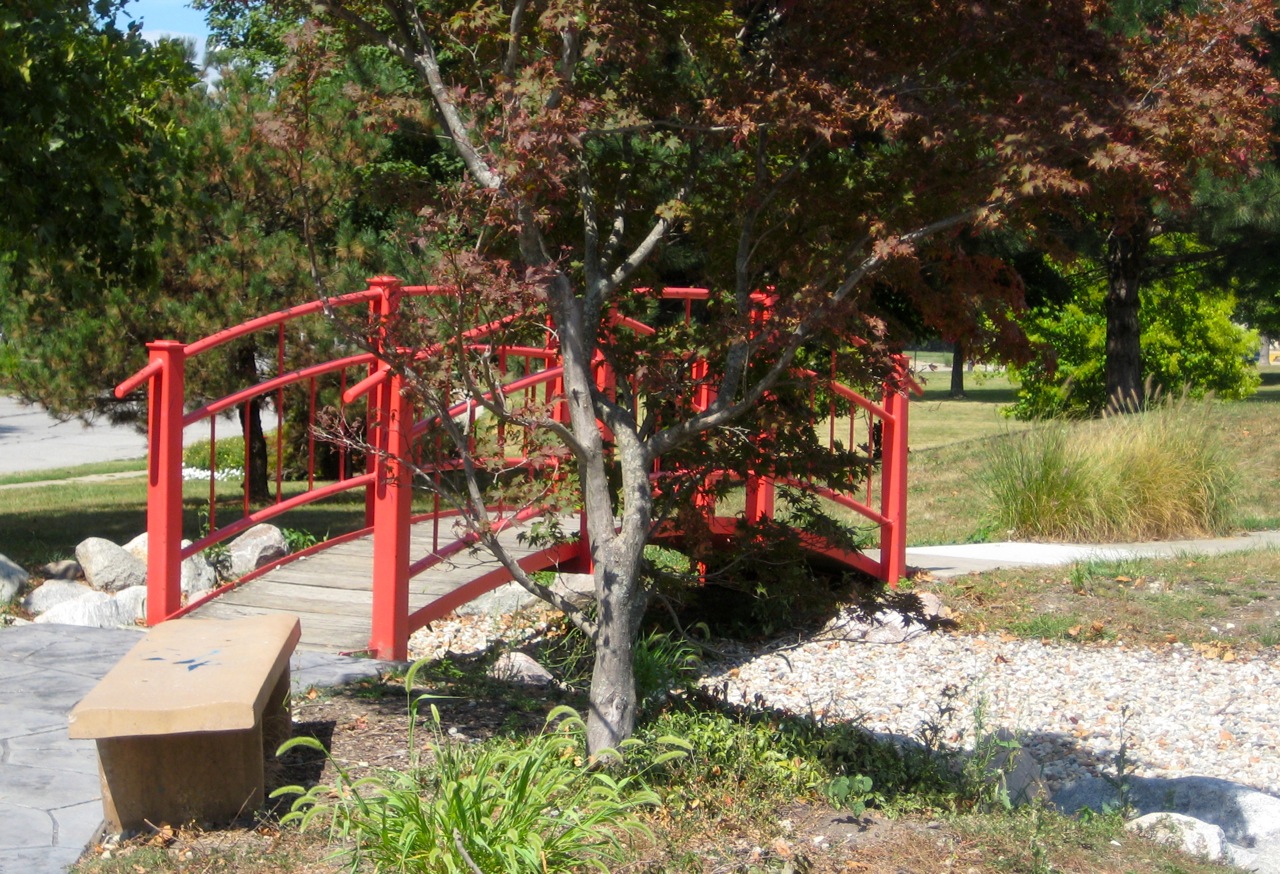
After lunch we proceeded toward Urbana, passing through the neighborhood where Jackie used to live before we started dating. One feature of that neighborhood is a little Japanese Garden. Jackie and I used to visit it pretty often. Eventually the last couple of reasons to visit that neighborhood vanished, and we quit going. I was pleased to get there again, although a little sad to see that they’d given up on the water features, and instead filled the pools with gravel. It’s not the same.

Red bridge in a Japanese Garden
The red bridge at the Japanese Garden near Sunnycrest

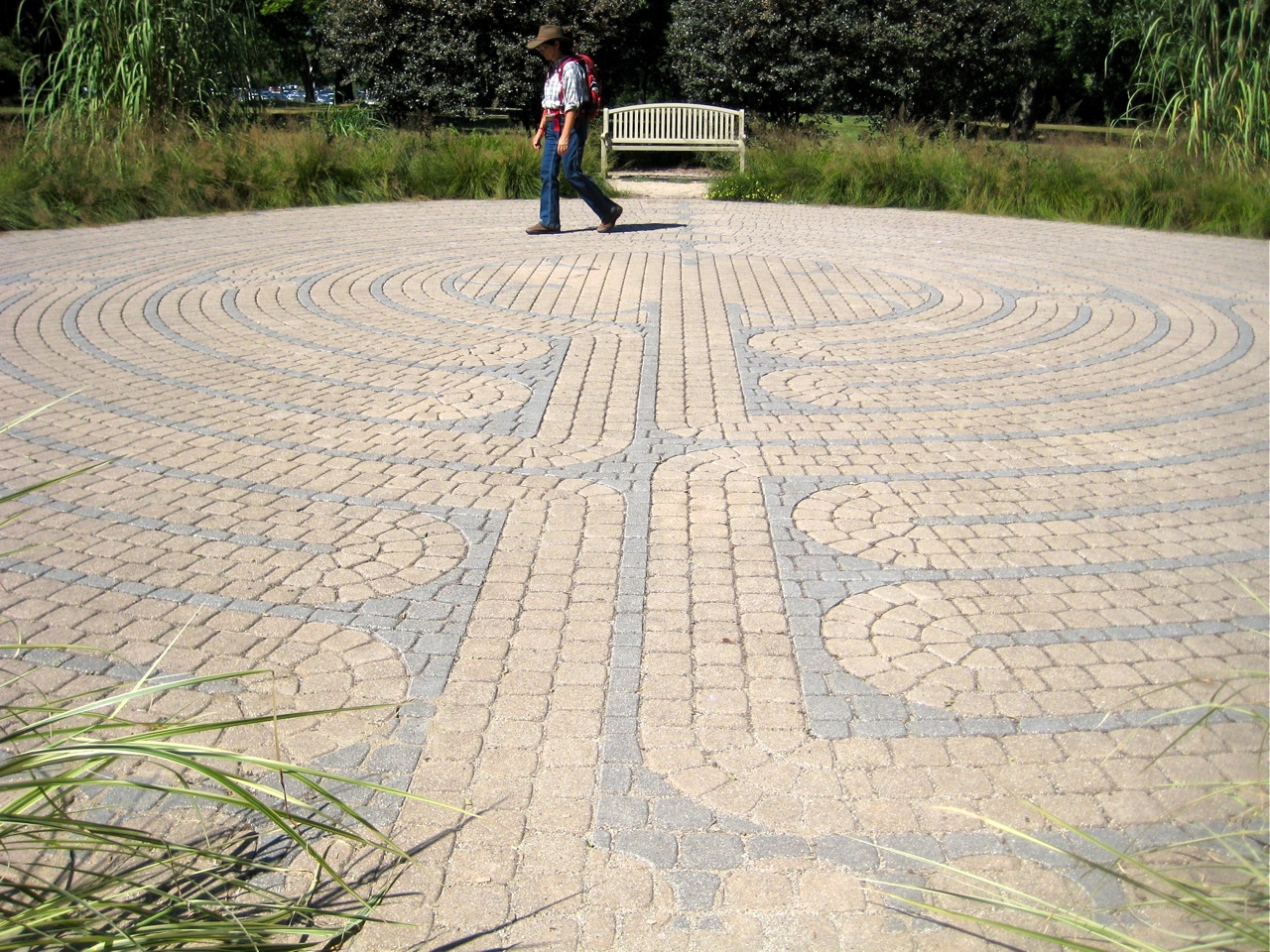
We also did a preposterous thing. In the midst of our very long walk, we paused to walk the labyrinth in Crystal Lake Park. (Endomondo did not seem to give us credit for this extra walking. I suppose at the level of precision possible with GPS, someone walking a labyrinth looks an awful lot like someone sitting at a bench.)

Jackie walking the labyrinth at Crystal Lake Park

For those who are interested in such things, here’s the data on our walk, via Endomondo:

It was a good walk.

I got a great comment on my previous post (thanks Ilana!), and started to reply in a comment there, but realized that I was straying into something that I wanted to talk in a post—training cycles that aren’t a multiple of 7 days.

Rereading my post, I see that it does look like my only runs are my long run and my fast run. That’s not the case, though. I try to include two or three easy runs each week as well.

In years past, my training schedule was pretty ordinary. Each week would include a long run and a fast run, each followed by a rest day. The other three days would each be a chance for an easy run. I found that I could just about maintain my fitness if I ran three times a week, but that I had to run four or five times a week if I wanted to improve either my speed or my endurance.

This summer my training routine has been complexificated by these very long walks I’ve been doing. It turns out that I need about two days to recover from a walk that pushes beyond the farthest I’ve ever walked before. Adding a long walk and one or two recovery days to my usual schedule pushes it out to a 9 or 10 day cycle, instead of a 7-day cycle.

The obvious thing to do would be to create a 9-day cycle—something like this: long walk, rest day, easy run, easy run, long run, rest day, easy run, fast run, rest day. One obstacle to that is that the various tracking tools I’m aware of all provide summaries for weekly periods, not for 9-dayly periods. (If you know of an exercise tracking tool that can produce useful summaries for training cycles of arbitrary length, let me know.)

So, I’m just winging it as far as a training schedule goes. Since it became clear that we wouldn’t get to Kalamazoo for the Kal-Haven trail walk this summer (we’re now hoping to do it next summer), we’ve eased up a bit on lengthening our very long walks, although we’re still planning to do 17 miles shortly. At these distances, it seems like doing each “even longer” walk ought to happen only every other week (with the long walk on the alternate weeks being comfortably within our established capability).