
The NYT article linked below talks to several people with anxiety or OCD, and somewhat reasonably comes to the conclusion that the Oura ring and similar devices are not for them.

I have a different perspective.

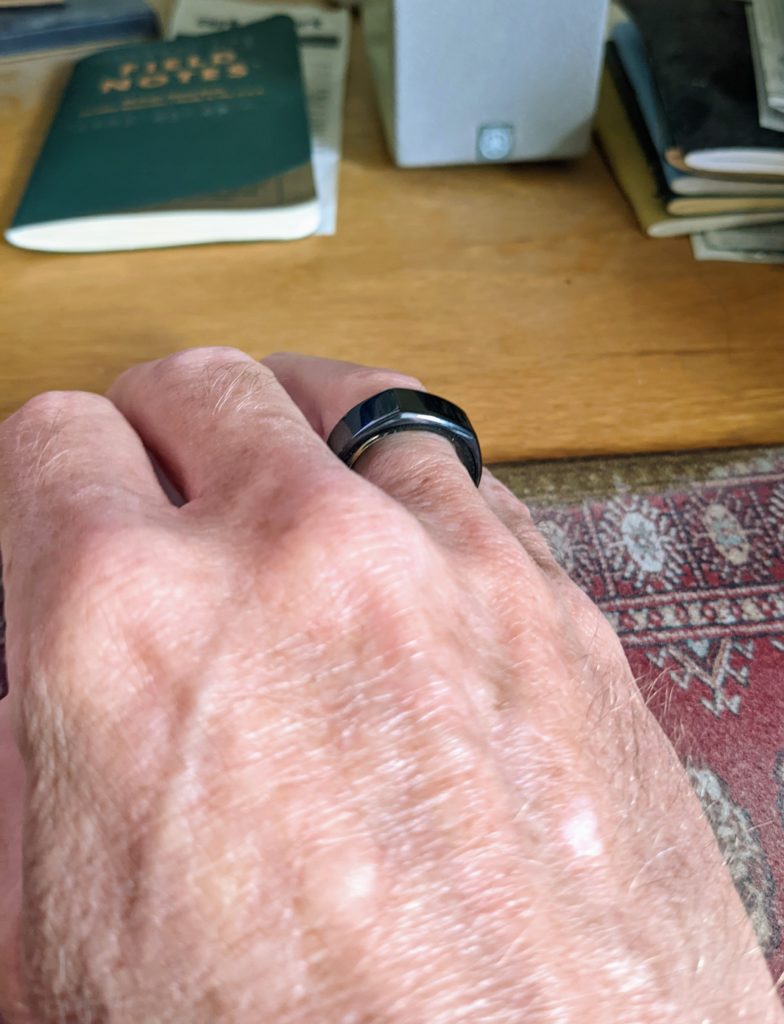
Selfie with my Oura ring

I wear an Oura ring and check it daily, and I’ve had none of these problems. I take what it tells me seriously, but I never let it override my own opinion on how I’m doing.

One fairly new feature is a warning when your metrics (temperature and resting heart rate in particular) suggest that you might be coming down with something. Even though I’m somewhat prone to hypochondria myself, it hasn’t been a problem for me.

Wednesday this week it warned me that I might be coming down with something. I felt fine, so I was inclined to ignore it. By evening I’d realized that I was coming down with a cold. (I felt pretty crappy all day Thursday. Today I feel nearly all better.) Although I was inclined to ignore it, I did take it seriously enough to skip my workout that day, which was probably a good idea.

I did react rather strongly the first time I got that warning, but only because I was visiting my 92-year-old mother, and didn’t want to risk passing something on to her. So I took the warning seriously enough to get and take a Covid-test and to wear a mask around my mom. Maybe that was an over-reaction—I wasn’t sick—but I am sure happier over-reacting than I would have been under-reacting and passing Covid on to my mom.

My brother teases me constantly for wearing such a thing, but I fall very much in the category of people who think, “Why not have as much information as possible?”

“They were like, ‘This is just not necessary information for a healthy, able-bodied person to have.’”

Source: Do You Have ‘Oura Paranoia’ From Having Too Much Information About Your Body? – The New York Times
I wrote this a while ago, after seeing two articles in two days ragging on fitness tracking devices, and suggesting that they’re bad for you. Both articles warn against outsourcing your intuitive sense of “how you are” to some device. And, sure, I guess you can do that. But if you actually are doing that, I’d suggest that what you have isn’t a harmful device. What you have is a device disorder.

I was going to make an even stronger statement along these lines, comparing a device disorder to an eating disorder. I think the comparison is valid, even though, upon reflection, it weakens my argument. Sure, some people have an eating disorder. But anybody is likely to engage in disordered eating when they eat industrially produced edible food-like substances. Maybe that’s a fair comparison with industrially produced fitness-tracking devices. Unlike with industrial food though, I think the data from fitness trackers can be consumed safely.

“… sometimes I would wake up in the morning and check my app to see how I slept — instead of just taking a moment to notice that I was still tired…”

Source: Opinion | Even the Best Smartwatch Might Be Bad for Your Brain – The New York Times

I get this, because I joke about this myself. My brother will ask how I slept, and I’ll say, “I’m not sure—I haven’t checked with my Oura ring yet.” Or I’ll say something like, “My ring and I agree that I slept well last night!” But I’m just joking. I know how I slept, I know how recovered I am from the recent days’ activities, and how ready I am to take on a physical or mental challenge.

My Oura ring

That doesn’t make the data from the Oura ring useless. My intuitive sense of how I am isn’t perfect. Many’s the time I’ve let wishful thinking convince me that I’m ready for a long run or a tough workout not because I really am, but because the weather is especially nice that day and the next few days are forecast to be cold or rainy. Or because I have some free time that day and the next few days are going to be busy. My Oura ring has been a useful counterbalance to that. If I had a hard lifting session yesterday, but I feel great today and my heart rate lowered early last night, maybe I am really ready for a long run today. On the other hand, if my heart rate took the whole night to get down to its minimum, and its minimum was higher than usual, that’s a good sign that I’m not fully recovered, even if I’m feeling pretty good.

If you have an eating disorder, do your best to avoid triggers that lead to disordered eating. Similarly, if you have a device disorder, it makes good sense to avoid using whatever sort of devices lead to disordered behavior. But that doesn’t make the devices bad, any more than eating disorders make food bad. But any particular device might be bad for you, just like any particular food might be bad for you. (And, I admit, industrially produced edible substances are probably bad for everybody.)