In a very small way, I’ve been persisting with my parkour training.
I’ve been practicing my shoulder rolls with some success: I can now do shoulder rolls from a kneeling start on both left and right shoulders. With that under my belt, I also did some from a standing start on my right side. I want a little more practice before I do them from the left side.
Next will be to do them at a run, and then to do them after dropping from a height. (Not a high height—I don’t want to hurt my feet, ankles or knees—but I want to develop the ability to drop from a height, absorb the impact of landing, and then go into a roll if necessary. It seems like a useful skill.)
The other thing I’ve started with are what the parkour folks call a precision: a jump to a specific point. You’ve seen them in movies where the actor (or a stunt man) jumps from one beam to another over a gap, or jumps from the top of one wall to the top of the next wall.
In the interests of not killing myself with my practice, I’ve been doing all my jumps at ground level, jumping and then landing on a curb. I’m not jumping very far—I still have no explosive power—but so far I have reasonably good accuracy. (The curb is maybe 6 inches wide, and I’ve managed to land on it, and to not topple over, pretty much every time so far.)
The distance I can jump is growing, which I think is just improving neuromuscular recruitment. (That is, at the level of the muscles, I’m getting better at firing off each phase of muscular contraction at the best moment to launch myself, and at the level of the limbs, I’m coordinating my arm and leg movements so that everything works together to launch me the distance I’m trying to go.)
In other news, packing to move proceeds apace. We’re soon to be at the point where we’re living in our summer place as much as we’re living in our old apartment. And we’ve learned that we’re #2 on the waiting list for Winfield Village
On many of my runs this spring, my ankles have been a little sensitive. I’m not sure why. It may be the last remnants of my ankle injury last summer. It may be that I haven’t been stretching my calves enough. It may be that I’ve been doing too many longish runs and not enough short ones. But whatever the cause, I’ve noticed that it seems much worse when the weather is cold.
Serious runners like to run in cool weather. Running generates a lot of heat. Even someone who runs as slowly as I do generates enough heat to keep warm (even in shorts and a t-shirt) in temps down into the 40s. But my ankles have tended to hurt after any run that I did in temps below the upper 50s. So for the past several weeks, I’ve been holding out for temps in the 60s to go for runs—and there hasn’t been much.
Happily our long, cold spring seems to be finally over. Since the end of winter, there have generally only been a few hours a week that were warm enough for me to run. As of today, it looks like we’re going to have 15 or 16 hours a day that will suit my purposes.
So, today I went out for a medium-ish length run, hoping that the weather and my schedule will let me get out for more runs nearly every day for the next while.
According to Zombies, Run! I went 3.11 miles in 36:18. It went great. No ankle pain (or foot, calf, knee, or hip pain). It was long enough for me to feel like I got in a real run, but short enough that (baring unexpected problems), I hope to be able to run tomorrow as well. And the day after that.
In related news, I’ve become interested in parkour. I’m not really interested in doing anything extreme in the way of climbing or leaping. It’s more that I’m hoping to see places to run differently—to see walls and railings and stairways and rocks as part of the course, rather than as obstacles. I haven’t done much so far, except step up the bodyweight parts of my resistance exercise, but I’ve started to practice jumping and landing where I mean to. (It turns out I have no explosive power at all. It’s really quite sad.) I’m also trying to recover my ability to do shoulder rolls. (Thirty years ago, when I was studying aikido, I could do a perfectly credible shoulder roll, come right to my feet, and then do the same roll on the other shoulder, all the way down the length of the dojo. Now I’m too timid to do a roll from a standing position, and even when I do it from my knee, it’s all clumsy and awkward. Which, come to think of it, is a pretty good reason to be timid about doing them at a run.)
We went to a local storytelling event last night. There were about six storytellers, telling stories over the course of most of two hours (with a 15 minute break). They served beer and wine, but we’d been to Whiskey Wednesday, so we didn’t get further alcohol.
There’s an active community of storytellers in town. As a writer, I’m extremely aware of the difference between writing stories and telling stories, and I’m endlessly fascinated by storytelling. The stories I write in English wouldn’t lend themselves to telling (although they read aloud okay). But the theme of the events (monsters and dragons) reminded me of my first Esperanto story, which was about monsters, and it occurred to me that story would probably work for telling pretty well.
Somebody ought to get some Esperanto storytelling events going.
This event, which was in English, was pretty cool. They had a good number of children in attendance (drawn, I suppose, by the monsters and dragons theme). They’re talking about making a monthly thing out of it, and I just might make my way downtown to listen to stories on a regular basis if they do.
Speaking of storytelling, I’ve been continuing to use Zombies Run when I run, because I enjoy the storytelling aspects. (And I am enjoying hearing the story unfold, quite a bit. I’ve got quite a bit more to listen to, but I’m already looking forward to replaying season one. In particular, I’ve been playing so far without zombie chases, and I’m sure adding those will change things enough to make it extra-replayable.)
Not really related to the storytelling aspect, but interesting to me, is that using the game has had an impact on my training runs.
The game is set up to give you training runs about 30 minutes (or about 60 minutes). The story is divided into 5 or 6 audio clips that dramatize the story. Between each pair of clips, the game plays 1 song (or 2 songs) from your running playlist.
Early in the season like this, my fitness improves almost every run. (Especially because the weather often makes it impossible to run day after day, so I’m getting my recover days in.) Normally what happens is that I’ll find a distance I can run at my current level of fitness, and I’ll run that distance pretty often for a while, until I get fit enough to run further. (Later in the season I mix it up more with a weekly “long” run.)
In years past, at this point in the season, I’d be running my regular 2.2-mile loop for most of my runs, and my times would be gradually improving.
Now, though, all my runs are about 30 minutes. But, as my fitness improves, instead of finishing a standard length sooner, I’m running for a standard period of time and having to run further.
The last two runs there was still story to go when I got back, and I ended up having to run around the apartment complex. In order to be sure I’ll have finished the story by the time I’ve finished my run, I’m going to have to start running a longer route! (The game has a feature for making sure that a route that runs longer than an episode doesn’t leave you bereft. It’s called “radio mode” it goes on playing stuff from your playlist, still alternated with audio clips, but these audio clips don’t try to advance the story. They just provides some local color. So, if you finish a mission, but end up running another 10 minutes to get home, it switches seamlessly to those bits.)
Once the weather improves a tiny bit more, and I’m running more days per week, I’ll probably ease up just a bit on my all-zombie running, which will make it easier to mix up the distance a bit more.
Maybe I’ll also practice telling a story in Esperanto.
I’ve always quit running during the winter. I found I could make myself get out and run in temps down to about 50 degrees, but when it got colder than that I didn’t enjoy the runs enough to make myself get out and run. I regretted this, because it meant that I did very little running for about six months of the year, but I didn’t regret it enough to get out and run in the cold.
This winter things have been a little different—the two phone-based games I’ve been playing have given me whole new motivations to get out.
I’ve walked 323 kilometers (200 miles!) playing Ingress, which I started playing back in September, almost all of that being walking that I wouldn’t have done without the game. That has stood me in good stead as a way to preserve fitness over the winter (although that includes walking that I did in the fall).
I experimented a bit with Ingress running, but found that although it was fine for the Ingress, it detracted from the run. I spent so much time pausing to play Ingress, that the average speed of my runs made them look like walks. There’s nothing wrong with that, and I may well do some more Ingress running this summer as a way to visit all my local portals without spending all day at it, but I missed the continuous effort of the run. I also missed having a measurable run, one that I could compare with an earlier run and get a sense of whether my fitness was ahead or behind of where it had been that year.
So, the Ingress hasn’t been getting me out to run, although it does get me out to walk.
However, I haven’t needed Ingress for running motivation, because I’ve got Zombies, Run!
It turns out, I don’t need temps above 50 to get me out to run, if I’m playing a Zombie mission. However, I’m still unwilling to run on ice and snow (because I’m not an idiot), and the cold, snowy winter, combined with the fact that people in Champaign-Urbana are the most un-neighborly people I’ve ever encountered when it comes to shoveling sidewalks, has meant that we’ve had conditions that kept me from running for the whole second half of January and most of February.
Today, though, the temperatures got up into the upper-30s, and got the snow and ice melting at speed. It was 36 degrees when I got back from lunch, and I’d seen that many sidewalks were finally clear, so I just changed into running clothes and headed right back out again.
I ran 3.16 miles in 37:11, for an 11:47 pace. (Zombies, Run! reports it as an 11:45 pace, probably due to rounding.)
Looking at my running log from last year, I see I didn’t do a 3-mile run until early May—so I’m a full two months ahead of the game. (Looking at the running log in more detail, I see that the issue wasn’t my aerobic fitness, it was the tendons in my knees that objected when I first ran 2.2 miles, and then again when I ran 2.4 miles. Last year I held my runs at those distances until my knees quit hurting. Being able to check this sort of thing is just what I’m talking about, when I complain about Ingress running not producing measurable, comparable runs. Happily, my knees felt fine today, probably because of all the walking.)
Best of all, the forecast is for highs above freezing every day for as far as the eye can see.
Now that I have my phone-based running games, all I ask is that the sidewalks be clear of ice and snow—and highs above freezing will take care of that.
After a brief lull as I began integrating already written text into my novel, things have picked up again, and the novel progresses apace.
I’ve been waiting to post about how successful my new daily routine has been until I’ve had at least one day where I actually followed it in each particular, and today was that day.
In fact, just aiming at my new routine has been enough to increase my productivity quite a bit. I’ve had at least one writing session nearly every day, and I’ve gotten some sort of exercise nearly every day, and most days have had plenty of both.
So, the new daily routine has been at least a modest success so far.
Today:
I wrote early.
I went to the Fitness Center and lifted weights.
I came back and wrote some more.
I had a light lunch.
I went out and experimented with combining Zombies, Run! and Ingress. (It seemed to work okay, as long as I paused Zombies before trying to Ingress.)
I came back home and put a final polish on a Wise Bread post I’d written a few days ago, then shared it with the editors.
Having accomplished all that stuff, figure I’m free to do whatever I want for the rest of the day.
By the way, here’s my zombie-ingress outing as tracked by Zombies, Run. I went 3.61 km (which works out to 2.24 miles) in 1:28:22. That would be a very slow run, but it was fine for a walk where I was spent many minutes standing around at portals. (I left the program in kilometers rather than miles, only because Ingress does everything in kilometers. I’ll probably change it, though. I think in miles when I run.)
I have a pair of problems, that I’m hoping to turn into solutions for one another.
The first is that I hate running on treadmills. I’ve tried all manner of things to distract myself from the fact that I’m running on a treadmill—music, audiobooks, podcasts, TV. Any of these can work, but none of them has worked reliably.
The other is that I’ve found it hard to expand my meditation practice from the modest group practice that happens in tai chi.
A while ago, it occurred to me that these might be solutions for one another: Perhaps, instead of trying to distract myself from my treadmill running, I could pay attention to my treadmill running.
There are a lot of different ideas about what meditation actually is, but my current take on it is that meditation is paying attention to what’s actually happening. Many forms of meditation suggest a finer focus—paying attention to your breathing or to a repeated mantra or to an ordered relaxation of body parts—but I view all these as tools for helping you pay attention to what’s actually happening (rather than thinking or planning or worrying or all the other things that are not meditation).
Today was my first attempt at this, and it went okay. I just ran for 10 minutes, which is not much of a test—I’ve always been able to tolerate 10 minutes on the treadmill; it was just when I tried to push beyond 20 or so that I found it intolerable. But 10 minutes is about as long as I ever meditate, so I thought I’d start there and expand gradually. Also, this was my first run since I hurt my ankle back in late September, so I didn’t want to run further until I verified that my ankle could handle a short run without hurting the next day.
If I can work up to 20 minutes or so, and feel like the time counts as both running and meditation, I’ll be very pleased. If I can do it three times a week (or nearly), I’ll both maintain an adequate fitness base to get back to running quickly in the spring and substantially expand my meditation practice.
Oh, and a side benefit: my attempts to run on the treadmill without paying attention have always seemed a little dangerous. I’ve known several people who’ve had treadmill accidents resulting in broken collarbones and broken teeth. Paying attention felt a lot safer.
I hurt my ankle last month, and had to quit running.
There was no injury event. In late September I had two weeks of very modest running and fairly modest walking—and then one night (after a rest day!) turning over in bed made my ankle hurt bad enough that it woke me up.
It didn’t seem bad. I quit running and waited for it to get better. Except it turned out to be easily reinjured. (It seemed especially prone to reinjury related to bus riding. Three different times I hurt it that way—once running to catch a bus, once stepping down from the bus and landing hard on that foot, and once just stepping up into the bus pushing off with that foot.)
After about three weeks, I began to think that maybe it was a stress fraction or some other injury that might need more than just rest to get better. (Spoiler alert: It wasn’t, and it didn’t.)
I went to see my doctor, who ordered x-rays and a podiatry consult. The podiatrist I saw was an orthopedic surgeon, who had quit doing surgery to do this instead.
According to my orthopedic surgeon/podiatrist, there was no sign of a stress fracture—but it almost didn’t matter anyway, because stress fractures of the ankle and leg (except at the head of the femur) very rarely dislocate. The treatment for almost any injury of this sort is just to rest it until it gets better.
My formal diagnosis was peroneal tendonitis.
My ankle seems to finally be about all better. Yesterday I (once again) carelessly ran for the bus—and this time it didn’t hurt! However, Jackie has several tasks for me to accomplish over the next few days, and doesn’t want me to be unable to accomplish them because I’m hobbling around. So I’ve agreed to hold off on running for one more week.
My orthopedic surgeon/podiatrist is also a runner, and he sounds just like a runner. Jackie asked if my having switched to minimalist shoes the previous summer might have put me at more risk for injury. The doctor didn’t seem to think so, and mentioned that he had started wearing five-finger shoes for his short training runs. He had liked them well enough, that when it came time for his half-marathon, he’d abruptly decided to wear them for the race, even though he hadn’t been wearing them for his long training runs. Said it worked out fine for him.
I expect the same will be true of me. I’ll resolve to be more careful about adding distance next year, but I doubt if my resolution will make much difference. Long runs feel too good.
As Steven says, “Running is great exercise between injures.”
My only real hope is to do a better job of maintaining a base level of fitness over the winter, and I have a plan for doing so.
Jackie’s Spinners and Weavers guild had an event at Forest Glen today. It’s an annual event called Dye Day, where they mix up half a dozen pots with natural dyes and all the members can bring in some fiber to dye with walnut husks or goldenrod or cochineal or indigo or whatever.
Because we were going to be at Forest Glen, I seized the opportunity to go for a trail run.
It was a great run. I ran a section of the same backpacking trail Jackie and I had walked back in July, beginning at the same point (near the Gannett Center). My plan was to run out on the trail for 30 minutes, then turn around and run back. That was probably a bit ambitious, given that it’s my first trail run of the year, and that I’ve only had about three runs so far this summer that hit the 60 minute mark, but I was pretty sure it was doable, and that as long as I didn’t try to hurry, I’d probably be fine.
And, in fact, I was.
I saw two deer—or very possibly the same deer twice. At any rate, he looked very annoyed when, having run off after catching sight of me, I came at him from another direction when my trail took me around behind a hill and then right up to the very spot where he’d run off to.
I also saw a stufflebeam, who galumphed at a reasonably high rate of speed back into the underbrush when I threatened to get between him and that safety.
But the best thing I saw was a large flock of turkey vultures, that were all roosting together in a big tree that overhangs the trail.
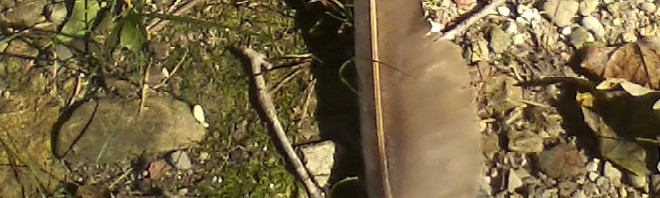
Turkey vulture feather
Like the deer and the stufflebeam, the vultures were not happy to have a runner come upon them suddenly. As I passed under their tree, first one and then another leapt from their branch and took off into the air, beating their wings with a power that isn’t so apparent when they’re soaring.
But there weren’t just two or three vultures. As I slowed, startled by the first birds’ explosive launches, they continued taking flight, no longer one at a time, now taking flight in groups of two or three at a time. At least twenty very large birds took off from that tree in the 5 or 10 seconds it took me to pass under it.
It was spectacular.
It was early enough in my run that I didn’t want to stop and gawk, even to see the birds climb into the air to join their fellows who were already soaring, although I enjoyed what I could see of it.
It was hard to beat that little adventure, although the deer and Mr. Stufflebeam did their best, as did the forest scenery and the trail itself.
The backpacking trail is only marked to be followed in the forward direction, so it’s easy to get off track if you try to follow it in reverse, and I did go off course for a bit as I tried to return. After a few minutes of bushwhacking I saw where I’d gone wrong and worked back just enough to get back on track.
Running the trail as an out-and-back meant that I passed once again under the vulture-roosting tree—and it turned out that quite a few vultures had decided that 9:00 AM was too early to be up soaring, and had returned to roost some more. Once again, they launched themselves into the air. This time I slowed down to watch, and finally stopped near the trunk of the tree.
One vulture, either lazier or more confident of his safety up on a branch maybe 20 feet above the trail, decided not to bother taking off, giving me a good look at his red head and vulturous posture.
Roughly under him, I found the feather pictured above, which I assume based on its location and size is a turkey vulture feather. From the shape, I’m assuming it’s a primary flight feather (although I don’t know my feather morphology as well as all that).
I picked it up and carried it a short distance to a sunny spot where I could get a good photo with my phone. (I hadn’t brought my good camera.)
From there it was less than a mile back to the trail head.
According to my GPS thingy, I ran 4.523 miles in 1:14:44, giving me a 16:39 pace. My old GPS thingy—a first generation Timex Bodylink—isn’t nearly as good as a modern GPS device, and tends to have trouble maintaining a satellite lock under a forest canopy, so it doesn’t get as many waypoints as it might. That tends to cheat me out of credit for my full mileage. (The device assumes that I’ve run a straight line between one fix and the next. When the device fails to get a lock for many seconds at a time, it treats my run as cutting a straight line, even though I was following a twisty path.) Still, 4.523 miles is the best number I’ve got, so that’s what I’m going with.
I headed back to the Spinners and Weaver’s guild event, got out my folding chair, and sat down to rehydrate. Turkey vultures—almost certainly the same ones I’d startled into the air—were circling overhead. One of Jackie’s guildmates turned to me and said, “I guess they’ve figured out we’re dying down here.”
Great to be out on the trails again. I will have to find a way to run more trails before the end of the season.
I got a great comment on my previous post (thanks Ilana!), and started to reply in a comment there, but realized that I was straying into something that I wanted to talk in a post—training cycles that aren’t a multiple of 7 days.
Rereading my post, I see that it does look like my only runs are my long run and my fast run. That’s not the case, though. I try to include two or three easy runs each week as well.
In years past, my training schedule was pretty ordinary. Each week would include a long run and a fast run, each followed by a rest day. The other three days would each be a chance for an easy run. I found that I could just about maintain my fitness if I ran three times a week, but that I had to run four or five times a week if I wanted to improve either my speed or my endurance.
This summer my training routine has been complexificated by these very long walks I’ve been doing. It turns out that I need about two days to recover from a walk that pushes beyond the farthest I’ve ever walked before. Adding a long walk and one or two recovery days to my usual schedule pushes it out to a 9 or 10 day cycle, instead of a 7-day cycle.
The obvious thing to do would be to create a 9-day cycle—something like this: long walk, rest day, easy run, easy run, long run, rest day, easy run, fast run, rest day. One obstacle to that is that the various tracking tools I’m aware of all provide summaries for weekly periods, not for 9-dayly periods. (If you know of an exercise tracking tool that can produce useful summaries for training cycles of arbitrary length, let me know.)
So, I’m just winging it as far as a training schedule goes. Since it became clear that we wouldn’t get to Kalamazoo for the Kal-Haven trail walk this summer (we’re now hoping to do it next summer), we’ve eased up a bit on lengthening our very long walks, although we’re still planning to do 17 miles shortly. At these distances, it seems like doing each “even longer” walk ought to happen only every other week (with the long walk on the alternate weeks being comfortably within our established capability).
Last week I got out for a long run. At 5.14 miles, I exactly matched the distance of my previous longest run of the year. (I ran the same route.) I also just about matched the time, running it in 1:07:04 versus 1:07:50 back in June (a 13:03 pace, versus a 13:12 pace).
At this point, I’m pretty happy with the duration of my long run. I want to be able to run for an hour, and I can now do that. Running for an hour makes me feel great. I like to attribute this to endocannabinoid production, although I don’t actually have any evidence for that. Whatever the cause, running that long makes me feel good in a way that running for 20 minutes doesn’t.
At this point, I don’t see much reason to ramp up the distance further. It might be that running even further would make me feel even better, but I hesitate to risk finding out. Where would it end? More particularly, would it end before my body broke down from the stress of running ever-longer runs?
On the other hand, I’d like to run a bit faster. In particular, I’d like to be able to run 6 miles in the hypothetical one-hour run that makes me feel so good.
To see whether I was in striking distance of that, I went out for a fast run yesterday, doing what I call a tempo run. (I run a tempo run simply by running a comfortable distance—the same as I might run for an easy run—but running pretty hard.) I ran my Kaufman Lake loop, which is 1.5 miles, and I did it in 14:12 for a 9:36 pace.
So that’s pretty promising. I can run the duration I want to run and I can run the speed I want to run. Now it’s just a matter of closing the gap—getting fit enough to run that speed for the whole distance.
I think that’s doable. Today I did my usual easy run of 2.2 miles, but I ran just a little faster than I’ve been lately, setting a 10:43 pace.
In fact, I don’t think I even need much of a plan. I’ll just go on doing a long run of about an hour every week or two, picking up the pace a bit as it feels comfortable to do so. And I’ll try to fit in a fast run every week, letting the distance creep up a bit as it seems like my fitness supports it.
With any luck I’ll be running an hour at a 10-minute-per-mile pace before the snow flies.