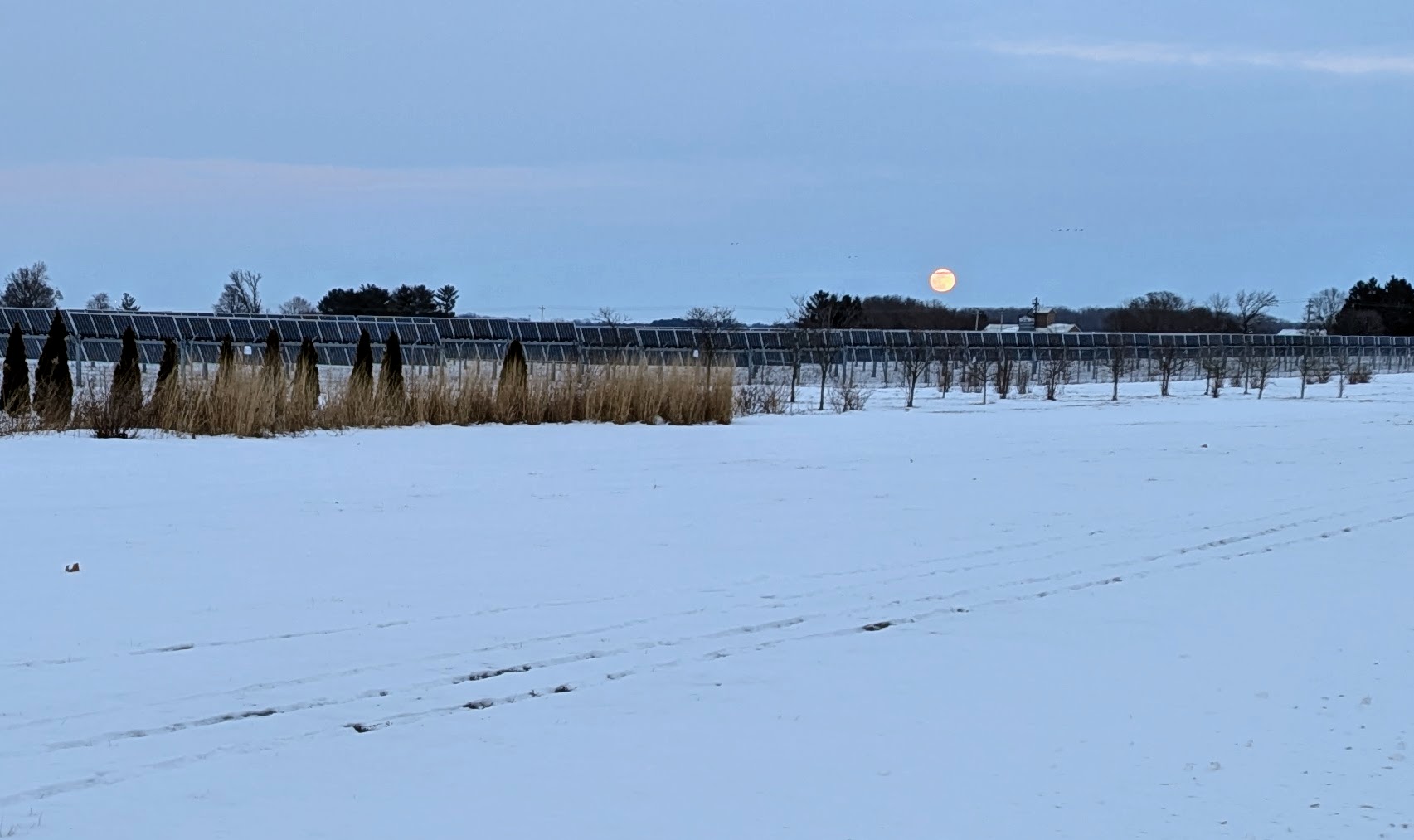
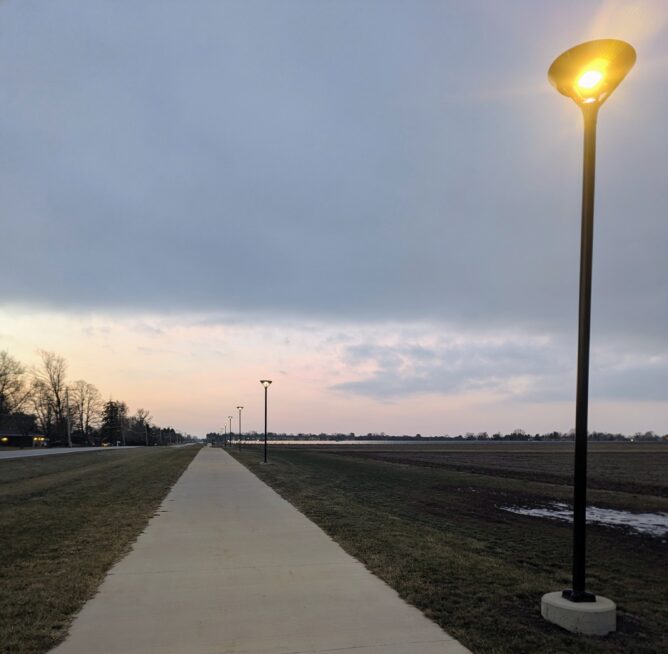
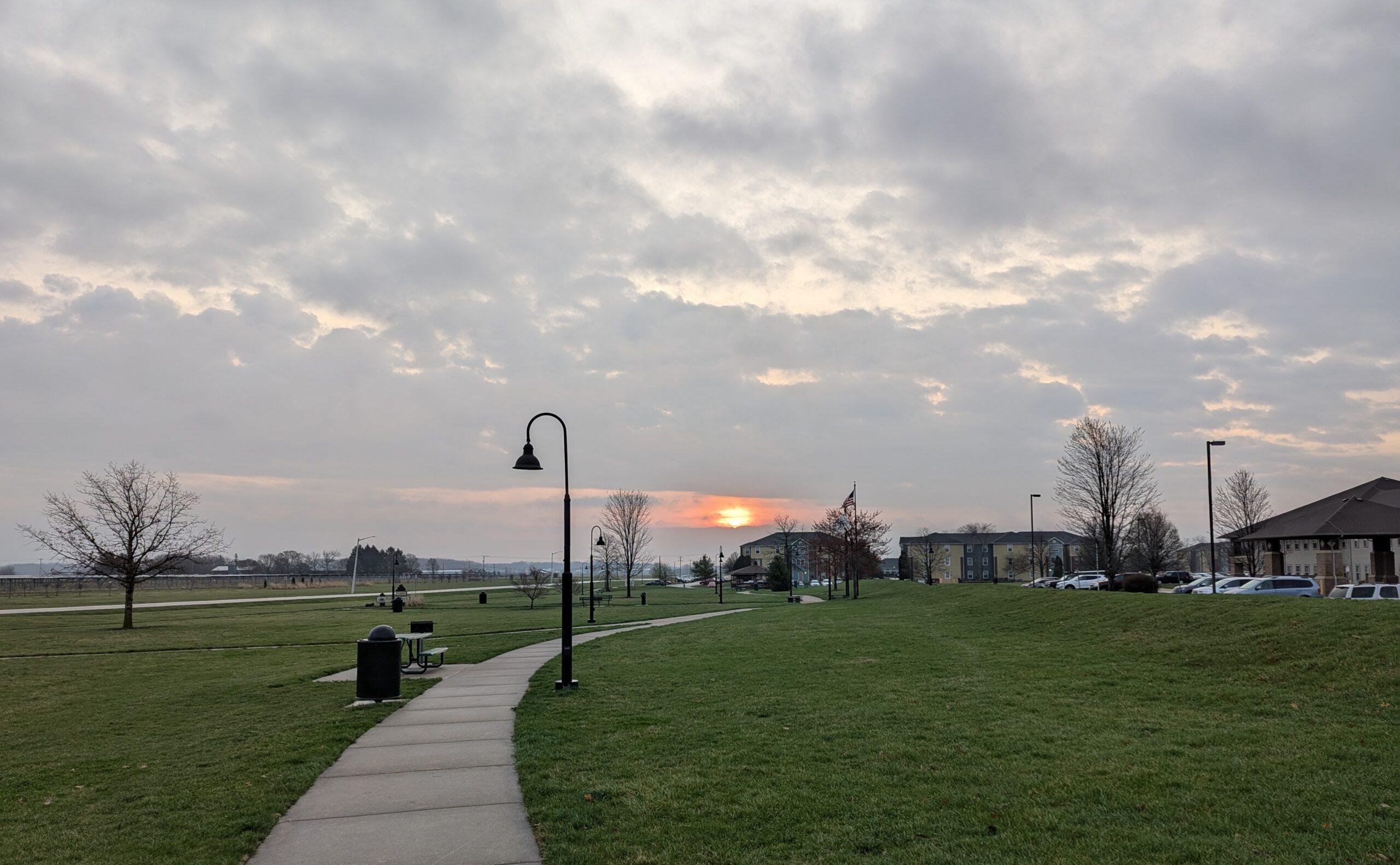
The footpath along First Street between Windsor and Curtis has some extra-fancy lights. They’re usually fairly dim, to minimize light pollution, but they have motion detectors that cause them to brighten if someone approaches.
Winston Churchill once said, “Nothing in life is so exhilarating as to be shot at without result,” but I think maybe Churchill had never had a dog pull hard on the leash while they were walking across an icy parking lot.
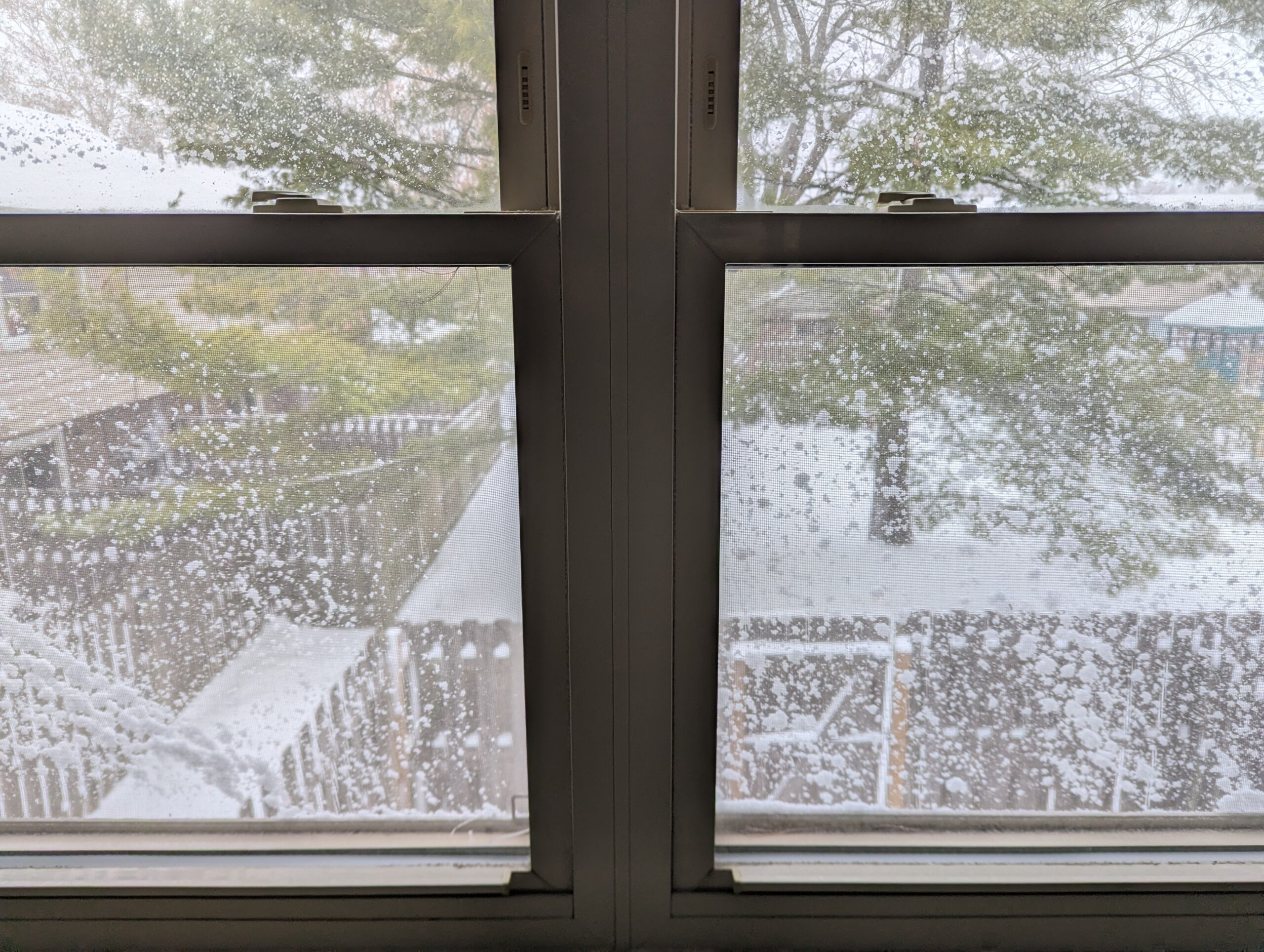
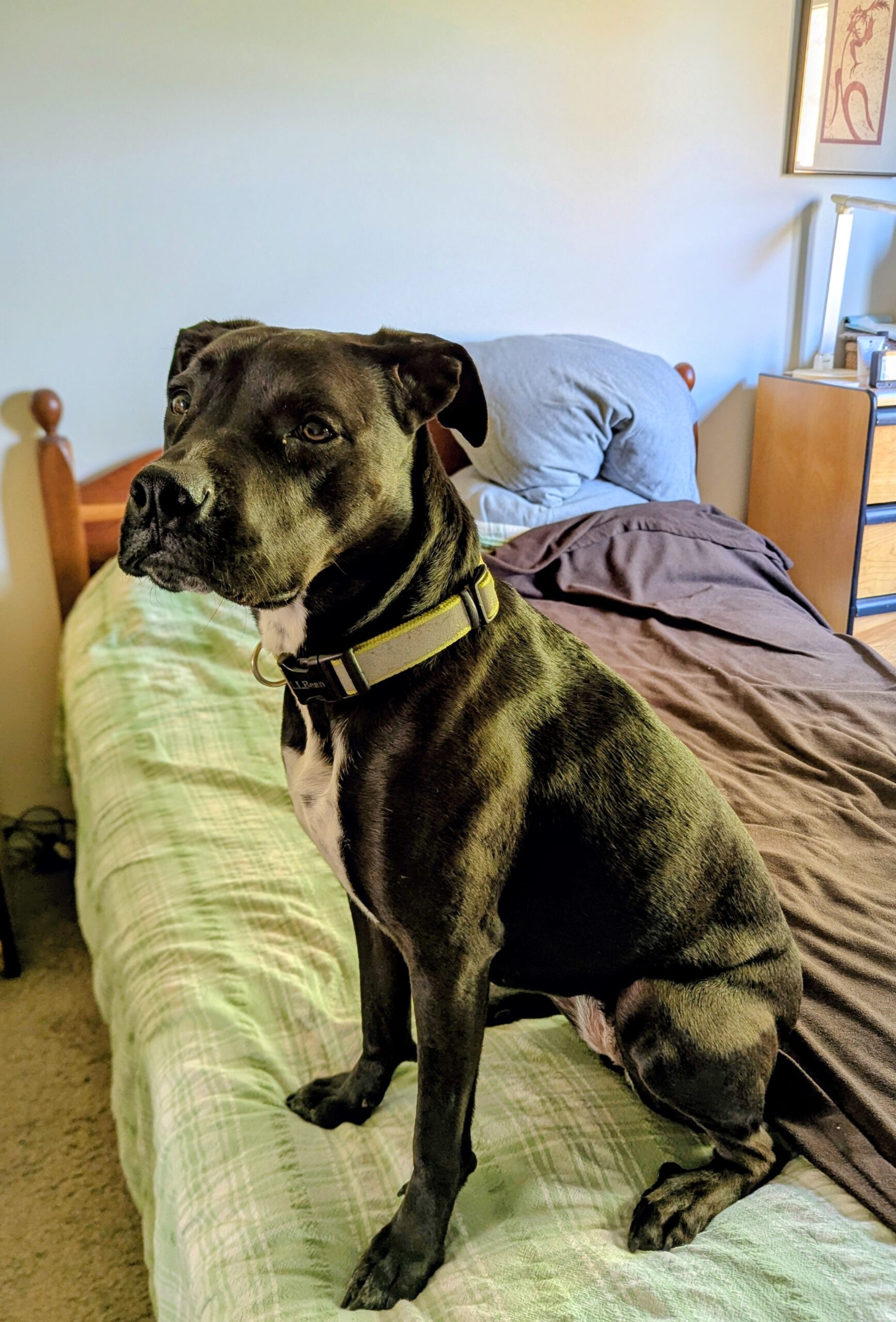
Ashley really wants to go for a long walk. But she doesn’t want to go for a walk in the outside that actually exists. She wants to go for a walk in some other outside—one where it’s not windy and snowing.
I walk a lot. Because I have a dog, and want to be sure my dog gets the exercise it needs, I take a truly inordinate number of steps per day. (Wait just a moment while I check my Fitbit…) Last week I averaged 14,036 steps per day. The previous week I averaged 17,197 steps per day. Those weeks are quite typical for me; I don’t average much under 15,000 unless I’m sick or the weather’s really bad.
So, when I saw the news recently that walking “3,000 to 5,000 steps per day can help to stave off mental decline,” I’m like, “Okay? Great.” Taking 5,000 to 7,500 steps per day seems to stave off Alzheimer’s disease by around seven years.
I mean, that’s great. Staving off Alzheimer’s disease by 7 years would probably cut the incidence of the disease by close to half (because people would die of something else first).
But really? I mean, yes, my inordinate walking takes a lot of time that most people don’t have. Back when I was working a regular job I’d try to get “enough exercise,” and that generally topped out at an average of a little over 100 minutes per day—and that much only in the summer, and that high only because I’d average in a 3 or 4 hour bike ride over the weekend. Now I probably spend close to 150 minutes per day just walking the dog. I recognize that almost nobody’s got time for that.
And, yes, walking in particular depends on capabilities that not everyone has. Lots of people old enough to worry about Alzheimer’s have bad knees or bad hips or bad feet or bad hearts or bad lungs. Maybe their endurance is very low. Maybe their balance is poor enough that walking is a risk.
But it doesn’t need to be walking. Walking is just easy to measure with a wearable device. Any sort of exercise will do the trick. Lift weights. (They don’t have to be heavy weights, as long as they’re heavy for you.) Ride a bike. Ride a stationary bike. Row. Use a rowing machine. Play almost any sport. Dance the night away.
Related to this, only in terms of how low the bar is set to do an enormous amount of good, a different study looked at whether walks needed to be long in order to provide the benefits, or whether cobbling together a number of shorter walks to add up to the same number of steps was just as good. It turns out longer walks are better. (Risk of being diagnosed with cardiovascular disease within 9.5 years dropped from 13% to around 4–8%.) But the dividing line in the study was that walks of at least 10–15 minutes counted as “long” walks, versus short walks of less then 5 minutes.
If you can walk 5 minutes, I’ll wager you can work up to walking 15 minutes in a very short period of time. And the evidence is now pretty clear that it’s worth doing.
Get some exercise. The bar is pretty low for making a big difference.
I was busy most of the day. In the morning I took Jackie to her (last!) physical therapy appointment, and in the afternoon I had my usual Thursday visit with some former co-workers. But in the early evening (after fourth dog walk) I sat down and wrote a few hundred words. I’ve also updated the progress tracker in the sidebar. (And, if you’re reading it, wrote this brief post on my day’s progress.)
Three things I should do soon (they’re on my schedule for “before November 1st”): Write a logline, short synopsis, and long synopsis for the story. I don’t know that I need to do all three, but I should definitely do some thinking about what the story is about before I spend much more time writing.
Probably just the sort of thinking to do tomorrow while walking the dog.
I’ve started generating prose for my NaNo 2.0 story, despite the fact that starting early is supposed to be against the rules.
I figure it’s okay because I’m not really trying to write the story yet. I’m just capturing some text to use to validate things like the NaNo 2.0 progress bar, which should now be visible in my sidebar, below my short profile, and above the form for subscribing to my newsletter.
I’m not sure the progress bar is working yet. It looks kind of minimal, but maybe that’s just because I haven’t written much yet. By the time NaNo 2.0 goes live on November 1st, it should be clear that it’s working.
Besides writing, I’m making notes about how the story is supposed to go. I don’t really have an outline yet, but I’m capturing internal details about the story world as I figure them out.
And I’m figuring it out while I’m walking. Mostly while I’m walking the dog.
I’ve always done some of my best thinking about stories while walking. The past three years or so, I’ve done less such thinking, for two reasons: The dog, and podcasts.
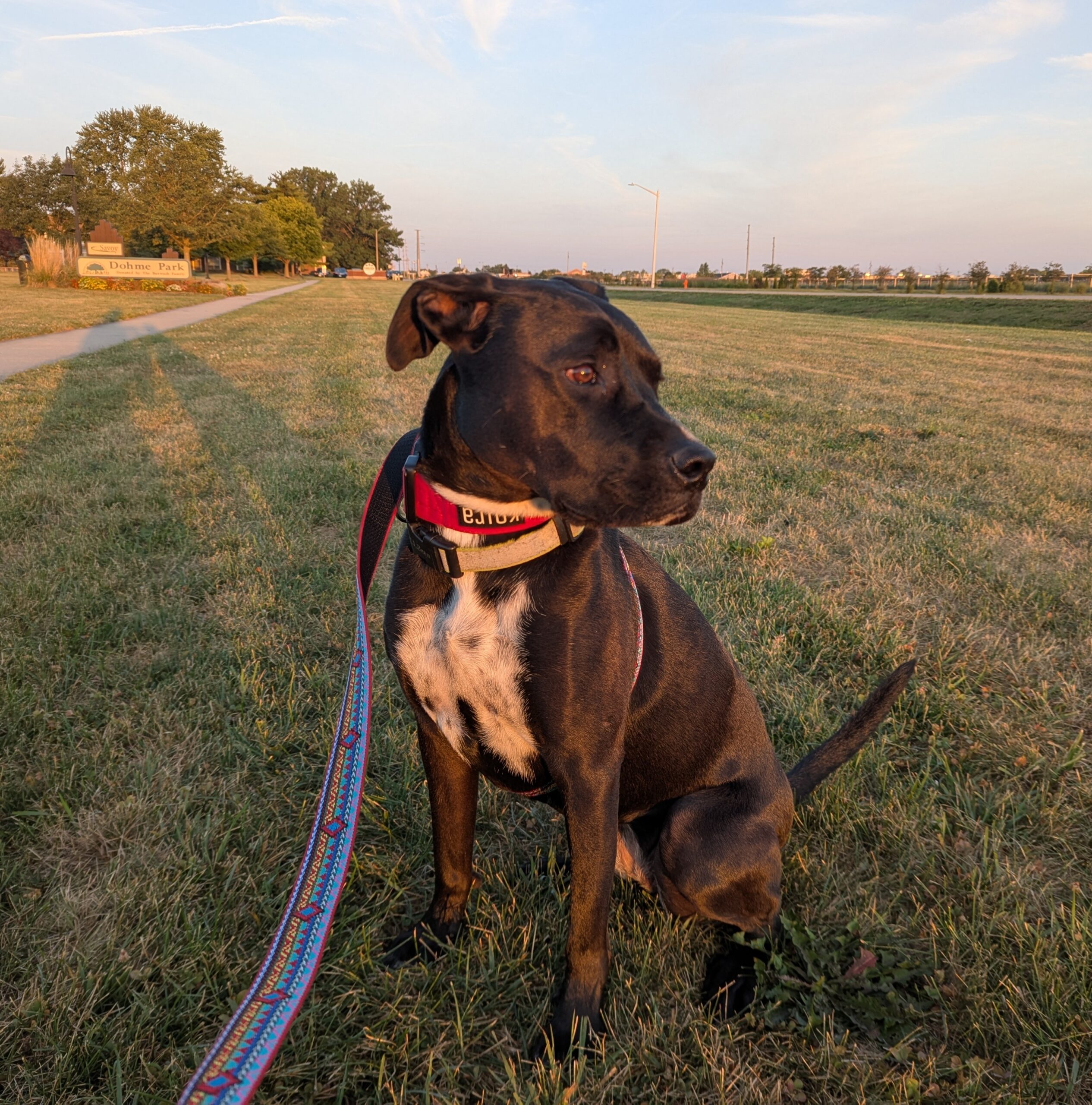
Ashley, especially as a younger dog, was kind of hard to walk. She was a little too likely to lunge growling and snarling at people. (Too often she acts like she’s a very good dog until she jumps on someone, so people want to meet her, and then get booped in the nose with Ashley’s snout.) So I’ve really had to be very alert to people coming within reach, to make sure nothing bad happened.
That made it harder to think about other stuff while I was walking Ashley.
I’ve also been listening to podcasts, which I rather enjoy, but which also lead to less thinking about stories while I’m walking.
So, between Ashley behaving much better these days, and cutting back on podcast listening, my walks are turning back into an excellent opportunity for plotting.
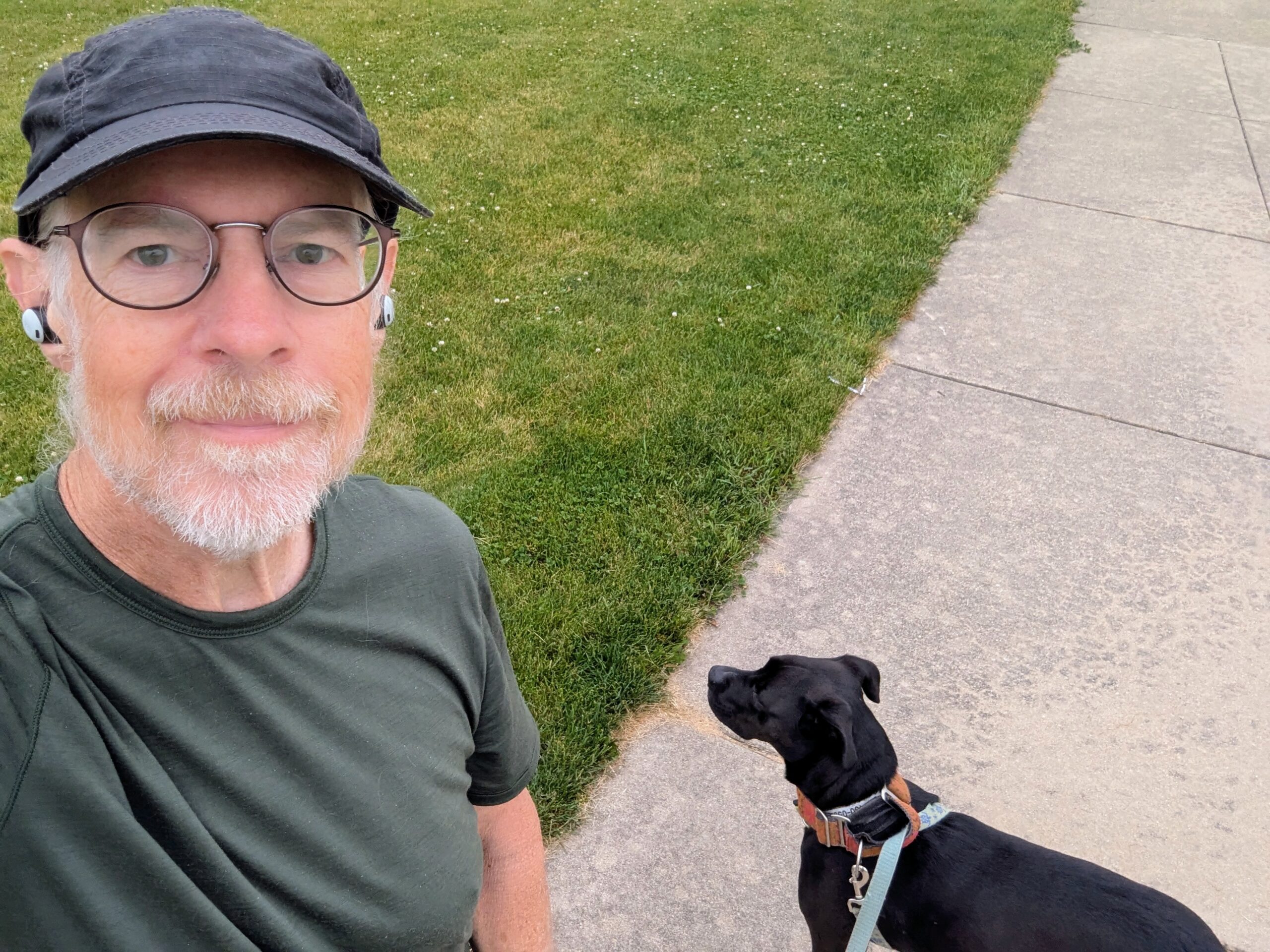
My brother sent a selfie he’d taken in the coffee shop where he’s staying for the SFWA board meeting and Nebula Awards conference. I wanted to reply, but I was out walking the dog, so I quick captured this image.
For years I worried a lot about daily routines. (Just click on the tag for “daily routine” and you can find literally dozens of posts on the topic.) Of late, that seems to no longer be the case. It’s been years since I posted on the topic.
A few days ago though, my brother mentioned me in a toot on daily routines, which prompted me to wonder what my current daily routine actually looks like. Turns out, I do have a daily routine, that I stick to pretty well (with minor adjustments for errands, medical appointments, etc.).
Unsurprisingly, it’s rather sun-aligned.
(6:00 AM) I get up around dawn, which is at different times at different parts of the year, but is around 6:00 AM right now. I drink a (ginormous) mug of coffee (or two). I spend some time dicking around on the internet, check my social media feeds, chat on-line with my brother, and get an update on our mom (who lives with him). I also check my Oura ring, to see how well I slept. (That’s a joke. Of course I know how well I slept. But the information my Oura ring provides is nevertheless sometimes valuable.) We usually do the Jumble via chat during this time as well.
(6:40 AM) Around sunrise I take the dog for her first walk of the day. That’s been around 6:45 lately, but is getting earlier every day just now.
(7:00 AM) After first-walk I might have a third cup of coffee, but I proceed to fixing and then eating breakfast.
(8:00 AM) After breakfast it’s time for the dog’s second walk. This is the long walk of the day. In bad weather it might also be just 20 minutes, but is usually at least 40 minutes, and in really nice weather might be an 90 minutes or longer.)
(9:00 AM) Once I get home from second walk, I proceed to my morning exercises, which I ought to be able to do in 20 minutes or so, but which often stretches out to twice that long. I’m working to shorten it, so I have some hope of getting something else done during the day.
(9:30 AM) After morning exercises (which is really a stretching/flexibility/mobility routine), I proceed to my workout, unless it’s a rest day. That takes 40 minutes to an hour.
Since I started drafting this post three or four days ago, I’ve been tracking the start and end times of my morning exercises and my workouts, with an eye toward collapsing the total time for this stuff down to the 60–80 minutes that it should be. If I can do that, I should be able to finish no later than 10:30, which should give me most of three hours available to get work done, before I need to break for the main meal of the day.
(10:30 AM) Get work done!
(1:00 PM) Jackie and I have moved our main meal of the day to 1:00 PM or 2:00 PM, which provides just a bit more flexibility for getting work done in the morning (although that time gets used up if I need to run an errand, or if I’m fixing lunch that day). Ashley usually gets her third walk of the day either right before or right after lunch.
I generally don’t even try to get anything useful done after that. I might take a nap. I might read. I might spend some more time dicking around on the internet. Just lately, I’ve been trying to get a backup server configured so that my brother and I can backup our backups to each other’s servers, meaning that we’ll have off-site backups.
(4:15 PM) At 4:15 PM we have our cocktail hour call with Steven and my mom. We’ve all cut back on alcohol consumption, so we usually drink water rather than a cocktail, but we’re sticking with the call. It means I get to talk to my mom nearly every day.
(4:45 PM) After cocktail hour I take Ashley for her fourth (and now, finally, last) walk of the day. When she was a puppy I had to take her for eight walks a day (to keep her from peeing in the floor). That ramped down pretty quickly to seven and then six, but it took a long time to get her down to five and then four. But this is actually much more convenient for me, as well as being enough walking for both of us. (I average over 12,000 steps a day, even in the winter. In the summer it’s more like 15,000.)
(5:30 PM) After fourth-walk I usually sit down to watch some video entertainment with Jackie, or else read some more.
Jackie goes to bed quite early most days, a remnant from her days working at the bakery (when she had to get up at 4:00 AM).
I generally like to go to bed a couple of hours after sunset, although not that early in mid-winter nor that late in high summer. Just lately I’ve been aiming to take Ashley out of the patio for one last peeing opportunity in time for me to get to bed around 9:00 PM.
There’s some variability, of course. Mondays I do Esperanto in the early evening. Wednesdays there’s (just recently) a gentlemen’s lunch. Thursdays there lunch with some former coworkers, that’s been going on in some form or another for decades now. Sunday afternoons (and when I’m feeling fit enough, Tuesday and Thursday evenings) there’s sword fighting.
As I said above, the main value of this post to me seems to be around how I might get my warmup and workout done more compactly. I think I’ll write about that soon, and if I do, I’ll link to it here.
Zone-2 cardio has been having its moment. That comes from a lot of sources, but unfortunately a big one is Peter Attia. I say “unfortunately,” because Attia seems to have a weird, compulsive sense that zone-2 cardio work needs to be, I don’t know, pure in some way, rather than just being enough to promote good metabolic health.
Attia suggests that you do your zone-2 work on a treadmill, stationary bike, or rowing machine, so you can be in control of your effort level at all times. Then you can just get into zone 2 and stay there for 45 minutes.
I think this is crazy, and not just because 45 minutes of steady-state activity on a treadmill or stationary bike would be excruciatingly boring.
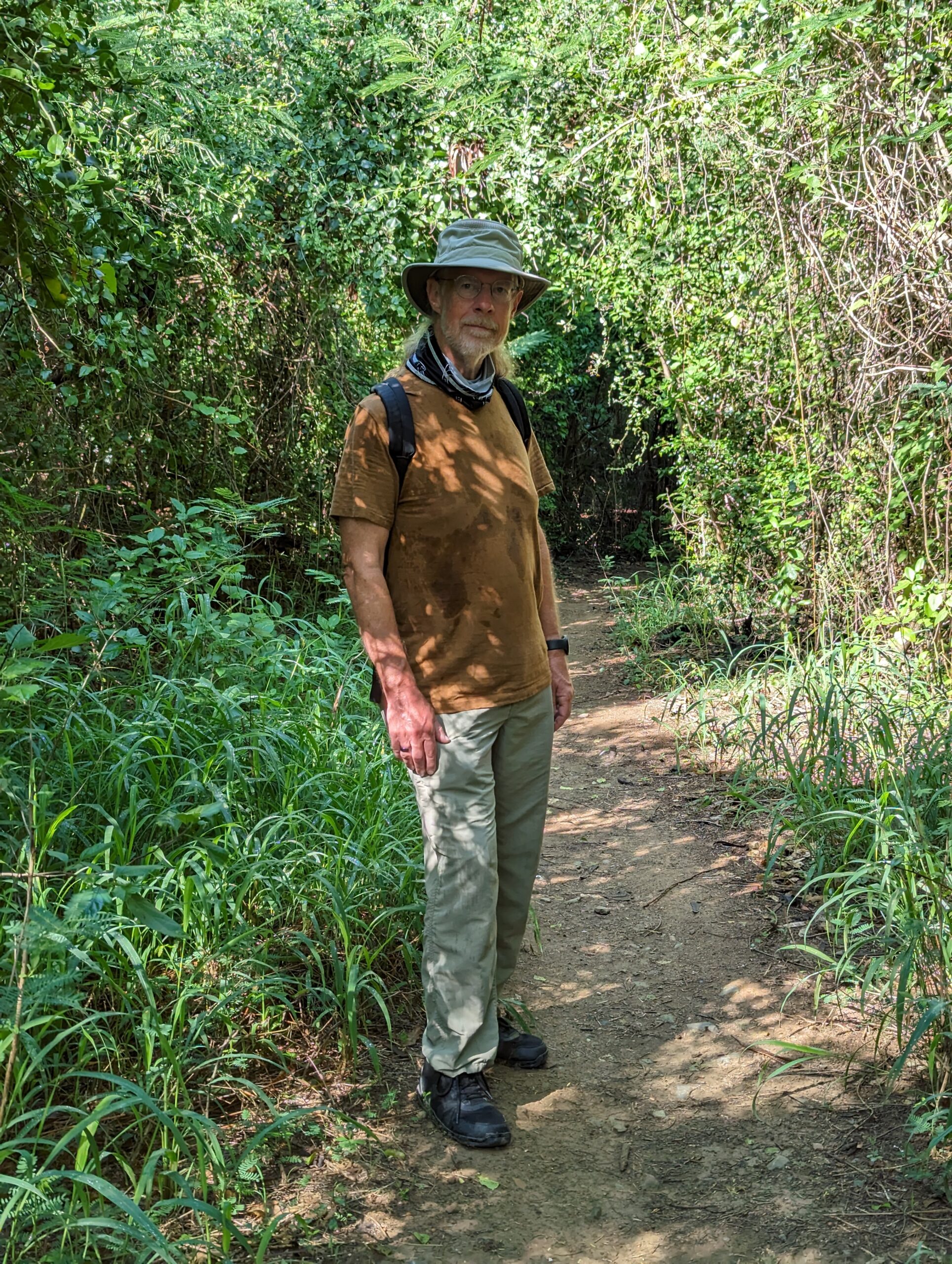
I do my zone-2 cardio with a mixture of walking my dog, running, and occasional hikes. Walking the dog isn’t perfect, because the dog keeps stopping to get in her sniffies, and no doubt my heart rate drops out of zone 2. Running isn’t great, because my heart rate probably spends a lot of time in zone 3 or zone 4. A lot of it is zone-2—at least, I can talk while I run, which is one of the tests for zone-2. (I run very slowly.) The hikes are probably perfect zone-2 cardio, but are a big time commitment in a single day.
Attia suggests that you optimize your cardio workouts by getting 3 hours a week of zone-2 cardio, which can optionally be divided into 4 45-minute workouts. And I’m sure that’s fine. But I suspect that getting in a couple of runs a week, along with a good bit of dog walking, is going to check the zone-2 cardio box no problem.
My theory (and I am not an MD, nor even a PhD in exercise physiology, but still) is that this is fine. You don’t need to get 45 minutes of pure zone-2 cardio to be metabolically healthy.
As I see it, the test for whether you’re getting enough zone-2 cardio is whether or not you can engage in a moderate level of exercise for an extended period—a 3-hour hike, let’s say. If you’re metabolically healthy you can go on and on at a moderate pace, because you’re doing it almost entirely aerobically.
If you can do that, you’re getting enough zone-2 cardio, regardless of whether your sessions are 45 minutes long, and regardless of whether they add up to 3 hours a week. If you’re not metabolically healthy, even going at a moderate pace is going to push you into anaerobic metabolism, which will quickly become impossible to maintain.
It probably is true that you need to get in 3 hours a week if you’re going to be able to go on long, long hikes. But the idea that they need to be pure zone-2 sessions, rather than mixed sessions at all different levels of intensity, is just crazy.