AI generated image from the prompt Make an image to suggest "immanentizing the eschaton?”

My brother asked me today, “Which author do you think best immanentizes the eschaton?”

Not being a moron, I immediately replied, “Obviously it’s Charlie Stross.”

Before I could finish typing that, he suggested a Mastodon poll to ask people, to which I replied, “The poll should be ‘After Charlie Stross, what author next best immanentizes the eschaton?'”

We speculated a bit, throwing out names like William Gibson, Bruce Stirling, Neal Stephenson, and Cory Doctorow.

I assume this was all prompted by the most recent Pluralistic, in which Cory Doctorow says, after explaining why, if their AI is so close to having god-like powers, anyone would be asking for money for their AI, when they could just be using the AI to make money for them, says:

So it’s not surprising that we don’t ask why these AI god-botherers need our stupid money while they’re immanentizing the eschaton. Why would they operate a hospital if they could go meta and sell the doctorbots to the MBAs running the hospital?

Source: https://pluralistic.net/2026/07/13/go-meta-meta/#meta-meta-meta

Anyway, at this point I put the question to confer.to (so I don’t know which AI model responded), but it gave me a great reply:

The Core “Eschaton Immanentizers” (Closest to Stross)

1. Vernor Vinge

  • Why: He literally coined the term “technological singularity” in his 1993 essay. Stross stands on Vinge’s shoulders.
  • Key Works: A Fire Upon the Deep (zones of thought = different physical laws based on intelligence density), A Deepness in the Sky, Marooned in Realtime.
  • Vibe: More optimistic than Stross, but equally committed to the idea that superintelligence changes everything, including physics.

2. Greg Egan ⭐⭐

  • Why: If Stross is the journalist of the singularity, Egan is the mathematician. He goes harder into the ontological breakdown. His characters upload, fragment, merge, and cease to be human in ways that make Stross look cozy.
  • Key Works: Permutation City (simulated reality, consciousness as substrate-independent), Diaspora (post-human civilization across dimensions), Quarantine (reality modification).
  • Vibe: Colder, more rigorous, less humor. The eschaton isn’t just immanentized; it’s proven.

3. Hannu Rajaniemi

  • Why: Writes about societies that already live in the post-singularity world Stross describes arriving.
  • Key Works: The Quantum Thief trilogy (solar system transformed by post-human technologies, memory as currency, gogolized consciousness).
  • Vibe: Dense, playful, requires work—but depicts the aftermath of eschatonization brilliantly.

4. Ken MacLeod

  • Why: Stross’s contemporary and friend; they share a intellectual milieu (Edinburgh SF scene). MacLeod explores similar themes but often from a more political/ideological angle.
  • Key Works: The Fall Revolution series (The Star Fraction, The Stone Canal), The Execution Channel.
  • Vibe: More focused on how ideologies (libertarianism, socialism, etc.) interact with singularity tech.

I mean, really, I don’t know why we didn’t have Verner Vinge in mind, or Greg Egan. I’ve read both, and I’m sure Steven has as well. They’re obviously on top.

I don’t know if Steven has read Hannu Rajaniemi, but I’ve at least read The Quantum Thief, and, yes, I’d put him on this list.

The AI also rather dismissed our guesses:

Your Guesses, Evaluated

AuthorVerdictNotes
William GibsonAdjacentCyberpunk is pre-singularity. His later work (The Peripheral) touches on it, but he’s more about near-future tech’s social impact than ontological rupture.
Bruce SterlingAdjacentSame as Gibson—cyberpunk pioneer, but more interested in design, aesthetics, and near-term futures than the actual singularity event.
Neal StephensonPartialThe Diamond Age and Snow Crash have elements, but he’s more interested in memes and social structures than the hard break of singularity. Anathem gets closer.
Cory DoctorowPartialWrites about these themes (especially in Walkaway and Makers), but with a more accessible, activist, optimistic lens. Less “reality breaks,” more “how do we organize after tech changes?”

The AI actually goes on a bit, mentioning several other authors including Richard Morgan, Ted Chiang, and others, but I’ll just go hang my head in shame rather than copy and paste more AI output.

(Normally my posts are entirely my own writing. This post is an exception, in that it includes a bunch of copy/pasted AI output. I think it’s adequately tagged, though, and it’s clear that I’m not trying to pass off AI output as my own writing. Because I thought it was funny, I also generated an AI image to be the “featured image” for this post. Once again, I hope it’s clear that I’m not trying to pass off AI output as my own.)

I mentioned a few weeks ago that I’d made two changes to my morning routine: I had quit wearing my earbuds (and listening to podcasts) during my first two walks in the morning, and had started sitting down to write as soon as I got home from the second walk.

I am pleased to report that these changes are working great. I’ve done at least some fiction writing every single day for over three weeks now. Most of it was on a long-form project that I’m pressing ahead with, but I briefly paused to work on a short story (a flash piece?), that made use of one idea from my long-form project that I really liked, but that wasn’t working in the story.

I’ve gotten back to writing regularly, for the first time in too long. I’ve made two changes to my daily routine to make this happen.

The first is that I’m avoiding listening to podcasts during my first two dog walks. This lets me use that time walking outdoors to get into the headspace of whatever story I’m working on.

The second is that I’m going ahead and sitting down to write, right after the second dog walk. I’ve known for a very long time that I have to get started writing early, if I’m going to be successful. After second walk is perhaps not idea—earlier might be better—but it’s been working these past few days.

A dog lying in unmowed grass with her tongue slightly out. She is not writing.

I had been using that time to get started on my morning exercises. But that leads into doing a workout, and by the time I’m done with that the dog is ready for her third walk, and then it’s time for lunch. And that is why I hadn’t been getting any writing done.

Slotting in a session of writing before I exercise is cutting into my exercise time, but maybe that’s okay. Delaying my workout for an hour (or, hopefully soon, an hour and a half) is certainly okay occasionally, and so far I’ve been getting in a reasonable amount of exercise anyway.

Okay, this is really, really good. About writers and writing (via @doctorow).

Makes me want to write some proletarian literature.

Characters in proletarian literature are often misled into believing that their individual flaws account for their miserable conditions, but then encounter a union organizer or a wise old Wobbly who tells them the truth, setting fictional men and women on the revolutionary path.

Source: Go Left, Young Writers!

Yesterday was a serious-thinking day on my novel, rather than fingers-on-keyboard day. I got zero words, but I figured out who the antagonist is. (I’d thought I had one already, but I’d realized he wasn’t going to work. I needed someone further away, and someone more. . . not more formidable, because the guy I’d been thinking of is plenty formidable, but more. . . Dangerous.

Anyway, after yesterday’s thinking, I got a good bit of writing done today.

It’s nice to be here, because I think I can see several more days of cranking out prose based on what I’ve just figured out, whereas for a couple of days there I was just creeping along, making little tweaks around the edges, because I didn’t know where it was going to go next. Now I do.

One of the flaws of my fiction writing is that my heroes tend to be quiet people, eking out a meager existence during hard times. This is largely due to my perspective on the future, which is that hard times are very likely coming, combined with my own cautious nature, projected onto my heroes.

The problem is that quietly eking out a meager existence in the face of hard times doesn’t really make for an exciting story.

What tends to make for an exciting story is a hero trying to achieve great things.

So, for my novel, I’m trying to lean into this idea. As this is not my natural inclination, I hadn’t really laid the groundwork for this in my first few thousand words, but I have now gone back and layered in a tiny bit of backstory that shows the hero as someone who has tried to achieve great things in the past, and as the sort of person who might do so again in the future.

And I think I did it without violating the rule about minimizing rewriting. During a November novel-writing month you want to move forward as fast as possible, leaving any rewriting for after there’s a first draft. Essentially everything I did was adding new scenes between existing scenes that advanced the action while providing a bit of backstory.

The writing isn’t going very fast. I’ve been averaging a bit under 700 words a day, which is a bit less than half of what I’d need to hit 50,000 by the end of the month. Which is okay, because hitting 50,000 words is a goal, not a moral committment. And I’m thinking things will pick up, once the “striving to achieve great things” mojo starts working.

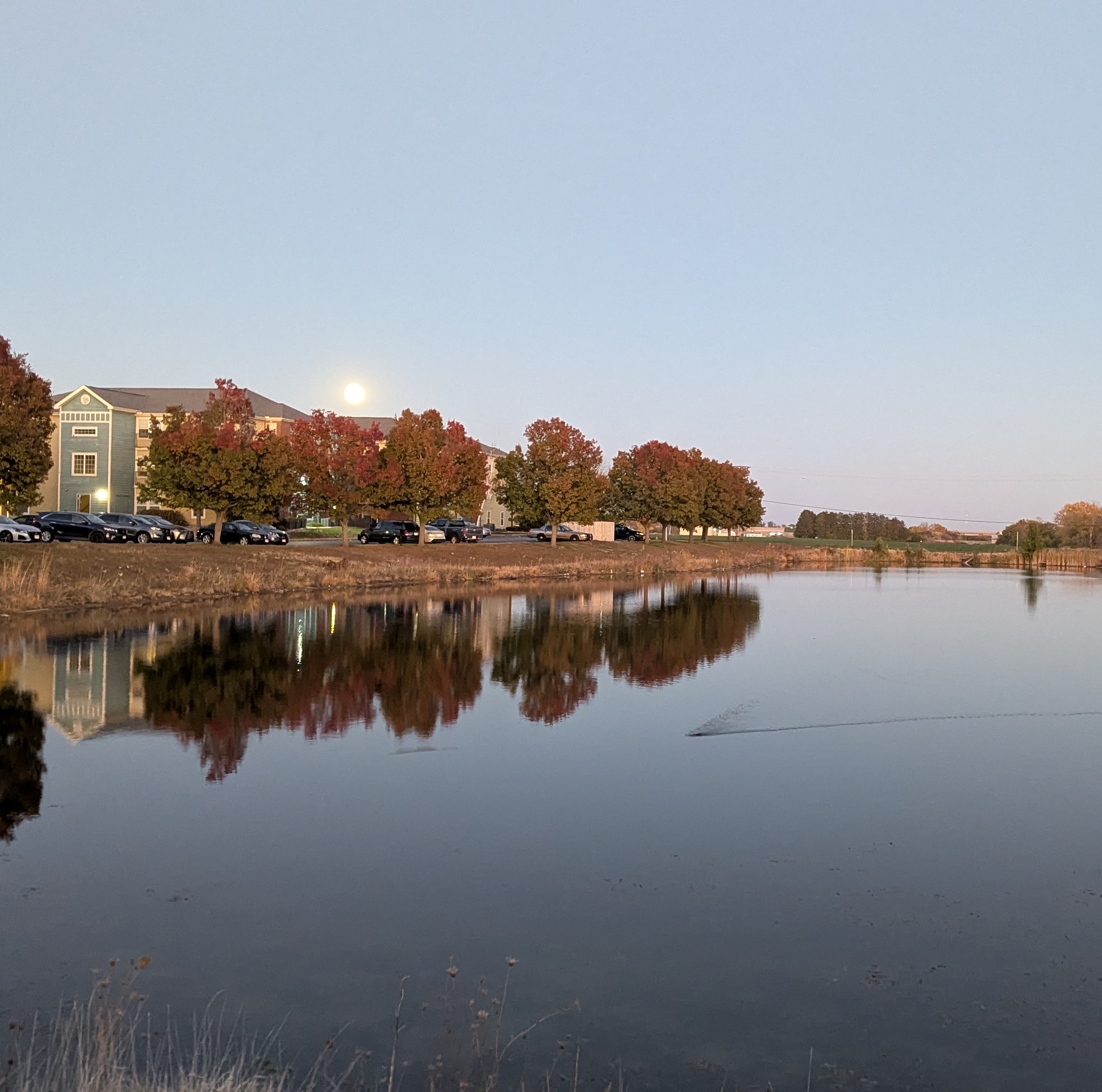
Full moon rising above trees on the other side of a pond, with a ripple visible in the foreground
Today’s supermoon rising above the detention pond I often walk Ashley around. Just right of center in the water you can see a V-shaped ripple that is the wake of a muskrat swimming along.

Sundays are the day I still manage to do some HEMA training. I used to go three times a week, but had to cut way back after I hurt my elbow. Now it’s just Sundays, because Sunday is the day my group does a sword-in-one-hand class, which is gentler on my elbow. We usually train dussack or rapier.

My plan for today was to get as much writing done in the morning as I could, then go train sword fighting, and then squeeze in a bit more writing in the late afternoon or evening. But, as often happens, things happened. My brother invited me to attend the kick-off meeting for SFWA’s Winter Worlds of Giving event, so that was most of an hour on zoom. Then my usual cocktail hour with my brother and my mom. Then walking the dog. Then an episode of The Diplomat with Jackie. Then another episode of The Diplomat with Jackie. And now I’m just too tired to get any more writing done.

So, it’s a good thing I got in that morning session, which got me 551 words.

Tomorrow I’ll be back at it.

Invited by my brother (SFWA’s board secretary), I just attended the kick-off meeting for SFWA’s Winter Worlds of Giving.

If you’re a writer, and especially if you’re a SFWA member, check out that link! They’re asking writers to make a public statement of their “creative interests, and the broad strokes of what you’ve got on the go.” Doing so will put you in a group of people who are going to be doing some pretty cool stuff over the next three months.

I got in a very good morning writing session today, starting pretty much right after second dog walk. By late morning I’d topped 1200 words. I took a break then and paused to do some on-line chatting with my brother, some morning exercises, and take the dog out for third walk just before lunch.

I stopped at a point where I’m not quite sure what comes next. This is widely considered a bad move, because it makes it harder to get back to writing. Still, sometimes it happens, and it’s worth having a couple of tricks for getting going again.

Here’s one: skip ahead and write a “candy-bar scene.”

A candy-bar scene, if you don’t know, is a scene that you already know is going to be fun to write. A scene where a character does something wonderful, or something wonderful (or wonderfully awful) happens. A scene where a reversal happens that’s both completely unexpected and inevitable. A scene that makes you reinterpret the whole story up to that point.

Besides being fun to write, hopefully a candy-bar scene is also fun to read.

Arguably, your whole book should be nothing but candy bar scenes. In practice that’s hard to do, but it’s certainly something to keep in mind.

Anyway, I had a candy-bar scene in mind as something I could write when I got back to writing this evening. In fact though, I picked up exactly where I left off, adding a good bit to the scene that had petered out on me in the morning session. (I can probably credit thinking during a dog walk for this.) Then I did go on to write the first bit of the candy-bar scene I’d had in mind. But only little bit of it, leaving a nice ragged edge where I know what happens next, all ready to pick up tomorrow.

It’s a nice feeling.

Another nice feeling is that I hit the target word count. (That is, the 1667 words per day I need to average, if I’m going to hit 50,000 words by the end of November.) I’m not actually very fixed on hitting the word count, but I figured I give it a try, at least for a little while.

For the morning writing session I wore my writing vest—the moleskin vest Jackie made me years and years ago, that I took to Clarion with me, and have made a point of wearing when I wanted to crank out some serious words. It worked great.

I didn’t get a photo, but I’ll try to get one later.

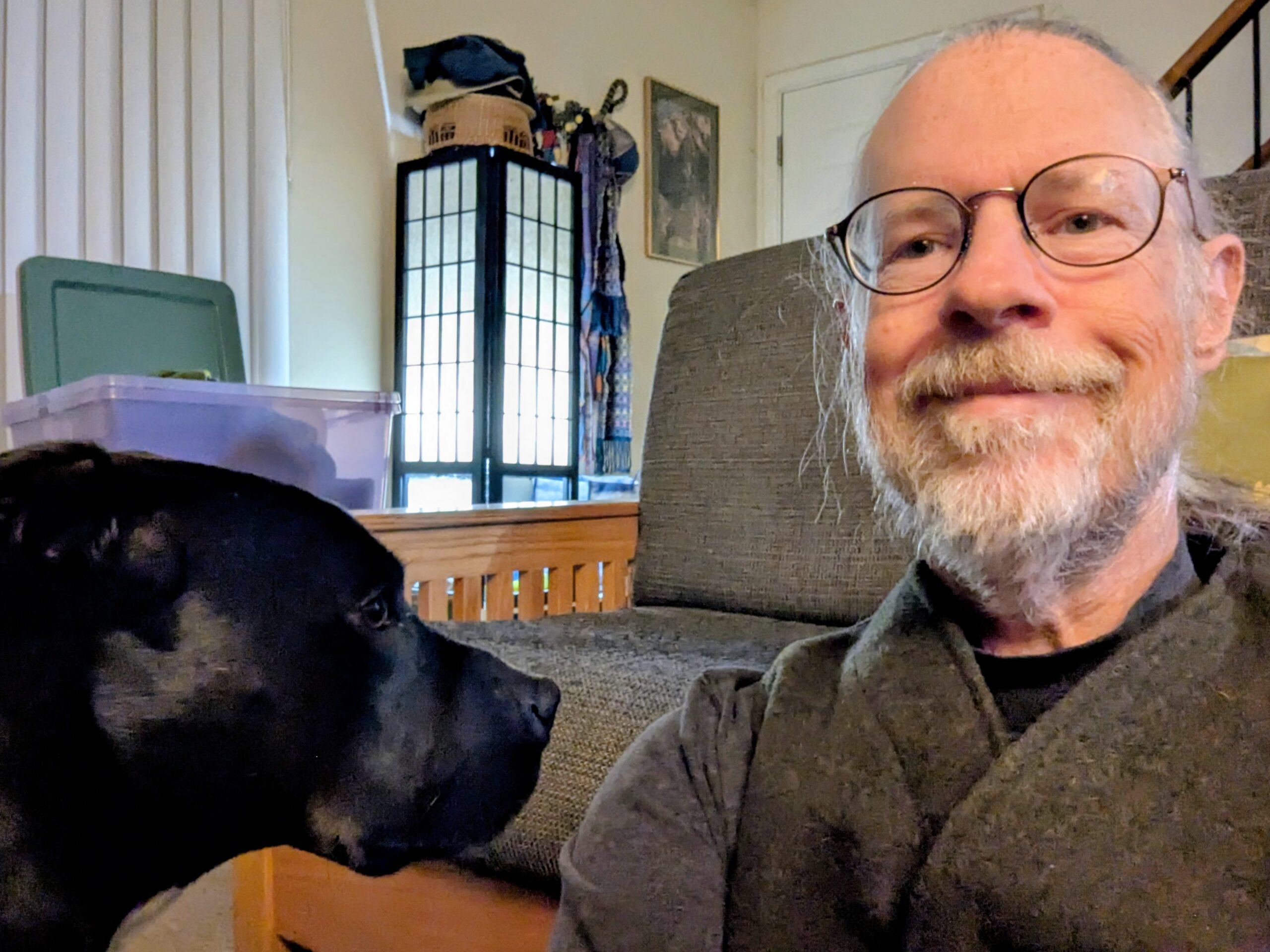
This evening I switched to my wool Filson vest, which I’d worn for warmth when I took the dog out for fourth walk, and I got a sort-of picture of me wearing it, sitting with my dog.

Me sitting on the floor wearing a wool vest, with the head of a black dog facing me

It’s a little hard to see in the photo—the green vest looks almost the same color as my grey mock-T—but this is the same vest that Joe Pickett wears in the C.J. Box stories. It is cozy and durable.

Ashley seems to enjoy going for a run, and she’s a pretty good running companion. She does want to stop and sniff rather more often than I do, and she wants to stop and pee occasionally, which does make it tough for me to hit my best pace for any particular mile. But that’s okay. Enjoying some dog-companionship is a lot better than hitting my best pace.

I had virtually quit running a couple of years ago. I’d gotten a trifle tentative after a fall, and then Jackie was out of town (and therefore not on-hand to rescue me if necessary), and then the weather got cold and the running routes icy. And by the time the weather improved, I’d just fallen out of the habit. For a few months now I’ve been working to reestablish the habit. I haven’t accomplished that yet, but I am getting in an occasional run.

The Fitbit software in my Pixel watch estimates my VO2Max. My estimated VO2Max has long been excellent for my age, but it had gradually dropped some, which was part of the reason I wanted to start running again. These past few runs have produced a modest increase, so as of today it’s in the 95th percentile for people my age. (I think Peter Attia suggests that the minimum acceptable VO2Max is the 95 percentile for someone a decade younger than you, which I’m still a bit below, although it seems perhaps doable.)

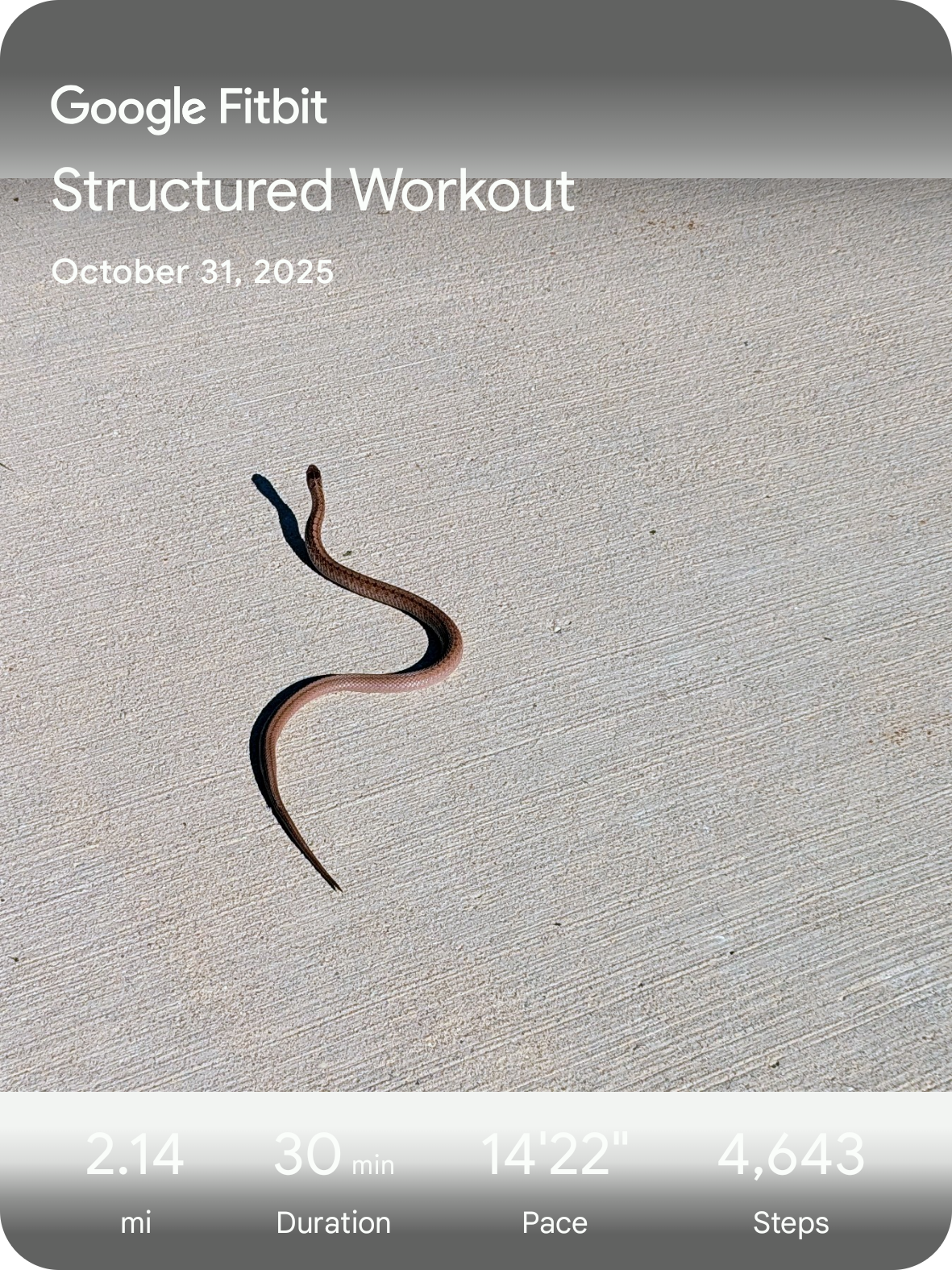
I’m afraid I failed to get a photo of Ashley or myself running (or better, the two of us running together), but I did get a picture of a cool little snake friend who was crossing the sidewalk where I was running.

A small snake on the sidewalk, with stats from my run superimposed on top by Fitbit

I got in one writing session in the morning. Now that I’ve finished my run, I very much hope to get in some more writing (and most especially some more plotting) before the end of the day.