I am almost completely unconcerned about the “dangers” of AI that I’m hearing about.
In particular, I’m completely unconcerned about the danger that terrorists (or bored high school students) are going to use AI to make a bioweapon. I guess the concern is that AI will be able to try thousands of changes in the time a human could try three? That is different from what evolution has been doing for two billion years in no way whatsoever.
Similar only in that it is another AI danger that’s easily ameliorated, is AI-facilitated hacking, which the AI firms want us to come up with regulations for.
The fact is, we scarcely need any new regulations at all. Just an ordinary legal structure where, if someone using AI does something improper, the legal and criminal liability falls equally on the person prompting the AI and on the company that wrote the AI.
Of course, if the harm passes through someone else who’s supposed to be taking due care (such as your bank or broker) that person also has ordinary responsibility. (So if an AI helps someone steal your retirement account, the broker holding your retirement account has to make you whole, just as if they had handed your money over to someone who hadn’t used AI. About the only AI-related regulation needed is something making it clear that the broker can not only sue the criminal who stole it, but also the AI firm whose tool was used to effectuate the crime.)
My point is that all those supposed horrible dangers are perfectly ordinary, and there is no need to do anything special at all.
What’s really interesting is why are the AI firms and AI scientists trying to gin up all this worry? Could it be that they can see that without some buy-in from governments the companies are all going to collapse in short order?
My brother @stevendbrewer, (who shared this with me) and I are not AI natives, or even AI immigrants. I guess we’re AI foreigners. Maybe AI refugees.
(My brother warns me “People get offended when you say ‘refugee,'” so I was all, “Ooh! I’ll post that immediately!” He claims to be more an AI refusenik, while suggesting that I’m more AI-curious.)
AI firms are on the ropes, having spent way too much money building infrastructure for tools that are valuable, but not nearly valuable enough to support the money already spent, let alone what they’re planning to spend over the next two or thee years. This is bound to come to a bad end.
As Jerry Holkins puts it:
They can only loan each other money for so long. Then, they’ll socialize the losses through nationalization.
At least, that’s their plan. Oliver Jutel and Gil Duran have a name for this plan: “exit through the state.”
Because I’m at heart an optimist, I like to imagine a more hopeful solution—one where this plan fails. And I legit think it might.
If Congress changes hands, and Trump becomes even more toxic (two things that seem very likely), there might not be anybody in a position to lead the charge for socializing the losses. A toxic Trump trying to hand another bunch of taxpayer money over to billionaire tech bros might actually be very unpopular. And if a Republican minority in Congress can’t get it together to come up with a plan that a significant number of Democrats will support, socializing the losses just might not happen.
But it has to “not happen” right then—with a Democratic (or divided) Congress.
If the AI firms can hold things together (with circular financing, SPVs, and the like) until there’s a Democrat in the White House, that guy will probably not be able to resist the pressure to “do something.”
If—as I hope, and kind of expect—it comes to a head before that, the Republicans might well not be able to come up with a plan that meets the demands of all their different constituencies, while the Democrats refuse to join in any plan that a large subset of Republicans will agree to. The result might just be that we just let the sucker go down.
Letting the sucker go down is what George W. Bush wouldn’t do in 2008. Except, of course, he kinda did, as far as homeowners were concerned. Banks, investment firms, and insurance companies got saved. Homeowners got hung out to dry.
My point being that the government is totally willing to let some suckers go down. The Republicans would like those suckers to be ordinary investors, computer users, and (in particular) tax payers. But I like to imagine that there’s at least some chance that the politicians will simply be unable to cobble together an arrangement to accomplish that, with the result that the AI firms go down, a bunch of AI firm executives get prosecuted for investment fraud, and all that infrastructure (data centers and large language models) gets sold off in bankruptcy, ending up in the hands of people with a certain amount of rationality (and much less debt).
The notion that “SpaceX’s ambition to put data centers in space” makes more sense than putting them in North Dakota, Alaska, Siberia, and maybe Tierra del Fuego or the Falkland Islands suggests that a bunch of people have no sense at all.
I’m using “AI” here in the older sense, rather than the newer sense where it’s just another way to say LLM.
In this older sense, I don’t have anything against AI (even though I generally try to avoid LLMs). So, I thought I’d talk a little about the things I actually object to, when it comes to what people call AI these days. Specifically, what I object to (in order of objectionableness) are:
Using them to generate anything that looks like creative output. (It isn’t creative output, but it resembles it enough that I can waste a lot of time realizing that. That’s what I object to.)
The copyright theft at the base of LLMs. (I think half the profits (perhaps 40% of the gross revenues) of every AI company should be distributed to holders of the copyrights that were violated in the generation of the models).
The resource usage needed to run the inference engines. (Also the resource usage that went into doing the training, but that’s already sunk, so there’s no more point in complaining about it than there is in complaining about the resources that went into building your house.)
The fact that AI is unnecessarily used to do stuff that used to be better without it (such as web search).
I do also have some good thoughts. Generally speaking, there’s all kinds of stuff that (I hope) is going to get a lot better. Here’s an almost random sampling of ideas I’ve had. This list is most definitely not comprehensive. It’s not even the most important stuff. It’s just a few things I have been thinking of, because they’re things I want.
I would like an AI to keep track of everything I read (including whether I finish reading it, or give up part way through), and then (insted of trying to sell me something), guess what I’d like to read next. I’d pay money for this. (Not much money, but a little.)
I’d like an AI that picked up domain information what what I read. When I read an economics or finance article, I’d like it to put a little note over on the edge of the screen that I could click on, and then it would apply the information in the article to my situation. “That article, and three others that you’ve read in the past two weeks, suggest that European stocks might do better than U.S. stocks over the next year. Your portfolio is 43% U.S. stocks and only 16% European stocks. Click here for steps you could take to boost your European stock holdings.”
Of course, it should also track future results of each of those hypotheticals and compare them to both what I had before and what I actually did.
I’d like an AI to look at a blog post I’ve written and then from the taxonomy of categories and tags I’ve already created, suggest which ones I should use for that post. (There have long been “tag recommending” plugins for WordPress, but the last time I checked, none of them preferred the tags I’ve already got. Most of them seem intended for a completely different purpose from supporting your own internal tagging system. It seemed like maybe they were intended for finding keywords for maximizing ad revenue?)
I couldn’t think of a good picture for this post, but didn’t want to post it without a picture, so I thought I’d use this picture of my dog. It’s been hot here.
My brother asked me today, “Which author do you think best immanentizes the eschaton?”
Not being a moron, I immediately replied, “Obviously it’s Charlie Stross.”
Before I could finish typing that, he suggested a Mastodon poll to ask people, to which I replied, “The poll should be ‘After Charlie Stross, what author next best immanentizes the eschaton?'”
We speculated a bit, throwing out names like William Gibson, Bruce Stirling, Neal Stephenson, and Cory Doctorow.
I assume this was all prompted by the most recent Pluralistic, in which Cory Doctorow says, after explaining why, if their AI is so close to having god-like powers, anyone would be asking for money for their AI, when they could just be using the AI to make money for them, says:
So it’s not surprising that we don’t ask why these AI god-botherers need our stupid money while they’re immanentizing the eschaton. Why would they operate a hospital if they could go meta and sell the doctorbots to the MBAs running the hospital?
Anyway, at this point I put the question to confer.to (so I don’t know which AI model responded), but it gave me a great reply:
The Core “Eschaton Immanentizers” (Closest to Stross)
1. Vernor Vinge ⭐
Why: He literally coined the term “technological singularity” in his 1993 essay. Stross stands on Vinge’s shoulders.
Key Works:A Fire Upon the Deep (zones of thought = different physical laws based on intelligence density), A Deepness in the Sky, Marooned in Realtime.
Vibe: More optimistic than Stross, but equally committed to the idea that superintelligence changes everything, including physics.
2. Greg Egan ⭐⭐
Why: If Stross is the journalist of the singularity, Egan is the mathematician. He goes harder into the ontological breakdown. His characters upload, fragment, merge, and cease to be human in ways that make Stross look cozy.
Key Works:Permutation City (simulated reality, consciousness as substrate-independent), Diaspora (post-human civilization across dimensions), Quarantine (reality modification).
Vibe: Colder, more rigorous, less humor. The eschaton isn’t just immanentized; it’s proven.
3. Hannu Rajaniemi
Why: Writes about societies that already live in the post-singularity world Stross describes arriving.
Key Works:The Quantum Thief trilogy (solar system transformed by post-human technologies, memory as currency, gogolized consciousness).
Vibe: Dense, playful, requires work—but depicts the aftermath of eschatonization brilliantly.
4. Ken MacLeod
Why: Stross’s contemporary and friend; they share a intellectual milieu (Edinburgh SF scene). MacLeod explores similar themes but often from a more political/ideological angle.
Key Works:The Fall Revolution series (The Star Fraction, The Stone Canal), The Execution Channel.
Vibe: More focused on how ideologies (libertarianism, socialism, etc.) interact with singularity tech.
I mean, really, I don’t know why we didn’t have Verner Vinge in mind, or Greg Egan. I’ve read both, and I’m sure Steven has as well. They’re obviously on top.
I don’t know if Steven has read Hannu Rajaniemi, but I’ve at least read The Quantum Thief, and, yes, I’d put him on this list.
The AI also rather dismissed our guesses:
Your Guesses, Evaluated
Author
Verdict
Notes
William Gibson
Adjacent
Cyberpunk is pre-singularity. His later work (The Peripheral) touches on it, but he’s more about near-future tech’s social impact than ontological rupture.
Bruce Sterling
Adjacent
Same as Gibson—cyberpunk pioneer, but more interested in design, aesthetics, and near-term futures than the actual singularity event.
Neal Stephenson
Partial
The Diamond Age and Snow Crash have elements, but he’s more interested in memes and social structures than the hard break of singularity. Anathem gets closer.
Cory Doctorow
Partial
Writes about these themes (especially in Walkaway and Makers), but with a more accessible, activist, optimistic lens. Less “reality breaks,” more “how do we organize after tech changes?”
The AI actually goes on a bit, mentioning several other authors including Richard Morgan, Ted Chiang, and others, but I’ll just go hang my head in shame rather than copy and paste more AI output.
(Normally my posts are entirely my own writing. This post is an exception, in that it includes a bunch of copy/pasted AI output. I think it’s adequately tagged, though, and it’s clear that I’m not trying to pass off AI output as my own writing. Because I thought it was funny, I also generated an AI image to be the “featured image” for this post. Once again, I hope it’s clear that I’m not trying to pass off AI output as my own.)
I just heard a teaser for a story on how PDFs have become ubiquitous, with the supposed downside that AIs have a lot of trouble reading a PDF. The implication was that was bad, but I thought “Awesome! I’m going to have to switch to PDFs for more of my output! Oh, and I think I’ll start using TeX to produce more of that output!”
If you’ve ever read the contents of a PDF file produced by TeX you’ll understand.
Update: Turns out it was a story in the Economist. Here’s a gift link to the story (should get the first few people who click on it past the paywall):
The large language models underpinning generative AI are often bamboozled by PDFs, reading a page set in columns from left to right rather than top to bottom, say, or getting confused by headers and footers. Trouble parsing PDFs is one of the reasons AI chatbots occasionally “hallucinate”, generating nonsense.
I mean, for values of “money” that are totally confused about why LLMs hallucinate.
There’s a broker offering a new product, that I’d have been all over 30 years ago. I think they’re calling it a “generated asset,” where they create a personal stock index just for you (based on a prompt to an AI), and then create an imaginary index fund for that imaginary index, and then (I assume) invest in the underlying stocks on your behalf.
Of course, you could do that yourself, but it would be awkward, probably expensive, and definitely fiddly, with a need to track the index over time.
So, instead of that (I assume), the company just promises to pay you the value of your index, and (I assume) hedges its promise by holding the underlying shares—and since this synthetic investment is a service, they can lump all these promises together and invest in all the underlying shares, and be generally sure that their hedge will be close enough that even very large stock moves won’t cost them more than investors are paying for access to this service.
As I said, I’d have been all over that 30 years ago. Now, not so much. I’ve gotten lazier and more conservative with my investments as I’ve gotten older.
But it did make me think what I’d want to invest in, if I were to create a synthetic index, and it occurred to me that the companies that are putting the least amount of money into AI crap will do much better over the next few years. So I asked confer.to if it could give me “a list of large corporations ordered by how much they talk about AI in their reports to investors.”
Sadly, the answer was no:
Based on the available data, I can’t provide a specific ranked list of large corporations ordered by how much they discuss AI in their earnings reports. While the information confirms that AI is a major topic in 2025 earnings calls across the S&P 500, the detailed company-by-company ranking you’re looking for isn’t publicly available in the sources I checked.
Here’s what we do know:
AI is a dominant topic: In Q3 2025, “AI” was cited on 306 S&P 500 earnings calls, the highest number in the past decade.
Significant increase: This is a large jump from the five-year average of 136 mentions and the 10-year average of 86.
Sector leaders: The Information Technology (95%) and Communication Services (95%) sectors have the highest percentage of companies mentioning AI.
Market impact: Companies that mentioned AI in their Q3 2025 calls saw a higher average stock price increase (13.9%) compared to those that didn’t (5.7%) since the end of 2024.
While sources like Yahoo Finance and MacroMicro track the overall trend and volume of AI mentions, they don’t publish a specific, ordered list of corporations ranked by the frequency or depth of their AI discussions in earnings reports.
This type of granular, ranked data is typically compiled by specialized financial data and analytics firms (like FactSet, which provided the data to Yahoo Finance) and is often part of a paid subscription service.
Perhaps the specialized AI tool that this broker uses to create its imaginary indices has access to the fine-grained data about AI mentions in earnings calls with investors. But I don’t care enough to go to the trouble of looking.
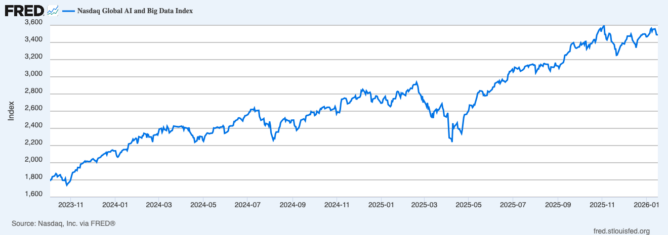
Poking around at the St. Louis Fed’s Fred graphing tool (to come up with a graphic to include for this post), though, led me to the graph at the top, which is of the “Nasdaq Global Artificial Intelligence and Big Data Index,” which “is designed to track the performance of companies engaged in the following themes: Deep Learning, NLP, Image Recognition, Speech Recognition & Chatbots, Cloud Computing, Cybersecurity and Big Data.”
So one option to get what I want would be to just go short on that index.
Turns out Cory Doctorow and I think a lot alike about the AI bubble, but he also has stuff to say about how to speed along the popping of the bubble, which would be a good thing. (Bubbles that pop sooner do less damage when they do.)
so I’m going to explain what I think about AI and how to be a good AI critic. By which I mean: “How to be a critic whose criticism inflicts maximum damage on the parts of AI that are doing the most harm.”
Back in May, I wrote an article about AI journaling. The idea (which I had stolen from some YouTuber) was that you write your journal entries as a brain dump—just lists of stuff—into an LLM, and then ask the LLM to do it’s thing.
. . . ask the LLM to organize those lists: Give me a list of things to do today. Give me a list of blind spots I haven’t been thinking of. Suggest a plan of action for addressing my issues. Tell me if there’s any easy way to solve multiple problems with a single action.
Now, I think it’s very unlikely that an LLM is going to come up with anything genuinely insightful in response to these prompts. But here’s the thing: Your journal isn’t going to either. The value of journaling is that you’re regularly thinking about this stuff, and you’re giving yourself a chance to deal with your stresses in a compartmented way that makes them less likely to spill over into areas of your life where they’re more likely to be harmful.
I still think that’s all true, and I still think an LLM might be a useful journaling tool. My main concern had to do with privacy. I didn’t want to provide some corporation’s LLM with all my hopes, dreams, fears, and best ideas, and hope that none of that data would be misused. I mean, bad enough if it was just subsumed into the LLMs innards and used as a tiny bit of new training data. Much worse if it was used to profile me, so that the AI firm could use my ramblings about my cares as an entry way into selling me crap. (And you know that selling you crap is going to be phase two of LLM deployment. Phase three is going to be convincing you to advocate and vote for the AI firm’s preferred political positions.)
Anyway, I figured it wouldn’t be long before local LLMs (where I’d actually be in control of where the data went) would be good enough to do this stuff, and I was willing to wait.
But I didn’t even have to wait that long! A couple of days ago, I saw an article in Ars Technica describing how Moxie Marlinspike of Signal fame had jumped out ahead with a really practical tool: confer.to. It’s a privacy-first AI tool built so that your conversation with the LLM is end-to-end encrypted in a way that keeps your conversation genuinely private.
I’ve started using it for journaling exactly as I described. Because of the way the privacy is inherent to Confer, I can’t actually keep my journal within Confer—all the content is lost when I end the session. So, I’m keeping the journal entries in Obsidian, and then copying each entry into Confer when I’m ready to get its take on what I’ve written.
[Updated 2026-01-20: This turns out not to be true. Conversations in Confer do last through browser restarts. Until I delete the key for that session, I can go back and see everything that was in that session.]
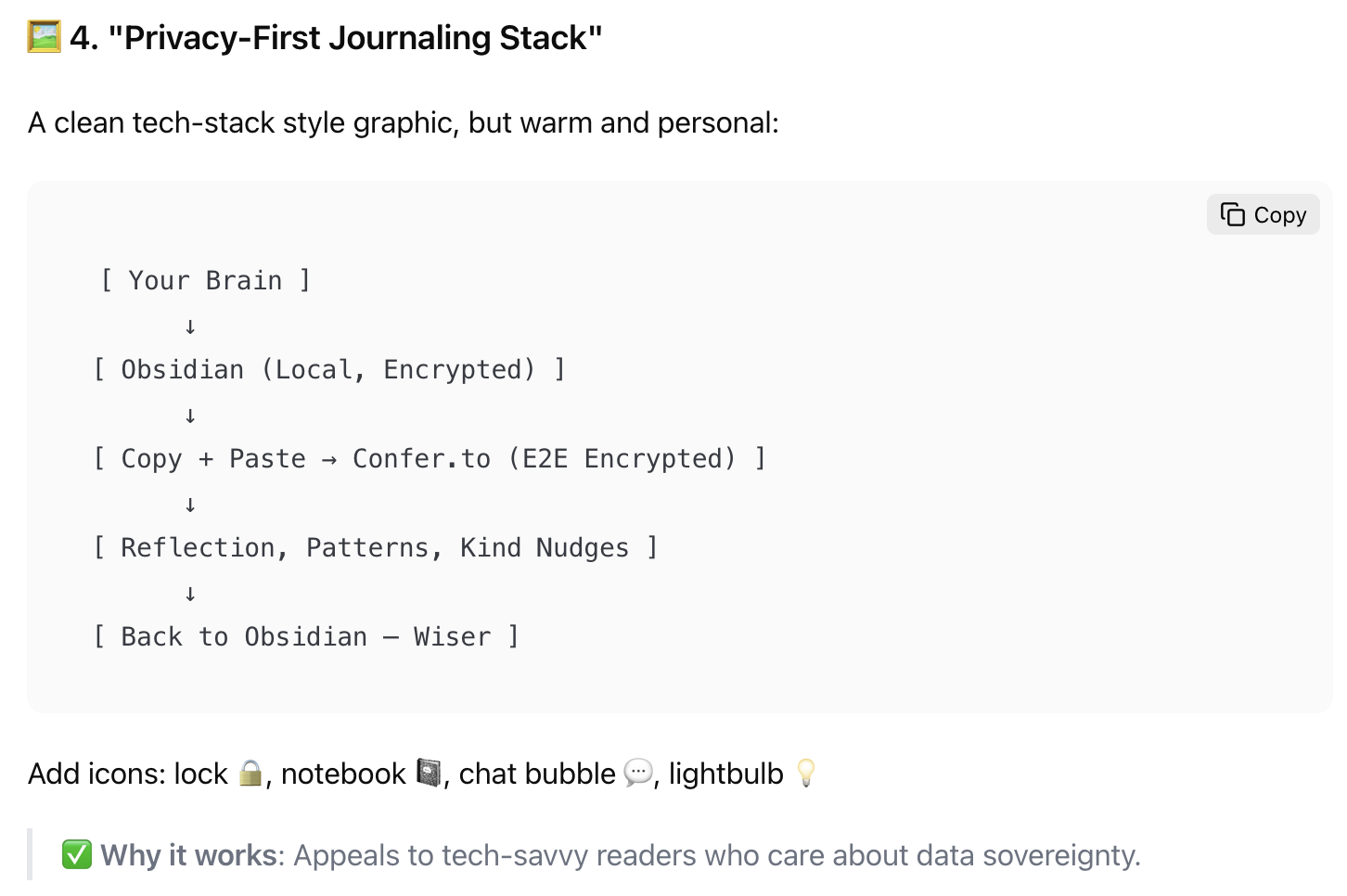
I wanted some sort of graphic for the post, and asked Confer to suggest something. It came up with 5 ideas, including this one, which (bonus) actually illustrates my process:
Anyway, I’ve already written three journal entries that I otherwise wouldn’t have, and gotten some mildly entertaining commentary on them—some of which may rise to the level of useful. We’ll see.
(Asked to comment on a previous draft of this post, Confer.to mentioned the “Give me a list of blind spots I haven’t been thinking of,” prompt above, and said, “But LLMs can’t actually know your blind spots — they can only reflect patterns in what you’ve said.” Which I know. And so, of course, once I started using an actual AI tool instead of just an imagined one, that ended up not being something I asked for.)
If I keep doing this (and I think I will), I’ll follow up with more stories from the AI-enhanced journaling trenches.