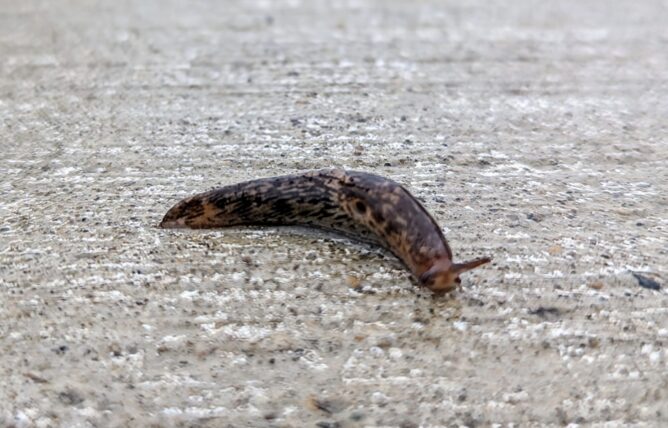
A slug crawling on a wet sidewalk

I am almost completely unconcerned about the “dangers” of AI that I’m hearing about.

In particular, I’m completely unconcerned about the danger that terrorists (or bored high school students) are going to use AI to make a bioweapon. I guess the concern is that AI will be able to try thousands of changes in the time a human could try three? That is different from what evolution has been doing for two billion years in no way whatsoever.

Similar only in that it is another AI danger that’s easily ameliorated, is AI-facilitated hacking, which the AI firms want us to come up with regulations for.

The fact is, we scarcely need any new regulations at all. Just an ordinary legal structure where, if someone using AI does something improper, the legal and criminal liability falls equally on the person prompting the AI and on the company that wrote the AI.

Of course, if the harm passes through someone else who’s supposed to be taking due care (such as your bank or broker) that person also has ordinary responsibility. (So if an AI helps someone steal your retirement account, the broker holding your retirement account has to make you whole, just as if they had handed your money over to someone who hadn’t used AI. About the only AI-related regulation needed is something making it clear that the broker can not only sue the criminal who stole it, but also the AI firm whose tool was used to effectuate the crime.)

My point is that all those supposed horrible dangers are perfectly ordinary, and there is no need to do anything special at all.

What’s really interesting is why are the AI firms and AI scientists trying to gin up all this worry? Could it be that they can see that without some buy-in from governments the companies are all going to collapse in short order?

That’s my best guess.

Well, that’s completely unexpected. Who could have anticipated such a thing?

“By now, it’s clear that weeds are evolving faster than companies are developing new weed killers: Just six years ago, in response to the onset of resistance to its marquee product, Roundup (active ingredient: glyphosate), Monsanto began selling a new generation of genetically modified seeds bred to resist both glyphosate and dicamba. By 2020, scientists had confirmed the existence of dicamba-resistant Palmer amaranth. The agribusiness giant took a decade to develop that product line. The weeds caught up in five years.”

Source: How Superweeds Like Palmer Amaranth Are Changing Agriculture – The New York Times

Tips from evolutionary psychology:

The more estrangements someone has in life, the worse his or her life is – across the board

If you trespass against someone in your world, realize that forgiveness is not an easy feat and it is actually rarely truly implemented – especially if the transgression is major and personal

Developing a reputation as someone who is genuinely trustworthy within a small community is golden

Source: What’s the Darwinian Recipe for a Fulfilling Life? 14 Questions with Evolutionary Psychologist Glenn Geher (PhD)

For years I was sure that blaze orange would be the most visible color—so sure that I bought all my shirts for bicycling in some approximation of that color. I simply couldn’t imagine that a greenish-yellow color would be more visible, especially against green backgrounds like corn and soybean fields.

Then one day while out riding in one of my orange shirts, I was passed by a pair of cyclists, one wearing just about the same color of blaze orange as I was, and the other wearing high-viz yellow.

They were riding quite a bit faster than I was, so over the course of the next few minutes they dwindled down to two small dots far ahead of me. And then they dwindled into one small dot: the high-viz yellow one. And that high-viz yellow shirt remained visible for a really long time after the orange-shirted guy riding right next to him had vanished in the distance.

After I thought about it, it made sense. Humans evolved as forest-edge creatures. Of course high-viz yellow stands out, even against a hundred different shades of leafy green. Picking critical detail out of dappled shade—where basically everything is a shade of yellow-green—is exactly what the human eye evolved to do.

All my new safety gear is high-viz yellow.