

Sculpture of an allegorical figure of Industry, standing outside the Chicago Board of Trade

Some years ago, I wrote an article on living off capital and published it as a guest post on another financial blog. The old link to it is dead, and a google search doesn’t turn it up any more, so I thought I’d go ahead and repost it, hosted here on my own blog.

People who come from wealthy families learn how to live off capital. The rules are taught along with all the other things they learn from their parents—how to dress, how to eat, how deal with bankers and trust officers. But even though most people don’t learn the rules, living off capital is just a skill, and it’s one that everybody should learn, because everybody lives off capital sometimes.

People usually think about living off capital in the context of retirement, but that’s just one (albeit important) example. Perfectly ordinary transitions, such as losing a job and having to find another, also amount to living off capital. There is also the broad swath in between: Living off capital for longer than just the length of time it takes you to run through your emergency fund, and doing so without the institutional support—social security, medicare, maybe even a pension—that comes along with retiring at an ordinary retirement age.

Income

If you’ve got a lot of capital—that is, if you’re wealthy—then living off capital is easy: You invest enough in treasury bonds that you can live off the interest.

It’s not trivially easy, of course. You have to allow for taxes. You have to allow for inflation. You have to have some sort of cushion or reserve in case your investment return falls. But, generally, living off your income is straightforward.

You allow for taxes by setting aside enough of your income to pay your taxes. This isn’t hard, even if you have to file quarterly estimated taxes, but you have to do it yourself; you don’t have an employer automatically taking care of it for you by deducting it from your pay. Screwing up is expensive—screwing up badly may even be criminal.

You allow for inflation by reinvesting enough of your income to preserve the value of your capital. If your money is in US dollars, TIPS (Treasury Inflation-Protected Securities) will do exactly that. The principle value of the bonds increases automatically to keep you even with inflation, and the interest is paid out on the inflation-adjusted principle, so your income rises with inflation as well.

(The adjustment is based on the Consumer Price Index while what matters to you is your own cost of living, so you can’t entirely delegate the job of allowing for inflation, but TIPS will do most of the heavy lifting.)

You allow for reversals by having a cushion somewhere. Ideally, have two cushions: First, a reserve fund with enough money to cover any unexpected expenses. Second, some flexibility in your cost of living, so that a decline in income can be matched with a decline in spending.

Beyond just income

The wealthy have other concerns than just supporting themselves—they want to pass down an estate. Because of that, they teach their kids this rather conservative version of living off capital. If you only spend your income, and if you reinvest enough to keep even with inflation, then you’re preserving your capital intact. (If you reinvest more then the minimum, or if some of your capital is invested for growth, than you can be growing your capital at the same time you’re living off it.)

If leaving an estate is not a concern for you, then you can spend more than just your income.

There’s a common rule of thumb that (if you have a well-diversified growth portfolio), you can probably spend about 4% of your capital and still expect to have more capital the next year. That won’t be true every year (it was really, really not true in 2008, for example), but historically it’s been true on average.

Still, the wealthy know that spending capital is a bad idea. Anytime you spend more than your income, you’re in danger of entering a death spiral: Your reduced capital earns less money so you have to spend even more capital to support your standard of living; repeat until broke.

A lot of people have back-tested versions the 4% rule, looking at historical periods to see if following that rule ever led to a death spiral. From what I’ve seen, it looks pretty good, but the current circumstance is going to put it to a particularly harsh test–especially for people who started living off their capital in 2007.

If you can afford it, choosing to spend only income is a safer strategy. If you can’t, you probably ought to accept that at some point you’ll have to earn some more money—and if you’re going to do that, sooner is probably better than later (before you’ve depleted your capital). Happily, a pretty small amount of money can make a big difference, if you’re right on the edge of being able to live on capital. Every dollar you earn is a dollar of capital that can go unspent.

Investments

If you were really rich, the safest thing to do would be to invest enough in TIPS that the income would support you. Then you could invest the rest of your money however you liked. Most people aren’t that rich—at the moment you’d need close to $2.5 million invested in TIPS to earn an inflation-protected $50,000 a year. Treasurys without inflation protection are earning more than twice as much. (Of course, you have to reinvest a big chunk of that to keep even with inflation).

Dividend-paying stocks can earn still more money, and dividend growth can provide some amount of inflation protection (as can capital gains). in recent years it has been tough to invest for dividend yield, but even with the recent recovery in the stock market, there are plenty of companies paying a reasonable dividend now—there are more than 40 companies in the S&P 500 whose dividend yield exceeds the yield on a 30-year treasury. None of those will be as safe as treasurys, but at least there are some options now for someone looking for income.

If you have it in you to be a landlord, there’s also the option of earning rent on real estate investments.

Mechanics

You can arrange the mechanics several different ways. The simplest version is simply to have the income from your investments directed into your checking account and use it to pay your bills. A slightly more complicated version would direct your income into the savings account where you keep your reserve fund, and then transfer money from there into your checking account. That makes it easier to even out the month-to-month money flows, which tends to be necessary because stocks generally pay dividends quarterly and bonds generally pay interest semiannually.

(If a lot of your capital is tax-sheltered in an IRA, 401(k), or similar vehicle, the tax rules make it more complex to use that capital for spending, but there are rules for handling the case when you’re actually retiring early.)

The key step–the one that rich families make sure that their children know—is to evaluate your capital every year: Make a new budget with your projected expenses for the following year, and then reinvest enough of your surplus that its earnings will cover any increase in your cost of living.

If you don’t have enough of a surplus to do so, you were living beyond your means.

It’s easy to do this by mistake. Even most people with a budget don’t know their cost of living accurately enough to know if they’re properly accounting for things like those large-but-rare expenses like a new car or a new roof, and any particular category of expense can rise much faster than overall inflation. (Think health insurance, college tuition, and fuel.)

People who are accumulating capital (rather than living on it) can use each year’s new savings as a buffer—even a major un-budgeted expense can often be covered out of this year’s planned savings without needing to dip into capital. Someone already living off capital doesn’t have this option. They have to provide their own buffer out of their reserve.

Fluctuations in income

There’s a second reason that a reserve is essential: The income earned by capital fluctuates. Anyone living off capital right now knows this quite acutely—the rate paid on Treasury securities is at generational lows. Other investments (such as dividend-paying stocks) earn an income that doesn’t necessarily shift in lock-step with treasurys, but can still go down—particularly during a recession.

The children of rich families learn that the key technique for stabilizing your earnings from capital is diversification.

You should diversify across time by investing some of your money in long-term treasurys, which will pay a fixed rate for a long period (decades). That offers some stability, but has two downsides. First, it while it protects you from falling rates, it makes it harder to take advantage of rising rates. Second, if all your treasurys mature at once, you might have to reinvest the whole sum at a much lower return. Avoid that making sure that your long-term securities mature in a staggered fashion. (Arranging for a fraction of your long-term securities to mature at regular intervals is called setting up a ladder.)

You should also diversify across kinds of investments by investing in more than one kind of vehicle. As attractive as TIPS are for someone living off capital, you probably want to have some of your money invested in ordinary treasurys, in stocks, and maybe in real estate. Other options (such as owning a business) are worth considering as well. This reduces the chance that your income streams will all fluctuate in the downward direction at the same time.

Other kinds of diversity are good as well. Consider investing in foreign treasurys as well as US issues, and maybe in corporate or municipal bonds.. Your stock investments should include multiple companies in different industries, and should include foreign companies as well as domestic ones.

The other key for dealing with a fluctuating income is to have a flexible cost structure, so that you have the option to cut your expenses, if necessary, to match your diminished income.

Those are the basics:

  • Invest for income
  • Reinvest to preserve your capital
  • Diversify
  • Keep enough flexibility that you can adjust your expenses

Learn those skills and you’ll have as much ability to live off capital as someone who grew up in a wealthy family. Then you just need the wealth.
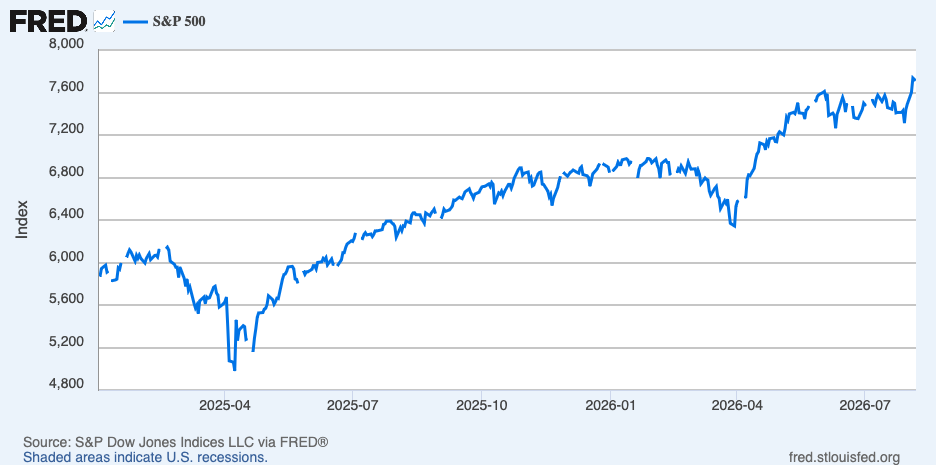

If, like me, you had any sort of reasonably balanced portfolio at the beginning of the year (or the beginning of last year), it’s worth observing that it is almost certainly way, way out of balance.

Graph of the S&P 500 since January 1 last year, showing an increase from under 6000 to over 7600

If so, this is your reminder to rebalance your portfolio.

Doing so is admittedly really hard to do. If you had a 60:40 (stocks to bonds) portfolio at the beginning of last year, you might very well have 70% or 80% invested in stocks now, and that probably feels great. You feel like a genius, letting your profits run. If there’s anything better than having 60% of your portfolio grow at 20% a year it’s having 80% of your portfolio grow at 20% a year.

But you know it’s a terrible idea. It’s bad enough to have 60% of your portfolio lose half its value. Having 80% of your portfolio lose half its value is much, much worse.

Knowing that it’s hard, let me point out a little thing that might make it a little easier right now: Bond rates are up nicely. You can get nearly 5.25% on 30-year bonds, or almost 3% on inflation-adjusted bonds. That’s good enough that you don’t really need to agonize about whether you can expect a capital gain or capital loss on the bond. Just buy it and take the coupon.

Of course, I have no idea what balance is right for your portfolio. Maybe it’s 60:40. If you’re young, maybe it’s 80:20. If you’re retired, maybe it’s 35:65. But if you had a sensible balance a year or two ago, and you haven’t rebalanced, it is now way out of whack.

This is your reminder to fix that.

AI firms are on the ropes, having spent way too much money building infrastructure for tools that are valuable, but not nearly valuable enough to support the money already spent, let alone what they’re planning to spend over the next two or thee years. This is bound to come to a bad end.

As Jerry Holkins puts it:

They can only loan each other money for so long. Then, they’ll socialize the losses through nationalization.

Source: Cyberbullies – Penny Arcade

At least, that’s their plan. Oliver Jutel and Gil Duran have a name for this plan: “exit through the state.”

Because I’m at heart an optimist, I like to imagine a more hopeful solution—one where this plan fails. And I legit think it might.

If Congress changes hands, and Trump becomes even more toxic (two things that seem very likely), there might not be anybody in a position to lead the charge for socializing the losses. A toxic Trump trying to hand another bunch of taxpayer money over to billionaire tech bros might actually be very unpopular. And if a Republican minority in Congress can’t get it together to come up with a plan that a significant number of Democrats will support, socializing the losses just might not happen.

But it has to “not happen” right then—with a Democratic (or divided) Congress.

If the AI firms can hold things together (with circular financing, SPVs, and the like) until there’s a Democrat in the White House, that guy will probably not be able to resist the pressure to “do something.”

If—as I hope, and kind of expect—it comes to a head before that, the Republicans might well not be able to come up with a plan that meets the demands of all their different constituencies, while the Democrats refuse to join in any plan that a large subset of Republicans will agree to. The result might just be that we just let the sucker go down.

Letting the sucker go down is what George W. Bush wouldn’t do in 2008. Except, of course, he kinda did, as far as homeowners were concerned. Banks, investment firms, and insurance companies got saved. Homeowners got hung out to dry.

My point being that the government is totally willing to let some suckers go down. The Republicans would like those suckers to be ordinary investors, computer users, and (in particular) tax payers. But I like to imagine that there’s at least some chance that the politicians will simply be unable to cobble together an arrangement to accomplish that, with the result that the AI firms go down, a bunch of AI firm executives get prosecuted for investment fraud, and all that infrastructure (data centers and large language models) gets sold off in bankruptcy, ending up in the hands of people with a certain amount of rationality (and much less debt).

The main entrance of the Federal Reserve Bank of Chicago

I don’t usually worry much about investment bubbles. There have been a lot of them over the past few hundred years, and most of them (railroads, telegraph, dotcom…) were expensive disasters largely only for the people who invested in them. Some though, such as the Great Financial Crisis of 2007–2009, were expensive disasters for lots of other people as well. So it’s worth thinking a bit about whether the current AI bubble is of the former sort or the latter—and how to protect your finances in either case.

Bad just for investors

One big difference between bubbles that are going to be wretched for everybody when they pop and those that’ll end up mostly okay except for the foolish investor’s portfolio, is whether the excess investment got spent on something of enduring value.

For example, railroad lines got enormously overbuilt in the 1840s in the UK and in the 1880s in the US, leading in both cases to a stock market bubble, followed by a stock market crash and a banking panic. But (and this is my point), the enormously overbuilt railroads were of some value. As the firms went bankrupt, the people who had over-invested lost a lot of money, but the railroad tracks, rights-of-way, and rolling stock all still existed. The new firms that got those assets, free of the excess debt, were often viable firms that went on to be successes—hiring workers, providing transportation, and eventually providing a return to the new investors. The people who got screwed were the old investors. (And not even all of them, as the original investors often saw the overbuilding happening early and sold out just as the clueless people who knew nothing about running a railroad, but just saw stocks soaring and wanted to get in on it, started piling in.)

Much the same was true of part of the dotcom bubble. A lot of money got spent on a lot of things. To the extent that it was spent on buying right-of-way and burying fiber, there was something of enduring value that ended up owned by somebody, making it one of the less-bad bubbles.

The key to avoiding catastrophe in bubbles of this sort is largely just a matter of not investing in the bubble yourself.

Bad for the economy

But some bubbles have produced horrible, wretched, prolonged difficulties for the whole economy. The other part of the dotcom bubble, besides the dark fiber build-out, was the bubble in companies with no profits and no prospect of ever having profits, whose stock prices went up 10x based on nothing but a story that sounded compelling until you thought about it for 10 seconds. As usual, that ended up being very bad for the people who invested in those companies, but it also was bad for the whole economy, because when those firms went bankrupt, they left behind nothing of enduring value.

The result was that the imagined wealth of those companies just vanished. The stock market went down, which was bad for (almost) everybody, and it produced a general economic malaise, because post-dotcom crash it became hard even for legit companies with real assets, a real profit, and a real business plan for growth, to raise money, which made actually producing that growth much harder.

Really bad for the economy

There is, however a step beyond just pouring a bunch of money into a bubble that doesn’t actually produce anything of enduring value, like a fiber optic network or a railroad. That’s when the money is raised with leverage (i.e. debt).

The 1929 stock market crash was a rather drastic example. People invested in stocks not because there was an underlying business that was worth what the investors were paying for it, but purely because the stocks were going up. That might have been okay in other times, but stock brokers had recently started allowing ordinary people (as opposed to just rich people) to buy on margin—where you just put up a fraction of the price of the stock you want to buy, and the broker lends you the rest.

In the 1920s you could buy on 90% margin, where you only put down 10% of the price of the shares. That meant that, if the stock price went down by just 10% your whole investment was wiped out, and the broker would sell you out to raise money to pay off (most of) the loan. And of course, all those sales into a falling market produced more losses, leading to the crash.

Since the 1930s you could only buy stocks on 50% margin, making it much less likely that your broker will sell you out into the teeth of a general stock market crash—although it can still happen.

Bubbles with leverage

A great example of a bubble with leverage is the Great Financial Crises of 2007. (Most people date it from 2008, because that’s when Lehman Brothers collapsed. I date it from 2007 because that’s when my former employer closed the site where I worked and I ended up retiring rather earlier than I’d planned.)

That was a particularly bad bubble. A whole lot of money was raised, with leverage, to buy housing. But very little of the money ended up being spent to build more housing (which would have been something of enduring value that would have lasted through the subsequent collapse). Instead, the money was spent bidding up the prices of existing housing, which then fell in value after the bubble popped.

So we had two of the classic producers of bad bubbles: Nothing of enduring value created, and leverage. The whole things was made even worse by the structure of the leverage in question.

This is getting rather far from my main point, so I won’t go into much details, but to raise the large amount of money that was going into houses, the rules on housing market leverage were being eased over a period of time. It used to be that you had to put 20% down on a house. Then you still had to put 20% down, but only half of it had to be cash, with the other half being funded with a second mortgage on the property (at a higher interest rate). Then they started letting people put just 3% down. Then they started letting people with good credit put nothing down. Then they started letting people with no credit put nothing down. At the same time, “structured finance” obscured just how risky all those mortgages were, meaning that when the bubble went pop lots of “mortgage-backed securities” ended up being worth zero.

Which kind is the AI bubble?

This brings us to the current AI bubble. A whole lot of money is pouring into building two things:

  • Data centers (buildings filled with computer chips of the sort used to train and run AI models)
  • Large language models (non-physical things that are basically just a bunch of numeric weights of a bunch of tokens which can be used to produce streams of plausible-sounding text)

Each of those may have some enduring value.

Data centers will have some. They will probably have a lot less than a network of fiber optic cables, which can be buried and will have value for decades with minimal cost or maintenance. Since newer, faster chips are coming out all the time, a data center is well behind the cutting edge as soon as it’s finished. Plus, training or running an AI model runs those chips hard, meaning that they probably only last a couple of years (due to thermal damage on top of regular aging).

Large language models probably have even less enduring value, because so many people are training new ones all the time. People are always trying to make them bigger (trained on more data) while also making them smaller (so they can run without a giant data center). All that means that your two-year-old LLM probably isn’t worth what you paid to build it, and a four-year-old LLM probably isn’t worth anything.

That’s how things looked a year or so ago—a perfect example of a bubble that would burn the people who sank money into it, but leave the broader economy untouched.

Sadly, that’s been changing.

First, the structure of the leverage has been changing. It used to be rich people and rich companies were building data centers and hiring software engineers to build LLMs. But lately that’s been getting screwy. Those large companies are raising off balance-sheet money with Special Purpose Vehicles (small companies that big companies create and provide some capital to, that then borrow a bunch of money to make something, with the loans collateralized by the things they’re making—but importantly, not an obligation of the big company that created them). Any particular SPV can blow up, if it turns out that the things it built don’t earn enough to pay the interest on the money the borrowed to build them. And large numbers of SPVs can blow up if financial conditions change to make it harder for all the SPVs to roll over their debts as they constantly have to keep their data centers running.

Second, they’re also engaging in weird circular investing and spending arrangements, where company A buys stock in company B which then turns around and pays all that money back to company A to buy chips, letting company A treat it as both income and an investment, while company B can pretend it got its chips for free.

Finally, there’s all the non-financial obstacles that may well throw a wrench into the whole thing. The fact that LLMs are all built on copyright violations. The fact that running data centers requires huge amounts of power and water (that has to be produced and paid for). The fact that producing that water and power brings with it horrible environmental impacts.

What to do

So, if AI is a bubble, and its one of the bad sort that will produce a panic and a recession when it pops, what should you do?

There are a lot of little things you can do that will help. I wrote an article with suggestions at Wise Bread called Are your finances fragile? It talks about what financial moves you can take to put yourself in a better position if there’s a general financial crisis. (If you’re interested in my writing about this stuff more broadly, I wrote a overview of my perspectives on personal finance and frugality called What I’ve been trying to say, that includes a bunch of links to other of my posts at Wise Bread.)

Besides that general advice, there are also a few things to strictly avoid. In particular, strictly avoid thinking that you can find some very clever investment strategy that lets you make money off the popping of the bubble. Yes, after the fact there will be some investments that make a lot of money, but no amount of keen insight will let you find and make those investments, as opposed to the thousands of very reasonable-seeming investments that will blow up just like all the rest.

Along about the end of the Great Financial Crisis I wrote an article called Investing for Collapse, which explains why any such effort is pointless. It holds up pretty well, I think.

Short version? Avoid debt. Keep your fixed expenses as low as possible. Build a diversified investment portfolio that limits your exposure to the most obviously stupid investments, but doesn’t do anything too weird or wacky in an effort to get them to zero—it’s pointless, and will probably do more harm than good.

Good luck when the AI bubble pops!

Here’s a quote from a good post on the difference between “feeling broke” and “being broke,” that also touches on tactics for getting by when you’re pretty close to that latter category—topics I wrote a lot about for Wise Bread.

What made me want to comment is a bit right near the beginning where the writer talks about the discontinuity in housing prices: Down to a certain price point you can pay a little less and get a little less space and slightly downgraded amenities, but there’s a breakpoint where that quits being true:

That’s the drop-off you experience at the lower price levels – there’s nothing between “This is a tiny but acceptable apartment” and “Slum apartments in stab-ville”.

On The Experience of Being Poor-ish, For People Who Aren’t – Resident Contrarian

The point I want to make is that this is only true in general. If you had to find 100 apartments that were cheaper-than-basic but not in a slum, you’d probably be out of luck. But unless your job is to find apartments for poor people, that doesn’t really matter. For your own household you only need to find one apartment that’s cheap but not in a slum, and across your city there’s probably several of those. (Maybe a small apartment building that’s not part of a complex, maybe a three-plex or four-plex, maybe a duplex owned by a retiree who is looking for a very low-maintenance tenant, maybe a big old house that was cut up into apartments, etc.)

The author is clearly aware of this—he goes into some detail on applying similar thinking to furniture (where you only need to get a great price on a great dining room table once and it’ll last the rest of your life). Applying it to apartments is different for various reasons (mostly having to do with urgency and risk—you can’t just wait indefinitely, because being homeless is different from eating off a TV tray table while you look for a great deal on a dining room table), but it’s not completely different.

For the first decade after my former employer closed the site where I’d worked, Jackie and I did a lot of that—looking to satisfy each need we had with one instance where we could get something of very high quality at an especially good price. It’s a tactic that works great, but only in a narrow range of circumstances. It’s not so good for people working long hours at a difficult job, because they lack the time and energy to do the search. It’s also not so good for people who are really broke (not just broke-ish), because these sorts of deals often require that you have cash on hand to close the deal immediately.

Here’s one of my old Wise Bread articles applying this thinking more broadly: How to have an above-average life for below-average prices.

Vicki Robin of Your Money or Your Life is right about responding to Covid-19 if you’re financially independent:

I wake up every morning asking, “What can I do for others to ease their material or psychological pain as Covid-19 upends our lives?” and “How can I use my leadership in communities of influence to increase vigilance where people are slack and calm where people are freaked?” The privilege of financial independence is the ability to serve.

Source: FI, FIRE and Covid-19; are we better set for this virus?

With no card number, CVV security code, expiration date or signature on the card, Apple Card is more secure than any other physical credit card.

Source: Apple Card launches today for all US customers – Apple

While @jackieLbrewer was working at the bakery there was a cash register glitch. For several days they took credit card payments on paper, writing the number down by hand, and then entering them manually at the end of the day.

Those customers would have been totally secure from being able to buy bread.

Marketing image courtesy of Apple