In 1981—the last year I was in college and the first year I was working at a real job, long-term interest rates got very high. I thought this was great. (I wasn’t in the market to take out a mortgage, but rather was starting to save money.)
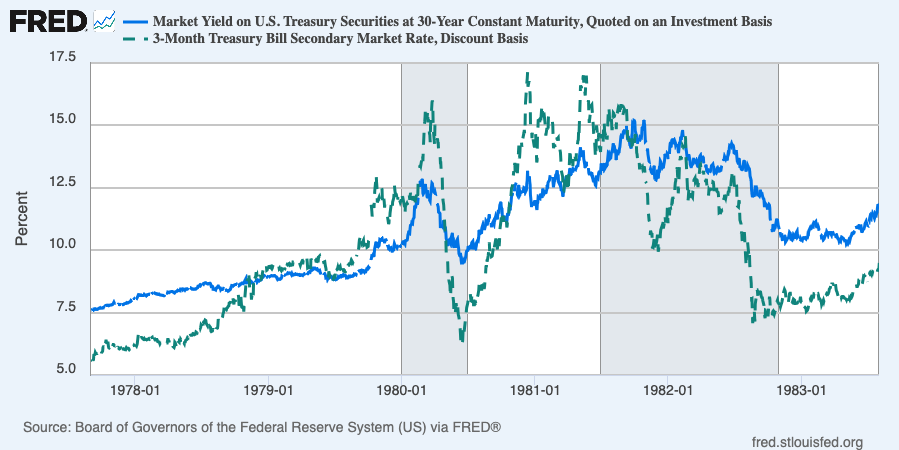
Graph of 3-month and 30-year interest rates from 1977 to 1983

I actually spent a lot of time calculating how much money I’d need to save and invest in long-term treasury bonds, in order to support myself without needing a regular job. I can remember when long rates got up around 14%, thinking that, since I could live on around $20,000 a year, I’d need a base amount of about $143,000 invested, plus enough extra to cover taxes, and to reinvest against inflation, totaling perhaps $300,000.

I was ahead of FIRE (Financial Independence Retire Early), and I rather missed out on the “reduce spending” half of the idea, so I didn’t make much progress toward my $300,000 goal for the first several years. It wouldn’t be until the early 1990s that I figured that part out, and by then interest rates were a lot lower. Worse, they were falling pretty fast, making the whole thing a lot harder.
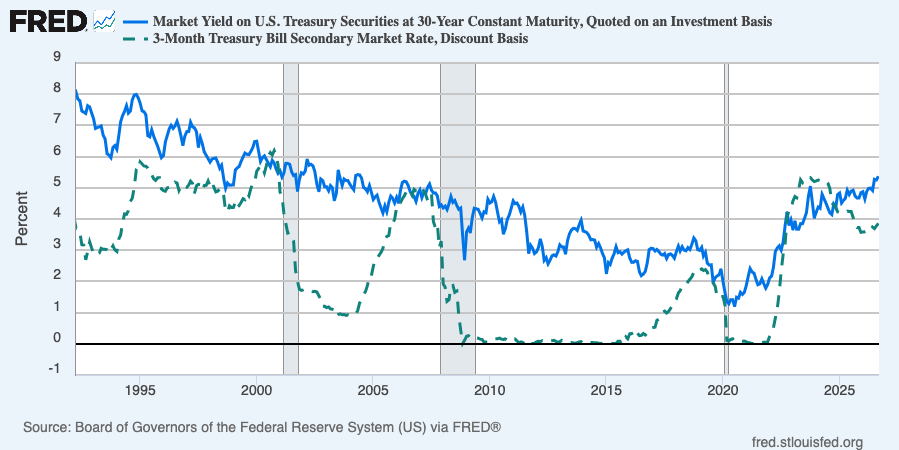
Graph of 3-month and 30-year treasury interest rates from 1992 to 2026

Rates kept moving against my goals pretty steadily, right through the great financial crisis in 2007, and then again during and after the pandemic in 2020. Of course inflation was falling until after the pandemic, making it seem a bit less difficult to invest enough that the return would support me even after allowing for inflation. (And, as a bonus, the Treasury started issuing TIPS, which adjusted their value to keep even with inflation, and paid their interest rate on the adjusted value. You still had to invest enough to cover inflation, but a lot of the risk and guess-work was removed.)

Now, finally, rates are moving in the right direction again. The 30-year TIPS is now paying an inflation-adjusted 3%.

The inflation calculator at the BLS says that $20,000 in 1982 is equivalent to $71,046 today. At 3% you’d need to invest $2,368,186 in TIPS to bring in that much cash. (But you wouldn’t have to worry about inflation.) Weirdly, the same BLS calculator says that the 1982 equivalent would have been $666,666. So just over double the $300,000 that I imagined would have sufficed back in the day. Which is perfectly reasonable, considering that back in the day I could have gotten 14% on my money.

Anyway, after a long period during which it was impossible to invest for a real return on a safe asset—what you want to do, if you’re doing the FIRE thing—we are finally back to having that option. It’ll be good for people like me. I think it’s good for the economy as well, even if it sucks if you want to take out a big mortgage so you can afford to buy a bigger house than you need.
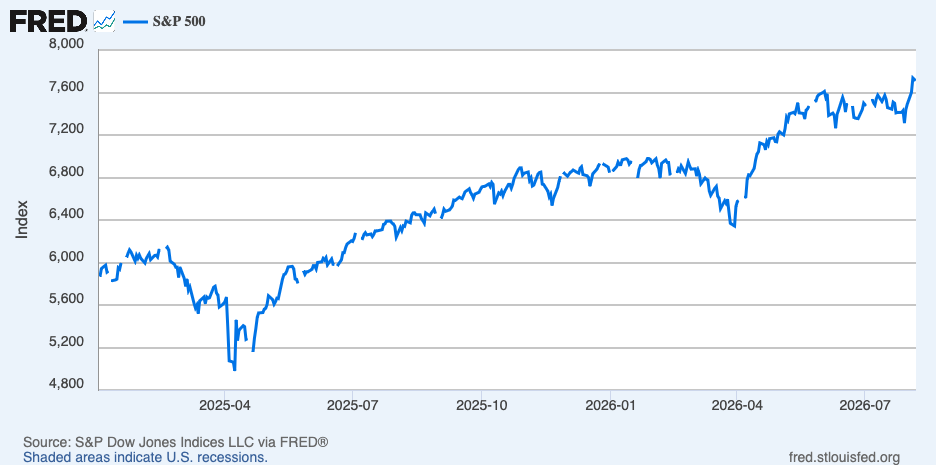
If, like me, you had any sort of reasonably balanced portfolio at the beginning of the year (or the beginning of last year), it’s worth observing that it is almost certainly way, way out of balance.

Graph of the S&P 500 since January 1 last year, showing an increase from under 6000 to over 7600

If so, this is your reminder to rebalance your portfolio.

Doing so is admittedly really hard to do. If you had a 60:40 (stocks to bonds) portfolio at the beginning of last year, you might very well have 70% or 80% invested in stocks now, and that probably feels great. You feel like a genius, letting your profits run. If there’s anything better than having 60% of your portfolio grow at 20% a year it’s having 80% of your portfolio grow at 20% a year.

But you know it’s a terrible idea. It’s bad enough to have 60% of your portfolio lose half its value. Having 80% of your portfolio lose half its value is much, much worse.

Knowing that it’s hard, let me point out a little thing that might make it a little easier right now: Bond rates are up nicely. You can get nearly 5.25% on 30-year bonds, or almost 3% on inflation-adjusted bonds. That’s good enough that you don’t really need to agonize about whether you can expect a capital gain or capital loss on the bond. Just buy it and take the coupon.

Of course, I have no idea what balance is right for your portfolio. Maybe it’s 60:40. If you’re young, maybe it’s 80:20. If you’re retired, maybe it’s 35:65. But if you had a sensible balance a year or two ago, and you haven’t rebalanced, it is now way out of whack.

This is your reminder to fix that.

Let me start by saying that, judging from his previous term, most of what the incoming president says has no particular bearing on what he’s going to do. But I think a few trends look likely enough that it’s worth thinking about the results on the dollar’s value.

The things I’m thinking of are tariffs and tax cuts, which I expect to lead to higher inflation and larger deficits, both of which will lead to higher interest rates.

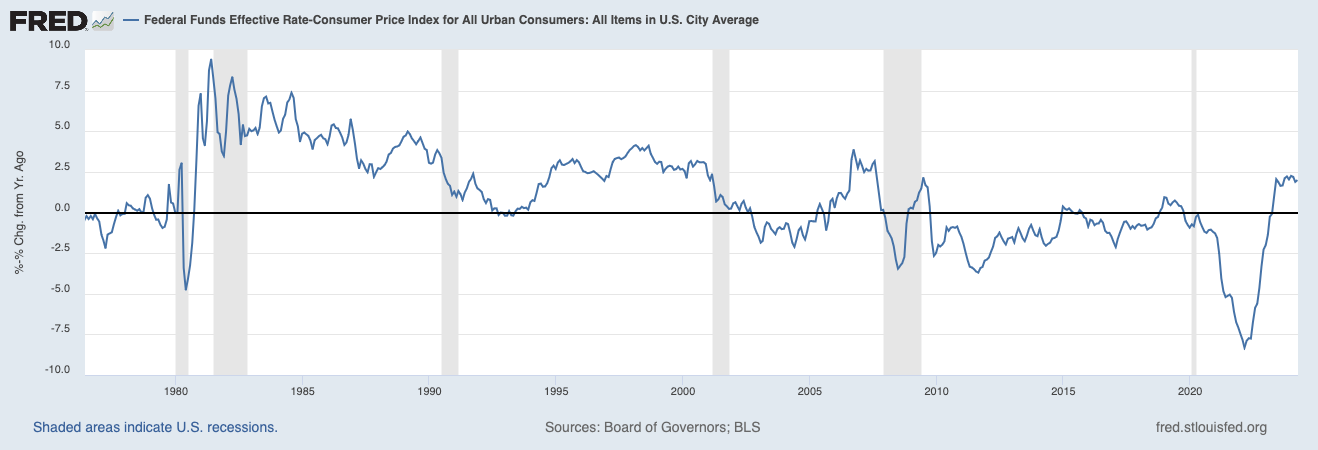
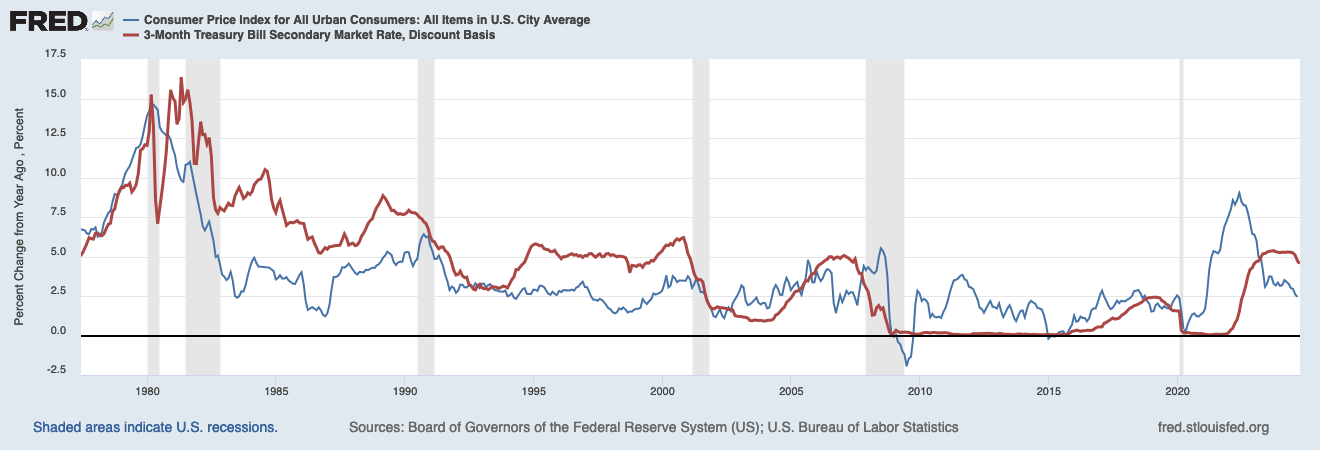
Graph of inflation rate and 3-month t-bill rate going back to June of 1977 (when I graduated from high school
Blue is the historical Inflation rate (CPI vs one year earlier). Red is the historical 3-month T-bill rate (roughly what you could earn in a money market fund). Both are from June, 1977 (when I graduated from high school) through last month.

Tariffs

The president can impose tariffs on his own, with no need for congressional action. Whether we’ll get the proposed 60% tariffs on Chinese goods, or whether that’s just a bargaining chip, I have no idea. But I think some amount of tariff increase will be imposed, which will feed through directly to higher prices.

That’s not to say that tariffs are necessarily bad (although usually they are). But they do feed through to higher prices.

Tax cuts

Tax cuts need to get through Congress. If the Republicans get the House as well as the Senate, it’s highly likely that legislation will preserve the 2017 tax cuts set to expire next year, and probably some additional tax cuts, such as a much lower rate on corporate income. It’s also possible that we’ll see the proposals to cut tax rates on tip income and on overtime pay enacted, although I doubt it. (The incoming president only cares about his own taxes, not about those of random working-class folks.)

The main thing taxes cuts will do is dramatically increase the deficit. The tariffs will bring in some countervailing revenue, but not nearly enough to fill the gap.

Other things that raise inflation and cut revenue

There are all kinds of other proposals that were bandied about during the campaign, such as deporting millions of immigrants, that raise costs both for the government, leading to higher deficits (the labor and logistics both cost money, and not a little) and for employers (they’re employing the immigrants because their wages are lower), which they will try to offset with higher prices.

What this means for our money

Rising costs will feed directly into higher prices, which is going to look like inflation to the Fed, so I think we can expect short-term interest rates (the ones controlled by the Fed) to get stuck as a higher level than we’d otherwise have seen.

At the same time, lower taxes will mean lower government revenues, leading to larger deficits. For years now, the government has been able to get away with rising deficits, but I doubt if the next administration will have as much success in this area. (Why not deserves a post of its own.)

My expectation is that higher deficits will mean higher long-term interest rates, as Treasury buyers insist on higher rates to reward the risks that they’re taking.

So: Higher short rates and higher long rates, along with higher inflation.

What to do

I had already been expecting inflation rates to stick higher than the market has been expecting, so I’d been looking at investing in TIPS (treasury securities whose value is adjusted for inflation). I’m still planning on doing so, but not with as much money as I’d been thinking of, for two reasons.

First, I’d been assuming that money market rates would come down, as the Fed lowered short-term rates. Now that I think short-term rates won’t come down as much or as fast, I’m thinking I can just keep more money in cash, and still earn a reasonable return.

Second, I’d been assuming that treasury securities would definitely pay out—the U.S. has been good for its debts since Alexander Hamilton was the Treasury Secretary. But the incoming president has very odd ideas about bankruptcy. As near as I can tell, he figures the smart move is to borrow as much as possible, and then declare bankruptcy, and then do it again. It worked for him, over and over again. I’m betting that Congress won’t go along with making the United States do the same, but I’m not sure of it.

Of course, if the United States does do that, the whole economy will go down, and my TIPS not getting paid will be the least of my problems.

The Winfield Village finance committee (everyone here interested enough in the budget to show up) met last night. The subject of interest rates came up, and I was surprised to find it a near-unanimous opinion that rates were going to stay high at least through 2024.

Thinking of myself as a contrarian, I always worry just a bit when I agree with everyone, but I think they’re right.