Over the course of my career as a software engineer, I only accepted job offers from employers that provided their software engineers with real offices, because I expected I would be less productive in a cube. When my last employer moved us from offices to cubes, that expectation proved correct. However, the situation turned out to be more complicated than that.

For certain kinds of work—certain phases in code generation, certain phases in prose generation—I need large blocks of uninterrupted quiet. That was hard to come by in a cube. When I spent the hour from 9:00 to 10:00 building the necessary state in my head to be able to generate code to solve a particular problem, and then had my manager come by at 10:10 to ask whether I was on schedule, I could quite literally lose a whole morning’s productivity—there was no point in starting over at 10:15, knowing that I’d want to break for lunch at 11:30.

For large blocks of uninterrupted quiet, an office with a door that closes is very much to be preferred.

Because I knew I needed an office—which I have in my apartment—I was surprised to find myself taking an interest in coworking. But it turns out that many phases of my work don’t require large blocks of uninterrupted quiet. In particular, when I pretty much know what I want to write, and it’s just a matter of sitting down and typing it out, a certain amount of activity in the surroundings actually makes it easier to get something done.

I have a few theories about why some surrounding bustle helps:

  • I think it’s good to have other people around me who are also working—modeling good working behavior.
  • I think a little activity makes it easier to just get a first draft down—making it easier to get past my internal critic that would otherwise insist on perfection.
  • I think a little stimulation makes it easier to be creative—providing some randomness that my brain can use to generate new ideas and make new connections.

Whatever the reason, sometimes I want to work in a place where other people are working.

There was a coworking place in Urbana a couple of years ago, called Collective Turf Coworking. I don’t know if they’re still around or not (their website seems to be down just now), but they were much too expensive for me.

Fortunately, there are a bunch of local public spaces that serve the purpose very well.

Both the Champaign Public Library and the Urbana Free Library provide a wide variety of spaces where work can be done:

  • Coffee shops
  • Large tables in the main library area
  • Divided workspaces in the main library area (Champaign Library only, I think)
  • Quiet rooms
  • Four-person study rooms

In my experience, the quiet rooms are quiet enough for me to be productive even on things that require quiet, the spaces in the main library area are only a little noisier, and the coffee shops are pretty noisy. The 4-person study rooms are great when two or more people want to work either individually or together.

The other place I’ve used to roll my own coworking space is the University of Illinois. Its various libraries provides an array of workspace options similar to those in the public libraries, but the main place I like to work is the Illini Union. It offers spaces ranging from the Pine Lounge (a very quiet place with desks and chairs), the South Lounge (just a couple of desks, but many chairs and sofas), the vending machine room (a bunch of long tables with chairs), and a very large Espresso Royale coffee shop.

Both libraries and the University offer free WiFi to the public. The University also offers secure WiFi to anyone with a NetID (which I have through OLLI). Not every space has power, but there are plenty that do. (The Pine Lounge has power at every desk, as does the quiet room in the Champaign Library.)

The main downsides are:

  1. Spaces aren’t reservable. On a day where there’s high demand, it’s entirely possible that all the prime spaces will be in use when you show up.
  2. Spaces aren’t secure. I’m unwilling to leave my computer and other stuff unattended even long enough to go to the bathroom and get a cup of tea.
  3. No off-hours access.

Those issues aside, each of these venues actually offer more options than any but the best coworking space is going to, in terms of a full spectrum from quiet space for individual work, meeting spaces for collaborative work, a coffee shop, outdoor spaces, and so on.

I wrote the following for my teenaged nephew, who is also a writer:

I understand that you’re ready to move beyond just writing stories for yourself, and to start submitting them for publication. There are a lot of articles with advice on this topic. You could spend a few hours reading a bunch, but I can save you the time. Their advice boils down to this: “Read the submission guidelines. Follow them.”

In the time I’ve just saved you, I suggest that you do a little exercise. It will take a couple of hours, and it will teach three or four very useful lessons on what it’s like to be an editor—and once you know that, you’ll scarcely need any of those articles.

Set aside two hours during which you can focus, and do this:

  1. Go to ralan.com. It has lists of markets to which you might submit sf or fantasy stories, organized by how much they pay per word. The top two categories are of markets that pay 3¢ a word or more. These are the markets that you’ll soon be submitting to. But for this exercise, we’ll be focusing on the lower tiers: Pay, Token, and Expo.
  2. Click on each of those lists. Look for markets that publish stories in your genre, and that publish them on-line.
  3. Make a list of 10 or 20 such markets. Pick ones that look like they’ll have the sort of stories you’d like to read. In your list, include the URL that will take you to each market’s most recent stories.
  4. Read 50 stories from those markets, and pick the two best.
  5. Write two quick notes about why each of those stories is superior.
  6. If you have time, write another 48 notes for each of the stories that didn’t make the cut, explaining how they fall short.

That last step, of course, is a joke. Obviously you won’t have time. In fact, if you tried to read every story all the way through, you’ll have used up your two hours long before you were done.

Now you know a bunch of things from an editor’s perspective:

  • You’ll know they start each submission they read hoping it’ll be great. They want it to be awesome, because that’ll mean that they get to read an awesome story—and then they’ll be able to print an awesome story in their magazine!
  • You’ll know that they can usually tell in just a few paragraphs that a story isn’t going to make the cut. Oh, they’ll read a bit further—they’ll be hoping that you’ve hidden an awesome story behind a weak opening. But they only get to accept two stories, and if your story isn’t better than the best ones they’ve read today, it’s not going to make the cut.
  • You’ll know why they’re so picky about the format they want submissions in. Editors don’t want submission stories to look awesome. They want them to be awesome, but they want them to look all the same. (How much time did you waste, just getting through each new market’s front page to find the stories?)
  • You’ll know why you aren’t going to get any useful feedback from editors. (How many of those 48 rejected stories did you provide notes for?)

Hopefully, you’ll also know a few new things from a writer’s perspective. You’ll know that there are a lot of crappy stories out there (and those are the best crappy stories—the ones that got published). There’s some consolation in that, but not much. It’s not good enough for your story to be better than the crappy ones—it’s going to have to be better than the great stories, and there are some of those too.

I’m sure you’re going to figure that you can get most of the benefit just by thinking about this exercise, without actually doing it. This is not true. Do the exercise. It only takes a couple of hours, and you won’t believe the things you’ll learn.

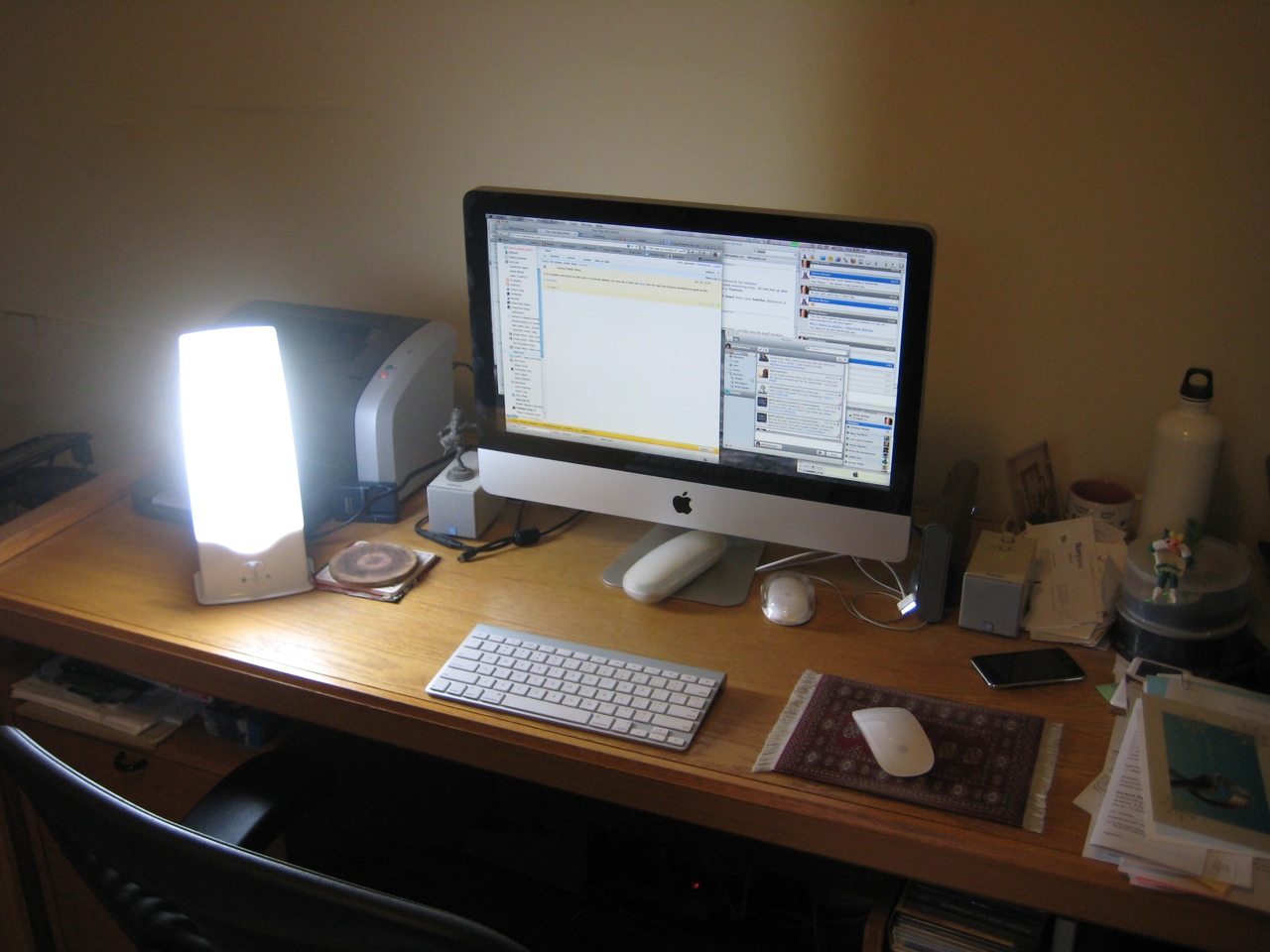
My dad and his wife gave me this light-therapy device for staving off SAD.

I took advantage of the fact that my brother was off work for the holidays by playing a whole lot of StarCraft.

My plan had actually been to continue that through today, but I got email from an editor expressing an interest in a story I’d finished a few days ago.

I’d done my “final” rewrite of this story back in December. But one of my Christmas presents was the book Save the Cat, and reading it had crystallized a couple of aspects of story structure that hadn’t quite been clear before. So, I’d cracked the story open to do a bit of restructuring.

Once the email arrived, I had to wrap that up right away. Fortunately, there wasn’t much left to be done. I did the restructuring pass in a couple of hours, made two editing passes to smooth off a few bits of awkward language, and sent the story off.

So, a day early, the work year is begun.

I sold one new story in 2011: “Watch Bees” to Asimov’s Science Fiction. It appeared in the August 2011 issue.

“Watch Bees” also gave me my first reprint sale, first foreign sale, and first sale in translation: it should appear in the Russian sf magazine ESLI early in this new year.

A story I sold in 2010 was published in 2011: “Like a Hawk in its Gyre” appeared in the February 2011 issue of Redstone Science Fiction. (They also published an interview with me in the same issue.)

As far as writing new fiction goes, I had mixed results. I finished several first drafts and got them critiqued by the Incognitos, but late in the year I had an unproductive spell, and only one of those critiqued drafts has been transformed into a submission draft that I’m satisfied with. (I have a query out to an editor who had expressed an interest in that story. If he doesn’t want it, I’ll send it off to the regular magazine markets.)

The new year should be more productive, with several stories a short step from being submission-ready, and several new projects waiting to be begun.

I wrote “Four Steps to Managing Personal Debt” for American Public Media Marketplace‘s Makin’ Money blog.

I also wrote 29 articles for Wise Bread. I’ve bolded a few where I thought I managed to say just what I was trying to say:

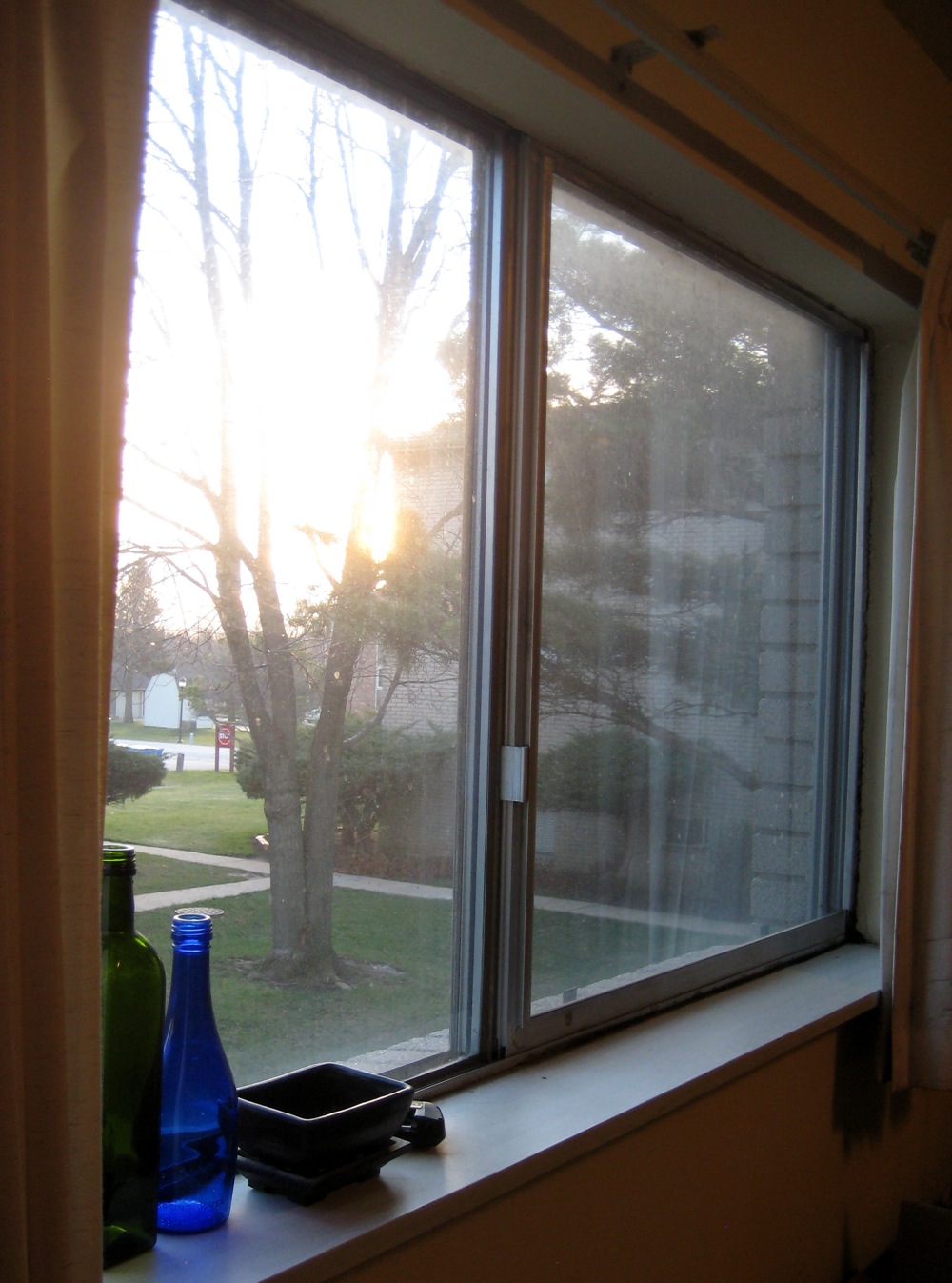
Sunset out the window of the study

I’m glad I have a Facebook account, so I can see what my friends are doing (or obsessing about). I enjoy reading my Twitter feed, for the occasional brilliantly pithy comment. I’m pleased with Google+, because it solves two big problems with Twitter (by letting me group the people I’m following into categories and by eliminating the arbitrary 140-character limit).

And yet, whenever I post anything substantive in any of those venues, I end up regretting that I didn’t post it here, and just link to it there.

There are several reasons, but they’re all related: the material is harder for me to find, harder for me to link to, harder for me to relate to all the other stuff I’ve written (and am going to write). When I post it somewhere else, the material is less useful.

So, I’m going to re-center my social writing here. I’ll still use Facebook, Twitter, and Google+ to comment on what other people write, and I’m sure I’ll occasionally use them to post brief items that I think will be of interest to my readers in those places in particular (and to re-share interesting bits in the place where I find them). But my substantive social writing will be here.

You know the sequencing problem. You want to bake cookies, but you don’t have any eggs, so first you have to go to the store, but you don’t have any cash, so first you have to the ATM, but you don’t have enough money in that account, so first you have to transfer money from another account.

So, there’s the solution to this sequencing problem: Transfer the money, go to the ATM and get cash, go to the store and buy eggs, bring them home and bake cookies.

I mention the sequencing problem for two reasons.

First, I’ve learned of late that, when I’m stressed, I begin to have difficulty solving the sequencing problem. After Jackie broke her wrist, for example, there was a bunch of extra work I had to do. That would have kept me busy enough, but it was made worse by an abrupt decline in my ability to solve the sequencing problem.

I’d be hungry, so I’d need to fix dinner, but we wouldn’t have any ingredients, so I’d need to go to the store first, but also the kitchen was a mess so I had to do dishes first. And then I’d be paralyzed:  two things that needed to be done “first,” with no way to parallelize them, and no clear way to decide how to sequence them.

Now, anyone with any sense would realize that it doesn’t matter whether you do the dishes first or the shopping first. (Or even decide to just go out to eat, and do the shopping and dishes when you’re not so hungry.) But, as I say, when I’m over-stressed I seem to develop deficiencies in my ability to solve the sequencing problem.

The second reason I mention it, though, is that this disability in solving the sequencing problem manifests itself in a perverse desire to go beyond solving a specific sequencing problem. I find myself wanted to produce a general solution to the sequencing problem.

This is insane. There is no general solution to the sequencing problem. It’s not just computationally infeasible: it’s a meaningless concept. A general solution to the sequencing problem would amount to an ordered list of everything I’ll ever need to do. There is no such thing.

I need to keep this in mind. All that’s possible are specific solutions to the sequencing problem. Fortunately, this is all we need.

Statue of the Three Graces at Allerton Park
This statue at Allerton Park is called the Three Graces, but I like to think of it as the Three Muses.

I was pretty productive these past two weeks. I finished a major rewrite pass on a short story that the Incognitos had critiqued a while back, and passed the story on to a couple of first readers. I wrote several posts for Wise Bread. I did some preliminary investigation on a tech writing assignment.

I thought that was great, not only because it’s nice to get things done, but because it makes me feel like it’s okay to spend time on various less (or non-) remunerative projects, such as art, poetry, and Esperanto.

I’ve just come to realize, that this is a harmful way to think.

I’ve always had these recurring bouts of unproductivity. The previous several weeks were an instance of it: I sat at my computer and tried to work, but I didn’t get much done.

Back when I worked a regular job, these bouts were always terribly stressful. How do you tell your boss, “Sorry, I just don’t seem to be able to get anything done”?

I had several coping skills. Because of the kind of work I did, my managers never really could know how difficult a task was, so I could just say, “It’s turned out to be tougher than I thought.” Also, even when I couldn’t make any headway on my major tasks, I was almost always able to do something. I got in the habit of seeking out smaller, one-day tasks that I could do. That let me be productive (so I felt better) and gave me an excuse to be late with my main task (so I was less stressed).

Now that I’m not trying to work at a regular job, the stress level is much reduced. There’s no boss whose understanding of my productivity needs to be managed. There’s no job to be lost if that management goes poorly. But that doesn’t mean that I don’t still have these periods of unproductivity.

As I was saying, since this latest surge of productivity, I’ve felt free to spend some time on less remunerative projects, like doing some writing in Esperanto. And that brought me to a realization: It’s dumb to think that I shouldn’t work on stuff that I’m interested in, just because it’s not the most important work I could be doing.

I think part of the reason I’ve been doing it is that I thought it might motivate me to get my important work done. I know some people bribe themselves by withholding permission to play with side projects until they’ve done an appropriate amount of work on the main projects. But it has never been an effective technique for me. Maybe it helps a little when I’m just feeling lazy. But being unproductive is different from being lazy, and it doesn’t work at all for that.

More important, I think I’ve finally figured out that this behavior is actively harmful. These other things I do—drawing, poetry, Esperanto—probably help me be productive. They’re not a waste of time that I could be spending on important projects. Rather, they’re a pathway back into productivity. Being productive—even being productive on something that doesn’t earn any money or advance my career—is still being productive. And experiencing productivity after a period of unproductivity is positive. It leads to more productivity.

In the past, getting started being productive again has always been the hard part. Maybe this will help. Maybe, if I can be productive on some frivolous task (without agonizing too much over the fact that it is frivolous), I’ll be able to bootstrap that experience of productivity into productivity in other areas.

In the meantime, I’m being productive again in a wide range of areas. Go me.

It’s common in novels to have scenes where a character who is known to the reader is observed by another character who lacks that knowledge. To indicate that fact, the writer sometimes refrains from using the character’s name (and generally from mentioning anything that the other character can’t know).

That’s fine, except when (for story purposes) it’s important that the reader recognize that the character being observed is the character that they know.

Many writers use some physical tag that, I guess, is supposed to clue the reader in as to who the character is, and here’s where my bad reading capabilities come to the fore: I read right past that stuff.

When the story talks about someone seeing “the tall man in the black coat,” I do not automatically assume that this guy must be the main character (whom I’ve long ago forgotten was described in the first chapter as being tall and some time later as owning a black coat).

I can’t count how many novels I’ve found utterly befuddling because I never realized that “the guy in the cowboy hat” was not just some guy in a cowboy hat, but rather was the main character (whose choice of chapeau had no doubt been mentioned, but without the important caveat “by the way, in the world of this novel, nobody else ever wears a cowboy hat”).

Now, it’s possible to make this work. I remember a novel that described one character as walking “with the outsides of his feet making first contact with the ground.” When someone with that particular gait was referred to later, I never once thought that maybe this was some other guy who happened to walk on the outsides of his feet.

So, how about you guys? When a book you’re reading references “the bald man” or “the guy with the red beard,” do you immediately know that the author means you to understand that this is the character described three chapters earlier as having that trait? Is it just that I’m a bad reader?

One cluster of particularly good bits of advice that I got at Clarion came from James Patrick Kelly. (That link goes to my Clarion journal entry for the day I wrote about it.) Among other things, he suggested that we should:

  1. Save all our rewrites until after Clarion (as a way of carrying some of the energy of Clarion forward),
  2. Do the rewrites in order of salability (and perhaps not bother rewriting any that didn’t seem salable), and
  3. Write a new story for every story that we rewrote. (Otherwise we could easily find ourselves at the end of the summer with five or six nicely polished stories, but totally out of the habit of writing.)

More recently, having gotten several stories critiqued by the Incognitos, I decided to put that advice into practice again. I made a plan to start revising and submitting those stories, in between writing new ones. But I decided that I’d write one more new story before getting going on to revisions.

I made that plan rather longer ago than I’d like to admit, because for quite some time now I’ve had real trouble getting a new story finished.

After two or three attempts at new stories stalled, I should have just gone ahead and gotten going on a rewrite. But, no. Without really thinking about it, I just pushed ahead on a plan A, even though it wasn’t working. That wasted a lot of time, I’m afraid. It was also really frustrating.

But, good news: I’ve finally finished a new story! I’ve sent it out to the Incognitos, and it’ll be critiqued at the next meeting.

And now, finally, it’s time to look at the stories they’ve already critiqued, pick the most salable, and get to work revising it.