All consumer-grade heart rate monitors have issues. Chest straps are pretty good. The optical captures from wrist (Google Pixel watch, etc.) or finger (Oura ring) are quite a bit less accurate.
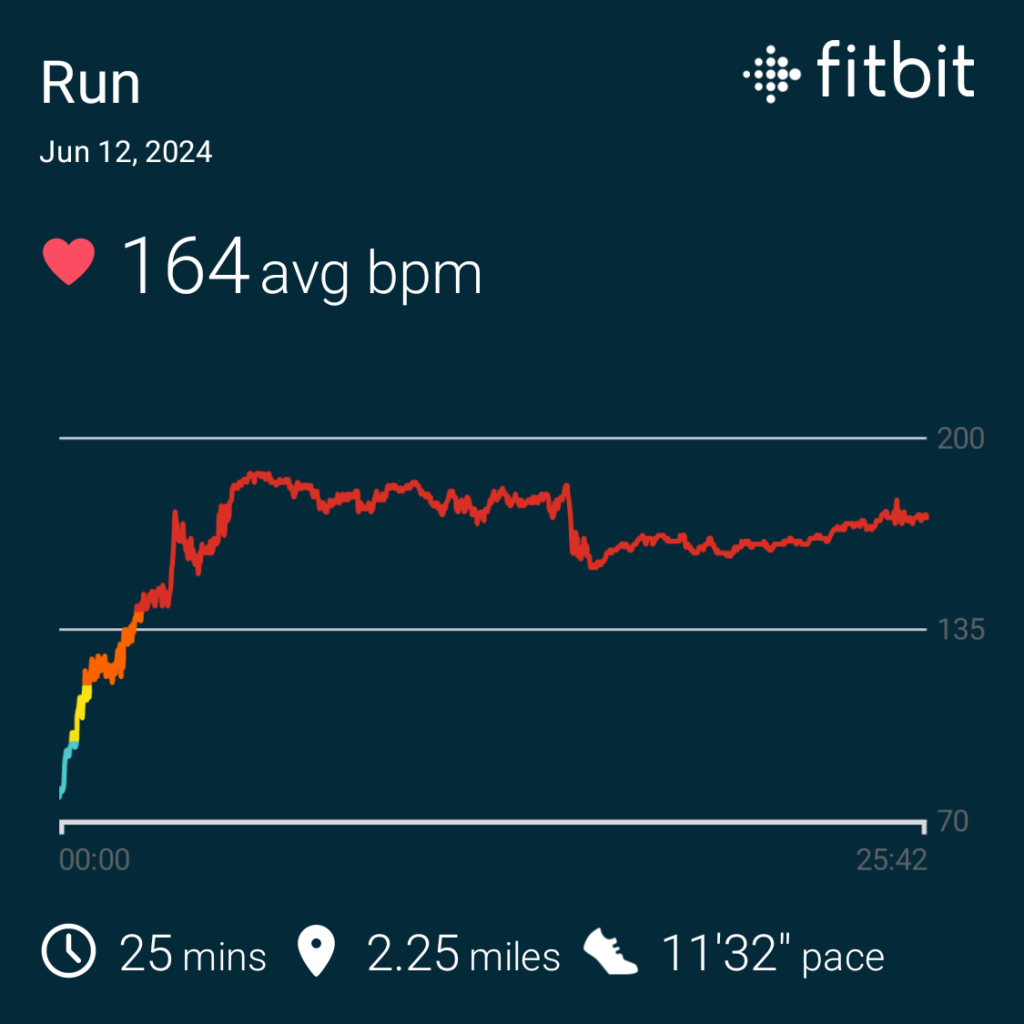
I’ve generally just tolerated it—taking the reported data with a grain of salt—but sometimes it would be nice to get good data. Today I did a little experiment with my Google Pixel watch—tightening the strap at the midpoint of my run—and found that it seems to give me pretty good data this way.
What you see is my warm-up, followed by 1 mile out and then 1 mile back. The HR shown for the “out” phase (averaging maybe 180 bpm) is ridiculous—what it’s capturing is not my HR, but rather my step rate.
In the second half my HR goes from about 160 to slightly above 170 (gradually rising as I get tired), and that’s probably just about right.
(The standard formula for estimating your maximum heart rate is 220 minus your age, which would give a max HR of 156 for someone of my age. But that’s clearly wrong for me. I pretty regularly see peak HRs of just over 170 that seem entirely legit. I assume that my genes and my training history just give me a higher max HR than typical. Sadly, it doesn’t make me faster, as you can see from my average pace for this run. I was running literally as fast as I thought I could maintain for 2 miles.)
Anyway, I think I can recommend tightening up the Pixel watch band as tight as tolerable, for getting the most accurate data.
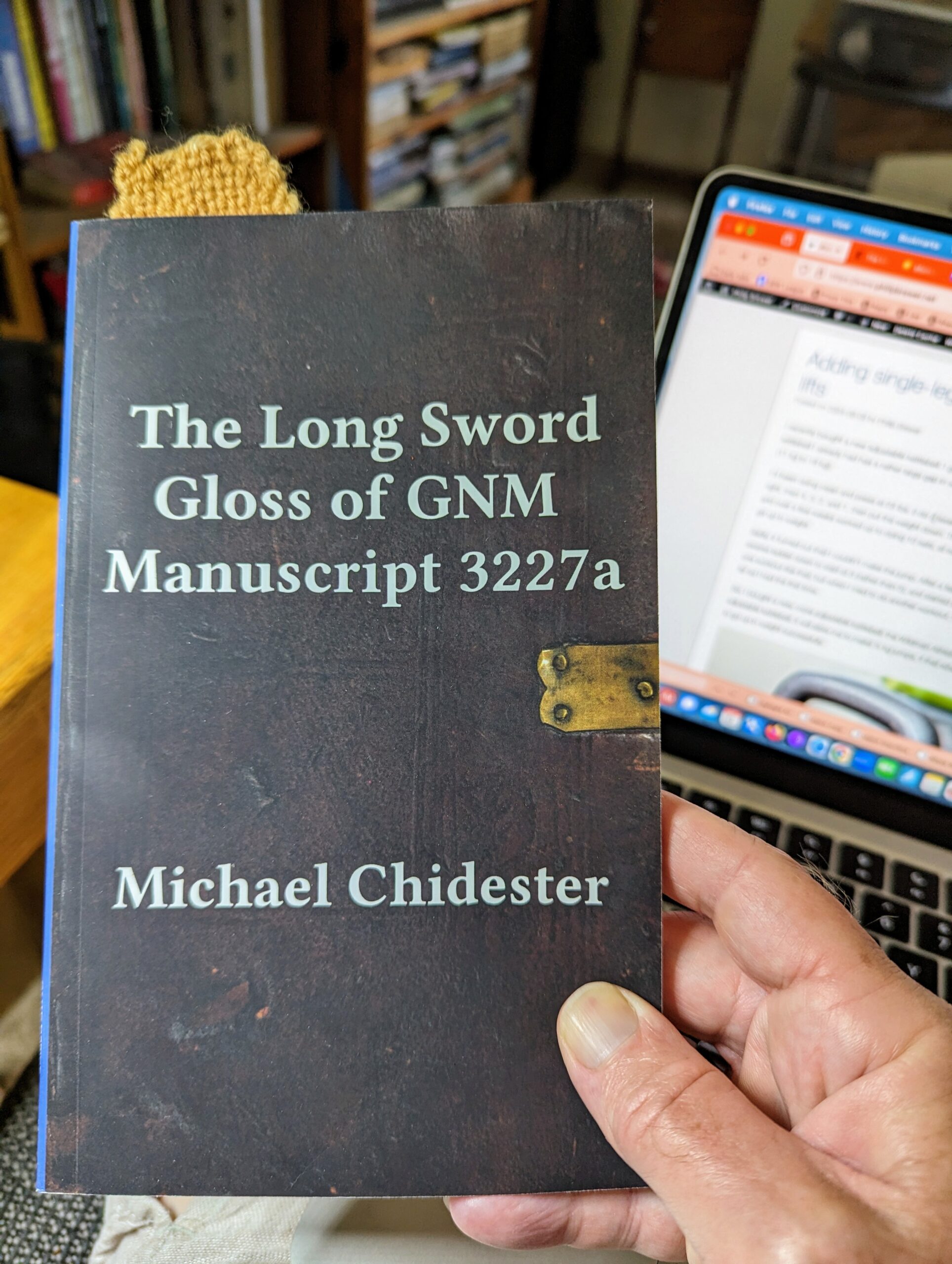
In my previous post, I talked about RDL (Romanian dead lift) the exercise. In HEMA practice RDL refers to something else: the writers of three famous glosses of Lichtenauer’s Zettel (a long didactic poem on sword fighting) by Sigmund ain Ringeck, Pseudo-Peter von Danzig, and Jud Lew.
So far, I’m reading a different gloss of the poem (although I’ll probably get to those as well):
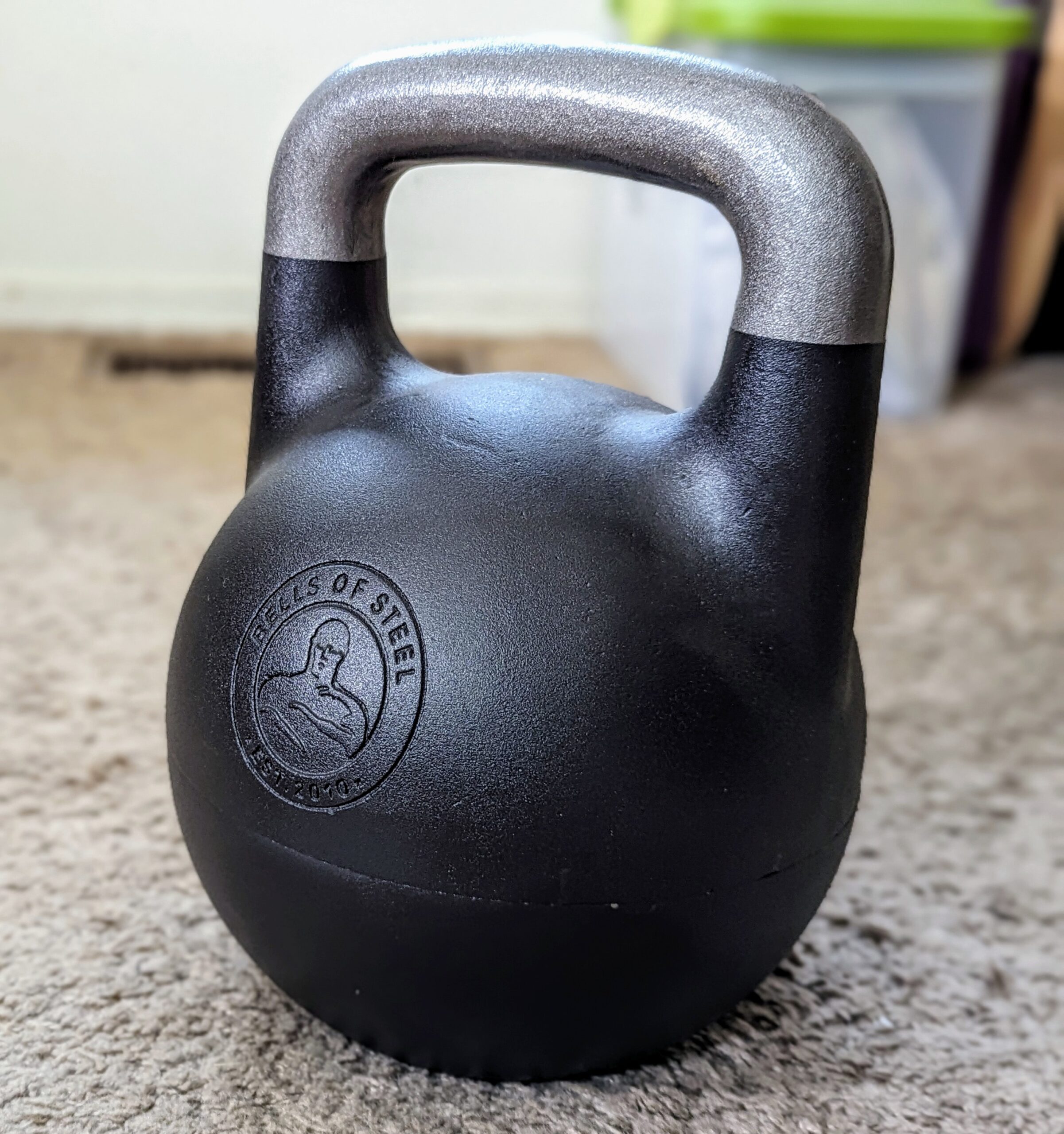
I recently bought a new adjustable kettlebell. I got it specifically because the adjustable kettlebell I already had has a rather large gap in weights: It goes from 25 lbs to 35 lbs (11 kg to 16 kg).
I’d been doing clean and press at 25 lbs. (I do a reverse ladder, where I do 5 left and 5 right, then 4, 3, 2, and 1, then put the weight down. That’s one set.) I started at 4 sets, and over a few weeks worked up to doing 10 sets, at which point I figured it was time go up in weight.
Sadly, it turned out that I couldn’t make the jump. After a failed attempt, I cut the reverse ladder down to start at 3 (rather than 5), and started at just 3 sets. I managed one workout like that, but when I tried to do another workout, I didn’t even make it as far as I had the first time.
So, I bought a new, more adjustable kettlebell: the Wildman Athletica competition adjustable kettlebell. It will allow me to make ½ kg jumps, if that what it takes to be able to go up in weight successfully.
It starts at 12 kg, which by happy coincidence is right where I need to be for my clean & press workouts.
The downside of the Wildman kettlebell is that it isn’t so easy to adjust the weight. Whereas my other adjustable weight kettlebell can be adjusted with a quick click of a dial, the Wildman adjustable kettlebell has to be opened up with a hex wrench, and then have weight plates added (or removed), and then tightened back up again. This is no big deal if you have to do it once or twice a month as you finish one cycle in an exercise program, but is pretty tedious if you have to do it every day or two as you switch between exercises—and 12 kg is rather low for lower-body exercises (for me). My other adjustable bell goes to 40 lb (18 kg) and my fixed-weight bell is 53 lb (24 kg)), and either of those is a much for appropriate weight for, let’s say, kettlebell swings.
So, I was trying to think of a lower-body exercise I could do with just 12 kg, and still get a reasonable muscle-building stimulus. I thought about hand-to-hand swings, which would work okay for the upper body, but wouldn’t make much difference as far as the lower body goes. Then I thought of single-leg Romanian dead lifts.
If I were doing regular (2-legged) Romanian dead lifts (RDL) with a barbell, I’d be able to use close to 135 lbs. You might assume half of that would be about right for a single-leg RDL, but the SLRDL turns out to require a much higher level of skill, because it’s a tricky balance exercise, as well as a strength exercise. In particular, it really works the smaller muscles of the feet and ankles—needed to keep from falling over.
All of which is to say that I think SLRDLs will turn out to be a very fine exercise for my purposes, at least for a while. I started at 5 sets of 5 left / 5 right, and just like with the clean & press expect to be able to run it up to 10 sets. Then, just like with the clean & press, I should be able to go up in weight. At some point—when I get the skill component nailed—I’ll probably see the weight I want for the lower-body exercise go up faster than the the weight for the upper-body exercise. But at least for a little while, I think I’m all set.
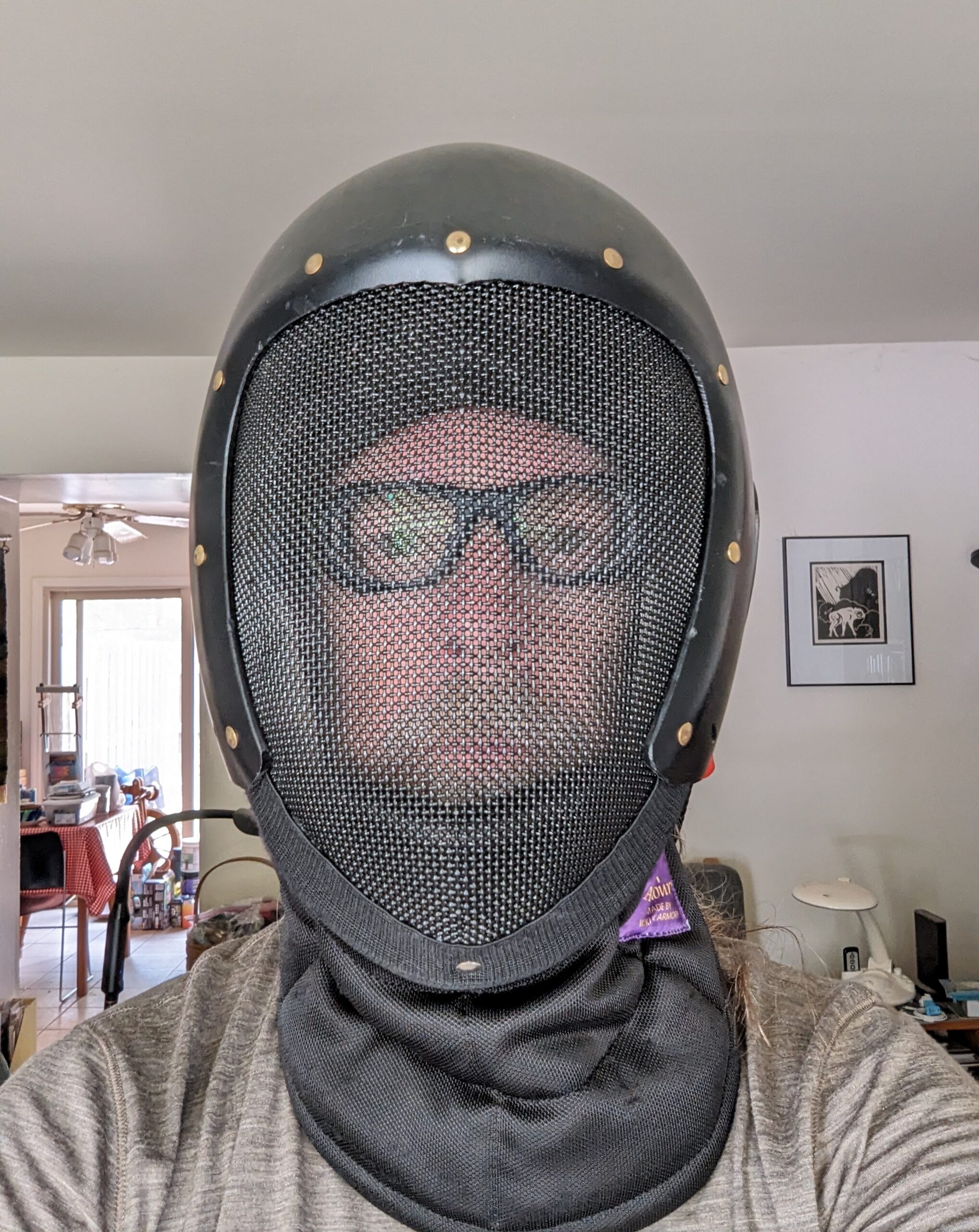
Putting my fencing mask on always pushes my glasses askew, and often mashes them up worse than that. So, a couple of weeks ago I ordered a pair of prescription goggles, and today they arrived!
They look okay:
And my mask just went on over my goggles no problem!
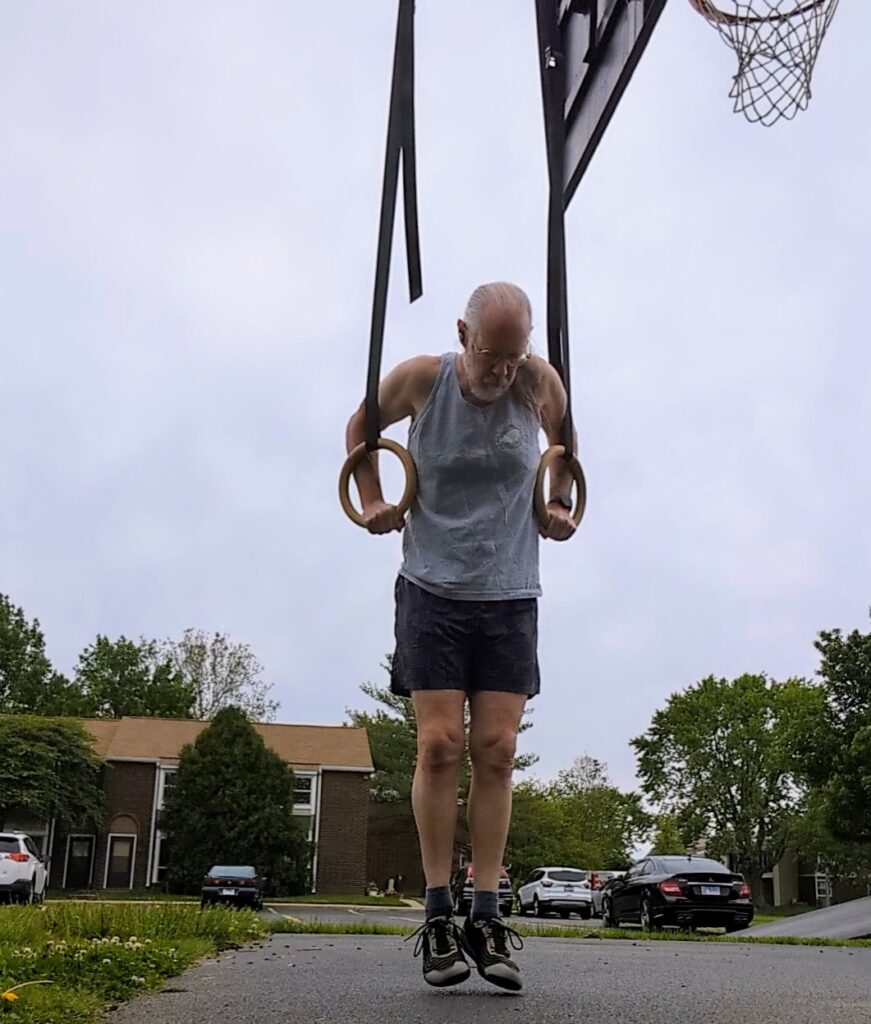
Back in 2020 I bought a set of gymnastic rings, and used them for pull ups, dips, and inverted rows during the period that fitness rooms were closed due to the pandemic. More recently, I’ve been doing a lot of club and kettlebell swinging—using equipment that was unavailable during the pandemic, but that I’ve purchased since.
I like the club and kettlebell stuff. However, probably because I’m not programming the workouts as well as I might, I don’t seem to be making progress. In fact, in some ways I’m backsliding. So, now that the weather supports getting outdoors and putting my rings up again, I’m going to do more of those workouts.
Today I did a circuit with three rounds of:
Jump rope (x110, x120, x120 jumps)
Dips (sets of 1 full dip + 5 negative dips)
Wall sit (1 set of 30″ left/right legs, 2 sets of 45″ two-leg)
Inverted rows (x7, x9, x9)
3-way core (30″ each of hollowbody hold, inverted plank, shoulder taps)
This picture has nothing to do with my workout. I took it while walking the dog at dawn.
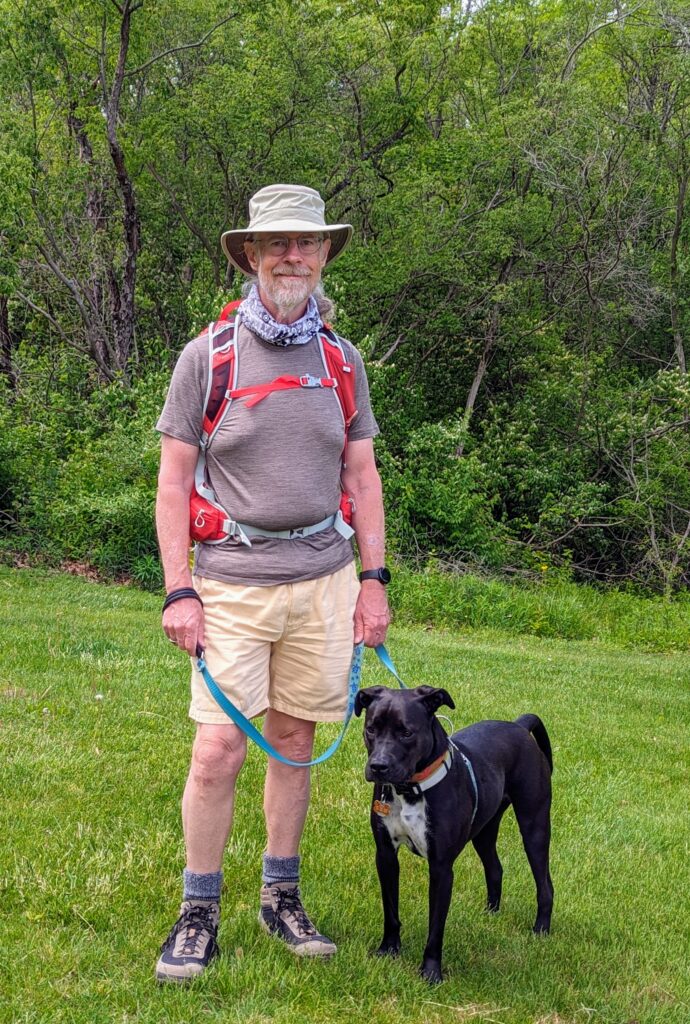
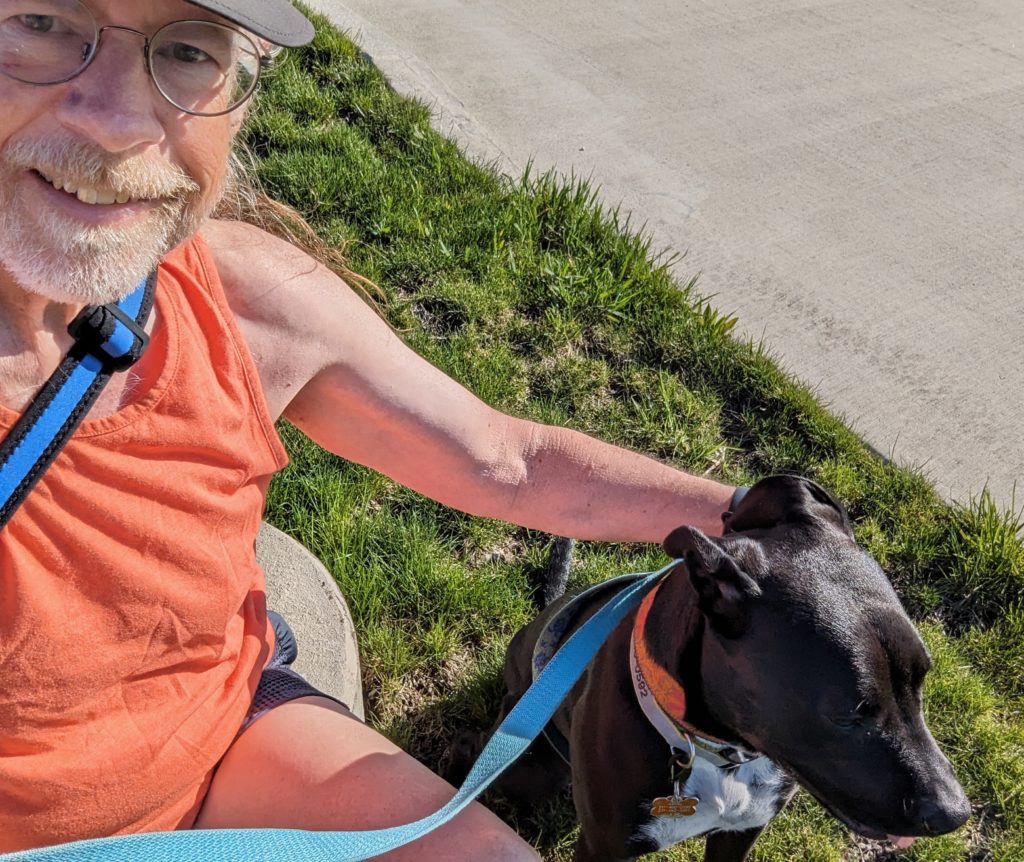
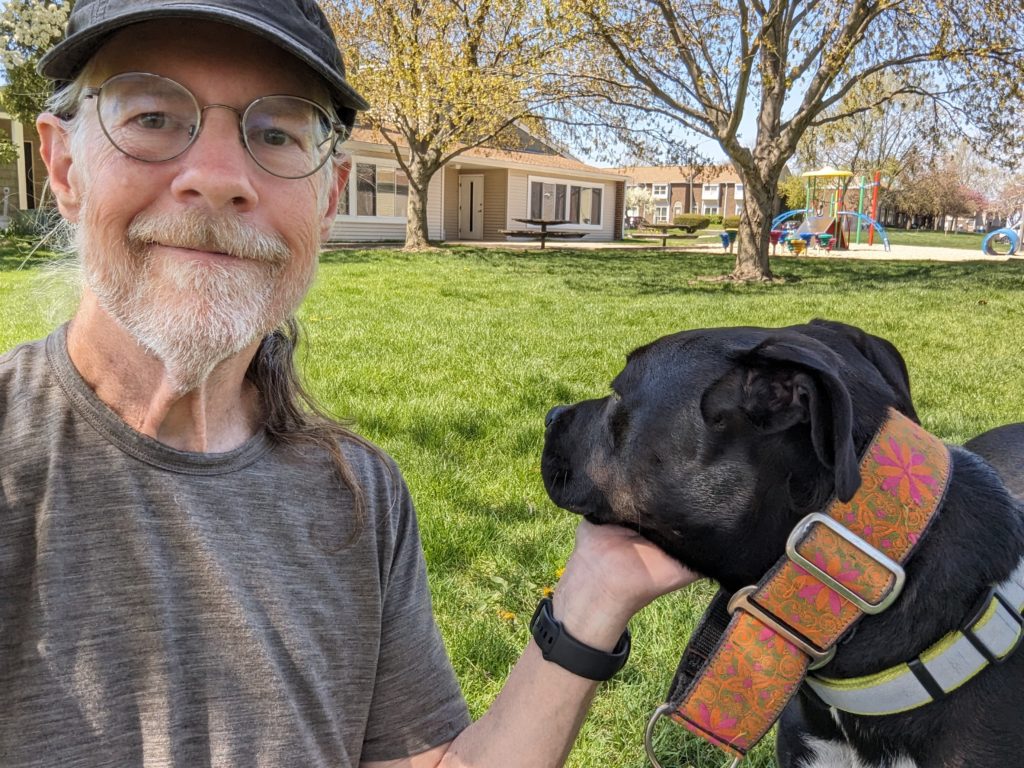
Me and Ashley, out for a #run. Once again, she’s a much better running companion than she is portrait model. 🏃🐕 #dogsofmastodon
Because of dog-related complications, I didn’t get good stats on the run, but it was about 2 miles and maybe 30 minutes (including time to water the dog and pose for photos).
The books say not to take your dog running until they’re at least a year (better: 18 months) old, so they’re running on mature bones and joints.
Early on, I instead let Ashley take me on runs, letting her drag me on the leash while she sprinted off in random directions at breakneck speed for 30 or 40 seconds, only to cut in front of me and then come to an abrupt stop. It wasn’t really satisfactory. After I fell and badly split the skin on my knee, I mostly quit doing that. If I wanted to go for a run, I’d leave the dog behind with Jackie and run by myself. But that was unhandy for all of us.
Now that it’s spring, and we’re getting some nice running weather, I thought I’d see if Ashley could run with me.
I took a bunch of pictures of us yesterday, but never got one that included Ashley looking at the camera.
I’d done some preparation: In the winter I took a “loose-leash” walking class, and she’d gotten a lot better at walking with me. For loose-leash walking I wrap the leash around her chest and then back through that loop you can see on the collar in the picture. That has a couple of positive effects: the leash is effectively shorter, and when she does pull, the friction from the leash constricting around her chest makes the pull gradual, rather than an abrupt hard yank. The key, though, is that it serves as a signal that I want her to walk like a pet, and stay by my side, and she’s gotten pretty good at doing so.
Yesterday I thought we’d give running together a try, and it worked great! I walked her a few blocks on a long leash, so she could get her sniffies in. Then, once we reached a multi-use path that’s about a quarter mile away, I put her on the leash wrap, and started running—and she did just what I wanted her to! She ran along, next to me, at my pace. She didn’t try to run off in some other direction. She didn’t try to sprint ahead. She didn’t lag behind like she didn’t want to run. She just loped along next to me.
It was great!
I had neglected to bring water for her, so I was a little worried that she’d overheat, but she seemed to do okay. We ran a mile, then turned around and walked partway home, but when it seemed that she wasn’t overheated, I picked up the pace again and we ran the rest of the way back to our starting point, then I put her back on a loose leash and we walked home (where she did proceed to drink a whole bowl of water).
For future runs I will bring water. I’ll also make a point of getting out early, before the weather gets hot.
If this doesn’t turn out to be a one-off thing, and she’s willing to run with me on a routine basis, I’ll start taking her running every other day, sticking to short runs for a while to make sure we don’t over do it, then gradually increase the distance until one or the other of us hits some limit or another. (I’ve been routinely walking her over 6 miles nearly every day, so we’re both already in pretty good shape.)
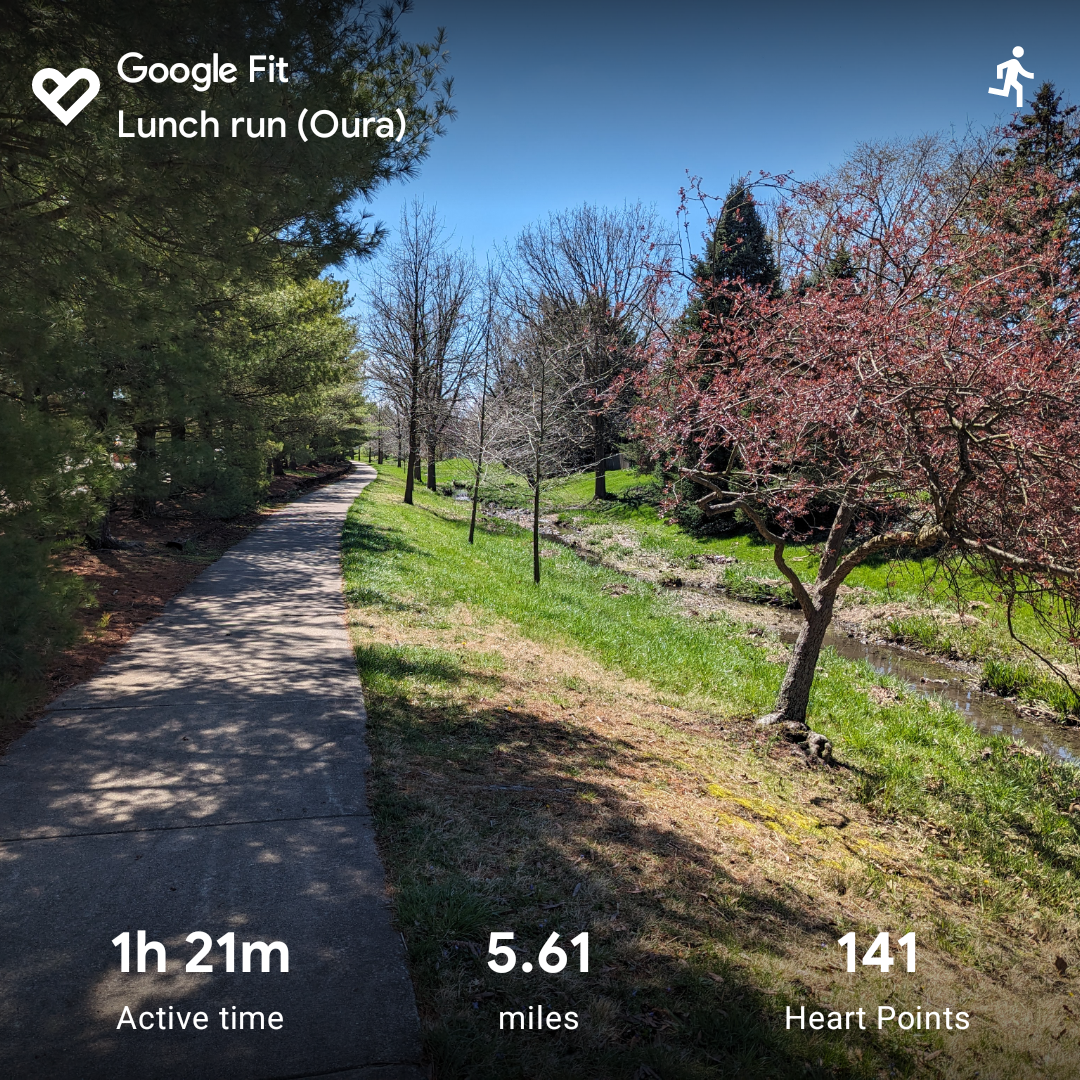
A great #run! 🏃 My feet and knees felt great throughout. And it looks like the weather will finally support getting out twice a week. (This was my “long” run. I also want to do a “fast” run.)