Suits of armor in a display case

I have long had mixed feelings about gameification, where you use the structures that underlie games (like points, achievements, badges, etc.) to motivate yourself to do the things you already know you want to do. I’m dubious about it, but at the same time, I do find myself motivated by such structures, which makes it very tempting to use them. (For exercise in particular, but really everything.)

Just lately, I’ve started thinking about a modest alternative: storyfication, where you use the structures of fiction to motivate yourself to do whatever it is you want to do.

Essentially, you tell yourself a story about what you’re doing, rather than making a game out of it.

Plenty of people do related things. There are several popular YouTube fitness channels that are all about using anime stories and situations, or superhero stories and situations, as inspiration for working out. (See for example JaxBlade, The Bioneer, or Kevin Zhang.) Some of them are primarily about aiming for the aesthetics of anime characters, but some reach into the story lines of specific anime. And some—the most interesting ones—use the underlying structure of anime or comic-book type stories as workout inspiration.

I’ll rough up an example here. Any story structure might be worth trying, but I’m inclined to start with the Hero’s Journey story structure. I’m assuming that we’re talking about doing exercises to get fit, but the basic storyfication thing could work for anything where you need to engage in repeated actions to get better at something—learning to paint, say, or learning to play the violin.

You begin with the Call to Adventure. If we’re talking about exercise, it would be a desire to get fit. Of course, the hero always initially resists the call. (Getting fit is a lot of work that’s hard and sometimes uncomfortable.) But finally the hero (you) chooses to accept the call.

The bulk of what you’d be doing would be “traveling on the road of trials, gathering powers and allies.” (That is, consistently doing your workouts.)

Dividing things up into separate books or seasons makes good sense. It can be very useful to grind away on one or a few things (building strength, say, or building endurance, or explosiveness) for a few weeks or a few months, but you need to include occasional breaks. You might consider each week of workouts a chapter or an episode. Put six or eight or ten together, then take a break. And then, of course, return for the next volume or the next season, perhaps with a new focus.

In the Hero’s Journey structure, the next thing would be to confront evil and be defeated, leading to a dark night of the soul. I don’t see much value in writing this into your plan, but there may be value in keeping the idea in your pocket for when things go awry. And, of course, things will go awry. A major project at work or at home may take so much time you can’t fit in all your workouts. An injury or illness may derail your workouts for a time. Maybe you’ll just hit a plateau in your fitness journey.

When something like that happens, well, you can view it as confronting evil. Remember, after being defeated, you face the dark night of the soul. One thing you might do at this point is think deeply about what obstacle might be blocking your progress. In fitness there are many possibilities: insufficient volume of exercise, insufficient intensity, insufficient recovery, poor exercise selection, poor nutrition . . . . The possibilities are nearly endless, and it is often hard to know which is the real culprit.

For that reason, the next step in the hero’s journey is especially appropriate: You take a leap of faith. Even though you can’t know what’s the best choice, you make a choice anyway. Maybe you ease up on intensity and focus on recovery. Maybe you double-down on exercise volume. Maybe you focus on your diet.

Whatever you choose, you can think of it as confronting evil again. And in a proper hero’s journey, this time are victorious.

Go ahead and write this part into your plan.

The final stage of the Hero’s Journey is that the student becomes the master. Again, there’s no need to write that into your plan. But it is entirely possible that having some success with storyfication will make you feel like sharing your insights with others, which is really what being a master of something is.

I generally view both gameifcation and storyfication as essentially neutral—neither good nor bad, except to the extent that the thing being motivated is good or bad.

Perhaps related to this is a word I’ve just learned:

“hyperstition.” The term, coined by “accelerationist” writer Nick Land, describes the belief that one can manifest future realities by telling compelling stories, and that prophecies become self-fulfilling through repetition and virality.

https://www.thenerdreich.com/silicon-valley-apocalypse-capitalism/

Telling yourself a compelling story can definitely help you put in the time and effort to achieve your goals, just like the structures that underlie games can do the same.

Is anybody else out there interested in using story structure to motivate themselves to exercise (or do something else)? Anybody already doing so, and able to provide some first-hand experience?

Let me know! (See my Contact page for many ways to contact me.)
I gave up multitasking a long time ago. I realized that I’m not good at it, and started paying attention so that I could notice when I was doing it and stop.

As an aside, I should mention that there’s now quite a bit of research to show that nobody is good at multitasking, and that the people who think they’re good at it are even worse than the people who know they’re not.

Even though I’m more efficient doing one thing with complete focus and then going on to the next thing, that practice alone doesn’t solve the underlying problem that tempts people into multitasking: How else can I get everything done?

Half of the answer to that is the drearily obvious, “You can’t. What you can do is get a whole lot done, if you quit frittering away your time on trivial, pointless stuff, and apply your time doing the most important stuff.”

I know some people who are pretty good at that, and they are routinely way more productive than me or most other people.

But there’s more to it than that. Katy Bowman has been talking about one useful practice, suggesting that you “stack your life” by accomplishing multiple goals at once—something that sounds suspiciously like multitasking, but really isn’t.

I’ve actually been thinking about this quite a bit, wanting to articulate the difference for my own sake if no one else’s. My take on it, is that it has to do with what the limiting resource is for each activity.

There are a lot of limiting resources. Your hands are one—they can really only do one thing at a time (although my mom used to read, fan herself, and drink lemonade all at the same time, and felt like she was being very efficient). Location is another—something that can only be done in the kitchen can’t be stacked with an activity that can only be done in the garage or the gym or the grocery store. Other people are another—something that requires the presence of another person can’t be done without him or her. (Though it’s not that simple, as sometimes you can stack up the other people and get multiple things done with multiple people.)

In multitasking, the limiting resource is your attention, and what’s unique about attention is that many activities can be done with partial attention. That experience tempts us into thinking that attention is more divisible than it really is.

Washing dishes only takes partial attention, meaning that you can listen to the radio or a podcast and get full benefit out of both activities.

Driving is a more complex example. We know that driving sometimes requires your full attention. This is why talking on the phone is unsafe to do while driving—talking on the phone requires enough of your attention that doing so reduces your competence at driving as much as getting drunk does. (Talking to someone in the car with you is much less unsafe, because that person can see when the road conditions are such that you need your full attention and shut up. Just listening to something—the radio or a podcast—does not seem to cause the same problem, probably for reasons having to do with deep structures in the brain that prioritize social interactions.)

Even though there are plenty of activities that can be done with partial attention, most important activities require full attention to be done well.

Writing a blog post can be done with partial attention, but when I try to do it while simultaneously listening to a podcast, checking my twitter and facebook feeds, chatting with a friend on-line and another in-person, and answering the occasional email message, I don’t do it as well.

As I’ve worked to apply this lesson—noticing when I’m multitasking and then refocusing on the main thing I’m doing—I’ve learned something else: Many activities that don’t require full attention turn out better when I give it to them anyway.

Beyond that, I feel better when I give my full attention to whatever I’m doing.

It was the meditation practice that I adopted as part of my taiji practice that taught me this. First, it taught me the skill of paying attention, then it taught me that paying attention to what I was doing right now paid dividends, even when all I was doing was sitting or standing.

I’ve noticed it particularly with exercise. I used to distract myself from exercise with music or podcasts or games like Zombies, Run!, because I found exercise to be unpleasant drudgery that I only engaged in to the extent necessary to build and maintain a basic level of fitness. I don’t do that any more. It’s much better when I fully embody my exercise: I enjoy it more, I’m less prone to injury, and the exercise is more effective.

The more I do this—give my full attention to whatever it is I’m doing, whether it seems worthy of full attention or not—the more I find it worthwhile.

Downside: I’m falling behind on my podcast listening, because there are so few things where I feel like partial attention is all they deserve. Maybe I’ll find more, but at the moment I’m just about down to riding on the bus.

So, yes: Stack your life. If you can do one thing with your brain, one thing with your hands, and one thing with your feet all at the same time, go for it. But think twice before dividing your attention. If something is worth doing, it may well be worth your full attention, no matter how hard that makes it to get everything done.

Prairie Spiderweb

Via an Art of Manliness podcast interview with Steve Kamb, I just learned about his new book Level Up Your Life. The book is just out, so it’s not so surprising that I hadn’t been aware of it before, but I’m a bit surprised that I hadn’t been more aware of the author’s website Nerd Fitness, which has been around for a while.

The site can’t be completely new to me: my browser remembers that I previously visited the definitive guide to parkour for beginners page, but I must have been totally focused on parkour that day, because I didn’t notice that the site is also full of other stuff that is very much my sort of thing: gamifying exercise (and life).

I haven’t read the book, but the interview laid out the case for how gamification can help you succeed, and not just at exercise. Kamb described how to use the motivational tricks of video games—that ones that keep you playing for one more minute, and then one more level, and then one more quest—and apply them to real life. Figure out what you want to do, and then divide those big goals into quests. Just like in a game, design a series of sub-quests, each one designed to give you the skills and experience to accomplish the next sub-quest, until finally you’re ready for the final level, where you face the biggest challenges, and overcome them.

It works great for fitness, where you can set a whole series of fitness goals, but the author was clear that it worked just as well for non-fitness goals. He talked in particular about international travel—that he wanted to do, but found intimidating, and that he approached by designing a series of trips that let him overcome one daunting aspect at a time (distance, foreign language, traveling alone, etc.). He also talked about learning to play a musical instrument, and then leveling up to where he could perform for an audience.

As someone who does just a little gamification of his own life, I got a bunch of useful ideas from the interview.

One I liked was a way to help you divide your attention among the inevitably many high-priority items in your life: the classic comic book trick of a secret identity. By day, a mild-mannered cubicle worker; by night, a secret agent honing his parkour skills for when he’ll need them to complete his mission (and survive the aftermath). Just like any superhero, you need to give both parts of your life the full attention they’re due.

Another was to use a trick nabbed from games for designing rewards for successfully leveling up: Instead of rewarding yourself with a taste of failure (such as rewarding yourself for losing weight with a supersized fast-food meal), do what video games do: give yourself a reward that improves your chance of success with the next quest. If your quest was to learn how to cook, reward yourself at level 5 by buying a really good chef’s knife, and then at level 20 by traveling to France for a workshop at a world-class cooking school. If you pay careful attention to this as you design your series of sub-quests—instead of just making it up as you go along—I can see you drastically increasing your chance of success at many of the harder sub-quests (because you have provided yourself with the right tool), while simultaneously saving a bunch of money.

Another is to gather allies for your quest. It is very hard to succeed in any area of your life unless the people around you are also successes in their lives. There is a certain temptation to be a big fish in a small pond—to gather people around you that you’re superior to—but then you don’t have people you can rely on when you face problems you can’t handle. There is also the temptation to let people who are better than you do for you what you can’t do yourself—but what would their motivation be? Just as in a multi-player video game, in real life you’re better off (and have more fun) if you have a team of people at about your level. If you’re a beginner, you certainly want a few higher-level players to help, and it’s always okay to have a few lower-level players that you can mentor. Ideally—and it often works out this way in practice—everyone will be better than you at some things and not as good at others. Then you can both help one another out; both learn from one another.

Those are just the things I remember from the interview, there’s more to it than that.

It sounds like a great book. I’ll have to get a copy, and I’ll also have to take a closer look at both Nerd Fitness and the book’s companion site Level Up Your Life.

I have mixed feelings about using the motivating power of maintaining a streak.

Lots of people do it. Lots of writers write every day. Lots of runners run every day. There’s probably no virtuous activity out there that doesn’t have someone who has done it every day (or every week, or every year) for decades.

I understand the power. I feel it too, as I’ll describe in just a moment. But I have mixed feelings about it, primarily for two reasons.

First, it tempts people into doing things they shouldn’t just to maintain the streak.

Any runner who has run every day for years has almost certainly gone for a run even though he or she was sick. If it’s just a cold, that’s merely pointless. But going for a run with the flu is life-threatening.

Second, the demotivating power of a broken streak is huge.

For example, I had a streak going in the game Ingress, where there’s a badge for maintaining an unbroken streak of playing every day. I’d gotten my badges for 15-, 30-, and 60-day streaks. When my 180-day badge was due, I found that had apparently missed a day—my streak had ended at 172 days. I immediately abandoned any thought of getting that badge, and quit making any effort to play Ingress on a daily basis. I still play, but my current streak is 4 days.

Because of those issues, I try to be careful about motivating myself by trying to maintain a streak. I still do it though.

I went for a walk yesterday, only because I’m trying to get out for a walk every day this month.

After I hurt my knees in late October, my ability to walk was constrained for several weeks. It was very sad. I missed the last nice days for outdoor exercise, stuck inside resting my knees.

I find it easy to exercise in the summer, and hard in the winter. Every year I imagine that, if I can just keep going through the fall, I’ll preserve the habit and be able to keep going through the winter. It hasn’t worked very well in general, and certainly is out for this year, so I figured I’d do something different: Establish a new habit. I am perfectly capable of just deciding that I’ll get out and exercise in the winter in particular.

So I did decide that. Specifically, I decided that I’d try to meet the goal I’ve established in Google Fit, to get at least 90 minutes of movement every day.

Google Fit’s evaluation is just a bit odd. It’s central metric is minutes, but what it actually counts is steps, and I have no idea exactly how it translates occasional steps into minutes. It works very well when I go for a walk, but when I do taiji, for example, I get essentially no credit for having moved during that hour.

(As an aside, I should mention that I could just manually enter the hour or two I spend doing taiji. I did that for a while, but it isn’t really satisfactory. Among the great thing about Google Fit are that it’s simple and objective—there’s no need to do anything other than just carry my phone all the time, which I do anyway. Manually entering activity misses the whole point.)

Anyway, yesterday was a cold, wet, snowy day. Just the sort of day on which any sensible person would decide to simply stay inside. But I had this unbroken streak going, and a plan to hit 90 minutes of movement each day in December. So, I went out in the cold, wet snow and walked the remaining forty minutes or so to hit the mark.

Cold, wet, snowy day

During the summer, one can just stay in when the weather is bad, and still get plenty of exercise. Do that in the winter, and it’s all too easy to end up spending three months indoors. So, I am using the power of an unbroken streak to prevent that.

Another couple of weeks, and it will be a habit. A couple of weeks after that, and I’ll have met my movement goal for the month of December—and having gotten that far, I expect I’ll be able to move enough in January and February as well.

For now, though, I’ve just checked—and I see that I need another 24 minutes of walking today.

At least it’s not snowing.

There’s a good Oliver Burkeman piece in the Guardian on gamification, or what Jane McGonigal calls living gamefully: using “the same psychological principles, featuring mini-challenges, systems for winning points, completing quests and moving upwards through levels,” to motivate people to do ordinary real-world stuff like exercise or go to work. Burkeman suggests that gamification “reliably divides people into those energized by it and those utterly appalled,” so I wanted to call myself out as an exception, because I’m both.

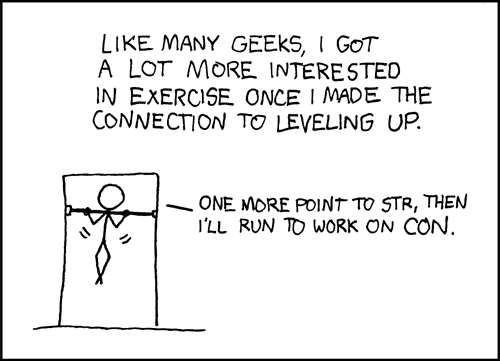
First of all, I’m totally in the target audience for this sort of thing. I remember seeing this comic in 2006, back when I was still working a regular job, and finding it spoke deeply to me.

xkcd comic Exercise by Randall Munroe

I bought both Zombies, Run! and Superhero Workout by Six to Start, two games that gamify exercise. I found myself strongly motivated to get out and run, even in winter cold, by the story in Zombies, Run!

More recently, I’ve observed myself strangely motivated by Google Fit. Even though my goal is self-set, and the reward for achieving it is merely a splash of orange lines and a “bling” sound, I have been known to nip out in the late evening to walk another six minutes just to get my walking time for the day up to my 90-minute goal.

I would pay serious money for a more clever version of Google Fit—one that could count not only time and distance walking, running, and bicycling, but also keep track of my crawling, hanging, climbing, jumping, balancing, throwing & catching, lifting & carrying, swimming & diving, and grappling & striking.

On the other hand, I recognize that this is fundamentally an error—the same error I talked about just a few days ago, when I explained that, although it’s in my nature to want to figure out what I need and make a plan to get it, I recognize that it’s a mistake. It’s a mistake because the “figuring it out” step is both impossible (intractably complex) and unnecessary (get ample natural movement and you’ll be fine).

And yet . . . . And yet, it is a fact that my life does not have enough natural movement in it. Given that I’m not going to become a hunter-gatherer (and would probably starve to death in a few months, if I didn’t die sooner from exposure or an accident), perhaps “living gamefully” is useful as a way to motivate myself and to keep track of the exercise I need to replace the movement I’m not getting.

I read a lot about fitness.

Non-fiction about fitness can be motivating. I find it especially useful to read when I shouldn’t workout due to injury. It lets me maintain momentum through a period when I’d otherwise be idle. I also find fiction about getting in shape to be motivating. (Either one is generally a lot more motivating than most of what passes for fitness motivation. I’d meant to link that to the motivation stream in the “Fitness” community I follow in Google Plus, but decided against it. Too much of the so-called motivation is either demotivating or outright offensive.)

There’s an issue with this source of motivation: both fiction and non-fiction come with a worldview—a model of what fitness is, what it’s for, what behaviors lead to it.

This is noticeable in non-fiction, particularly when the model is weird as to its goals or methods. But it’s especially noticeable in fiction, because then it gets bound up with the goals of the fictional characters. For example, the hero in Greg Rucka’s Critical Space (I’ve mentioned the fitness montage in the middle of that book before, as a good example of the sort of thing I find motivating) is getting in shape to be ready to defend against an assassin.

As long as I’m choosing reasonable behaviors that lead to fitness in a model of my choice, I figure the fact that there’s an action hero doing some of the same stuff is harmless.

Sometimes the fictional character’s worldview resonates with me. For example, one thing Rucka’s hero describes is that learning how to carry himself—learning how to be balanced, centered—teaches him how to see that in other people. My taiji practice has begun to produce the same result in me. I notice when people do or don’t have a good vertical structure, something that I never would have thought to notice before.

Other times the fictional character’s worldview holds nuggets that are genuinely worth picking up. It’s common, for example, for a hero to get better at paying attention to what’s going on—to be more vigilant and watchful. Clearly a useful perspective if you’re living in a thriller or an action-adventure, but probably even if you’re not. Paying attention to what’s going on around you is just good advice. Even if you’re not being targeted by an assassin, being inattentive makes you more vulnerable to everything from muggings to being hit by a car.

Which brings me to the title of this post. As someone who does not live in a thriller or action-adventure, I have the luxury of not paying attention.

As one specific example, when I play Ingress, I pay very close attention indeed—but the focus of my attention is on the fictional augmented reality of the game. Despite its grounding in the actual built environment of public sculpture, the game really distracts me from paying attention to the people who are nearby. I do make a point of being very careful about cars—I don’t cross roads or driveways with my head down at my phone—but I’m much less attentive to people nearby.

While I’m playing Ingress, an assassin would have no trouble getting to within arm’s reach completely unnoticed.

The other augmented reality game I play, Zombies Run!, isn’t as bad, because it doesn’t occupy my eyes. Even so, its fictional world colors my perspective of the real world.

I’m not alone in this. Mur Lafferty describes the immersive power of the game this way:

I was running to avoid a zombie chase . . . and I passed another runner going the opposite way. I nearly yelled that she was running right toward the zombies and she should turn and race away like me. But since I don’t want to be labeled the neighborhood crazy lady, I didn’t do this. I also feel a need, when I pass someone walking, to tell them that they should pick up the pace because of what is behind me . . .

An immersive game is fun. It is a great luxury to feel safe wandering about in public with my attention on a fictional world rather than the real one. I probably indulge myself a bit too much.

In this case, it would probably be wiser to take the advice of my action heroes, and pay attention.