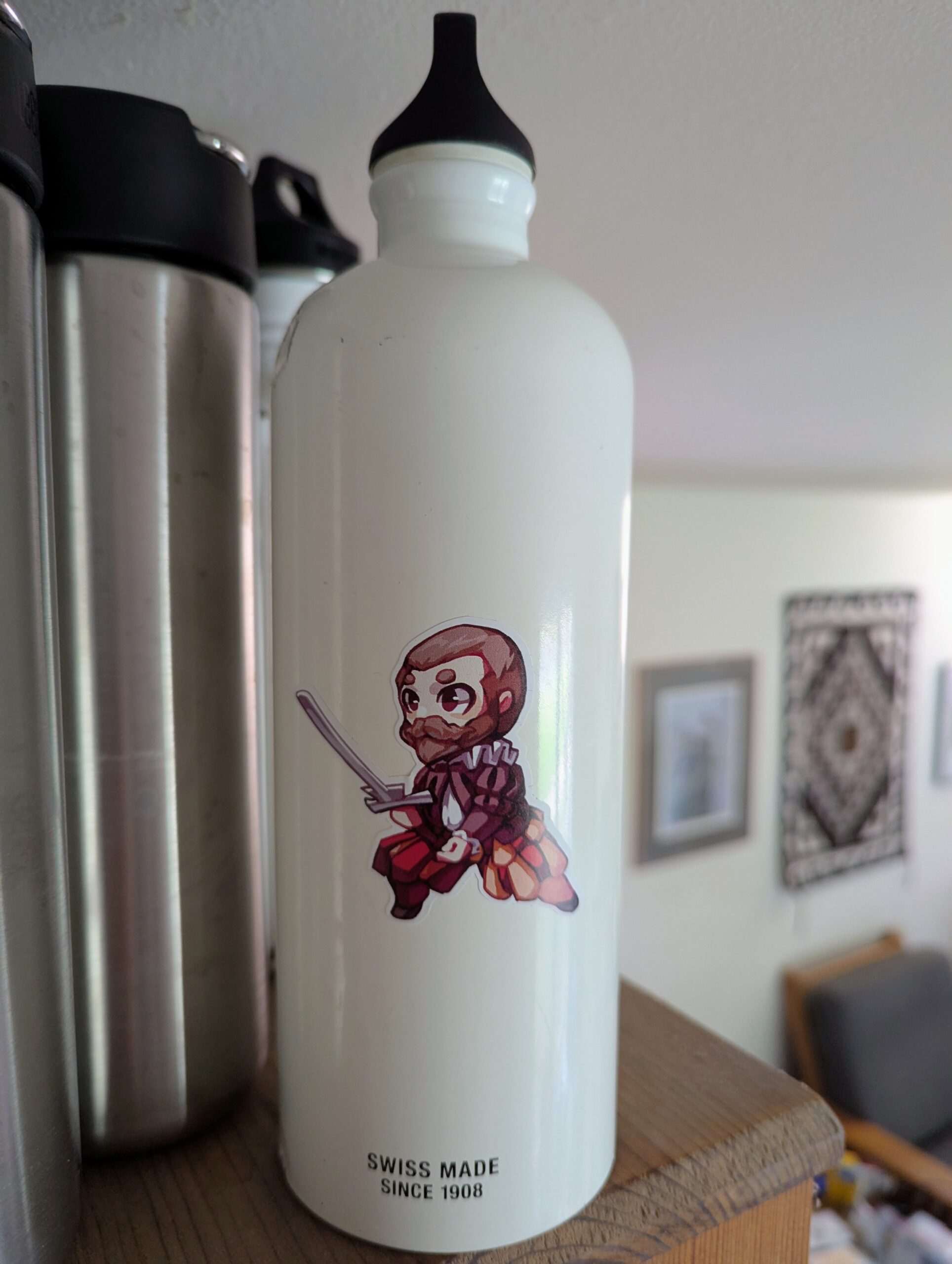
We study primarily Meyer in our group, so I put the Joachim Meyer sticker on the water bottle that I bring to practice:
But because I’m not particularly good at all the fancy stuff that Meyer teaches, I have a sneaking admiration for Johannes Liechtenauer, whose sword fighting instruction is accessible to any random peasant who happens to pick up a sword, so I put his sticker on my laptop:
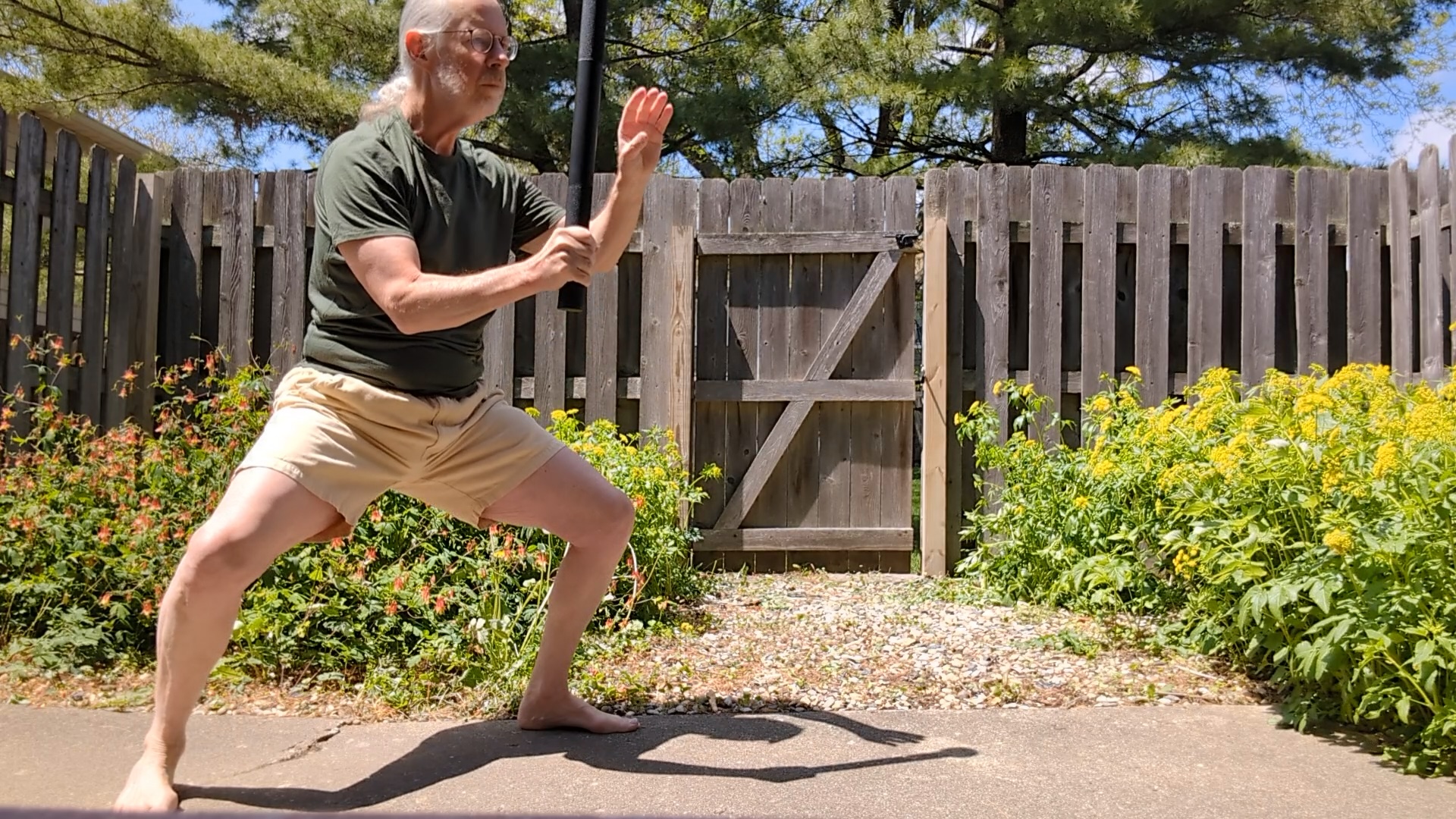
I wanted a workout to practice my Meyer fencing stance—a workout more interesting than just standing in the stance for a minute or two.
Mark Wildman, in one of his a live Q&A videos, suggested the mace drop swing as a useful exercise for someone doing longsword. (It was in response to a question I asked about improving arm strength and endurance for holding your arms forward and overhead at full extension for extended periods, as one does in longsword.) He had suggested doing it in Warrior 2, but specifically mentioned that you could do it in whatever stance went with your longsword style; it just got harder as your stance got wider.
Besides being boring, just standing in a Meyer stance for a minute or two seemed like a missed opportunity; even a modest challenge to your stability in the stance seemed like it might pay off in strength, flexibility, and control of your stance.
So here’s the workout I came up with:
Get in your best Meyer stance, with your mace in your front hand. Execute 5 drop swings, checking your stance after each rep. Shift the mace to your rear hand and repeat. Take one passing step forward. (Your mace will now be in your front hand.) Repeat five swings with the front hand and five swings with the back hand.
That’s one set.
Here it is as a video:
My plan is to gradually add sets until I can comfortably stay in the Meyer stance for 5 or 10 minutes, to build the habit and capability of keeping a good stance while it is challenged by a shifting weight.
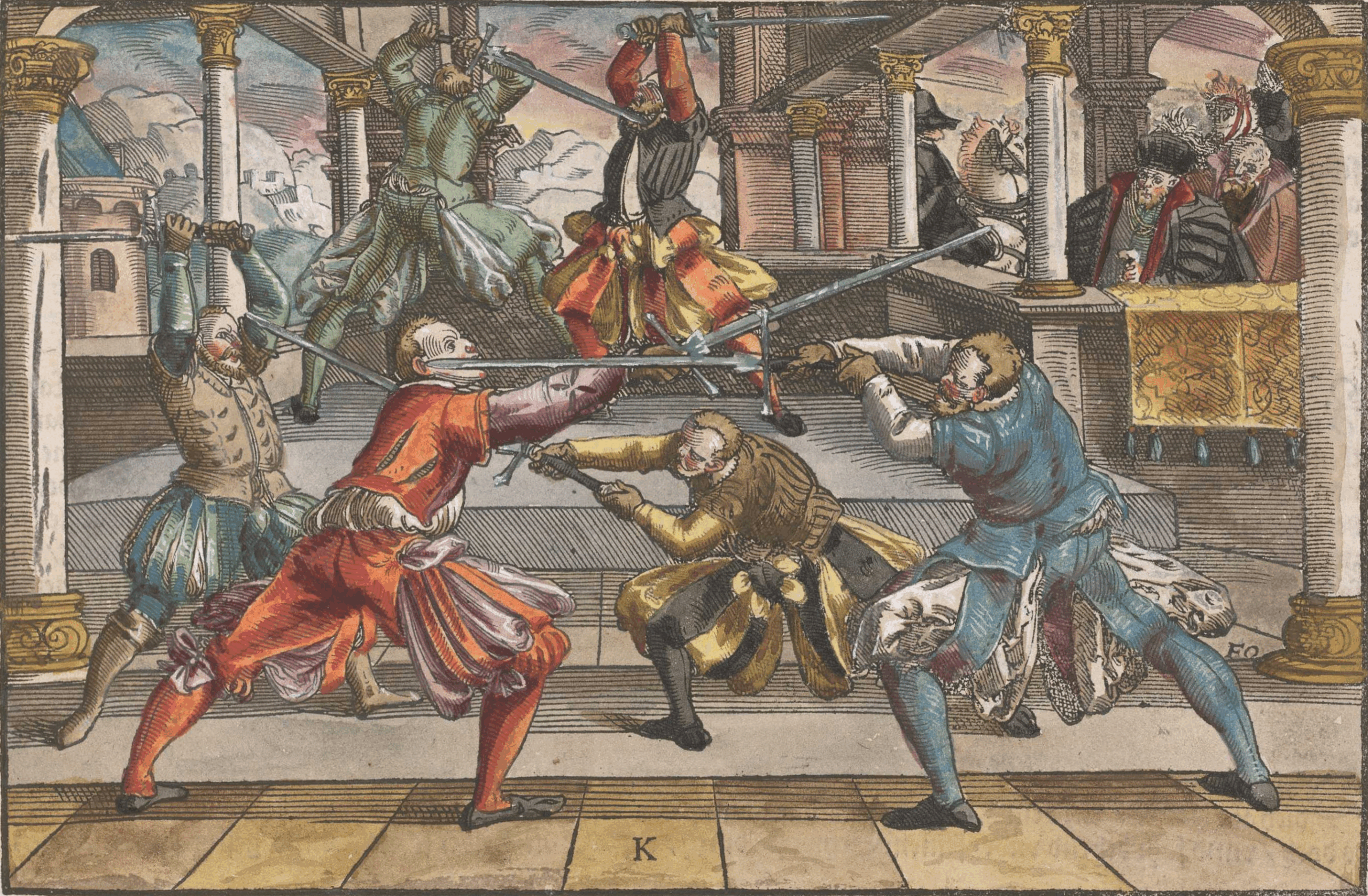
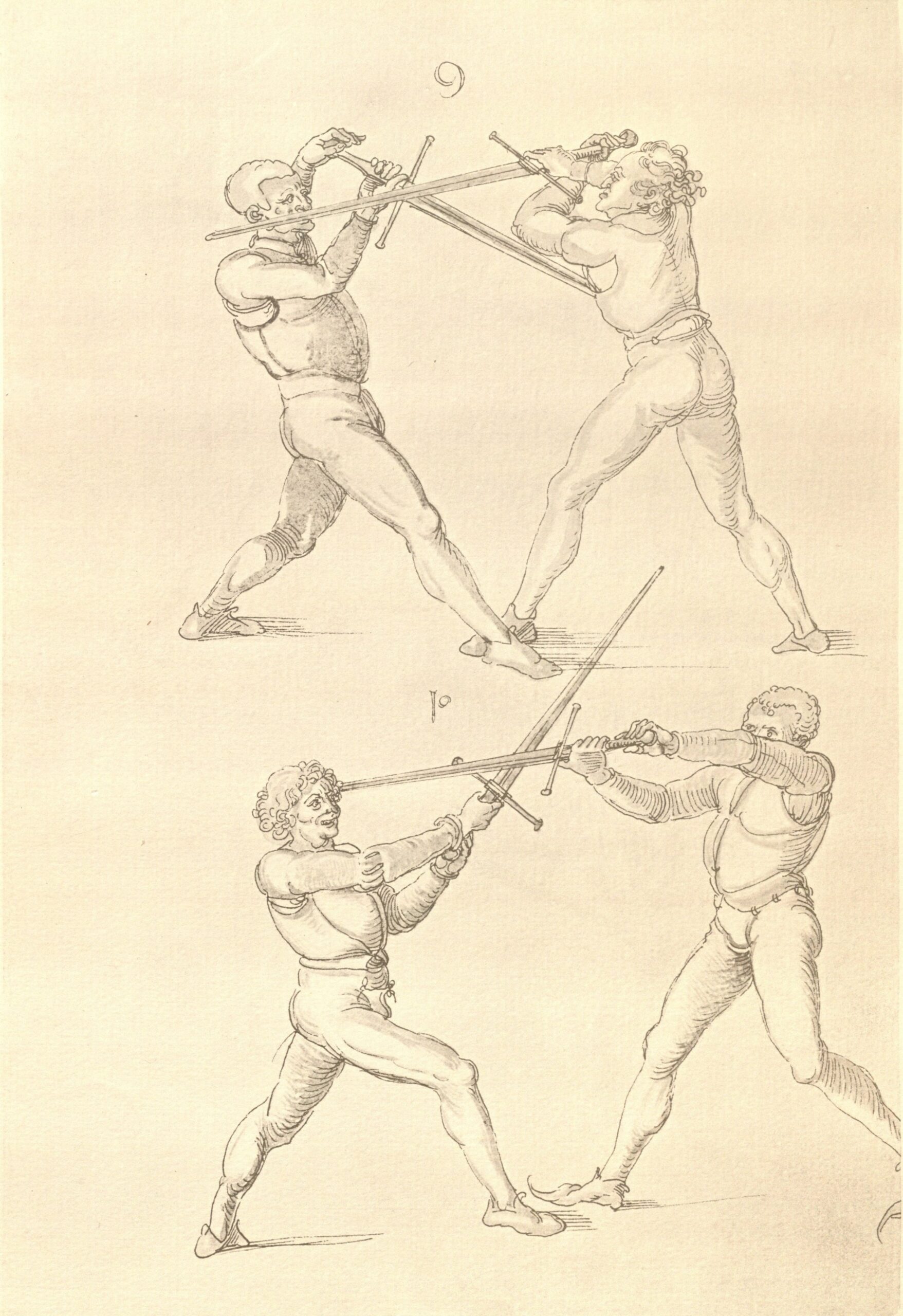
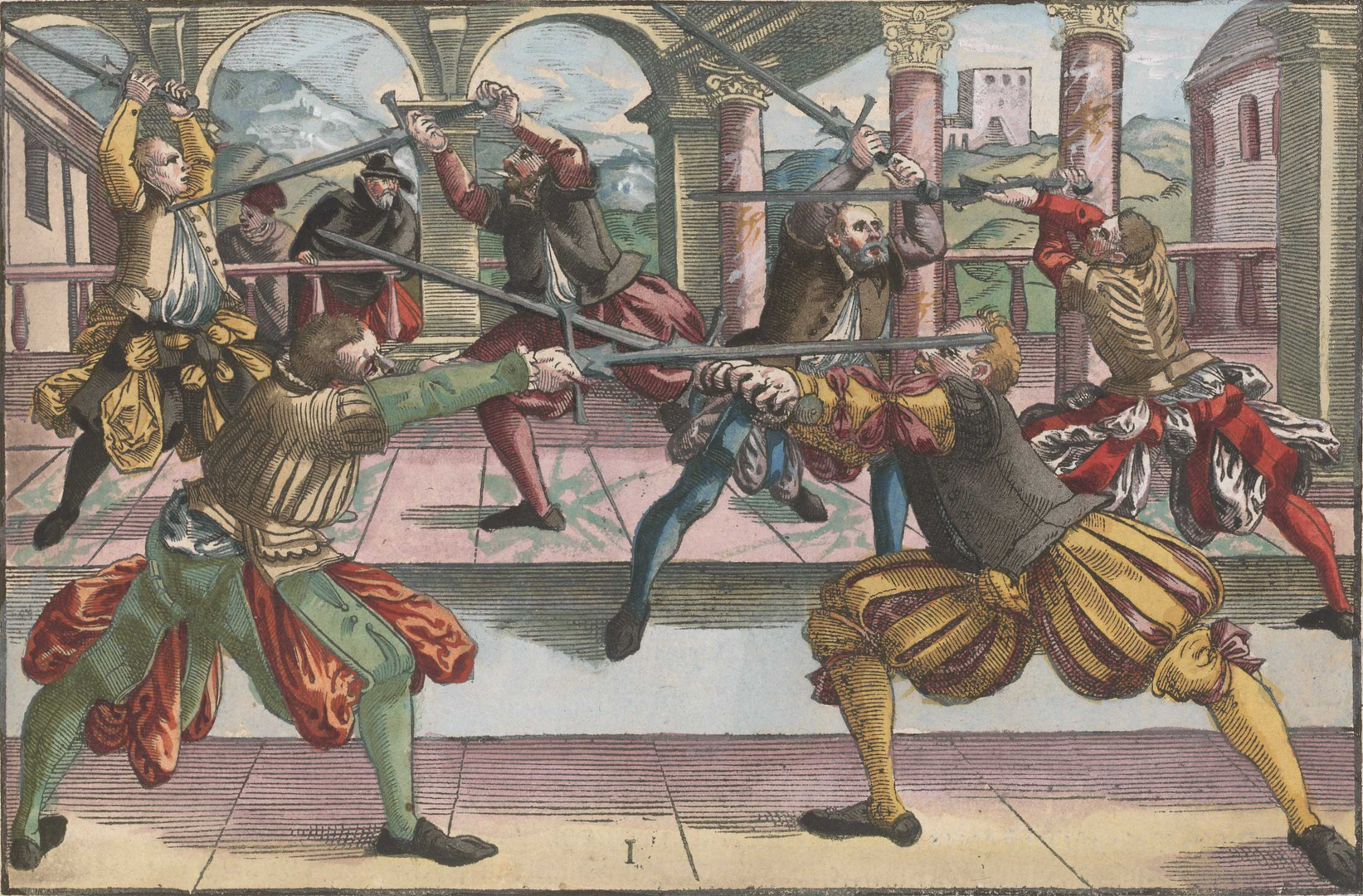
I think my stance is okay here. Of course, there isn’t just one Meyer stance. This image from Meyer’s treatise show the range pretty well:
The front two figures are both in what I think of as a basic Meyer stance. The two figures behind them are also in Meyer stances, the one on the right in something of a lunge, the one on the left in a more upright stance.
My drop swings clearly need a lot of work (do not copy mine!), but that basically comes along for free as I do the stance workouts. (I wrote a post called Fitness training for longsword, Mark Wildman style that embeds two Mark Wildman videos of the Warrior 2 stance mace drop swing, if you want to see someone doing it better.)
I’m doing the swings with my 5 lb mace. I have a 10 lb mace that I’ll want to move up to, once I have the drop swings a bit more under control.
Some months ago my elbow started hurting. (The little bump on the inside of my elbow joint was where it hurt.) I don’t think it was a sword-fighting injury; I think it was a dog-walking injury—but the sword fighting seemed to aggravate it.
So I did less sword fighting. I switched from three times a week to just twice, and then just once, and then I quit going altogether. Then last week I traveled to Amherst to visit my brother and my mom, and just about didn’t exercise at all while I was on that trip. My elbow got steadily better, so that for about a week now, it hasn’t hurt at all.
So yesterday I went back for a sword-fighting class!
The class was kind of abbreviated. At the beginning of class we did a bearpit for a member’s birthday, so I got to do three passes at longsword. Then we did an actual class on rapier fencing. Then we were going to switch to longsword, but there was a tornado warning, and we all stopped to stare at our phones, looking at weather radar and texts with friends and relations in the area, making sure we were all okay.
Turns out that’s just a well. My elbow seemed to hold up fine during class, but today it’s a bit twingey again, so I’m glad I didn’t aggravate it more.
This pretty clearly means I’m not ready to go back to three-times-a-week training, but maybe it doesn’t rule out once-a-week training.
I’ll see how my elbow feels over the next few days.
I’ve scarcely fenced with the students since the groups split a year ago. It was made clear that I was welcome to come train with the student group, but most of the training sessions were the same time as my group was meeting, and anyway my shoulder and elbow issues meant I had to reduce the amount of training I was doing, so I ended up training with my own group.
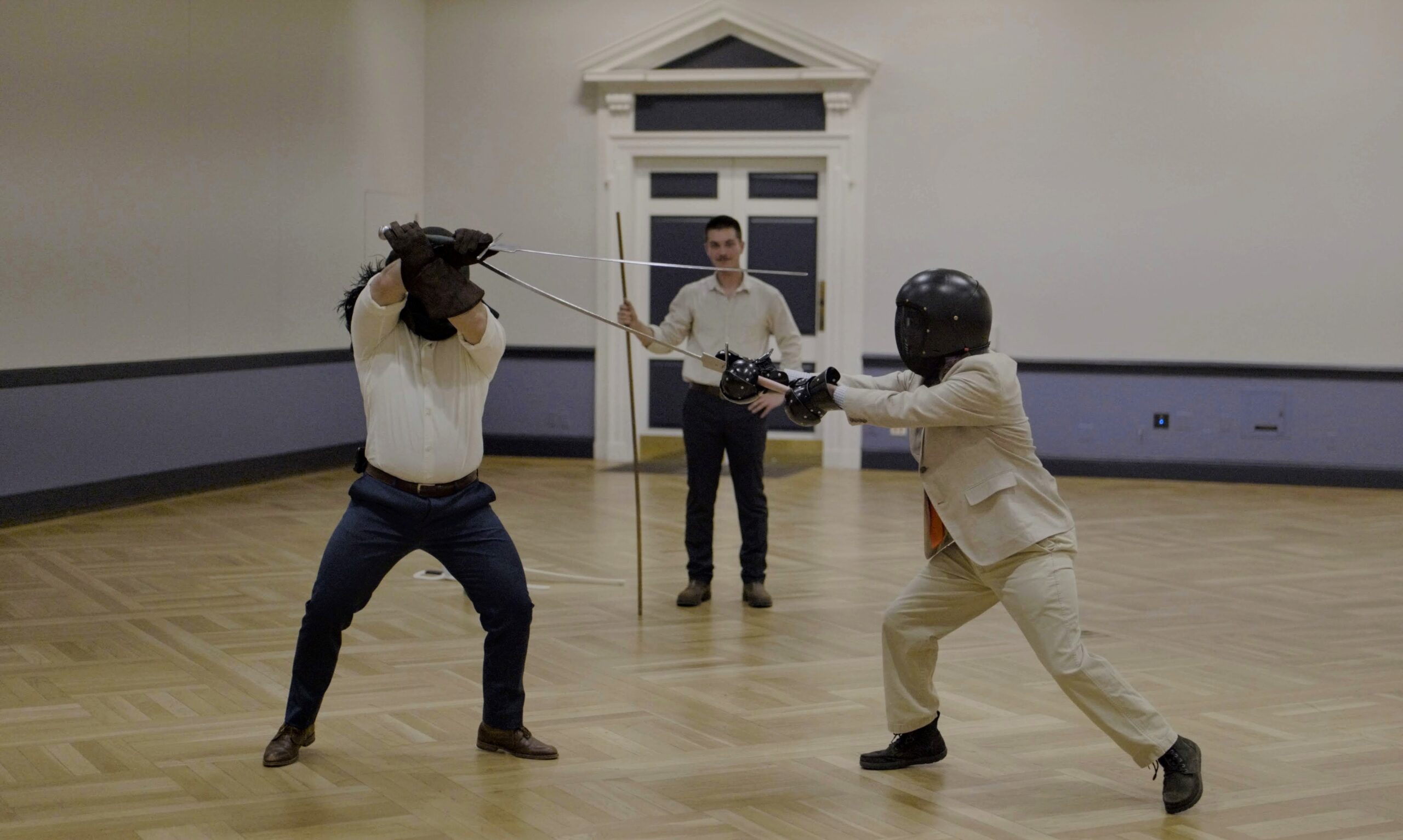
That changed this week when the student group had a “fancy-dress fechtschule,” and invited the TMHF members to join in.
A fechtschule (which just means “fight school”) is a particular kind of contest where the point is not so much to “win” (although you want to do that too), as it is to display artful fencing. To encourage that the rules call for only head hits to count, and prohibit things like thrusting (too likely kill your opponent), grappling, pommel strikes, etc.
Because only head hits count, it seemed reasonably safe to wear just masks and not full protective gear, enabling a fancy-dress version, which seemed to me like great fun. Many of the women showed up in dresses or gowns of one sort or another (some in heels!). Many of the men wore suits. I wore a coat and tie.
The call for attending was simply to wear “the most formal thing you own that you are willing to fight in.”
After a youth during which I couldn’t imagine “dressing up” any more than absolutely necessary, somewhere along the line I figured out a few things, one of which was that men’s dress clothing is actually more comfortable than casual clothing, because it is altered to fit well, rather than just being “the right size.” These days besides wearing dress clothing whenever it will give me an advantage, I also wear it anytime it seems like fun. (While traveling—on a plane or a train, and while in a station or an airport—you get much better service if you’re wearing a coat and tie than if you’re wearing shorts or sweats.)
It has taken most of three years, but I’m finally doing a pretty good job of keeping my arms extended while doing longsword. (Partly I just needed to develop the habit, but I also needed to build strength and endurance in that arms-extended posture.)
It was glorious fun. I even did okay in the contest. (I think Milosh went easy on me.)
During today’s longsword and rapier class with my HEMA group, Tempered Mettle Historical Fencing, we noticed that a banner had gotten crooked, and took a break to adjust it.
If my posts about HEMA (aka sword fighting) have caught your interest, here’s a free sample class you can take to see if our group (TMHF) is right for you: https://www.facebook.com/events/1240755200476163/
Last night, in celebration of my birthday the day before, my local HEMA club (Tempered Mettle Historical Fencing) honored me with what’s called a “bearpit”: I faced all comers with rapier or longsword for three passes each.
In my previous post, I talked about RDL (Romanian dead lift) the exercise. In HEMA practice RDL refers to something else: the writers of three famous glosses of Lichtenauer’s Zettel (a long didactic poem on sword fighting) by Sigmund ain Ringeck, Pseudo-Peter von Danzig, and Jud Lew.
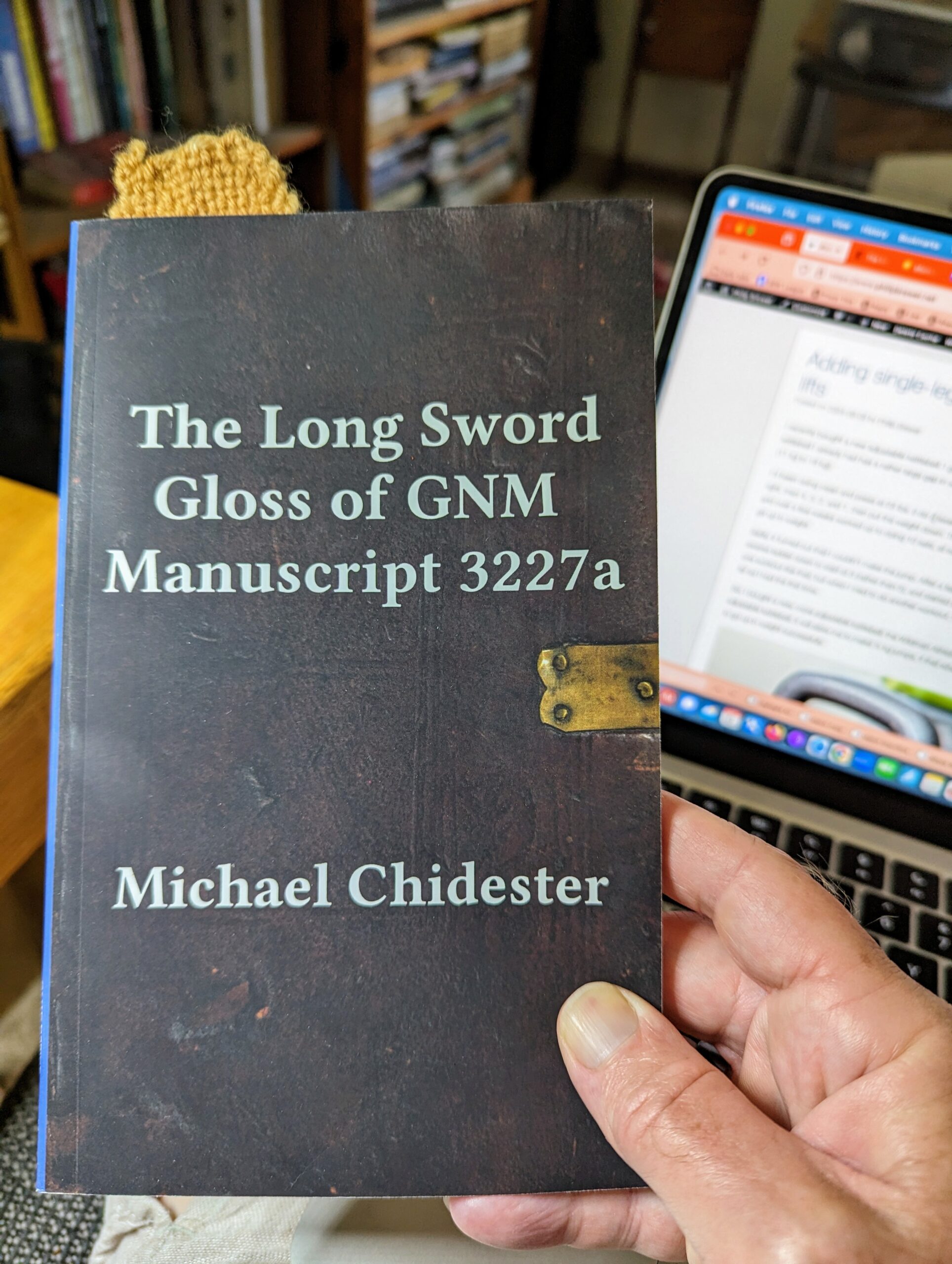
So far, I’m reading a different gloss of the poem (although I’ll probably get to those as well):
A couple of aspects of longsword turn out to be hard not from a skill perspective, but from a simple strength and endurance perspective. Look at the guys in this picture. Their arms are fully extended, either forward or upward. That’s just hard to do for minutes at a time. Besides that, they’re in a pretty low lunge position. That’s also hard to do for minutes at a time.
A couple of days ago, I had a chance to ask celebrity trainer Mark Wildman how he’d program for building arm strength and endurance. It turns out he’s a huge longsword geek. Here’s the video, cued up to where he reads my question (should be 41:57). The related stuff goes through 48:50).
My original question was: “I’m doing longsword. One issue is arm strength and endurance. I’m doing kettlebell clean&press and pushups (for holding the sword overhead and extended forward). Any other ideas?”
Here are my notes on Mark’s reply:
Mace & Club
Single-arm heavy club program (a program that isn’t for sale yet, but that is pretty easy to deduce from the videos on Mark Wildman’s youtube channel).
Basis of Strength (2-Handed club program that does exist, although it’s pretty expensive).
Mace 360s. (The mace equivalent of a club shield cast: You bring your hand past your opposite ear, swing the mace behind you, and catch it back in front.)
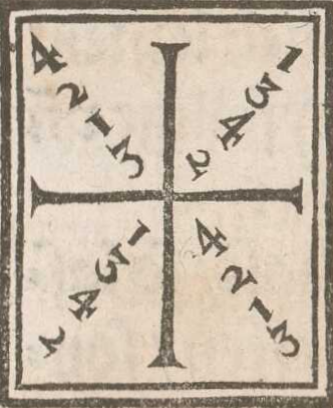
Cut the Meyer square for time. (I don’t think he said WHAT time would be appropriate. Maybe do a 10-minute emom, where you do the full square, rest until the end of the minute, and then repeat. Or maybe 30 seconds on/30 seconds off.)
He emphasized training both dominant hand and non-dominant hand.
This, by the way, goes against the advice of Liechtenauer, who says:
Fence not from left when you are right.
If with your left is how you fight,
You'll fence much weaker from the right.
I suspect that the difference has to do with your goals. Liechtenauer was speaking to someone who had to win sword fights. Wildman is speaking to someone trying to get fit for a hobby.
Push ups as part of a warm-up. (Since I had mentioned pushups.)
Instead of pushups, do burpies in full HEMA gear. (Oy.)
Don’t do actual sword movements with mace or club. Do those with an actual longsword.
Mace drop swing in Meyer stance (4 versions: contra- and ipso- lateral with each foot forward): Here’s two videos of that:
I’ve ordered a mace so I can try that (and other mace stuff). I haven’t yet pulled the trigger on the (expensive) Basis of Strength program, although I’m tempted. While I ponder that, I’ll start doing mace drop swings while in a lunge, and see if I can get both my extended arm strength and endurance up, while also improving my Meyer fencing stance.