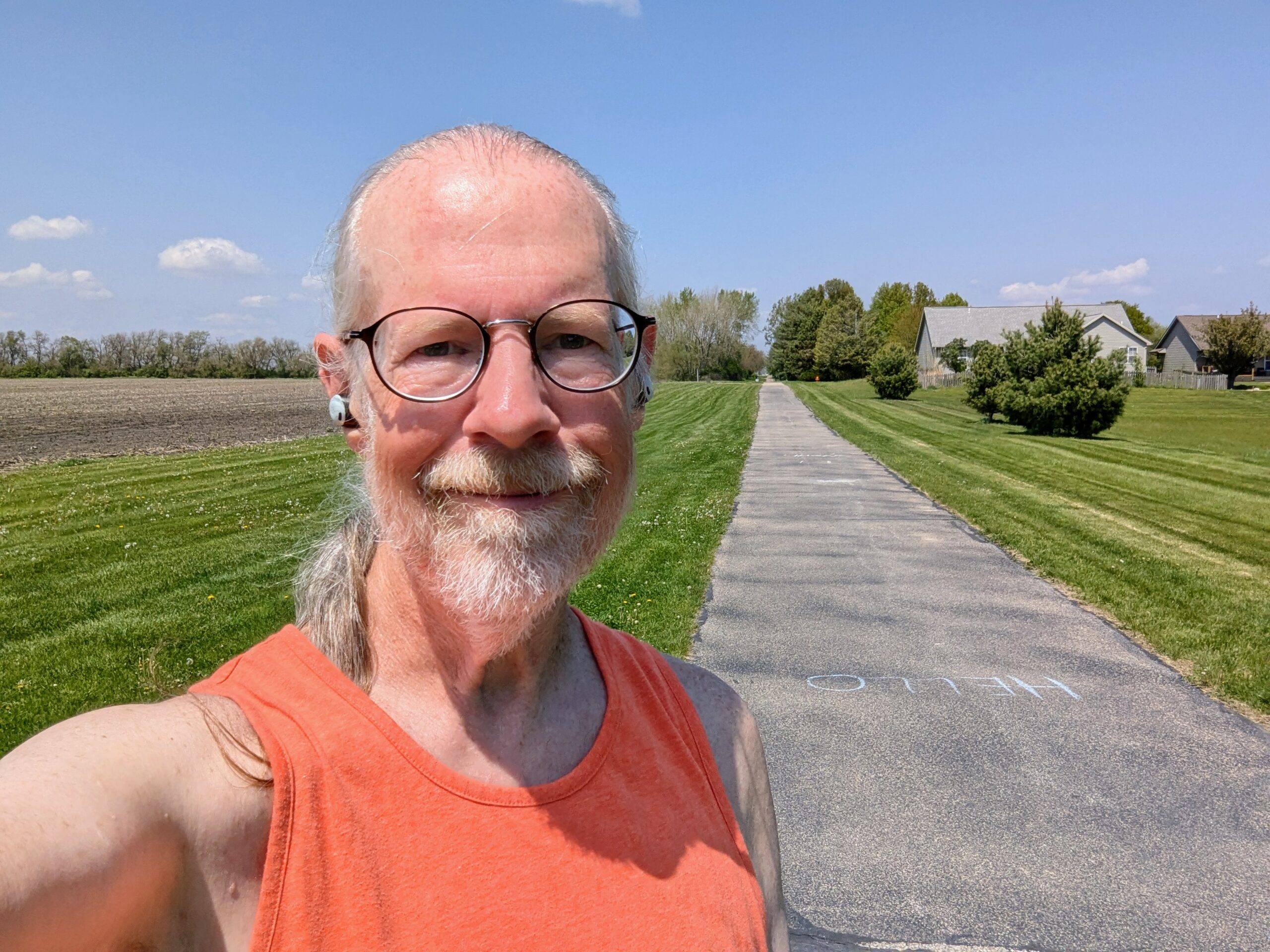
I’m trying to ramp up to two runs a week—a “long” run (currently anything over 4 miles), and a “fast” run (sometimes hill sprints, sometimes an interval session, sometimes—as today—just a shorter run where I press the pace).

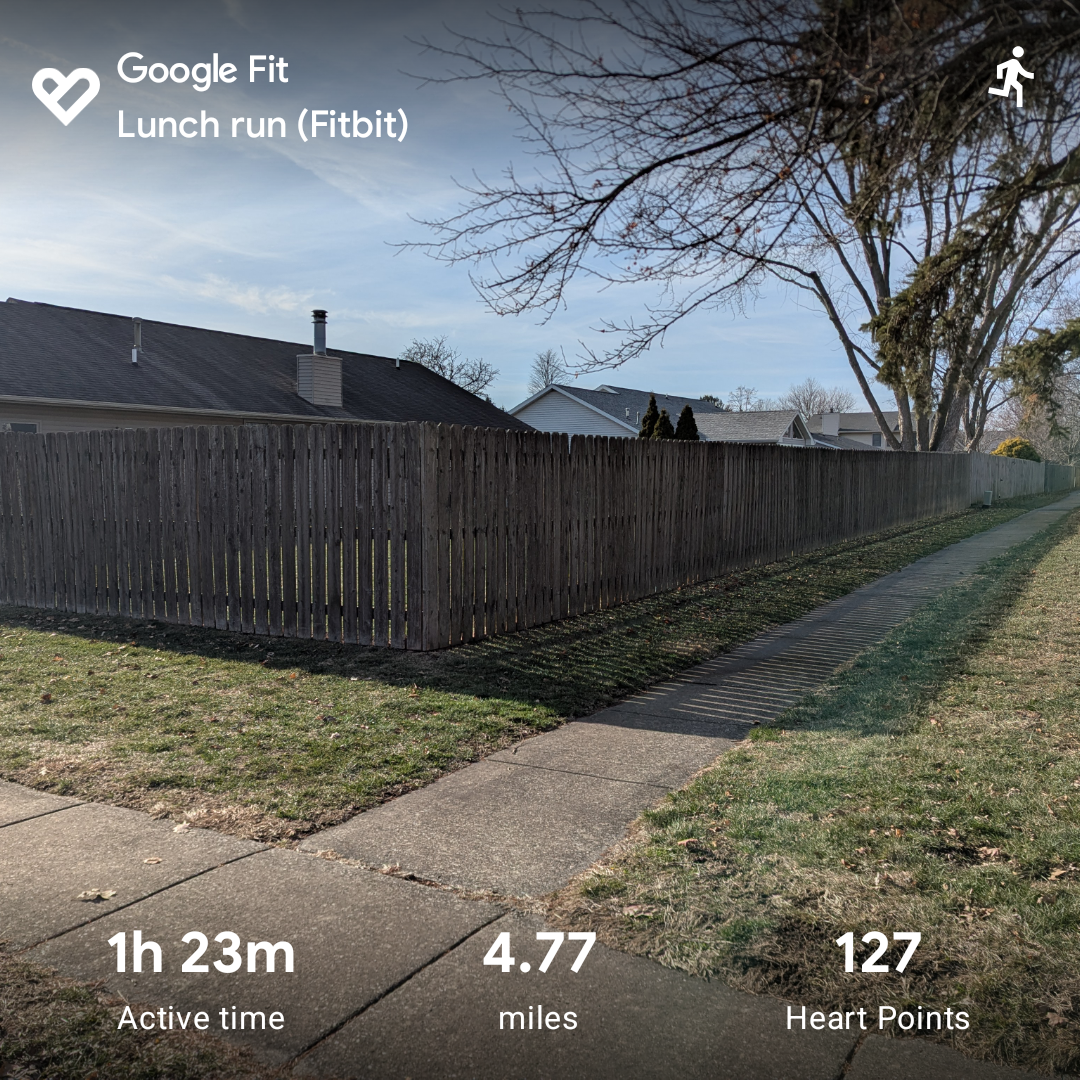
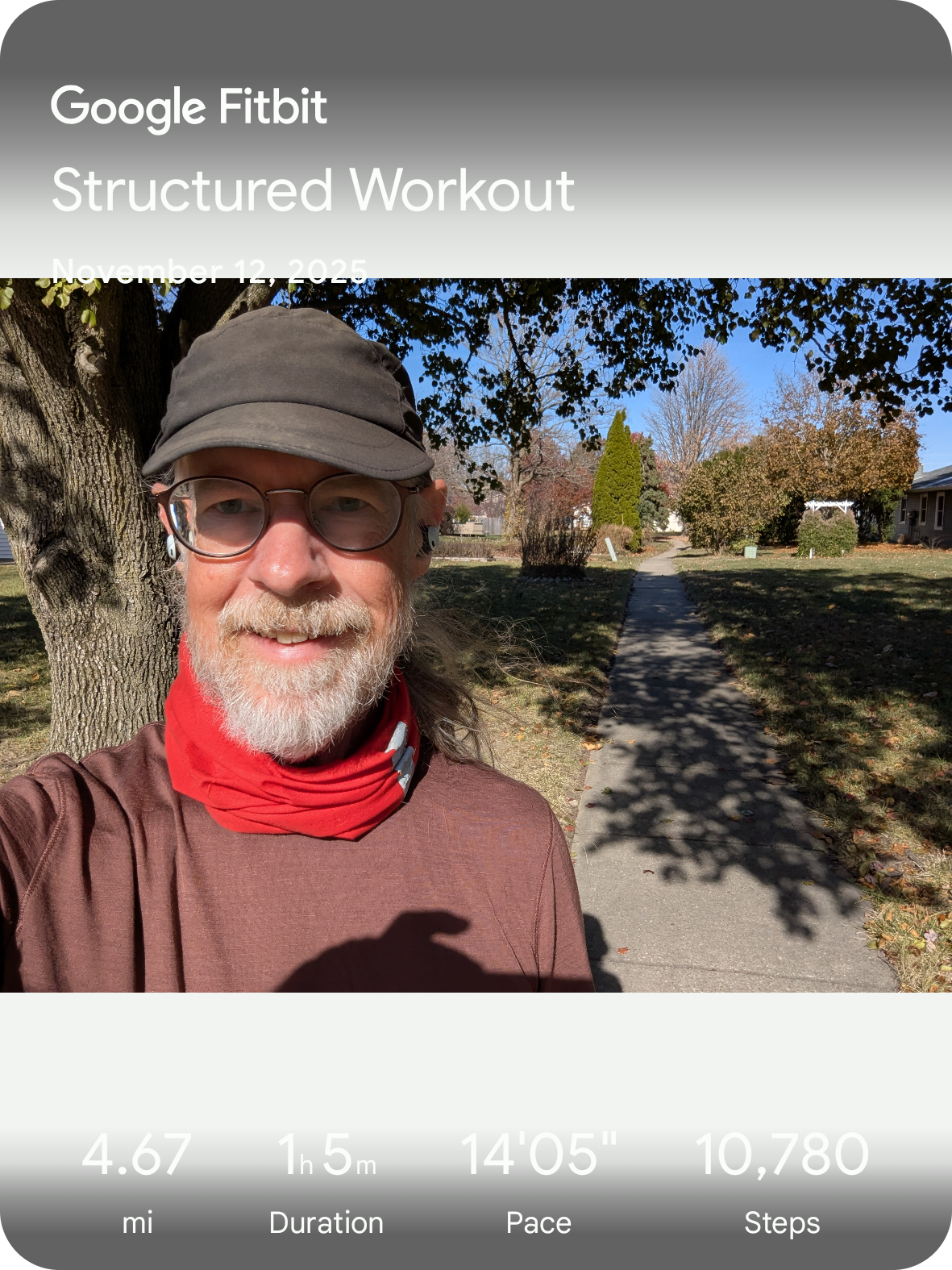
I got in a nice run: 4.67 miles in 1h 5min 51s, for an average pace of 14:05. My Fitbit would have me believe that I spent 59 of those minutes with my heart rate in zone 5, which I’m sure is double-false. That is, I don’t think my HR reached the 200 bpm that the Fitbit recorded, nor do I think my maximum HR is nearly as low as 154, which is what the Fitbit estimates.
Still it was a great run. My fastest and longest in a long time, and I felt great the whole time.

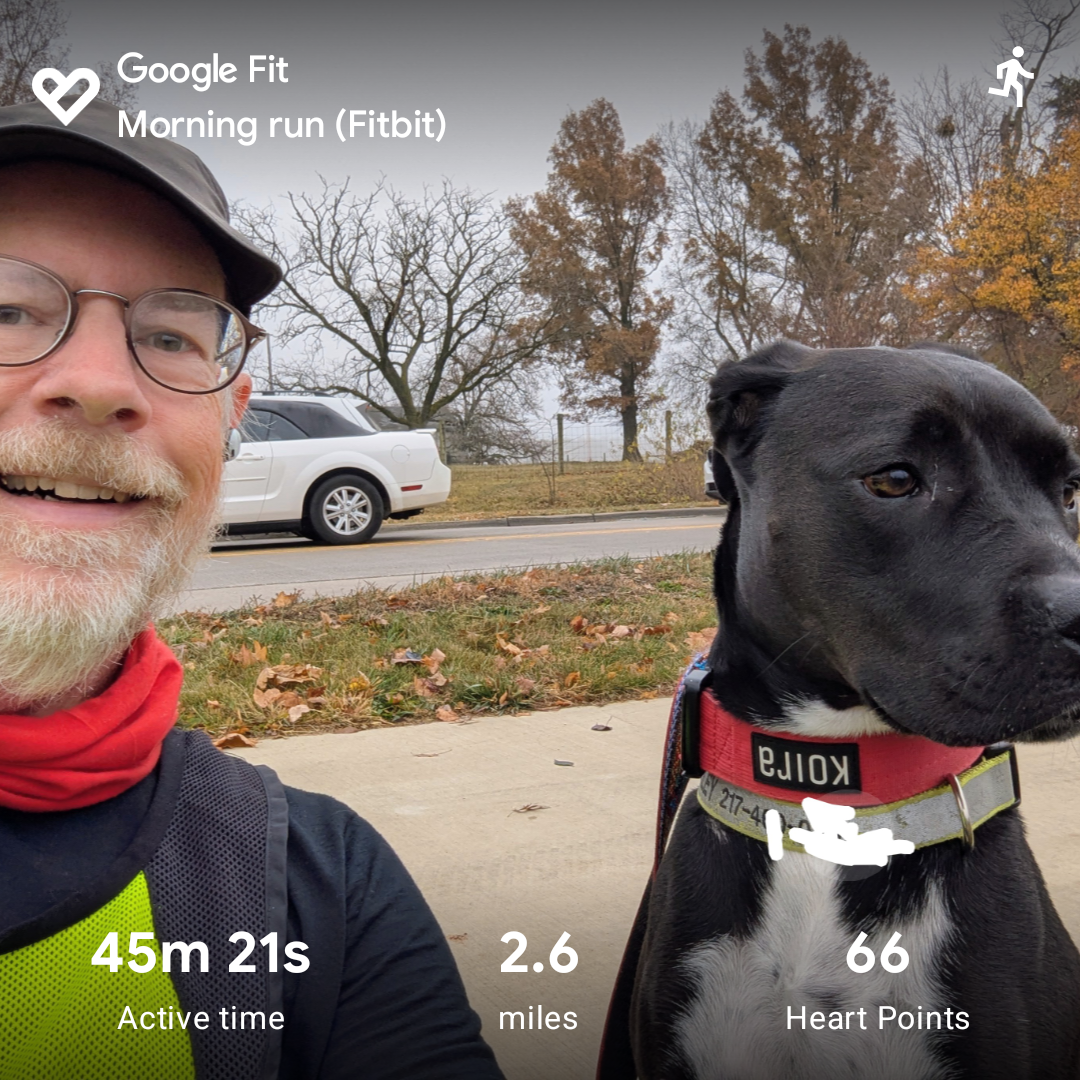
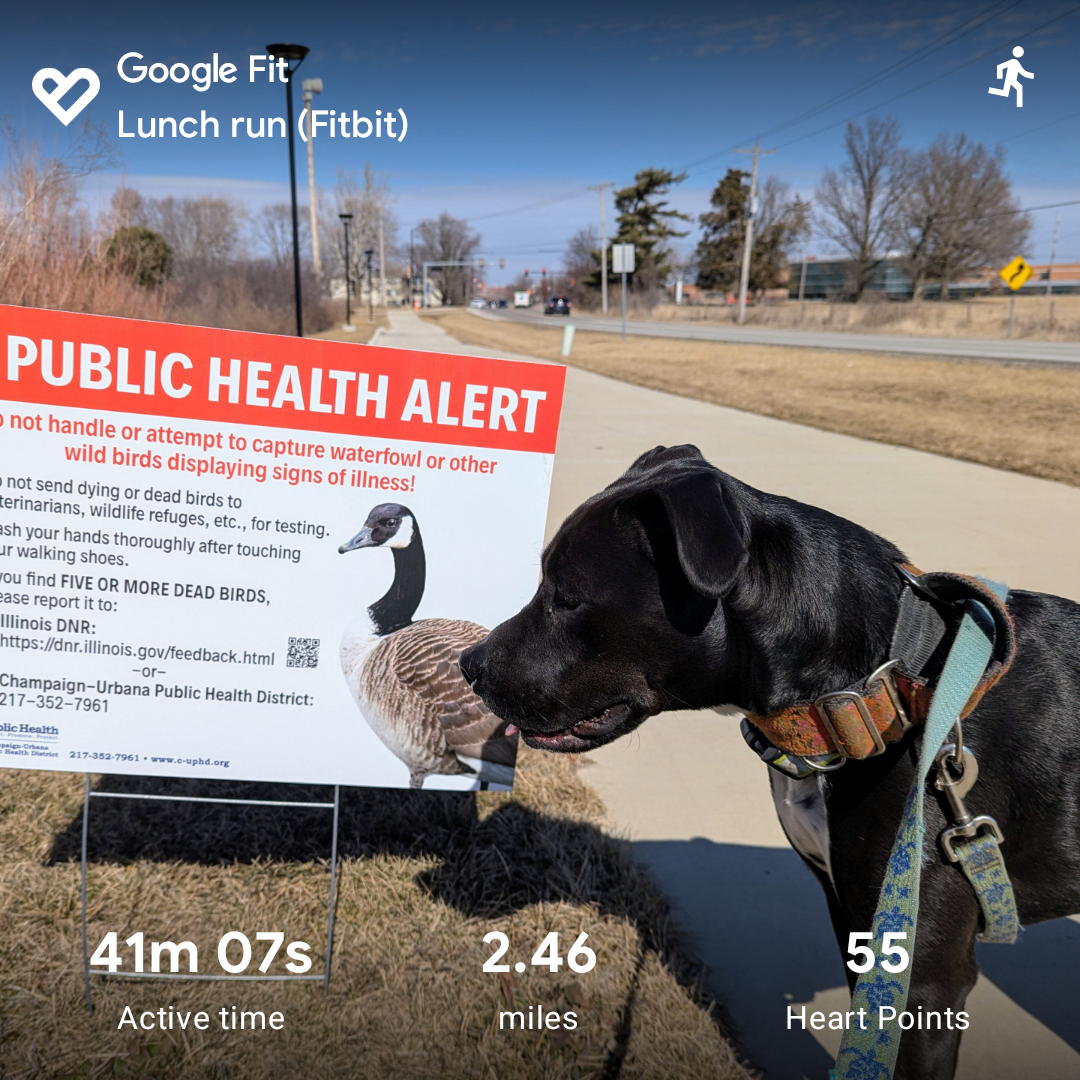
Ashley seems to enjoy going for a run, and she’s a pretty good running companion. She does want to stop and sniff rather more often than I do, and she wants to stop and pee occasionally, which does make it tough for me to hit my best pace for any particular mile. But that’s okay. Enjoying some dog-companionship is a lot better than hitting my best pace.
I had virtually quit running a couple of years ago. I’d gotten a trifle tentative after a fall, and then Jackie was out of town (and therefore not on-hand to rescue me if necessary), and then the weather got cold and the running routes icy. And by the time the weather improved, I’d just fallen out of the habit. For a few months now I’ve been working to reestablish the habit. I haven’t accomplished that yet, but I am getting in an occasional run.
The Fitbit software in my Pixel watch estimates my VO2Max. My estimated VO2Max has long been excellent for my age, but it had gradually dropped some, which was part of the reason I wanted to start running again. These past few runs have produced a modest increase, so as of today it’s in the 95th percentile for people my age. (I think Peter Attia suggests that the minimum acceptable VO2Max is the 95 percentile for someone a decade younger than you, which I’m still a bit below, although it seems perhaps doable.)
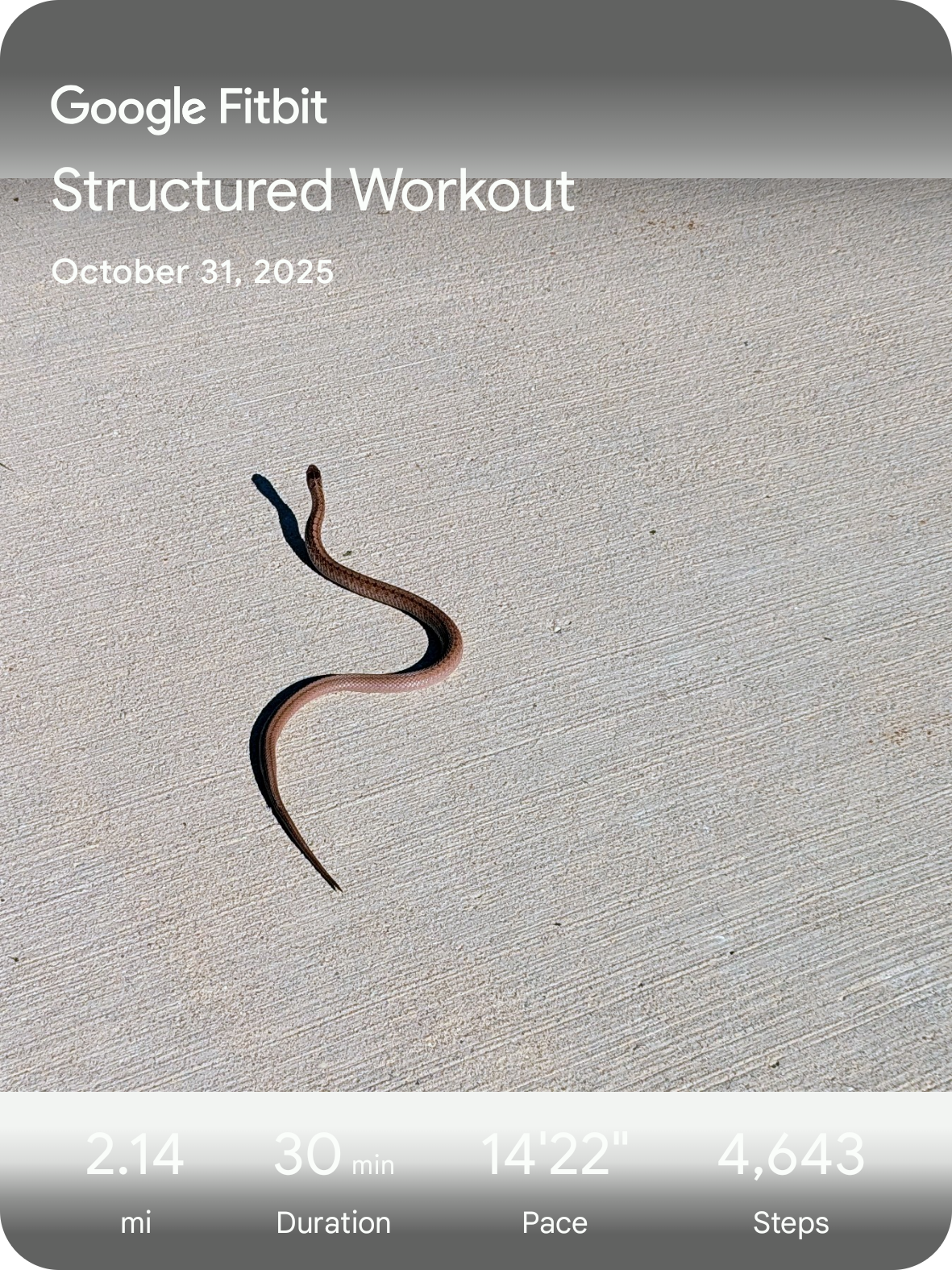
I’m afraid I failed to get a photo of Ashley or myself running (or better, the two of us running together), but I did get a picture of a cool little snake friend who was crossing the sidewalk where I was running.

I got in one writing session in the morning. Now that I’ve finished my run, I very much hope to get in some more writing (and most especially some more plotting) before the end of the day.
I haven’t been running enough, so I went for a run today. The metrics are kinda funny, by which I mean my Fitbit thought it was an insanely hard run. I thought it was interesting enough to post about.

Fitbit calculates heart rate zones based on your “heart rate reserve,” which is your maximum heart rate minus your resting heart rate.
Your resting heart rate (roughly what you’d get if you checked your heart rate right after you woke up, before you started moving around) the device actually measures. My resting heart rate, according to the Fitbit, was 56 bpm. (It actually hit 44 bpm at some point while I was asleep, but your lowest resting heart rate is a different number.)
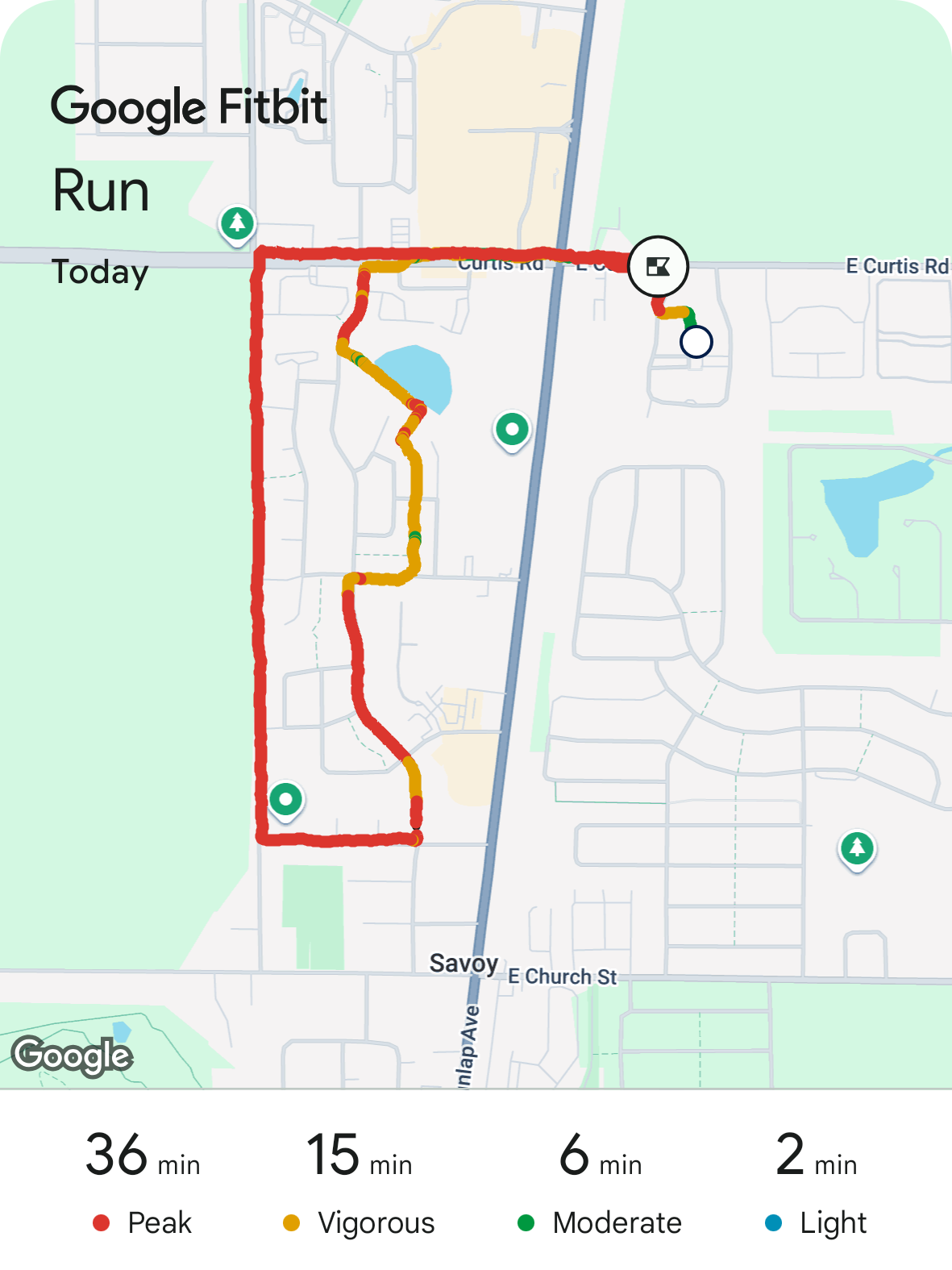
Your maximum heart rate, though, isn’t measured. Instead, it’s estimated as 220 minus your age. I’m 66, so that comes to 154. So my heart rate reserve is 154 minus 56 equals 98. Then my various zones are calculate as a fraction of the reserve plus the resting rate. Zone 5 (peak activity) begins at 85%, so my zone 5 begins at (0.85 ✖️ 98) + 56, which comes to 83 + 56 = 139. All the parts of my run shown in red in the map above were run at a heart rate at or above 139.
In fact though, my maximum heart rate is way higher than that estimate. I have in the past been somewhat dubious of the maximum readings shown by my Fitbit during a run, because all the wrist-worn devices sometimes sync up at your foot-strike rate, so you get anomalous readings around 180 (a common foot-strike rate). But I also check my heart rate doing other exercises, such as kettlebell swings, where foot-strike rate doesn’t matter. Plus, I get heart rate readings from my Oura ring, which is not wrist-worn, and which doesn’t seem to have the same syncing-with-foot-strike problem. So I know my max heart rate is much higher.
On this run, for example, the maximum heart rate as measured by my fitbit was 169. My Oura ring thinks the peak was 166 (but it averages over 5-minute periods, which smooths out the peaks quite a bit).
Anyway, if you take 166 as my actual maximum heart rate, then my heart rate reserve is 110, 85% of it comes to 94, so my zone 5 range ought to begin at a heart rate of 150, rather than 139.
I find that a lot more plausible. If the Fitbit is right, then I just spent 36 minutes in zone 5, which seems very unlikely. It was kind of a hard run, because I haven’t been running enough, but I not only could have talked while I was running, I actually did sing, which is one of the markers for being in zone 1. (I was listening to and singing along with some Kpop songs.)
So, I think much of that run, even some of the bits shown in red above, were in zone 2 or 3, not zone 5.
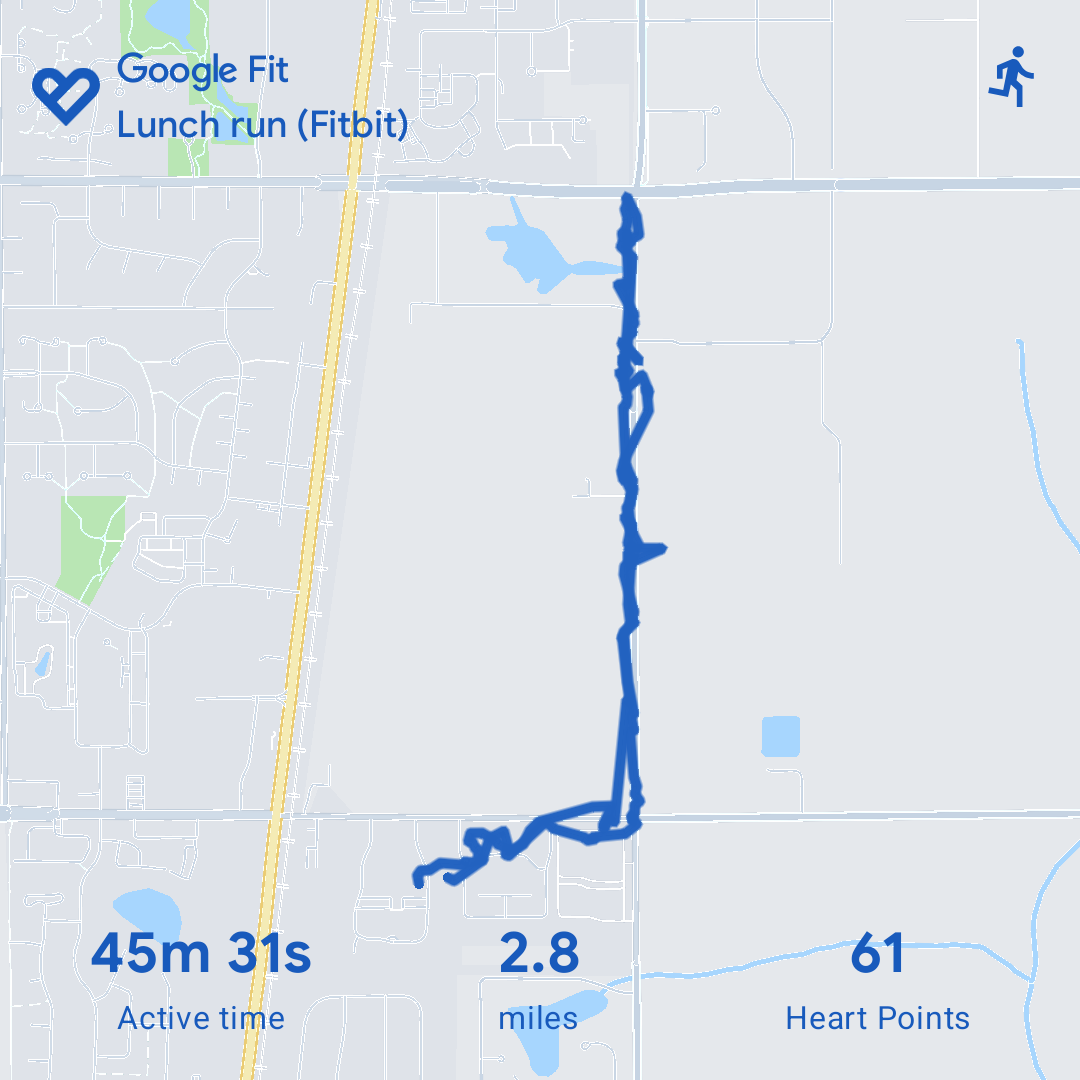
Whatever the heart rate metrics, it was a rather slow, rather short run: 3.15 miles in 58min 10s.
Much better than not running.
Updated next morning: I slept great after my run, and woke up feeling great. Legs not sore at all. Overnight heart rate right back down to my current baseline.
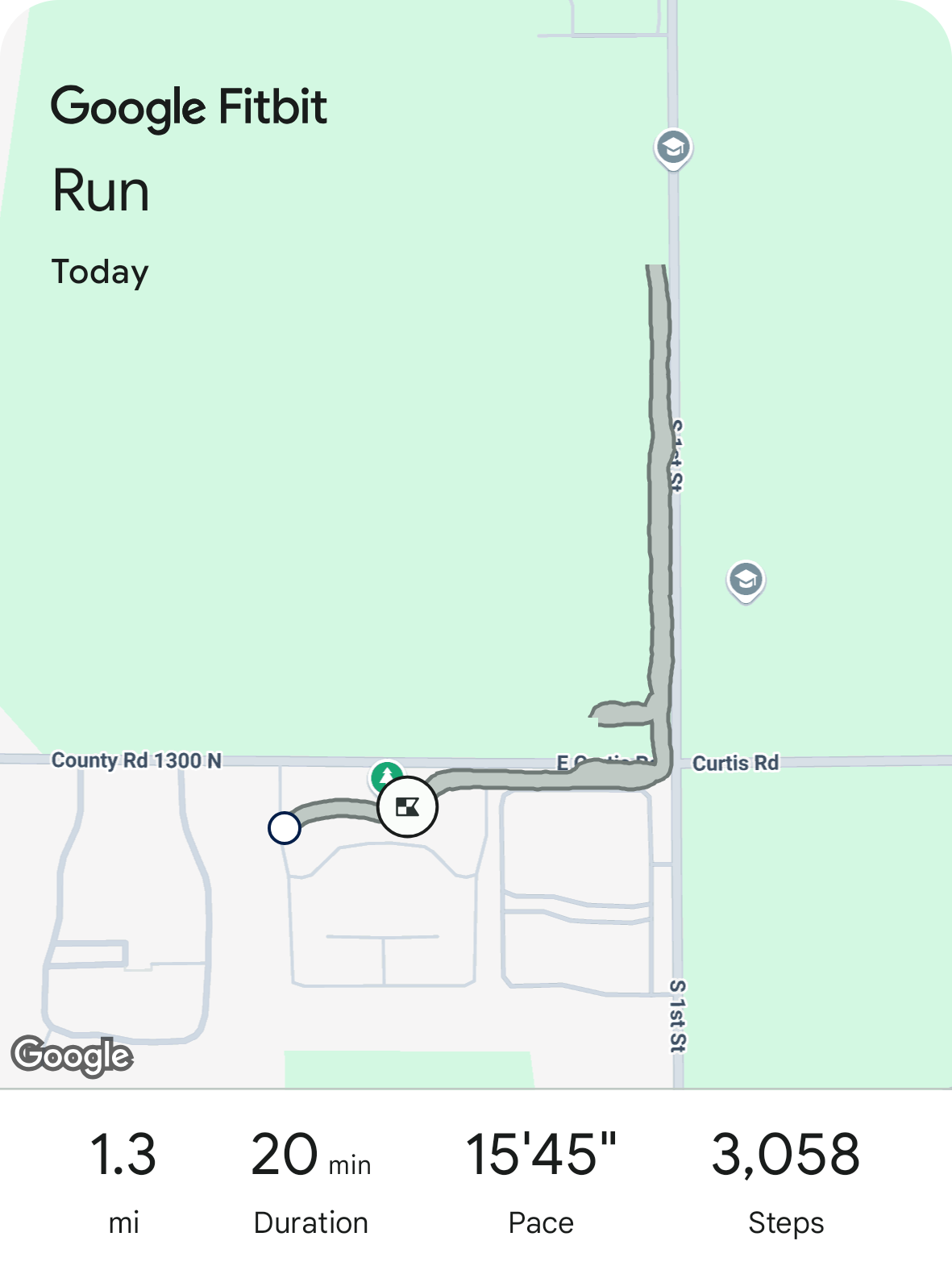
My run was already supposed to be pretty short—about 2.5 miles, across Dohme Park, up First Street to Windsor and then back—but it ended up being even shorter than that, because Ashley wasn’t up to running even that far in the heat of the day.

According to my weather app it was already 75℉ when I got home, and I’ve noticed previously that starting at about 72℉ the dog starts to suffer.
You can see on the map a short spur off to the west just after I started north on First Street. That was where we saw a groundhog, and Ashley really wanted to chase it. I indulged her for a minute, hoping the groundhog would quickly find a place to hide, but it wasn’t to be, and I eventually had to drag Ashley back to the First Street path very much against her will.
Anyway, 1.3 miles is a very short run indeed, but I still spent most of 20 minutes with my heart rate up (average was 141, peak was 169). So, a good workout.
For most of my adult life, trying to use “intuition” to decide on rest days would have been a terrible idea. If I’d let myself say, “Hmm. I don’t really feel like a workout today,” I’d scarcely have worked out at all. Instead, I came up with a schedule, and stuck to it, either well or poorly.
When I stuck to it well, I’d see progress. When I stuck to it poorly, I wouldn’t.
Starting around 5 years ago or so, something changed in my brain: I started really enjoying my workouts.
Partially, it was that they were working well, which is just satisfying. But it was more than that. First, I noticed that I felt better after a workout. Then I started feeling better during a workout. Instead of it being hard to motivate myself to work out, I craved workouts.
People who knew me were mildly disturbed by this. It was unlike me. It was certainly unlike them. I would not be surprised if they began to suspect that I was some sort of pod-person.
Because I wanted to work out nearly every day, I would sometimes wonder if I was over-training (or under-recovering), but that’s not trivially easy to determine in the moment.
I’ve long tracked my workouts, but not really in a consistent way—I’d just write down what I did that day. Sometimes I could look back and say, “Wow. That looks like a serious workout,” and other times I’d look back and say, “Was that really a workout?” But often times it wasn’t clear either way.
Just lately though, I’ve been doing the Mark Wildman workout programs that I mentioned a few weeks ago. That gives me a pretty consistent metric. I’m doing three different programs, each of which has 4 to 7 different levels, each of which can be done with an almost infinite range of weights, but they all have a consistency in design: start with a light weight, work up in complexity, then bump up the weight but go back down in complexity. If you’re consciously attempting to make progress, then it’s pretty easy to make each workout “count” as a workout, while avoiding overdoing it in any particular workout.

But while avoiding overdoing it in any particular workout is good, it is possible to do that, and yet get over-trained, simply by doing too many workouts with inadequate recovery.
So, today I went back over my past 3 months’ training log entries. For my first cut at this, I’m just counting rest days. I figure that I want to work out either 5 or 6 days a week, which makes any week where I have either 1 or 2 rest days a “good” week.
In the past 13 weeks I’ve had 1 week with 0 rest days, 1 week with 3 rest days, and 1 week with 4 rest days. All the rest were “good” weeks with either 1 or 2 rest days.
That’s just about perfect. The usual advice is to take a “deload” week every 4 to 6 weeks, so 2 weeks out of 13 being weeks with extra rest just about hits the nail on the head. The one week with 0 rest days was probably just an artifact of rest days falling outside of one calendar week—not a big deal, as long as it’s rare.
Anyway, the intuitive rest days seem to be working well. I’m getting in my workouts, and I’m getting in adequate rest. I guess I can stick with it for a while.
Zone-2 cardio has been having its moment. That comes from a lot of sources, but unfortunately a big one is Peter Attia. I say “unfortunately,” because Attia seems to have a weird, compulsive sense that zone-2 cardio work needs to be, I don’t know, pure in some way, rather than just being enough to promote good metabolic health.
Attia suggests that you do your zone-2 work on a treadmill, stationary bike, or rowing machine, so you can be in control of your effort level at all times. Then you can just get into zone 2 and stay there for 45 minutes.
I think this is crazy, and not just because 45 minutes of steady-state activity on a treadmill or stationary bike would be excruciatingly boring.
I do my zone-2 cardio with a mixture of walking my dog, running, and occasional hikes. Walking the dog isn’t perfect, because the dog keeps stopping to get in her sniffies, and no doubt my heart rate drops out of zone 2. Running isn’t great, because my heart rate probably spends a lot of time in zone 3 or zone 4. A lot of it is zone-2—at least, I can talk while I run, which is one of the tests for zone-2. (I run very slowly.) The hikes are probably perfect zone-2 cardio, but are a big time commitment in a single day.
Attia suggests that you optimize your cardio workouts by getting 3 hours a week of zone-2 cardio, which can optionally be divided into 4 45-minute workouts. And I’m sure that’s fine. But I suspect that getting in a couple of runs a week, along with a good bit of dog walking, is going to check the zone-2 cardio box no problem.
My theory (and I am not an MD, nor even a PhD in exercise physiology, but still) is that this is fine. You don’t need to get 45 minutes of pure zone-2 cardio to be metabolically healthy.
As I see it, the test for whether you’re getting enough zone-2 cardio is whether or not you can engage in a moderate level of exercise for an extended period—a 3-hour hike, let’s say. If you’re metabolically healthy you can go on and on at a moderate pace, because you’re doing it almost entirely aerobically.

If you can do that, you’re getting enough zone-2 cardio, regardless of whether your sessions are 45 minutes long, and regardless of whether they add up to 3 hours a week. If you’re not metabolically healthy, even going at a moderate pace is going to push you into anaerobic metabolism, which will quickly become impossible to maintain.
It probably is true that you need to get in 3 hours a week if you’re going to be able to go on long, long hikes. But the idea that they need to be pure zone-2 sessions, rather than mixed sessions at all different levels of intensity, is just crazy.
About a decade ago, thanks especially to finding the work of Katy Bowman, but also from taking an interest in parkour and similar disciplines, I came to realize that movement was a better model for healthy activity than exercise.
Then came the pandemic.
For a lot of reasons—in particular, the loss of the opportunity for moving with a community—I found that returning to exercise suited me better, especially in the early days of the pandemic. (Follow that link for a pretty good post about where training falls on the movement vs. exercise spectrum.)
Over the past year I realized that it’s been five years now that I’ve prioritized exercise over movement, despite the fact that I still think that movement is the better choice. But when I started thinking that I should start trying to emphasize movement more again, I realized I already have been.
The biggest way that movement has snuck back into my practice is HEMA (aka sword fighting). There is some exercise involved in training for sword fighting, and it is certainly not a complete healthy movement practice all on its own, but it is moving, for a purpose, with a community—things I had been lacking for years.
The next biggest has been walking. In particular, dog walking. It’s not that walking has snuck back into my practice. I have always been a walker, and all that getting a dog changed was that now I walk every single day, instead of merely almost every day. (Even during bad weather, I average at least 12,000 steps per day. When the weather is nice, I top 15,000.) What having a dog changes is that now the walking is not exercise. It’s movement, because I’m doing it for a purpose that has nothing to do with “getting some exercise,” and rather is about making sure my dog is getting what she needs.
I still do some exercise. In particular, I’ve paid up for four workout programs by Mark Wildman: His two club programs two-handed and one-handed, his slamball program, and his “actual action hero” ab program. I skipped getting a kettlebell program (I’ve been doing kettlebells long enough that I feel like I know how to integrate them into a fitness routine, plus my sore elbow seems to be aggravated more by kettlebell moves than by club or slamball moves.)
I’m really pleased with the two-handed club program, which adds to the basic swinging moves a set of lunge moves, a set of squat moves, and a set of ab moves (that work toward a get-up).


The one-handed club program is also good, but much more technical and specific. It’s purpose, I guess, is to improve your alignment and structure, which is cool (and which I expect will be useful for sword fighting), but it doesn’t look like it’s going to do a lot for overall fitness.
The ab program is interesting. Mark Wildman wrote it for his friends who are stunt people, who needed a program that could be done in a very small space (basically a yoga mat on the floor of a trailer, which is what stunt people live in on-set), that focused not on making your abs look good (although it definitely will) but rather on building the muscle, strength, and control to do the sorts of moves that stunt people need to do. It’s designed to be done in just a few minutes every day at the end of your usual workout. It has 50 moves, and it gives you a different combination of them every day for up to a year (assuming you can work up to doing continuous ab work for 14 minutes a day, five days a week.

So, I do continue to exercise, because it seems useful, and it suits me, but I’m going to resume trying to prioritize movement going forward.