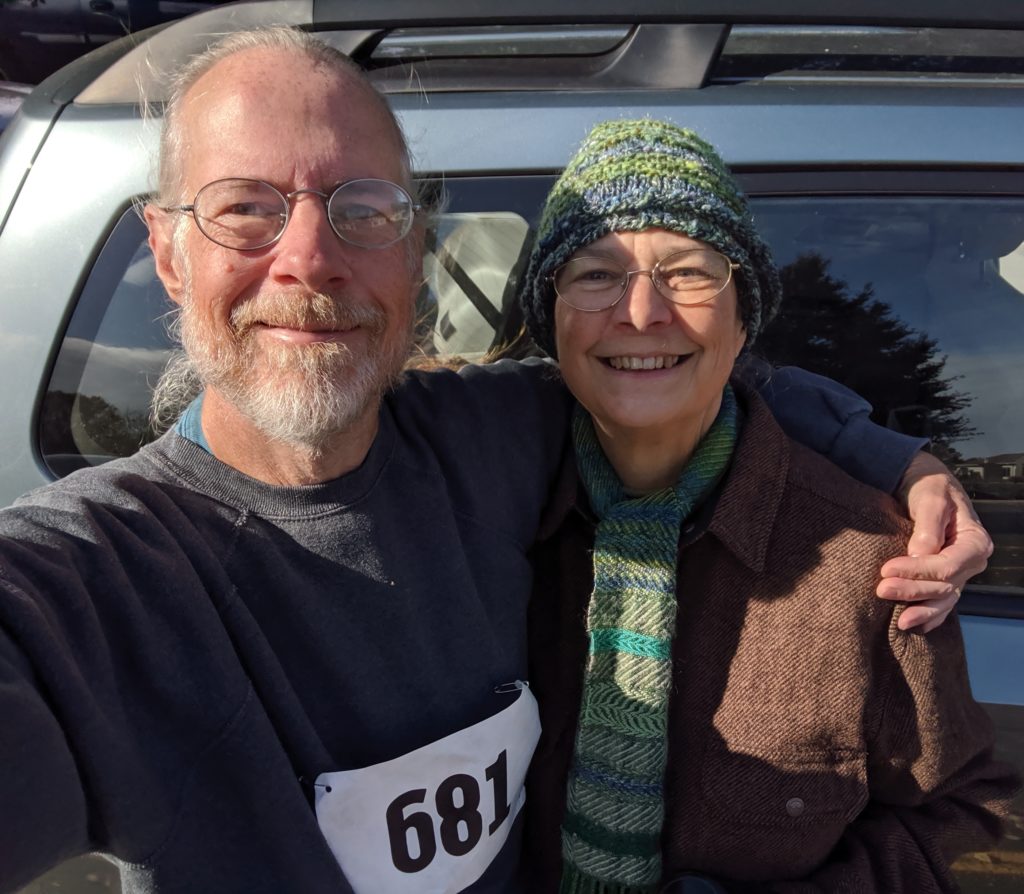
All it took to get this badge was making the dog’s long walk of the day a 5 miler, taking her for all her other ordinary walks, the activities of daily living, and then going for a 6-mile run.
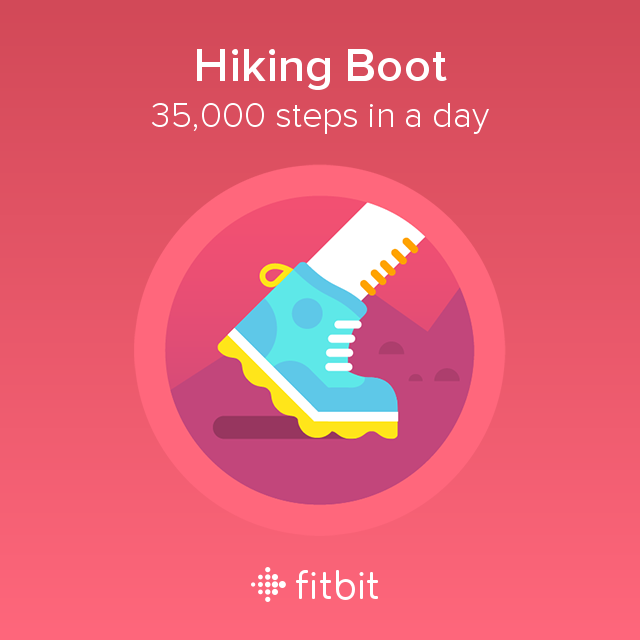

All it took to get this badge was making the dog’s long walk of the day a 5 miler, taking her for all her other ordinary walks, the activities of daily living, and then going for a 6-mile run.
I have been surprised (and a little amused) by how difficult the first exercise in the Born to Run training guide is. It’s really just a combination of two exercises that I do all the time already, so I figured it would be pretty easy. But no.
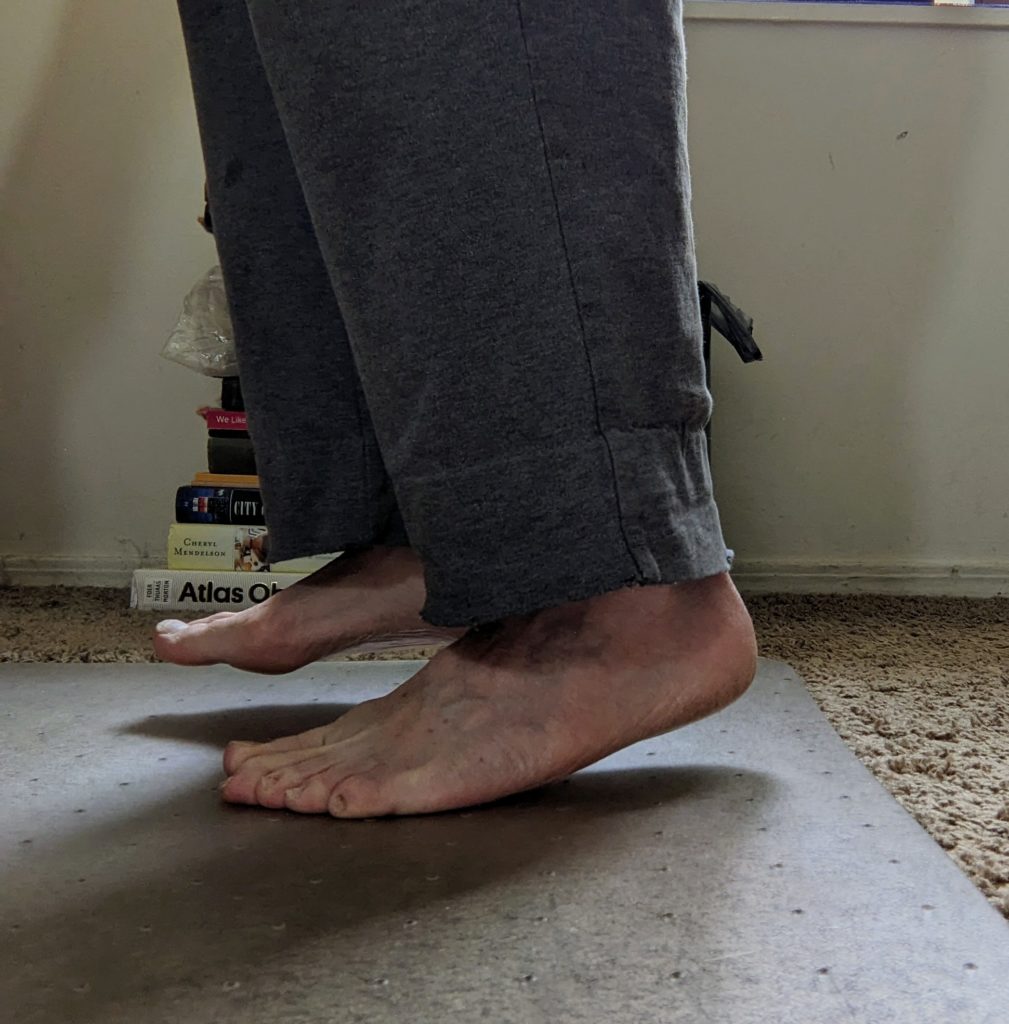
Basically, it’s just single-leg standing with the heel raised. There are three versions with minor differences in what you do with the non-standing leg, to challenge your standing leg in different ways.
I have done single-leg standing for years as part of my tai chi practice. I also do calf-raises nearly every day, including some single-leg calf-raises. And yet. Put them together and things get dramatically harder.
With the single-leg standing exercises I do as part of my tai chi practice, I have my heel down—which makes standing on that foot much, much easier.
With the single-leg calf-raises, I’m only balancing on the standing leg for a few seconds, which turns out to also make a difference.
Standing on one foot with the heel off the ground, and then staying that way for tens of seconds, turns out to be much harder than I’d expected. But it’s harder in ways that I can already tell will mean practicing those exercises will quickly produce improvement not just in those exercises, but also in my running, and in my general foot strength and foot health.
In particular, I keep trying to jab the tip of my left index toe into the ground, when I should be using the pad of the toe. (Probably a left-over from decades of sometimes wearing too-small shoes. My index toes are longer than my big toes, which is not something that shoe salesmen in the 1960s thought about. Also my left foot seems to be a fraction of an inch longer than my right foot, so shoes that fit my right foot perfectly slightly constrained my left index toe.)
Do I need a new running training routine? Probably not? I’ve had pretty good success with running for several years now—I’ve maintained my aerobic fitness, boosted the distance I can run, and suffered almost no injuries. But what if I could reduce not only my injuries, but also my risk of injuries? What if I could run much faster?
I’ve never been a fast runner, and I was okay with that. I never wanted to win races. I just wanted to be fit and healthy. And yet….
Over the past couple of weeks I read Christopher McDougall and Eric Orton’s new book Born to Run 2: The Ultimate Training Guide, which draws on the vast material that McDougall wrote about in the original Born to Run, and in Natural Born Heroes, but offers a detailed 90-day training program, rather than requiring that you read between the lines of the narratives in those books. It’s a regularized version of the training Eric Orton provided while McDougall was writing Born to Run—training that took him from a frequently injured recreational running to someone who routinely runs ultramarathons.
It sounded good enough to me that I was going to give it a try. In fact, I was going to start with day one this past Monday. Then I read the first day’s activities and observed that before day one (on day zero, I suppose), you’re supposed to time yourself running one mile as fast as you can. The book then goes on to use that time to give you target paces for all the upcoming runs.
There was too much ice and snow to get my one-mile time until yesterday, when I did go out and run one mile fast. I mean, not very fast, because, as I said at the start, I’m not a very fast runner. But I did run 1 mile in 10:04, which is very nearly as fast as I’ve ever measured myself running (click for a few measurements from 2003 and 2004).
Not only does that mean that my running speed has scarcely declined in the past 20 years, it also challenges one of my fundamental beliefs. Back in the day I used to be able to average 12-minute miles, which meant that I’d have to run three times as fast to be competitive in a race. (And the past few years, as I was focusing on MAF training, I’ve done a lot of my runs even slower than that—averaging 14 or 15 minutes per mile.) But if I can run a 10-minute mile, then I’d only have to run twice as fast in order to be running with the non-elite front-of-the-pack runners.
Of course, McDougall makes no promises that his 90-day program will double my running speed, but even if I run only a little faster, with only a slightly lower chance of injury, it seems like it would be well worth giving it a try.
I’ve got my day-zero measurement, so maybe I could start in on day one of the program. Except, we’re still right at the start of winter, and I’m not at all sure that I’ll be able to follow the schedule, as far as the outdoor runs are concerned. But I don’t want to wait.
I think I’ll try to split the difference this way: I’ll start in on the various exercises in the program, many of which are indoor exercises anyway. They look like the sort of thing that need some practice anyway, so I’ll focus on learning them and on watching the weather. As soon as it looks like I’ll have a reasonable shot at getting the runs in, with only minor adjustments to the scheduled days, I’ll jump in.
I’ll keep you posted.
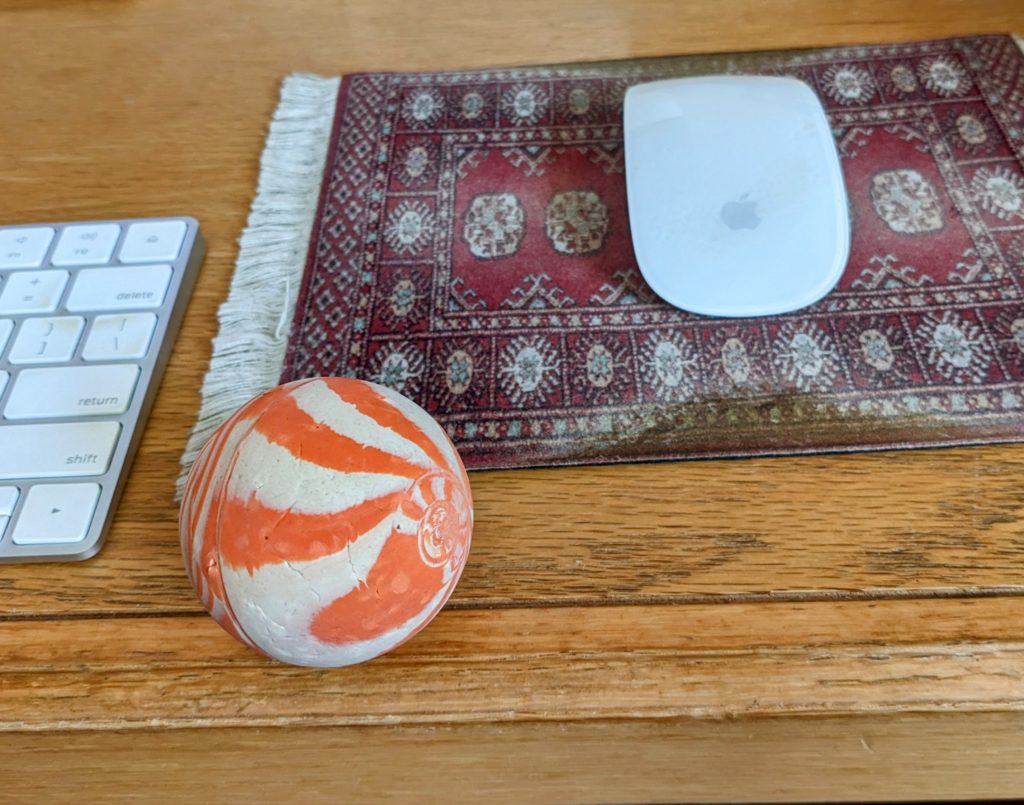
For a couple of years now I’ve included in my warm-up mobilizing the joints in my foot by standing on and rolling this hard rubber ball. It’s really helped reduce running injuries.
But Ashley will use whatever means necessary to get the ball. So for two months I’ve scarcely done it.
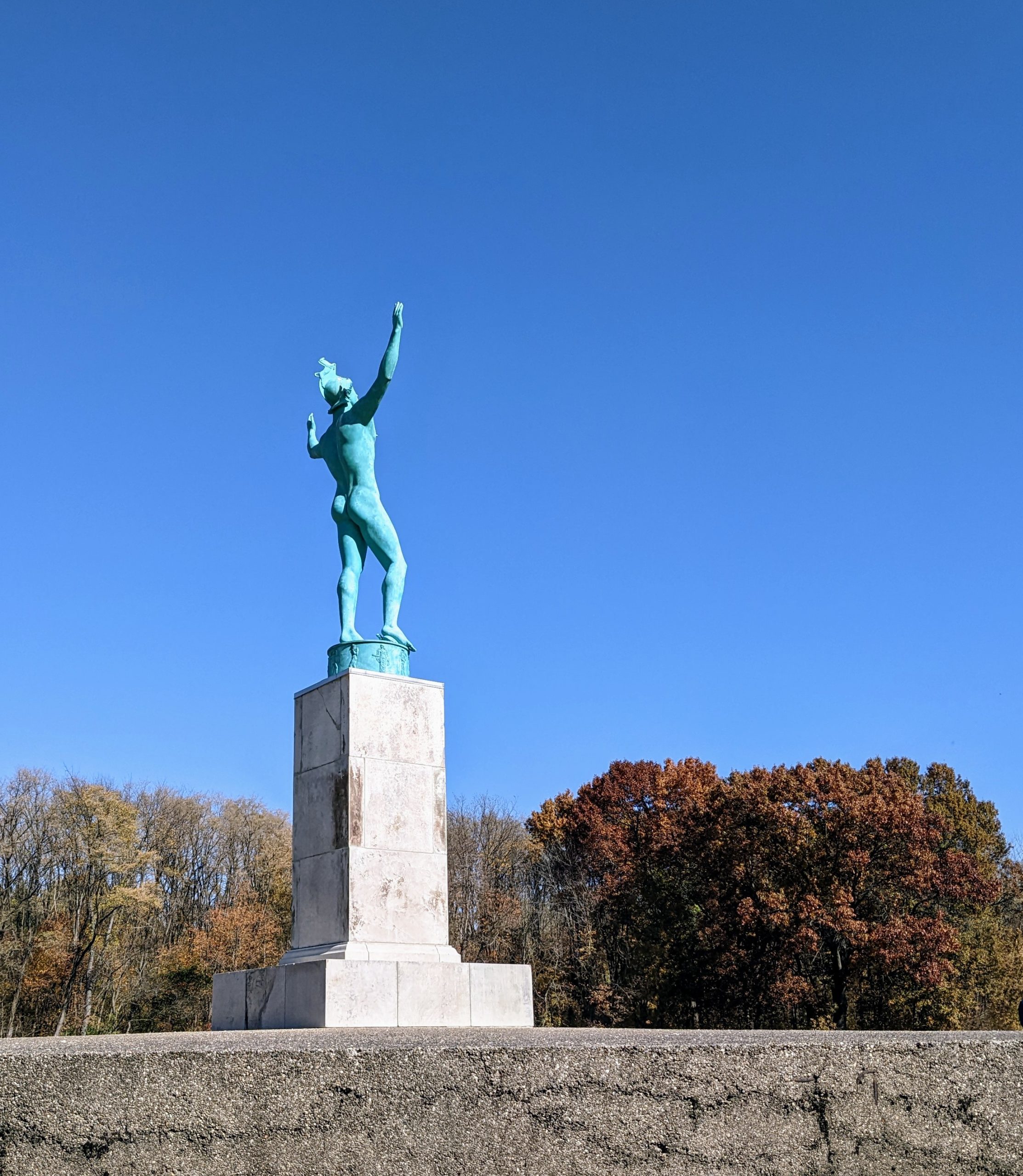
Walked with @jackieLbrewer to a nearby venue for early voting, and exercised the franchise. The walk was also a bit of exercise, although after I went for a run as well. 🏃

Taking the short way, past the back of the Sunsinger, rather than around. About 2 miles into my run.
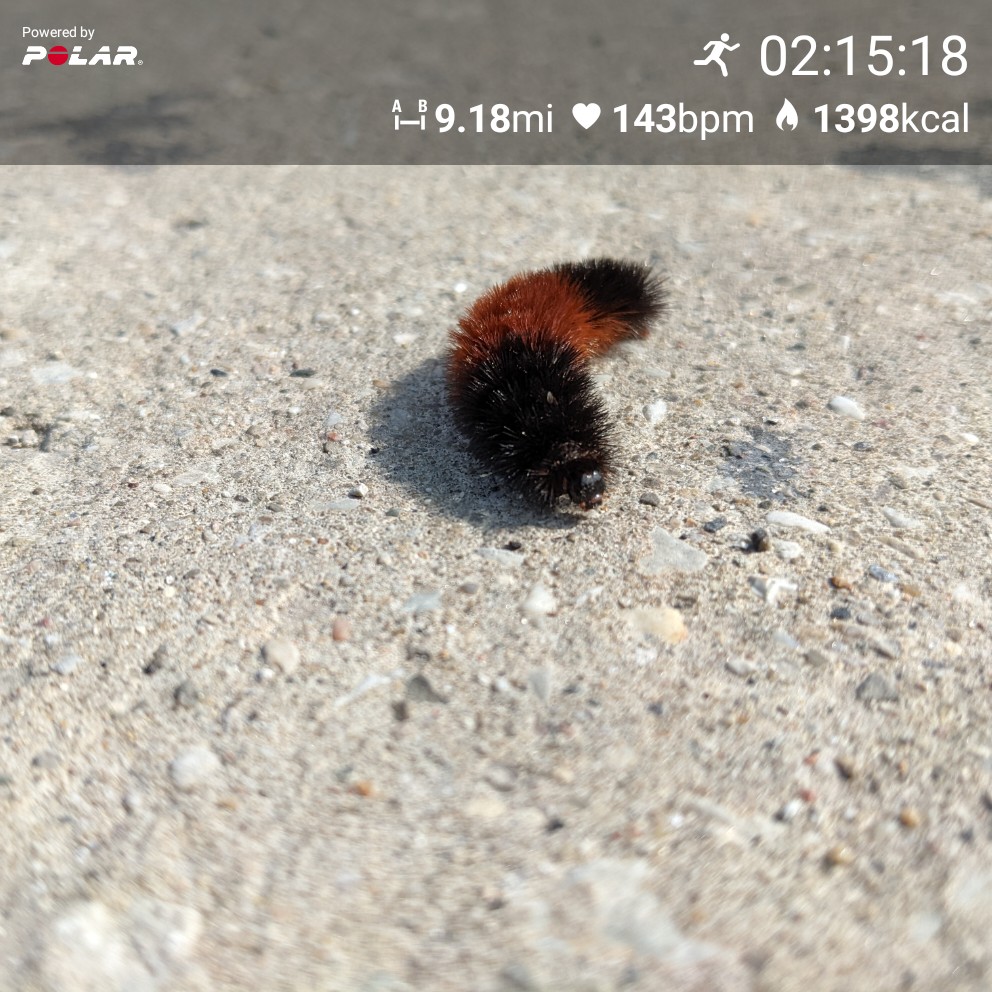
Time and distance are for my run, not the woolly bear’s.
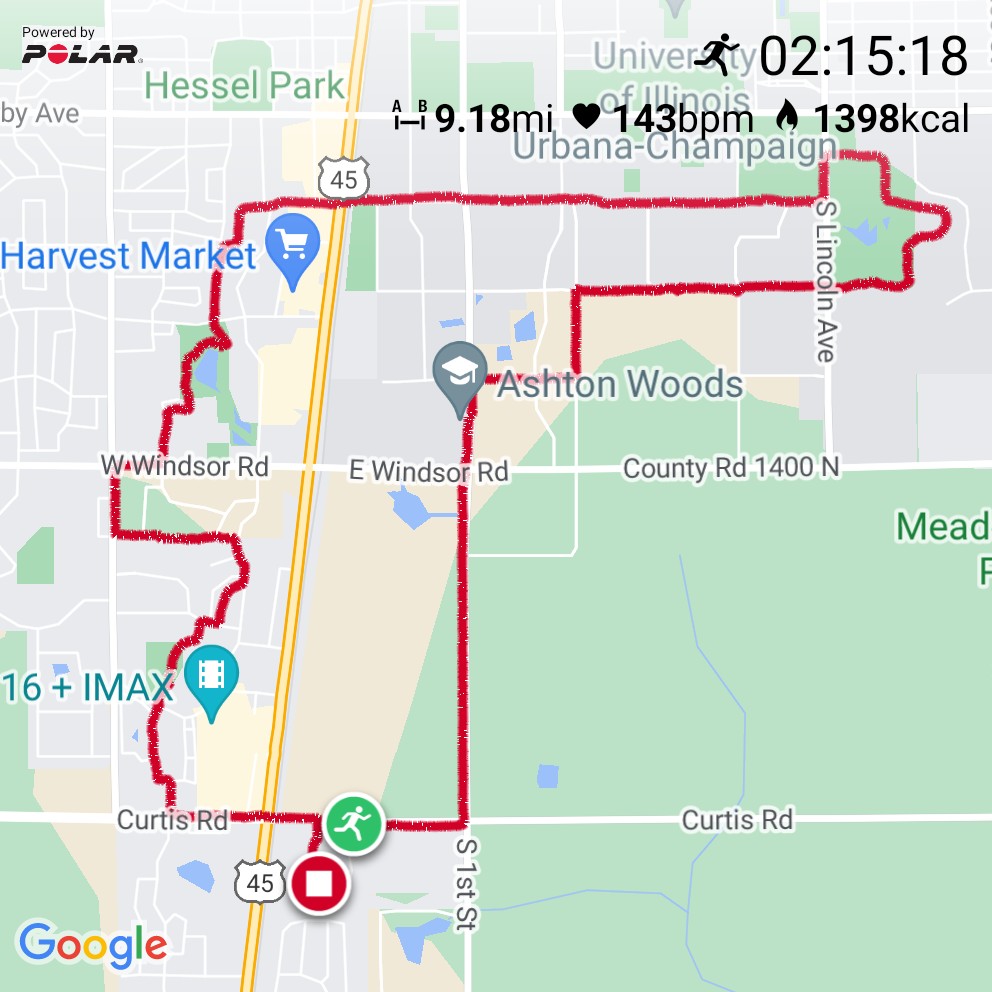
At over 9 miles, this is my longest run ever.
And, in case anyone is interested, here’s a map of the run:
I’m considering registering for the Rattlesnake Master Run for the Prairie 10k coming up in just over a month. Ahead of any race it makes sense to do a bit of speedwork. And I wanted to do a little test, to make sure I’m up for running hard for (close to) that long. So I did.
I always hesitate before I call a workout “speedwork,” simply because I run so slowly, but really, anytime you run faster than usual, it counts as speedwork.
I do two sorts of speedwork. Sometimes I do sprints (either on the flat or uphill). Other times I do what I did today, which is perhaps a tempo run or perhaps a lactate threshold run—I’m not sure which is a better description.
What I actually did was set out to run at the fastest pace I could maintain for an hour. The whole run came in at 5.19 mi in 01:08:43, so an average pace of 13:13 min/mi. That included some easy minutes to warmup at the beginning, and then some cooldown at the end. The core part of the workout (which was intended to be 1 hour) came in at 4.58mi in 00:58:50, so an average pace of 12:50 min/mi.
I’m actually pretty pleased with that. For around six years now I’ve been trying (for almost all my runs) to keep my heart rate low enough that the exercise is almost entirely aerobic. The target HR for that is given by what’s called the MAF 180 formula. (The formula is 180 minus your age, and then with a few modifiers, which for me would include another minus 5 because I’ve gone back on blood pressure meds.) So I should probably be trying to keep it under 112 bpm. Boy would that be slow.
Years ago I came up with 130 bpm, and had never updated it. I usually keep my HR down around 130 for the first two-thirds of a run, after which it tends to start creeping up.
To hit those low heart rates I had to run pretty darned slowly: I averaged maybe 16 min/mi, which put my running speed down into the range of a fast walk. (Actually, very slightly faster than that. When Jackie and I were training for our day-hike of the Kal-Haven Trail we worked on upping our walking pace, to be sure we’d be able to walk 34 miles during daylight, and we got up to where we could do a mile in less than 18 minutes, but I’m not sure we ever walked a mile in less than 17 minutes.)
Back in March I realized that I’d probably been pushing on that one lever (workouts at a low heart rate) for longer than made sense, and I started easing back into running faster for at least some of my workouts, and this is one where I tried to go a bit faster.
For this run my HR (excluding a few glitchy readings before I got sweaty enough for my HR monitor to work well) averaged 141 and maxed out at 151.
I looked back at this blog for reports of my running pace at various times, and found that I used to routinely break 12 min/mi, but all the specific reports I found were for runs under 3 miles. I did find that the previous time I ran Rattlesnake Master Run for the Prairie I ran it with an official time of 1:17:13.4 meaning a 12:26/mile pace.
At any rate, I’m pretty pleased with this run, both as a test, and as a bit of speedwork ahead of next month’s Rattlesnake Master Run for the Prairie, which I’m now considering a little more seriously.
This article is powerfully anti-fitspo:
“You are the hero of your life. The villains you are fighting are the stereotypes and prejudices that make you feel like the end goal should be a dramatic physical transformation.”
Source: Runner’s Body and Fat Acceptance | Britanny Runs a Marathon
Having lunch in Monticello after hiking and running at Allerton Park. Despite what the glasses say we’re both drinking the Half Acre Daisy Cutter. 🏃