I’d thought this was going to be the easy part—writing the part of the novel where the action parallels the action of the existing short story. In fact, it’s turning out to be really hard.

It’s not surprising, now that I think about it. Probably the biggest thing is that I’ve already mined this material for all the good stuff—the best bits got pulled out and used to set up the later action in the novel just the way they had set up the later action in the short story.

The work of taking the material out is minimal. Even the work of replacing it with a quick reminder to the reader that it happened isn’t a big deal.

The big deal is that what’s left behind is a terrible, pointless scene. All the significant action is gone—all the plot development, all the character development—leaving behind little more than transitions. The characters make their way from point A to point B. It’s excruciating to read.

I’ve given up on copying the text and editing it. At the moment I’m doing what one might have done in the days before computers—looking at the old manuscript while typing a fresh draft. Even that isn’t working very well. Probably better would be to just write a fresh outline that covers the necessary plot points and tuck the old text away until I’ve got a new draft. Then I can look over the old draft for any gems that got left out.

I’ll try that tomorrow.

Progress on the novel continues apace.

In particular, I’ve reached the point where the action in the novel lines up with action in the failed short story that the novel draws from.

The short story failed because I simply couldn’t cram in all the setup needed, a problem easily solved in novel form—the setup occurs naturally in the body of the novel. As I wrote, I kept in mind the various bits that I needed to set up, and have been making sure to cover them as I went along.

With that done, I’d imagined I’d just about be able to copy whole scenes from the short story into the novel manuscript. Except, that turns out not to work. I tried it this morning, growing my story by about 1600 words, only a couple hundred of which were newly written prose.

Part of what’s in these scenes are the failed attempts to provide the setup. Since that setup is now provided (in full scenes of their own, earlier in the manuscript), I need to remove those attempts from these later scenes.

That turns out to be harder than I’d expected. The text I’m working on is near-final draft stuff. I had previously polished every paragraph, every sentence. Everything is all hooked together as smoothly as I could mange. Some things can be removed by just deleting a paragraph, but other things require a complete re-writing. Plus, a lot of things shouldn’t be removed entirely. Rather, the failed attempts to set something up should be replaced with a little call-back to the setup—a little memory-jogger that reminds the reader of what happened many pages ago, so that when it becomes significant, they say, “Oh, yeah. I remember that.”

The upshot is that I have another six thousand words or so ready to go in—but I now see that adding those words will be as hard as writing them would have been. Maybe harder.

After adding three scenes by copying and editing, I’m now thinking that it might be better to just write fresh scenes. (In fact, thinking about the amount of editing that remains to be done on the scenes I added this morning, that’s really starting to seem like a good idea. I’ll try it that way tomorrow.)

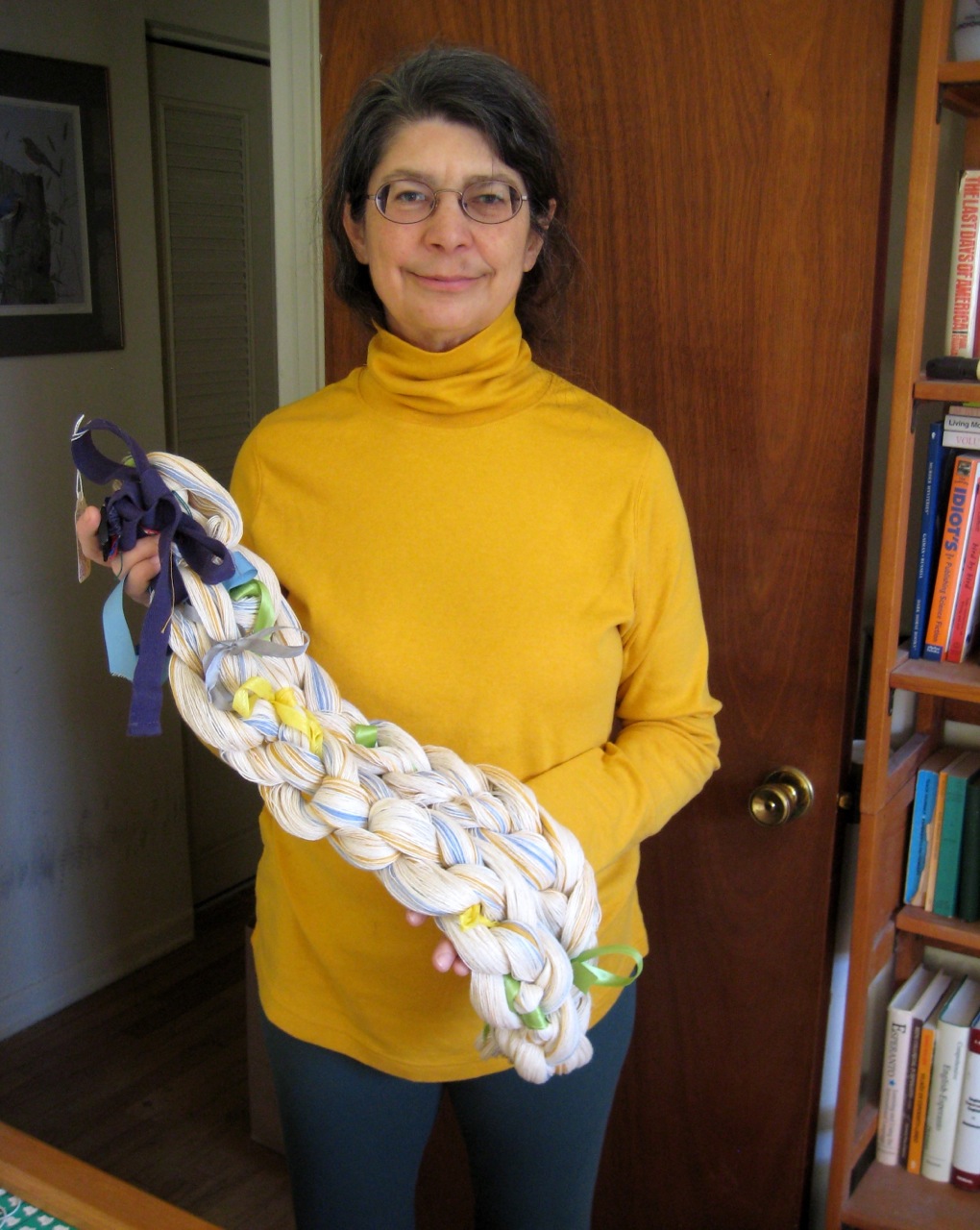
As I’ve been writing, Jackie has been working in her media—spinning and weaving mostly. She wove two silk scarves in the past weeks, and spend much of the past couple of days winding a warp for her next weaving project.

Here’s Jackie with the warp, chained up for storage or transportation, but ready to be threaded onto the loom:

jackie wound a warp

Via Clarion classmate Mart, I spotted this post about Amtrak’s Plan to Give Free Rides to Writers.

One of my most productive days ever was on board an Amtrak train from Chicago to Champaign. I think I wrote four Wise Bread posts (including this one in praise of Amtrak), as well as getting some fiction writing done.

Related to that, I have been meaning for a while to link to this post about using cruise ships as workspaces. The cruise ships don’t offer free travel for writers, but the repositioning cruises are relatively cheap (because they tend to be dull—long days of crossing the open ocean–and because you end up on the other side of the world and end up having to fly back home), so you can do it yourself.

I’m always intrigued by ideas like this (such as rolling my own coworking spaces locally) because writing can so easily turn into day after day of solitary sameness. In fact, though, my desk in my study is a great place to get work done.

Speaking of which: progress on the novel continues apace. I’m averaging 1000 words a day, and it does not seem like a strain to do so. (Whereas trying to average 1667 words a day for NaNoWriMo did feel like a strain. Maybe I’ve found my sweet spot.)

I’ve long struggled to balance the need to be somewhat monomaniacal (in order to complete a large project) and the need to perform at least the bare minimum necessary tasks of everyday living. This struggle is made all the harder by the realization that multitasking is a terrible strategy for getting things done.

So, I was interested in the recent post by J.D. Roth, Moderators and Abstainers: Two Approaches to Balance and Temptation, which argues that there are two kinds of people: Those who can achieve a moderate balance versus those who lurch from excess to excess unless they go for a zero option with regard to the things they’re prone to overdo. Of course, it immediately made me think of my recent conversation with my doctor about how addiction was the right model for thinking about diet and weight loss.

More than that, though, it made me feel pretty good about how things are going for me right now. It’s still early days, but I’m feeling like I’ve found a pretty good balance between productivity and fitness. I’m getting my writing done, and I’m getting my exercise in. Rather than finding myself doomed to lurch from regular exercise (and no writing) to lots of writing (but no exercise), I’m having pretty good success with a schedule that includes both.

I’ve been working my way toward this for a long time. As far back as 2008 I wrote Being Routinely Creative, where I argue that rather than constraining your creativity, having a firm schedule protects the time you need for creative pursuits. It took me a while to find that post, because I had been conflating it with the even earlier 2007 post Scheduling Time versus Scheduling Tasks, where I make a related point praising the value of blocking out chunks a time (as opposed to the then-recent time management fad where you instead organize your work around lists of “next actions”).

One key for me has been the realization (really, the re-realization, because I’ve known this for a long time too), that the writing has to come early in the day. Once I’ve started writing—once I’ve gotten my brain in the story space—I can take a break for exercise (or whatever), and then return to writing later in the day. Starting with exercise is much less effective. After exercise, I feel like I’ve accomplished something, which blunts my urge to be productive. I’m also often tired. And, if I’ve had to go out to exercise (such as to the Fitness Center or the Savoy Rec Center), it seems only reasonable to run an errand or two on the way home, which has the effect of postponing the start of writing even further. The result, far too often, is no writing at all.

One concern I have is that the block of time that I’m protecting for my writing falls right in the middle of the early morning hours when it’s cool enough to exercise outdoors during the hot days of summer. But I can’t work up much worry. At this point in the winter, I positively yearn for a long afternoon too hot for vigorous exercise.

Oh—and this post would not be complete without a shout-out to Jackie, who performs so many of the necessary tasks of everyday living for both of us, freeing me up to do far more of my creative work than would otherwise be possible. (And who somehow does it while also doing her own creative work.)

When I was first starting on my novel, I estimated the final length at about 80,000 words.

It was a minimally informed estimate. I had a vague sense of how much stuff needed to happen over the course of the story. I looked at a few other novels that had about that much stuff in them and counted how many words they had, and 80,000 words was a typical length. I also looked at other first novels that had been published recently, and saw that 80,000 words was not unusual. The size of the “story” is a much more important determinant of manuscript length than what seems to have been marketable a few years ago, but if I’m going to have a target, there’s a certain comfort in knowing that it’s not wildly out of the norm.

I’m not sure that having a length estimate is even useful for a first novel, but I thought it might be, for two reasons.

The first is a holdover from a book I read, back when I did software, on software process. It modeled a process where you’d make a length estimate up front, use it to produce an effort estimate, and then track daily progress. At the end of the project you’d compare your estimates to what actually happened, and use the result to improve your estimates for the next project. The claim was that, after a few projects, you could produce quite excellent estimates, and could make accurate predictions for when you’d be done.

I don’t know if that’s true or not. I sure hope my start-and-stop progress on this novel doesn’t predict a similar profile on future novel efforts.

A second reason I came up with a length estimate was to give me a sense of whether I was on track.

Some years ago, I went to a workshop on screenwriting. The guy teaching the workshop pointed out that a considerable amount of knowledge about pacing flows directly from the fixed form of a screenplay. A feature-length movie is going to have a script something under 120 pages.  If, for example, you’re writing a movie about a road trip from New York to California, then along about page 60 you’re going to be in the middle of the country. Maybe you’re in St. Louis, maybe you’re in Kansas City—but if you’re in Philadelphia, you’re doing something wrong. Thinking along those lines has been helpful already.

Today I passed 40,000 words, so I’m at the midpoint of my estimated length.

In writing 40,000 words, I’ve learned a lot about this novel. (I’d hesitate to claim that I’d learned much about writing novels, but I’ve learned a lot about this novel.)

Happily, I think I’m past the stage of going back and fixing first-draft stuff to conform to my evolving ideas of the structure of this novel. That’s a combination time-waster and procrastination technique that many people warn against, but that I was unable to resist while working on the first third of the novel. (And it did waste a lot of time; I now see that a lot of stuff that I labored over isn’t going to make it into the second draft.) Worse, reworking those bits got me out of the habit of writing new stuff. Only just lately have I been writing entirely new prose—which is, for me, one of the fun bits. I hadn’t realized how much I’d missed it, until I finally got back to it.

Hopefully, the second half goes along more smoothly than the first.

I first encountered Andrew Leonard when Steve pointed me to the column “How the World Works” at Salon.com. Filled with keen observations about globalization, right at the moment when globalization was changing everything, Steve spotted it as being just the sort of thing I was interested in at the time.

The column wrapped up a while ago—globalization is just how things are now—but I’ve kept up with Leonard’s writing, so today I spotted his latest essay, The astonishing power of Richard Powers.

I’ve been aware of Power’s novels for a long time, because he was a local sf writer, sort of, on the faculty at the University of Illinois. (I gather he just last year took a position at Stanford.)

His work is only sort of sf; it’s more literary than genre. It’s very well-regarded, but my few attempts to read it were unsuccessful: it seemed deliberately opaque. I grasped that the stylistic choices were intended to make the book’s form echo the book’s intent, but in my couple of experiments, they didn’t work for me.

This essay, though, almost convinces me to give more of his books a try. Certainly I’ll take a look at his latest, Orfeo.

But the essay is interesting beyond that. Despite having followed Leonard’s work at Salon for years, I was completely unaware that his father was “the youngest editor in chief in the history of the New York Times Book Review.”

I found in the younger Leonard’s experiences an echo of my own—choosing to be a writer when my father is one of the best writers I know.

A great essay. Long, but well worth reading.

Years ago, my dad pointed me to the seminal article by K. Anders Ericsson The Role of Deliberate Practice in the Acquisition of Expert Performance. From 1993, it’s the ur-text for all the later popularizers of the idea that it takes 10,000 hours of practice to get really good at something.

Of course, if you read the actual article, that’s not what it says at all. What it says is that it takes 10,000 hours of “deliberate practice” to acquire expert performance.

A friend of mine once objected strenuously to Ericsson’s term “deliberate practice,” on the grounds that we already have a perfectly good term for this set of activities: practice. If you weren’t doing what Ericsson called deliberate practice—if you weren’t monitoring your performance, evaluating your success, and trying to figure out how to do it better—then you weren’t practicing, you were just dicking around.

That being the case, you will not be surprised to learn that there was nothing new for me in Debunking the Myth of the 10,000-Hours Rule: What It Actually Takes to Reach Genius-Level Excellence. If, on the other hand, you have fallen into the popularizer’s trap, and started to imagine that spending 10,000 hours dicking around with something would make you an expert, there may be quite a bit for you to learn.

Having dug up my copy of the original paper and looked through it again as I was writing this post, I’m glad I did. It’s a great paper, and it’s good to be reminded of what practice really is.

I often figure that the time I spend writing is practice for getting better at writing—and sometimes it is. Sometimes I do monitor my performance, evaluate my success, and try to write a sentence or paragraph better. But, of course, that’s not the fun part. The fun part of writing is when you get immersed in the world of the story and the words just flow effortlessly—and any thought of monitoring, evaluating, and improving is deferred to some future editing phase.

And, unsurprisingly, Ericsson was there ahead of me:

Recent analyses of inherent enjoyment in adults reveal an enjoyable state of “flow,” in which individuals are completely immersed in an activity (Csikszentmihalyi, 1990). Similarly, analyses of reported “peak experiences” in sports reveal an enjoyable state of effortless mastery and execution of an activity (Ravizza, 1984). This state of diffused attention is almost antithetical to focused attention required by deliberate practice to maximize feedback and information about corrective action.

In contrast to play, deliberate practice is a highly structured activity, the explicit goal of which is to improve performance. Specific tasks are invented to overcome weaknesses, and performance is carefully monitored to provide cues for ways to improve it further. We claim that deliberate practice requires effort and is not inherently enjoyable. Individuals are motivated to practice because practice improves performance.

Yeah. Exactly.

And yet, there can be a certain kind of enjoyment in practice.

When I’m writing and I’m not in flow state, but rather am struggling—trying over and over again to get something right—that’s practice. And, granted, that’s not much fun—except that pretty often I do manage to get something just right. (Or at least, get something that’s better than I can do on an average day.) That’s fun.

It is perhaps even more obvious in my taiji practice, especially the qigong practice, where we do simpler moves than the movements of the taiji form, and where we do the same move over and over again. Those exercises are (or at least can be) practice. Doing the same movement a dozen times, watching how the instructor does it, trying to match his form—that’s practice. Creating a small variation with a goal of improving some specific aspect—that’s practice. And yet, it can be fun, too, if approached with a playful attitude. (Today I tried to do some of my single-leg standing practice with my eyes closed. I picked the easiest of the various single-leg standing exercises that we do, and still wasn’t very successful—I almost toppled over a couple of times. But it was amusing in a way—and in the course of just a few minutes, I became perceptibly better at standing on one leg with my eyes closed. That was fun.)

Practice. It’s not just for getting to Carnegie Hall.

After several abortive efforts to track daily wordcounts on my current novel project (dating back almost two years), I’ve not resumed doing so over the three or four weeks I’ve been back to work. However, I have been checking the current wordcount almost daily, and recently passed 30,000 words. (It had been slightly under 20,000 words when I got back to work in late December.)

My best guess is that this novel will come in at around 80,000 words, so I’m now solidly in the middle. I have a pretty good idea how the ending goes, so things are moving along pretty briskly now. I have three or four key things I need to set up. The rest of what I’m up to is pure fun and games—my heroes playing around with cool stuff, getting into and out of trouble. (Of course at this point, they’re getting into trouble faster than they’re getting out of it.)

I’m of three minds about tracking wordcount as a productivity measure.

First of all, I think it’s at least theoretically useful data to have for planning purposes. If I know how fast I write, I’m in a much better position to estimate how long something will take me.

Second, I find it somewhat useful for motivation. Many’s the time I’ve sat down for a short writing session late in the day to get at least a few dozen words written, so I don’t have to enter a zero in my spreadsheet.

However, third, I find that it’s sometimes demotivating. When I’ve missed several days, I find it so depressing to enter those zeros, that just doing so is an extra hurdle that’s hard to get over, even when I’d otherwise be ready to get back to writing.

The main reason that I’ve not yet gotten back to tracking is point three above. Secondarily, I’ve held off because the wordcounts would have been misleading: I’ve slotted back in some text that I’d earlier pulled out because it was in the wrong place, or to accord with shifting visions of the novel.

Still, something over 10,000 words in something under a month comes to around 400 words a day. That’s not very fast writing—and yet: 10,000 words a month is plenty fast enough to write a novel-length text in less than a year.

Essentially all the pre-written text is back in now, so at this point it would not be misleading to start tracking words again, if I’m confident that any little productivity glitches won’t become self-reinforcing downward spirals. I was still doubtful when I started this post, but now that I’ve finished it, I think I’m ready to get back to tracking. (In fact, I have just now resurrected my old tracking spreadsheet. Let’s hope doing so doesn’t cause a bunch of demotivating thoughts.)

I’ve been waiting to post about how successful my new daily routine has been until I’ve had at least one day where I actually followed it in each particular, and today was that day.

In fact, just aiming at my new routine has been enough to increase my productivity quite a bit. I’ve had at least one writing session nearly every day, and I’ve gotten some sort of exercise nearly every day, and most days have had plenty of both.

So, the new daily routine has been at least a modest success so far.

Today:

  • I wrote early.
  • I went to the Fitness Center and lifted weights.
  • I came back and wrote some more.
  • I had a light lunch.
  • I went out and experimented with combining Zombies, Run! and Ingress. (It seemed to work okay, as long as I paused Zombies before trying to Ingress.)
  • I came back home and put a final polish on a Wise Bread post I’d written a few days ago, then shared it with the editors.

Having accomplished all that stuff, figure I’m free to do whatever I want for the rest of the day.

By the way, here’s my zombie-ingress outing as tracked by Zombies, Run. I went 3.61 km (which works out to 2.24 miles) in 1:28:22. That would be a very slow run, but it was fine for a walk where I was spent many minutes standing around at portals. (I left the program in kilometers rather than miles, only because Ingress does everything in kilometers. I’ll probably change it, though. I think in miles when I run.)

Here’s Marissa Lingen with one of those ideas that ought to be obvious, and yet is so very much not-obvious in practice that I’m very glad she wrote about it.

When her critiquers suggested that her books needed more setting, she made a plan for including more setting:

Very, very early on in the writing process I started thinking about setting and the specific locations that each scene would take place in. Then I sat down and wrote settingy stuff for those scenes first. Sometimes it was just a few lines, sometimes a paragraph or more, but, for example, when the protag was going to join her crazy mad scientist magician genius little sister in said sister’s room for some crazy mad science magic, I did not let myself run along with what they were doing until after I had put down some thoughts about what a crazy mad scientist magician genius little sister’s room would look like.

A great idea for adding description, but also a great idea for adding anything that you tend to under-write—because it is so much harder to add this sort of thing in later, when you’ve already got carefully crafted paragraphs, each one leading to the next, beginning with a great opening image and ending with a nice little cliffhanger.

And however great this idea is, much greater is her insight that people who are naturally good at something usually have no idea how someone who is not naturally good at it can get better.

I learned that fairly early, with my difficulties learning how to spell. Teachers tried putting me next to people who were good at spelling, in the hopes that their spelling skills would somehow rub off on me. This did not work at all, because people who are naturally good at spelling have no idea how to get better at spelling. (People who are naturally good at spelling tend to be people who see words in their head and then can just read off the letters and write them down. Since I can’t do that, I had to come up with a completely different way to get (barely adequately) good at spelling.)

I’m always on the lookout for people who do well things they aren’t naturally good at. They’re often hard to spot. (Spend thousands of hours honing your craft, and you too can look like someone who’s naturally good at something.) But there are clues—such as earlier works where the author or artist wasn’t as good, and works where some aspects are crafted like a masterpiece, while other aspects show merely a journeyman’s skill. Those are the people who might have some insight into how they got better.

With this sort of thing, it’s always useful to put it in terms of KA Ericsson’s model for the acquisition of expert performance. Just practice isn’t enough to get better at something—you also need to monitor your performance and evaluate your success—with help, such as a critique group, when possible. Then you need to figure out how to do it better—which Marissa’s post is a perfect worked example of.