
Foggy dawn over the solar far

Light exposure is good for you. All the different frequencies are good for you. This has led many people to try to tweeze them apart: tanning beds, red-light panels and masks, therapy lights, etc. It turns out, sunlight is best consumed whole, just like food.

I should mention that by inclination, I’m rather vulnerable to getting this wrong. I wrote at some length about how, because of the sort of person I am, I simply like the idea of figuring out all the nutrients I need, and then trying to construct a diet that provides all those things. Similarly, I like the idea of coming up with a perfect workout plan, and then getting all the movement that I need by hitting all the right exercises. But, if you follow that link, you’ll see that I eventually realized the whole notion was just wrong-headed.

There is no need—in fact, no value—in tweezing apart the nutrients in food. Just eat a varied, whole-food diet and your body will get it right. The same with movement. Just engage in a wide range of diverse movement, and your body will become highly capable of moving in all those ways, (and if your “movement diet” is adequately diverse, your body will become fairly capable of all sorts of movements you don’t even practice).

The same is true of sunlight. That’s the main message of In Defense of Sunlight: The Surprising Science of Sun Exposure by Rowan Jacobsen.

The book is consciously modeled on Michael Pollan’s In Defence of Food, which systematically destroyed the notion that you could build up a diet that optimized all the nutrients. And it’s message is very similar. Sunlight is best consumed whole, just like food.

All of the different frequencies are good for you:

  • UV (to make vitamin D, and to release nitric oxide from the skin into the blood),
  • blue (to tell your brain it is daytime, and to tell your subcutaneous fat cells to release fat and signal your brown fat to burn it for energy),
  • green and yellow (to calm you down—I have written before about my theory of dappled shade, and for vision—you see shades of yellow better than shades of white, which is why yellow glasses are good for driving, shooting, and the like),
  • red light and infrared light (to boost energy production in your mitochondria and promote wound healing).

“But what about skin cancer!?!?” I can hear you asking from here.

The book is well worth reading, because just the information on skin cancer is worth the price of the book (and it takes half the book to adequately deal with the subject). Because there’s so much of it, it’s not really practical to try to summarize it here, so I’ll just mention that “Don’t get sunburned” is much better advice than “Put on sunbock,” or even “Stay out of the sun.”

I figured this out years ago. I’ll use sunblock if I’m going to be out in the sun so long that I might get sunburned—I needed it for a snorkling trip to Buck Island, for example. Otherwise, I use a combination of changing my clothes, taking advantage of shade, and limiting my time out in the midday sun. But I don’t minimize my time in the sun. I maximize my time in the sun, while making sure not to get sunburned. At this point in the summer (having gotten a modest amount of sun every day since the weather turned warm) I’m okay for up to about 40 minutes of mid-day sun. And I try to get that nearly every day.

Here’s one statistic, that I’ll let stand in for dozens of others about the advantages of sun exposure. The UK Biobank has data on health outcomes for hundreds of thousands of people. A researcher Jacobsen mentions went in and counted:

… in the fifteen years of tracking, a total of 40 people had died from skin cancer attributable to too much UV light, while 2,982 people had died from diseases attributable to a deficiency of sunlight.

The final third of the book is about artificial light, and makes the case that too much light at night is just as bad as too little light during the day.

Again, this is something that I figured out long ago. All the “sleep hygiene” stuff makes it clear that you want your sleeping space to be very dark, and there’s no doubt that getting enough high-quality sleep is probably the best thing you can do for your health, maybe even above good nutrition and plenty of exercise (both of which are easier to get if you’re sleeping well).

The prescription is almost trivially easy: Get outside at dawn. Get as much sunlight as you can without burning during the day. Within a couple of hours after sunset make your space as dark as possible and get some sleep.

In Defense of Sunlight: The Surprising Science of Sun Exposure by Rowan Jacobsen. Highly recommended.

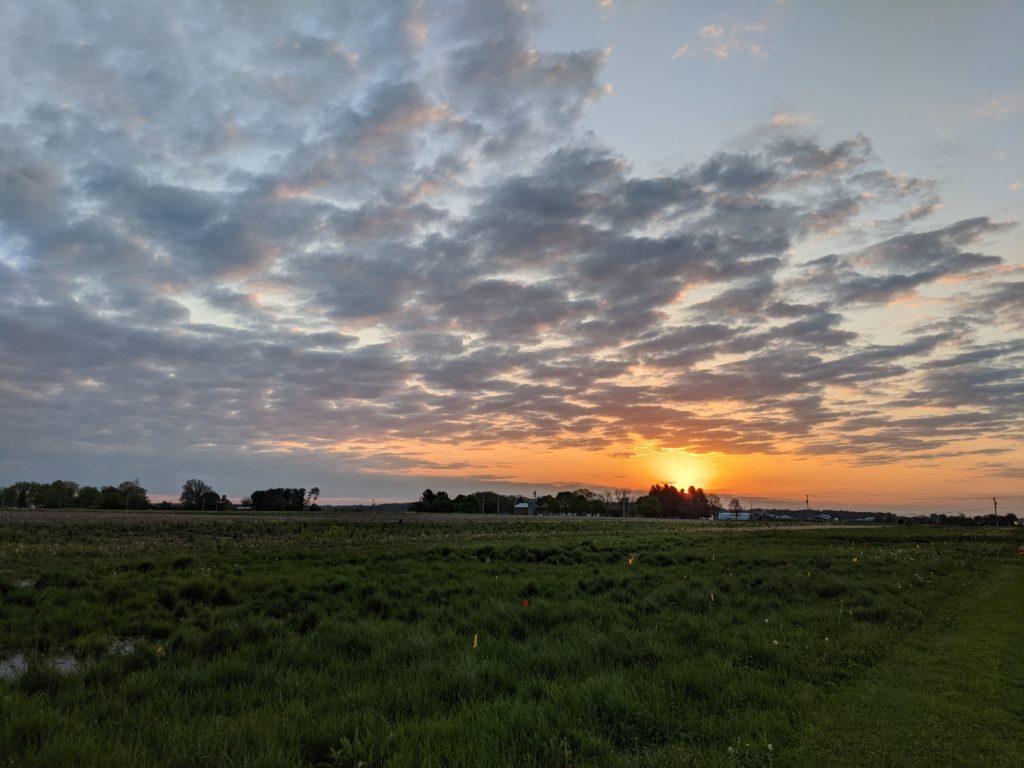
Sunrise beyond a crossroads

I’m always on the lookout for books that take a more balanced view of sun exposure than “skin cancer bad,” and this looks to be a good one: In Defense of Sunlight: The Surprising Science of Sun Exposure by Rowan Jacobsen

From a review in Nature Briefing:

“One study he mentions analysed the skin of lifeguards at the start and end of a summer season during which they were heavily exposed to the sun. By summer’s end, their skin was enriched with microbial “beneficial bugs” that protect against UV radiation. A square centimetre of human skin contains millions of microorganisms, some of which produce compounds that kill cancer cells without harming normal ones.”

Source: The best way to start your day? The science backs naked cartwheels in the sun

I mean, really. We know the UV rays are actinic, as are the blue-green rays (tell your brain it’s daytime), and the red and infrared rays (promote healing at various depths of skin and below the skin). I don’t know about all the other wavelengths, but I’m willing to bet that they all do something.

Humans evolved in the sun, and evolved different skin pigmentation that varied with latitude (and, I suspect, varied with other things as well). The idea that our skin can’t handle a perfectly ordinary amount of sunlight is just silly.

Another for the “all the rays are actinic” files: Your fat cells need blue light.

insufficient stimulation of the light-OPN3 adipocyte pathway is part of an explanation for the prevalence of metabolic deregulation in industrialized nations where unnatural lighting has become the norm.

https://www.medicalnewstoday.com/articles/could-sunlight-combat-metabolic-syndrome

[Update 2025-12-06: That link seems to have gone dead. I think maybe this is the original paper that article referred to: https://pmc.ncbi.nlm.nih.gov/articles/PMC7341981/.]

Another post to file under “all the rays are actinic”:

[Near infrared light] can trigger cellular activities that restore cellular metabolism, promote blood flow, neuroprotection, and reduce levels of inflammation and oxidative stress. All of these cellular mechanisms can be summed up as “helping the brain to repair itself.”

Source: Will the Photobiomodulation Trial Be the One to Turn the Tide Against Alzheimer Disease?

Here’s a report on a study which measured vitamin D levels of Hadzabe and Maasai individuals living traditional hunter-gatherer or pastoral lifestyles, the data having been collected with an eye toward learning something about what would have been typical during our evolution as a species.

For the Hadzabe the mean was 109 nmol/l and for the Massai 119 nmol/l. These levels are not outside the reference range, but are way above the minimums.

[T]he mean vitamin D concentration of traditional Africans is indicative of the level that would have been typical throughout much of our evolution, and hence, the level that the human physiology would have grown accustomed to over millions of years. Hence, it’s not unreasonable to speculate that such a level may indeed represent optimality…

Source: The Vitamin D Levels of the Hadzabe and the Maasai: An Important Study That Flew Under the Radar

People not living traditional lifestyles can get enough sun to see similar levels, but probably not if they work in an office, and probably not at all in the winter (unless they live in the tropics).

I had my own vitamin D level measured once. It was 38.5 ng/mL (equivalent to 96 nmol/l) versus a reference range of

As I was observing just a few days ago, when exposed to sunlight, your skin does a lot more than just make vitamin D. I’m pretty sure that high vitamin D levels are just a marker for adequate sun exposure. Taking vitamin D supplements in sufficient quantity to raise your blood levels high enough to mimic those of people who get enough sun will produce no more benefit than gaming any metric does.

I’d be interested to know what my vitamin D levels are right now, after a long summer of getting plenty of sun. But not interested enough to go to the effort of convincing my doctor that it’s worth testing again, nor interested enough to pay for the test.

I observed years ago that the more sunlight I got the better I felt. Although “it’s the vitamin D” seemed like a reasonable hypothesis, I’ve been pretty careful not to just assume that—whenever I’ve written about this I’ve gone ahead and listed some of the other “active ingredients” that tend to come along with sun exposure—exercise, time in nature, etc. As I look into the matter more, I find there’s a growing body of evidence that sunlight itself does provide benefits, but it’s not just the UV light—the other frequencies of light are also actinic in all kinds of ways.

UV light

The UV light doesn’t just make vitamin D. It also has all sorts of other effects. In particular, it modulates your immune system in ways that reduce the risk of multiple sclerosis, and probably other autoimmune disorders and some cancers. It also reduces blood pressure. In mice it has been shown to limit diet-induced weight gain.

Blue light

We’ve long known that blue light (especially, but not exclusively, a specific frequency of blue-green light absorbed by a pigment in the eye called melanopsin) was critical for establishing and maintaining an appropriate circadian rhythm. Very recently we’ve discovered that adipose tissue expresses the genes that produce the same pigment and use it to vary how the cell acts. In particular, after exposure to an amount of blue-green light that might shine through skin exposed to full sun, fat cells reduce the amount of fat they store, and also produce less leptin (a hormone that affects feelings of satiety).

Red light

As I discussed a few weeks ago, there’s been a lot of research on the effects of red and near-infrared light exposure. Here’s a page with links to a bunch of studies that suggest that red and near-infrared light boosts collagen synthesis, speeds healing of burns, incisions and broken bones, reduces inflammation, and generally reduces the effects of aging on your skin.

I guess that leaves us with orange and yellow light unaccounted for, but I don’t doubt that they’ll turn out to be actinic as well.

For most of my adult life I carefully limited my sun exposure. More recently—after discovering that the more sun exposure I got the better I felt—I’ve been trying to get as much as I could without getting burned. Just lately I’ve been groping towards something more nuanced.

Back in maybe the 1980s I briefly tried to follow the advice of dermatologists to never go out without sunblock. That didn’t work well—inevitably there would come the day when I was out in the sun longer than anticipated, and (not having built up a protective tan) I’d end up burned.

After that, for a decade or two, I came up with some simple rules: Unlimited sun before 8:00 AM and after 5:00 PM, but I’d aim to get 20 minutes of mid-day sun. If I was going to get more than that, I’d wear sunblock, but I tried to get that much sun every sunny day. That worked pretty well—I’d get enough of a tan to provide some protection on those days that I was unexpectedly out in the sun.

That schedule, of course, fell out pretty much automatically from working at a regular job. I stuck with it even after I wasn’t working at a regular job because it worked pretty well.

For various reasons, such as needing to take very long walks to train for our big Kal-Haven trail walk, I started spending more time out in the sun, and began to observe that the more time I spent in the sun the better I felt, leading me to get what was probably more sun than is really wise.

Since recently running into the idea that certain frequencies of red and near-infrared light are good for your skin and deeper tissues, I’ve been prompted to think about all this in a more systematic way, and have been trying to come up with a plan that maximizes the benefits while reducing the harm caused by sun exposure.

I’m still in the research stage, but here are the early changes that I’m making:

First, I’m reducing the amount of mid-day sun I’m getting. I’ve been going for around 40 minutes (as much as I can get without risk of burning), but I’m bringing that back to around 20 minutes. Still enough time to make plenty of vitamin D.

Having gotten the amount of mid-day (2:27 PM) sun exposure I wanted, I moved the rest of my walk into the woods.

Second, I’m replacing that 20 minutes of mid-day sun with 20 (or more) minutes of sunlight during the period that the UV index is between 1 and 3. (This time of year, where I live, that’s maybe 7:30 AM until 9:00 AM.) My hope is that part of the reason more sun makes me feel better is the red light (rather than the UV), and that morning and evening sun can provide those frequencies.

Taken during at 8:59 AM during a walk in the prairie.

Third, I’m trying to get some very early (dawn) sun exposure. This is specifically for the effect early morning light has on the circadian rhythm.

Early morning (6:53 AM) sun over the Lake Park/Winfield Village prairie.

Only in the middle of writing this did I realize the extent to which I’ve come back to what I did for most of my working years—except that instead of having to squeeze my morning sun exposure into the time I spent crossing the parking lot, now I can extend it to 20 minutes or longer, and combine it with a proper walk in nature for some sweet, sweet vitamin N.

Sun shining through a lily flower.

I went for a long-for-me, 7.22-mile run this morning, and listened to a podcast about light therapy.

(I go back and forth on listening to podcasts during runs. When I listen I feel like I miss out on being fully embodied in my physical activity. When I don’t listen I fall behind on stuff I really want to listen to. Today I listened.)

The podcast had Paleo Magazineʼs Ashleigh Van Houten interviewing Scott Nelson, the founder of Joovv, talking about the health benefits of exposing your skin to red and near-infrared light. I’d heard about this, but had assumed it was some woo-woo new-agey thing. Turns out it’s probably not. There’s been a huge amount of research on the benefits of exposing your skin to red light in the 660-nanometer and near-infrared light in 850-nanometer range.

(There was apparently a lot of research funded by NASA back in the 1990s when they had to use lasers to get light of just the right frequency. Nowadays LEDs make it easy to get the intensity and frequency of light that you want.)

So, I’m out on my run, listening to Ashleigh and Scott talk about all the health benefits to your skin (of the red light) and to deeper connective tissues (of the near-infrared) and thinking that it all sounds really cool, but knowing that I’m probably never going to want to spend even hundreds, let alone thousands, of dollars to buy a device that will shine bright red light on my skin.

At around the mid-point, maybe 4 miles into my run, I paused for a drink of water out of the fountain in Morrissey Park, thinking it was pretty hot for just 8:40 AM . Which made me think of this giant glowing orb in the sky, which was shining down on me with pretty intense light at a wide range of frequencies, most definitely including red and near-infrared.

Turns out, sure enough—the energy in the red and near-infrared frequencies of sunlight is right in the range of therapeutic doses shown to have health benefits.

Of course, full sunlight is full of other frequencies of light, including blue (prone to mess up your circadian rhythm if you’re exposed too close to bedtime, but just what you want to get your circadian rhythm set correctly if you get your exposure in the early morning like I was doing), and ultraviolet (dangerous in excess, but the UV index was zero when I started my run at 7:40 AM and probably didn’t reach 5 before I was safely back indoors). So you need to treat sunlight with respect. But I already knew that.

I have mentioned before that I feel better when I spend a lot of time outdoors, and have speculated that sun exposure is part of the reason. (Along with time in nature, moving more, appropriate quantities of community and solitude, etc.) The information about red and near-infrared light exposure seems to lean a bit in the sunlight direction—but with the welcome news that it’s not just the vitamin D that helps make me feel better, which means maybe I can feel great without having to expose myself so much to the deadly actinic rays of the sun.

Maybe there are non-deadly actinic rays!