Another for the “all the rays are actinic” files: Your fat cells need blue light.
insufficient stimulation of the light-OPN3 adipocyte pathway is part of an explanation for the prevalence of metabolic deregulation in industrialized nations where unnatural lighting has become the norm.
I’ve been lifting weights for decades. I was pretty consistent about it for a long time. For years while I was working at a regular job, Jackie and I would go to the Fitness Center and lift before I went to the office at least two, often three times a week, using whatever machines they had (three or four different brands/styles of machines over the years). I saw pretty good gains the first six weeks or so that I was doing this, but they leveled off. I kept at it for years after that, with very little to show for it.
All that time I imagined that the issue was intensity—to make more gains, I needed to lift more and harder. I now think that was wrong. I think the problem was just that machines are a crappy way to build strength or muscle.
Four and a half years ago we moved to Winfield Village, which has a pretty good set of free weights. I’ve been using them—once again without much to show for it. In this case, the issue is not a matter of using the wrong equipment or a lack of intensity—it’s that my consistency has fallen off. I get on a schedule of lifting two or three times a week, but only keep it up for a week or two and then miss a few workouts.
Happily, this month I’m doing pretty well. In 21 days I’ve gotten in 9 lifting sessions, which is just about exactly my target. (I aim for every other day, so when I miss an occasional day it still comes in at 3 times a week.)
I’m seeing some nice strength gains (although after just three weeks I can’t be sure I’m not back in the situation of “anything will build strength for six weeks”). I’m also putting on some weight—probably just because I’ve been eating too many carbs, which I’ll fix here shortly, but in the meantime I’m choosing to imagine that I’m adding some muscle as well.
Understanding that consistency is the key, maybe I’ll be able to keep it up. (Watching my older relatives become frail due to sarcopenia, I’m determined to avoid that fate.)
I’m pretty sure I’ll manage okay until the weather turns and I have to start balancing the lifting with the running and hiking. (I’ve only gotten in one run this month, because of ice and cold.) We’ll have to see after that. But as I say, I’m determined.
Some years back, after I’d finally made some real progress at losing weight and getting in shape, I was thinking of writing a post about it, when an on-line acquaintance posted a stern note to the effect that she didn’t want to see any “weight-loss success stories” from anyone who hadn’t kept the weight off for five years.
It’s a reasonable perspective. Almost any weight loss program will work for six months. Almost nobody who undertakes such a program manages to get down to a normal weight and maintain that weight for five years.
Despite the aforementioned reasonableness, I was somewhat put off by her attitude. Who was she to tell me when and how I could tell my own story? (To be fair, she wasn’t telling me I couldn’t tell my story, just that she didn’t want to see it.)
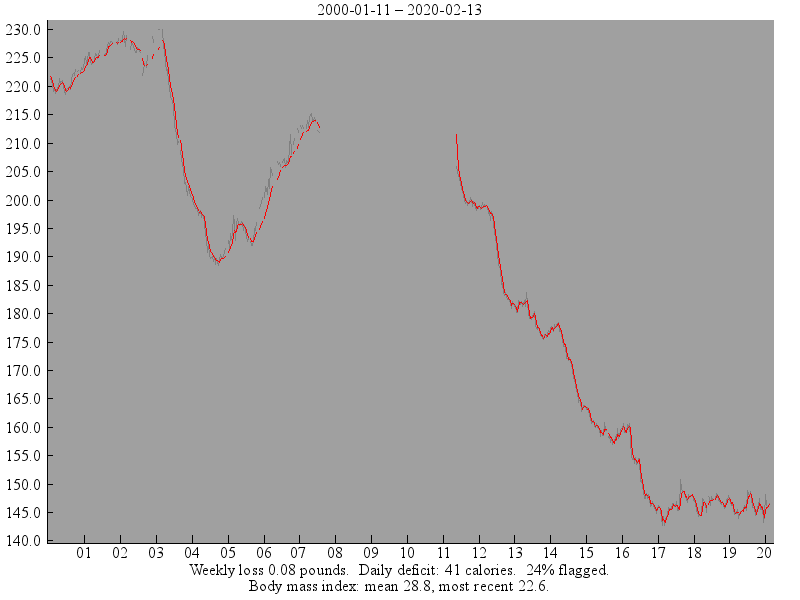
That feeling of being just a tiny bit stifled made the whole thing stick in my mind, such that I’ve kept track: February 14th, 2015 was when my BMI dropped from 25 (overweight) to 24.9 (normal weight). It has now been in the “normal weight” range for five years.
I didn’t stop there. I continued losing weight for almost two more years, until in December 2016 I decided that I didn’t want to get any smaller. At that point I started targeting a stable weight (145 lbs, which gives me a BMI right at the midpoint of the “normal weight” range). I’ve achieved my target pretty well, keeping my weight to within plus-or-minus about 3 pounds of my target.
My weight going back to January 2000. The faint gray shows my actual measured weight. The bolder red line is a logarithmic moving average “trend weight.” The big gap is from when I lost access to the good doctor’s scale at the Motorola office in mid-2007 until I bought a good digital scale in mid-2011.
I wish I had something useful to say about how to lose weight, but I really don’t.
I lost the first fifty pounds the long, slow, hard way—eating less (portion control) and moving more. Because it was hard—I was hungry all the time—I knew that even a slight misstep could easily see me gaining back back all that weight. At that point I did an experiment with low-carb eating, to see if it would address some health issues unrelated to my weight, and quickly peeled off another 15 pounds.
Since then I’ve been eating what I call a “carb-aware whole-foods diet,” meaning that my main focus is on eating food (and refraining from eating industrially produced food-like substances), but purposefully keeping my carbs down in the 100–125 grams per day range, and taking my carbs down lower if my weight gets up above where I want it.
Because eating low-carb worked well for me, I’m modestly inclined to be a booster of the diet, but only modestly. Who am I to say that just because it worked for me it would work for anyone else?
Besides eating actual food and watching my carbs, anybody who reads my blog knows that I spend a lot of time moving. Just click on the “exercise” tag or the Fitness category to see post after post talking about my efforts to get enough exercise (in the old days), and see how they gradually changed into my efforts to keep moving throughout the day. It’s common knowledge that you can’t exercise your way out of a bad diet, but I think it’s also true that moving throughout the day is critical to achieving and maintaining good health.
I’m going to be providing an introduction to Tai Chi at the Tolono Public Library next week. If you’ve any interest in Tai Chi or the class I teach at the Savoy Rec Center, come check it out: February 4th, 2020 9:00 AM.
When you feel sick, you prefer to sit still. This behavior pattern is not only well known, it even has a name: “inflammatory-induced sickness behavior.”
In the modern world this easily leads to a particularly pernicious vicious cycle. Modern lifestyles lead to metabolic syndrome. Metabolic syndrome produces systemic inflammation, which makes you feel like sitting still. Wanting to sit still makes what would otherwise be the most potent tool for reducing systemic inflammation—exercise—tough to bring to bear.
This rather dense article from back in 2010 describes the problem: Inflammatory modulation of exercise salience: using hormesis to return to a healthy lifestyle. It also proposes a category of solutions: hormesis. That is to say, any of a set of mild metabolic stresses that prompt a response greater than “just enough” to stave off the damage produced by the stress itself.
The result is less systemic inflammation, and therefore less inflammatory-induced sickness behavior, hence an increased inclination to move.
Or, as they say:
We therefore propose that exercise salience, the motivation to undertake physical activity, is modulated by the inflammatory status of an animal, decreasing in an inflammatory phenotype, including the metabolic syndrome and increasing in an anti-inflammatory “healthy” phenotype. The type of phenotype may well be determined by the degree of hormesis, as metabolic stressors, such as exercise, plant polyphenols and calorie restriction tend to induce an anti-inflammatory phenotype.
Besides exercise, the article suggests two other broad categories of available hormetins.
One is related to food, and consists of the obvious stuff that everybody knows: Avoid industrially produced edible substances. Consider such modalities as time-restricted eating, calorie restriction, or fasting. Include foods rich in plant polyphenols. (In other words, “Eat food, not too much, mostly plants.”)
The other is related to temperature: Expose yourself to mild cold and/or heat stress. (Spend time outdoors in the winter. Take a cold shower. Spend time outdoors in the summer. Take a sauna.)
Each of these things will produce some mild metabolic stress. As long as you don’t overdo it, that mild stress will produce a stress response greater than necessary to handle the stress itself, with the side-effect of bringing down systemic inflammation. With the systemic inflammation eased, you’ll start feeling like moving again. That puts the potent tool of exercise back on the table.
Nature has a more recent article on all this stuff, which is sadly behind a paywall.
Among the things that I pay more attention to than I ought is a vast swath of preliminary research (and guesses based on preliminary research) about how large physical things (like diet and exercise) work at the scale of cellular biology.
To work though an example:
It seems likely that eating soup, or just drinking good, gelatinous bone broth, will provide your body with the amino acids that it needs to build connective tissue: tendons, ligaments, cartilage, as well as skin and hair.
Actual growth of those tissues is mediated in various ways. It seems virtually certain that mechanical transduction is involved—just pulling on tendons and ligaments, as well as pounding on cartilage—spurs them to get stronger and thicker. But it seems likely that it’s mediated by chemical signals as well. There’s pretty good evidence that Human Growth Hormone signals all these tissues to grow, provided all the building blocks are available.
Even if (like me) you’re quite leery of exogenous supplements of Human Growth Hormone, you can nevertheless raise your circulating levels in various ways, such as by getting a good night’s sleep. In particular, exercise will do it, both resistance exercise and aerobic exercise. In fact (I have heard) a hard leg workout will raise your circulating HGH level temporarily higher than the level produced by a typical dose of supplementary HGH.
This suggests a simple protocol, good for your tendons, ligaments, and cartilage, but also good for skin and hair:
Drink some bone broth. (Make sure you have some vitamin C as well. Doesn’t have to be extra; an ordinary amount is fine.)
After 30 minutes or so, do some stretching exercises and some light lifting. (Your tendons, ligaments, and cartilage tend to have poor circulation. The mechanical action of pushing and pulling them produces the fluid exchange necessary to get the amino acids into them.)
Do a heavy resistance workout, focusing on your largest muscles. Squats are the obvious choice.
Rest.
Get a good night’s sleep.
This is why my thighs are really sore this morning.
Great advice on the right way to handle fall risk for seniors. Includes an excellent video.
Elliott Royce takes practice falls at least five times every morning. He doesn’t just practice; he preaches, too. He goes to assisted living centers, senior centers and community centers to talk about how to prevent serious injuries if you take a tumble.
For my fall-semester OLLI class I took “Ballet for Adult Beginners,” taught by Lei Shanbhag.
I took the class as enrichment of my movement practice. I felt like adding something very different to my existing range of taiji, running, natural movement, a tiny bit of parkour, and so on, and I thought that ballet would be very different, and yet still fall within the broad spectrum of “movement practice.”
I also took it as cultural enrichment. I wanted to learn a bit of the vocabulary of ballet—both the literal vocabulary (Allongé, Battement, Ronds de jambes), and the movement vocabulary (learning to see a dance as a conversation between the dancers and one another, and with the audience).
As far as enhancing my movement practice, I’d have to say it wasn’t a complete success—I did the moves in class, but I didn’t really learn them.
That’s entirely a matter of my own abilities: I’m just very slow to learn movement stuff. I have crappy mirror neurons, and I can only learn movement stuff verbally—I have to watch the movement, describe it to myself in words, and memorize the verbal description. Only then can I attempt to do the movement, by playing back my memorized description and attempting to execute it.
As perhaps you can imagine, this is not the quick and easy way to learn to dance. The upshot is that I need to go more slowly than most people (so I have time to create the verbal description), do it more times than most people (so I have time to memorize my verbal description), and then do it yet more times (so I can learn to execute the moves that I’ve described).
I could probably have learned, let’s say, half or a third of what was taught, if we’d done just that much, and spent two or three times as long on each thing.
As it was, I enjoyed the moving very well, but didn’t leave each class with one or two specific things I might practice between then and the next class.
I don’t mean this in any way as a criticism of the class, which was enjoyable and informative. I had the sense that other people in the class (all with some sort of dance background) were picking up much more of the movements than I was. And Lei was constantly asking if the amount done was the right amount. I could have said, “Wait! Before we go on, let’s do this one thing 5 more times.” I chose not to, so that’s all on me.
Despite not learning the movements, I nevertheless did the movements (as best I could), so the classes were a nice workout—well structured, with a warmup, stretching, practice of the moves we were learning, and more stretching.
I was more successful at learning the cultural stuff. I didn’t learn every ballet term, but I learned enough to provide some useful context. Now I can look things up and understand them. I also began to learn to see ballet, which is something that I didn’t really appreciate before.
One tidbit that we learned the first day stuck with me: The posture of ballet dance—feet turned out, hips forward, weight forward—dates back to Louis XIV. Basically, turning your feet out lets you activate your glutes, while shifting your weight forward lets you activate your quads. If you’ve got good musculature in your legs, this posture lets you show that off. (Especially if, as Louis often was, you’re wearing tights.)