Jackie and I rode the yellow bus into campus yesterday evening and attended a reception for and talk by Rick Bell about Active Design—using architecture to encourage people to move more, to eat better, etc.
We enjoyed it, and found the ideas very interesting, even though the talk itself was only fair—a long series of slides with pictures of places that exemplified one or another aspect of what he’s talking about, arranged geographically rather than according to the principles he’s suggesting. (The talk would have been more interesting for me if it had been organized by idea, rather than by place.)
One focus throughout the talk was on staircases. Of course any multilevel public space needs to have elevators (to make the space available to people who can’t climb stairs) and perhaps other things as well—ramps, escalators, and so on. But stairs are required too (for fire safety, if nothing else) and Bell points out that staircases can be done well or badly. In a bare concrete box closed in behind fire doors, they’re pretty uninviting. Brought out front and center, they can be wonderful. They can be beautiful design elements—glass stairs can float in the space, mirrored risers can reflect the space, etc. Staircases—if they’re broad enough—can also be places where people gather in small groups to stand or sit together. He had a photo of what I guess is a famous red staircase being used that way. (The talk was for architecture students, and was full of references to famous architecture and architects that mostly meant very little to me.)
He also had some photos of places where these things had been done badly, such as a second-floor fitness center with escalators to the entrance, and no sign of where the stairs might be, even if you wanted to use them.
There’s a lot to Active Design besides staircases—walkable spaces, bicycling infrastructure, creating (often re-creating) multimodal transportation infrastructure (like having bike paths and foot paths lead to and from the bus station, and having the bus station co-located with the train station and a bicycle rental place), seasonally appropriate spaces (like skating rinks), bringing food production into the city center, etc.
I’m glad we went. I’m glad we went by bus, rather than driving.
At Country Fair, we had route for a walk around the apartment complex that we could do almost entirely on sidewalks that we called “walking around the block.” It took 7 minutes, so I figured it was about a third of a mile. Most nice evenings we’d go do that walk, often going two or three times around.
One of the first things I wanted to do at Winfield Village was find a similar walk, and the situation is actually a bit better here: At Country Fair the old part of the complex had its various sidewalks connected so that you could walk in a big circle. The newer part of the complex wasn’t like that: It had sidewalks from each building to the closest parking lot, but they’d not been connected to one another, so there was no good way to go for a walk—you constantly had to either cut through the grass, or else walk through the parking lots. Here the whole complex is well-connected with sidewalks.
The most obvious way around is a bit over half a mile, but has the disadvantage of taking us out along Curtis Road, which doesn’t make for an especially pleasant walk.
It’s easy to skip that leg, staying inside the complex, but that shortens the walk, making it a bit less than half a mile.
Happily, there are some additional segments of sidewalks, connecting the sidewalks that run to the backs of the parking lots to one another (exactly what was missing at Country Fair), meaning that it’s pretty easy to put together a connected walk around the perimeter of the complex.
We went out for just that walk today, and I tracked it on Endomondo to see the length, and was pleased to find that the most obvious way to walk around the perimeter of the complex, starting and ending at our townhouse, is exactly one mile.
Here’s the map:
It’s not crucial to have a defined walk to call a “walk around the block.” It would be just as good to just go wander around, turning whichever way we feel like on any particular day, putting together different segments in a different order each day. But I like having a particular walk that we call a “walk around the block.” It’s comfortably predictable.
I’ve been losing weight for the past few years, and wanted to share a small milestone: With a body mass index of 24.9, I am now in the range the National Institutes of Health consider “normal weight.”
It’s been a strange process. Subcutaneous fat departs on its own schedule—probably mostly genetic, but probably other things as well—so I’ve had the experience of bodyparts changing shape at unexpected times. A few months ago I noticed something hard in my side, a couple of inches down from my ribs. It took some seconds of poking with my finger, tracing out the contours, for me to realize it was my pelvis. (For someone who assembled a Visible Man in elementary school, I had a surprisingly poor conception of where the pelvis is. I thought of it as being down by my hips, but the top of the iliac crest comes up to the height of the navel, I guess.) I had similar, if less startling, experiences with other bits of my skeleton, including my ribs and my cheekbones.
I wish I had a better understanding of what changed. I’d been overweight essentially all my adult life. I’d been trying, largely without success, to lose weight for 40 years. Then, a few years ago, something changed, and the weight started gradually coming off.
I did make an effort to eat less, and to exercise more, but I’d done those things a hundred times before.
I know some of the things that changed. I quit working a regular job, so I had more time for exercise, and more flexibility in my schedule to schedule the exercise. I started studying taiji, which is not an especially vigorous exercise, but which I now do almost every day—and consistency has a vigor all its own. Jackie’s willingness (and creativity) in producing healthy meals that conform to my odd preferences has been a big help.
One other thing that was different from all the other times was that this time I didn’t have a goal weight.
All the other times I had an idea in my head that I wanted to lose 15 or 45 pounds, and I’d calculate how many weeks that would take if I had a calorie deficit of this or that amount. Then I’d track my weight, and be pleased or disappointed as it progressed along or deviated from that track.
This time I didn’t do that. Instead, I decided that my goal was simply having a downward trend to my weight. Being in calorie deficit would (I figured) improve my blood chemistry, and probably right away get me most of the health benefits of losing weight.
Since I don’t have a goal, I’m not at an inflection point here, now that I’m at “normal weight.” I can just carry on doing what I’ve been doing. I’m in no danger of becoming underweight any time soon. (The National Institutes of Health suggest I’d be “underweight” if I lost another 40 pounds.) So, I’ll go on gradually losing weight for a while. I expect it will become more and more gradual over the next year or two, before I eventually stabilize, probably not too far from the midpoint between “underweight” and “overweight.”
There’s no evidence for a health benefit to weighing less than I do now, but probably some health benefits to being in calorie deficit—so it makes sense to prolong that phase.
There are, of course, the other benefits to losing weight. There’s an aesthetic benefit. (At least, I think I look better now than I did 40 pounds ago, and expect I’ll look better still if I lose another few pounds.) There’s a convenience benefit. (Society has upsized almost everything as Americans have gotten larger—the main exception being coach seats on airliners—but being slimmer still makes almost everything easier and more comfortable.)
If I lose another 15 pounds or so, I’ll be at the same body mass index as Jackie. She’s most fetchingly slim, and there’s a certain symmetry to us matching that way, but I wouldn’t go so far as to call it a goal. Just a whimsy, really.
I promised a while back that this wouldn’t becoming a weight-loss blog, and I think I’ve kept that promise, but this was a milestone that I wanted to share. I’m not sure there’ll be any more, though. Since I don’t have a goal, there’ll really be nothing to announce.
In a very small way, I’ve been persisting with my parkour training.
I’ve been practicing my shoulder rolls with some success: I can now do shoulder rolls from a kneeling start on both left and right shoulders. With that under my belt, I also did some from a standing start on my right side. I want a little more practice before I do them from the left side.
Next will be to do them at a run, and then to do them after dropping from a height. (Not a high height—I don’t want to hurt my feet, ankles or knees—but I want to develop the ability to drop from a height, absorb the impact of landing, and then go into a roll if necessary. It seems like a useful skill.)
The other thing I’ve started with are what the parkour folks call a precision: a jump to a specific point. You’ve seen them in movies where the actor (or a stunt man) jumps from one beam to another over a gap, or jumps from the top of one wall to the top of the next wall.
In the interests of not killing myself with my practice, I’ve been doing all my jumps at ground level, jumping and then landing on a curb. I’m not jumping very far—I still have no explosive power—but so far I have reasonably good accuracy. (The curb is maybe 6 inches wide, and I’ve managed to land on it, and to not topple over, pretty much every time so far.)
The distance I can jump is growing, which I think is just improving neuromuscular recruitment. (That is, at the level of the muscles, I’m getting better at firing off each phase of muscular contraction at the best moment to launch myself, and at the level of the limbs, I’m coordinating my arm and leg movements so that everything works together to launch me the distance I’m trying to go.)
In other news, packing to move proceeds apace. We’re soon to be at the point where we’re living in our summer place as much as we’re living in our old apartment. And we’ve learned that we’re #2 on the waiting list for Winfield Village
We’re just about there. The Kal-Haven trail is 33.5 miles, and yesterday we walked 23.3.
My plan had been “more than 20,” and we managed that, although we went a bit over.
It turns out to be surprisingly hard to plan a route with a very specific distance, if you want the route to be interesting. (It would be easy enough if you were willing to just map about a 2-mile loop and walk it 10 times.)
We did pretty well in the past using Google Maps to plan a route, entering waypoints and then going in and tweaking Google’s suggested route to match what we knew we were going to want to do. I did that again, but with a walk this long, I ran into some limits I don’t remember hitting before. In particular, there seems to be a 10-waypoint limit, and those “tweaks” to the route seem to use up waypoints. I don’t know if that wasn’t true with the old Google maps, or if our earlier walks just didn’t need more waypoints than that.
Without being able to tweak the route to match what we were going to do, I just entered points of interest for each of the corners of our walk, then fiddled with them a bit until I saw that we were at 20.1 miles. Then I figured we could just adjust it on the fly. It almost worked.
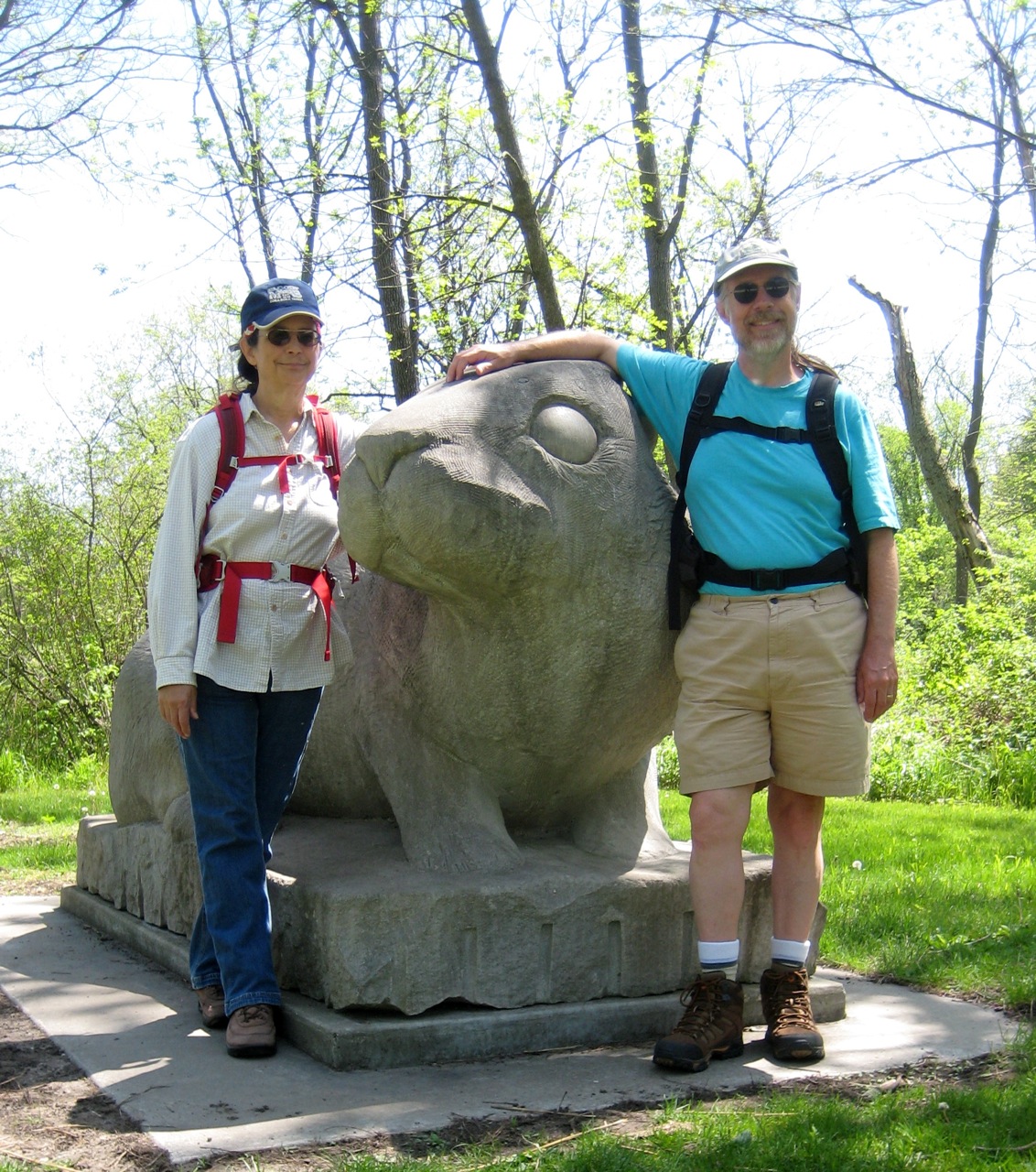
The route was pretty similar to our longest walk of last year, except that we’ve decided to carry our lunch on the trail, so we skipped the leg to Milo’s Restaurant. We walked to the Olympic Monument near Parkland College, then to Busey Woods (via downtown Champaign and Crystal Lake Park), then to Meadowbrook Park, where we had our lunch at the Prairie Viewing Platform. (We paused shortly after to get the above picture of us posing with the giant rabbit sculpture.)
The other place I particular thought we ought to stop was Triptych Brewery, which we’d never made it to before, even though they’ve been there for a year. (We go almost right past it several times a week—in particular, when she walks home from taiji class, Jackie passes just three or four blocks away—but always in the morning when it seems a little early for beer, and anyway they’re not open.)
It wouldn’t be a long walk from Meadowbrook to Triptych, if you wanted to walk along Windsor Road, but that sounded unpleasant. Instead we hiked north up Race and then cut across through married student housing and the arboretum, took Hawthorn through the research park, crossed the railroad tracks at St. Mary’s, and then headed back south on the Boulware Trail. That probably added a good mile to our route.
We made it to Triptych around 4:00 PM. The joint was hopping, which was good to see. They had about 10 beers on tap. Jackie had a honey basil blonde ale, which she liked very well. (The honey and basil were very subtle, she said.) I had their dry Irish stout, which was also excellent.
As we were passing through the research park, we’d calculated the distance we were going to end up walking (because of her walks from taiji, Jackie knew just how far it would be from Triptych to home), and we knew we were going to come out over our planned 20 miles. But we really wanted those beers, so we decided to just take the most direct routes and hope for the best. And it worked out fine.
The first 5 miles over our previous very long walk was no problem. After that, things got kinda tough—we were tired and footsore—but there was never a point where we worried that we might not make it. If you’re interested, Endomondo has the GPS track and details. (Ignore the altitude data. When the phone loses the GPS signal, it often inserts a point with an altitude of zero. However, no point in Champaign County is at sea level.)
In my report last week on our previous very long walk, I mentioned that my plan for after the 20-mile hike would be a 25-mile hike. Almost as soon as I’d posted that, I realized that obviously our next hike should be 26.2 miles. Duh.
The Illinois Marathon passes just a few blocks from our apartment. The closest point is very near the midpoint of the race.
I grabbed the map off their website, and figured we could just walk to the nearest point, pick up the route there, walk it until the finish line, cross over to the starting line (just a block or two from the start) and then carry on until we get back to the midpoint, and then go home.
It’s not a plan yet. More of an intention. Maybe just a notion.
Today we’re going to rest, have a mother’s day lunch with Jackie’s mom, and take her out for something fun. Maybe a walk in the woods, or maybe (if the predicted rain arrives) to the art museum.
On many of my runs this spring, my ankles have been a little sensitive. I’m not sure why. It may be the last remnants of my ankle injury last summer. It may be that I haven’t been stretching my calves enough. It may be that I’ve been doing too many longish runs and not enough short ones. But whatever the cause, I’ve noticed that it seems much worse when the weather is cold.
Serious runners like to run in cool weather. Running generates a lot of heat. Even someone who runs as slowly as I do generates enough heat to keep warm (even in shorts and a t-shirt) in temps down into the 40s. But my ankles have tended to hurt after any run that I did in temps below the upper 50s. So for the past several weeks, I’ve been holding out for temps in the 60s to go for runs—and there hasn’t been much.
Happily our long, cold spring seems to be finally over. Since the end of winter, there have generally only been a few hours a week that were warm enough for me to run. As of today, it looks like we’re going to have 15 or 16 hours a day that will suit my purposes.
So, today I went out for a medium-ish length run, hoping that the weather and my schedule will let me get out for more runs nearly every day for the next while.
According to Zombies, Run! I went 3.11 miles in 36:18. It went great. No ankle pain (or foot, calf, knee, or hip pain). It was long enough for me to feel like I got in a real run, but short enough that (baring unexpected problems), I hope to be able to run tomorrow as well. And the day after that.
In related news, I’ve become interested in parkour. I’m not really interested in doing anything extreme in the way of climbing or leaping. It’s more that I’m hoping to see places to run differently—to see walls and railings and stairways and rocks as part of the course, rather than as obstacles. I haven’t done much so far, except step up the bodyweight parts of my resistance exercise, but I’ve started to practice jumping and landing where I mean to. (It turns out I have no explosive power at all. It’s really quite sad.) I’m also trying to recover my ability to do shoulder rolls. (Thirty years ago, when I was studying aikido, I could do a perfectly credible shoulder roll, come right to my feet, and then do the same roll on the other shoulder, all the way down the length of the dojo. Now I’m too timid to do a roll from a standing position, and even when I do it from my knee, it’s all clumsy and awkward. Which, come to think of it, is a pretty good reason to be timid about doing them at a run.)
Jackie and I have gotten back to our very long walks.
Last Saturday we went to Lake of the Woods and cobbled together their 5-mile prairie trail and their 3.3-mile bike path (together with a couple of jaunts down maintenance roads) into an 11-mile hike. (My goal had been “more than 10 miles.”)
It was great.
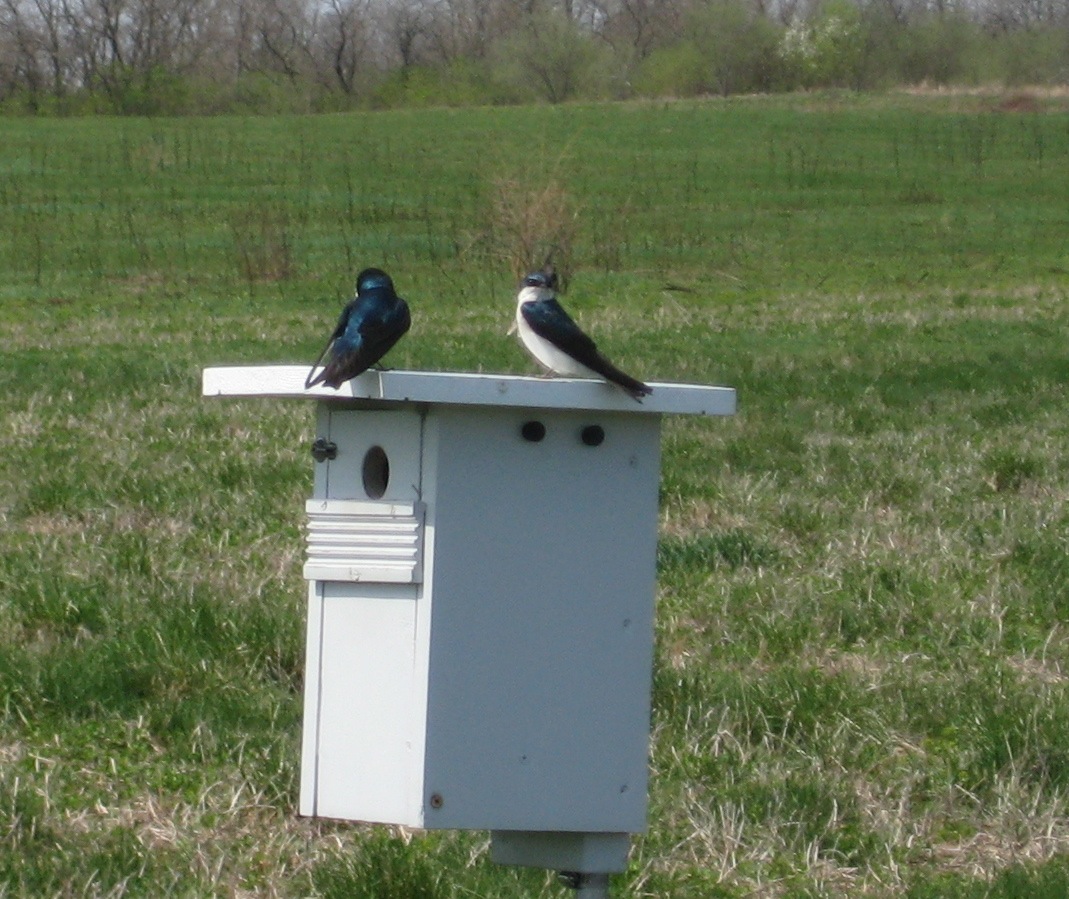
The prairie was full of these bluebird houses that had been occupied by tree swallows.
The tree swallows daunted me briefly; I don’t remember having seen the species before (although I must have). I spent the whole prairie phase of our walk staring at them, thinking “They’re not bluebirds. They’re not indigo buntings. They’re not purple martins,” over and over again.
I’m sure they weren’t the only interesting species I saw, but they’re the only one that comes to mind now, a week later.
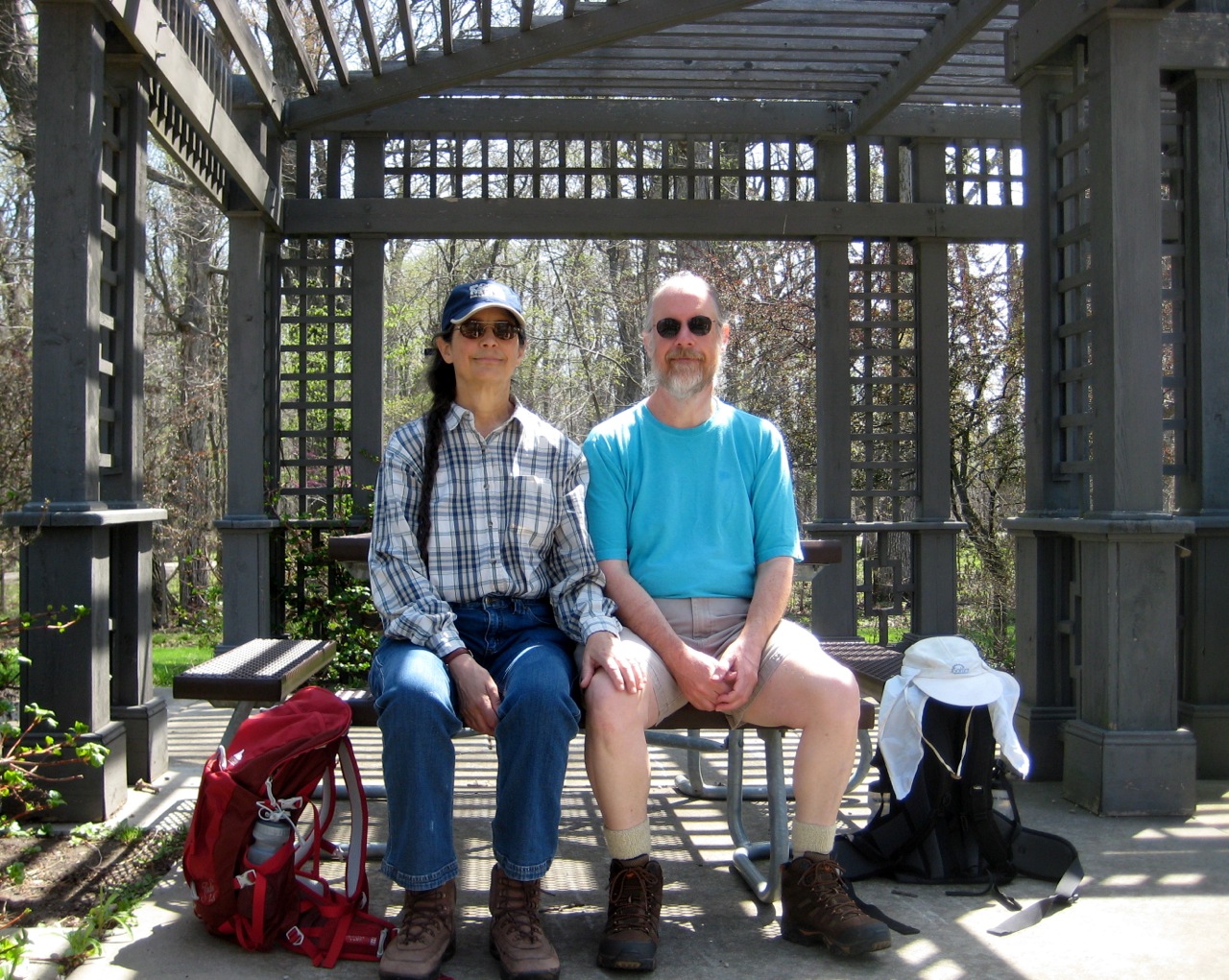
We parked near the Museum of the Grand Prairie, and ate our snack in the botanical garden, which brought to mind the day Steven and I bicycled to Lake of the Woods, which I’d remembered as last year, but which turns out to have been in 2011.
I’d earlier gotten a picture of Jackie and me at the picnic table where we’d later have our snack. I like to think of it as a modern reinterpretation of the Victorian portrait.
Yesterday we did a longer hike. My goal this time was “more than 15 miles,” and we each hit it, although we separated around mile 13, after swinging by the Student Union in time for me to attend my Esperanto meeting. Jackie went on home after drinking some iced coffee. I stayed to speak some Esperanto, then walked on through the water amenities, downtown Champaign, and West Side Park.
Along the way we passed the university’s Agronomy building. We’d passed it a year ago, and I’d neglected to get a picture of the name over the door, and very much regretted it ever since. So this time I made a point of pausing for a photo-op:
I like the harvest iconography on each side of the name. Very handsome.
To do the whole 33.5 miles during daylight, we’re going to have to set a pretty good pace.
Last summer we did okay when we didn’t have to spend too much time fiddling with things. (It’s surprising how many things need to be fiddled with on a long walk—socks, boot laces, packs and their contents, water bottles and the refilling thereof, intersections both with and without pedestrian walk signals. The list is all but endless, and on more than one hike it seemed like something needed to be fiddled with on virtually every mile, such that we’d get home and look at our speed and remember, “Oh, yes. That mile was slow because we stopped to get a snack, and that mile was slow we had to reapply suntan lotion, and that mile was slow because we stopped to use the restroom. . . .”) When we didn’t stop to fiddle with something, we often finished a mile in not much over 18 minutes, even late in a hike. However, even when we hustled right along, we never broke 18 minutes all summer long.
Last week we did do a sub-18 minute mile, and when we started out yesterday, our first mile came in under 18 minutes again. We were pleased with ourselves and decided to pick up the pace a bit more, and managed to beat our time for the second mile, and then again for the third. By then we were all warmed up and covering a stretch of the route where there was almost no interaction with traffic, so we decided to push the pace a bit more, and managed to do a sub-17 minute mile, which is pretty darned fast walking.
Here’s the Endomondo track of my version of the walk (Jackie’s is the same until we separated along about mile 13):
Up to now, we’ve pushed the distance rather quickly, since we’re just recovering distance that we were doing easily enough last summer. Our next walk, which will be around 20 miles, will be a new “longest walk ever” for each of us. After that, we’ll want to do perhaps 25 miles in late May and then the same (perhaps slightly more) in early June. I think that’s as long of a training walk as we’ll need to do. The whole point is to make 33.5 miles a special effort, something that would be undermined by doing the whole distance in training.
We went to a local storytelling event last night. There were about six storytellers, telling stories over the course of most of two hours (with a 15 minute break). They served beer and wine, but we’d been to Whiskey Wednesday, so we didn’t get further alcohol.
There’s an active community of storytellers in town. As a writer, I’m extremely aware of the difference between writing stories and telling stories, and I’m endlessly fascinated by storytelling. The stories I write in English wouldn’t lend themselves to telling (although they read aloud okay). But the theme of the events (monsters and dragons) reminded me of my first Esperanto story, which was about monsters, and it occurred to me that story would probably work for telling pretty well.
Somebody ought to get some Esperanto storytelling events going.
This event, which was in English, was pretty cool. They had a good number of children in attendance (drawn, I suppose, by the monsters and dragons theme). They’re talking about making a monthly thing out of it, and I just might make my way downtown to listen to stories on a regular basis if they do.
Speaking of storytelling, I’ve been continuing to use Zombies Run when I run, because I enjoy the storytelling aspects. (And I am enjoying hearing the story unfold, quite a bit. I’ve got quite a bit more to listen to, but I’m already looking forward to replaying season one. In particular, I’ve been playing so far without zombie chases, and I’m sure adding those will change things enough to make it extra-replayable.)
Not really related to the storytelling aspect, but interesting to me, is that using the game has had an impact on my training runs.
The game is set up to give you training runs about 30 minutes (or about 60 minutes). The story is divided into 5 or 6 audio clips that dramatize the story. Between each pair of clips, the game plays 1 song (or 2 songs) from your running playlist.
Early in the season like this, my fitness improves almost every run. (Especially because the weather often makes it impossible to run day after day, so I’m getting my recover days in.) Normally what happens is that I’ll find a distance I can run at my current level of fitness, and I’ll run that distance pretty often for a while, until I get fit enough to run further. (Later in the season I mix it up more with a weekly “long” run.)
In years past, at this point in the season, I’d be running my regular 2.2-mile loop for most of my runs, and my times would be gradually improving.
Now, though, all my runs are about 30 minutes. But, as my fitness improves, instead of finishing a standard length sooner, I’m running for a standard period of time and having to run further.
The last two runs there was still story to go when I got back, and I ended up having to run around the apartment complex. In order to be sure I’ll have finished the story by the time I’ve finished my run, I’m going to have to start running a longer route! (The game has a feature for making sure that a route that runs longer than an episode doesn’t leave you bereft. It’s called “radio mode” it goes on playing stuff from your playlist, still alternated with audio clips, but these audio clips don’t try to advance the story. They just provides some local color. So, if you finish a mission, but end up running another 10 minutes to get home, it switches seamlessly to those bits.)
Once the weather improves a tiny bit more, and I’m running more days per week, I’ll probably ease up just a bit on my all-zombie running, which will make it easier to mix up the distance a bit more.
Maybe I’ll also practice telling a story in Esperanto.
I’ve always quit running during the winter. I found I could make myself get out and run in temps down to about 50 degrees, but when it got colder than that I didn’t enjoy the runs enough to make myself get out and run. I regretted this, because it meant that I did very little running for about six months of the year, but I didn’t regret it enough to get out and run in the cold.
This winter things have been a little different—the two phone-based games I’ve been playing have given me whole new motivations to get out.
I’ve walked 323 kilometers (200 miles!) playing Ingress, which I started playing back in September, almost all of that being walking that I wouldn’t have done without the game. That has stood me in good stead as a way to preserve fitness over the winter (although that includes walking that I did in the fall).
I experimented a bit with Ingress running, but found that although it was fine for the Ingress, it detracted from the run. I spent so much time pausing to play Ingress, that the average speed of my runs made them look like walks. There’s nothing wrong with that, and I may well do some more Ingress running this summer as a way to visit all my local portals without spending all day at it, but I missed the continuous effort of the run. I also missed having a measurable run, one that I could compare with an earlier run and get a sense of whether my fitness was ahead or behind of where it had been that year.
So, the Ingress hasn’t been getting me out to run, although it does get me out to walk.
However, I haven’t needed Ingress for running motivation, because I’ve got Zombies, Run!
It turns out, I don’t need temps above 50 to get me out to run, if I’m playing a Zombie mission. However, I’m still unwilling to run on ice and snow (because I’m not an idiot), and the cold, snowy winter, combined with the fact that people in Champaign-Urbana are the most un-neighborly people I’ve ever encountered when it comes to shoveling sidewalks, has meant that we’ve had conditions that kept me from running for the whole second half of January and most of February.
Today, though, the temperatures got up into the upper-30s, and got the snow and ice melting at speed. It was 36 degrees when I got back from lunch, and I’d seen that many sidewalks were finally clear, so I just changed into running clothes and headed right back out again.
I ran 3.16 miles in 37:11, for an 11:47 pace. (Zombies, Run! reports it as an 11:45 pace, probably due to rounding.)
Looking at my running log from last year, I see I didn’t do a 3-mile run until early May—so I’m a full two months ahead of the game. (Looking at the running log in more detail, I see that the issue wasn’t my aerobic fitness, it was the tendons in my knees that objected when I first ran 2.2 miles, and then again when I ran 2.4 miles. Last year I held my runs at those distances until my knees quit hurting. Being able to check this sort of thing is just what I’m talking about, when I complain about Ingress running not producing measurable, comparable runs. Happily, my knees felt fine today, probably because of all the walking.)
Best of all, the forecast is for highs above freezing every day for as far as the eye can see.
Now that I have my phone-based running games, all I ask is that the sidewalks be clear of ice and snow—and highs above freezing will take care of that.
After a brief lull as I began integrating already written text into my novel, things have picked up again, and the novel progresses apace.
More than 20 years ago, I got word from my doctor that my cholesterol was elevated. I responded by changing my diet to reduce my fat consumption. That led to reading a lot of food labels, which led to observing that a lot of manufacturers were gaming the system by manipulating portion sizes.
The specific example that served as patient-zero for my peeve was a brand of sliced cold cuts that advertised itself as “fat-free.” Their justification for that was slicing their smoked chicken and turkey into slices so small they had less than half a gram of fat, which they could then round to zero—and then calling one paper-thin slice a serving. With “zero” grams of fat per “serving,” they were “fat-free.”
Now, I was a bit torn. I mean, portion control is a legitimate part of eating a good diet, and I was willing to accept the idea that one thin slice—perhaps torn up on top of a chef’s salad—might be a serving. I was totally down with supporting, even encouraging, people to make that choice.
On the other hand, when I used that lunch meat to make a sandwich, I used 8 or 10 slices—and had no idea how much fat I was eating. I could assume it was pretty close to 5 grams, but I would have really liked to have a more accurate figure.
My own preferred solution would have been to put the total fat content of the whole package on the label. Then if I used half or a third of the package to make a sandwich, I’d just have to divide by two or three to get a reasonably accurate figure.
That idea never seemed to get much consideration. Finally now the new rules move us some ways toward that, at least in categories where everybody knows that people consume a whole package. For example, soda companies will no longer be able to pretend that a 20-ounce bottle of soda contains two and a half 8-ounce servings.
What surprised me about the whole thing is that, although I remember caring deeply about this 20 years ago, I’m over it. I scarcely even look at food labels any more.
Part of the reason is that I’ve outsourced the label-checking to Jackie, but probably the bigger part is that a whole lot less of what I eat even has a label any more, because I eat a lot less in the way of manufactured edible products. (Strangely, food often doesn’t come with a food label. It’s the food-like products that get the food labels.)
Still, it’s good that people are paying attention to this. My label-based efforts to reduce fat consumption were effective: I brought my cholesterol down, and have kept it down for 20 years. It would have been a lot harder without the labels. Better labels would have helped more.
Even now I make use of the labels, although not so much the content of the label. Now that I’ve observed that food tends not to have labels, the presence of a label is a good, quick way to spot that I’m dealing with a manufactured food-like substance. (And I do eat them, I just try to make them a small part of my diet.)