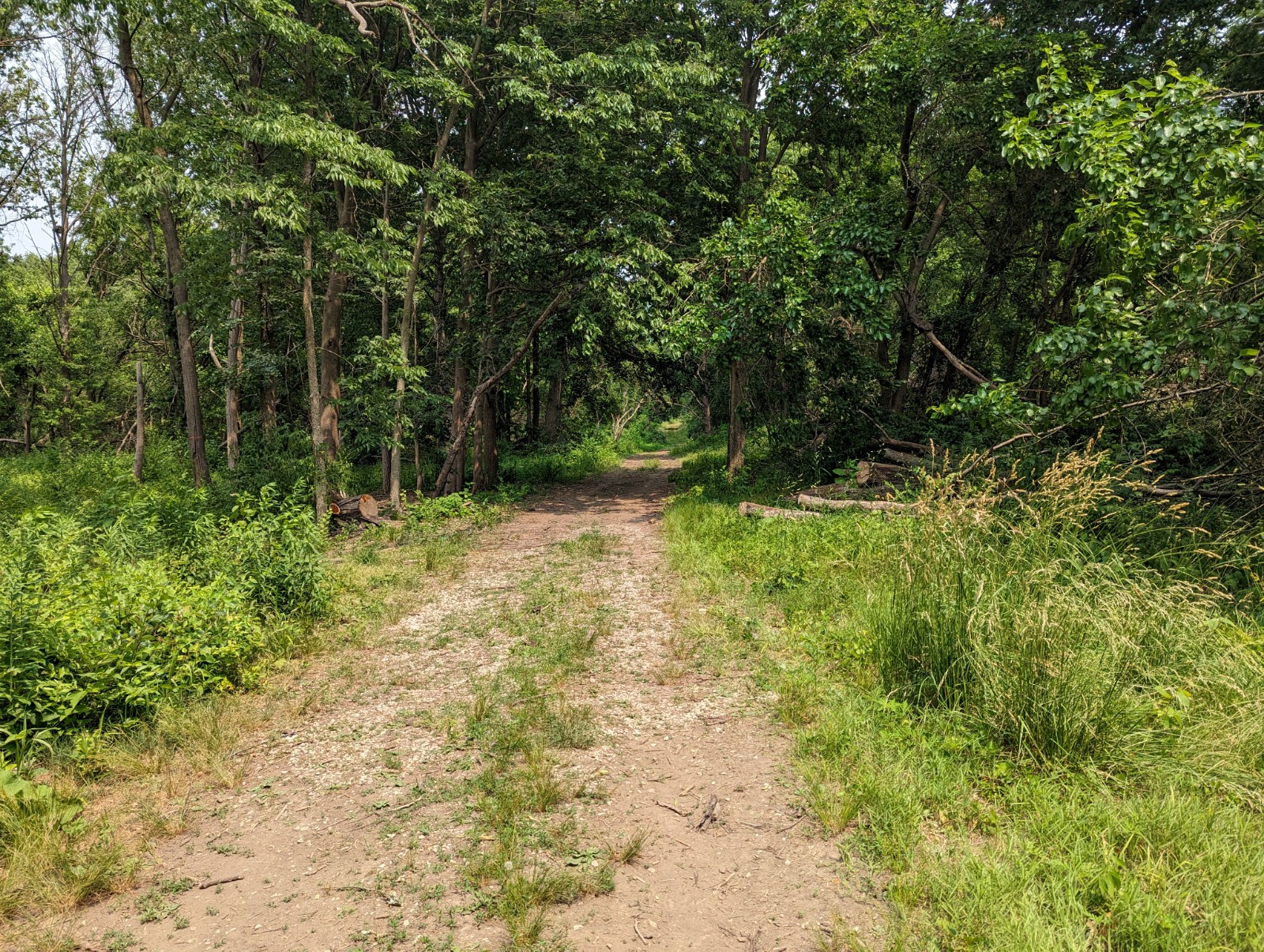
I blew right on past the distance of my longest run ever by close to a mile and a half. 🏃🏻♂️ I felt great right on through—no pain at all. I did start feeling tired at about mile 9.5, but I ran pretty strong right to the end.


I blew right on past the distance of my longest run ever by close to a mile and a half. 🏃🏻♂️ I felt great right on through—no pain at all. I did start feeling tired at about mile 9.5, but I ran pretty strong right to the end.
Mildly amusing. Low peak for the first dog walk, notch for drinking coffee and Jumbletime, then my most active time is 7:00 AM, for the second dog walk.
Before I got a dog, my most active time was 11:00 AM, because that’s when I finally get to my workout.

I was not particularly sporty as a child. My dad played catch with me an ordinary amount of time for a father who had no particular aspirations that his son would be a sports star. I played whiffle ball with the neighborhood boy across the street, and threw that ball a good bit. I took tennis lessons, and played quite a bit of tennis, and eventually got sorta okay at tennis, and there’s a certain amount of throwing in tennis, to get the ball to the person whose serve it is. (Plus, a serve and a forehand are both throwing-pattern type movements.)
My point is simply that although I did throw balls around some as a boy, it was never important, and I pretty much quit as soon as I was out of high school.
(And even in high school phys ed there was way less ball-throwing than there probably should have been—the fake, altered versions of sports that they made us play in class provided neither training nor practice for the kids who were not “good at sports.” We were sent out to stand in the field and do nothing except be available to be blamed once every 10 or 15 hours when a ball unexpectedly came our way.)
This was brought home to me a couple of times in the past decade or so. Once, perhaps 10 years ago, while out walking near some ball fields in our old neighborhood, I had a softball roll up at my feet. A player across the street asked me to throw it to him. I attempted to do so, and ended up throwing it perhaps halfway to him.
That was embarrassing.
When I thought about why I did so poorly, my analysis was that there were several issues. One was perhaps just a lack of strength. Just as much was simply having forgotten how hard to throw a ball to get it to go a particular distance—an important skill in many sports, and one that requires quite a bit of training. Mainly, though, I think the issue had to do with having lost the fine motor-control patterning. Throwing a ball involves a bunch of muscles that all have to fire in sequence, each one at just the right moment.
I was reminded of this more recently, because Ashley likes to chance a ball, so I’ve been throwing one for her from time to time.
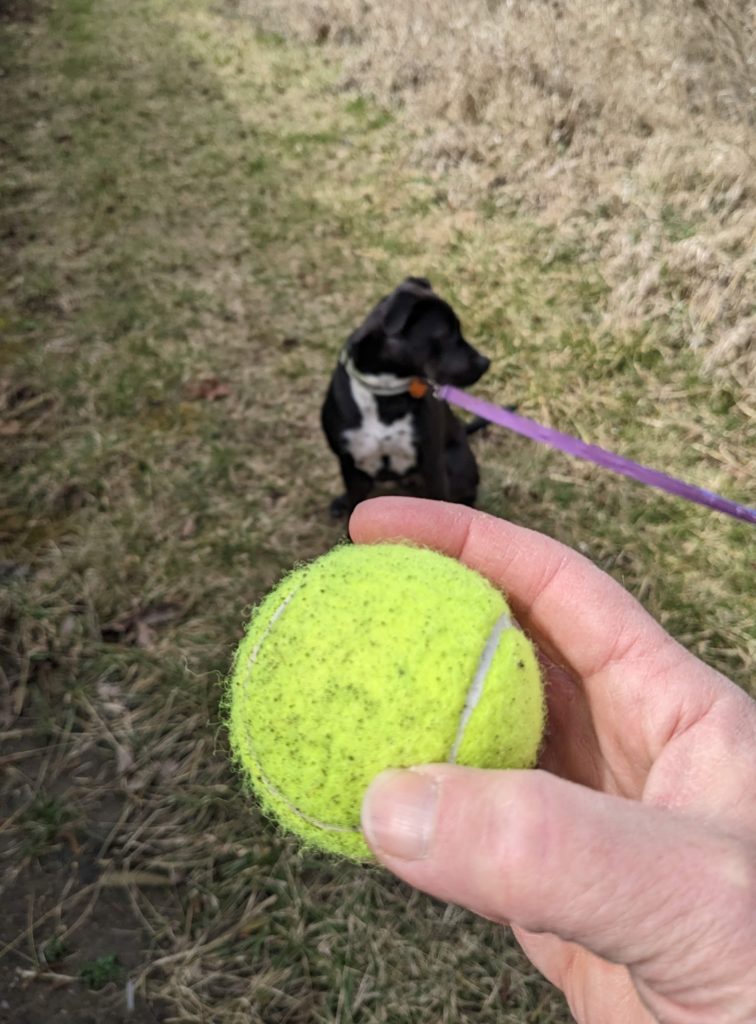
When I started doing this, around the end of November last year, once I had Ashley signed up for the dog park, I was crap at throwing a ball.
I’m still crap at throwing a ball by any objective standard, but maybe 1000 throws, spread out over the course of six or seven months, have gotten me up to being able to throw the ball perhaps three times as far as I could in November, and with quite a bit more accuracy.
I suspect that the main thing is simply the muscle pattern stuff: my nervous system has relearned which muscles to fire at which moment in order to execute a competent throw. Secondarily, I think my heavy club swinging has helped some. Inside Circles are essentially a throwing pattern, and using a 15 lb club lets me build considerable strength in those muscles.
It’s not the exact same motion as throwing any particular ball, so I still need to practice whatever throw I want to be good at, but the muscles are being strengthened in the right patterns, which I’m sure has already helped.
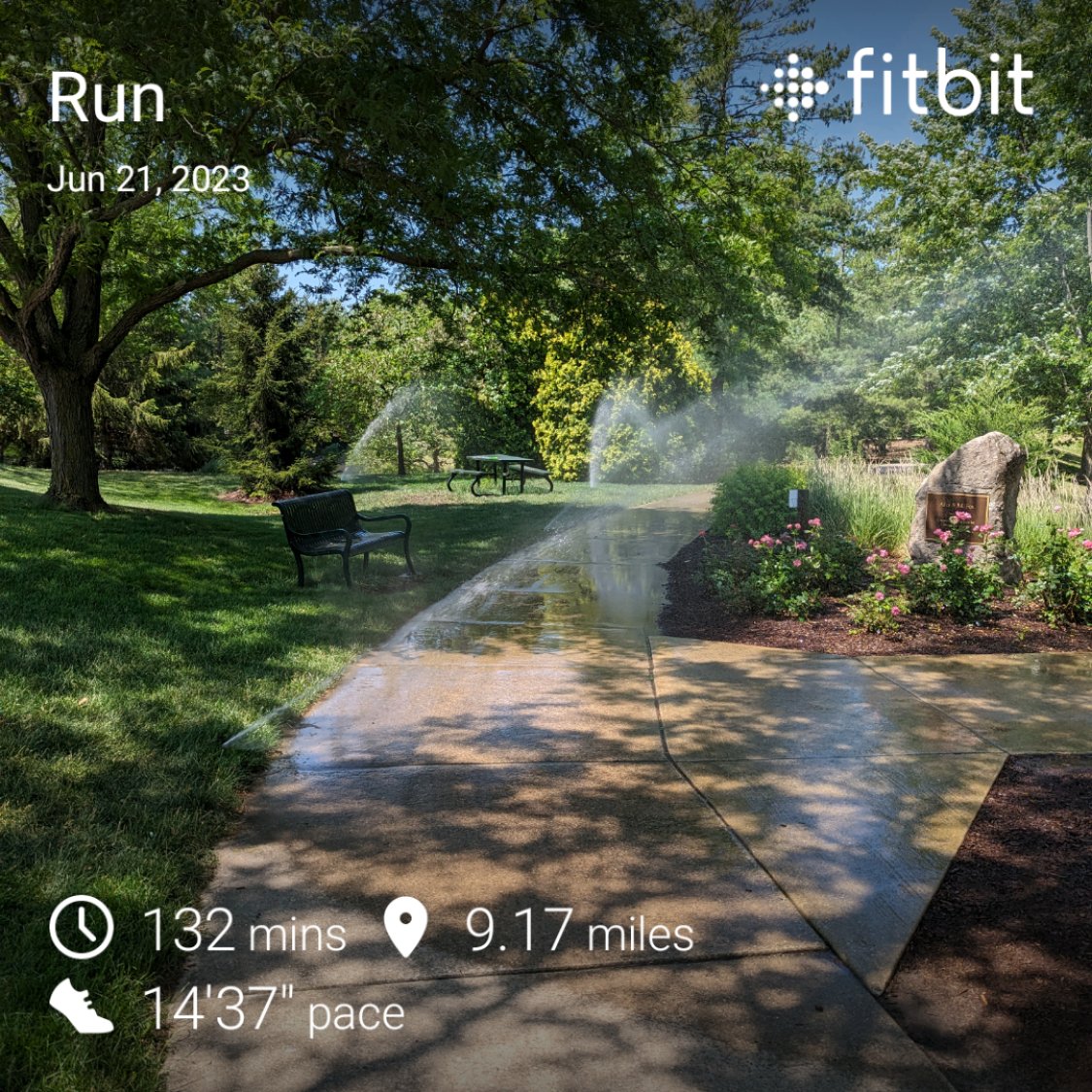
If I’d realized that this run would be 0.01 miles less than my longest run ever, I’d have run another 0.02 miles. I did run it three minutes faster, though, despite the heat. #run 🏃🏻♂️
It may not be obvious from the picture below, but those sprinklers are not only blocking the sidewalk; they cover the entire right-of-way from the detention pond to the drainage creek. To get around it I had to walk through a parking lot, down the street, and back through two more parking lots.
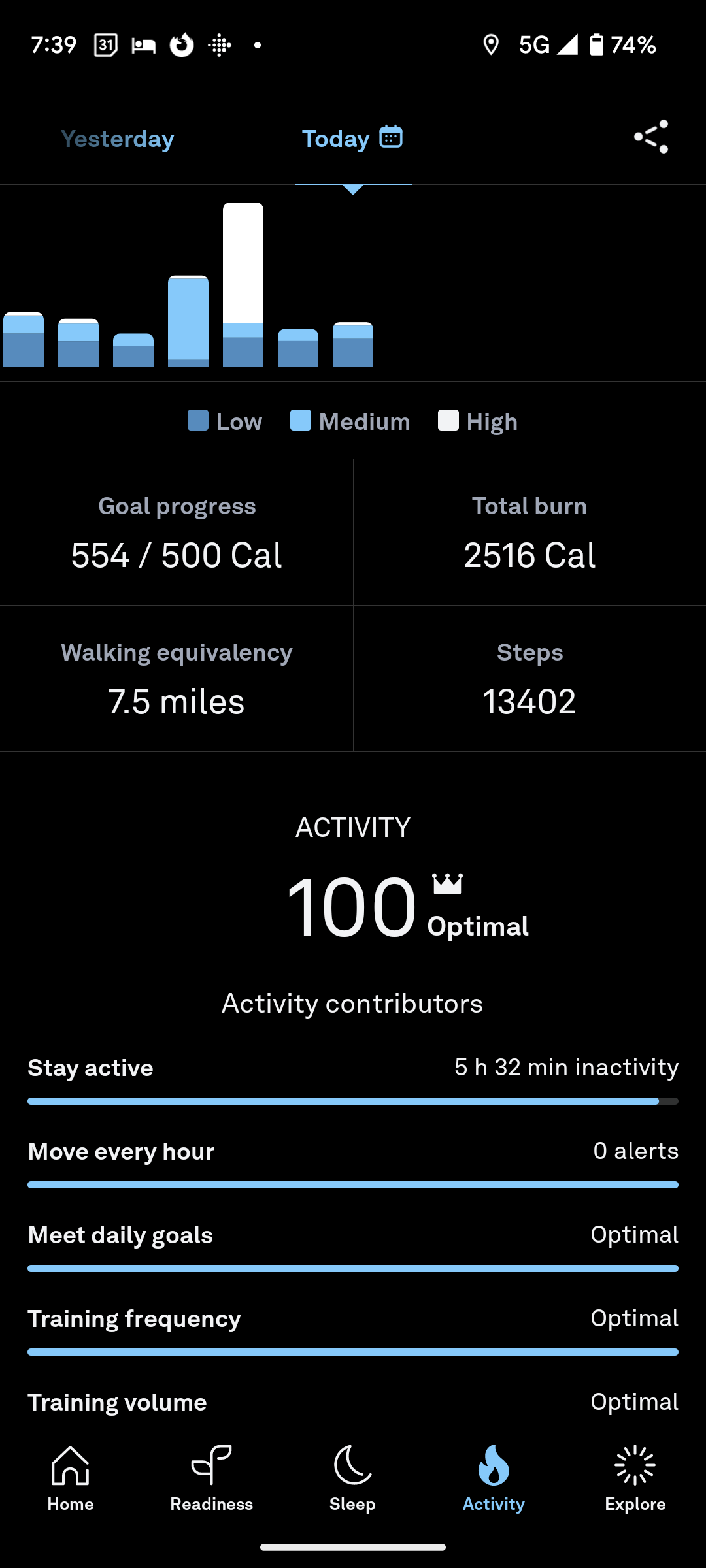
I’m a little surprised to get a score of 100, considering that I didn’t go for a run. In fact, I got a 2 hour nap in the early afternoon.
It’s true I spent most of the rest of the day walking the dog.
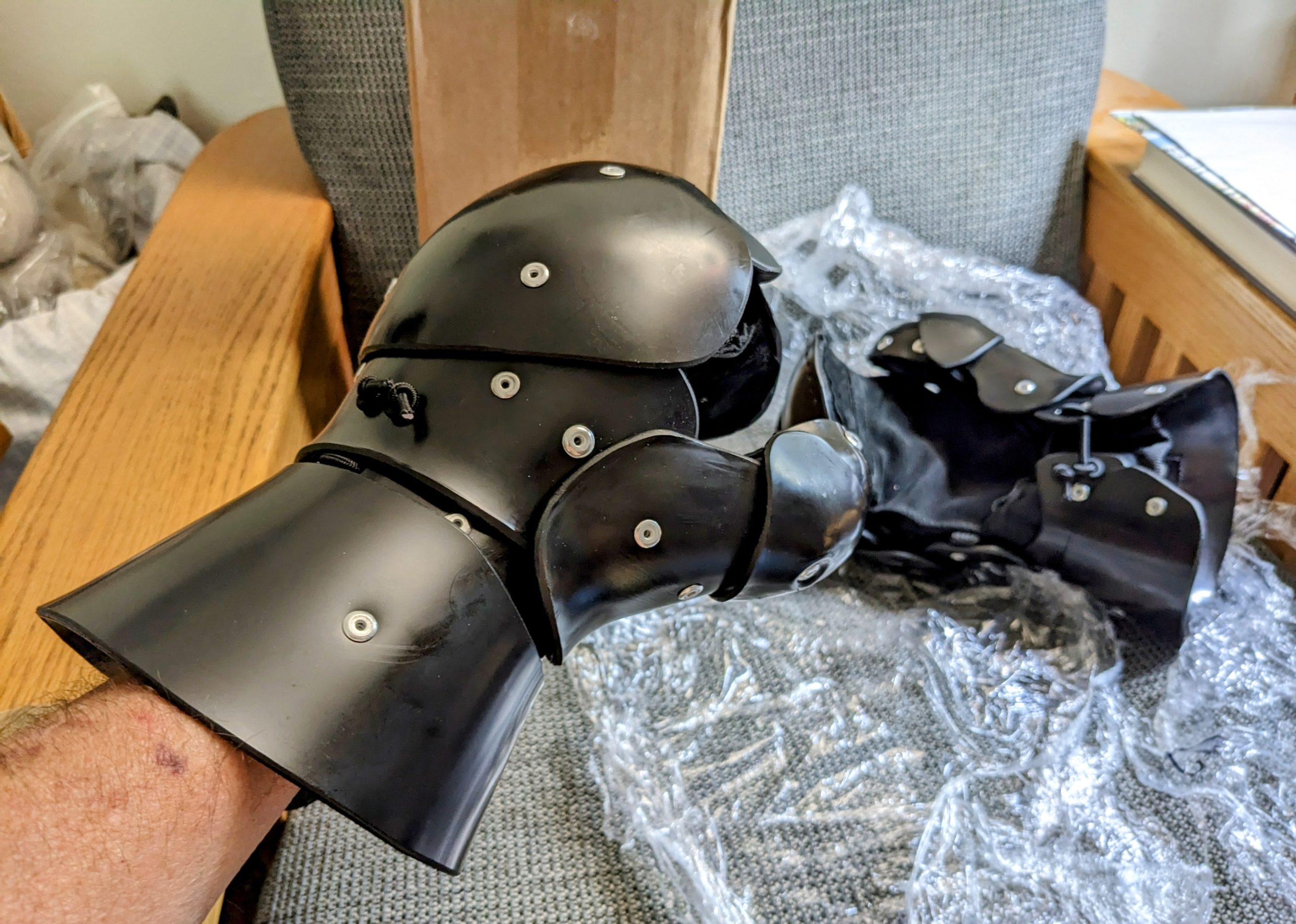
My progress toward being ready for sparing is very slow, but Purpleheart Armoury got some stock of HF Armory Black Knight gloves in my size, so I figured I should just go ahead and buy them.
They arrived today.
In my workout yesterday, in the “lower body” slot where I’d usually do either some type of squat or some type of lunge, I decided to practice stepping for longsword fencing. As soon as I started, I realized there was all sorts of nuance to how to do it, with a lot of details I wasn’t sure of.
I posted a question to the group discord, asking when to pivot the foot. (That is, the front foot is pointed straight ahead and the back foot is turned out 45 to 90 degrees. After you step forward with your back foot it’s easy enough to just put it down pointed straight ahead. But your new back foot needs to turn out at some point.) I also wanted to know whether people did a toe-pivot or a heel-pivot.
A couple of people responded to say that they did toe-pivots, and that they did them at the end, after establishing the new front foot. Good to know.
When I got to today’s class, Christopher Lee French (one of the intermediate HEMA students, but also an instructor in sport fencing at The Point Fencing Club & School of Champaign) gave me a whole master-class in stepping. He made a series of excellent points.
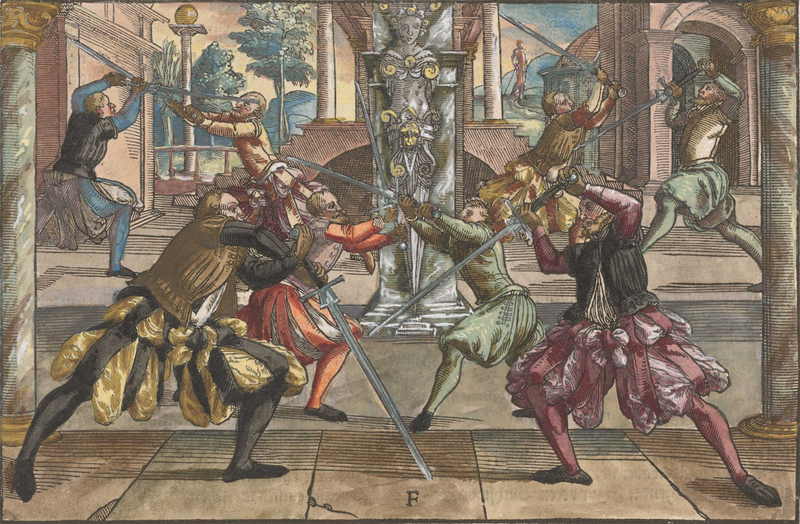
(Let me pause just for a moment here to make it clear that all the following is my understanding informed by what he was telling me. It’s certainly not his fault if I’ve gotten some things wrong here.)
Here’s a short list:
He demonstrated many of these, and his example steps also helped me make sense of the (to me) odd use of a toe-pivot described by others in the discord. He tended to finish a quick step with his back foot not yet pointed out. Instead it was pointed forward, with the heel off the ground. When I asked about why he wasn’t turning it out, he said, “Fix that when you have time.” And the way you’d fix it would be to do a toe pivot, and then put your heel down.
None of this really has much to do with Meyer’s text. That is, I’m not trying to figure out how to step. Rather, I’m thinking about what to train to be able to execute what Meyer’s text documents.
Specificity would suggest that the way to train for fast, smooth, even steps would be a lot of stepping. But I know from experience that it’s always worth breaking these things down and checking to see if any of the pieces is posing a limitation.
To pick a not-so-random example, I’m limited by my leg strength for single-leg standing in a very low stance. Things to train for leg strength with bent knees: wall sits, single-leg wall sits, single-leg standing. Those first two I’ve done before, but I can emphasize them a bit for a while. I can add some bent-knee single-leg standing. And, because specificity is still a thing, I’ll also practice executing passing steps and gathering steps as smoothly and rapidly as possible.
I’ve long known I’m no good at paying attention to more than one thing at a time. Because of that, I try pretty hard to avoid even trying to multitask. Still, even having accepted that I’m crappy at this sort of thing, I’m a little frustrated at how it’s showing up in my longsword practice.
Generally I think I’m okay if I try to just do one thing. For example, I’d assume I could execute a single cut or a single parry. But, no. In fact, I can only do a piece of a cut or parry—because one of the things Meyer says is “Every cut gets its step.” So I’m not doing it right unless I do the sword action and the stepping action.
It’s not actually quite as bad as I’m making it sound. I can move into any of the guards. I can swing my sword in any of the principle cuts. I can step with proper form. I can even swing my sword and step forward. But as soon as I try to, let’s say, step to the side and swing my sword, my form tends to break down.
Longsword is called “longsword,” not because the sword is long, but rather because nearly all the cuts and parries are executed with the arms extended. (And this is actually crucial to being successful. If you have your arms extended and your body in the right position, you can parry any cut. Try that with your elbows bent, and you’re very likely to get hit with a sword.)
I can hold the sword in good structure, with my arms straight. I can execute a cut with it, with my arms straight. I can even execute a cut and step forward, with my arms straight. But when I try to do any specific cut with any specific footwork, my form starts to break down: I tend to pull my arms in. And if I focus on keeping my arms extended, I forget to take the step.
It’s very frustrating.
Fortunately, having learned taiji, I know the solution to this: Practice.
That is, proper “deliberate practice” à la K. Anders Ericsson, where you: perform an action, monitor your performance, evaluate your success, try to figure out how to do it better, and then repeat.
If I can only pay attention to one thing at a time, I need to break these sword moves down further. I need to practice keeping my arms straight during a cut, and then repeat that move (paying attention) over and over again, until I can do it without paying attention. Then I can add in the stepping, and practice cutting with a step over and over again until I can do both of those things without paying attention. Then I can start working on a longer phrase: cut while stepping, next cut while stepping. And so on.
I haven’t started practicing outside of class much yet. There are only certain things that can be done without a partner, but those things—stance, guards, footwork—are exactly what I need to practice.
And we will still be meeting over the summer, so I’ll have plenty of opportunity to practice the other things as well.
It’s time to make a plan.
I keep taking Ashley on longer and longer walks, trying to tire her out so I can get stuff done, but (duh) it just makes her ready for yet longer walks.
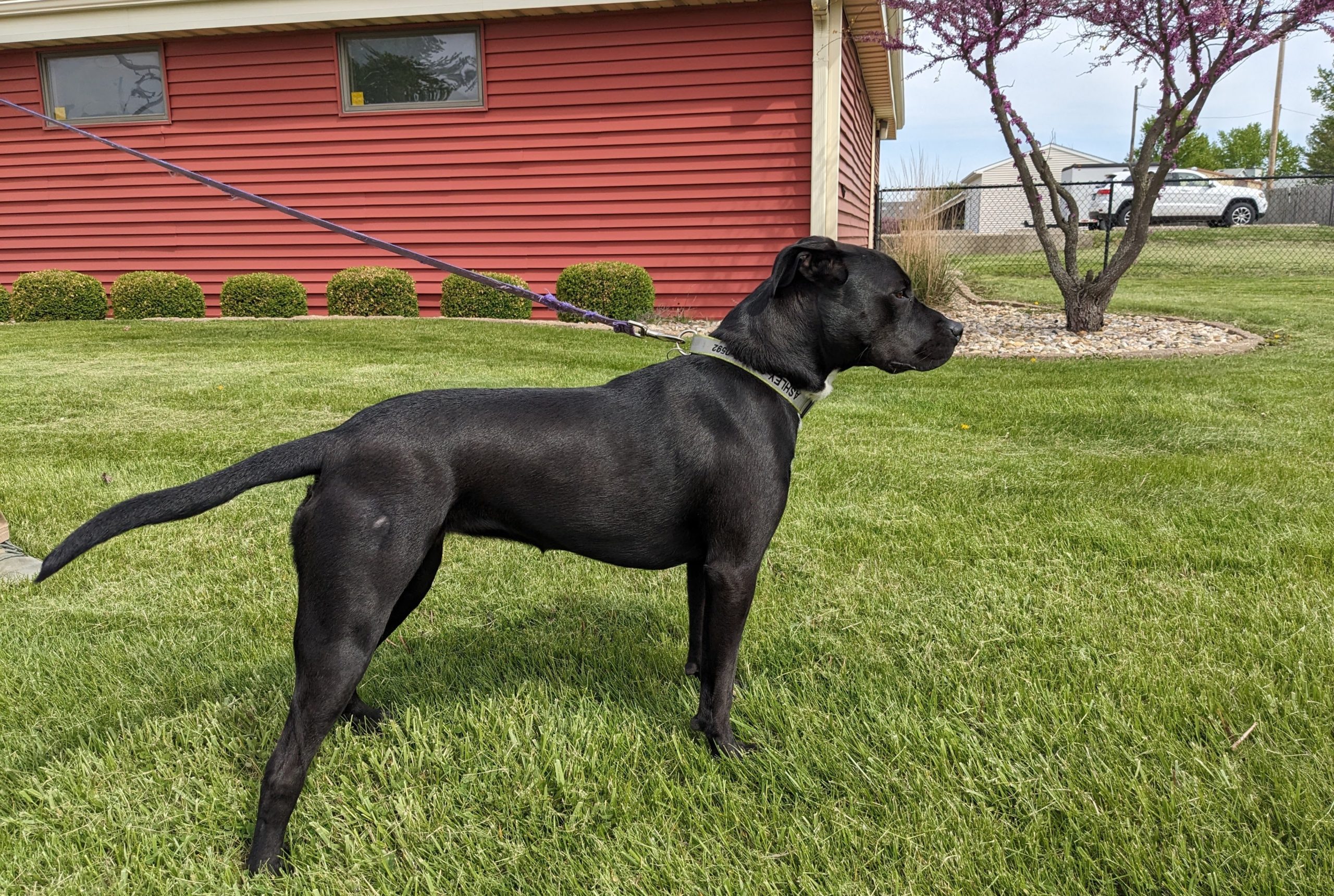
In other news, Ashley continues to look like a dog fitness model. #dogsofmastodon