My progress toward being ready for sparing is very slow, but Purpleheart Armoury got some stock of HF Armory Black Knight gloves in my size, so I figured I should just go ahead and buy them.
They arrived today.
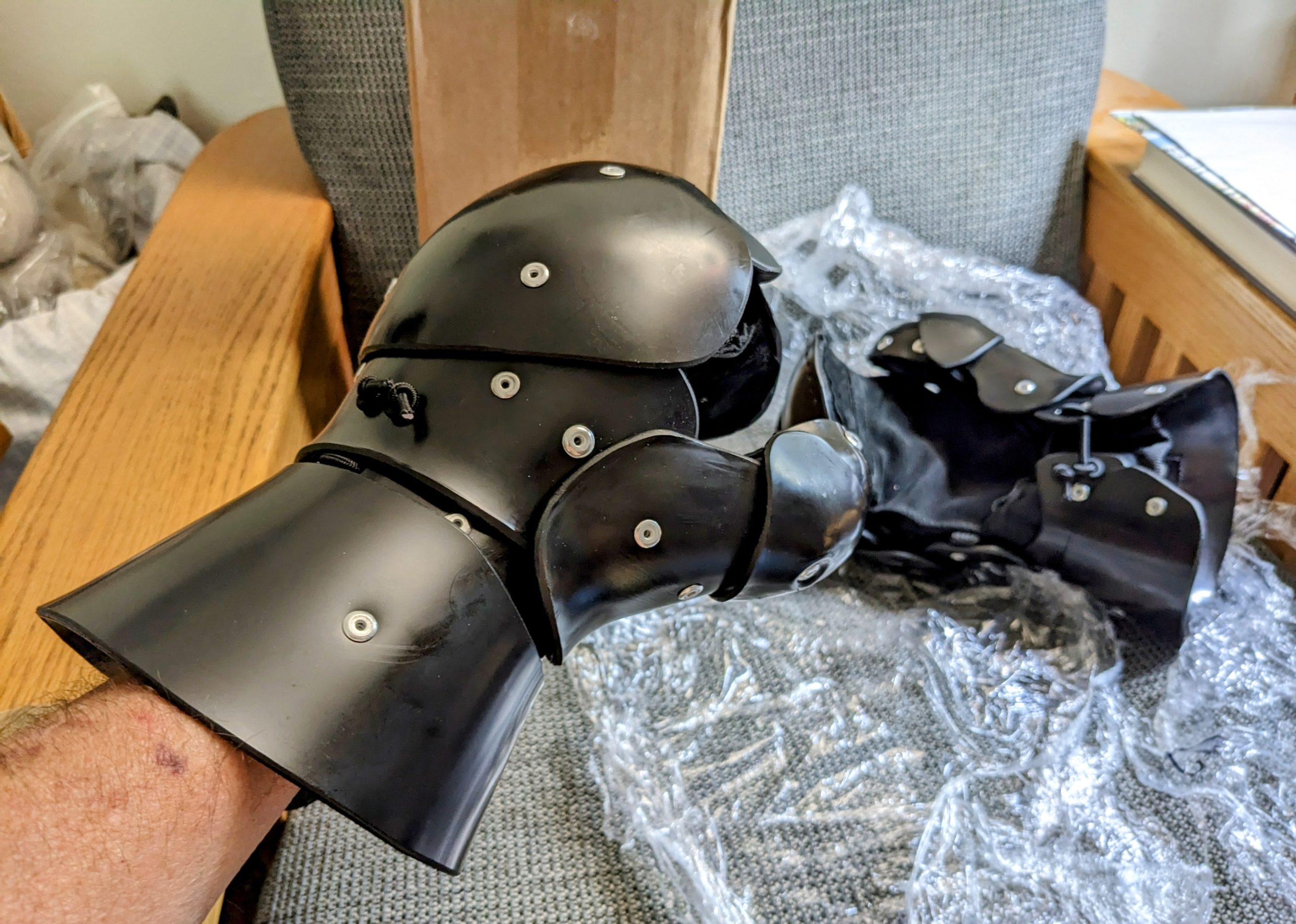
My progress toward being ready for sparing is very slow, but Purpleheart Armoury got some stock of HF Armory Black Knight gloves in my size, so I figured I should just go ahead and buy them.
They arrived today.
In my workout yesterday, in the “lower body” slot where I’d usually do either some type of squat or some type of lunge, I decided to practice stepping for longsword fencing. As soon as I started, I realized there was all sorts of nuance to how to do it, with a lot of details I wasn’t sure of.
I posted a question to the group discord, asking when to pivot the foot. (That is, the front foot is pointed straight ahead and the back foot is turned out 45 to 90 degrees. After you step forward with your back foot it’s easy enough to just put it down pointed straight ahead. But your new back foot needs to turn out at some point.) I also wanted to know whether people did a toe-pivot or a heel-pivot.
A couple of people responded to say that they did toe-pivots, and that they did them at the end, after establishing the new front foot. Good to know.
When I got to today’s class, Christopher Lee French (one of the intermediate HEMA students, but also an instructor in sport fencing at The Point Fencing Club & School of Champaign) gave me a whole master-class in stepping. He made a series of excellent points.
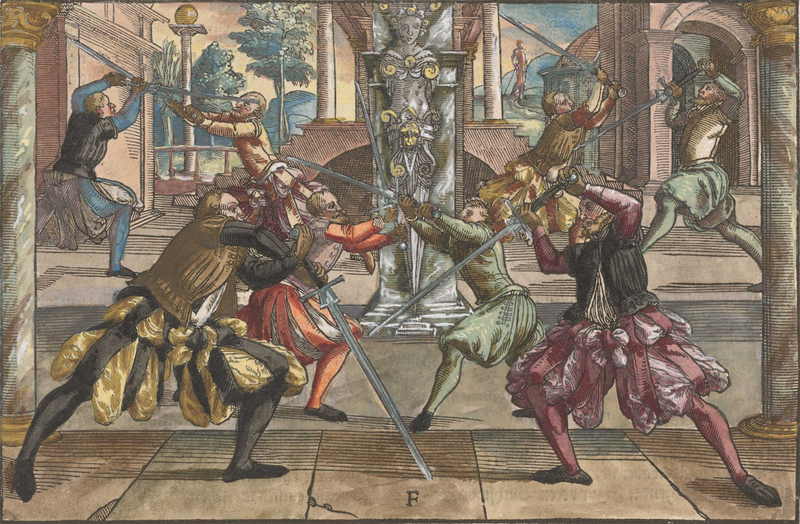
(Let me pause just for a moment here to make it clear that all the following is my understanding informed by what he was telling me. It’s certainly not his fault if I’ve gotten some things wrong here.)
Here’s a short list:
He demonstrated many of these, and his example steps also helped me make sense of the (to me) odd use of a toe-pivot described by others in the discord. He tended to finish a quick step with his back foot not yet pointed out. Instead it was pointed forward, with the heel off the ground. When I asked about why he wasn’t turning it out, he said, “Fix that when you have time.” And the way you’d fix it would be to do a toe pivot, and then put your heel down.
None of this really has much to do with Meyer’s text. That is, I’m not trying to figure out how to step. Rather, I’m thinking about what to train to be able to execute what Meyer’s text documents.
Specificity would suggest that the way to train for fast, smooth, even steps would be a lot of stepping. But I know from experience that it’s always worth breaking these things down and checking to see if any of the pieces is posing a limitation.
To pick a not-so-random example, I’m limited by my leg strength for single-leg standing in a very low stance. Things to train for leg strength with bent knees: wall sits, single-leg wall sits, single-leg standing. Those first two I’ve done before, but I can emphasize them a bit for a while. I can add some bent-knee single-leg standing. And, because specificity is still a thing, I’ll also practice executing passing steps and gathering steps as smoothly and rapidly as possible.
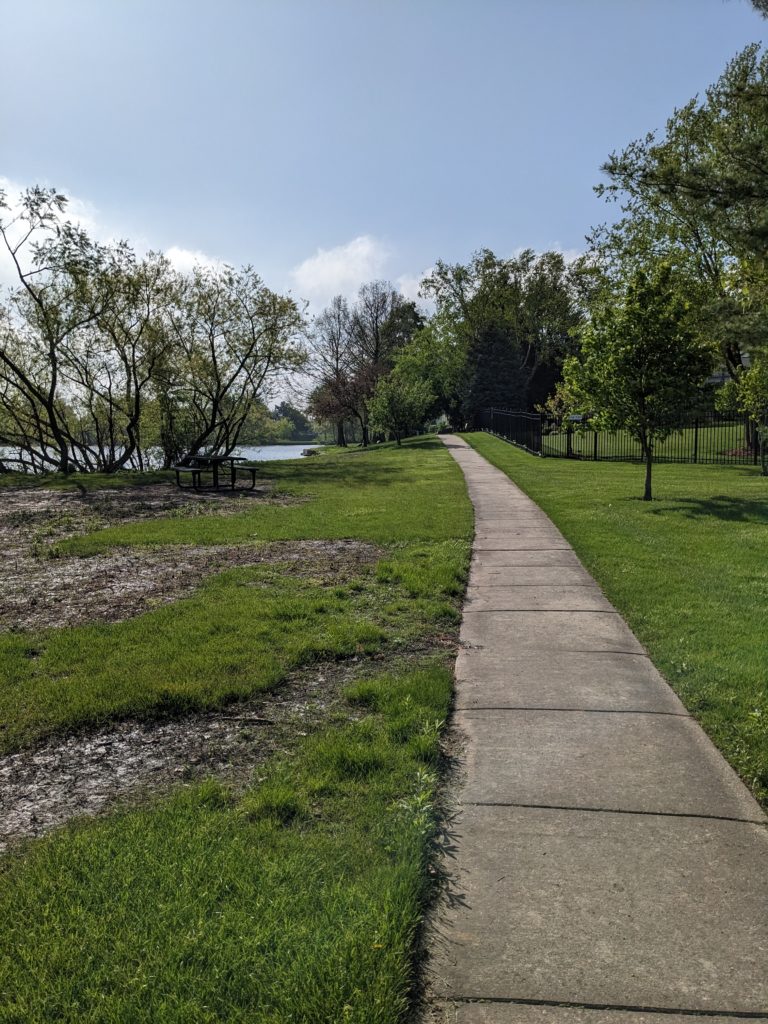
“That felt like going downhill,” said Jackie.
“We’ve been living in Central Illinois too long,” said I.
(To be fair, it was downhill—just barely.)
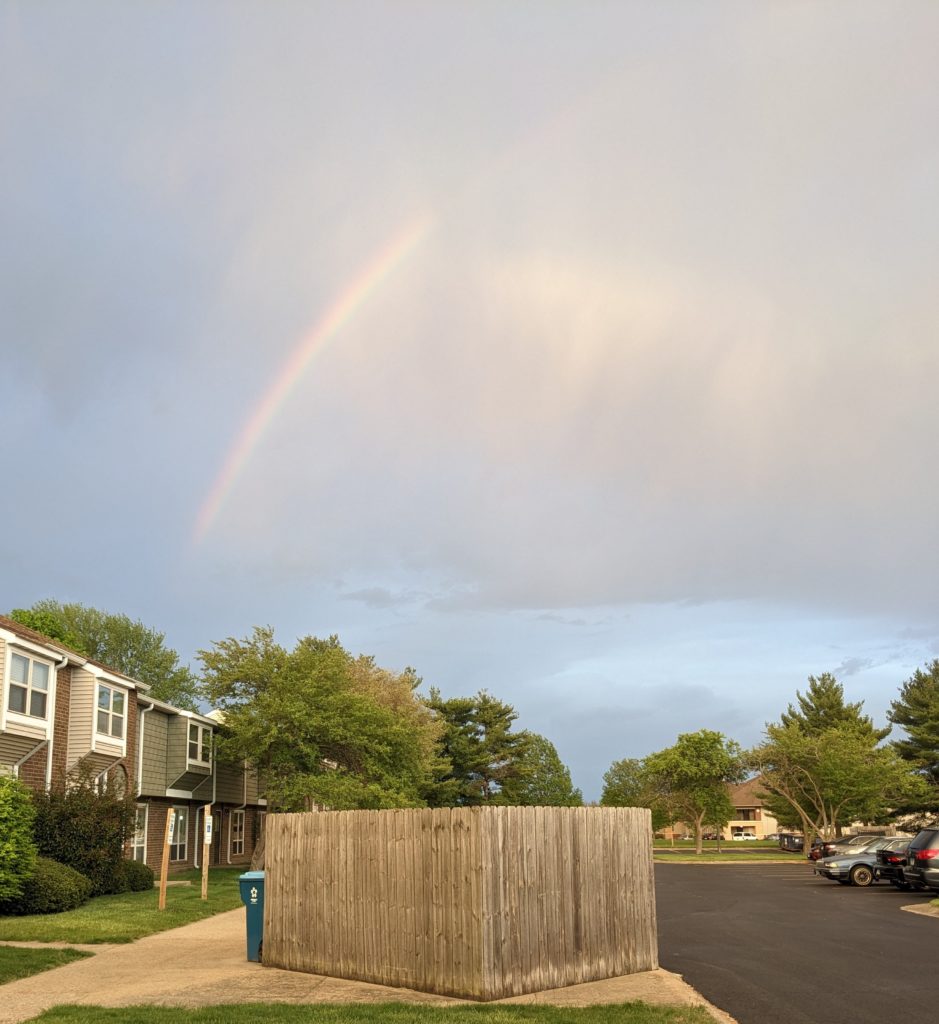
I got kinda ho-hum about rainbows when I lived in California, because they were so common. Back here in Illinois they’re more of a big deal—I probably see less than one a year, on average.
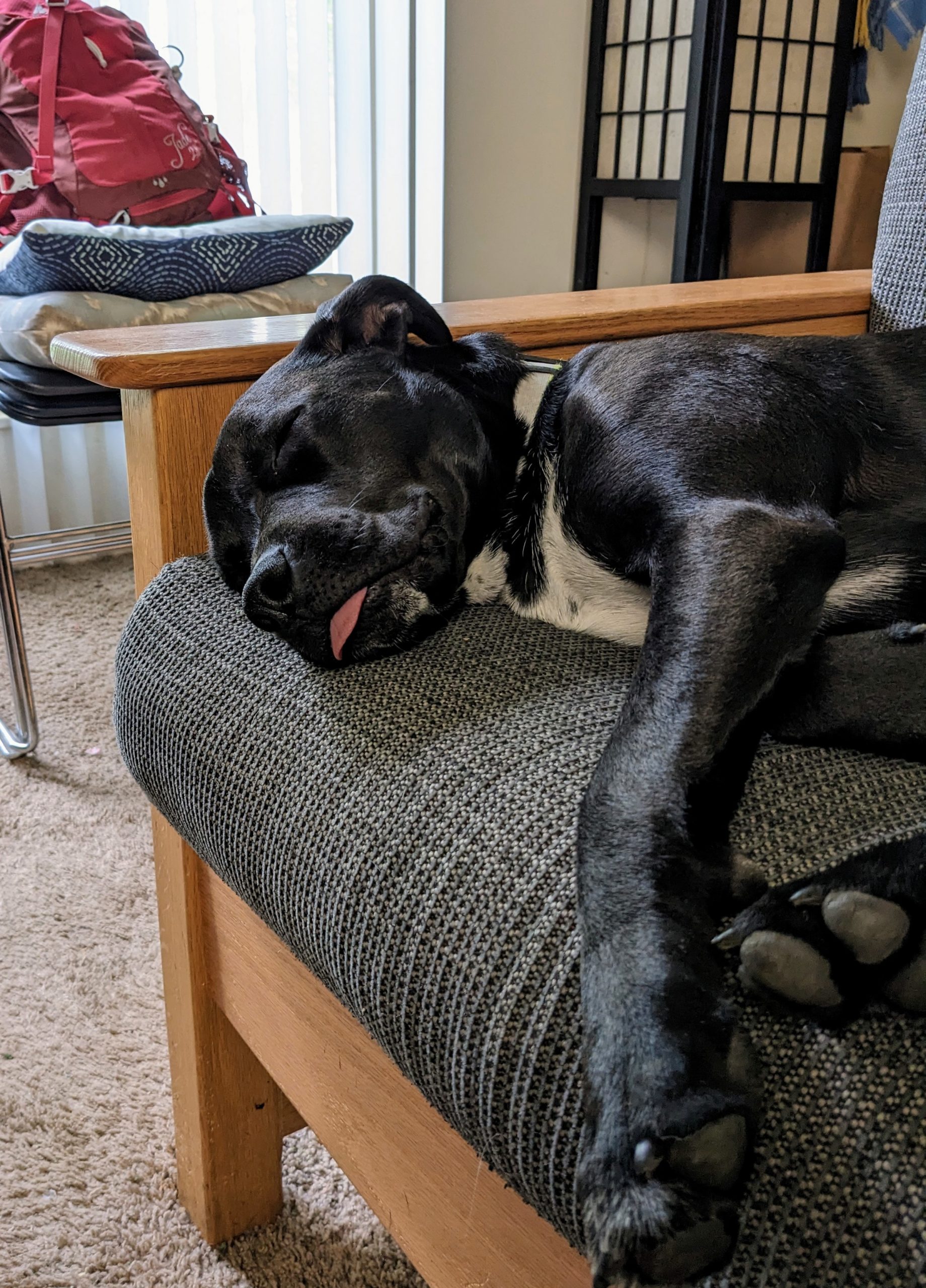
I was unaware of the word blep until the last time I posted an image like this. But this one is new today.
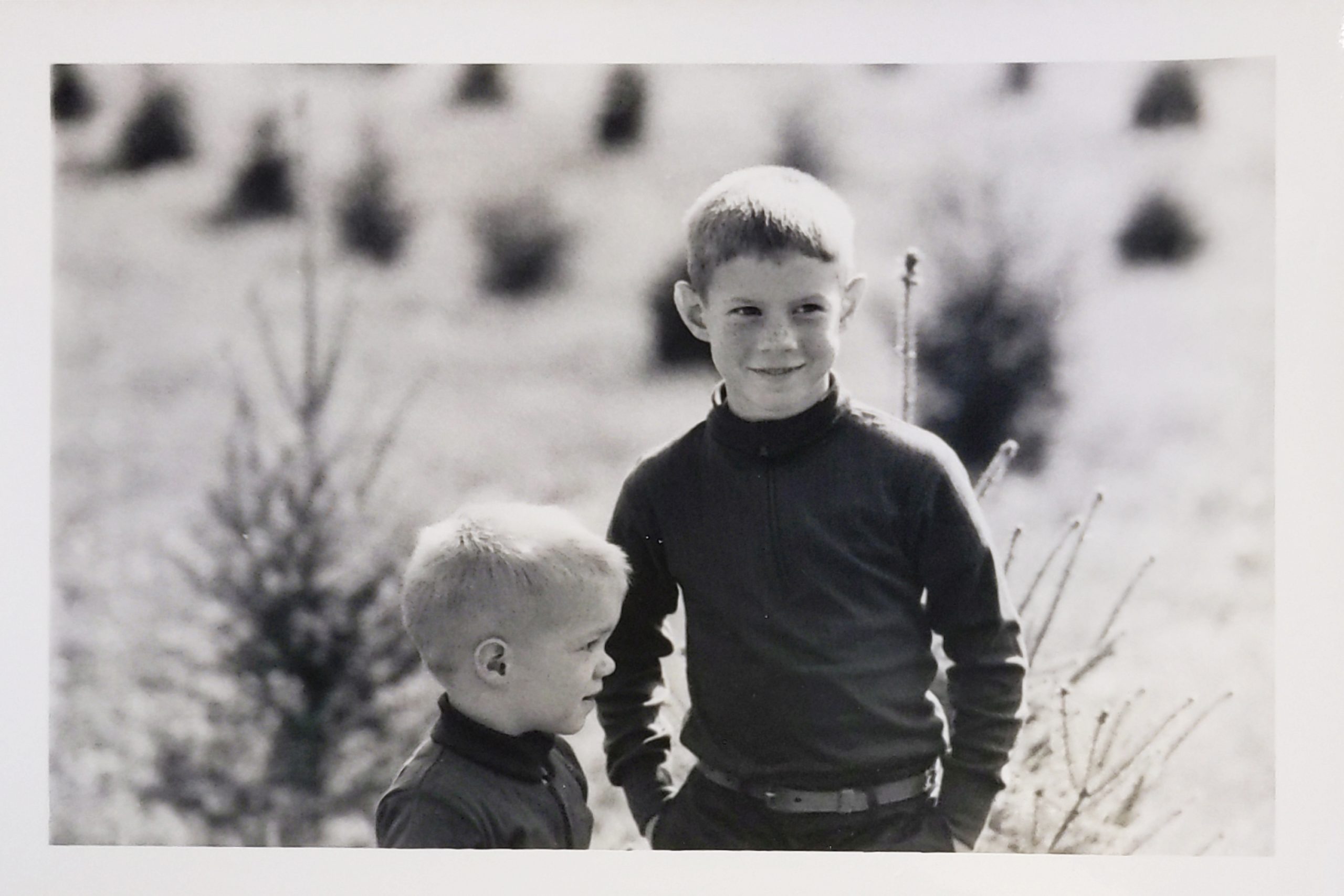
Looking through my dad’s stuff while in Kalamazoo for his funeral, I happened upon this photo of my brother and me that he’d taken.
Katy asked me to say a few words about my father at his funeral. I wrote the following and read it at the service.
My father was a scientist—an ornithologist and an ecologist.
He was many other things too, of course. Father. Teacher. Student. Writer. Conservationist. Artist. But even those things he often did in ways that drew on the fact that he was a scientist.
He told me a story once of when he was an undergraduate student.
He had taken a course in optics, and the optics textbook that the teacher had chosen was unusual, in that it did not solve some classic—very difficult—problem in optics that was worked as an example in every other optics textbook. Instead, it offered that as a problem for the students to solve, and his professor had assigned it as homework.
Finding the problem difficult to solve, my father went to the library and looked at another optics textbook which worked through the solution as part of the text. Grasping the essence of the solution, my father solved the homework problem.
The next day the professor asked if anyone had managed to solve the problem, and the only student to raise his hand was my father. The professor asked how he had solved it, and my father said, “It seemed obvious to me.”
As, of course, it was, after working through the solution in the textbook from the library.
I tell this story for several reasons. First of all, it was very much how my father was. Asked to solve a difficult problem of course he would use the resources available at the library. And, although he wasn’t quite so much this way after becoming a father, I gather he was something of a smart ass as a college student.
I think he always hoped that his students would approach the problems he provided in this manner, and was always a little disappointed how few did so.
My father had a pretty good sense of humor about most things. But he also had his quirks.
One time he mentioned aloud that he needed his license plate number for some form, and my brother immediately replied, “It’s 332 QRQ.”
“How is it that you can remember my license plate number?” my father asked.
“It’s easy,” my brother replied. “You have three hundred thirty-two quirks.”
My father didn’t think that was especially funny, which of course made it all the funnier to the rest of us.
Along with being a writer, my father was also an editor. He edited the Jack Pine Warbler for many years. When I was first writing science fiction stories he would read them. He didn’t offer much in the way of a critique, just unqualified support. And a careful line edit, which was very useful.
We spoke many times about our philosophies of writing. One time in particular I remember him saying that his goal in writing was, “To say exactly what I mean in limpid prose.”
It struck me as exactly the right goal for a writer. I have stuck with it, even though it is clear that having a more distinctive voice might make my stories my salable, because it suits me so well.
My father taught me to think like a scientist.
Several times when I was in high school I remember sitting with him in his study, trying to come up with a testable hypothesis for this or that phenomenon. I remember two in particular. Once we generated a few hypotheses for why we see reverse dimorphism in many raptors, but rarely in other birds. Another time we generated some hypotheses for why we sleep.
We never conducted any experiments to falsify any of these hypotheses, but the experience of generating falsifiable hypotheses—of thinking about things in terms of falsifiable hypotheses—was invaluable to me for the rest of my life.
Even our family vacations were expressions of his scientific understanding and interest. More than one vacation took place at a biological research station. One in particular was memorable for its black flies.
My father was many things but, above all, he was a scientist. This influenced and governed his thinking about everything. His work. His writing. His art. His land conservation. It was what he devoted his life to, and what he would want to be remembered for.
My father passed away a few weeks ago. His funeral was Saturday.
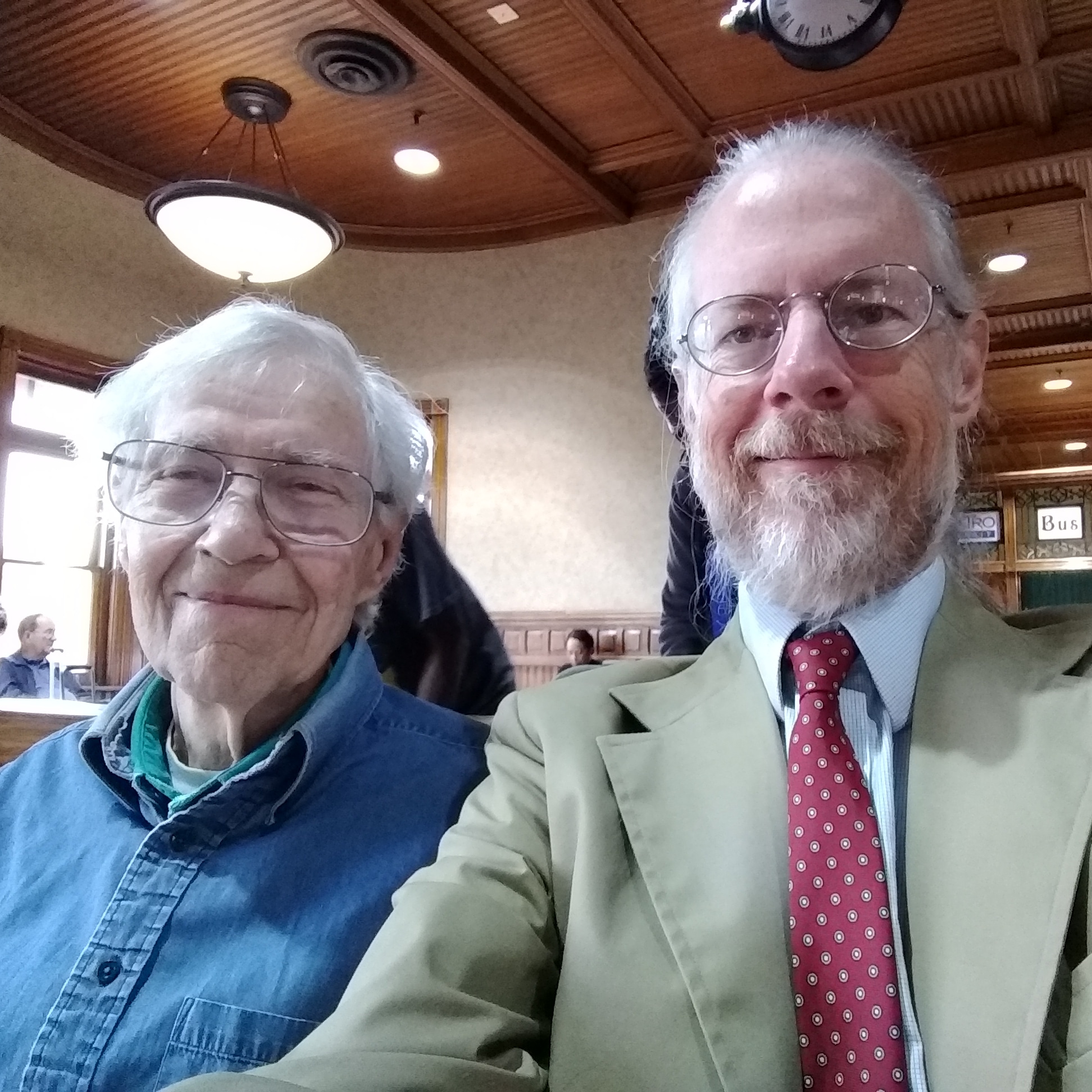
My dad and me in 2018
Jackie and I found a place to board the dog, and then made a lightning-fast trip to Kalamazoo, driving up on Friday, hanging out with Katy that evening and the next morning, attending the funeral, and then heading right back home.
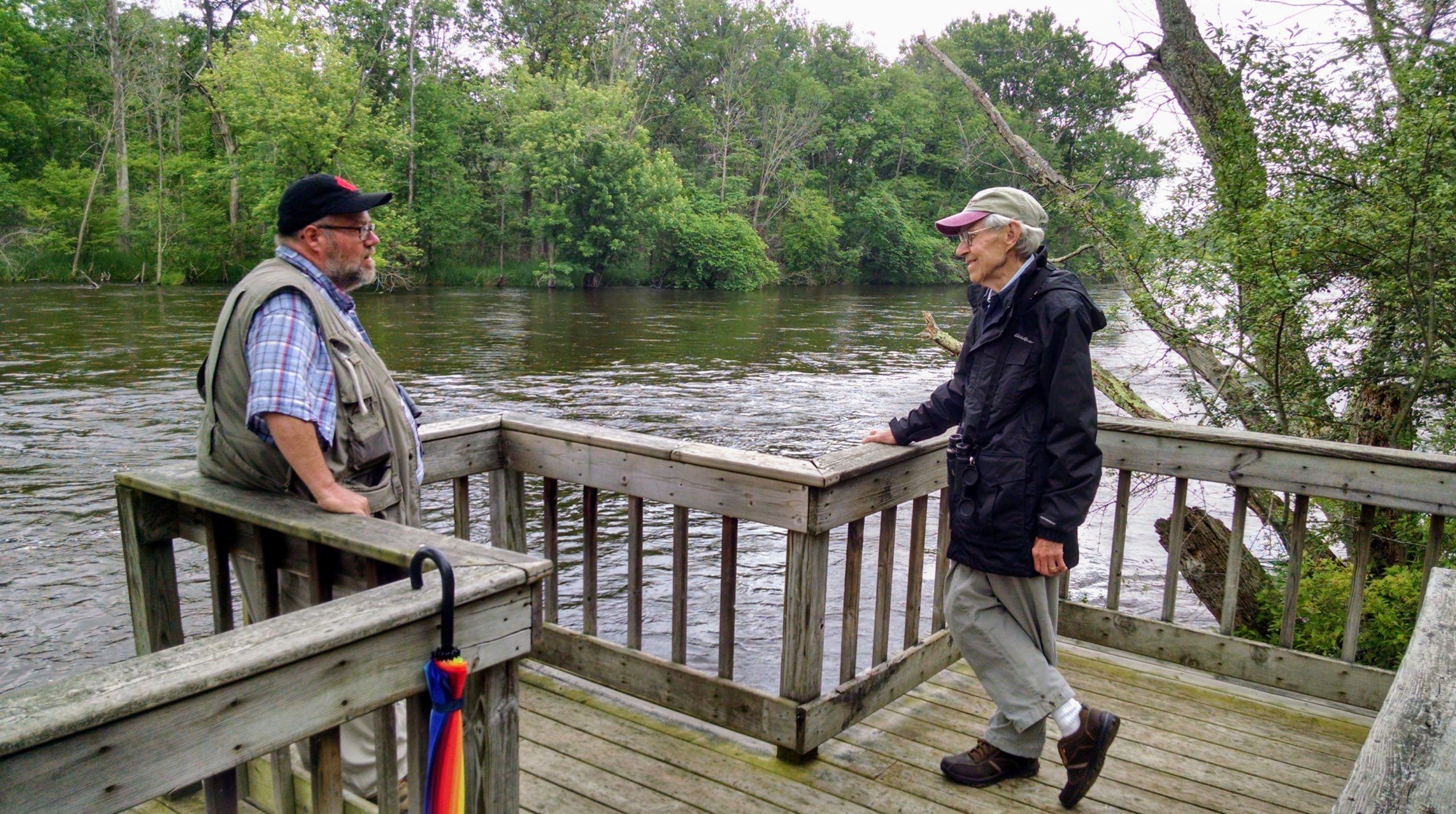
My brother and my dad in 2015
All of Katy’s kids came, along with their spouses. It was good to be able to visit with them as well.
The funeral was at People’s Church, the Unitarian church that my family attended from some time when I was in late elementary school. It was a great church, offering a spiritual community that avoided being laden down with a bunch of “god” stuff. I had not previously met Rachel, the current minister, but she did a great job, talking about the value of mourning, the value of sharing stories.
Along with Katy and her kids and their spouses, Jackie and I stood outside the sanctuary and shared a few words with each of the more than 100 people who came to celebrate my father’s life. There were many neighbors who had met them just in the few years that they’d lived at Friendship Village, neighbors from their old neighborhood on 5th street, many of my father’s former students, and more of my father’s old colleagues than I had expected, given that he had outlived so many of them.
After the funeral Jackie and I hit the road straight from the church, and headed on home, getting in just about dusk.
I’m glad to have gone.
I wrote a few words about my dad to read at the funeral. I’ll post the text in a bit.
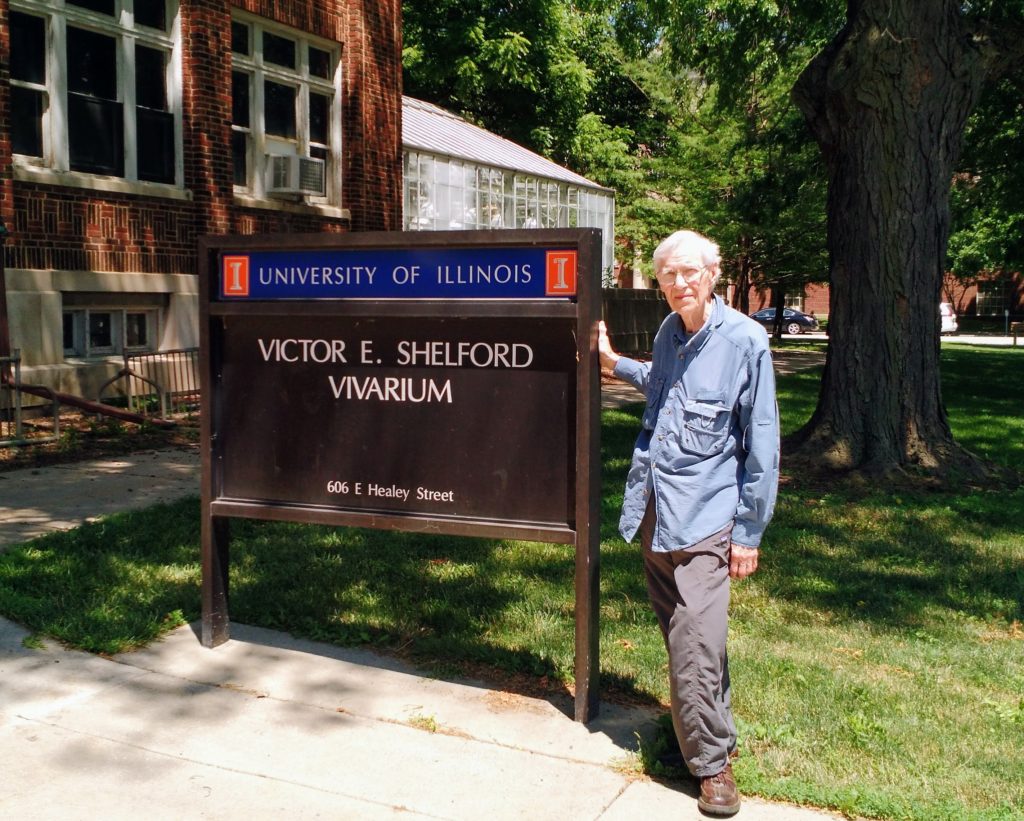
I keep taking Ashley on longer and longer walks, trying to tire her out so I can get stuff done, but (duh) it just makes her ready for yet longer walks.
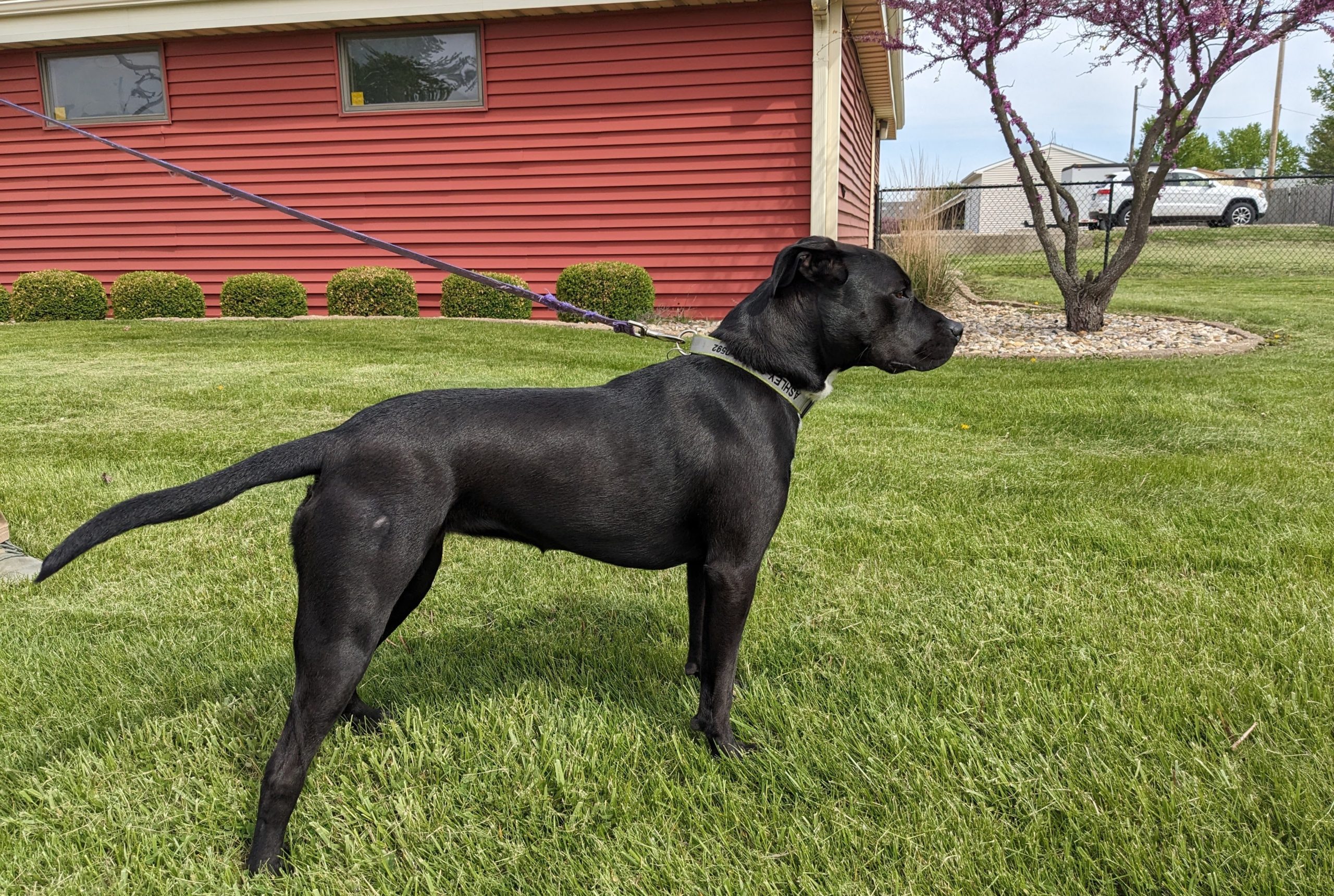
In other news, Ashley continues to look like a dog fitness model. #dogsofmastodon
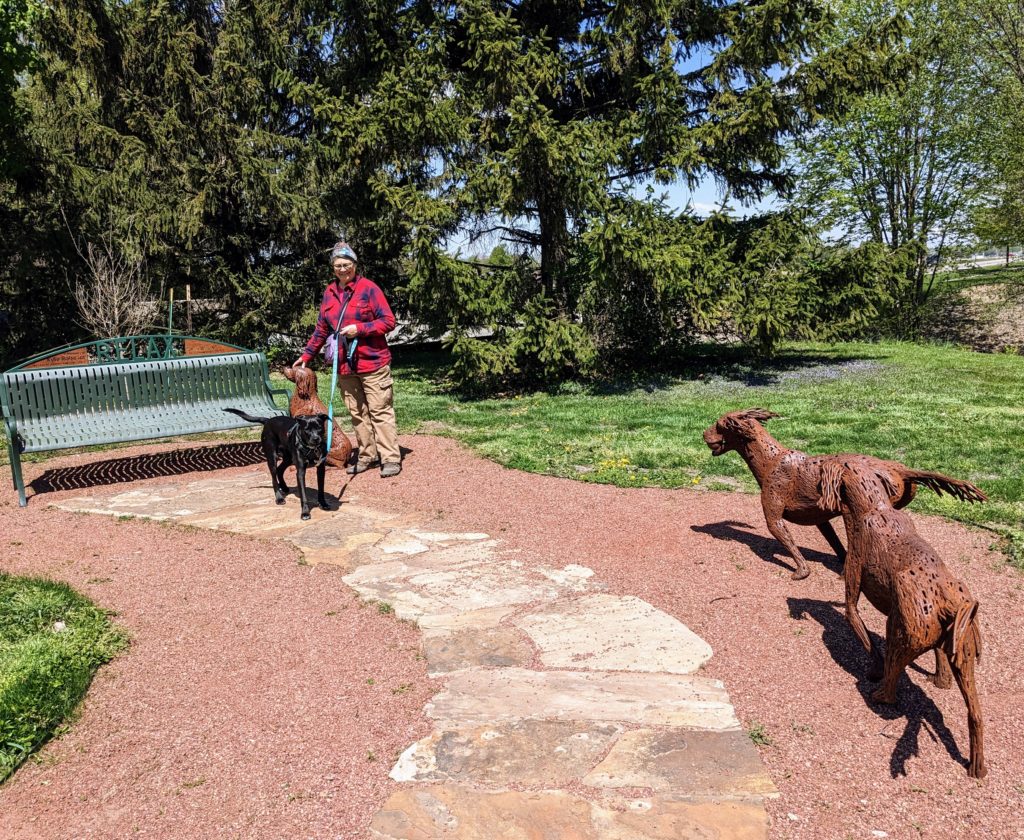
Jackie and I had seen these sculptures from the road on our way to our dog training class. Today we parked at the other end of the Robe trail, then walked to this spot and back to the car, about a 3-mile round trip. #dogsofmastodon