For about six weeks now, I’ve been playing Ingress.

It’s a game. You could almost call it a video game—you see what’s happening on a video screen—but to play you have to go outside: The action of the game happens at specific places in the real world.

The conceit of the game is that matter from another dimension is intruding into our world via portals. In our world, these portals appear as works of public art or unique architecture. Via the game (running on an Android phone or tablet), you can locate and manipulate these portals.

I’ve been having a great time. I’m working with a half-dozen or so local Resistance players, some new like me, others already at level 8 and mainly providing support (since they’re no longer working to level up themselves).

The structure of the game encourages team play—building a powerful portal requires multiple high-level players to work together. But the team play doesn’t need to be simultaneous, just somewhat coordinated. Lower-level players can make faster progress if they play with a higher-level player, but it’s not necessary.

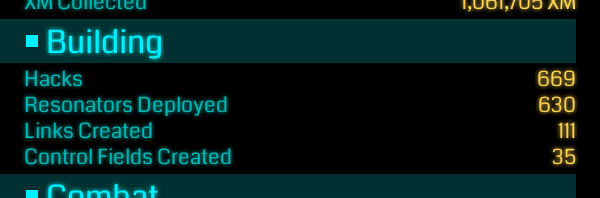
Screenshot_2013-11-01-11-15-12Besides the pleasures of loosely integrated, minimal-pressure teamwork, the other great thing about the game is that, because it takes place in the real world, to play it you have to go out in the real world. The game reports on how far you’ve walked in the course of playing it—for me, 50 km in the past six weeks. (See “Distance walked” in screenshot.) I credit that walking with helping me maintain my weight even though I haven’t been able to run for the past month.

I’m also really into the public art aspect of the game. I was already a huge fan of public art, but the game has made me connect with individual works in a way that I hadn’t. I’m aware of individual pieces in a whole new way—how they relate in space with one another and with other aspects of the community. (Although it is a different experience now to go for a walk downtown. Even when I’m not playing, I’m aware that certain works that are portals in the game. I have to remember that most people are not.)

Anyway, Ingress is now in open beta. If you have an Android device, you can just download the game and go.

I recommend it.

If you’re local and play, get in touch. I’d be glad to help you level up.

Continuing our series of long walks to prepare for a possible through hike of the Kal-Haven trail, Jackie and I walked 16.72 miles today.

We walked to the University of Illinois’s arboretum, and then on through south Urbana to Milo’s where we had lunch. Then we walked to Meadowbrook Park and along the trail that goes along the south and west edges of the park, then through married student housing to the old Motorola building (where OLLI is now) to refill our water bottles, and then on home.

Jackie has asked that I specifically mention that we got a very close look at three juvenile Stufflesbeam (the plural of Stufflebeam, which is what we call ground hogs), just on the west side of the railroad embankment where Stadium Drive crosses Neil. One in particular stood just a few feet away, eating grass with great enthusiasm, close enough to give us a great view of his little nose.

Here’s what my tablet captured via Endomondo:

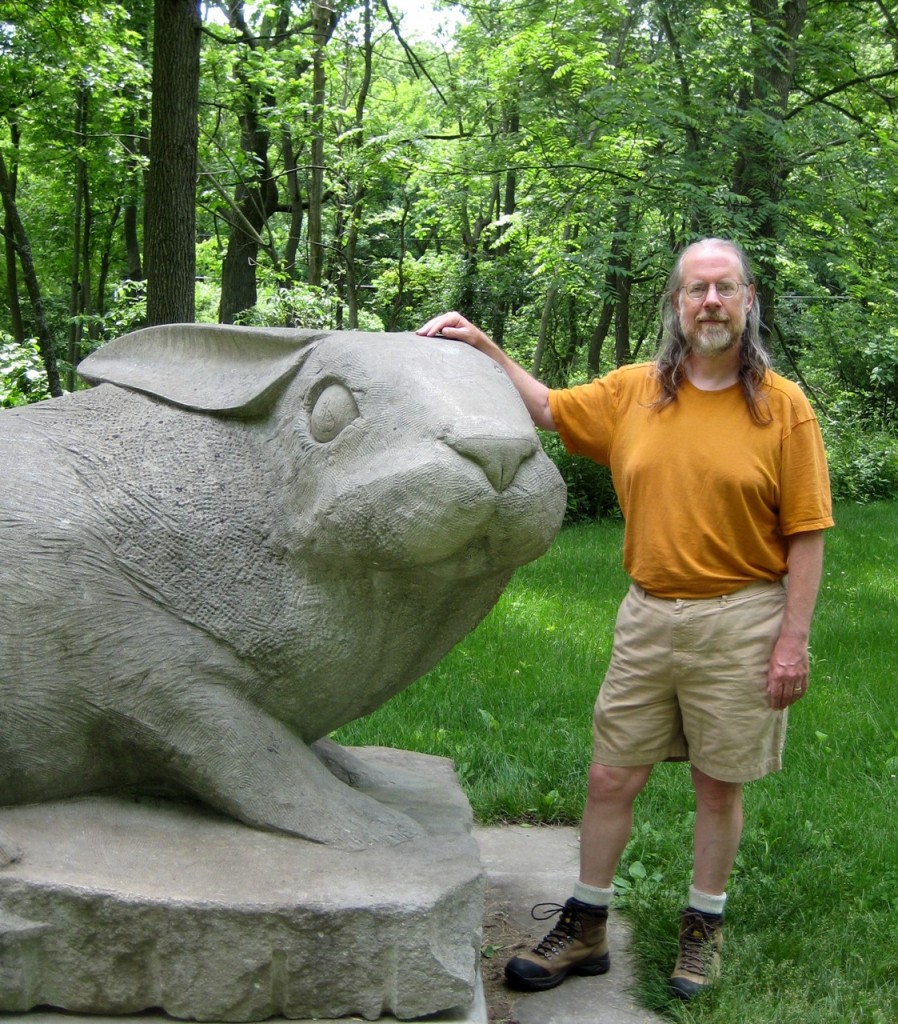
Jackie and I took a couple of pictures of one another with one of our favorite sculptures. We like this sculpture for various reasons, but one is that the very first time we came upon it, suddenly and unexpectedly as we took a turn in the path, we both had the same thought—and we both knew that the other was having that thought: “Anya wouldn’t like that!”

The picture Jackie took of me is pretty good—that’s what I look like. It’s of some interest to me because we took pictures with this sculpture a few years ago, and I didn’t like the pictures of me because of my weight at the time, and there was no way to crop the picture to hide my stomach and yet keep the rabbit sculpture.

I like this one better.

phil-with-rabbit

And, although Jackie just got an ordinary good picture of me, I managed to get a great picture of Jackie.

jackie-with-rabbit

It’s a perfect picture of the Jackie I know—the Jackie I’ve been married to for 21 years.

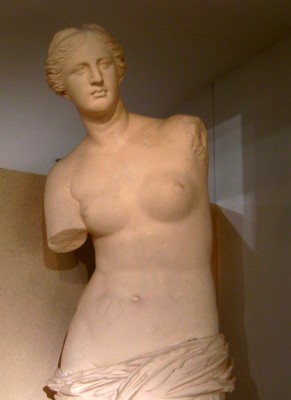
Plaster copy of Venus de Milo.

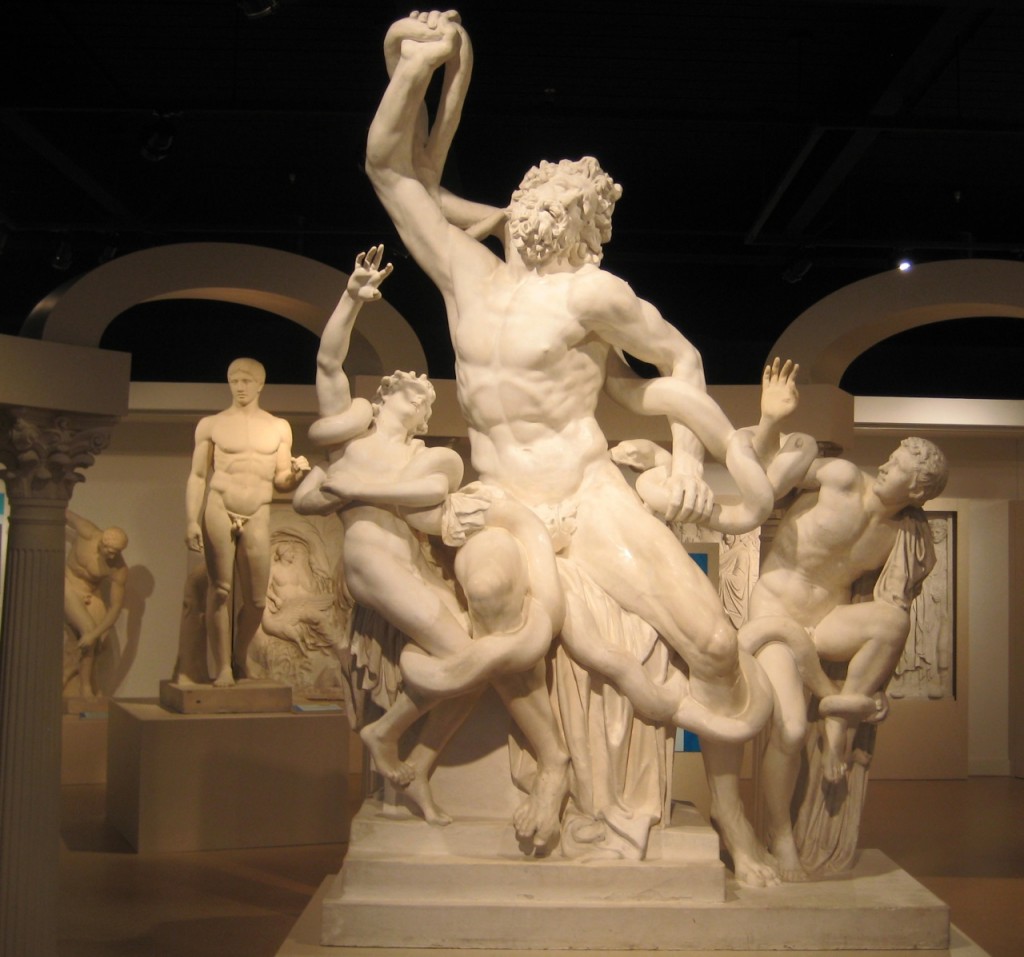
A hundred-odd years ago, a lot of towns and cities had their own museum. In those days, international travel was beyond the reach of ordinary people, and museums saw it as part of their mission to bring the great artistic and cultural works of the world to a place where ordinary people could see them. To support that, a whole industry existed making molds of the great works of European sculpture, and then casting plaster replicas of those works to be displayed in museums.

After all, the Venus de Milo can only be in one museum, but should only people who can get to the Louvre be able to see it?

A few decades later, fashions changed. Air travel and other changes made it possible for ordinary people to get to Europe after all, so they could see the great works of European art and culture. Rather suddenly, it no longer seemed like a great service to show people copies of the greatest works of art and culture.  Museums decided that they should show people originals—even if they could only afford 3rd rate originals.

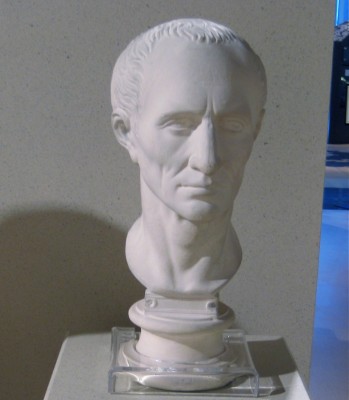
julius caeser
Plaster copy of bust of Julius Caeser

Thanks entirely to great good fortune, at the time that this shift was at its peak, a budget crunch at the University of Illinois had virtually shut down the museums that are now known as the Spurlock Museum. They had so little money, they were unable to hire a director, meaning that there was no one in authority to throw out the plaster copies of the great works and replace them with 3rd rate originals.

At museums all over the country, an incredible number of these excellent copies—quite literally museum quality—were simply thrown away. But not those belonging to the Spurlock Museum.

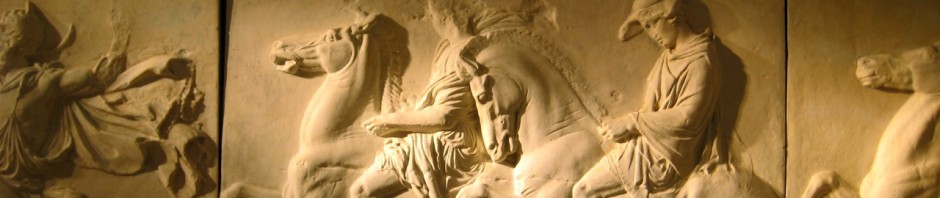
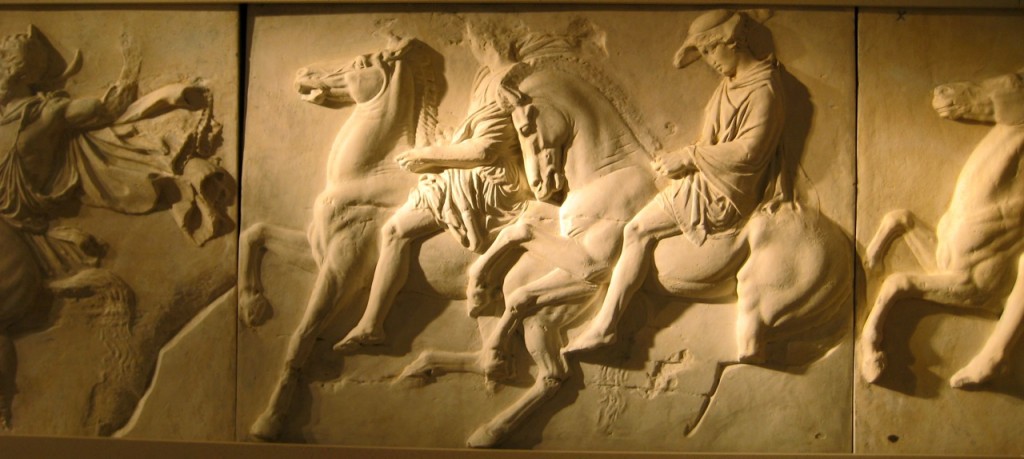
Among other things, we have a fairly complete set of replicas of the Elgin Marbles, made from molds taken before an ill-fated attempt at cleaning did serious damage to the originals. Scholars come from all over the world to study our copies.

elgin marbles
Plaster copy of frieze blocks from the Parthenon

I was going to the Spurlock Museum today, to attend a meditation class by Mary Wolters (an excellent workshop, by the way), and decided to catch an earlier bus so I’d have half an hour to look around the collection. I’d several times wished I had a picture of one or another items from their collection to use to illustrate a Wise Bread post, and I figured this would be a good chance to get a few photos.

Having taken a few, I thought I’d share some here.

spurlock scupture

If you’re local, don’t miss the wonderful Spurlock Museum.

As a huge fan of poster art, I’m delighted that Jay Lake linked to Timothy Anderson’s Art site, full of retro posters (and retro book covers) for sf and fantasy books and films.

Wonderful, wonderful stuff.

The Italian language text is a clever way to reference the spaghetti westerns. Of course, Esperanto text would have been a much better choice.

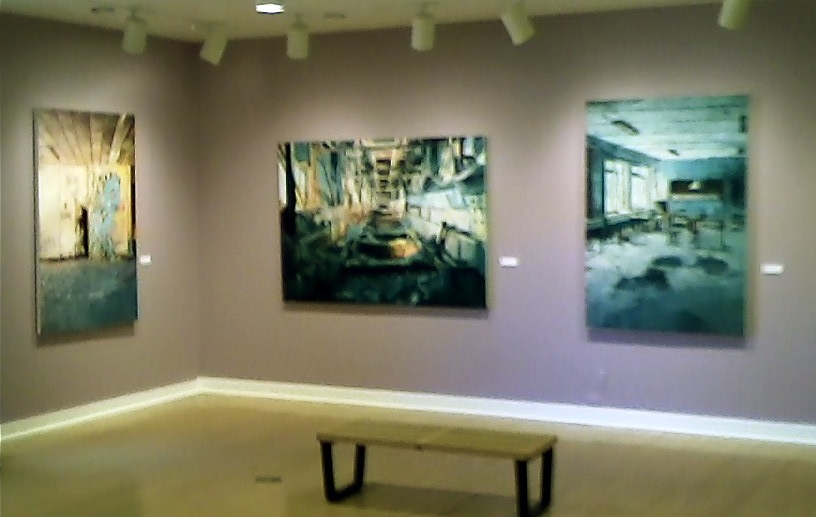
Corner of the Morgan Craig exhibit at the Parkland Art Gallery

Jackie and I were over by Parkland College to do the final harvest at our garden plot, and took the opportunity to visit the Parkland Art Gallery, where the current exhibit is a set of large oil paintings by Morgan Craig.

I’ve been meaning to mention Parkland’s art gallery for a long time. It’s an excellent small gallery that shows a wide range of art. Students, faculty, local artists, and internationally known artists are all featured. It is one place that, despite our straitened  condition, we donate to. That’s not only because we want to support this great resource for the community, but also because they respect and appreciate even their small donors. Our $50 donation to the Parkland Art Gallery makes us patrons. A $50 donation to the Krannert Art Musuem doesn’t even make you a friend (maybe a passing acquaintance).

Sorry for the crappy camera phone image of the art, it really doesn’t do it justice—check out the exhibit link above or Morgan Craig’s artist site to get a better idea of the art, which shows great mastery of line, mass, and perspective. (The leftmost picture in my image, for example, is foolish thing desire.)

I wanted to put the picture up, though, to talk about the color pallet. Most of these pictures are rich in teal and orange. It’s a striking paring. (For one thing, the colors are complementary—that is, opposite one another on the color wheel—so they pop when viewed together.) These pictures of urban decay use them well: the teal for unrusted metal and the orange for the rust, the orange for daylight and the teal for shadows. But a little goes a long way, and as you can see from my crappy little picture, this exhibit was really heavy on the teal-and-orange, something that I’ve been perhaps over-sensitive to since reading the article Teal and Orange – Hollywood, Please Stop the Madness. (Don’t click through to that post unless you want to be similarly sensitized.)

Anyway, given my own interest in the theme of urban decay, I found this a great little exhibit. If you’re local, you should definitely check it out. Visiting it has reminded us that we really ought to go see every exhibit at the Parkland Art Gallery. It’s so close, and the exhibits are so often excellent, that it would definitely reward the minor effort involved.

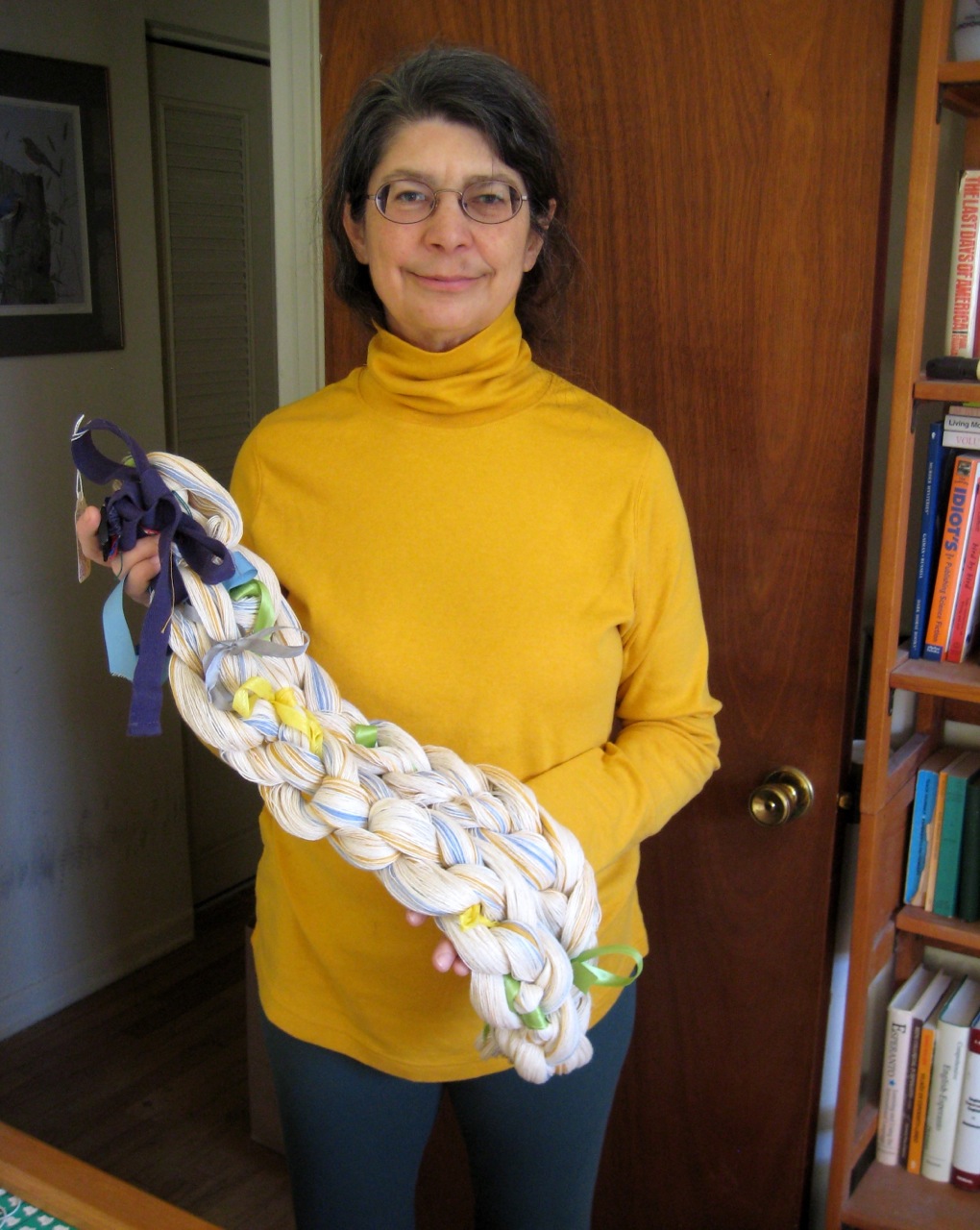
Jackie has an update about her latest project, in which she’s weaving something called Huck Lace.

I mostly wanted to draw attention to the third picture, in which I captured Rapunzel “helping.” In this case, she’s helping by poking her face up through the warp.

Pure luck that I got that picture—her head wasn’t even headed that way when I pressed the button, but there it was in the captured image.

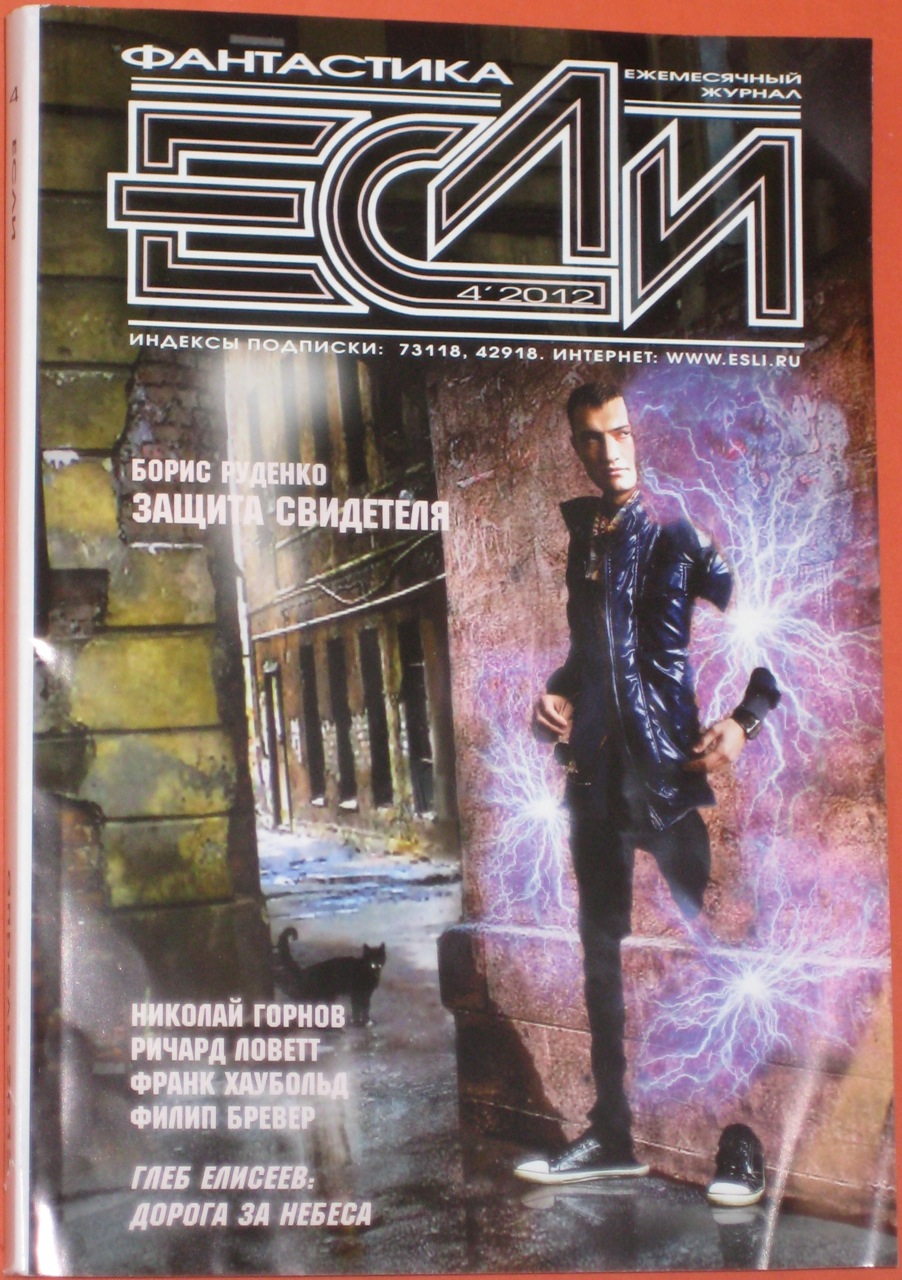
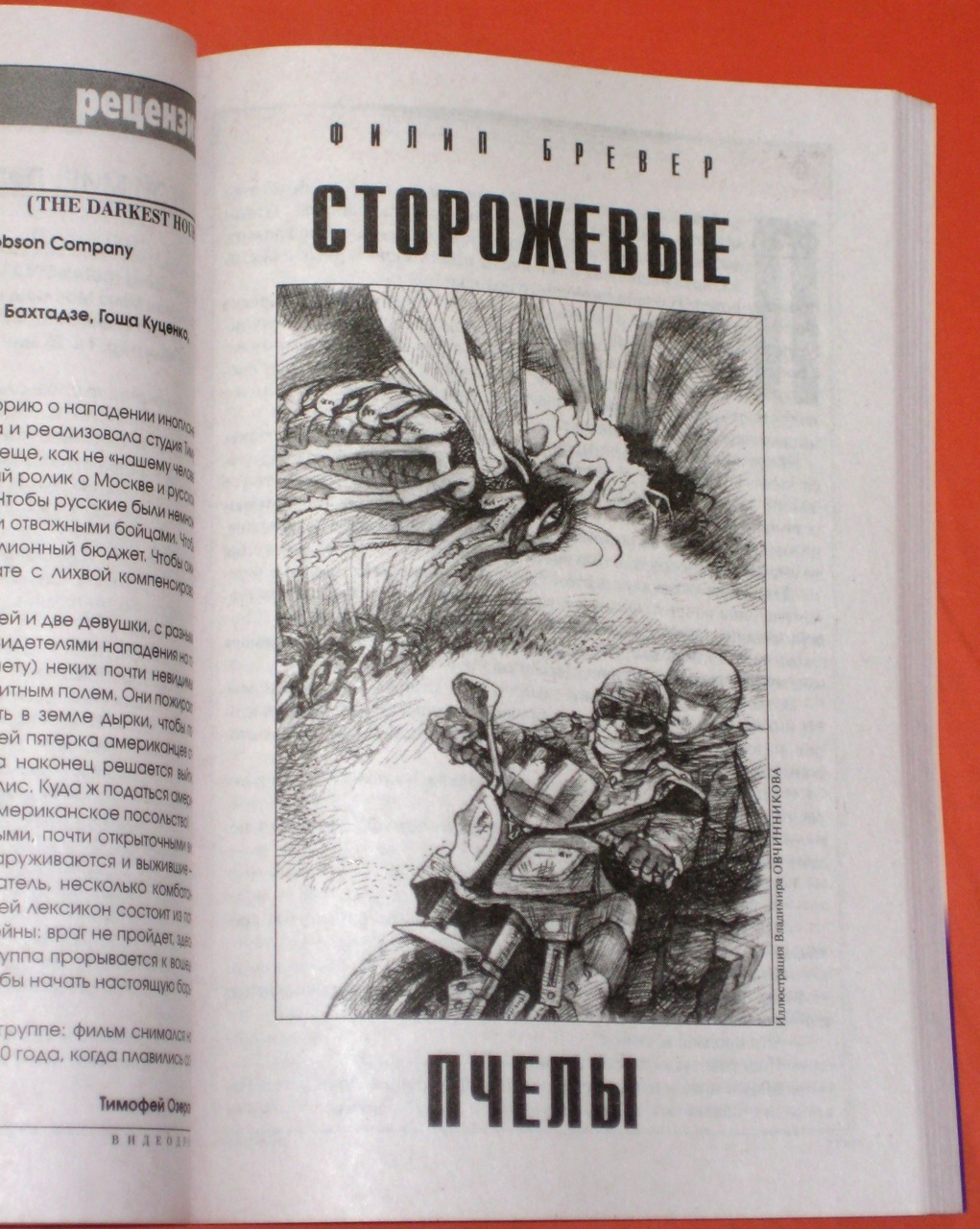
In the post yesterday I found my contributors copy of the Russian magazine Esli (If) with the Russian translation of “Watch Bees”!

I’d been keeping an eye on their website, expecting that they’d update it with the new issue before I got my copy by international mail, but the paper copy arrived first.

Very interesting to see my name transliterated into Cyrillic characters.

I happened to know that the character that looks like P is pronounced as R, so I was tentatively able to spot “Brewer” in the table of contents by the placement of the Ps. I still wasn’t sure, of course, but my feeling was somewhat strengthened by the initial character of my first name looking like a Greek Phi.

The table of contents directed me to page 111, and flipping ahead to there I was able to confirm my story by the interior illustration:

What a great picture! It captures a key scene in the story while avoiding any spoilers.

I haven’t very often gotten an illustration for one of my stories, so I’m especially pleased.

I’ll try to figure out the artist’s name and see if he or she has a website I can link to. (The name is there on the picture, but in Cyrillic characters. And it’s a long name. I guess my next step is to spend half an hour hunting for each character on a Unicode character table.)

My mother-in-law, who speaks some Russian, has been asking after this issue. She’ll be very excited to learn that it has arrived.

If you’re a fan of anime-influenced art jam-packed with memey goodness, I’ve got a treat for you: Doctor Emery’s Nightmares.

[Update 2013-12-06: Doctor Emery’s Nightmares is back! I’d take the original link down when the site was taken over by some advertising crap. Now Doctor Emery has a new tumblr site, so I’m pointing there.]

When it comes to physical objects, I’m at least a generation behind the cool kids. (I not only still have an iPod, my iPod still has a hard drive.) But when it comes to internet memes, I figure I’m only two or three steps behind. I mean, I read BoingBoing. I have an account on Reddit! Even so, I usually have to visit Know Your Meme two or three times for every one of Emily Mongeau’s comics.

But if that’s not you—if you already know your memes—then you’ll find Emily’s comics great fun. And if, like me, you’re a few steps back on your memes, you can still enjoy the art.

Oh, and I should also mention: Emily drew the picture I’ve been using for my favicon for a while now. It’s a picture of my totemic animal: the sloth.

Here it is in slightly less faviconic form. Have you ever seen such a handsome creature?

I always like poster art. In particular, I like the way poster artists manage to make such effective use of a limited color pallet. Several of these are excellent examples:

Exoplanet Travel Posters

[Update 2016-02-14: That link seems busted, but a search still finds the exoplanet posters: http://www.chungkong.nl/?s=exoplanet]

With just a few shades of the same color, the Chungkong paints a whole alien world.

—via Jay Lake.

Statue of the Three Graces at Allerton Park
This statue at Allerton Park is called the Three Graces, but I like to think of it as the Three Muses.

I was pretty productive these past two weeks. I finished a major rewrite pass on a short story that the Incognitos had critiqued a while back, and passed the story on to a couple of first readers. I wrote several posts for Wise Bread. I did some preliminary investigation on a tech writing assignment.

I thought that was great, not only because it’s nice to get things done, but because it makes me feel like it’s okay to spend time on various less (or non-) remunerative projects, such as art, poetry, and Esperanto.

I’ve just come to realize, that this is a harmful way to think.

I’ve always had these recurring bouts of unproductivity. The previous several weeks were an instance of it: I sat at my computer and tried to work, but I didn’t get much done.

Back when I worked a regular job, these bouts were always terribly stressful. How do you tell your boss, “Sorry, I just don’t seem to be able to get anything done”?

I had several coping skills. Because of the kind of work I did, my managers never really could know how difficult a task was, so I could just say, “It’s turned out to be tougher than I thought.” Also, even when I couldn’t make any headway on my major tasks, I was almost always able to do something. I got in the habit of seeking out smaller, one-day tasks that I could do. That let me be productive (so I felt better) and gave me an excuse to be late with my main task (so I was less stressed).

Now that I’m not trying to work at a regular job, the stress level is much reduced. There’s no boss whose understanding of my productivity needs to be managed. There’s no job to be lost if that management goes poorly. But that doesn’t mean that I don’t still have these periods of unproductivity.

As I was saying, since this latest surge of productivity, I’ve felt free to spend some time on less remunerative projects, like doing some writing in Esperanto. And that brought me to a realization: It’s dumb to think that I shouldn’t work on stuff that I’m interested in, just because it’s not the most important work I could be doing.

I think part of the reason I’ve been doing it is that I thought it might motivate me to get my important work done. I know some people bribe themselves by withholding permission to play with side projects until they’ve done an appropriate amount of work on the main projects. But it has never been an effective technique for me. Maybe it helps a little when I’m just feeling lazy. But being unproductive is different from being lazy, and it doesn’t work at all for that.

More important, I think I’ve finally figured out that this behavior is actively harmful. These other things I do—drawing, poetry, Esperanto—probably help me be productive. They’re not a waste of time that I could be spending on important projects. Rather, they’re a pathway back into productivity. Being productive—even being productive on something that doesn’t earn any money or advance my career—is still being productive. And experiencing productivity after a period of unproductivity is positive. It leads to more productivity.

In the past, getting started being productive again has always been the hard part. Maybe this will help. Maybe, if I can be productive on some frivolous task (without agonizing too much over the fact that it is frivolous), I’ll be able to bootstrap that experience of productivity into productivity in other areas.

In the meantime, I’m being productive again in a wide range of areas. Go me.