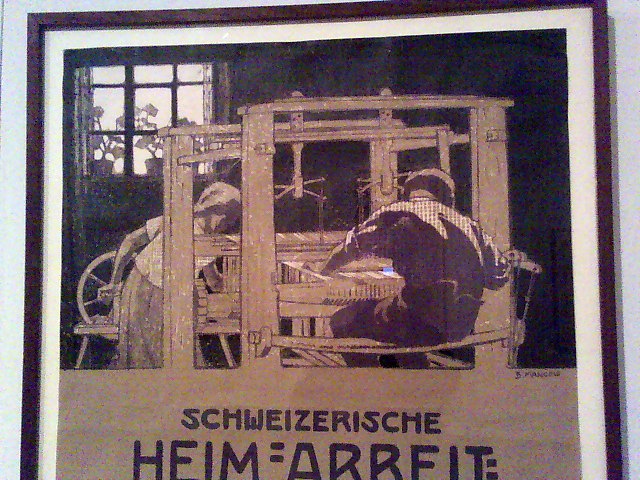
Poster detail showing loom setup

I was feeling kind of glum yesterday. It was just brain chemicals, I think—the result of a gray day when I was already feeling a little discouraged about my progress on my novel. (My recent post on how I’m not suffering as much from seasonal affect disorder notwithstanding.)

I was already feeling better today (it’s sunny), but decided to do something cheering anyway. So, I went to the Krannert Art Museum, which turned out to be showing an exhibit of turn-of-the-century poster art. I’m a big fan of poster art and art deco, so it was full of wonderful stuff. By merest coincidence, I’d earlier in the day happened upon this Art of the Poster 1880-1918 site, so I got a fun double dose of poster art.

Plus, one of the posters featured a loom, which I thought Jackie would appreciate.

There was also an exhibit of student art in the lobby outside the art museum that was much more interesting than 90% of what was in the museum itself. I couldn’t find a link, which is too bad. There was a lot of good stuff—some pretty, some funny, some thoughtful.

When it comes to dealing with glumness, I think it’s basic things that really matter—nutrition, exercise, getting enough sleep, spending some time out in the sun whenever there’s a sunny day. Once I’ve got that covered, though, the best short-term response to short-term glumness is to fit something cheerful into the day; preferably something that’s not just cheerful, but also meaningful in some way. For that, I particularly like going to museums. Something that’s merely cheering is worth doing. Something that’s cheering and also feeds the soul is even better.

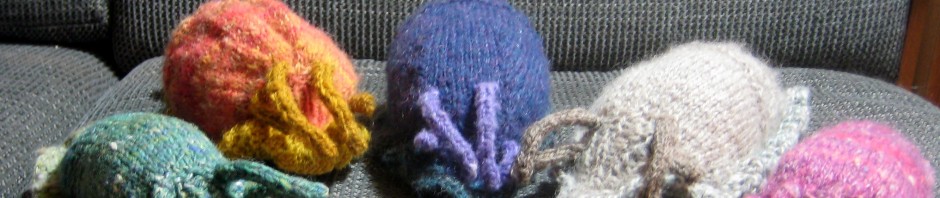
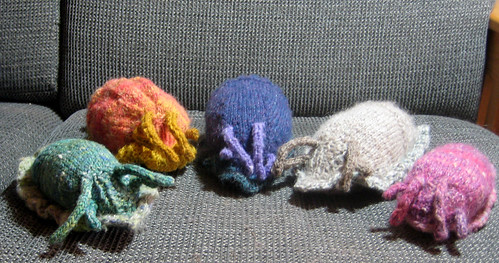
Slugs, originally uploaded by bradipo.

A couple years back, Steven expressed an interest in a slug stuffy, seeing as how its his totemic animal and all. Jackie knitted him a slug for his birthday. (Here’s a picture of Steven admiring his slug.)

The additional slugs she knitted sold pretty well, so she decided to knit some more this year. The three middle slugs (Pumpkin Slug, Blueberry Slug, and Quarry Slug) will be available for purchase at the Spinners and Weavers Guild Annual Show and Sale, coming up Friday and Saturday this week. (The first and last slugs are our household slugs.)

Creative Commons License
Slugs by Philip Brewer is licensed under a Creative Commons Attribution-NonCommercial-NoDerivs 3.0 Unported License.

Noted Zen artist Shozo Sato gave a talk on black ink painting and calligraphy at an open house for the Japan House on the University of Illinois campus.

It was a wide-ranging talk, starting with his own history at the University and at Japan House and his earlier work here with kabuki theater. Then he went on to talk about black ink (the same ink is used for painting and for calligraphy): how the blocks of ink are made, about how there are two colors of black ink (a slightly red warm black and a slightly blue cool black), and about how an electron microscopic image of the brush strokes of a piece of calligraphy looks distinctly different from a similar image of the artist’s signature (even though they’re made with the same ink, same brush, and by the same hand).

He talked about and demonstrated some painting techniques involving crumpling the paper—wadding it up to make random crinkles, and then painting the peaks of the crinkles to show a texture like a rocky surface, or folding it up and painting the edges of the folds to show a texture like clefts in a mountainside. (Then you can dampen the paper and the folds will relax.)

Calligraphy is going to be the topic of his next book, and he demonstrated that briefly. He showed us how to hold the brush (vertical, with the elbow high). Then, after pausing for a long moment, he quickly drew a few Japanese characters with bold strokes.

After just that one calligraphy example, he finished by talking about traditional Japanese and Chinese black ink painting. He showed us the basic brush strokes—thick-to-thick, thick-to-thin, and thin-thick-thin—and demonstrated how you can use them to draw a bamboo plant. (He even showed us an ancient Chinese secret: You can easily paint a leaf that goes behind the stem by masking the stem with another piece of paper as you paint.)

After the talk, he autographed copies of his new book Sumi-e: The Art of Japanese Ink Painting. (That page at Amazon has a video of Shozo Sato demonstrating black ink painting techniques.)

After the talk, walking through the Japanese tea garden, I wrote a haiku. In the original Esperanto it is:

La majstro staras
brosho en mano kaj jen!
Rapide skribas.

It doesn’t work quite as well in English. A literal translation would be:

The master stands
brush in hand and behold!
Rapidly writes.

It was a really interesting talk. I actually have a little Chinese black ink painting set—ink stick, grinding dish, brush, and a book of techniques. I think I’ll get it out and do a little painting.

Jackie and I traveled by train to Chicago, going up Tuesday and returning Wednesday.

I like traveling by rail. It’s is more comfortable and more convenient than traveling by either car or plane, especially if you’re going to want to be downtown (where the train station is) anyway. So, as I’ve written before on Wise Bread, I’m a big fan of Amtrak. On the trip up, though, we did have a problem. Apparently, a freight train had derailed somewhere north of Gilman, leaving the track blocked.

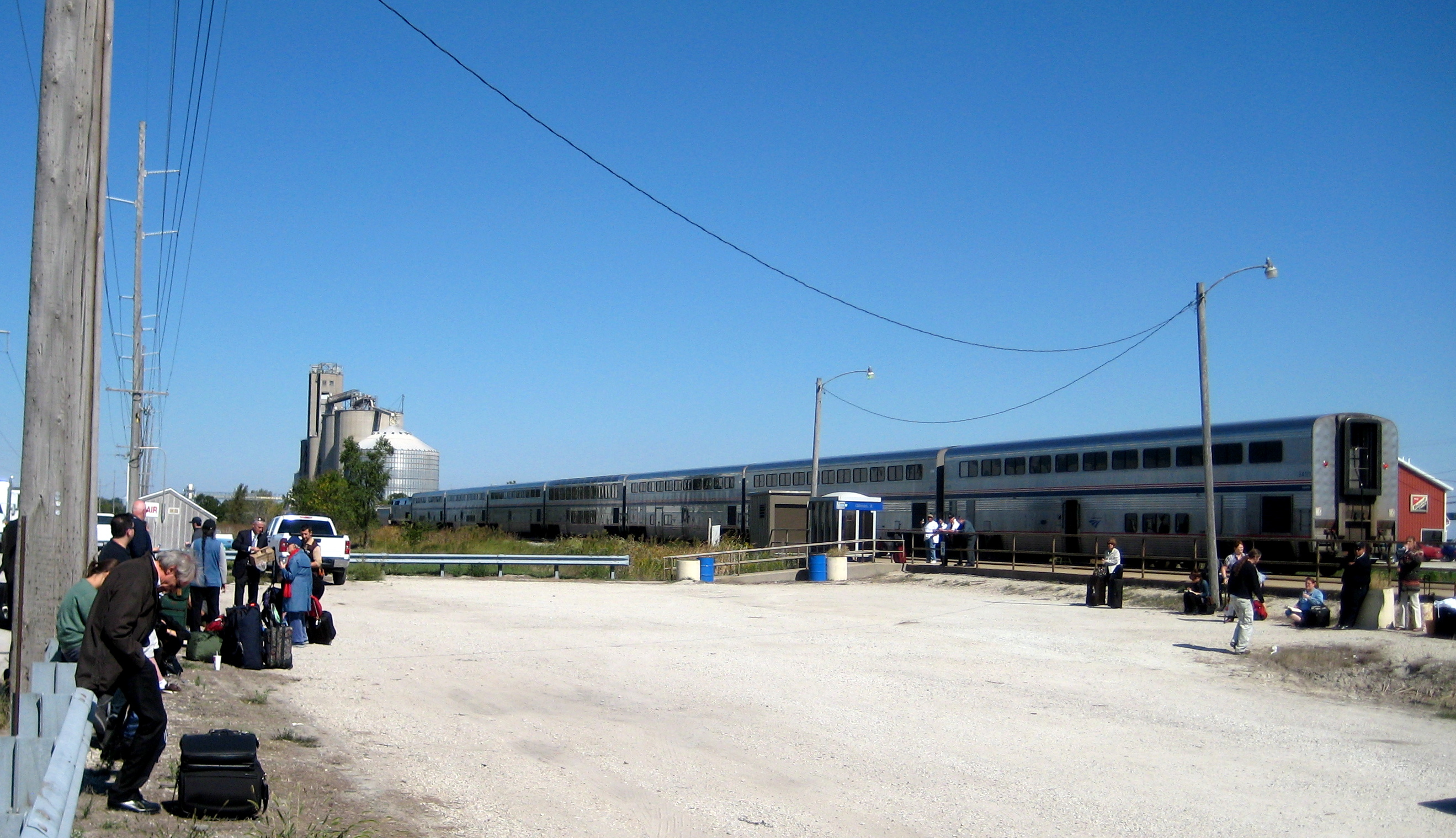
Amtrak hired buses to take us from Gilman on into Chicago. Here’s a picture of where we waited for the buses to arrive:
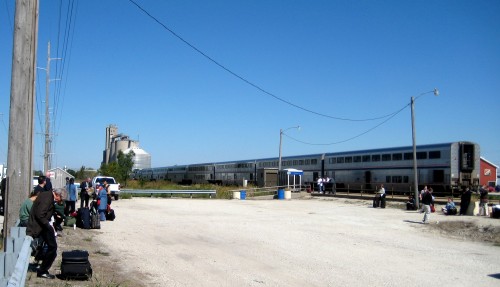
The passengers who’d been faster getting off the train than us had already filled the first bus and departed, so here the rest of us are, waiting for the next bus. I’m not sure what train that is sitting there. The train we’d been on (the Saluki) had already departed, heading on back south to be ready for the next day’s trip to Chicago, I suppose.

The station itself is that bus shelter structure in the middle of the picture.

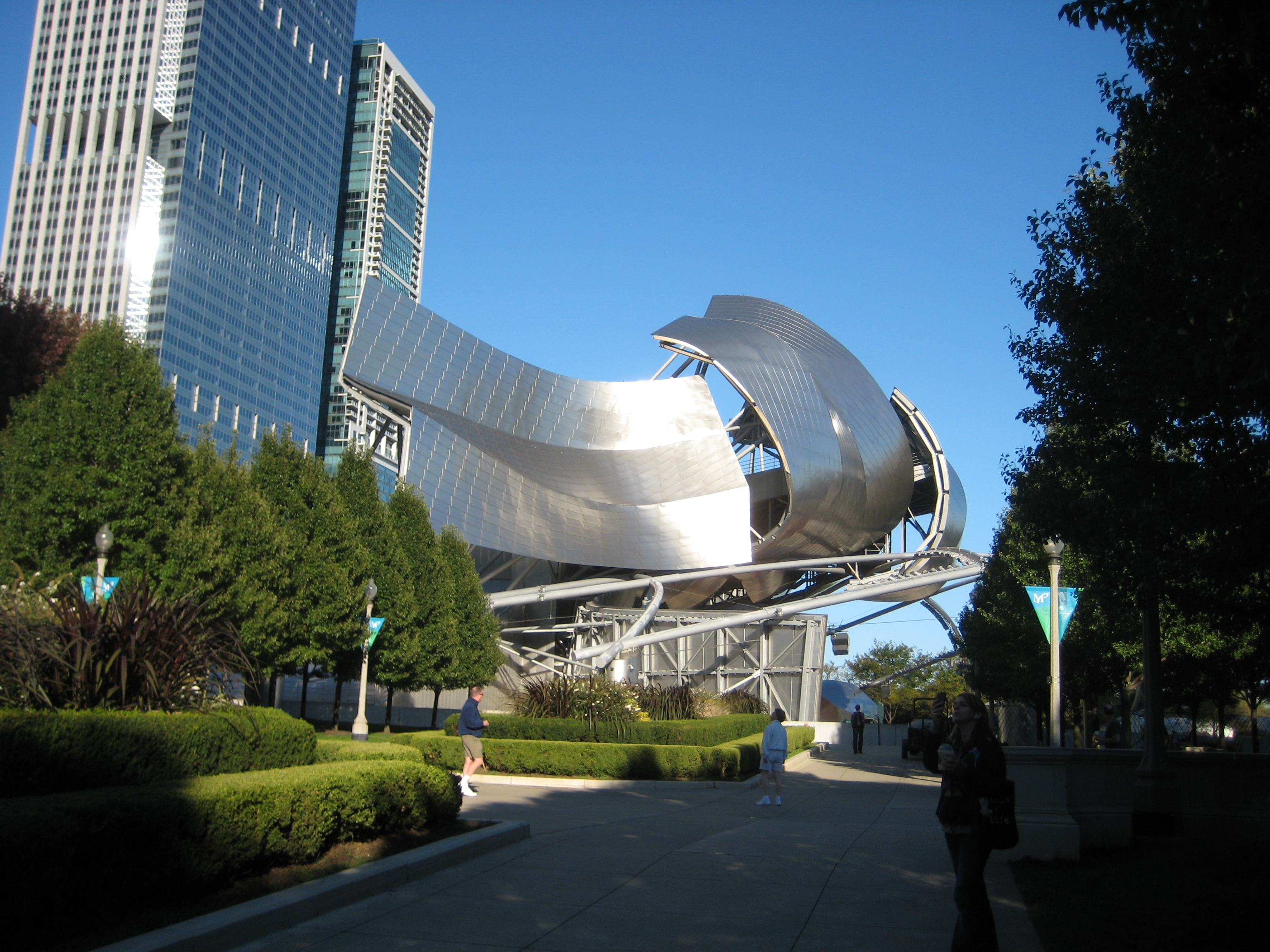
We got to Chicago about three hours later than planned, which rather messed up our schedule for the  afternoon, but we had a nice trip anyway. Jackie and I went out for some brisk urban walking shortly after checking into our hotel. In Millennium Park, north of the Art Institute, we saw this:
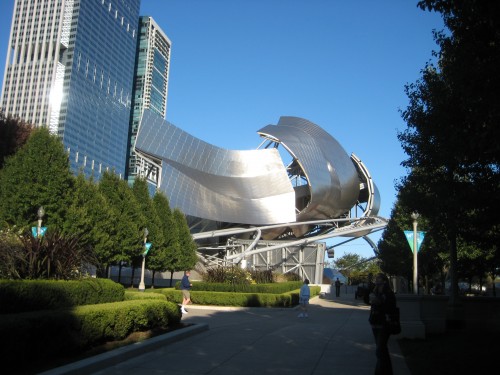
Object in Millenium Park

Coming upon it produced the following conversation:

Me: What do you suppose it is?

Jackie: An amusement park ride?

Me: Maybe. Maybe it’s a solar power station.

Jackie: But it’s all shiny. That wouldn’t be very efficient.

Me: I bet I know! I bet it’s designed so that one day a year, when the sun is at a particular point in the sky, all those surfaces work together to concentrate the entire reflected power of the sun on one single point, vaporizing whoever happens to be standing there.

Jackie: That doesn’t make any sense. Think of the liability.

Me: You’re right. I guess amusement park ride is a better guess.

Today we took a bus down to Jackie’s old stomping ground in Hyde Park. We went to the Oriental Institute, the Seminary Co-Op bookstore, had lunch at Edwardo’s, and went to 57th Street Books, before heading back to Chicago and catching the Illini to come home.

A good trip, despite the unplanned bus ride from Gilman.
View of Mt. Fuji, originally uploaded by bradipo.

Jackie and her mom and I went to the Indianapolis Museum of Art’s exhibit of Utagawa Hiroshige’s “36 views of Mt. Fuji.” This was part 2 of the exhibit, and featured 18 of the woodcuts.

I’ve always liked the Japanese woodcuts of this era, for much the same reason that I like poster art: I like the use of strong, simple images and the effective use of a limited color pallet. (I also rather like the particular shade of blue that they used.)

Besides the woodcuts, we also spent a chunk of time in an exhibit on drawings together with prints, etchings, and the like. Some were source drawings prepared for the engraver. Others were copies of etchings, drawn as studies. I find it interesting to think about the differences between poster art and woodcuts, versus etching, engravings, and so on—differences in intention, technology, result, etc.

We also walked a bit on the grounds. I particularly enjoyed the tow path along the canal behind the museum.

This was just our second visit to the museum, which is too bad—it’s a great museum. It’s more than 2 hours away, though, which makes for a rather long day. We enjoyed it enough that we’re thinking about getting a room in a hotel and making a 2-day trip of it. That would mean that we could spend a whole day (or two half-days) at the museum, instead of trying to cram everything into a few hours between two long drives.

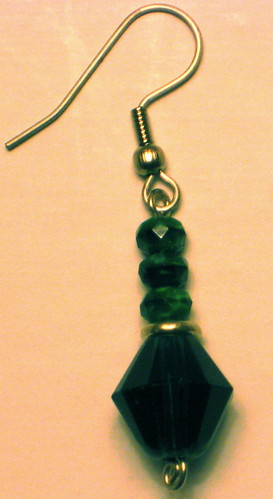
The Sinister Leprechaun, originally uploaded by bradipo.

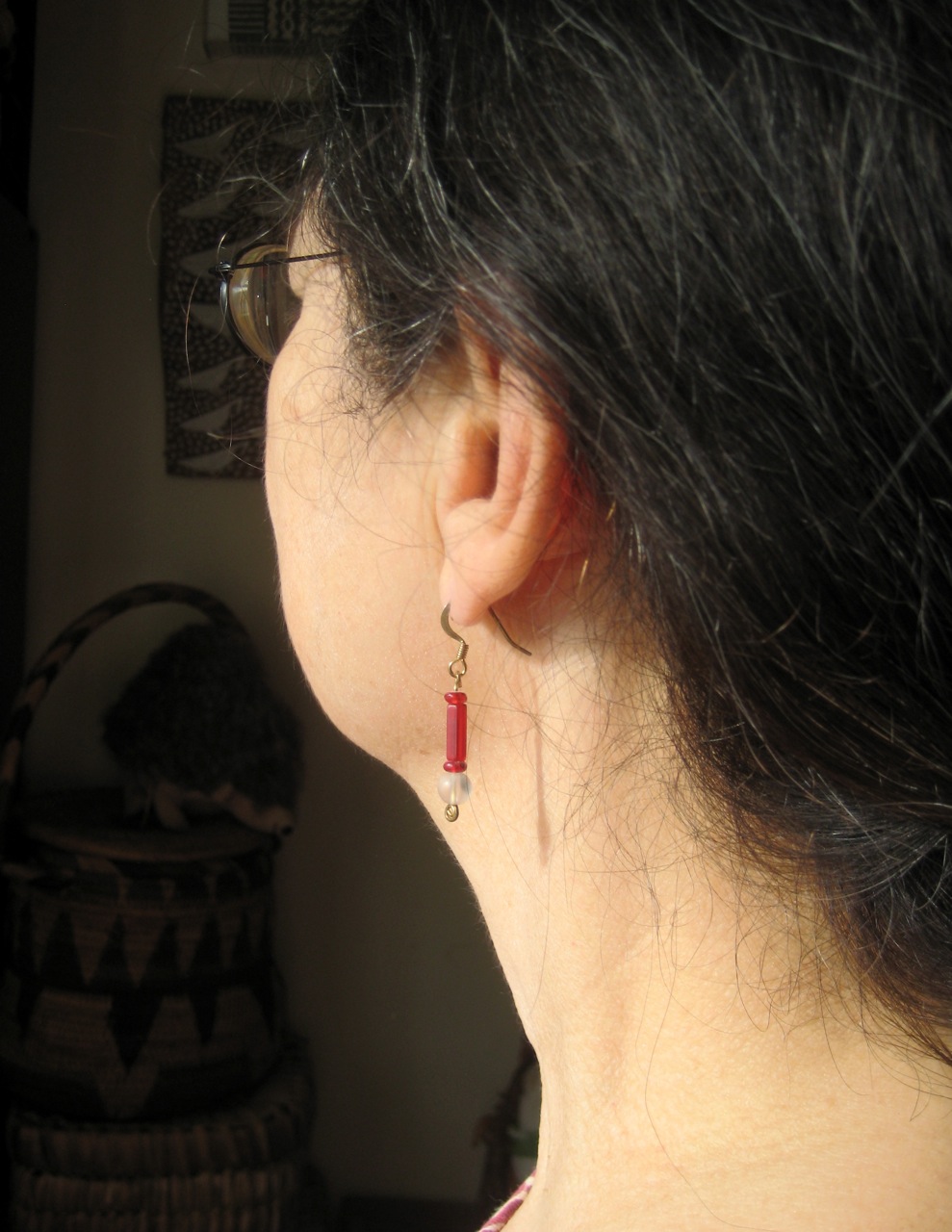
Jackie and I attended the Haiku Earring Party at WisCon this evening.

In case you’re not familiar with it, here’s how it works: Elisem creates pairs of earrings. You pick out a pair you like and bring it to her. She gives the pair a title. You then write a haiku or senryu inspired by the title and the earrings, which you trade for the earrings.

At least, I tended to think of it as a swap—haiku for earrings. Jackie, it turns out, had a slightly different take on it. In her mind I was winning the earrings for her via a display of skill, like winning a stuffed animal by tossing rings at the county fair.

“The Sinister Leprechaun”

Find at rainbow’s end
Not expected pot of gold.
Green stones turning black.

Or, in Esperanto:

“La Minaca Irlanda Koboldo”

Ĉielarka fin’
Ne atendita oruj’
Verdŝton’ negirĝas

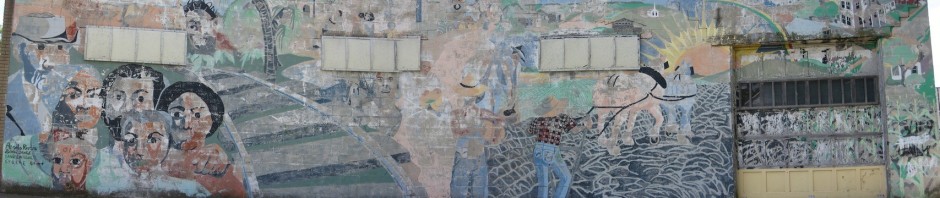
Angela Rivers Mural

I heard on the news this morning that Champaign was going to lose (to building renovations) a large public mural by Angela Rivers.

The mural, painted in 1978, is in pretty poor shape, which I suspect had something to do with the decision to let it go, but it’s still sad to lose. I’m a big fan of public art.

Since I had some warning, I figured I’d seize the opportunity to go grab some pictures. Here’s a detail with some faces and the signatures:

Detail of Angela Rivers Mural

And here’s another bit I particularly like, horses plowing toward the sun on the horizon:

Detail from Angela Rivers Mural

If you’re local, it’s worth getting up there to see it in person. It’s on the north side of a warehouse at the corner of Park and 5th Street, just a few blocks east of downtown Champaign.

Our Christmas Star, originally uploaded by bradipo.

When I first moved out on my own I had only sparse Christmas decorations. Among the things that were lacking was a star for the top of the tree.

I didn’t feel it was so terrible—the tree was decorated, even if it didn’t have something on top. One Christmas, though, my brother and his wife came to visit at Christmas, and Alisa was appalled. Rather than tolerate such a defect, she cut a star out of shirt cardboard, covered it in aluminum foil, and put it on top of the tree.

I was delighted. I kept that star and used it on my trees for many years.

We went on using it for some time after I got married, until Jackie started doing needle-felting. Deciding that a Christmas star would be a perfect little project, she needle-felted this star, which has been our tree-topper ever since.

Creative Commons License
Our Christmas Star by Philip Brewer is licensed under a Creative Commons Attribution-Noncommercial-No Derivative Works 3.0 United States License.