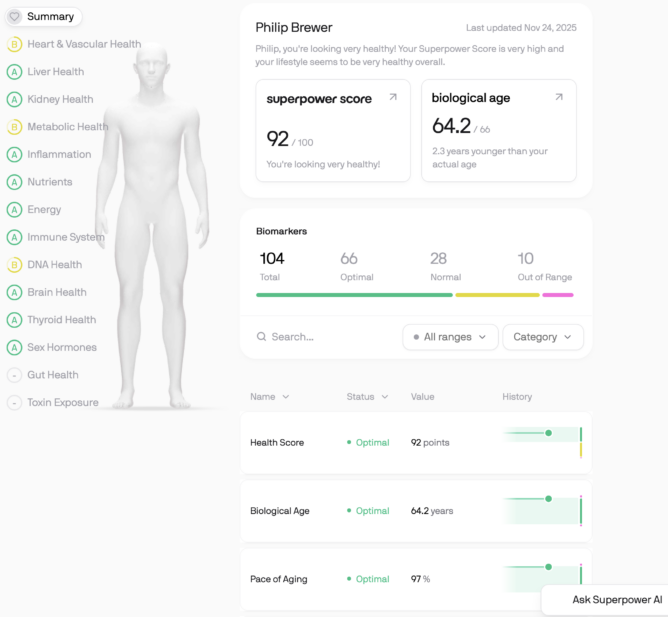
Overview of my results from Superpower.com

If you’ve been following me for any length of time, you know I’m big on metrics. It’s why I own both an Oura Ring and a Pixel watch. I am similarly interested in the annual blood work I get from my doctor’s office. That last though is often not quite as much or as often as I want, so I was very interested when Superpower reached out to offer me an extensive panel of blood work, if I’d post a review of their service.

This offer came at a particularly opportune time, as I’d been thinking of trying to get at least one specific test run ahead of my next physical. (I’d gotten a result that was slightly out-of-range on my creatinine test. This is common if you’re taking creatine, which I had been, but I still wanted to verify that it wasn’t indicative of a kidney problem. So, I’d gone off creatine, and wanted to re-run the test and be sure that my values had returned to normal.)

Getting a physical scheduled these days takes a ridiculous lead time, so it was going to be months before I got that blood work done. As I said, this made me want some other path to getting that test.

Enter Superpower, which is a way to get a vast suite of blood work done, but it’s much more than that. They have an AI trained on all these tests, with access to your results, that can integrate them together and answer questions about them. The answers are probably very similar to what your doctor could provide, except your doctor isn’t likely to have a couple of hours to go through your results line-by-line, the way I did last night with the Superpower AI.

You could get a reasonable read on any one of these markers just by googling the test name, but the Superpower AI has all your other results at its fingertips as well, so it can relate one value to another. For example, one of the blood tests measured my cortisol levels, and Superpower had this to say:

“Your cortisol level of 11.1 mcg/dL sits comfortably in the optimal physiologic range (10–18 mcg/dL), which suggests your adrenal function and stress response are well balanced.”

That’s roughly what you could get just by doing a google search on cortisol test and looking at the reference range. (Superpower is slightly better, because you won’t have to slog through the high values, the low values, the normal values, or the difference between the reference range and the optimal value.) But Superpower can do even better, because it has all your other data. For example, for me it goes on to say

  • This level indicates your hypothalamic–pituitary–adrenal (HPA) axis is functioning normally—not underactive (as in adrenal fatigue or insufficiency) and not overproducing cortisol (as with chronic stress, inflammation, or metabolic strain).
  • Given your low hs‑CRP (0.9 mg/L), balanced glucose (A1c 5.4%), and strong energy habits, your body is managing everyday physiological stressors efficiently.
  • You also show good DHEA‑S (88 mcg/dL), suggesting adrenal reserve is intact and age‑appropriate. The cortisol‑to‑DHEA‑S ratio is within the healthy range, a good sign of adaptive—not excessive—stress output.

I knew nothing about DHEA‑S, so reading what the Superpower AI said about it was instructive.

There were dozens of other tests (I think 160 in the basic panel), so the part of my brain that wants all the metrics was very happy indeed. If you’re like me, and just want the metrics, Superpower seems great: Lots of metrics and a very useful AI tool to tell you what they mean.

If you’re not like me, and you’re just interested in improving your health and performance, the value of Superpower isn’t quite as clear, but I think there is some value:

  • Every result that’s in the “optimal” range is one more thing to not worry about, and that’s useful.
  • Every value that’s in the “good” range (normal but not optimal) is a thing you could work on to improve your health or performance, and the AI will make some suggestions for how you could work to optimize all your blood work.
  • Every value that’s out of the reference range is, maybe, something you ought to talk to your doctor about.

That last is a bit uncertain. The doctors I’ve talked to over the years are pretty down on the idea of taking every test and then worrying about every value that’s out of the reference range. There are a few values (blood sugar, LDL cholesterol), where it’s both a clear sign that there’s something wrong that’s likely to lead to specific harms and there are practical treatments available that can reduce those harms. But just because a number is out of range isn’t much of a reason to do anything, unless there’s some symptom that’s plausibly related.

You almost certainly know what you ought to be doing to optimize your health. Eat food. Move a lot. Sleep well. (If not, read my post I’ve spent too much time thinking about longevity, which gives you a very slightly longer version of that same overview.)

Given that you know those things already, what would paying Superpower to run a bunch of blood tests do for your health and performance? That is: who is Superpower for?

First of all, it’s for people like me: People who just like having a bunch of metrics.

Second, it’s for people like me: People with a specific question to ask, like my question about creatinine levels.

Third, it’s for people who have trouble getting their doctor to go through all their test results with them. Of course any doctor who won’t go over any out-of-range results with you needs to be replaced. But ordinary blood work won’t even mention which of your results are in the reference range but outside the optimal range, and even a good doctor isn’t going to have time to go through those results and help you figure out how to improve them. The Superpower AI is a great tool for going through the normal-but-not-optimal results and coming up with a plan for optimizing your health.

Fourth, it’s for people who like the reassurance of being able to say, “Okay, I’ve got that one covered,” when one of the metrics is optimal, while being able to say, “Ah, but this other one could use a little more effort,” when one of the metrics is a little off. And, of course, there’s always the possibility that it’ll clue you in to something serious that you ought to take to your doctor.

So, how did I use it? Well, my creatinine levels had come back normal, so I’ve restarted creatine. My blood lipids are still a little off, even though I started a drug for that, so I have another thing to talk to my doctor about. Other than that, pretty much everything is normal, and most values are optimal, so I’m in that comfortable zone of feeling like I don’t have much to worry about.

How about the future? I just got the basic suite of blood work, and there are several options if I want to pay more money, and some of them are attractive.

For example, I’d be very interested to know about my magnesium levels. (Magnesium is very important in many cellular processes.) It’s not impossible to get enough magnesium from your diet—lots of foods have some magnesium in them—but there’s no one or two foods where you can just say, “Eat a couple of servings of this or that,” and you can be confident that you’ve got that base covered.

As another example, there are several B vitamins that need to be methylated to be turned into their active form, and people have a diversity of enzymes to do that, some of which are better than others. There are genetic tests to see if you have the gene for one of the good enzymes or one of the bad ones, but there are also tests to see if the vitamins in your blood are properly methylated, offered in the Methylation Specialty Panel. That’s another one that appeals to me.

I’ll consider those. If I decide to spring for them, I’ll follow up here in the future.

In the meantime, I’m pretty pleased with what I got: Something just for me.

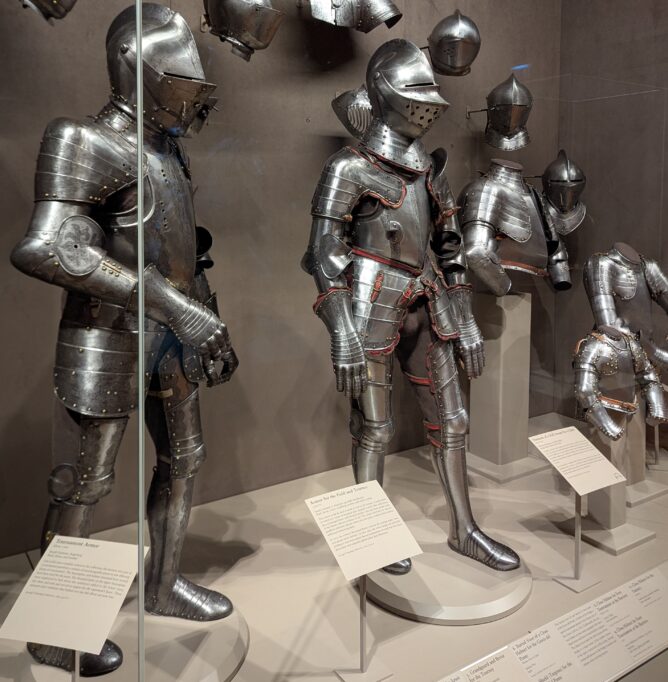
Suits of armor in a display case

I have long had mixed feelings about gameification, where you use the structures that underlie games (like points, achievements, badges, etc.) to motivate yourself to do the things you already know you want to do. I’m dubious about it, but at the same time, I do find myself motivated by such structures, which makes it very tempting to use them. (For exercise in particular, but really everything.)

Just lately, I’ve started thinking about a modest alternative: storyfication, where you use the structures of fiction to motivate yourself to do whatever it is you want to do.

Essentially, you tell yourself a story about what you’re doing, rather than making a game out of it.

Plenty of people do related things. There are several popular YouTube fitness channels that are all about using anime stories and situations, or superhero stories and situations, as inspiration for working out. (See for example JaxBlade, The Bioneer, or Kevin Zhang.) Some of them are primarily about aiming for the aesthetics of anime characters, but some reach into the story lines of specific anime. And some—the most interesting ones—use the underlying structure of anime or comic-book type stories as workout inspiration.

I’ll rough up an example here. Any story structure might be worth trying, but I’m inclined to start with the Hero’s Journey story structure. I’m assuming that we’re talking about doing exercises to get fit, but the basic storyfication thing could work for anything where you need to engage in repeated actions to get better at something—learning to paint, say, or learning to play the violin.

You begin with the Call to Adventure. If we’re talking about exercise, it would be a desire to get fit. Of course, the hero always initially resists the call. (Getting fit is a lot of work that’s hard and sometimes uncomfortable.) But finally the hero (you) chooses to accept the call.

The bulk of what you’d be doing would be “traveling on the road of trials, gathering powers and allies.” (That is, consistently doing your workouts.)

Dividing things up into separate books or seasons makes good sense. It can be very useful to grind away on one or a few things (building strength, say, or building endurance, or explosiveness) for a few weeks or a few months, but you need to include occasional breaks. You might consider each week of workouts a chapter or an episode. Put six or eight or ten together, then take a break. And then, of course, return for the next volume or the next season, perhaps with a new focus.

In the Hero’s Journey structure, the next thing would be to confront evil and be defeated, leading to a dark night of the soul. I don’t see much value in writing this into your plan, but there may be value in keeping the idea in your pocket for when things go awry. And, of course, things will go awry. A major project at work or at home may take so much time you can’t fit in all your workouts. An injury or illness may derail your workouts for a time. Maybe you’ll just hit a plateau in your fitness journey.

When something like that happens, well, you can view it as confronting evil. Remember, after being defeated, you face the dark night of the soul. One thing you might do at this point is think deeply about what obstacle might be blocking your progress. In fitness there are many possibilities: insufficient volume of exercise, insufficient intensity, insufficient recovery, poor exercise selection, poor nutrition . . . . The possibilities are nearly endless, and it is often hard to know which is the real culprit.

For that reason, the next step in the hero’s journey is especially appropriate: You take a leap of faith. Even though you can’t know what’s the best choice, you make a choice anyway. Maybe you ease up on intensity and focus on recovery. Maybe you double-down on exercise volume. Maybe you focus on your diet.

Whatever you choose, you can think of it as confronting evil again. And in a proper hero’s journey, this time are victorious.

Go ahead and write this part into your plan.

The final stage of the Hero’s Journey is that the student becomes the master. Again, there’s no need to write that into your plan. But it is entirely possible that having some success with storyfication will make you feel like sharing your insights with others, which is really what being a master of something is.

I generally view both gameifcation and storyfication as essentially neutral—neither good nor bad, except to the extent that the thing being motivated is good or bad.

Perhaps related to this is a word I’ve just learned:

“hyperstition.” The term, coined by “accelerationist” writer Nick Land, describes the belief that one can manifest future realities by telling compelling stories, and that prophecies become self-fulfilling through repetition and virality.

https://www.thenerdreich.com/silicon-valley-apocalypse-capitalism/

Telling yourself a compelling story can definitely help you put in the time and effort to achieve your goals, just like the structures that underlie games can do the same.

Is anybody else out there interested in using story structure to motivate themselves to exercise (or do something else)? Anybody already doing so, and able to provide some first-hand experience?

Let me know! (See my Contact page for many ways to contact me.)

I walk a lot. Because I have a dog, and want to be sure my dog gets the exercise it needs, I take a truly inordinate number of steps per day. (Wait just a moment while I check my Fitbit…) Last week I averaged 14,036 steps per day. The previous week I averaged 17,197 steps per day. Those weeks are quite typical for me; I don’t average much under 15,000 unless I’m sick or the weather’s really bad.

So, when I saw the news recently that walking “3,000 to 5,000 steps per day can help to stave off mental decline,” I’m like, “Okay? Great.” Taking 5,000 to 7,500 steps per day seems to stave off Alzheimer’s disease by around seven years.

I mean, that’s great. Staving off Alzheimer’s disease by 7 years would probably cut the incidence of the disease by close to half (because people would die of something else first).

But really? I mean, yes, my inordinate walking takes a lot of time that most people don’t have. Back when I was working a regular job I’d try to get “enough exercise,” and that generally topped out at an average of a little over 100 minutes per day—and that much only in the summer, and that high only because I’d average in a 3 or 4 hour bike ride over the weekend. Now I probably spend close to 150 minutes per day just walking the dog. I recognize that almost nobody’s got time for that.

And, yes, walking in particular depends on capabilities that not everyone has. Lots of people old enough to worry about Alzheimer’s have bad knees or bad hips or bad feet or bad hearts or bad lungs. Maybe their endurance is very low. Maybe their balance is poor enough that walking is a risk.

But it doesn’t need to be walking. Walking is just easy to measure with a wearable device. Any sort of exercise will do the trick. Lift weights. (They don’t have to be heavy weights, as long as they’re heavy for you.) Ride a bike. Ride a stationary bike. Row. Use a rowing machine. Play almost any sport. Dance the night away.

Related to this, only in terms of how low the bar is set to do an enormous amount of good, a different study looked at whether walks needed to be long in order to provide the benefits, or whether cobbling together a number of shorter walks to add up to the same number of steps was just as good. It turns out longer walks are better. (Risk of being diagnosed with cardiovascular disease within 9.5 years dropped from 13% to around 4–8%.) But the dividing line in the study was that walks of at least 10–15 minutes counted as “long” walks, versus short walks of less then 5 minutes.

If you can walk 5 minutes, I’ll wager you can work up to walking 15 minutes in a very short period of time. And the evidence is now pretty clear that it’s worth doing.

Get some exercise. The bar is pretty low for making a big difference.

Sundays are the day I still manage to do some HEMA training. I used to go three times a week, but had to cut way back after I hurt my elbow. Now it’s just Sundays, because Sunday is the day my group does a sword-in-one-hand class, which is gentler on my elbow. We usually train dussack or rapier.

My plan for today was to get as much writing done in the morning as I could, then go train sword fighting, and then squeeze in a bit more writing in the late afternoon or evening. But, as often happens, things happened. My brother invited me to attend the kick-off meeting for SFWA’s Winter Worlds of Giving event, so that was most of an hour on zoom. Then my usual cocktail hour with my brother and my mom. Then walking the dog. Then an episode of The Diplomat with Jackie. Then another episode of The Diplomat with Jackie. And now I’m just too tired to get any more writing done.

So, it’s a good thing I got in that morning session, which got me 551 words.

Tomorrow I’ll be back at it.

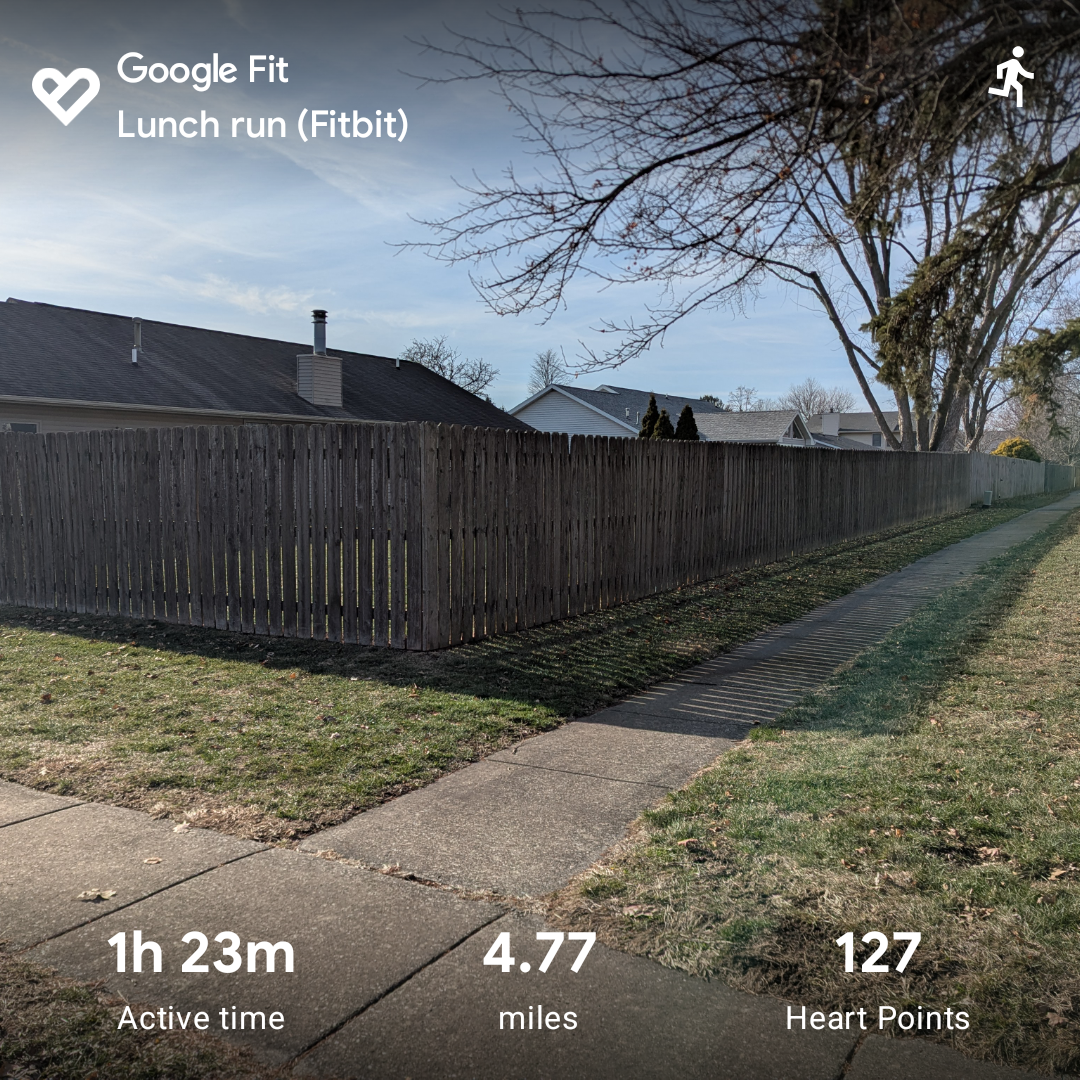
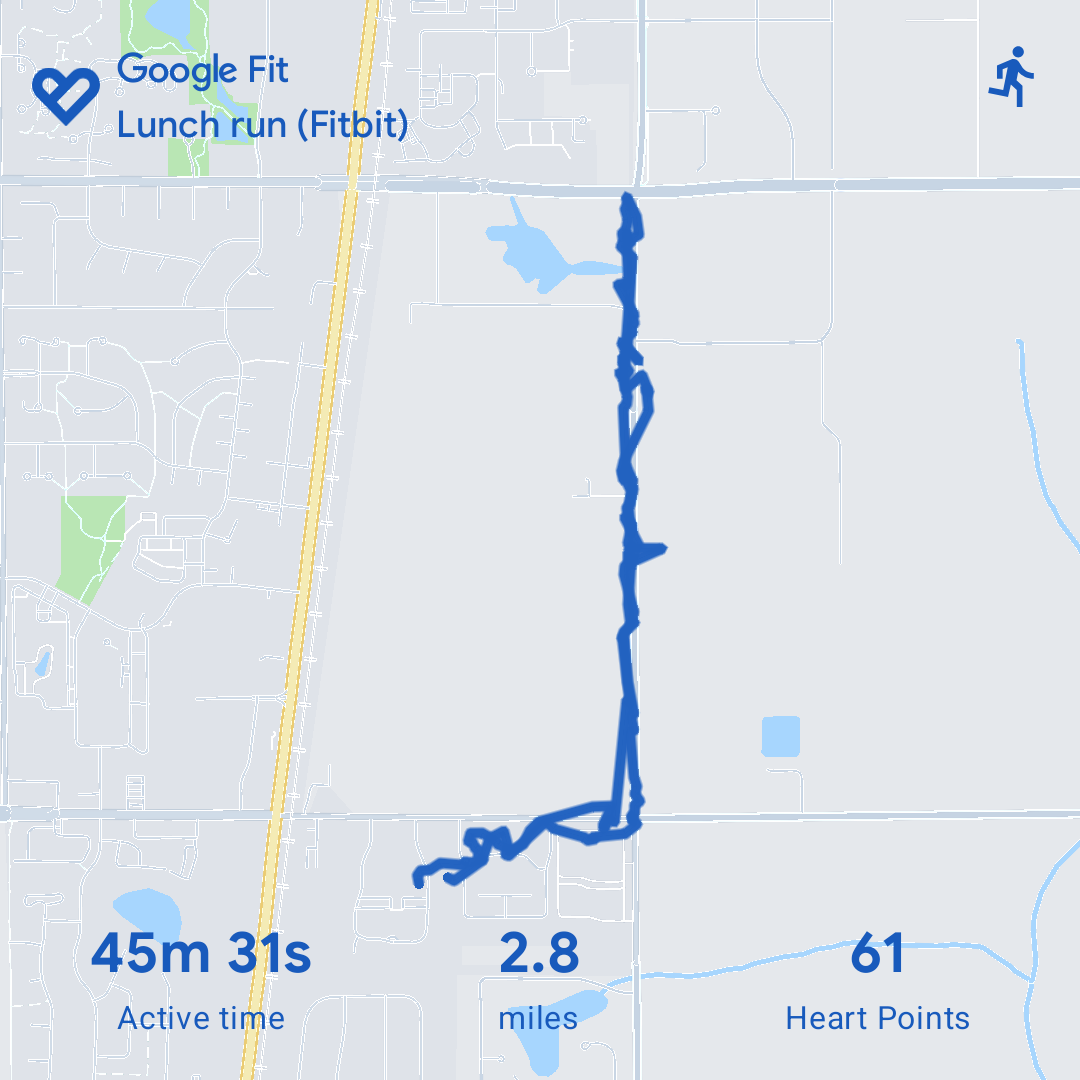
Ashley seems to enjoy going for a run, and she’s a pretty good running companion. She does want to stop and sniff rather more often than I do, and she wants to stop and pee occasionally, which does make it tough for me to hit my best pace for any particular mile. But that’s okay. Enjoying some dog-companionship is a lot better than hitting my best pace.

I had virtually quit running a couple of years ago. I’d gotten a trifle tentative after a fall, and then Jackie was out of town (and therefore not on-hand to rescue me if necessary), and then the weather got cold and the running routes icy. And by the time the weather improved, I’d just fallen out of the habit. For a few months now I’ve been working to reestablish the habit. I haven’t accomplished that yet, but I am getting in an occasional run.

The Fitbit software in my Pixel watch estimates my VO2Max. My estimated VO2Max has long been excellent for my age, but it had gradually dropped some, which was part of the reason I wanted to start running again. These past few runs have produced a modest increase, so as of today it’s in the 95th percentile for people my age. (I think Peter Attia suggests that the minimum acceptable VO2Max is the 95 percentile for someone a decade younger than you, which I’m still a bit below, although it seems perhaps doable.)

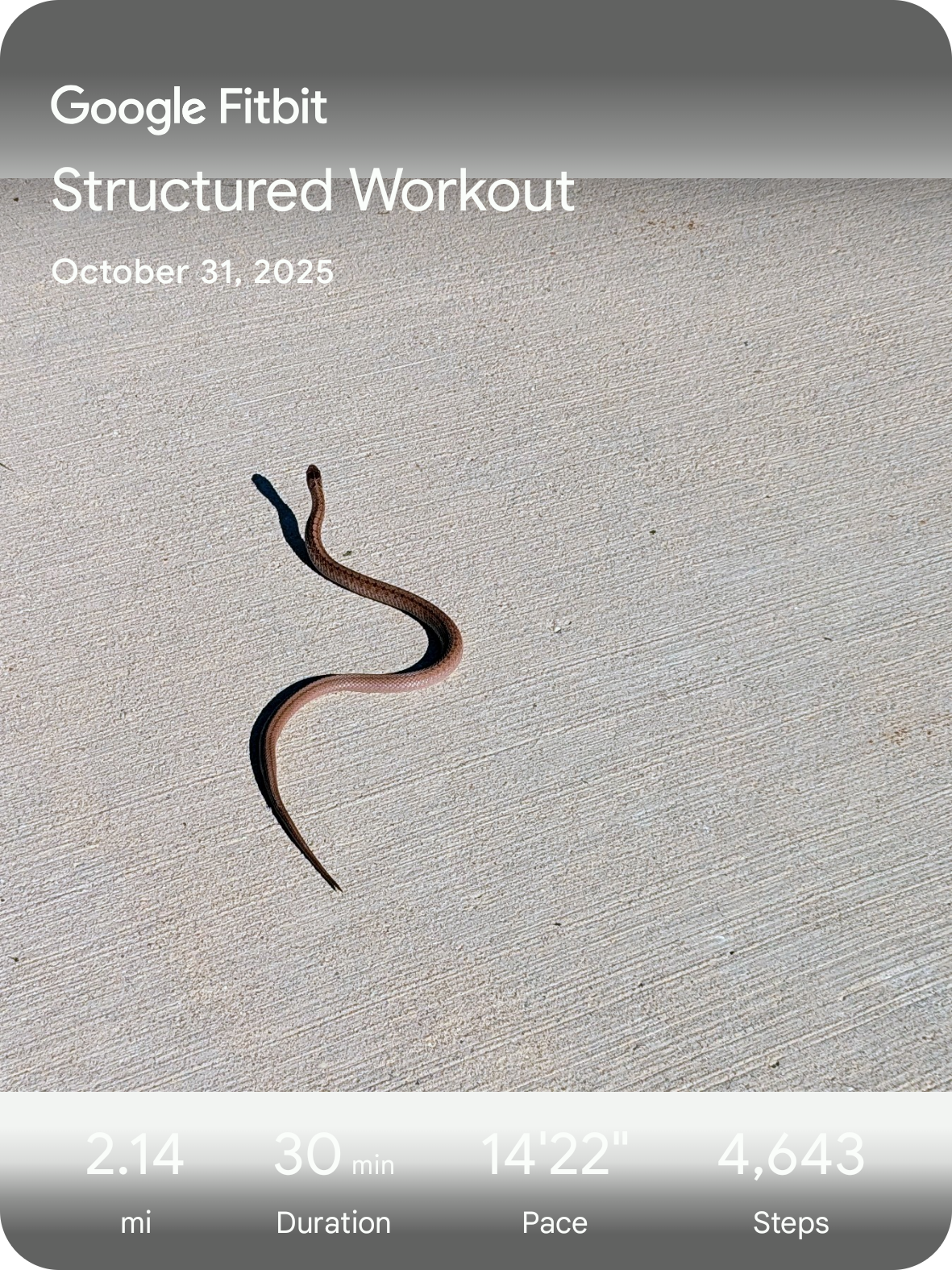
I’m afraid I failed to get a photo of Ashley or myself running (or better, the two of us running together), but I did get a picture of a cool little snake friend who was crossing the sidewalk where I was running.

A small snake on the sidewalk, with stats from my run superimposed on top by Fitbit

I got in one writing session in the morning. Now that I’ve finished my run, I very much hope to get in some more writing (and most especially some more plotting) before the end of the day.

One of the things I haven’t done well in learning sword fighting has been “getting in the reps.” We’ll learn a move—a particular cut or thrust or parry—and I’ll work on it until I can do it correctly once (or a few times), but then I’ll quit. I don’t “get in the reps” that it would take to really learn the thing.

This is about 80% my own fault, of course. (It’s about 20% the fault of the instructors, who always want to move on and teach the next cool thing.) Clearly, having done something correctly once (or a few times) should put me in the position of being able to practice it more, either alone or with a training partner. And it’s totally on me that I hardly ever do that.

Anyway, I occasionally remind myself that I should get in the reps of whatever we’ve just learned. Sometimes I do better or worse, but I rarely forget. (I just get tired or busy or forget all the things we learned except the last one or find some other reason to fail to get in my reps.)

The reason I’m thinking about this today is simply that I’ve been writing more just lately, and of course writing is the same way. If you want to get better at writing, you need to get in the reps.

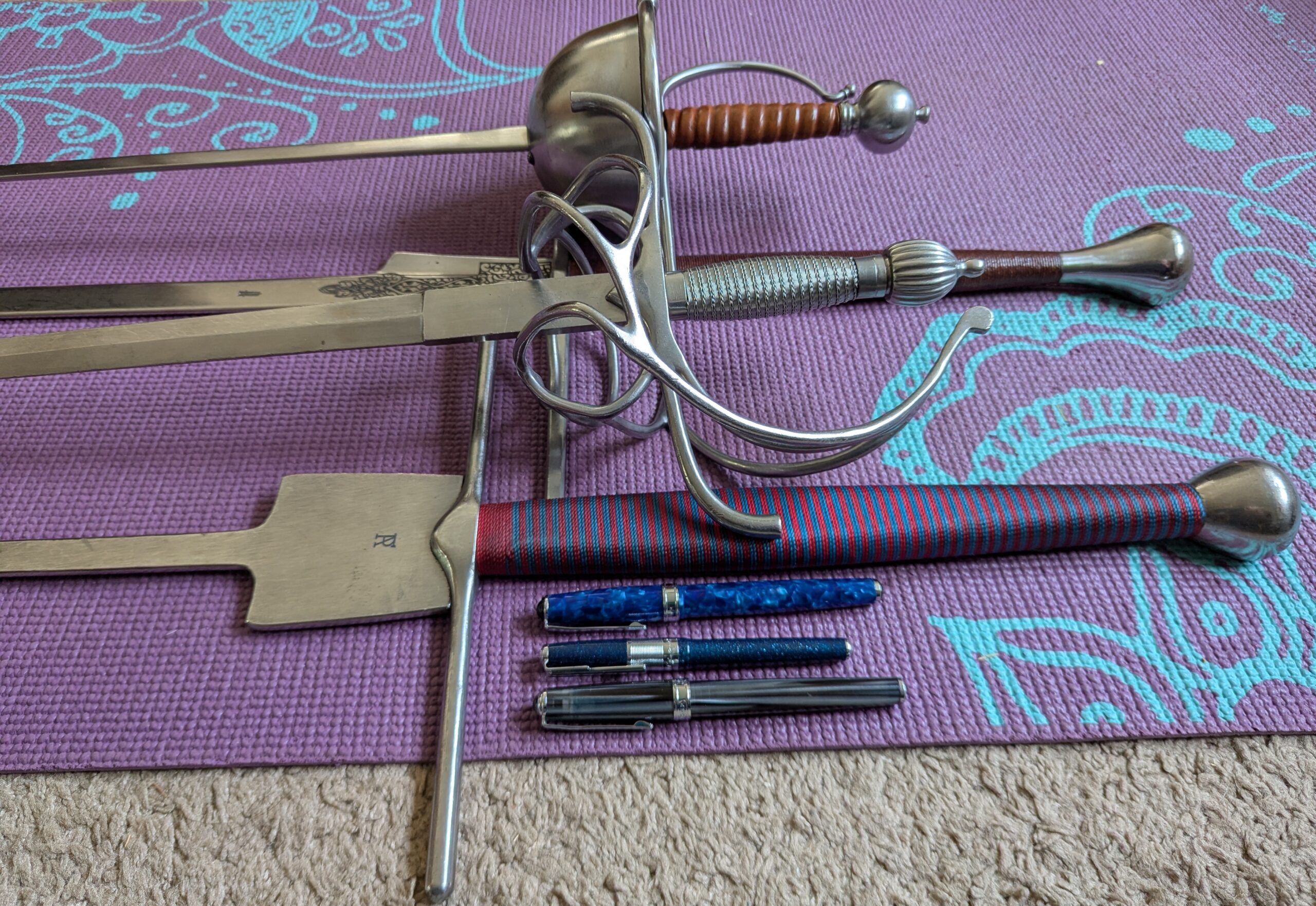
The hilts of two longswords and two rapiers, with three fountain pens in the foreground
Add your own “pen is mightier than the sword joke here.”

More specifically, you need to engage in “deliberate practice.” So it’s not just getting in the reps. You need to get in one rep, monitor your performance, evaluate your success, and then figure out how to do it better. Then repeat.

This is true at every level. In sword fighting there’s the cuts, thrusts, and parries, of course. But there’s also footwork to go with each one of those things. Then there’s postures that you might pass through along the way. There’s distance management. There’s watching your opponent’s postures for clues as to what he might be about to do. There’s figuring out what you might do in response.

Writing has its own levels, but it’s still the same. Word choice. Sentence structure. Paragraphs. Telling a story.

After decades of practice, I’m pretty good with words, sentences, and paragraphs. My skills with telling a story still need some work.

I need some more reps.

I haven’t been running enough, so I went for a run today. The metrics are kinda funny, by which I mean my Fitbit thought it was an insanely hard run. I thought it was interesting enough to post about.

A map showing my running route, color-coded to show that I spent most of the 3+ miles with my heart rate in zone 5

Fitbit calculates heart rate zones based on your “heart rate reserve,” which is your maximum heart rate minus your resting heart rate.

Your resting heart rate (roughly what you’d get if you checked your heart rate right after you woke up, before you started moving around) the device actually measures. My resting heart rate, according to the Fitbit, was 56 bpm. (It actually hit 44 bpm at some point while I was asleep, but your lowest resting heart rate is a different number.)

Your maximum heart rate, though, isn’t measured. Instead, it’s estimated as 220 minus your age. I’m 66, so that comes to 154. So my heart rate reserve is 154 minus 56 equals 98. Then my various zones are calculate as a fraction of the reserve plus the resting rate. Zone 5 (peak activity) begins at 85%, so my zone 5 begins at (0.85 ✖️ 98) + 56, which comes to 83 + 56 = 139. All the parts of my run shown in red in the map above were run at a heart rate at or above 139.

In fact though, my maximum heart rate is way higher than that estimate. I have in the past been somewhat dubious of the maximum readings shown by my Fitbit during a run, because all the wrist-worn devices sometimes sync up at your foot-strike rate, so you get anomalous readings around 180 (a common foot-strike rate). But I also check my heart rate doing other exercises, such as kettlebell swings, where foot-strike rate doesn’t matter. Plus, I get heart rate readings from my Oura ring, which is not wrist-worn, and which doesn’t seem to have the same syncing-with-foot-strike problem. So I know my max heart rate is much higher.

On this run, for example, the maximum heart rate as measured by my fitbit was 169. My Oura ring thinks the peak was 166 (but it averages over 5-minute periods, which smooths out the peaks quite a bit).

Anyway, if you take 166 as my actual maximum heart rate, then my heart rate reserve is 110, 85% of it comes to 94, so my zone 5 range ought to begin at a heart rate of 150, rather than 139.

I find that a lot more plausible. If the Fitbit is right, then I just spent 36 minutes in zone 5, which seems very unlikely. It was kind of a hard run, because I haven’t been running enough, but I not only could have talked while I was running, I actually did sing, which is one of the markers for being in zone 1. (I was listening to and singing along with some Kpop songs.)

So, I think much of that run, even some of the bits shown in red above, were in zone 2 or 3, not zone 5.

Whatever the heart rate metrics, it was a rather slow, rather short run: 3.15 miles in 58min 10s.

Much better than not running.

Updated next morning: I slept great after my run, and woke up feeling great. Legs not sore at all. Overnight heart rate right back down to my current baseline.

For an athlete, being explosive is good. You can jump higher, run faster, hit harder, and (the point of this post) thrust a sword more quickly. Sadly, I’m perhaps the least explosive person around. This is very frustrating when it comes to sword fighting, because my thrusts aren’t quick enough to hit my opponent, whereas their thrusts are quick enough to hit me, before I can parry them.

I can obviously compensate in various ways. I can try and be very deceptive, and then launch an attack that is so surprising my opponent can’t react. I can get very good at parrying, so I can stop an attack with a very small movement that doesn’t have to be so quick. I’m working on these things.

But one other thing I can do is work on explosiveness.

This will have other advantages too. Explosiveness (roughly the same thing as power) is an aspect of muscular strength that disappears early as one ages, and it’s very useful. Just being strong is great, if you want to lift something heavy, but power (or explosiveness) is what you need if you catch your toe, and then want to get your foot out in front of you before you fall down.

I’m going to have to do some research on training for explosiveness, but one exercise that I already know that I can start training right away will be to throw my slam ball. Some people do that facing a wall, so they can catch it and throw it again. But I think I’ll throw it, and then spring forward as fast as possible to pick it up and throw it again, so I can train both explosive arm strength and explosive leg strength.

Me holding an orange slamball above my head, about to slam it down
Another slamball exercise to improve power and explosiveness—the classic slamball slam

I’ve finally started getting invited to fitness influencer events! I got email today offering me a chance to get early access to a new line of athleisure clothing if I attend their event!

Sadly, their event is in Los Angeles. And, based on the images, their clothing line is for women. I’d look funny wearing their short skirts and tight tops for skinny girls.

Still, once I show up on one brand’s radar, surely other brands will start noticing me.

Note: I have no interest in being a fitness influencer or a brand ambassador, or getting early access to athleisure clothing. I don’t even really have any interest in free athleisure clothing, although I’m not sure I’d turn it down, because that’s just the sort of ethically ambiguous guy I am.

Pictures of me in exercise clothing, so that future firms know what they might get:

If that doesn’t make you want me wearing your athleisure clothing in my content, well, I guess you probably don’t want me wearing your athleisure clothing in my content.

Jackie and I are in Chicago for the weekend, staying in the Palmer House. We came to attend the opening of a tapestry exhibit at an art center in the West Loop, put on by the American Tapestry Association. The exhibit includes a piece by one of Jackie’s teachers, So Jackie particularly wanted to see it.

Jackie looking at a tapestry showing a woman with a dinosaur
Jackie looking at a different tapestry, this one showing a woman with a dinosaur

After a period where I was being a bit casual about them, for the past few months I’ve been doing pretty well at getting my workouts in, and I didn’t want to let that go, so I went to the fitness center here at the Palmer House. It’s pretty good!

I cranked through a slightly reduced version of my usual morning exercises, then went to the main room of the fitness center for the workout proper. They had an adequate set of kettlebells, so I did two exercises with those:

  • With a 35 lb (16 kg) kettlebell I did 10 x 20 swings emom
  • With a 20 lb (9 kg) kettlebell I did 4 x 5/5 clean&press reverse ladder

Then I found a barbell and loaded it up with a pair of 45 lb plates and did 2 x 5 deadlifts. I’m super out-of-practice with deadlifts, and would not have wanted to do more weight or more reps, but that much was okay.

Having done the tapestry thing, we’re looking to do some other Chicago stuff. Probably the Art Institute. Maybe one of the boat tours where they talk about the architecture. Maybe the Field Museum. Maybe something else! We’ll just see.