I gave up multitasking a long time ago. I realized that I’m not good at it, and started paying attention so that I could notice when I was doing it and stop.

As an aside, I should mention that there’s now quite a bit of research to show that nobody is good at multitasking, and that the people who think they’re good at it are even worse than the people who know they’re not.

Even though I’m more efficient doing one thing with complete focus and then going on to the next thing, that practice alone doesn’t solve the underlying problem that tempts people into multitasking: How else can I get everything done?

Half of the answer to that is the drearily obvious, “You can’t. What you can do is get a whole lot done, if you quit frittering away your time on trivial, pointless stuff, and apply your time doing the most important stuff.”

I know some people who are pretty good at that, and they are routinely way more productive than me or most other people.

But there’s more to it than that. Katy Bowman has been talking about one useful practice, suggesting that you “stack your life” by accomplishing multiple goals at once—something that sounds suspiciously like multitasking, but really isn’t.

I’ve actually been thinking about this quite a bit, wanting to articulate the difference for my own sake if no one else’s. My take on it, is that it has to do with what the limiting resource is for each activity.

There are a lot of limiting resources. Your hands are one—they can really only do one thing at a time (although my mom used to read, fan herself, and drink lemonade all at the same time, and felt like she was being very efficient). Location is another—something that can only be done in the kitchen can’t be stacked with an activity that can only be done in the garage or the gym or the grocery store. Other people are another—something that requires the presence of another person can’t be done without him or her. (Though it’s not that simple, as sometimes you can stack up the other people and get multiple things done with multiple people.)

In multitasking, the limiting resource is your attention, and what’s unique about attention is that many activities can be done with partial attention. That experience tempts us into thinking that attention is more divisible than it really is.

Washing dishes only takes partial attention, meaning that you can listen to the radio or a podcast and get full benefit out of both activities.

Driving is a more complex example. We know that driving sometimes requires your full attention. This is why talking on the phone is unsafe to do while driving—talking on the phone requires enough of your attention that doing so reduces your competence at driving as much as getting drunk does. (Talking to someone in the car with you is much less unsafe, because that person can see when the road conditions are such that you need your full attention and shut up. Just listening to something—the radio or a podcast—does not seem to cause the same problem, probably for reasons having to do with deep structures in the brain that prioritize social interactions.)

Even though there are plenty of activities that can be done with partial attention, most important activities require full attention to be done well.

Writing a blog post can be done with partial attention, but when I try to do it while simultaneously listening to a podcast, checking my twitter and facebook feeds, chatting with a friend on-line and another in-person, and answering the occasional email message, I don’t do it as well.

As I’ve worked to apply this lesson—noticing when I’m multitasking and then refocusing on the main thing I’m doing—I’ve learned something else: Many activities that don’t require full attention turn out better when I give it to them anyway.

Beyond that, I feel better when I give my full attention to whatever I’m doing.

It was the meditation practice that I adopted as part of my taiji practice that taught me this. First, it taught me the skill of paying attention, then it taught me that paying attention to what I was doing right now paid dividends, even when all I was doing was sitting or standing.

I’ve noticed it particularly with exercise. I used to distract myself from exercise with music or podcasts or games like Zombies, Run!, because I found exercise to be unpleasant drudgery that I only engaged in to the extent necessary to build and maintain a basic level of fitness. I don’t do that any more. It’s much better when I fully embody my exercise: I enjoy it more, I’m less prone to injury, and the exercise is more effective.

The more I do this—give my full attention to whatever it is I’m doing, whether it seems worthy of full attention or not—the more I find it worthwhile.

Downside: I’m falling behind on my podcast listening, because there are so few things where I feel like partial attention is all they deserve. Maybe I’ll find more, but at the moment I’m just about down to riding on the bus.

So, yes: Stack your life. If you can do one thing with your brain, one thing with your hands, and one thing with your feet all at the same time, go for it. But think twice before dividing your attention. If something is worth doing, it may well be worth your full attention, no matter how hard that makes it to get everything done.


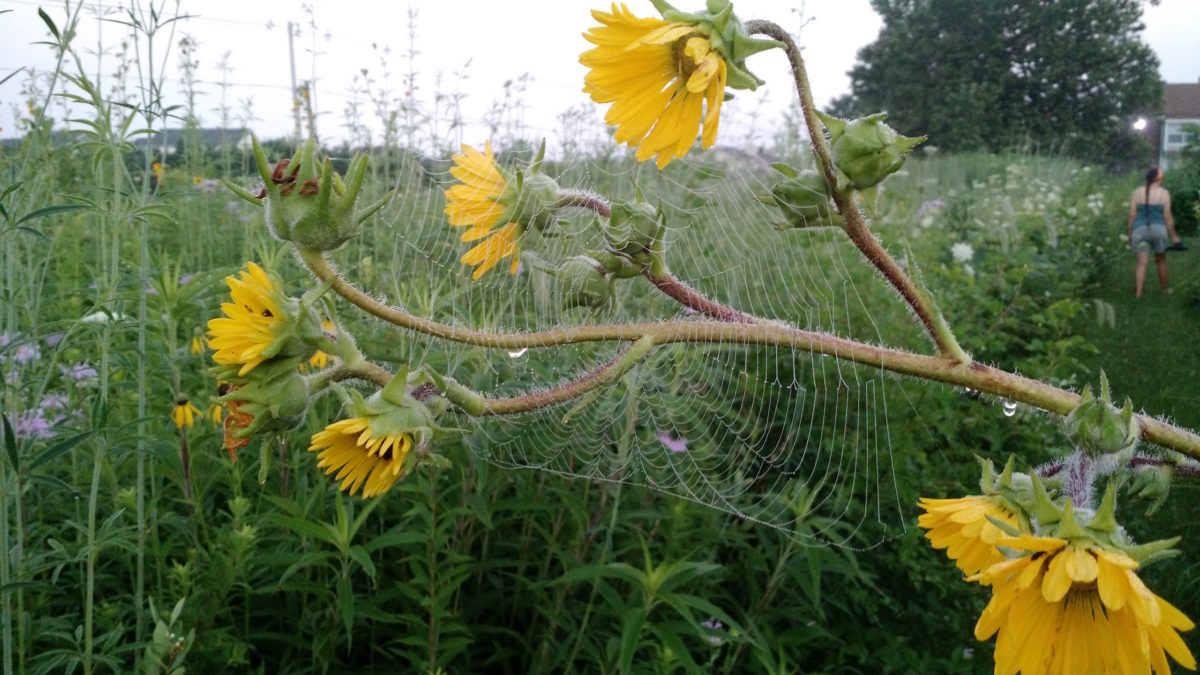
Prairie Spiderweb

A true fact about me: I’m terrible at watching another person move and then moving in the same way. My coping mechanism for this limitation is that instead of doing what ordinary people do—watching and then doing the same thing—I go through an intermediate step of describing the move in words, and then executing my verbal description.

It’s a slow process. First I have to watch enough times to figure out what the verbal description is, and then I have work through the move very slowly, executing my verbal description while (slowly, and with difficulty) comparing what I’m doing to what I’m supposed to be doing.

Because of all this, I’ve always found it hard to learn things like dance moves and martial arts moves, but it also makes it hard to learn even just ordinary exercise moves.

I mention this, because it has a lot to do with why I’m only now starting to turn up the volume on my exercise: Over the past year, I have added a lot of new exercise moves, drawn from Katy Bowman’s Move Your DNA, from Ben Musholt’s Parkour Strength Training, from Erwan Le Corre’s MovNat videos, and from other sources. For a long time, I’ve felt awkward doing a lot of these moves, and am only now starting to feel like I’m doing them well enough that it’d be safe to start doing them in higher volumes.

One thing that Julie Angel’s book Breaking the Jump reminded me of was that the early parkour practitioners pushed the volume way up in their training, doing hundreds of push-ups, thousands of sit-ups, and covering long distances balancing on a rail (or hanging under a girder, or jumping from rock-to-rock or post-to-post) every day, often multiple times a day.

Of course I can’t do hundreds of push-ups or thousands of sit-ups. What I can do—what I’ve started doing this week—is add sets. I can do 40 meters of quadrupedal movement, and then do another 40 meters later in my training session. I can do 4 negative pull-ups, and then another 4, and then another 3. And so on.

In between sets, I can do the more flexibility oriented restorative exercises. (Right now I’m working on getting the ankle, knee, and hip mobility I need to do deep squats.)

I started upping the volume on the pull-ups and quadrupedal movement a while ago. Now I’m adding some of the newer exercises, such as lunges and squats, that I hadn’t done before, and that felt awkward enough that I wasn’t inclined to add volume.

So far it’s feeling really good.

Oh, and to bring things full circle, it turns out there is an upside to my coping mechanism for my inability to mirror movement—it has made me a better tai chi instructor. When I’m teaching a move, I already have a verbal description of how the move goes. I already have a vocabulary out of which to build descriptions. And I have a lot of practice at producing a verbal description of a movement. These things have turned out to be very helpful.

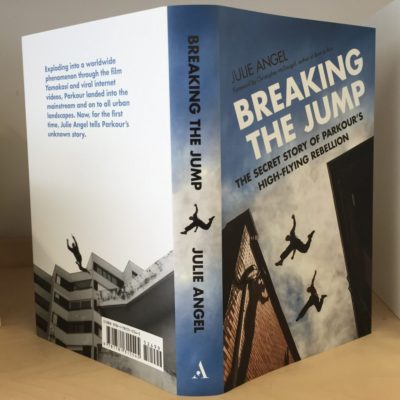
breaking-the-jump-coverI’m not sure exactly when I discovered parkour. Its first mention here in my blog is in May 2014 when I talk about starting to practice precisions and shoulder rolls.

By then, Julie Angel had already finished a PhD and created a large body of photos and videos on parkour.

I came across her work fairly early, and immediately appreciated its strength, so I was delighted to learn that she was writing a book. I bought a copy as soon as it came out, and spent last week reading it.

I’d read some about the early history of parkour, so I knew about David Belle as an individual and the Yamakasi as a group, but this was largely my first exposure to the other early practitioners as individuals—and a bunch of interesting individuals they are.

Early in the book Angel takes a stab at tweezing out the many threads that went into making parkour something that appeared in this place at this time: The urban planning that produced the built infrastructure in Lisses and that also drew in the immigrant population that lived there. The life- and family- histories of the handful of young men who became the Yamakasi. The kinds of men they were. Angel never really pins down exactly why these young men produced parkour when no one else had done so, but it’s a credible effort at answering a question that’s probably unanswerable.

Because on the one hand, many other groups of young men could have created parkour. Most of the key traits of these young men—a certain facility with movement; a willingness to train very, very hard; a tendency to push one another to ever greater efforts (and to let themselves be pushed)—are not that rare. Although many young men are clumsy or lazy, you need only look among the national-level competitors in any boys or junior individual sport, or even at any good high school sports team, to find both movement skill and the capacity for hard training.

More important than those things—which are, as I say, fairly common among young men—was an ethos that leaned against that willingness to push and be pushed. It’s an ethos exemplified in some of their sayings—things like “Start together, finish together,” and “Be strong to be useful.” Everyone was pushed outside their comfort zone, but no one was pushed to attempt anything that he didn’t know he could succeed at. It is surely the reason that early parkour practitioners had such an incredibly low rate of training injuries whether from accidents or from overtraining. (Would that runners were as durable.)

New to me—and a perfect example of that ethos—is the picture Julie Angel gradually paints of Williams Belle. Younger than the others, he was someone I hadn’t even been aware of until I read the book. Williams is portrayed as having all the movement skill and all the willingness to train very, very hard as any of the other pioneers, but lacking the ego of David Belle, and possessing teaching methods that seem uniquely gentle.

She has Stéphane Vigroux saying this about Williams:

On the surface it was the same training school, but somehow the energy and feel when observing Williams was different. . . . From the first jump . . . Williams had known that the discipline should be about helping and sharing with others.

It makes Williams sound like someone I’d like to get to know.

Angel includes a good look at the prehistory of parkour—Georges Hébert and others—and a look at contemporaries who created things that overlap—people like Erwan Le Corre—but it’s not really about them. Most of the book is about the early practitioners. But only most of the book. A little bit—maybe ten or fifteen percent—is kind of a memoir of Julie Angel’s own experiences beginning with parkour. Her stories of her struggles to break her own jumps, learn to balance on a rail, or simply to attend her first class are very effective at illuminating the journey of the founders.

Maybe she used every such story she had—at least, that’s the only good reason I can think of for including so few, because frankly, those bits are some of the best bits in the book. If she wrote a longer memoir of her own journey learning parkour, I’d buy it.

If you’re interested in the history of parkour, and especially if you’re interested in understanding what it meant to those early folks—what it meant to work together, to train very hard, to confront their fears and overcome them together—this is an outstanding book

Breaking the Jump: The secret story of parkour’s high-flying rebellion by Julie Angel.

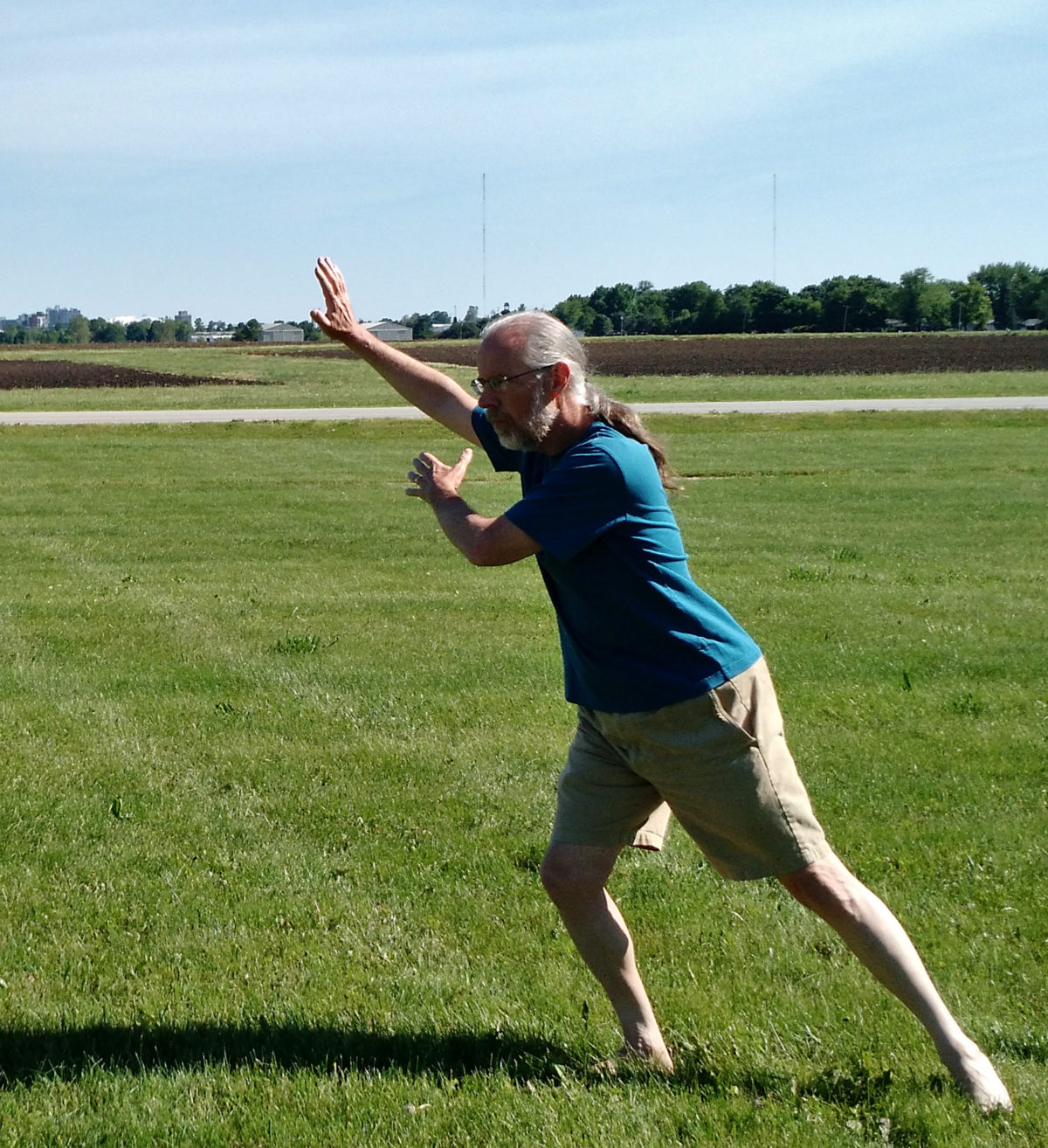
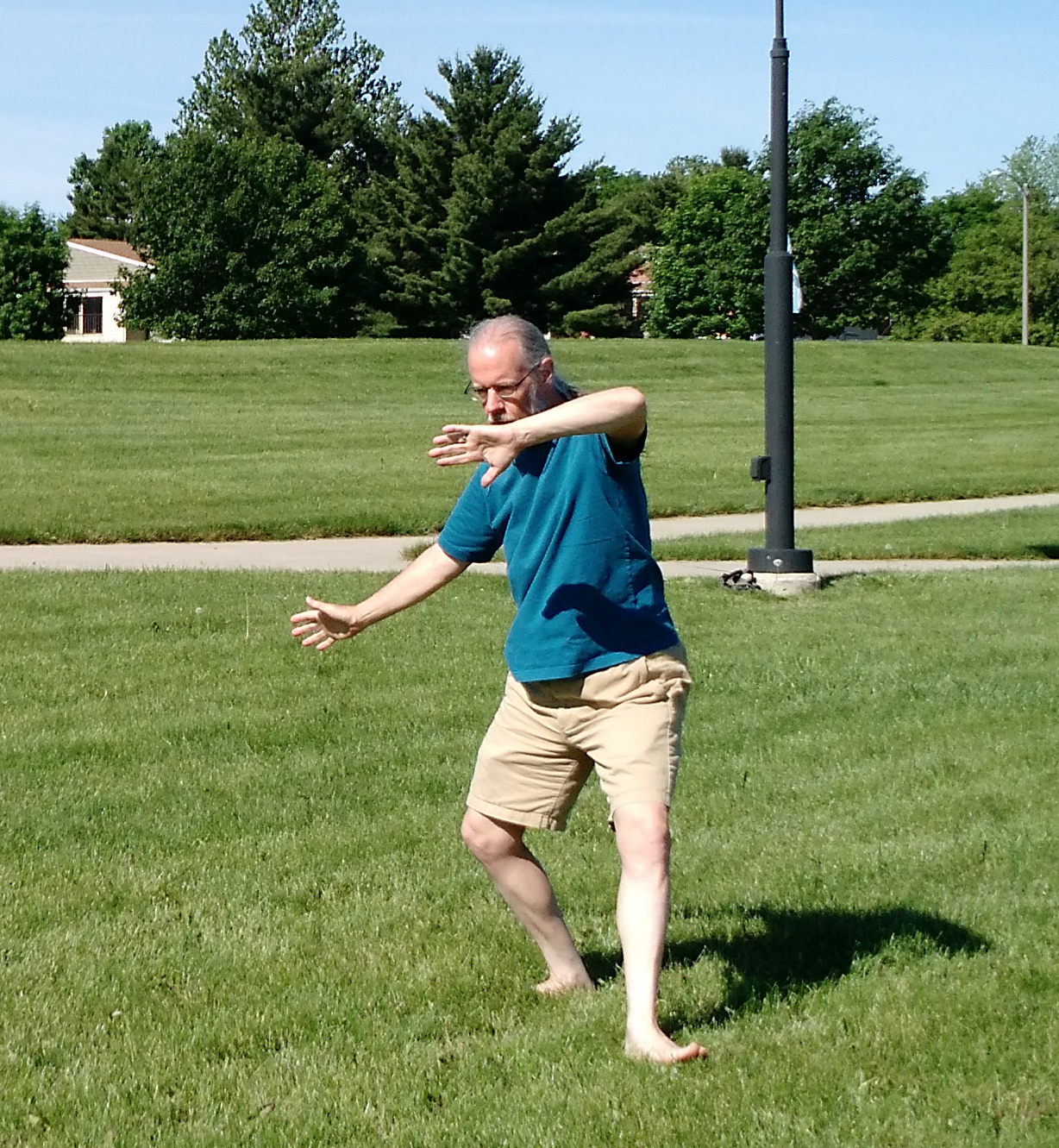
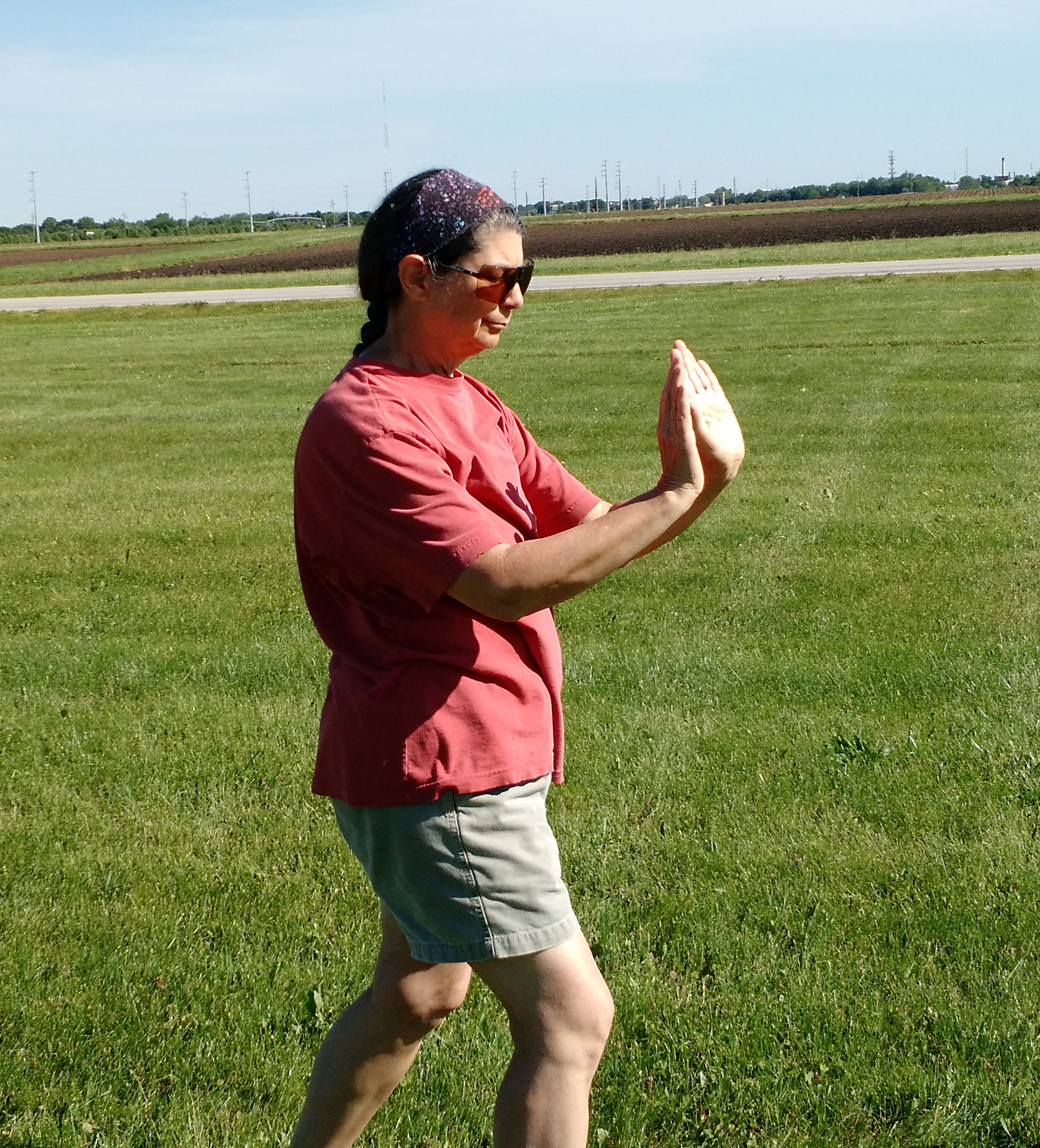
img_20160530_091940035_27254416212_oEveryone is welcome to join me and the folks from the tai chi groups I teach for free practice sessions this summer.

We’re planning to meet Monday-Wednesday-Friday 8:30–9:30 AM in Morrissey Park. (If we meet later it gets too hot before we’re done.)

These group practices sessions have no teacher or leader, so they’re free.

These sessions tend to be much like our usual classes:

  • A few minutes of opening exercises
  • Half an hour of moving Qigong
  • Ten minutes of standing meditation
  • A short tai chi form
  • The 48-movement form

This means that most of the hour is accessible to anybody, even complete beginners.

We’re starting Wednesday, June 1st. I’ve promised to show up for the first couple of sessions to help students from my beginner class get started on the longer form. (After that I’ll miss several sessions in a row because I’ll have family visiting, but there are lots of other friendly people there, many of whom know tai chi as well I do.)

Join us!

img_20160530_085444842_27253378762_o

A few months ago, I wrote about my plan to do some strength training to prepare myself for parkour training this summer. As I’m now working on my plan for the summer, I thought I ought to evaluate how my winter’s training had gone.

There were four specific areas I wanted to work on:

  • Hanging
  • Wall support/wall dip
  • Squatting
  • Toe flexibility

Although my progress was mixed, I’m reasonably happy with how things have gone.

I’m most pleased with the hanging. I don’t remember for sure how far I had gotten last summer—I think I remember hanging for forty seconds—but I’m sure I beat it this year. (Recent best: one minute fifteen seconds.) In addition, I started adding negative pull-ups to my workout, and can now do four of them. (And do them with pretty good control.) I may be within striking distance of my first pull-up!

I’ve been quite lazy about the wall support and wall dip exercises. In my brain the reason for this is that I don’t have a good wall to practice on, which is crazy, because the window seat is right here about two feet from where I’m sitting, and it’s a perfectly good place to do the exercise. It’s not perfect, though: It’s too low, so I have to bend my knees to get my feet off the ground, and that means that I can’t do the most parkour-like version of the exercise in which my feet can contribute to the effort. Which is no excuse for not doing the upper-body part of the exercise, but that’s brains for you.

I’m not sure I made much headway with the squatting, although I figured out that ankle flexibility is my main limitation. If I prop my heels up a couple of inches, I can squat down, linger there for a while, and stand back up again. Without the heel support, I need some other aid—something to hang onto to keep myself from topping over backward. I’ve been doing a lot of stretching for calf (and hamstring) tightness, and also just spending some time in a squat (with heel support). I’ve also done some bodyweight squats, going as low as I can, and some goblet squats (where the weight allows me to get all the way down without toppling over, and provides some resistance).

I think I did gain some toe flexibility, or perhaps just a better understanding of my limitations. I’m hoping that I improved enough that I’ll be able to do things like quadrupedal motion barefoot without hurting my toes. In any case, I’m pretty sure that even my most minimal shoes will provide adequate protection that I can train while I continue to work on it.

Besides just progress, I thought I’d mention one further insight: For a while in the autumn I’d been just a little restless during the night—I’d wake up and toss and turn, and often end up getting up for a bit before I was able to get back to sleep. I was very surprised to discover that this immediately got better. My theory is that it was due to the stretching I’ve been doing to improve my squatting: My lack of flexibility meant that I’d start getting achy and uncomfortable after a few hours of lying still, and the stretching improved that almost immediately.

As I said up at the top, I’m working on my plan for the summer. I’ll be sharing those thoughts shortly.

I think Champaign-Urbana is great. The university gives it cultural and scientific amenities far beyond its size. It’s a cheap place to live, which not only enables my lifestyle, it enables the lifestyle of any number of clever creative people who choose to live where they can make enough from their art to support themselves.

Just about the only thing that CU really lacks is relief—that is, a variation in height from one place to another.

What I mean to say is: it’s really, really flat. Take for example, this image:

Looking toward Yankee Ridge

That’s the hilly direction. I’m looking toward Yankee Ridge, which is about three miles away from where I’m standing. It may not look like much, but that hill in the distance is a big deal when you’re on a bicycle. At least, it is if you’re used to riding in Central Illinois.

Given the terrain, we don’t get enough hiking on hills, unless we make an effort to go to the hills. So, that’s what we did yesterday. We drove to Fox Ridge, a nearby state park which has some hills.

I remember hiking in Fox Ridge last summer, shortly before our big Kal-Haven trail hike, and finding that we were in pretty good shape for dealing with the hills, despite our very limited practice. That was less true this spring. I was a bit tired from my unexpectedly fast run the previous day, and we were both a bit out of shape from a lack of hills over the winter.

Still, we did okay. We saw some spring wildflowers, like these dutchman’s breeches:

img_20160416_101623469_26401844861_oAnd this buttercup:

img_20160416_101630244_26468029235_o

And this solomon’s seal:

img_20160416_110056171_26401892471_oTotal hiking was probably only a little over 3 miles, but the hills made it a very different sort of hike than our much longer hikes closer to home. Plus, we got to spend time in the woods.

So, that’s another bonus of Champaign-Urbana: We’ve got Fox Ridge State Park just 50 miles away.

The weather finally became what I want from weather: gloriously warm and sunny. Friday I celebrated by going for a run.

Conventional wisdom for a while now has been that faster foot-turnover—at a rate of 180 steps per minute—is better. Supposedly it maximizes the amount of energy stored in the elastic properties of your feet and ankles which can then be returned as free energy in the next stride. Slower foot-turnover means you have to work harder twice—first, using muscle strength to absorb the energy of the foot-strike, and then using fresh muscle power to generate the next stride.

To work on that, I’d downloaded a metronome app to my phone, and set it to tick at 180 bpm. I started that up, and started running in sync with the ticking.

I’m sure it’s possible to run at a slow pace with fast foot-turnover, but doing so did not come naturally to me. I sprinted off down the road at quite a bit faster than my usual running pace.

Perhaps, if I’d focused on running slowly at 180-foot-strikes per minute I’d have been okay, but the other thing I was focusing on was making my foot-strikes as gentle as possible. (There’s recent research supporting the obvious: minimizing impact loading of each step reduces running injuries.)

With my attention focused on faster, lighter foot-strikes, I managed to get myself pretty out of breath in just a mile or so. At around 2 miles, I passed a playground that I like to pause at—I practice my balancing by running around the perimeter formed by (I think) 1×6 boards, and then do some inverted rows using a piece of playground equipment. That gave me a chance to catch my breath a little, and I walked for a minute or so after I finished there.

Once I started up running again, I ran a bit more slowly. I’d turned off the metronome, although I was trying to keep the 180 bpm pace in my head. I was doing a bit better at keeping a lower pace, until I came into sight of the traffic light to cross Route 45, and saw that Jackie was also approaching the intersection, about a block ahead of me.

I responded to that by picking up the pace (again), and managed to cross on the same walk signal. Then I quit running, and walked the rest of the way home with her. The run came in a 3.2 miles, at an average pace that is nothing to write home about, except that it includes the time playing on the playground equipment.

Next step: Figure out how to run slowly with fast foot-turnover.

By the way, this is still true:

The image at the top is the view out the study window, where you can see that our neighbor’s flowering tree is in full bloom. Ours is perhaps a day or two behind.

Having written about endocannabinoids as the likely source of runners high, I wanted to draw people’s attention to this report, which talks (in the middle third) about the use of exogenous cannabinoids by athletes.

If runner’s high is not enough, why do people exercise on THC, the active ingredient in cannabis? It is not unusual for athletes, like other social groups that follow common routines, to combine popular lifestyle activities like alcohol (beer after racing) and food consumption (pre-race pasta parties), with others in the clan. The same appears true of cannabis use, enhancing leisure and social activities such as getting together for a run or race.

Source: REPORT: Smoking and Exercise – Dr. Phil Maffetone

Even the first bit (on nicotine as a possible performance-enhancing drug) is interesting, with an appropriate emphasis on tobacco’s dangers. The bit on marijuana, viewed largely through the lens of its possible beneficial effects both during and after exercise, made for a nice contrast.

I like to have something around which to organize my walking. Training for our big Kalamazoo to South Haven hike worked great, but having completed that I was looking for something new.

Via Nerd Fitness’s How to walk to Mordor page, I found this little page on Walking to Rivendell, and I think that just might be what I was looking for.

Way back in 2003, some clever people got the idea to go through The Fellowship of the Ring (and a handy Atlas of Middle Earth) and note down all the legs of Frodo’s journey from Hobbiton to Rivendell. Then, as they did their own daily walking, they tracked their progress, noting each milestone as they passed it. (Five miles along; crossed the Great Road from the Brandywine Bridge and entered Tookland.)

Jackie doesn’t seem to have the same strange urge I do to organize walks around some arbitrary or fantasy goal, but she has embraced the idea with some enthusiasm, and decided that we should begin at the beginning and follow the path of Bilbo’s journey to Rivendell. It begins with a hurried dash from Bag End to The Green Dragon in Bywater, then down the Great East Road to a camp site a couple of miles past the three farthing stone, for a total of 11 miles.

We won’t match Bilbo’s journey day by day, but we thought we’d at least start with an 11-mile walk to get into the spirit of the thing.

So yesterday we did.

To make the mileage come out right (and to avoid a boring bit of the walk that we do all the time), we took the bus to campus and started our walk there.

From the Research Park (just across the street from my old office) we walked through campus and on to the Urbana Library (where we returned a library book and checked out another), then went across the street to Lincoln Square Village where we had lunch in their little food court. We went back to the library where we split a brownie for desert and lingered over coffee. Then we headed west across the north end of campus, paused briefly in the Engineering Quad so I could play just a bit of Ingress, and proceeded to the water amenities at 2nd street.

We’d had lunch early, so it was at just about this point that the vitamin D window opened. It was preternaturally warm and sunny, so I took off my jacket and put it in my pack and we spent a half hour or so comprehensively walking the paths through both halves of the water amenities (with my arms exposed to the deadly ultraviolet light of the sun) before heading on to downtown Champaign. We walked through West Side Park, near our 2014 summer place, and then turned south and walked past our 2014–2015 winter palace.

Not far south of there, we passed a house where the grassy verge between the sidewalk and the road was filled with these tiny ceramic houses:

img_20160130_140716526_24689044956_o

Not exactly Rivendell’s last homely house, but I felt they were adequately in the spirit of elven houses anyway.

From there we proceeded to Hessel Park, and thence along familiar paths to home.

I neglected to run Endomondo, but Google Fit claims I walked 11.1 miles.

It was a great walk! Jackie had a sore shoulder and didn’t want to carry a pack, so I carried not only the library book, but also the first aid kit, our lunches, and water for two.

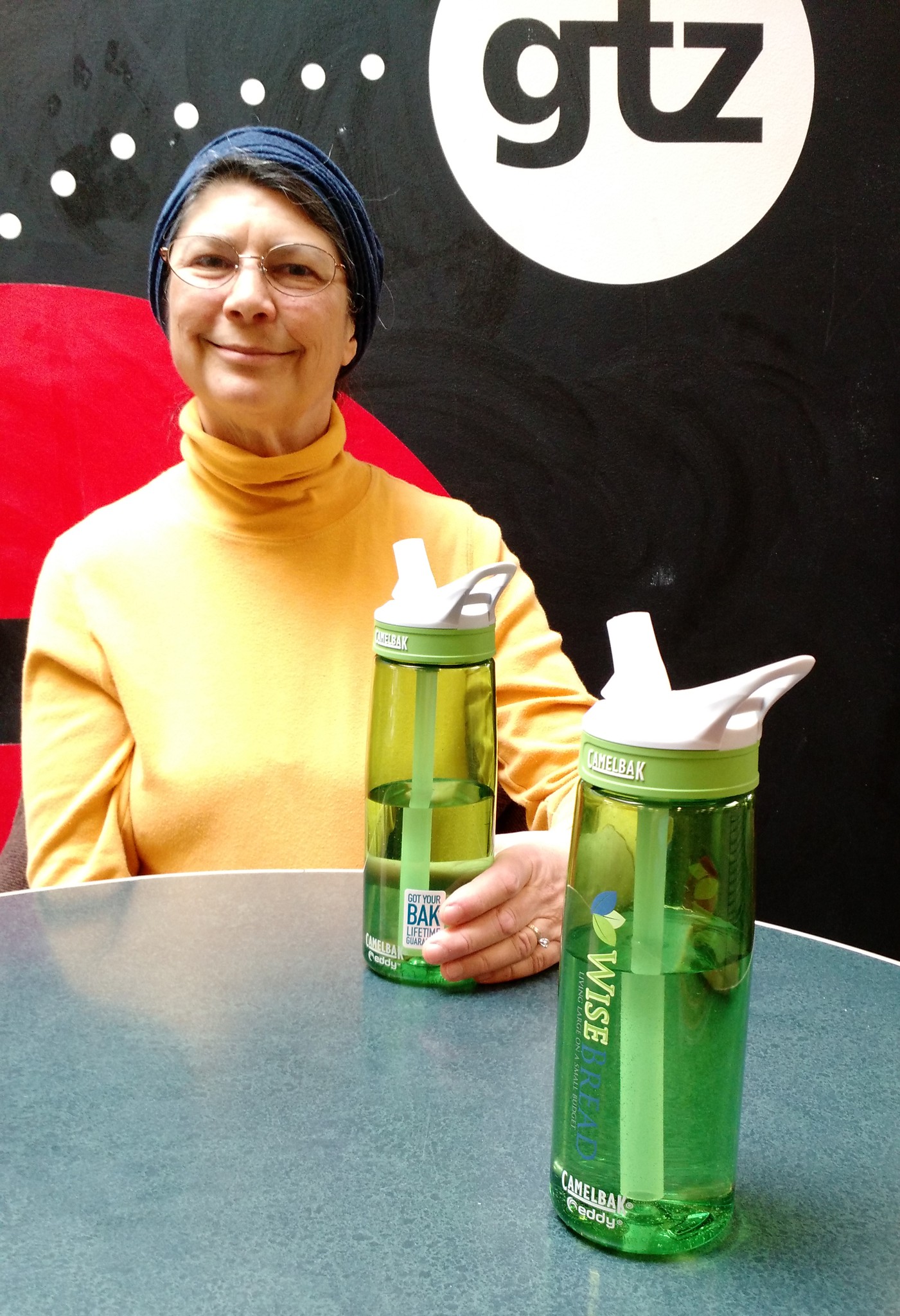
Jackie with our water bottles

Speaking of water, last year Jackie bought one of these Camelbak water bottles, and was very pleased with it. I was happy enough using bicycle-style water bottles. But—by sheerest happenstance—the kindly admins at Wise Bread gave me (as a thank-you gift for being one of their writers) the exact same water bottle as Jackie’s—except that mine has the Wise Bread logo.

These bottles are a little bigger than the ones I carried last year. That together with the library book made my pack a little heavier—enough to be noticeable, but not too much for a walk to Rivendell.

I wore my minimalist boots, which seemed like a nice compromise between my regular hiking boots and going barefoot like a hobbit. In the summer I plan to get back to barefoot walking in a big way (although it may be a while before I’m taking my long walks barefoot).

Via an Art of Manliness podcast interview with Steve Kamb, I just learned about his new book Level Up Your Life. The book is just out, so it’s not so surprising that I hadn’t been aware of it before, but I’m a bit surprised that I hadn’t been more aware of the author’s website Nerd Fitness, which has been around for a while.

The site can’t be completely new to me: my browser remembers that I previously visited the definitive guide to parkour for beginners page, but I must have been totally focused on parkour that day, because I didn’t notice that the site is also full of other stuff that is very much my sort of thing: gamifying exercise (and life).

I haven’t read the book, but the interview laid out the case for how gamification can help you succeed, and not just at exercise. Kamb described how to use the motivational tricks of video games—that ones that keep you playing for one more minute, and then one more level, and then one more quest—and apply them to real life. Figure out what you want to do, and then divide those big goals into quests. Just like in a game, design a series of sub-quests, each one designed to give you the skills and experience to accomplish the next sub-quest, until finally you’re ready for the final level, where you face the biggest challenges, and overcome them.

It works great for fitness, where you can set a whole series of fitness goals, but the author was clear that it worked just as well for non-fitness goals. He talked in particular about international travel—that he wanted to do, but found intimidating, and that he approached by designing a series of trips that let him overcome one daunting aspect at a time (distance, foreign language, traveling alone, etc.). He also talked about learning to play a musical instrument, and then leveling up to where he could perform for an audience.

As someone who does just a little gamification of his own life, I got a bunch of useful ideas from the interview.

One I liked was a way to help you divide your attention among the inevitably many high-priority items in your life: the classic comic book trick of a secret identity. By day, a mild-mannered cubicle worker; by night, a secret agent honing his parkour skills for when he’ll need them to complete his mission (and survive the aftermath). Just like any superhero, you need to give both parts of your life the full attention they’re due.

Another was to use a trick nabbed from games for designing rewards for successfully leveling up: Instead of rewarding yourself with a taste of failure (such as rewarding yourself for losing weight with a supersized fast-food meal), do what video games do: give yourself a reward that improves your chance of success with the next quest. If your quest was to learn how to cook, reward yourself at level 5 by buying a really good chef’s knife, and then at level 20 by traveling to France for a workshop at a world-class cooking school. If you pay careful attention to this as you design your series of sub-quests—instead of just making it up as you go along—I can see you drastically increasing your chance of success at many of the harder sub-quests (because you have provided yourself with the right tool), while simultaneously saving a bunch of money.

Another is to gather allies for your quest. It is very hard to succeed in any area of your life unless the people around you are also successes in their lives. There is a certain temptation to be a big fish in a small pond—to gather people around you that you’re superior to—but then you don’t have people you can rely on when you face problems you can’t handle. There is also the temptation to let people who are better than you do for you what you can’t do yourself—but what would their motivation be? Just as in a multi-player video game, in real life you’re better off (and have more fun) if you have a team of people at about your level. If you’re a beginner, you certainly want a few higher-level players to help, and it’s always okay to have a few lower-level players that you can mentor. Ideally—and it often works out this way in practice—everyone will be better than you at some things and not as good at others. Then you can both help one another out; both learn from one another.

Those are just the things I remember from the interview, there’s more to it than that.

It sounds like a great book. I’ll have to get a copy, and I’ll also have to take a closer look at both Nerd Fitness and the book’s companion site Level Up Your Life.