I happened upon a post by Ragen Chastain, a writer and activist on size acceptance. She’s also a dancer and an athlete, and I mention her because a recent post on training resonates with my experience, without quite matching it.

She’s training for an IRONMAN race, and the post in question compares the difference between training skills versus training fitness. In training, for example, dancing, you’re learning stuff. It may be really hard, but once you learn a move, you’ve learned it: For a long time it’s hard and you suck, and then you get it and then it doesn’t suck any more. Running (and swimming and bicycling, but especially running) is very different:

One of the things that is interesting about training for the IRONMAN is that it is a process of constantly increasing distance and time (sometimes alternately, sometimes at the same time.) such that “progress” doesn’t necessarily mean that my workouts feel better, but that my general feeling of suckiness remains constant at an increased time and/or distance.

Case in point – Wednesdays are speedwork which means intervals at the highest speed I can manage.  The interval time has increased four minutes, and the speed has increased 5 minutes per mile since I started training.  I still feel like I’m going to die at the end of each workout but I’ve gone farther, faster, for a longer time period.  It’s the stasis of suck.

I totally get where she’s coming from: running as fast as you can (or as far as you can, or as long as you can) is hard. But my experience is different.

Especially when I’ve gotten out of shape, I absolutely feel the massive suckage of starting to get into shape again. Many times I’ve gone trudging around my old 1.5-mile loop near Kaufman Lake, gasping for air, thinking “I’m going to die.”

But after three, four, five runs—such a short time that I can’t possibly have made more than a tiny improvement in my fitness—my perspective is completely different. I’m still trudging around the same loop. I’m still gasping for air. But now I’m thinking, “Wow, I’m getting a great workout!”

Perhaps this is because I don’t have a coach. Maybe if I had someone carefully measuring my performance and matching it to a model of my theoretical maximum performance, that person could arrange for my experience of suckage to remain constant.

But I don’t really think so. A lot of the experience of suckage is in your head. With one mindset I experience the physical sensations of slowly running as far as I can as miserable, because it’s so hard. With a different mindset I experience the exact same physical sensations as wonderful, because I’m doing what I want to do, accomplishing something that’s difficult and yet rewarding.

That doesn’t suck, even if it’s hard and painful.

We have a bunch of things we’re hoping to do this year, and most of them require some amount of preparation—preparation which will have to occur in the winter and spring.

My plans stretch out to the end of July, because the last week of July I’ll be in Lille, France to attend the 100th Universala Kongreso de Esperanto.

As preparation for that, I really want to spend half an hour almost every day practicing my Esperanto. That should be plenty—I already read and write the language and I’ve attended international Esperanto gatherings in the past. But just a bit of practice listening to spoken Esperanto (podcasts and such) and a bit of practice actually conversing (with my local Esperanto group, and such other folks as I can find) will go a long way toward making attending this kongreso a rich and satisfying experience.

About a month before that will be the solstice, and right around then—second half of June or very early July—is the only good chance do the Kal-Haven trail walk that we’ve hoped to do each of the last two years. (In those weeks because only then are the days long enough to finish the walk in daylight.)

As preparation for that, we need to go on several walks each week, including a very long walk roughly every other week, working our way up to being able to walk the 33.5 mile trail.

Several months earlier—just one month from now—we’re going to have a little party for people to come see our townhouse. We’ve fixed the date as February 1st, and are thinking of it as a celebration of Groundhog’s Day Eve, or  Imbolc, if you prefer. Invitations are forthcoming. If you don’t get one, it is surely an oversight—let me know.

As preparation for that, we need to finish unpacking!

Without a specific deadline, but very soon now, I want to finish revising my novel so I can get it out to first readers.

As preparation for that, I need to spend an hour or two every morning writing.

Normally at this time of year we’d also be planning our garden, but Jackie has convinced me that working a garden plot this summer will be more than we can manage.

I read a lot about fitness.

Non-fiction about fitness can be motivating. I find it especially useful to read when I shouldn’t workout due to injury. It lets me maintain momentum through a period when I’d otherwise be idle. I also find fiction about getting in shape to be motivating. (Either one is generally a lot more motivating than most of what passes for fitness motivation. I’d meant to link that to the motivation stream in the “Fitness” community I follow in Google Plus, but decided against it. Too much of the so-called motivation is either demotivating or outright offensive.)

There’s an issue with this source of motivation: both fiction and non-fiction come with a worldview—a model of what fitness is, what it’s for, what behaviors lead to it.

This is noticeable in non-fiction, particularly when the model is weird as to its goals or methods. But it’s especially noticeable in fiction, because then it gets bound up with the goals of the fictional characters. For example, the hero in Greg Rucka’s Critical Space (I’ve mentioned the fitness montage in the middle of that book before, as a good example of the sort of thing I find motivating) is getting in shape to be ready to defend against an assassin.

As long as I’m choosing reasonable behaviors that lead to fitness in a model of my choice, I figure the fact that there’s an action hero doing some of the same stuff is harmless.

Sometimes the fictional character’s worldview resonates with me. For example, one thing Rucka’s hero describes is that learning how to carry himself—learning how to be balanced, centered—teaches him how to see that in other people. My taiji practice has begun to produce the same result in me. I notice when people do or don’t have a good vertical structure, something that I never would have thought to notice before.

Other times the fictional character’s worldview holds nuggets that are genuinely worth picking up. It’s common, for example, for a hero to get better at paying attention to what’s going on—to be more vigilant and watchful. Clearly a useful perspective if you’re living in a thriller or an action-adventure, but probably even if you’re not. Paying attention to what’s going on around you is just good advice. Even if you’re not being targeted by an assassin, being inattentive makes you more vulnerable to everything from muggings to being hit by a car.

Which brings me to the title of this post. As someone who does not live in a thriller or action-adventure, I have the luxury of not paying attention.

As one specific example, when I play Ingress, I pay very close attention indeed—but the focus of my attention is on the fictional augmented reality of the game. Despite its grounding in the actual built environment of public sculpture, the game really distracts me from paying attention to the people who are nearby. I do make a point of being very careful about cars—I don’t cross roads or driveways with my head down at my phone—but I’m much less attentive to people nearby.

While I’m playing Ingress, an assassin would have no trouble getting to within arm’s reach completely unnoticed.

The other augmented reality game I play, Zombies Run!, isn’t as bad, because it doesn’t occupy my eyes. Even so, its fictional world colors my perspective of the real world.

I’m not alone in this. Mur Lafferty describes the immersive power of the game this way:

I was running to avoid a zombie chase . . . and I passed another runner going the opposite way. I nearly yelled that she was running right toward the zombies and she should turn and race away like me. But since I don’t want to be labeled the neighborhood crazy lady, I didn’t do this. I also feel a need, when I pass someone walking, to tell them that they should pick up the pace because of what is behind me . . .

An immersive game is fun. It is a great luxury to feel safe wandering about in public with my attention on a fictional world rather than the real one. I probably indulge myself a bit too much.

In this case, it would probably be wiser to take the advice of my action heroes, and pay attention.

We’ve enjoyed the TV series “Arrow” right from the start, and I’ve been particularly amused this season, when it appears that everyone (except the police captain, and maybe poor Felicity) is now a superhero (or supervillian): All of the Arrow’s team have what amounts to superpowers, Merlin has long had them, and now Thea is all trained up, and her sister Laurel is working on it.

In fact, in the Arrowverse, it seems that anybody can develop superpowers with a fairly short period of intense workouts.

Since back in season one, where one could already see this principle at work with Oliver, I was trying to convince Jackie that we ought to become superheros. She expressed a willingness, although I suspect she was just humoring me. I can’t speak for Jackie, but I so far do not seem to have superpowers. Probably my workouts have not been intense enough.

Anyway, the upshot is that I was an easy sell for Six to Start’s new Superhero Workout game, which was just released for Android. Like their “Zombies, Run!” game that I’ve mentioned several times, it gamifies exercise, and I’m a sucker for that. (Not to mention being a sucker for fictional characters getting into shape.)

So far I’ve just done the tutorial and part of the first storyline workout. But even in that little bit, I was already exercising more intensely than I have been. A few more weeks of this, and I’ll no doubt be besting multiple ninja warriors both unarmed and with swords.

It was preternaturally warm today, so I seized the opportunity to go for a run outdoors.

I skipped the zombies, figuring I’d save them as an incentive for running on the treadmill. With mild weather, running outdoors is its own reward.

When I’d seen the forecast, I’d imagined that I might run on the trails in the Lake Park prairie and woods. But in the actual event, the warm southern breeze over the cold ground produced enough dew that it might just as well have rained, making it muddier than I thought would be really fun for a trail run. So, instead I just ran down Curtis to Prospect, and then south along the bike path as far as the Savoy Rec Center, and then back again. It came in at 3.13 miles.

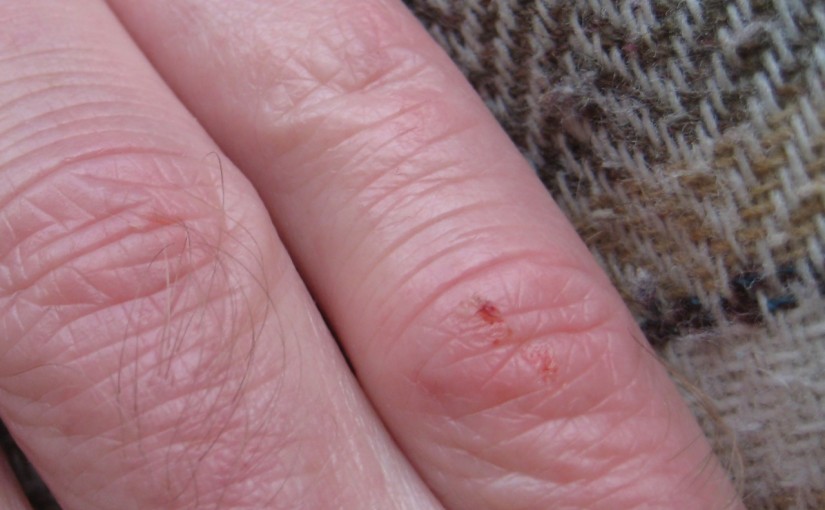
It was a great run. It wasn’t even hampered by a stumble right at the end, when I caught my toe on an uneven bit in the pavement. I went down on the wet asphalt, but managed to turn my fall into a credible parkour-style roll, and then come up on my feet ready to keep running. I don’t know how much was pure luck and how much was the time I put in practicing my shoulder rolls back in May, but I’m pretty pleased with the result either way. I have one teeny-tiny scratch on my palm, but am otherwise unhurt. I don’t want to think about how much skin I’d have left on the pavement if I’d slid rather than rolling.

I can’t really expect any more weather this warm until spring, but between fond memories of this run and the zombies, I have high hopes for putting in the necessary treadmill time to be still in shape for running when spring comes.

I went for a treadmill run with “Zombies, Run!” this morning. Despite it seeming like a particularly ineffective way to flee the zombies, it was by a wide margin the easiest 30-minute treadmill run I’ve ever had. I can usually just barely get myself to run 20 minutes on a treadmill.

I’ve gotten in the habit of setting any treadmill to an incline of 1%, because I find that matches my speed on the treadmill with my perceived level of effort. (That is, when I’m running at a 10-minute pace on the treadmill, it feels about like running at a 10-minute pace outdoors, if the treadmill is set at a 1% incline.)

This particular run came out at just over 31 minutes and just over 2.5 miles. I had turned off the GPS on the game and told it to use the accelerometer instead. At the default setting, it suggested that I’d gone 2.31 miles, so I bumped up the stride length by about 8%. Next run I’ll see if the treadmill distance and accelerometer distance aren’t just about the same.

I’ve been playing the game with the zombie chases turned off. That was mainly with the thought that it would increase replayability—I figured once I finished all the missions, I could go back and play them all again with zombie chases turned on for a fresh experience. Since I’m currently in no danger of running out of missions, I might turn them on for treadmill runs, to add a bit more variety.

Winfield Village has a little fitness room. From our townhouse it’s very handy—right across the parking lot.

It has an odd selection of equipment. There are perhaps 8 pieces of aerobic equipment—more than half treadmills, but also an elliptical machine and a couple of cycle-type machines. There are a pair of leg machines—leg extension and leg curl. There’s a fancy configurable machine with a pair of weight stacks hooked up to a pair of pulleys with interchangeable handles that can be set at any desired height, so you can adjust it for various kinds of rows, presses, swings, etc. And there’s a huge selection of dumbbells.

After two decades of doing my lifting with machines, I’d already been gradually switching away, so this new facility is nicely in line with what I was already headed towards.

My inclination to change away from machines started when I wanted to start doing squats (instead of doing the leg press machine). Maybe it would be more accurate to say it started when I wanted to be able to squat.

Being able to squat had always seemed like one of those basic capabilities a person ought to have (like being able to stand or walk), but like most westerners—like most people who own chairs—I lacked both the strength and the flexibility to squat properly. When I had to squat down—to look at something on a bottom shelf, let’s say—I could do it, but my heels would come up off the floor and I’d end up squatting with my knees way forward and my weight up on the balls of my feet. (Don’t do this—it’s dangerous for your knees.)

Primarily because of my taiji practice, I’d gained both a lot of control over my body and a lot of insight into how it ought to move, and some months back it occurred to me that I was probably at a point where I could do a proper squat.

I did some preliminary practice squatting, and found that doing it correctly wasn’t hard. (Keeping your heels down on the ground is only possible if you bend at the hips, stick your butt back, and lean your upper body forward. If you keep your head up, the result is a squat that looks just like the pictures of proper squat form.)

I experimented with squatting in the Smith machine at the Fitness Center, and did some squatting with a bar over my shoulders, but ended up deciding that bodyweight squats did the job just fine.

So I’m not really missing the bar or the squat frame. I can imagine wanting to add weight to my squats, but so far I’m happy just adding reps. When that’s not enough, I can add weight with dumbbells.

Since I have all those dumbbells at my disposal, I thought I’d look for some workouts that made use of them, and found an excellent dumbbell workout page over at Art of Manliness.

I’ve started doing something closely modeled on that page’s upper-body workout, with the addition of some qigong exercises from my taiji practice, and some exercises intended to help me work up to being able to do pullups.

I’d not had much success with the assisted pullup machine at the Fitness Center, so I was ready to do something different even if we hadn’t let our membership expire when we decided to move here. The replacement that I’m experimenting with at the moment is negative pullups: I use a bench to climb up to the top of pullup position, then lower myself down to hanging.

As I was writing this post I read a bit about working up to pullups. It looks like before I go all-out with the negatives, I should practice my dead hangs.

I’ll come up with a lower-body workout shortly. It’ll include squats.

With the fitness room right across the parking lot, I’m hoping to get a lot more regular with my lifting. If I succeed, I expect I’ll be posting about it here. If not, I suppose I’ll quietly start posting about something else.

Jackie and I rode the yellow bus into campus yesterday evening and attended a reception for and talk by Rick Bell about Active Design—using architecture to encourage people to move more, to eat better, etc.

We enjoyed it, and found the ideas very interesting, even though the talk itself was only fair—a long series of slides with pictures of places that exemplified one or another aspect of what he’s talking about, arranged geographically rather than according to the principles he’s suggesting. (The talk would have been more interesting for me if it had been organized by idea, rather than by place.)

One focus throughout the talk was on staircases. Of course any multilevel public space needs to have elevators (to make the space available to people who can’t climb stairs) and perhaps other things as well—ramps, escalators, and so on. But stairs are required too (for fire safety, if nothing else) and Bell points out that staircases can be done well or badly. In a bare concrete box closed in behind fire doors, they’re pretty uninviting. Brought out front and center, they can be wonderful. They can be beautiful design elements—glass stairs can float in the space, mirrored risers can reflect the space, etc. Staircases—if they’re broad enough—can also be places where people gather in small groups to stand or sit together. He had a photo of what I guess is a famous red staircase being used that way. (The talk was for architecture students, and was full of references to famous architecture and architects that mostly meant very little to me.)

He also had some photos of places where these things had been done badly, such as a second-floor fitness center with escalators to the entrance, and no sign of where the stairs might be, even if you wanted to use them.

There’s a lot to Active Design besides staircases—walkable spaces, bicycling infrastructure, creating (often re-creating) multimodal transportation infrastructure (like having bike paths and foot paths lead to and from the bus station, and having the bus station co-located with the train station and a bicycle rental place), seasonally appropriate spaces (like skating rinks), bringing food production into the city center, etc.

I’m glad we went. I’m glad we went by bus, rather than driving.

I’ve been losing weight for the past few years, and wanted to share a small milestone: With a body mass index of 24.9, I am now in the range the National Institutes of Health consider “normal weight.”

It’s been a strange process. Subcutaneous fat departs on its own schedule—probably mostly genetic, but probably other things as well—so I’ve had the experience of bodyparts changing shape at unexpected times. A few months ago I noticed something hard in my side, a couple of inches down from my ribs. It took some seconds of poking with my finger, tracing out the contours, for me to realize it was my pelvis. (For someone who assembled a Visible Man in elementary school, I had a surprisingly poor conception of where the pelvis is. I thought of it as being down by my hips, but the top of the iliac crest comes up to the height of the navel, I guess.) I had similar, if less startling, experiences with other bits of my skeleton, including my ribs and my cheekbones.

I wish I had a better understanding of what changed. I’d been overweight essentially all my adult life. I’d been trying, largely without success, to lose weight for 40 years. Then, a few years ago, something changed, and the weight started gradually coming off.

I did make an effort to eat less, and to exercise more, but I’d done those things a hundred times before.

I know some of the things that changed. I quit working a regular job, so I had more time for exercise, and more flexibility in my schedule to schedule the exercise. I started studying taiji, which is not an especially vigorous exercise, but which I now do almost every day—and consistency has a vigor all its own. Jackie’s willingness (and creativity) in producing healthy meals that conform to my odd preferences has been a big help.

One other thing that was different from all the other times was that this time I didn’t have a goal weight.

All the other times I had an idea in my head that I wanted to lose 15 or 45 pounds, and I’d calculate how many weeks that would take if I had a calorie deficit of this or that amount. Then I’d track my weight, and be pleased or disappointed as it progressed along or deviated from that track.

This time I didn’t do that. Instead, I decided that my goal was simply having a downward trend to my weight. Being in calorie deficit would (I figured) improve my blood chemistry, and probably right away get me most of the health benefits of losing weight.

Since I don’t have a goal, I’m not at an inflection point here, now that I’m at “normal weight.” I can just carry on doing what I’ve been doing. I’m in no danger of becoming underweight any time soon. (The National Institutes of Health suggest I’d be “underweight” if I lost another 40 pounds.) So, I’ll go on gradually losing weight for a while. I expect it will become more and more gradual over the next year or two, before I eventually stabilize, probably not too far from the midpoint between “underweight” and “overweight.”

There’s no evidence for a health benefit to weighing less than I do now, but probably some health benefits to being in calorie deficit—so it makes sense to prolong that phase.

There are, of course, the other benefits to losing weight. There’s an aesthetic benefit. (At least, I think I look better now than I did 40 pounds ago, and expect I’ll look better still if I lose another few pounds.) There’s a convenience benefit. (Society has upsized almost everything as Americans have gotten larger—the main exception being coach seats on airliners—but being slimmer still makes almost everything easier and more comfortable.)

If I lose another 15 pounds or so, I’ll be at the same body mass index as Jackie. She’s most fetchingly slim, and there’s a certain symmetry to us matching that way, but I wouldn’t go so far as to call it a goal. Just a whimsy, really.

I promised a while back that this wouldn’t becoming a weight-loss blog, and I think I’ve kept that promise, but this was a milestone that I wanted to share. I’m not sure there’ll be any more, though. Since I don’t have a goal, there’ll really be nothing to announce.

In a very small way, I’ve been persisting with my parkour training.

I’ve been practicing my shoulder rolls with some success: I can now do shoulder rolls from a kneeling start on both left and right shoulders. With that under my belt, I also did some from a standing start on my right side. I want a little more practice before I do them from the left side.

Next will be to do them at a run, and then to do them after dropping from a height. (Not a high height—I don’t want to hurt my feet, ankles or knees—but I want to develop the ability to drop from a height, absorb the impact of landing, and then go into a roll if necessary. It seems like a useful skill.)

The other thing I’ve started with are what the parkour folks call a precision: a jump to a specific point. You’ve seen them in movies where the actor (or a stunt man) jumps from one beam to another over a gap, or jumps from the top of one wall to the top of the next wall.

In the interests of not killing myself with my practice, I’ve been doing all my jumps at ground level, jumping and then landing on a curb. I’m not jumping very far—I still have no explosive power—but so far I have reasonably good accuracy. (The curb is maybe 6 inches wide, and I’ve managed to land on it, and to not topple over, pretty much every time so far.)

The distance I can jump is growing, which I think is just improving neuromuscular recruitment. (That is, at the level of the muscles, I’m getting better at firing off each phase of muscular contraction at the best moment to launch myself, and at the level of the limbs, I’m coordinating my arm and leg movements so that everything works together to launch me the distance I’m trying to go.)

In other news, packing to move proceeds apace. We’re soon to be at the point where we’re living in our summer place as much as we’re living in our old apartment. And we’ve learned that we’re on the waiting list for Winfield Village