I’m something of an absolutist on free speech. Not a complete absolutist—I’m fine with rules against libel and slander, and I’m glad that there’s a copyright scheme (even if our current scheme has the copyright running for far too long). But that’s about it.

Still, I find myself disagreeing with Catherine Shaffer on using boycotts or similar sorts of pressure to influence the sponsors of speech I disagree with.

I guess my logic is this: I totally support the right of people to say things I disagree with; I just don’t feel like they have a right to make a good living saying it.

I’d oppose a boycott aimed at an ISP who hosts objectionable speech—that’s an effort to block the speech. I’d feel the same way about an effort aimed at convincing a venue not to allow a speaker to present his message.

But even a fairly successful effort to convince advertisers to pull funding from an objectionable speaker wouldn’t bring the speaker’s income to zero. There’ll always be some sponsors out there who’ll support even the most offensive speech, and if they want to pay enough to be associated with it to allow the speaker to pay his domain registration and hosting fees, I’m all for it. Heck, if they’ll pay enough to allow a radio personality enough to see the show broadcast on the airwaves, that’s okay too. But if pressure on the advertisers means that the speaker has to get a day job because his offensive speech no longer earns enough money to cover the rest of the bills, I think that’s probably a win.

(In practice, except for the most universally offensive speech, trying to organize a boycott is probably counterproductive, because people who agree with the speech will rally around.)

A modestly (or even highly) effective effort to reduce the income-earning power of offensive speech seems like a good thing. I don’t think it works against free speech.

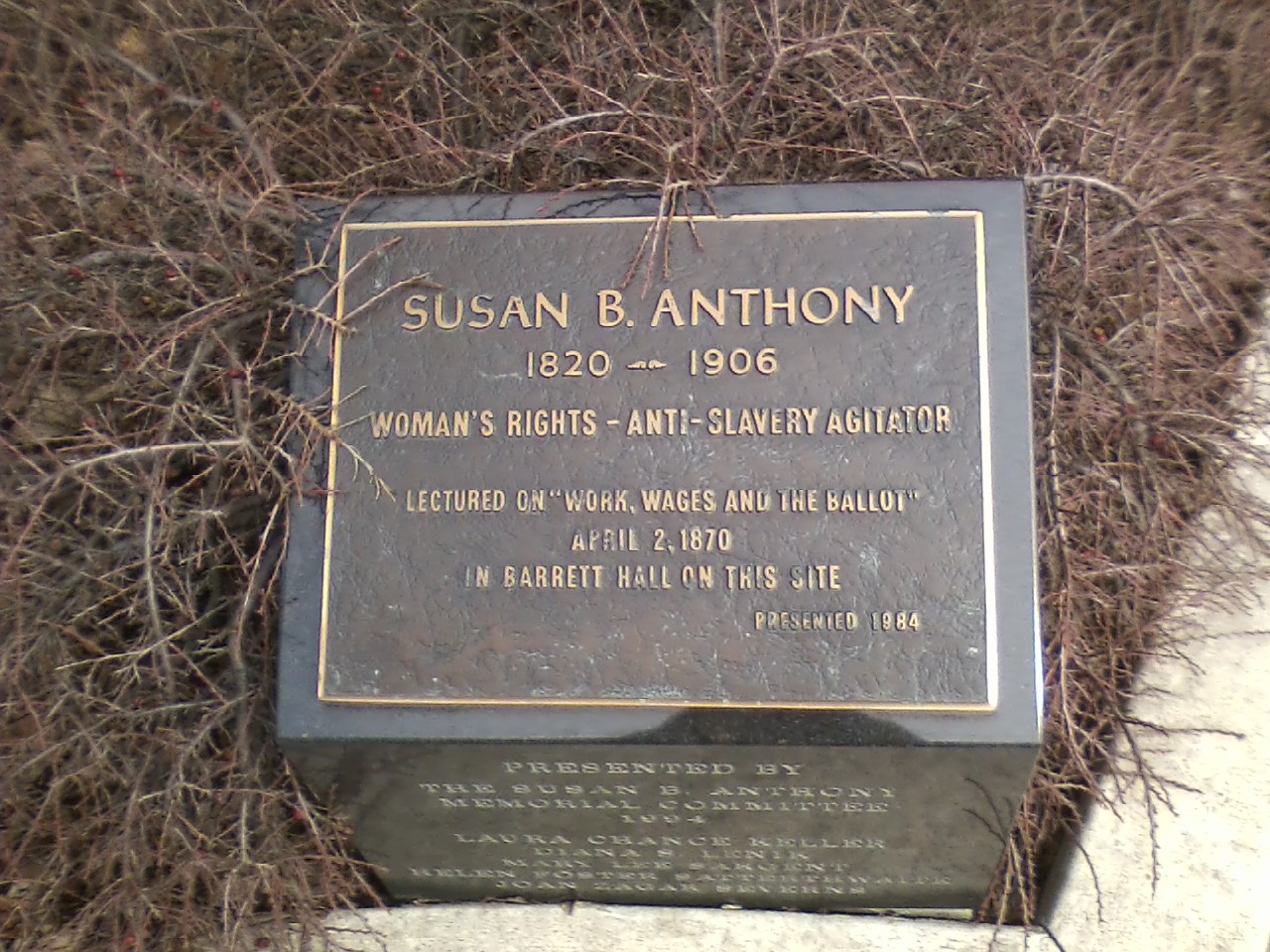
Plaque commemerating a lecture by Susan B. Anthony

Plaque commemorating a lecture by Susan B. AnthonyI’ve long been peeved by how little credit people give to the power of their vote.

So many people seem to think that a vote isn’t effective unless it holds the balance of power, as if their vote only counted when the other voters were equally split, so that their vote would sway the election one way or the other.

This isn’t true for individuals, and it most especially is not true for groups.

Back in the run-up to the 2008 election, I heard a  story on NPR that provided a good counterexample. An Indian tribe in (I think) New Mexico was getting attention from state and national candidates of both parties, because they had started voting. Pretty much all of a sudden, after their voting turnout had shot up, their issues became important to politicians at all levels. And their issues weren’t just important when there was a close election and their votes might make the difference: Because they voted in every election, every politician needed to pay attention to their issues all the time.

If you’re a member of a group that votes, your group’s issues will be taken seriously. You don’t need to be a majority. You don’t even need to vote as a block. (In fact, it’s probably better if you don’t: You want politicians thinking that each individual vote is up for grabs, if they institute the right policies.)

The image at the top of this post is of a plaque in downtown Champaign, commemorating a lecture on “Work, Wages, and the Ballot,” that Susan B. Anthony gave here back in 1870. I’ve seen the plaque many times, but couple of days ago, I thought to take a picture of the plaque, and that prompted me to do a proper search, which yielded some results.

This Project Gutenberg Book Susan B. Anthony: Rebel, Crusader, Humanitarian, by Alma Lutz is pretty good:

She had at hand a perfect example in the unsuccessful strike of Kate Mullaney’s strong, well-organized union of 500 collar laundry workers in Troy, New York. Aware that Kate blamed their defeat on the ruthless newspaper campaign, inspired and paid for by employers, Susan asked her, “If you had been 500 carpenters or 500 masons, do you not think you would have succeeded?”

“Certainly,” Kate Mullaney replied, adding that the striking bricklayers had won everything they demanded. Susan then reminded her that because the bricklayers were voters, newspapers respected them and would hesitate to arouse their displeasure, realizing that in the next election they would need the votes of all union men for their candidates. “If you collar women had been voters,” she told them, “you too would have held the balance of political power in that little city of Troy.”

I turned 18 shortly after the voting age in the US had been lowered to 18. The drinking age had been lowered along with it, so it was legal for me to drink. But a big jump in drunk driving accidents prompted many states to raise their drinking age.

In Michigan it turned out to be an oddly complex process. A state law was passed, raising the drinking age to 19, but grandfathering in people who were already old enough to have started drinking before the law went into effect. After that law was passed, but before it went into effect, a state constitutional amendment was put on the ballot, that would raise the drinking age to 21, without any grandfathering. That would create a whole cohort of people who’d been able to buy alcohol for a year or more, who would lose that right. And all of them could vote.

I voted against it, of course. But nobody else I knew who was going to be in the affected group bothered to vote. They didn’t much care about the issue—it was as easy for under-age drinkers to buy booze then as now—and they didn’t think their vote would count for much. And, as it turned out, they were right. But only because their peers didn’t vote. Not only could a solid voting block of 18-to-20 year olds have affected the outcome, I rather doubt if the issue would have even gone on the ballot, if 18-to-20 year olds voted at the rates that senior citizens do.

The way voting helps is not by winning individual elections (although that does happen and it’s nice when it does). The way voting helps is that if you’re a voter, politicians take your interests into account all the time.

In many places with repressive governments, nascent political parties (unable to achieve political power via the ballot box, because elections are rigged or the group is banned from participating) provide public services as an organizing tactic. They provide food for children, health care, mediation services, neighborhood watch, financial aid to victims of government actions, and so on.

This tactic has proven to be effective, so I’ve always been a little surprised that we don’t see more of it in the US. So, I was interested to see a post about the Black Panther’s free breakfast program, and the FBI’s concerns about it.

Upon reflection, I figure that the main reason we see little of this in the US is that in the US we really do have public services. There are government programs to feed hungry children, provide medical care to the sick and injured, police the streets, adjudicate conflicts, and so on. They’re flawed and limited, but they do exist. They’re good enough, that it would take a lot of money to compete—and if you have that much money, there are better ways to seek power, especially since our political system is reasonably open.

But this is becoming less true. With constant pressure on public services, holes are opening up that can be—and are being—filled by private organizations. So far, those organizations are mostly charitable non-profits, but there’s no reason that a political party couldn’t join in.

I think we’ll see it pretty soon, especially at the local level. People who have felt disenfranchised will be very willing to support political parties that directly provide what the government won’t and ask nothing in return except that you consider voting for their candidates.

There’s a bill, the Enemy Expatriation Act, that aims to strip US citizens of their citizenship if they are accused of “engaging in, or purposefully and materially supporting, hostilities against the United States.” (The term “hostilities” is defined to mean any conflict subject to the laws of war.)

This is almost certainly unconstitutional. The US Supreme Court held some years ago that it was impossible for a US citizen to unintentionally give up his citizenship. In particular, formally renouncing your citizenship in front of a foreign official was not enough to actually lose your citizenship, because maybe you intended to retain your citizenship (and were just going through the motions of renouncing it as part of obtaining citizenship of some other country).

Now, the Supreme Court has become pretty unreliable on this sort of thing of late, but it seems to me that if formally renouncing your citizenship is ineffective, just in case you didn’t really mean it, then a whole lot of things that fall under the general heading of “supporting” (such as donating money to a charity that is later found to have been diverting some of that money to groups that are in some way connected with other groups that are accused of) hostility certainly don’t qualify as intentional renunciation.

What makes a country rich? Hint: It has nothing to do with natural resources. Places like Singapore, Hong Kong, and Japan prove that. (See also: How to Get Rich by Being Evil)

We’ve known how to have rich countries for a while now; Adam Smith laid most of the ground work in 1776 with The Wealth of Nations, and we’ve improved on it modestly since then. You need three things:

  1. Private property
  2. Free markets
  3. Rule of law

None of those things have to be perfect for a country to get rich. Look at what China and India have done over the past twenty years. Allow a little private property, reduce government regulation a little, and you unleash a lot of entrepreneurial activity. Pretty soon, you have a bigger economy, higher incomes, and a richer population.

What’s interesting to me is how important that third point turned out to be.


As the Soviet Union began to collapse, a lot of people were offering advice on how to free the economies of the formerly communist countries. Most of the advice had to do with getting state property into the hands of ordinary people in ways that would allow the greater productivity that private property and free markets allow.

There was a lot less focus on how to imbed the rule of law into the system. It was almost as if people figured that the shift from a police state to the rule of law would be easier than getting there from a state of anarchy. (A dumb idea, once you think about it.)

So, thanks to the unhappy experiments in Russia (and other places) we now know what happens if you have (some) private property and (moderately) free markets without the rule of law. You don’t get a rich country; you just get a lot of rich people.

This insight has been guiding me politically for a while now. Obviously, it would be great to be a rich person in a rich country, but few of us have that option. Pretty much by definition, most of us are going to be somewhere in the broad middle. But if you’re going to be in the broad middle, it’s a lot better to do so in a rich country.

Happily, we know how to have a rich country.


Note: This was originally written for Wise Bread, but they decided it wasn’t for them, so I’m posting it here. I’ve kept it just as I’d written it, including the “see also” link back to Wise Bread. And, since it was written for a monetized market, I’ve gone ahead and put some ads in this post, even though I don’t general monetize my blog. Somehow, the post seemed lonely without them.

Just as my brother’s kids figured out (see his post Children and Power), I figured out in about third grade that teachers had surprisingly little power over me: they lacked the tools to compel me to do anything I didn’t want to do.

Oh, they had tools that could make things unpleasant for me. But once I figured out that the unpleasantness that they could impose was limited and bearable—and, in particular, less unpleasant than spending large blocks of my time doing busywork—their ability to control me was just about zero.

I did make some mistakes, as is to be expected when important decisions are being made by someone that age. I figured out almost immediately that busywork was pointless, and started refusing to do it. It was only when I got to college that I figured out that the truth is more complex: only most busywork is pointless. (In particular, learning the multiplication tables and learning how to spell the common words in the English language are both worth doing and inevitably involve some busywork.) But there was so much pointless busywork, and I lacked the perspective to separate the pointless from the pointy.

Either of two things might have saved me a lot of grief later:

  1. Elimination of pointless busywork from the curriculum. (Then I’d never have gotten the idea that it was pointless in the first place.)
  2. Someone that I trusted to clue me in as to which few bits of busywork would eventually turn out to have been worth my time.

The first didn’t exist, even though I went to an elementary school that stood head and shoulders above others in treating students like people.

The second is a bit more complex and subtle. There were people I trusted, but I think they hesitated to admit that most of the busywork was pointless (because doing so would undermine the teachers) and probably didn’t know which things I wouldn’t be able to just pick up along the way. (For example, my dad picked up spelling along the way, and never needed to learn how to spell by laboriously memorizing the list of letters that makes up each word the way I did.)

Looking back, I marvel at just how adversarial the whole school system is, even for a student who was bright and not inclined to be disruptive.

Here’s an example: I remember a set of first-grade arithmetic drills done with pictures of counting sticks. Our worksheets would show pictures of sticks, which we were supposed to count. When the number of sticks was large, they’d be grouped into batches of 10. But my experience with school was that it was an adversarial process. To my mind (as a bright first-grader), it seemed extremely likely that the worksheets would group the sticks in batches of 10 for a while—just long enough that we’d lulled into taking it for granted—and then would start printing some groups with 9 or 11 sticks. Then any student who had gotten so lazy as to not check each group would get the problem wrong and be mocked for being so stupid and trusting as to not count out the sticks in each bundle.

Imagine what I must have gone through—imagine how teachers must have treated me in the months leading up to that point—to have made me expect that. (I certainly wouldn’t have expected such trickery from most of the other people that I interacted with.) And those were good teachers! I shudder to think about kids who have to suffer with bad teachers.

Kids who learn early that their power is greater than they imagine will end up making things harder for themselves in some ways. But I still think they come out ahead. I’m glad it’s a lesson I learned early.

I’m generally against zero-tolerance policies. I’ve read too many stories about kids expelled because of an asthma inhaler or a pocket knife forgotten in a jacket pocket (or in the trunk of a car) and accidentally brought to school. Those sorts of harmless, technical violations of the rules are exactly the sort thing that should be tolerated.

But there’s one zero-tolerance policy that I’d really like to see. Prompted by the gruesome story Occupy Oakland: second Iraq war veteran injured after police clashes, about a man beaten so badly by police that his spleen was lacerated, who was then denied medical care for 18 hours, I think we need a zero-tolerance policy for failure to provide medical care to prisoners.

Every person involved in taking or holding a prisoner—police, guards, staff, managers—should be absolutely responsible for doing everything necessary to ensure that needed care is provided.

If needed care is not provided, everyone who heard the prisoner request care, saw the prisoner in distress, or got a report that the prisoner needs or has requested care, should be fired.

There should be no exceptions.


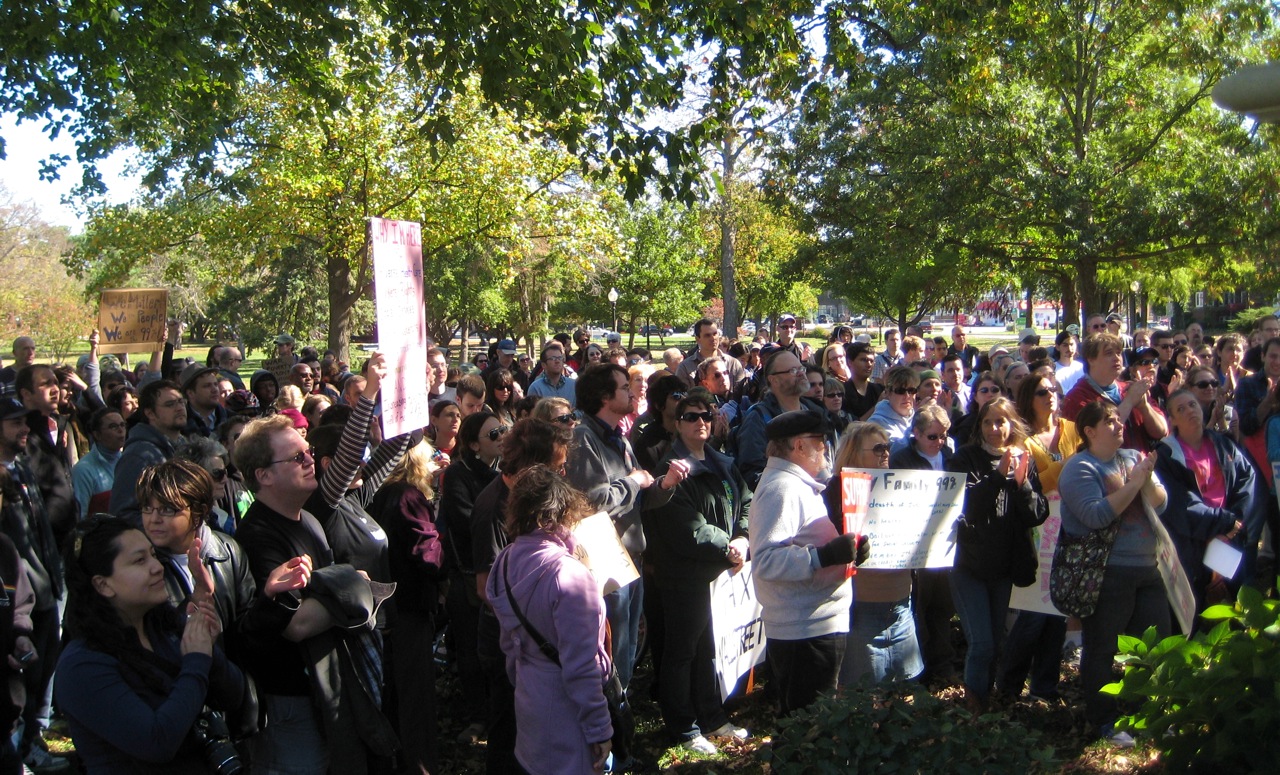
The crowd in West Side Park at the Occupy CU rally

I came out of college almost debt-free, because my parents paid for my education.

I got a job writing software. It was exactly what I wanted to do—the only thing I wanted to do as much as writing prose. I remember being glad that my manager didn’t know that I’d have worked for free, just to get access to the computers. (In 1981, computers were still expensive.)

I started my career right at the moment when software started to became important everywhere. Even though my degree was in economics, I had no trouble finding software jobs.

I got raises, because software went on becoming more important. Even when the companies I worked for fell on bad times, I found a new job without difficulty.

I saw things changing. After about 1990, jobs went away a lot quicker, and when they went away, they didn’t come back.

I was still okay, because software was still important.

I realized that software wasn’t going to remain special. I realized that millions of people around the world could write software just as well as I could. I realized that the ones in China and India could live a middle-class life on one-tenth the money I was earning. I realized that I couldn’t compete with them on price.

I figured I was safe for a while, but only because there were so many managers who were sure that an employee he couldn’t see working probably wasn’t working. But that wouldn’t last. Managers would adapt. And managers who couldn’t adapt would lose their jobs.

I started saving money. I could see that I wasn’t saving it fast enough, so I started living more frugally. That was a double win: Spending less left more money to save, and it also provided me with an existence proof that I could live on less.

I lost my job when Motorola closed its Champaign facility in August of 2007. By then, I had saved and invested a lot of money. Not enough to retire in any ordinary sense, but enough that I figured I could get by without a regular job.

I am a writer now. It’s exactly what I want to do.

I am very lucky. That’s not unusual; there are a lot of lucky people. What’s a little unusual is that I know just how lucky I’ve been.

I am the 99%.

Both my brother and the local makerspace’s Brian Duggan shared the link to the EFF’s Why We Need An Open Wireless Movement. Steven, because he’s the only person he knows who actually does run an open access point for his home network, and Brian because the local meshing network access point project is already able to provide this part of the necessary functionality.

At the meeting last night with some of access point folks, we got a quick demo of how to configure an access point running OpenWrt so that it provided both a closed network with access to the LAN and an open network that only had access to the WAN (hence, no access to local servers, printers, etc.).

The demo didn’t go as far as to show how to configure the system with quality of service limitations on the open network (so that random strangers can use your network, but can’t suck down all your bandwidth). Figuring that out will be one of my next steps.

There’s some info on OpenWrt’s quality of service page, but it’d be really nice to have an example with some appropriate settings that would allow some basic email and web surfing while leaving most of the bandwidth of a typical cable or DSL connection available for the connection owner. I haven’t found that yet. (Actually, I think I understand why it doesn’t exist. The upload and download speeds are set in kBits/s, so the correct values depend on the speed of your underlying connection. Values that shared 10% of a fast cable-modem connection could consume a large fraction of a DSL connection. Still, it’d be nice if there were some suggested values for typical configurations.)

Fabric on loom


[This article originally appeared as a guest post on Self Reliance Exchange, but that site no longer exists and the successor site doesn’t seem to be using my post. Rather than just let the article disappear, I figured I’d post it here.]

Fabric on loom
Fabric on Loom

There’s a reason we don’t see more self-sufficiency: It’s not frugal. It almost always takes more time to make something than it takes to earn enough money to buy one—and that’s without even considering the time it takes to learn the skills (let alone the cost of tools and materials). On the other hand, frugality is a powerful enabler for self-sufficiency. So, how do you find the sweet spot?

My wife spins and weaves. I have a beautiful sweater that she hand knit from hand spun yarn. It’s wonderful—and it’s comforting to know that my household is not only self-sufficient in woolens, we produce a surplus that we can sell or trade. But the fact is you can buy a perfectly good sweater at Wal-Mart for less than the cost of the yarn to knit it.

If you try to be genuinely self-sufficient—in the sense of producing through your own labor everything your household uses, like a hunter-gatherer or a subsistence farmer—you’re going to be poor. Your neighbor who works at a job for wages or a salary is going to be better off by almost every measure.

Oh, his factory-made microwave meals won’t be as good as home-cooked food from your garden and his furniture from Ikea won’t be as good as what you make in your wood shop. But he’ll have so much more! In the time it takes you just to build a kiln he’ll earn enough money to buy a thirty piece set of Corelle ware. Unless he’s only making minimum wage, he’ll probably have enough left over to buy an iPod—and you’ll never be able to make your own iPod from sand and vegetable oil.

That’s why we have trade. If everybody specializes in one or a few things, and then trades with others for what they need, everybody can be better off. It raises your standard of living, but it means that you can’t be self-sufficient.

There are still many reasons to do for yourself. You can make exactly what you want, instead of having to make do with whatever happens to be available on the market. You can use superior materials, and take them from the environment in a sustainable manner. You don’t have to worry that the stuff you use was made in a sweatshop by children or prisoners or slaves. You aren’t dependent on the continued smooth functioning of the vast global economy. But you can’t be self-sufficient in very many things—even if you had the skills and the tools and the land, you’d quickly run out of time.

So, we find ourselves trying to figure out where we belong on the continuum between actual self-sufficiency and ordinary self-reliance. How do you find the sweet spot? Here are my thoughts:

  1. Focus on necessities. It’s a lot more important to be self-sufficient in food, clothing, and housing than it is to be self-sufficient in tennis rackets and rollerblades.
  2. Focus on capabilities. Instead of trying to fill your pantry by hunting and fishing, do enough to maintain and improve your skills—and then start developing your next capability.
  3. Focus on what’s practical. It’s really hard to be self-sufficient in window glass and impossible to be self-sufficient in digital watches. Don’t waste your time.

Start with the few things where homemade actually is cheaper, like gardening. Then move on to things that can be done as a hobby—and that you’d enjoy doing as a hobby. Don’t let point #1 above (necessities) keep you from developing self-sufficiency in something that’s fun and interesting just because it’s not important. It may not be important to be self-sufficient in beer, but the equipment is cheap, brewing is a pretty easy skill to acquire, and the result is better than what you can buy.

Finally, remember that there’s a vast range between being “self” sufficient and being dependent on a global supply chain. It’s almost as good as self-sufficiency to source things from your neighbors. Short of that, it’s still an improvement to source things closer rather than farther—your home town, your region, your state, your country.

Once you set your priorities, don’t hesitate to go with the cheapest option for things that don’t make the cut.  That frees up money that you can use on the important underpinnings of self-sufficiency—things like land and tools in particular, but also things like books, training classes, materials to practice with, and so on.

Then you’re in your sweet spot.