I’ve known since before the inauguration that the economy was facing stagflation. The tax cuts would boost the deficit, raising interest rates. The tariffs would boost prices, producing inflation. Both those things, plus forcing out immigrants, would tank the economy, producing stagnation (at best), yielding stagflation.

I wrote about this more than a year ago, in Our new upcoming stagflation. We are now seeing it, even before the war started.

I’m actually a little surprised we didn’t see it sooner. I credit the delay to a few things. First, Biden had left the economy in really good shape. It took a lot to tank it. Second, even though it seemed to us that Trump was “moving fast and braking things,” it’s just hard to move that fast on things like tax cuts, imposing tariffs, and deporting migrants—even if you’re willing to break laws to do it faster, these things take time. Third, Trump always chickens out, so we didn’t get the threatened tariffs on schedule; we got watered down tariffs after a delay.

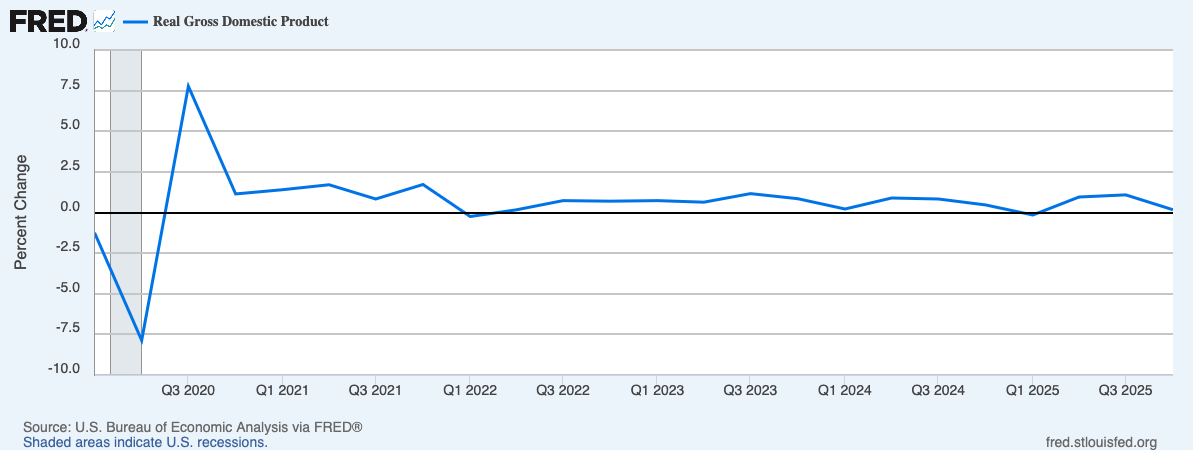
However, the stagflation is here. Check out this graph of Real GDP. As you can see, in Q4 it had fallen almost to zero. The economy wasn’t shrinking, but it was stagnating.

A graph of Real Domestic Product with the last data point showing a growth rate of barely above zero.

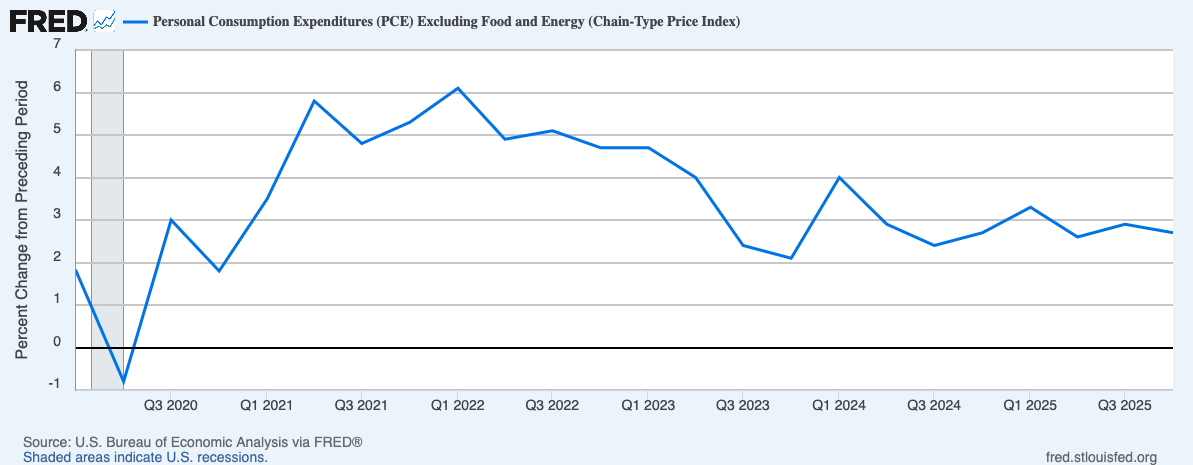
At the same time, inflation had quit coming down. Here’s a graph of Core PCE, the Fed’s preferred inflation index. After getting down almost to 2% (the Fed’s target) about 8 months ago, it reversed course and has been bumping along close to 3% since then.

A graph of Core PCE with the last data point only a little below 3%

I think all of these things were about to get worse. Even with the Supreme Court’s ruling that a major part of Trump’s tariffs were illegal, there were plenty of others that aren’t going away. The tax cuts are still in place. Immigration has virtually come to a halt, many immigrants have been detained or deported, and any sensible foreigners with skills that they can apply elsewhere are fleeing the country.

So: Stagflation was already here. But things are about to get much, much worse, because now there’s a war on.

That has already spiked up oil prices. Those won’t feed immediately into Core PCE (which excludes food and energy prices), but will feed in over time, because higher energy prices make everything we produce more expensive. And, of course, wars are fantastically expensive, meaning that the deficit will blow out way worse than it was already going to, which will lead to higher interest rates (soon) and higher taxes (later).

Oh, and don’t expect AI to save us. If you listen to the business news, you know that the only reason the economy isn’t in much worse shape is that businesses have been paying huge amounts on AI infrastructure. As I wrote in my AI bubble post, I think a large fraction of the data centers and model training that that money got paid for will turn out to be worth much less than was paid for it.

So, where are we? Well, about where I thought we’d be, as far as the economy goes—in a modest stagflation that could be fixed pretty quickly, at the cost of a substantial recession, if the Fed had the guts for that. Except that now we’re in a war too.

I can tell you how to arrange your finances to survive a stagflationary period, but I can’t tell you have to survive a war. Wars are very bad, much worse than recessions.

If you know how to survive a war, let me know. If not, good luck.

Stephen Miller would have ICE agents (and the rest of us) believe that they have “immunity” to perform their “duties.”

This is, of course, false. Depriving any person (not just citizens) of their rights “under color of law” is its own crime. But it is in that light that we should view their position on face masks as admitting that they know they have it wrong:

The administration’s perceived need for face coverings evocative of Iranian secret police and Russian security agents helps us recognize that assertions of state supremacy and citizen insignificance are claptrap…

Source: All the king’s masked and anonymous henchmen

If they were immune, they’d not hesitate to show their faces. The fact that they feel the need to keep them hidden makes it very clear that they know they’re totally exposed in a legal sense.

I don’t think of myself as someone who wishes ill for others. I genuinely do not wish for anyone to come to harm. But I’m struggling just a bit with schadenfreude right now.

Take, as an example, the wildfires in California. As I mentioned a couple of weeks ago, these fire events were not just entirely foreseeable; they were actually foreseen forty years ago. And yet, there are tens of thousands of people who apparently made the calculation that the views from a house on a hillside at the urban-chaparral interface were so good it was worth taking the risk—and especially so, given that a large fraction of the costs of fighting those fires, and insuring against financial loss, could be spread to other people. People like me.

I think I’m allowed a bit of, “I hope you are enjoying the entirely foreseeable consequences of your choices.”

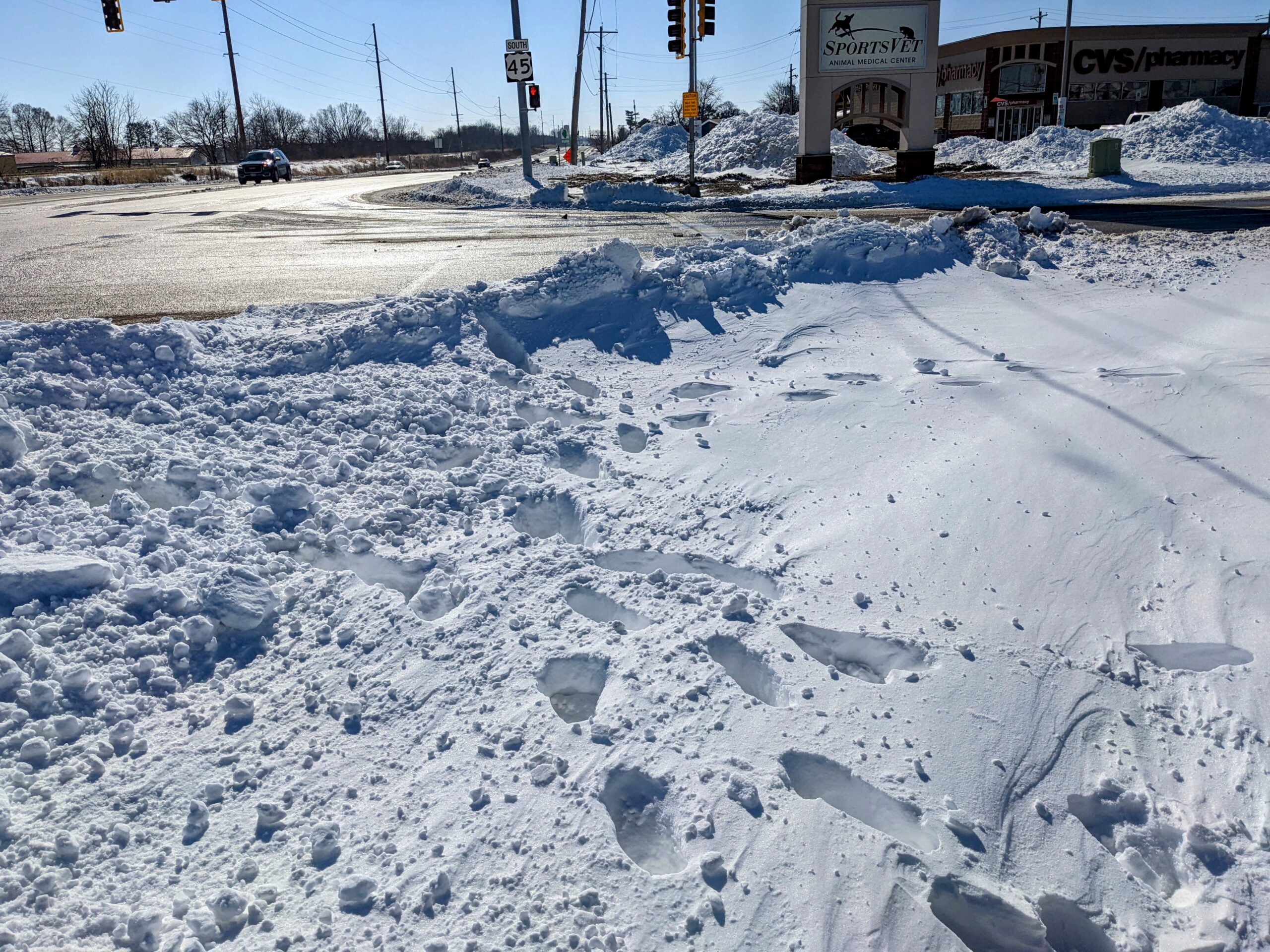
As another example, take the snow about to hit New Orleans:

By Tuesday, the winter storm will drop freezing rain, sleet and likely several inches of snow onto south Louisiana, including in New Orleans, Metairie, Slidell, Baton Rouge and Lafayette.

I have to admit that when people in red states face an extreme weather event that’s entirely to be expected, a certain part of me thinks, “Well, you could have voted for politicians and policies that would have greatly ameliorated climate change, but you didn’t. Enjoy the entirely foreseeable consequences of those choices.”

And, as a non-climate example, apparently a lot of black and brown male voters refused to vote for Kamala Harris. I suspect many of them will be surprised and saddened by the utterly predictable deportations of friends, family members, neighbors, coworkers, and employees over the next few years. And I will be very sad about that—sad for the people deported and their friends and family, and also about the dreadful police actions that will be required to make them happen. But I hope I will be excused from feeling no sympathy for the bosses who find themselves having to pay up to get workers who haven’t been deported, and very little sympathy for the people who voted for these policies and find that everything they want to buy costs more.

“Welcome to the entirely foreseeable consequences of your actions as well.”

Inflation and a declining standard of living are two different things. Inflation is when the money becomes less valuable, resulting in rising prices. But when a whole society becomes poorer, it can look like inflation, because prices may rise, but it’s not the same thing.

“Despite the Bank of England’s efforts so far, there is accumulating evidence that inflation will be harder to stamp out than previously expected. In the past week, data has shown that pay in Britain has increased faster than expected, inflation in the services sector has accelerated and food inflation is still near the highest level in more than 45 years.”

https://www.nytimes.com/2023/06/22/business/economy/bank-of-england-interest-rates-inflation.html?smid=url-share

To my eye, viewed from over here, that looks less like inflation and more like a falling standard of living—largely caused by Brexit. If you block immigration, of course wages are going to go up. If transporting stuff across the border takes longer and is more expensive and difficult, of course food is going to be more expensive. That’s not inflation. That’s reducing everyone’s standard of living by raising actual costs.

It looks similar, because the symptom tends to be rising prices, but they’re two different things. If the problem is inflation, then raising interest rates (by reducing the rate of growth in the money supply) will probably help. But if the problem is a declining standard of living, then it’s probably not going to help. Higher interest rates will just be yet another expense (like border controls) that flow through to making everything cost more.

I just sent the following to my representative in Congress via the web form on his page at the House website:

Based on media reports and what I can find on your website and twitter feed, it appears that you have not yet taken a stand against Trump’s illegal and unconstitutional executive order blocking entry by nationals from certain countries.

Can I count on you to do so in short order?

I didn’t mention in my note, but wanted to mention here, that Davis’s words for his constituents after the recent election invoked Lincoln’s phrase “With malice toward none, with charity for all,” so I’m a little concerned that he may be putting a dangerous strain on our nation’s limited supply of irony.

I also refrained from once again pointing out that the Republicans in Congress are straight-up cowards, afraid of widows and orphans.

I have long opposed most sorts of gun control. The main reason is the same reason I oppose drug prohibition: There is no way to enforce a ban on a thing, except through police-state tactics (and I don’t like living in a police state).

How do you ban a thing? You can pass a law against possession, but that law is unenforceable except by house-to-house searches. You can’t even enforce a ban on carrying concealed weapons except by stopping and frisking everyone out on the street. (Please don’t suggest only stopping and frisking “suspicious” people, unless you have first-hand experience with looking like one.) Since there’s no victim to report the crime (“I was illegally possessed at!”), you only find the criminals by chance, unless you’re willing to go full war-on-drugs with undercover agents, coerced informants, wiretaps, search warrants executed by SWAT teams and so on.

You could impose a high penalty on possession of a gun, and then only enforce the law when a gun came to the attention of the police. That would probably get the guns off the street—a gun hidden under the floorboards isn’t much of a threat—except of course for the “only criminals will have guns” issue: High penalties don’t much deter people who are already committing crimes with high penalties. Plus, it leads to all the classic slippery-slope arguments. Selective enforcement (searches used to harass disfavored people) and unfair results (unlucky people spending 20 years in prison for a gun they didn’t know was in the boxes of grandfather’s personal effects) being just two of the downsides.

Besides, guns are useful tools. If we have a ban that applies as well to the police and the military, then we’ve denied them tools that they may need to do their jobs. But if the ban doesn’t apply to them, then we have to draw the line in a specific place—or a series of specific places. If police qualify, how about campus police? Transit police? Park rangers? Do bodyguards qualify? How about armored-truck guards? Stalking victims? The result is once again selective enforcement and unfair results, this time with a side order of political shenanigans.  Some people who need the tool will be denied it. Other people who thought they were allowed the tool will have their lives destroyed when a court rules that they were not.

Much more sound than laws against things is laws against behavior. It’s illegal everywhere to shoot someone or to threaten someone with a gun or even to discharge a gun in a populated area. These are the sorts of laws that gun-control opponents always point to as the right way to control guns. But they self-evidently don’t work. Even if you discount suicides and accidents, there are 12,000 homicides a year in the United States—with about 90% committed with a firearm.

So, what other behaviors could we regulate? There is often talk of regulating the sale of firearms. Being in the business of selling firearms is already extensively regulated, but currently it’s legal to sell (or give away) a firearm without being in the business—sales between friends and gifts between relatives are legal, and don’t require that you be a licensed firearms dealer. That could be changed. You could make selling firearms be like selling prescription drugs, which only a licensed pharmacist can do. Many currently legal, perfectly ordinary behaviors would be illegal, or else the laws would have to be very carefully drafted. Could a father buy his son his first .22 rifle? Could an Olympic-champion riflewoman let her aspiring-sharpshooter daughter take mom’s match-grade pistol to the shooting range to practice with? If a down-on-his luck man pawned a family heirloom firearm, would he be committing a crime if the pawn shop owner’s firearms license were not in order? What if the pawn shop clerk were a felon?

Registering guns is often proposed, although I don’t see how doing so would reduce violence. Further, I think gun-owner fears of gun registries being useful primarily as a tool for eventual confiscation is well-founded: What other use would a registry have? The parallel is less with registering cars (which are big and operate in public where people can see them) and more with registering typewriters (which are small and are generally used in private).

Illinois has long had a registry of “allowed gun buyers,” which is somewhat less pernicious than a list of guns: It would still provide a list of places to search, if things trended even further toward a police state, but it would do so without providing what amounts to a master of list of guns to be seized. In fact, I would fully support such a scheme, if it were automatic: Every adult who has not been convicted of a felony or violent misdemeanor, nor adjudicated as dangerous or incompetent in some other fashion, should be on the list of those allowed to buy guns. The government could automatically strike people from the list upon conviction or commitment to a mental institution (with an appropriate appeals process to correct errors). Or people could file a simple form to ask to be taken off the list, if they had some personal objection. It’s basically the instant background check from the opposite direction.

I will say this, though—gun control advocates are finally on the right track, in attempting to mobilize public opinion. For the past thirty years, members of a small, mostly liberal elite have been trying to use their influence over government officials to pass gun control. But with public opinion so divided, legislative sausage-making has produced laws that are pointless and ineffective, full of easily ridiculed loopholes, but still with traps for the unwary gun-owner to commit a technical violation that leads to harsh sentences, without reducing the number of guns or making them less dangerous. (I am thinking in particular of the so-called assault rifle ban that ended up merely banning a handful of cosmetic details.)

And yet, I am nearly brought around. I am ready to support gun control legislation, if something can be found that would actually reduce violence (or at least its severity), doesn’t require police-state tactics to enforce, and doesn’t send people to prison simply because their papers are not in order.

That last is non-negotiable for me, an attitude puts closer than I’d like to be to unsavory company on other issues, such as immigration, where I agree with many Republicans that I think we should control our borders better. It’s because the other tactics of keeping our population density low are ineffective, unless we empower the police to check people’s papers. If we want the higher standard of living that comes from living well below carrying capacity—and I do—we can’t let just everybody live here. But having a category of “illegal” people forces immigrants to live outside the rules that promote the health, safety and prosperity of everybody, for fear of deportation. That risks the health, safety, and prosperity of all of us.

I’m no happier with letting police demand my firearm paperwork, and send me to prison if it’s not in order, than I am with letting police demand my citizenship papers against similar consequences.

I also think playing with guns is fun, and would be sad if they were banned. But I would give up playing with guns, if I thought it would prevent a large fraction of 11,000 murders a year. I don’t see a clear path from here to there, but I have joined the mass of people trying to find one.

I’d seen it right along, and plenty of other people have commented on it before me, but I don’t think it really sunk in until just this past week, with all the hand-wringing over Syrian refugees:

Republicans are a bunch of cowards.

I’ve never seen so much fear as has been on display the past week from the Republicans (and, I must admit, way too many Democrats as well). And over what? A bunch of people—largely educated and middle class—who have been forced to flee their homes.

Seriously, the Republicans are straight up afraid of widows and orphans. What’s up with that?

I mean, I totally understand why the Syrians are afraid. They have soldiers and militias fighting house-to-house in their neighborhoods, blasting them with artillery, even using chemical weapons. Not to mention, they have U.S., French, and Russian air forces dropping bombs on those same militias, in the same neighborhoods.

But the Republicans? What are they afraid of? They’re afraid that some “terrorist” will “slip in” amongst the masses of refugees and commit “acts of terror” in the United States.

Well, these hypothetical refugee-terrorists (of which we’ve seen exactly zero so far) will have to get at the back of a pretty long line, behind the non-hypothetical white-supremacist, right-wing, and anti-government militias (not to mention depressed loner high-school boys) who have been committing mass murders in the U.S. in numbers well in excess of those committed by foreign terrorists.

Perhaps worst of all, most of the Republican rhetoric isn’t even aimed at affecting government policy; it’s aimed at preemptively setting up other people to take the blame. “We said you had to give ‘100% assurance’ that they wouldn’t be terrorists before you could let them in, so if even one of them commits a terrorist act it’s all on you!” (They know perfectly well that ‘100% assurance’ is impossible, which is why they demand it. It makes me want to point out that in the U.S. we convict people of capital crimes and execute them, and all we require is assurance “beyond a reasonable doubt.” I expect pointing that out makes me a rose-colored glasses wearing liberal who’s endangering our country.)

Fortunately, some people are man enough not to quake in their boots at the idea of some ordinary families fleeing terror and ending up here, and man enough not to be terrorized at the idea that they might have to take the blame if an evildoer does slip in. I’m thinking of President Obama here, rather too few Democrats in Congress, most of my liberal friends, and (oddly, because I don’t think of myself as especially brave) me.

I got email today from one of my senators, with the text of a truly appalling letter to president Obama from the senator and eleven of his colleagues.

The letter (here’s his press release on it) calls on the president to ensure that “no refugee related to the Syrian crisis is admitted to the United States unless the U.S. government can guarantee, with 100 percent assurance, that they are not members, supporters, or sympathizers of the so-called Islamic State of Iraq and Syria (ISIS).”

It’s obviously intended to be an unattainable threshold, but that’s really beside the point—the whole thing is completely wrong-headed.

I was moved to respond, and sent him this message via the contact form on his website:

I wanted to say that I was appalled by the letter to president Obama that you shared with me.

Since 9/11, the number of refugees who have committed terrorist attacks in the US is exactly zero—which suggests to me that keeping refugees out of the US is a complete waste of time and effort.

Targeting refugees—the most helpless and vulnerable among us—is not only pointless, it is also heartless and cruel. It is a failure to live up to our obligations under international law. It is also, in my opinion, terribly unamerican.

There are far better, far more effective ways to protect US citizens than by heaping yet more misery on those who have already faced the violent extremism of ISIS—those Syrians who have been forced by it to flee their own country.

I urge you to write to the president and let him know that you repudiate your entire letter, and to suggest that existing US policies on refugees, established in accordance with international law, should remain in place.

Another eleven senators signed the letter. If yours was one of them, you might want to contact your senator and say something. Feel free to borrow from my text, if it speaks to you.

I’m big on reducing poverty, both locally and globally. (I do worry that more rich people will use more resources, suggesting that reducing poverty isn’t an unalloyed good thing. On yet another hand, only rich people can afford things like sequestering carbon or preserving habitat. It’s complicated.)

Since I’m interested in reducing poverty, I was interested in Lant Pritchett’s recent talk Everything you think you know about poverty is wrong.

Pritchett and I see pretty much eye-to-eye on how to have a rich country, I think.

These well-off countries have a productive economy, a government that is responsive to the citizens, a capable bureaucracy, and the rule of law.

This has interesting implications for global development, because these are all things where it’s very difficult to improve someone else’s situation. If a country has government by-and-for the elites, or a corrupt bureaucracy, it’s going to be poor—and there’s very little outsiders can do to help. One of Pritchett’s points is that things that seem like they might help, such as improving education, seem to do more harm than good—perhaps because well-educated corrupt bureaucrats are worse than ignorant ones.

His solution is for rich countries to create or expand guest worker programs, which I think is a poor idea.

It’s not that I don’t think it would work. A poor worker who came to a rich country and worked a couple of years could both support relatives back in the poor country and save up enough money to return home and start a business. That would relieve poverty both immediately and going forward. It would also produce another person with first-hand experience of the advantages of a less-corrupt society (as opposed to merely seeing the advantages of getting in on the corruption).

The main reason I think it’s a poor idea is that enforcing a guest worker program eventually requires a police state. Somebody has to check all workers—it’s the only way to identify those who aren’t legally entitled to work. Somebody has to make sure those whose permission to work has expired get fired. Those whose permission to live here has expired, but who don’t go home, become an underclass with all the usual problems of an underclass—crime, violence, oppression, disease. I’ve written about this before (see Missing the point on immigration).

There is also the issue of how guest workers affect salaries, wages, and working conditions of citizen workers (short version: I think it makes them worse).

The ideal solution, of course, would be for every country to be rich enough and free enough that people from all over the world would want to move there. But that just brings us back to where we started.