Recovering the ability to move well after decades spent sitting still is hard. I’ve spent years working on it, making fitful progress—walking more, running (when I managed not to injure myself), riding my bicycle, lifting weights, doing taiji, etc. I feel better than I have since I was much younger, and I move with more flexibility, mobility, power, and control. I am very pleased with my progress, especially these past three years since I went down the rabbit hole of natural movement, but it was a hard trip.

The internet is a help—there are many, many videos of movement gurus demonstrating how to move well, and many pages with advice, corrections, and exercises for getting from here to there. One good place to start is with Katy Bowman, whose eight books and thousands of blog posts provide step-by-step instructions on recovering the ability to move well (and much else besides). But as I say, it’s hard to do without local support, and until the last few weeks my efforts had just one source of local support—my taiji instructor and community of fellow students (now my students).

So I am delighted that we now have one of Katy Bowman’s students teaching here in Champaign-Urbana: Restorative Exercise Specialist Ashley Price. I’ve taken several of her classes and can assure you that she knows her stuff and knows how to teach it.

(She also knows how to geek out about it, which is a marvelous delight for someone like me. I learned so much about shank rotation! Learning to get my humeri into neutral position made a world of difference for my rhomboid pushups.)

I gather that her special interests are things like diastasis recti, pelvic floor dysfunction (and pelvic function in general), which are potentially issues for everyone, but especially pregnant and postpartum women, but she also teaches the full range: foot function (did you know that your foot contains 26 bones and 33 joints?), squatting, neutral posture, core function, shoulder mobility, etc.

Getting this sort of local support earlier would have helped me a lot. Although most of the work of recovering the ability to move better comes in the form of time spent moving, it’s easy to exacerbate problems rather than improve things when you start to move more. I’ve certainly limited my own progress many times by trying to up the intensity when I should have been becoming more grounded in the basics, or simply by practicing moving incorrectly.

Taiji is an excellent movement practice, being as it is about having an intention to move in a particular way, and then paying attention to whether or not you are executing your intention. But its roots in martial arts give it a particular focus, and it does not serve all areas of movement equally well.

The first time I tweeted something about Katy Bowman, one of her senior students tweeted back, welcoming me to the fold. I said something like, “I’m just working my way through the archives of her old posts,” to which Petra Fisher responded, “That’s how it starts.” I have to admit that she was right.

If you want to learn to move better, and you’re local to the Champaign-Urbana area, I recommend Ashley Price highly.

After posting a couple of weeks ago about how I was having trouble adjusting to the cold and dark, I got a comment from Srikanth Perinkulam suggesting that I take a look at What Doesn’t Kill Us by Scott Carney, which I have now done.

The book grabbed me right from the start. The forward by Wim Hof is delightful. The preface sets the stage for the climactic event. In the introduction the author suggests that his spirit animal is a jellyfish—a comforting thought for someone like me whose totemic animal is the sloth.

Because the first few pages were so interesting, I suggested that my brother use Amazon’s “look inside” feature to read them, but he was unwilling to do so—pretending to be daunted by the fact that the “look inside” feature depends on scripts he had turned off in his web browser. He also declared the book to be “pseudoscientific drivel.” (A comment that must have been—since he wouldn’t read even a few pages—based entirely on the subtitle: How Freezing Water, Extreme Altitude, and Environmental Conditioning Will Renew Our Lost Evolutionary Strength.)

Of course it’s not a scientific book, but rather a journalistic one, and my urging was because I thought he would appreciate how well the story was set up—and the jellyfish spirit animal. After all, my brother’s totemic animal is the slug.

The book does talk a good bit about new scientific research into how the body responds to cold and other stresses. Part of the background that is being reported on is emerging evidence that humans have some degree of control over all sorts of autonomic responses, and that one path to gaining that control is by exposing yourself to stresses that trigger those responses, so as to gain an opportunity to practice exerting control.

One area that’s still disputable is how much of that control is real, and how much of of the observable changes are really a matter of “getting your mind right” about the stressor—maybe all of the changes being measured, such as increased mitochondria turning white fat into beige fat (or turning muscle that preferentially burns carbs into muscle that preferentially burns fat), are merely incidental, and the real difference is just deciding that being a little bit cold isn’t so bad.

Since that was, after all, why I was reading the book, that would not be so bad either.

Last winter, when I got off to a better start than I had this year, much of the change in attitude had been prompted by Katy Bowman’s comments pointing out that the actions your body takes in response to cold (vasoconstriction, shivering, activation of the arrector pili muscles) are all movements—movements that, like squatting and crawling, are done all too rarely these days by most people.

The arrector pili muscles in particular intrigue me. Always described as a left-over muscle that helps animals keep warm by making their hairs stand up for extra insulation, it seems like an awfully complex mechanism to have been so well conserved in humans if that’s all it was for. I suspect they have additional uses. Perhaps the calories burned pulling on hair follicles provides a bit of local thermogenesis that can stave off frostbite without the risk to core body temperature that would result if the area were warmed by blood-flow.

Carny talks a bit about vasoconstriction, suggesting that the pain associated with it is due to the fact that it’s such an uncommon movement in most people. If you train yourself for it, he says, it becomes much less uncomfortable.

Carny also has interesting things to say about non-shivering thermogenesis, which is produced by specialized mitochondria that live in brown fat and beige fat (but also apparently in muscle). In particular, he says that the process of converting white fat to beige fat starts with temperature sensing nerves in the skin! I would have assumed that difficulty maintaining core body temperature would have been the initiator, but apparently not: All you need to do is get your skin cold. This means that going for cold-weather runs will do the trick, which has to be the easiest possible way to do it, because your body produces enough heat while running to scarcely feel cold at all.

Thinking about this sort of thing makes it easier for me to get my mind right with winter.

Also helpful is that we’re getting a few days of less-cold weather. It’s still cold enough to provide the necessary circumstances to induce some cold adaptation, but not so cold that I immediately turn up the thermostat and pull out my warmest parka whenever I need to go outside. In fact, I’ve been making  a point of dressing slightly less warmly—choosing a jacket one notch down—than I would if comfort were my only criterion.

I expect that by the time full-blown winter weather arrives, I’ll have gotten my mind right.

A friend of mine posted to her Facebook page recently criticizing a whole category of ageist comments along the lines of “You’re only as old as you feel.”

It caught my interest in particular because I’d been mentally composing a post about how I just turned 58, but I’m not suffering the aches and pains that supposedly go along with getting old. My friend’s post reminded me that referring to this as “feeling young” is problematic. And yet, I find that I come down on the other side of this issue. Sure, there is a certain irrefutable accuracy to say that your age is the current year minus your birth year, but age is many things besides a mathematical calculation—at a minimum it’s a social construction, and also perhaps a collection of biological circumstances.

It’s true that what I mean—and what perhaps I should say—is I feel good. Better, in fact, than I’ve felt in years. I’m stronger, more flexible, and more agile than I’ve been in longer than I can remember. I move with more ease, more power, and more control. I have more endurance. I’m certainly more comfortable in my own skin.

A lot of this is just good luck, of course—good genes, avoiding serious injuries and serious illnesses so far.

Beyond good luck I credit my movement practice for most of the rest. Taiji. Walking and hiking. Running (merely an adjunct, but one I enjoy in particular). After years of lifting with machines to little noticeable effect I now do almost all my strength training with bodyweight exercises and am having much more success. (The main exception to pure bodyweight exercise is doing kettlebell swings for my high-intensity interval training, which I ought to write about because it seems to be doing some good, and is also quick and fun.) Push hands I wrote about recently. Animal movement ditto. So new I haven’t had a chance to write much about it yet, I did yoga for the first time last week.

But to bring this back full circle, I’m not so sure that it’s wrong to talk about “feeling young.” My friend is right—growing old is a privilege not everyone enjoys. It is indeed better than the alternative: dying young. But just as I can see her objections to denying age (as if refusing to acknowledge it meant something), I object to denying one’s felt experience. If someone says that they “feel young,” does an appeal to mere arithmetic justify correcting them?

Certainly I am not the only person to feel this way. There are always people trying to express health and fitness in terms of age. There are websites that will suggest a guess as to your physiological age vaguely based on your weight and your activity level. Various practitioners of various disciplines will measure specific things ranging from your maximum heart rate to the length of your telomeres and use the results to calculate a biological age.

They’re all pretty dubious, but I find that I do not object in principle to thinking and talking about concepts like health, fitness, and vitality in terms of age. Even though there are many unhealthy young people and many old people who are fit and vital, I think the notion resonates in a useful way.

As for me, I feel good. I also feel younger than I’ve felt in years.

Another quick experiment with WP-GPX-Maps, but also a quick report of using my heart rate in my running training.

First, here’s this morning’s run:

[sgpx gpx=”/wp-content/uploads/gpx/Philip_Brewer_2017-07-06_07-13-23.gpx”]

Roughly the same route as last time, except that instead of running back past the woods the same way I ran out I ran back on a path through the woods itself, and then I added another out-and-back through the prairie, out on the path we call the Low Road and then back on the Middle Way, adding a half mile or so.

(By the way, my heart rate ought to be showing up and isn’t. Part of the reason it’s not there is that it’s not being included in the GPX file that I’m getting from Polar. I was able to get a GPX file that included the heart rate, by exporting a TCX file from Polar and then converting it using TCX Converter, but that still didn’t work. The result was actually worse, in that it lost the altitude data as well. The map above is generated from the straight GPX file from Polar.)

I’m trying to train at my MAF heart rate, which I calculate at 127.

The theory here is that training at this intensity is best for improving your ability burn fat (rather than glucose) for energy. At higher heart rates you end up using a great deal of glucose, so you end up glycogen depleted and then have to eat carbs to replenish your stores. At this lower intensity your consumption of glucose is modest and easily replenished with even a low-carb diet.

With regular training, you gradually get faster at this low intensity (for a while, anyway), which means that you’re automatically training for both speed and endurance at the same time.

I have a heart rate monitor from Polar which works great, except that (incomprehensibly) the Polar app doesn’t have alerts to let you know when you go outside your target range. I’ve been trying to learn through trial and error to feel the intensity level that gets me to the target HR.

This time I got it just about exactly right.

Polar has its own idea of target range, and the closest they have to the zone I want (which is 117 to 127 according to MAF) is what Polar calls Zone 3 and pegs (for me) at 115 to 131. I did 92% of this run in that zone. And, judging from eyeballing the graph, a lot of it was just under 127, right where I want it.

I also squeezed in a 20 minute lifting session after my run. The HR data from that is also kind of interesting, but also doesn’t display with the WP-GPX-Maps plugin.

I really like to gather and play with data from my workouts, but I dislike the way the tools I use to gather it tie me to their own websites for analysis and display—and in particular the way they always want to spin up their own scripts on my website when I want to display the data here. So, via Srikanth Perinkulam, I’m experimenting with WP-GPX-Maps as a way to display a workout with less use of closed software. This is a test:

[sgpx gpx=”/wp-content/uploads/gpx/Philip_Brewer_2017-06-29_08-50-47.gpx”]

That’s my run from Thursday, along my most common route for a short run: Out on sidewalks along Curtis Road and First Street (around “The Place), and then the rest of the way on trails back through the Lake Park Prairie (along what we call the High Road—on top of the berm along the north edge of the prairie), over the weir across the creek that feeds into the Embarras River, past the little pond and down along the west and south sides of the Lake Park Woods, and back again across the weir.

If you’re a reader of this blog, your opinion is earnestly sought: Is that better than the workout sessions I used to share via Endomondo? Or did you never object to the closed tools in the first place? If you simply have no interest in my workout tracking data, that’s okay too.

Here’s one more test, the hike Jackie and I took at Forest Glen on June 11th:

[sgpx gpx=”/wp-content/uploads/gpx/2017-06-11T15_3.gpx”]

This year didn’t have a stunt like last year’s Kal-Haven Trail walk. Instead I tried to spend the year turning my realization that “getting plenty of exercise” is a poor substitute for “moving all day” into something that guided my behavior all the time.

I did not have perfect success. I still spend too many hours sitting at my computer during the day, and then spend too many hours sitting and watching videos in the evening. Neither did I fail. I included movement throughout the day most days of the year, especially through the spring, summer, and fall.

Although movement was my focus I certainly did not give up on exercise. In particular, I used exercise to make progress on developing certain capabilities that I lack.

Exercise

I had four specific things I was going to work on for 2016: squatting, toe flexibility, hanging, and wall dips. I made good progress on all them except the toe flexibility.

Squatting

My limitations in squatting turn out to be almost entirely mobility. (My personal test for this is the goblet squat. Using a modest weight—just enough to serve as a counterbalance so I can get down into a deep squat—I can do a dozen reps.)

The other ways (besides a counterbalance) to compensate for squat-limiting mobility issues are heel bolstering, hanging onto something in front of you, and taking a wide-legged sumo stance. I don’t practice the last, but use it when I want to look in my mailbox (which is down low) or into a low cabinet or the bottom of the refrigerator. I don’t much practice hanging onto something while squatting either. Most of my practice has focused on bolstering.

With a modest amount of heel-bolstering I can now get down into a deep squat, and linger there comfortably. Almost every day I do my calf and hamstring stretches and then do some squatting with progressively lower heel bolstering. I haven’t done as much hip flexor stretching as I probably need to. I’ll add that to my daily routine, both for the stretching itself, and also for the motor control practice—I’m kind of wobbly doing a hip flexor stretch, which probably causes all the related muscles to tighten up some.

Hanging

My hanging is probably where I’ve made the most progress. I can now hang for long enough (90 seconds) that there’s time to do stuff while hanging—things like swinging back-and-forth or side-to-side, pulling my knees up toward my chest, or raising my legs up in front of me.

To just hanging I added negative pull ups. After an ill-advised increase in volume hurt my shoulder in July I eased up just a bit, but still made good progress, working up to 3×5 negative pull ups.

When that turned out not to have enabled even one pull up, I changed the exercise just a bit: Now I’m doing the negative pull ups even slower, trying at each point to see if I can (from that point) lift myself up, or at least stop my descent.

Soon. Soon I will be able to do a pull up.

Wall dip

I thought I was ready to do wall dips a year ago, because I could do wall supports—support myself with my hands on the top of a wall. I could even sort-of do one wall dip—lowering myself and then pushing back up.

I didn’t train that exercise enough in the summer, largely because I didn’t have a good wall to practice on. When I came back to it in the fall, I found that going from one wall dip to two wall dips was quite challenging.

Something that is well-known in the bodyweight exercise community—that I know, but always seem to have trouble applying to myself—is that when an exercise is too hard you should back off to an easier progression.

So, just now that it’s winter, I have finally backed off a bit to an easier dip progression: bench dips (where you have your hands on a bench behind you, with your legs stretched out in front of you, and you lower and raise yourself with your arms while some weight rests on your heels).

I’ve already worked up from 1×8 bench dips to 1×12. Pretty soon I’ll be doing 3×12. Then it’ll probably be time to return to wall dips. I’ll also keep up with my wall supports, when I happen upon a good wall.

Toe stretches

The area where I’ve made the least progress is toe dorsiflexion. That’s been kind of frustrating.

This may be one area where what I need is not just more stretching (which hasn’t seemed to do any good at all) but some sort of deeper tissue work to break up adhesions, recover space in the joint capsule, etc.

It just now, while writing this, occurred to me that I probably I need to expand my focus to include my whole foot and not just the toes. So that can be my winter practice: the same, plus extra foot mobility.

Pushups

I’m adding a fifth area of focus for 2017: Pushups.

They had not been a priority before, because pushing strength in that plane is not particularly important for parkour. And yet, it’s such a basic exercise, it seems silly not to give it a little attention—particularly because I was actually really weak in that area: I could barely do one pushup.

I just decided to add pushups a few weeks ago, about the same time I figured out I should back off from wall dips to bench dips. So when I found I could barely do a pushup, I quickly realized that I should back off to something easier for that move as well. So I’ve just started doing bench pushups (hands on a bench, rather than on the floor). I can do 1×8 of those as well.

Because trying to do a pushup is so easy, I probably won’t wait until I can do 3×12 bench pushups before switching back to regular pushups; I’ll just include an occasional few (as many as I can do) in the mix. Once I can do 5 or 6, I’ll switch back to actual pushups.

Non-Exercise Movement

Walking

Without a stunt walk to work up to, Jackie and I did not walk as much this year as last, but we did plenty of long walks and at least one very long walk. Some of our walking is exercise, but most of it is either just a way to get places, or else companionable social time together—often both.

Running

I also did a good bit of running, especially before August. As I’ve been doing more and more these past two or three years, I skipped most of the short and medium runs, letting walks stand in for those, and just did the long runs. That worked surprisingly well, and in July I did a 7.25 mile run, my longest run in years. This is probably a slider as to whether it counts as “exercise” or not, but I do it as much because I enjoy it as I do it for fitness, so I think it legitimately goes here.

Parkour

Early in the summer I did some training with the campus parkour group, which was great fun. I found it a bit stressful: I’m not strong enough to do some of the basic moves, and I’m too timid to commit to some of the ones I could do if I’d just go for it. I quit going in July when I hurt my shoulder, and then never got started again. I will go back. Maybe being stronger will help some with the timidity as well.

Taiji

I’ve continued to teach taiji, and to do taiji for myself when I’m not teaching it. The qigong practice that we start each session with provides a pretty good mobility routine (although lacking in the things I mention above: hip flexion, ankle dorsiflexion, and toe dorsiflexion). It builds strength (especially leg strength), balance, and precision (matching movement to intention). It includes a meditation practice—in each class we sit for a few minutes and stand for a few minutes, as well as trying to approach the form itself as moving meditation. It fills so many rolls it goes way beyond exercise (although it’s that too).

Push hands

One new thing I added—perhaps the most fun of all—is push hands. Closely related to taiji and qigong, it’s kind of a transitional step between taiji as a moving meditation and taiji as a martial art. It deserves a post of its own, so I won’t try to describe it here, and instead just thank the new friends I’ve been able to push with and say how much I’m looking forward to practicing again now that the holidays are over.

Volunteer stewardship work days

This doesn’t really describe a category of movement at all, which is I guess the way in which this is totally not an exercise.

Jackie’s master naturalist program includes a substantial volunteer commitment. It can be met a lot of different ways, but one is working in the various parks, doing things like clearing invasive plants, planting native species, and so on.

I’ve just done a few of these, but spent a couple of hours each time moving. Some of the movement—in particular, gathering prairie seeds—must have been identical to what our ancestors would have done in gathering seeds. Others were perhaps slightly different—we had saws and pruning clippers that our earliest ancestors would not have had—but once something has been cut, the lifting and dragging is right back to being the exact same movements that humans have been doing for hundreds of thousands of years.

I’m always torn this time of year, between looking forward to spring and being able to move outdoors again, versus motivating myself to get outdoors anyway (also: finding ways to move more indoors). I’m trying to discipline myself not to just defer my plans to the spring even implicitly such as by saying “I’m looking forward to spring and being able to move outdoors again.”

I’m pleased with 2016, a year of great progress in my movement practice, and I have every reason to hope that 2017 will be even better.
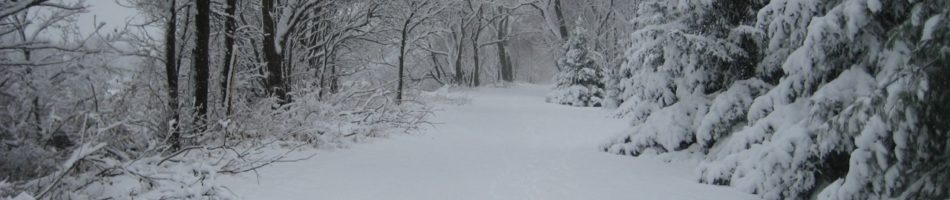
 

I do a lot of things to stave off winter depression. I walk. I spend time in nature. I spend time walking in nature. I move in other ways—taiji, lifting, stretching, running, parkour. I use my HappyLight™. I take vitamin D. But probably most important is finding things to take delight in.

Jackie doesn’t suffer with the dark days of winter the way I do, which is probably a matter of brain chemistry, but perhaps another factor is that she is very good at taking delight in winter as an opportunity to wear her woollies.

I’m trying to do the same.

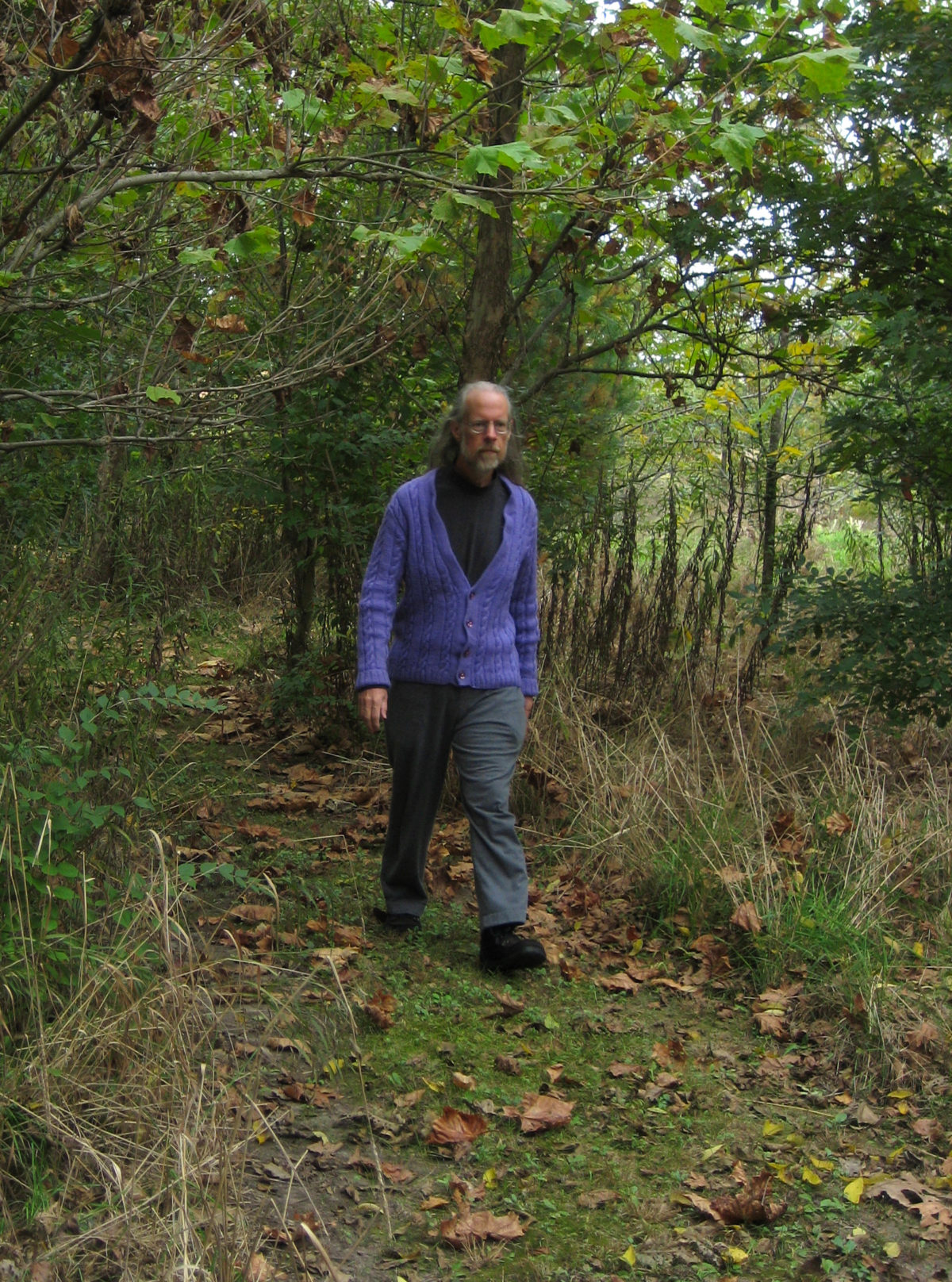
It helps that I have new winter clothes, and old winter clothes that fit again. The photo on this page shows me walking in nature, wearing a purple sweater my mom knit for me years ago.

Besides my old sweaters and my new sweaters, I have a smashing wool vest that Jackie gave me, some wool pants that I bought as field pants (but that are perhaps too nice to wear in the field), and a vast collection of scarves that Jackie wove and knit for me. And that’s just the woollies. I also have a nice collection of moleskin and flannel garments perfect for winter, various fleecy things, and a range of jackets and coats to cover all possible temperatures from “slightly brisk” to “well north of the arctic circle.”

This year, I’ll try to take delight in my seasonally appropriate garments, especially the woollies, and see if that won’t carry me through to spring.

I gave up multitasking a long time ago. I realized that I’m not good at it, and started paying attention so that I could notice when I was doing it and stop.

As an aside, I should mention that there’s now quite a bit of research to show that nobody is good at multitasking, and that the people who think they’re good at it are even worse than the people who know they’re not.

Even though I’m more efficient doing one thing with complete focus and then going on to the next thing, that practice alone doesn’t solve the underlying problem that tempts people into multitasking: How else can I get everything done?

Half of the answer to that is the drearily obvious, “You can’t. What you can do is get a whole lot done, if you quit frittering away your time on trivial, pointless stuff, and apply your time doing the most important stuff.”

I know some people who are pretty good at that, and they are routinely way more productive than me or most other people.

But there’s more to it than that. Katy Bowman has been talking about one useful practice, suggesting that you “stack your life” by accomplishing multiple goals at once—something that sounds suspiciously like multitasking, but really isn’t.

I’ve actually been thinking about this quite a bit, wanting to articulate the difference for my own sake if no one else’s. My take on it, is that it has to do with what the limiting resource is for each activity.

There are a lot of limiting resources. Your hands are one—they can really only do one thing at a time (although my mom used to read, fan herself, and drink lemonade all at the same time, and felt like she was being very efficient). Location is another—something that can only be done in the kitchen can’t be stacked with an activity that can only be done in the garage or the gym or the grocery store. Other people are another—something that requires the presence of another person can’t be done without him or her. (Though it’s not that simple, as sometimes you can stack up the other people and get multiple things done with multiple people.)

In multitasking, the limiting resource is your attention, and what’s unique about attention is that many activities can be done with partial attention. That experience tempts us into thinking that attention is more divisible than it really is.

Washing dishes only takes partial attention, meaning that you can listen to the radio or a podcast and get full benefit out of both activities.

Driving is a more complex example. We know that driving sometimes requires your full attention. This is why talking on the phone is unsafe to do while driving—talking on the phone requires enough of your attention that doing so reduces your competence at driving as much as getting drunk does. (Talking to someone in the car with you is much less unsafe, because that person can see when the road conditions are such that you need your full attention and shut up. Just listening to something—the radio or a podcast—does not seem to cause the same problem, probably for reasons having to do with deep structures in the brain that prioritize social interactions.)

Even though there are plenty of activities that can be done with partial attention, most important activities require full attention to be done well.

Writing a blog post can be done with partial attention, but when I try to do it while simultaneously listening to a podcast, checking my twitter and facebook feeds, chatting with a friend on-line and another in-person, and answering the occasional email message, I don’t do it as well.

As I’ve worked to apply this lesson—noticing when I’m multitasking and then refocusing on the main thing I’m doing—I’ve learned something else: Many activities that don’t require full attention turn out better when I give it to them anyway.

Beyond that, I feel better when I give my full attention to whatever I’m doing.

It was the meditation practice that I adopted as part of my taiji practice that taught me this. First, it taught me the skill of paying attention, then it taught me that paying attention to what I was doing right now paid dividends, even when all I was doing was sitting or standing.

I’ve noticed it particularly with exercise. I used to distract myself from exercise with music or podcasts or games like Zombies, Run!, because I found exercise to be unpleasant drudgery that I only engaged in to the extent necessary to build and maintain a basic level of fitness. I don’t do that any more. It’s much better when I fully embody my exercise: I enjoy it more, I’m less prone to injury, and the exercise is more effective.

The more I do this—give my full attention to whatever it is I’m doing, whether it seems worthy of full attention or not—the more I find it worthwhile.

Downside: I’m falling behind on my podcast listening, because there are so few things where I feel like partial attention is all they deserve. Maybe I’ll find more, but at the moment I’m just about down to riding on the bus.

So, yes: Stack your life. If you can do one thing with your brain, one thing with your hands, and one thing with your feet all at the same time, go for it. But think twice before dividing your attention. If something is worth doing, it may well be worth your full attention, no matter how hard that makes it to get everything done.

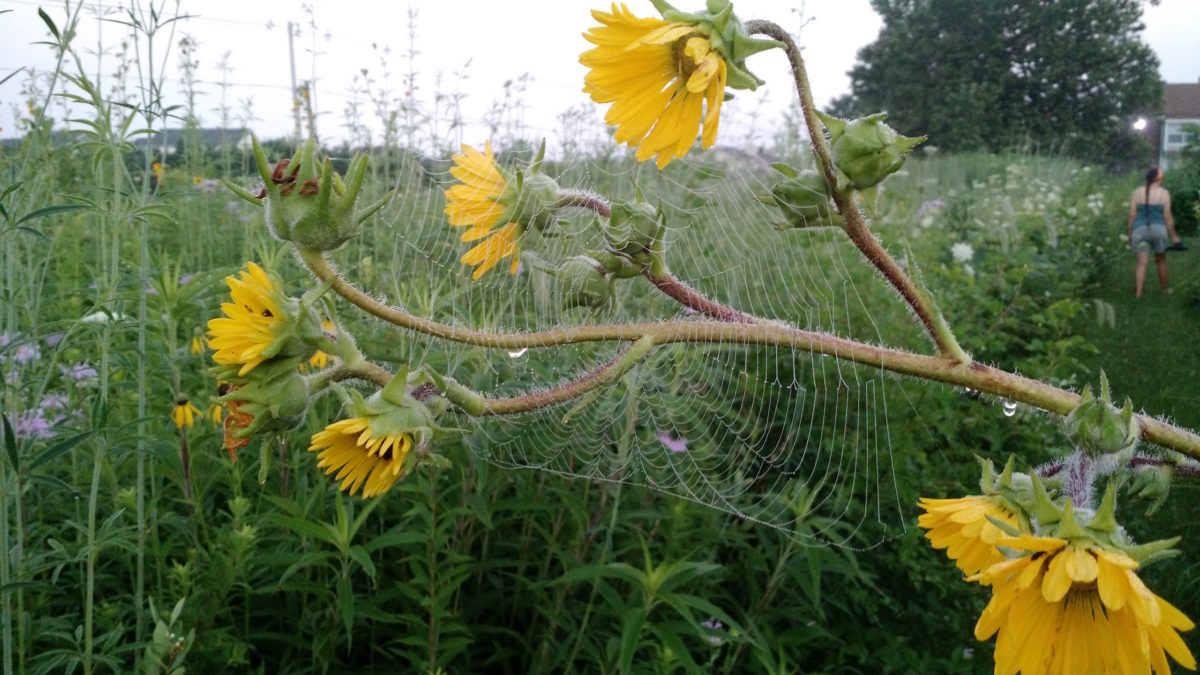
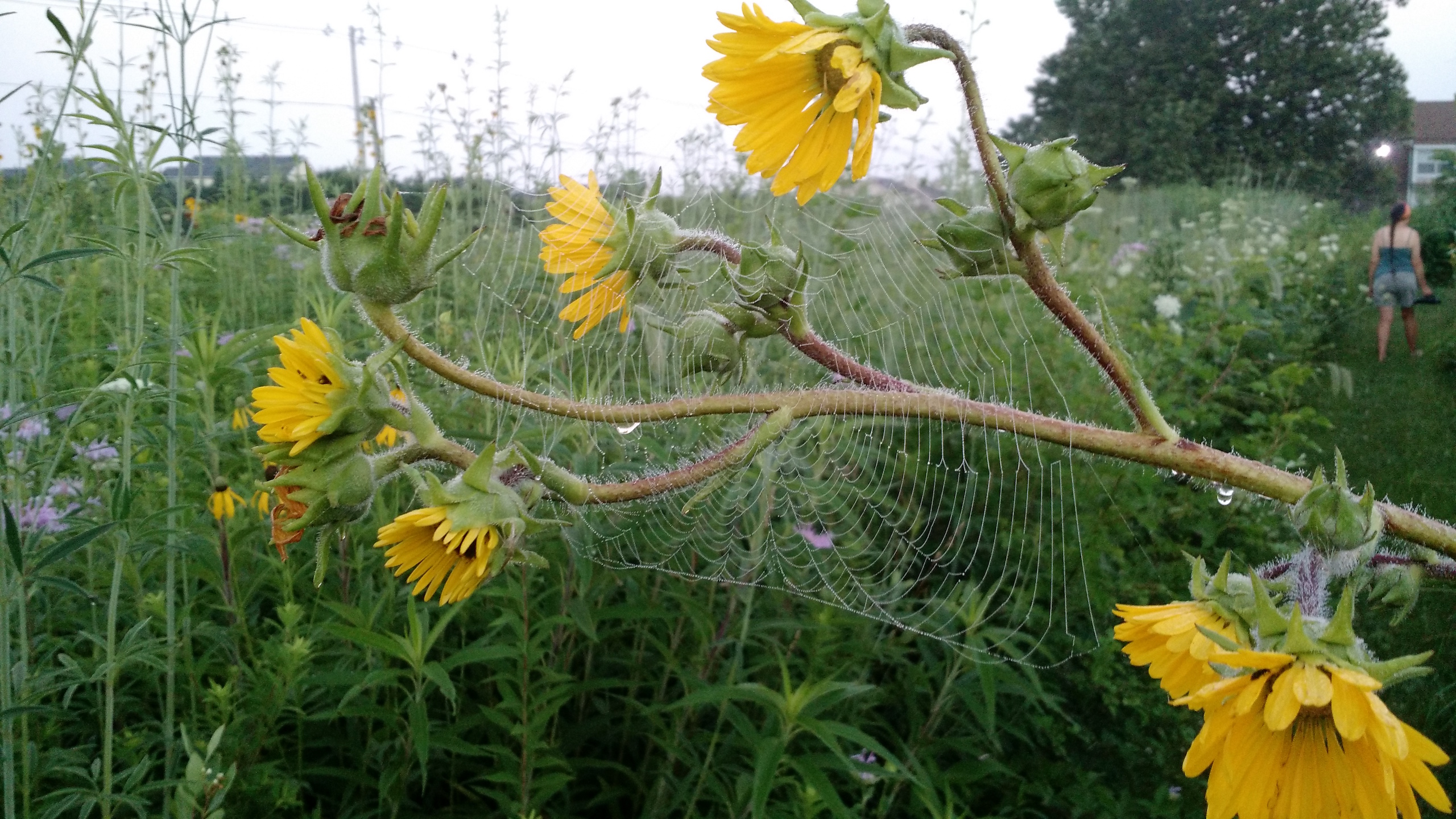
Prairie Spiderweb

The weather finally became what I want from weather: gloriously warm and sunny. Friday I celebrated by going for a run.

Conventional wisdom for a while now has been that faster foot-turnover—at a rate of 180 steps per minute—is better. Supposedly it maximizes the amount of energy stored in the elastic properties of your feet and ankles which can then be returned as free energy in the next stride. Slower foot-turnover means you have to work harder twice—first, using muscle strength to absorb the energy of the foot-strike, and then using fresh muscle power to generate the next stride.

To work on that, I’d downloaded a metronome app to my phone, and set it to tick at 180 bpm. I started that up, and started running in sync with the ticking.

I’m sure it’s possible to run at a slow pace with fast foot-turnover, but doing so did not come naturally to me. I sprinted off down the road at quite a bit faster than my usual running pace.

Perhaps, if I’d focused on running slowly at 180-foot-strikes per minute I’d have been okay, but the other thing I was focusing on was making my foot-strikes as gentle as possible. (There’s recent research supporting the obvious: minimizing impact loading of each step reduces running injuries.)

With my attention focused on faster, lighter foot-strikes, I managed to get myself pretty out of breath in just a mile or so. At around 2 miles, I passed a playground that I like to pause at—I practice my balancing by running around the perimeter formed by (I think) 1×6 boards, and then do some inverted rows using a piece of playground equipment. That gave me a chance to catch my breath a little, and I walked for a minute or so after I finished there.

Once I started up running again, I ran a bit more slowly. I’d turned off the metronome, although I was trying to keep the 180 bpm pace in my head. I was doing a bit better at keeping a lower pace, until I came into sight of the traffic light to cross Route 45, and saw that Jackie was also approaching the intersection, about a block ahead of me.

I responded to that by picking up the pace (again), and managed to cross on the same walk signal. Then I quit running, and walked the rest of the way home with her. The run came in a 3.2 miles, at an average pace that is nothing to write home about, except that it includes the time playing on the playground equipment.

Next step: Figure out how to run slowly with fast foot-turnover.

By the way, this is still true:

The image at the top is the view out the study window, where you can see that our neighbor’s flowering tree is in full bloom. Ours is perhaps a day or two behind.