One of my fellow Wise Bread writers, Nora Dunn, has been posting some of the financial details of her travel-heavy lifestyle, including this post on her 2011 Income. (It’s got a link to her earlier post on her 2011 spending, and promises a forthcoming post on why she chooses to earn this much money and not more.)

It’s pretty interesting for anyone who’s thinking about the sort of issues that I write about in my Wise Bread articles—how and why to spend less, and how and why to earn the money to support that frugal lifestyle (and not some other lifestyle).

I think of myself as a writer, not a “content creator,” so I find Drew Breunig’s warnings of doom to anyone whose business is built around “content” to be hopeful. Those same warnings ought to terrify the owners and managers of those businesses.

My writing for Wise Bread has given me a particular perspective on this. The Wise Bread admins have done a pretty good job of seeking out and paying for high-quality writing. They have fallen prey to the idea that winning in this niche is all about SEO and monetizing, but that’s not so bad.

The SEO thing tends tends to work in favor of a writer who wants his work to be read. A Google search for budget categories finds my article Refactor Your Budget Categories, despite a lot of other articles on budgeting. (I was going to say that I wouldn’t do so well if I just posted the article on my own blog, but when I tested that theory, I found a Google search for rich country finds my article How to Have a Rich Country just fine. Maybe I could do as well on my own site.) In any case, there’s nothing wrong with SEO, as long as it’s in service of good content—good writing.

The monetizing thing is more of a slippery slope. If you let your browser do so, it’ll run scripts from at least 15 other domains every time you load a page on Wise Bread. I haven’t looked at what they’re all for, but most of them either serve ads or provide some sort of analytics or tracking of who’s viewing what. As a reader, I don’t care about any of that stuff, so I generally don’t let my browser run those scripts. As a writer, I tolerate it as a way to make more money, but I don’t think it makes my posts look better. (Wise Bread does at least avoid the very worst of the interstitials and floating boxes that cover the page and so on.)

So, as I say, I hope Drew Breunig is right. I’d very much like to see the revenue potential of a content farm article fall to zero. Or, at least, low enough that there’s no point in paying some semi-literate buffoon a nickle to cobble together a few paragraphs that look like prose and are stuffed with keywords. Not that I begrudge the semi-literate buffoons their nickles; I’d just like to see the incentives in the system shift so as to make it pointless to hire writers who can’t write.

It would take a lot of those nickles to add up to a reasonable wage, but there are a lot of those nickels. A world in which we swapped 10,000 worthless articles for one worthwhile article—and paid one writer $500 instead of a thousand buffoons 50¢ each would be a better world.

What makes a country rich? Hint: It has nothing to do with natural resources. Places like Singapore, Hong Kong, and Japan prove that. (See also: How to Get Rich by Being Evil)

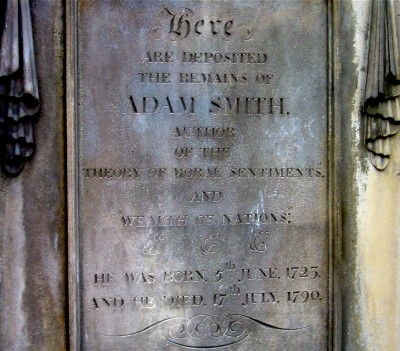
We’ve known how to have rich countries for a while now; Adam Smith laid most of the ground work in 1776 with The Wealth of Nations, and we’ve improved on it modestly since then. You need three things:

  1. Private property
  2. Free markets
  3. Rule of law

None of those things have to be perfect for a country to get rich. Look at what China and India have done over the past twenty years. Allow a little private property, reduce government regulation a little, and you unleash a lot of entrepreneurial activity. Pretty soon, you have a bigger economy, higher incomes, and a richer population.

What’s interesting to me is how important that third point turned out to be.


As the Soviet Union began to collapse, a lot of people were offering advice on how to free the economies of the formerly communist countries. Most of the advice had to do with getting state property into the hands of ordinary people in ways that would allow the greater productivity that private property and free markets allow.

There was a lot less focus on how to imbed the rule of law into the system. It was almost as if people figured that the shift from a police state to the rule of law would be easier than getting there from a state of anarchy. (A dumb idea, once you think about it.)

So, thanks to the unhappy experiments in Russia (and other places) we now know what happens if you have (some) private property and (moderately) free markets without the rule of law. You don’t get a rich country; you just get a lot of rich people.

This insight has been guiding me politically for a while now. Obviously, it would be great to be a rich person in a rich country, but few of us have that option. Pretty much by definition, most of us are going to be somewhere in the broad middle. But if you’re going to be in the broad middle, it’s a lot better to do so in a rich country.

Happily, we know how to have a rich country.


Note: This was originally written for Wise Bread, but they decided it wasn’t for them, so I’m posting it here. I’ve kept it just as I’d written it, including the “see also” link back to Wise Bread. And, since it was written for a monetized market, I’ve gone ahead and put some ads in this post, even though I don’t general monetize my blog. Somehow, the post seemed lonely without them.

In 2008 I posted Ron’s paper on Peak Debt. He recently extended his work, in a new paper called Peak Debt and Income.

Once again, I’ve got a piece up at Wise Bread that provides an overview of paper:

Laszewski creates a simple model of the economy as a tool for investigating the question of how to get household balance sheets back in order after suffering the problems diagnosed in the earlier Peak Debt paper…

Really, though, you ought to read the paper. (The math in this one isn’t as tricky as the math in the original Peak Debt paper.)

Late last summer, I got email from the publisher Gale. They wanted to license my Wise Bread article Bankruptcy is a Good Thing to use in their book Bankruptcy (Introducing Issues With Opposing Viewpoints).

They have a whole series of “introducing issues with opposing viewpoints” books, each of which contains a variety of articles and essays on some topic. I gather that the idea is to help teach students the skill of reading a number of articles, any one of which may be unbalanced or narrowly focused, and then synthesizing an understanding of the topic. It’s a useful skill, and one that’s hard to teach with a textbook, since textbooks generally try to present a comprehensive and balanced viewpoint.

I executed the license agreement back in August. The book came out in April, and the check (payment on publication, of course) arrived today!

It would probably be worth my time to market reprint rights more aggressively, but I enjoy writing more than I enjoy marketing. So, it’s especially nice when the chance to earn a license fee falls into my lap like this.

Because of the nature of (and price of) the book, I didn’t try to negotiate a contributor’s copy. If you happen upon a copy, I’d be pleased to hear a little about it.

My Wise Bread post Buy Your Groceries European-Style picked up mentions at both the Discovery Channel’s Planet Green and Lifehacker.

Jason Fitzpatrick had kind words for my post in his piece Shop European-Style for Fresher, Cheaper Food.

Lloyd Alter was especially generous, saying (in a green-living piece subtitled “I thought I was a lonely failure as a frugalista, but I am not“):

I thought we were pretty much along among the frugal living types to do this. However, one of my favourite writers on frugal living, Philip Brewer at Wisebread, agrees…

Thanks guys!

Two of my Wise Bread posts, The Ethics of Hoarding and Healthy, Frugal Eating, got very kind mentions in the Doctor Oz blog:

Wow. Just a stellar post… Philip Brewer strikes again with a straightforward, no-bull piece on why we gotta suck it up and stop eating expensive crap. Stern, but informative!

I find it surprisingly difficult to extract quotes like that—it seems too much like bragging. I guess that’s why it’s useful to have a publicist.

My Wise Bread post Have Style, Not a Lifestyle was featured on the Discovery Channel’s Planet Green.

Here’s the gist of what I had to say:

The key to resisting the Diderot effect is to have style. Not just any old style, but a particular style. Something nicer than everything else you own isn’t in keeping with your style and that makes it easier to resist: It’s just not you.

Check out the Planet Green’s Watch Out For the Diderot Effect which includes a link to a translation of Diderot’s famous essay.