Esperantists are celebrating today. It’s 150 years since the birth of L.L. Zamenhof, the creator of Esperanto. Celebrating along with them is Google, which is featuring the Esperanto flag in their logo.

Google logo featuring the Esperanto flag

Esperanto has been important to me for twenty years. I’ve traveled overseas with it. I’ve met bunches of cool people, read fascinating books and magazines, and listened to great music.  Most important, I’ve done it on equal terms with the writers, performers, guests, hosts, and other people that I’ve met.  Instead of one of us speaking our native language, we’re both speaking a second language–but one that’s easy to learn.  Easy enough to learn that you don’t need to have any special talent with languages to learn it.

Happy Esperanto Day!
Last August I got email from UK sf writer Gareth D Jones, who was looking for Esperanto magazines that might be interested in translating and publishing his work.

There have been Esperanto-language publications that focused on science fiction (in particular, the Sfero series published by Grupo Nifo), but none of those seem to be active at the moment. (This is not as sad as it might seem, though, because the Esperanto-language literary magazines are not averse to publishing science fiction or fantasy. In particular, a recent issue of Beletra Almanako focused on speculative fiction.)

I told Gareth what I knew about sf in Esperanto, but also reached out to the Esperanto community, asking if anyone knew translators or publishers who would be interested in doing something with Gareth’s work. Pretty promptly, I heard back from Brazilian publisher Luciana F Campos whose publishing house Lusíadas was interested in publishing Gareth’s work.

I’ve heard from Gareth that the publications are now out.  Esperanto translations of two of his stories can be found in I Antologio Luzidoj (link to pdf) as well as Portuguese translations in I Antologia Lusíadas (link to pdf).

Helping make another Esperanto connection in the world is really its own reward, but as a bonus I also got this cool link to Douglas Smith’s Foreign Market List, an annotated list of  publications that buy foreign-language reprint rights to English-language stories.

I’ve been trying to get out for a walk each day, and trying to take a photograph on the walks. I want to do both of these things, and my theory is that these desires will be self-reinforcing: My desire to take a photo will get me out on my walk, and my desire to go out on a walk will prompt me to get out and take a photograph.

With that in mind, I’ve been going ahead and scheduling a chunk of walk/photograph time between my two morning writing sessions. Today, though, I was meeting some friends for lunch, so I postponed the walk until late morning, then did my walking and photography in the neighborhood of the restaurant.

Thursdays are my most social day–I have lunch with one group of friends (a couple of them former coworkers) and then before dinner meet with my local Esperanto group. With all that, plus the fact that I spent a chunk of the afternoon working on a short talk that I delivered to the Esperanto group, meant that my fiction word count was just 500 words. But they’re words I’m happy with.

This is by no means a comprehensive list; I’m just trying to capture stuff that was previously in various places on this site and put it in one place.  If you’re an Esperanto speaker, there’s more stuff (in Esperanto) on my Esperanto site.

About Esperanto

National organizations in English-speaking countries

Learning and Using Esperanto

Local to East-Central Illinois

My English-language writing that features Esperanto

Thanks to Darcy and Meryl, we’ve once again got a functioning Esperanto group in Champaign-Urbana!

There are several komencantoj, but also three or four of us who speak Esperanto adequately, so we’re trying to do a mix of things at the meetings.  We’ve been reading Gerda Malaperis, which is something that even beginners can do. We also started watching Mazi, which is fun. We’ve decided to all read a couple of articles from the Esperanto Wikipedia and show up ready to discuss them. We’re hoping that narrowing the topic of conversation down to a specific article will make it easier for people who’s working vocabulary is still really small–they can look up a few domain-specific words before the meeting (even make notes to refer to, if necessary).

I’ve already noticed improvements in my own Esperanto, after just three meetings–it’s amazing how fast you can pick up fluency if you’ll just practice.

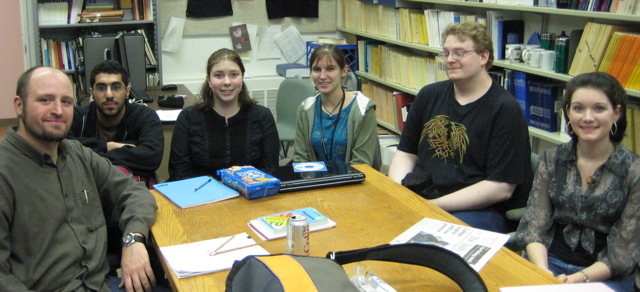
Here’s the folks who were at the last meeting:

Our new local Esperanto group
Our new local Esperanto group: Jack Hutchens, Omar Ali, Phoebe, Darcy Ross, Matt, Meryl Garrison.

Esperanto-tago

My brother, Steve, is once again organizing Esperanto-Tago, a day for everyone with a blog to post about language problems from their own perspective, bilingually–in their own language and in Esperanto.

Two years ago, all kinds of people posted on all kinds of topics–immigrants, children of immigrants, people whose native language has a small number of speakers, people whose languages are not supported by the culture where they live.  Everybody has some language problems, if only wanting to connect with people with whom they don’t share a common language.

At the Esperanto-Tago page there’s support of various kinds, including support for hooking non-Esperanto-speakers up with volunteers willing to translate their post into Esperanto.

If you’ve got a blog, think about the language problems that you face, and consider writing a post for Esperanto-Tago.