Jackie and I have continued to work up toward being able to take our planned very long walk in mid-June.

Our previous outing was planned for 15 miles, but we actually did about 17. For yesterday’s outing we came closer to hitting our target distance—planned for 20 miles and came in at 20.61 miles.

It was a pretty good walk. The temperature was a bit cool, but stayed steady for the duration, so we weren’t having to adjust clothing repeatedly.

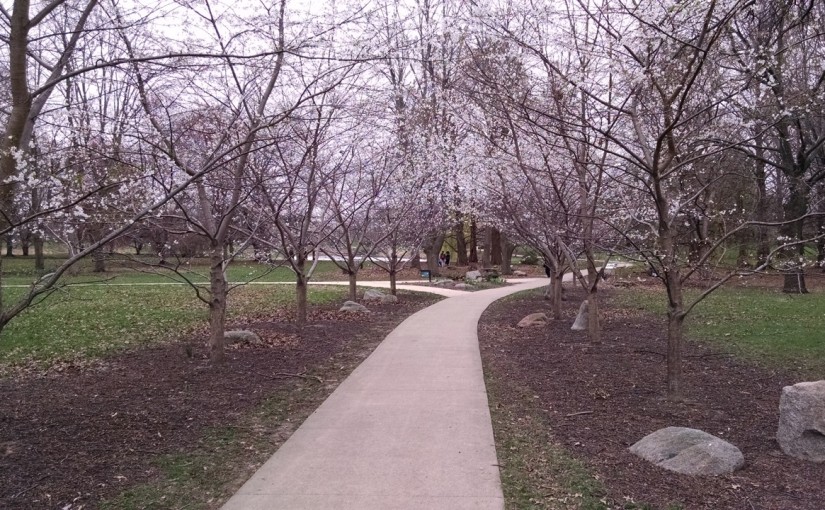
We walked through Robeson Park and then to our old neighborhood where we had lunch at El Toro. Then we went up the Greenbelt Bikeway and visited our old garden plot near Parkland College. Then we angled our way to downtown Champaign, passing near both our summer place and our winter palace, pausing for coffee at Pekara Bakery. Finally, we walked to the University of Illinois Arboretum (where the cherry trees were just blooming) and then headed home through south campus and the research park.

We held up pretty well, perhaps because the distance was only 3 miles beyond our previous long walk. My plan is that we’ll do 26.2 miles for our next walk, sometime towards the end of April, but we’ll see how things go. We have time in our schedule if we want to take that jump in two steps.

We haven’t been getting in as many of the medium walks as I’d hoped, mostly because of problematic early-spring weather. With the weather shifting to more of a late-spring pattern, I’m hoping that won’t be a problem going forward.

One thing I’d like to do is start including some faster miles in those medium-length walks. We can walk fast enough, but we tend to slow down late in the walk. That’s fine, but if we have very many miles at 20+ minutes per mile, it will make for a very long day on the Kal-Haven trail.

Here’s the details on this walk:

And here are the details for the previous one:

Jackie recently expressed a concern related to my expanding interest in fitness: “We were both nerds together at Motorola, but now you seem to be turning into a jock.”

I assured her that she was mistaken, pointing out that I have no new interest in team sports, nor in spectator sports—two key markers for jocks in my mind.

But I did see how she might be concerned. I was putting a lot of time, effort, and attention into this fitness stuff. I was also writing about it and taking about it a lot. (Enough that I felt I had to move some of the writing to my Esperanto-language blog, where it would bore fewer people.)

Most recently, I’ve been looking at some Natural Movement stuff, in particular at MovNat. They have roots in the same source as parkour, but without the urban bias. They also have a broader perspective—parkour is all about getting from point A to point B, dealing with obstacles as efficiently as possible. MovNat is about rediscovering a broader range of human movement skills—not just running, jumping, climbing and balancing, but also throwing and catching and swimming and diving and fighting.

Aware of the fact that I’m in that brief phase where some new thing is all shiny and interesting, I try not to spend all my time talking about it, but I still talk about it enough to bore any ordinary person. (Jackie recently let me go in for some minutes about one of these things and then said, “You should write something about this on your Esperanto blog!”)

Yesterday, while we were out on our long walk, I was once again going on about this or that aspect of movement skills. Jackie listened patiently, then said, “I take it back. You’re not turning into a jock. You’re becoming a geek about parkour.”

We were both reassured.

Today was our nicest day of the year so far, and Jackie wanted to do another long walk, so that’s what we did.

It seemed kinda early for a long walk, just 4 days after our last long walk. It was also kinda soon after my little parkour adventure yesterday. But the weather was great.

I had rather expected to be too sore after yesterday’s parkour—and I had noticed in the night that my core muscles were pretty sore.

Did you know that your core muscles are critical to turning over in bed? If not, I invite you to spend an hour on quadrupedal motion, precisions, and vaults, after which (unless you’re already a highly trained traceur) I’m confident you’ll be able to observe the fact for yourself. But when I got up, I discovered that I was otherwise fine. My feet, ankles, knees and hips were all fine, as were my calves and thighs. So, if Jackie wanted to do a long walk, I was okay with that.

We did it on kind of a whim, so we didn’t have a route planned, but that was fine: We just winged it. Today was a taiji day, so we started by walking to taiji. After taiji we walked to campus, where we decided to eat at Ambar India on campus—it’s a buffet, so we wouldn’t have leftovers to deal with. Then we walked to the Nutritional Food Store, the only place we know of to get freshly ground peanut butter. Then we walked home.

It came in at just under 13 miles, but we were tired enough and sore enough to not want to walk another couple of miles around home just to hit the 15-mile mark. We’ll do that later in the month, closer to the planned time. (Instead we sat out on the patio and drank beers. It was the first day warm enough for patio sitting this year, and we enjoyed it a lot.)

Here’s the details on the walk:

I’ve been following the local University of Illinois parkour club via its facebook page since last year, but what with being busy moving and such last summer, had never gotten out to train with them until today.

I had a great time! We practiced our quadrupedal movement via a game called QM Tag, we practiced our precisions, and they taught me one vault and showed me several others.

They’re a great group—focused on their training but eager to teach me stuff, careful not to push me (or one another) to do things we’re not ready for.

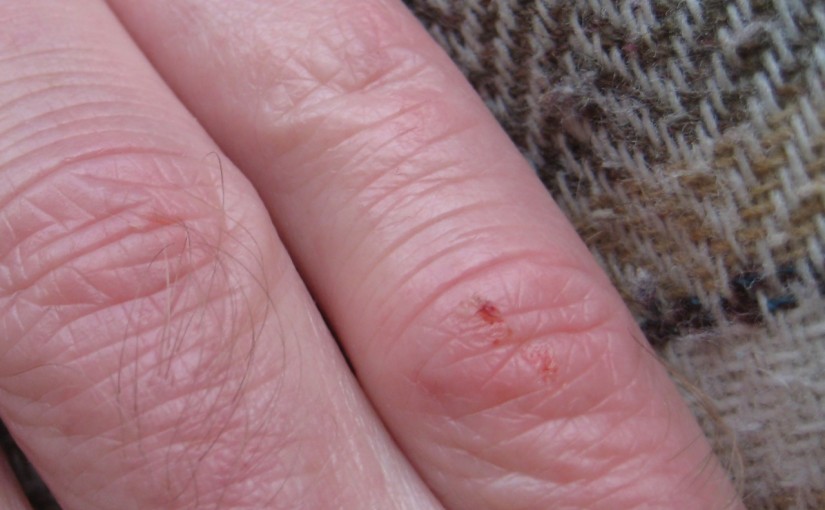
I bowed out early, after a bit over an hour, but except for having skinned my knuckles in the QM Tag, I believe I escaped uninjured. I’ll definitely be back—and I’ll definitely be stepping up my own practice in the meantime. I want to do more.

I went for my first outdoor run of the year on Sunday. It was the first day that the paths were clear enough of ice and snow to make it possible.

Although the paths were mostly clear of ice and snow, there was a lot of melt water, flowing across the path in hundreds of rivulets. I found myself integrating into my run hundreds of small leaps, in a (partially successful) effort to keep my feet dry.

I was well aware of the leaps as I did them—I remember making a conscious effort to refrain from favoring one side over the other, trying to execute each leap with the most natural foot leading, based on my current point in my stride as I approached.

For some reason, all those leaps were not the first thing that came to mind the next day, when my calves were as sore as they have ever been. I was just sad at how much more out-of-shape I must be than I had realized, to be so crippled by a simple three-mile run. (They hurt a lot more than when I actually tore a calf muscle a couple years ago.) It was only late Tuesday, when I was heading to teach my taiji class, that I jumped over a similar stream of water in a parking lot—one calf screaming when I launched, the other screaming when I landed—that I realized that it was the leaping that had done such a number on me.

With that reassurance I felt much better, and by Wednesday my calves were feeling much better, which was good because Wednesday Jackie and I went on our first long walk of the year, part of the series of long walks we’re taking to prepare for the 33.5-mile Kal-Haven Trail walk that we’ve been meaning to take for a couple of years now. We’re quite determined that this will be the year.

For our first long walk we walked to taiji, attended our class, and then walked on to downtown Urbana and had lunch at Crane Alley (good beer). After lunch we walked back through campus. Having exceeded our planned distance (we wanted to do 10 miles and got in 11.5), we caught a bus at the south end of campus to go the rest of the way home. (The walk home from the south end of campus isn’t far, but there’s no good footpath. I think during the summer, when it’s possible to walk along the side of the farmer’s fields, it’ll be a fine walking route, but yesterday it would have been too wet and muddy.)

It was warm enough that I was able to expose my forearms to the sun!

My training plan, such as it is, covers just the long walks—we’ll include many shorter walks in our daily activity, and plenty of medium walks as well. But the long walk plan looks like this:

  • first-half March: 10 miles — done
  • second-half March: 15 miles
  • first-half April: 20 miles
  • second-half April: 26.2 miles (because why not?)
  • first-half May: 30 miles

The main event is planned for roughly June 18th, but it will depend on the exact schedule of when we go to visit my dad and what the weather looks like those days. I figure we’ll be fit enough to do a very long walk of the planned distance any time after mid-May, so that gives us a month’s cushion to allow for any glitches.

I’m kind of excited about possible medium-length walks from our new house, here south of town. All of south campus is reasonably close, including, for example, the Arboretum with its cherry trees, which should be in bloom in about a month. It might make sense to walk there several times in early April, to keep up with the progress of the cherry blossoms, and take the opportunity for both haiku and photographs.

The most obvious way to walk (starting with the exact route from south Campus that I rejected yesterday) would be about 3 miles each way, the first half along the sides of country roads. As I say, it should be an entirely satisfactory route anytime the ground isn’t too wet.

Here’s the details for Sunday’s run:

And here’s the details for Wednesday’s walk:

If you made a short list of the things I’ve taken an interest in just lately, and then added knife-throwing to the list, you’d pretty much have the table of contents for Christopher McDougall’s new book Natural Born Heroes. It’s like he’s been following me around to see what I’ve been researching, asking about, and talking about. But, you know, not in a creepy way.

The book isn’t out for another six weeks or so, but he’s got a fascinating series of little articles and videos over at Outside Magazine’s website that hits some of the high points—parkour, lifting, standing, foraging (most of which are already tags here on my blog)—with the bonus addition of the knife throwing, which is now a tag for this post, and will get some more attention in the very near future (because how cool is that?).

The book itself is coming out in mid-April, and is available for pre-order at Amazon: Natural Born Heroes: How a Daring Band of Misfits Mastered the Lost Secrets of Strength and Endurance.

I’ve had a slightly sore foot for a while now.

It hasn’t been a big deal. It doesn’t hurt when I run. It doesn’t hurt when I walk (except sometimes when I walk really fast). It doesn’t hurt when I stand, or when I’m just sitting.

Mostly it hurts when I use my foot as a brace to turn or twist, such as when I brace the side of my foot against the mattress to turn over in bed. Sometimes it hurts when I’m standing on my other foot, and touch just the toe of the sore one down to catch my balance.

It sometimes hurts for the first few minutes right after I get up in the morning, kind of like plantar fasciitis, but a different part of my foot: the medial edge, just posterior to the ball of the foot.

Even then, it doesn’t hurt much.

However, it has been persistently hurting occasionally, just a little, for a long time now. Months.

I had been doing basic, conservative care. I was wearing supportive shoes, avoiding things that hurt it as best I could, and figuring it would eventually get better. But it hasn’t.

So, a couple days ago, I decided to step it up a notch: I decided to treat it with a placebo. (The effectiveness of placebos is well-established. They’re effective even when people know that the treatment is a placebo.)

My initial plan had been to add in some sort of cream or ointment. I thought of something like Aspercreme, but it doesn’t hurt enough to justify the use of even a mild analgesic, so I thought I’d get something like Bengay or IcyHot: just some sort of counter-irritant that would make it clear that I was “doing something” to treat my foot. Then I saw Walter Jon Williams’s recent post on Tiger Balm, and knew that I’d found the right stuff.

Jackie discovered Tiger Balm several decades ago, during her travels in Asia, and it has long been a staple item in our medicine cabinet, but we’d let ourselves run out in the run-up to our several moves, so we didn’t have any. Fortunately, the closest store to our townhouse is a CVS, and they had two varieties of Tiger Balm in stock. They seemed almost identical (a one-percentage point difference in menthol), but the one they were marketing as their “ultra strength” “sports rub” was $1 cheaper, so we got that one.

I’ve been using it for two days now, and I’m imaging that my foot is feeling better.

Perhaps because I’m finally doing something about my foot, I also remembered something else. For years now I’ve been wearing a pair of slip-on Birkinstocks as slippers. I started wearing them when I first got plantar fasciitis, and found that it was crucial to never go barefoot on our hardwood floors. Along with other supportive footwear, they solved the problem.

Usually I only wore them indoors, but very occasionally I’d wear them outdoors for very short trips—if I was only going as far as the mailbox, for instance. One or two summers ago, I tried to wear them for a walk around the block, and found that they really hurt the joint at the base of my big toe. I couldn’t make it even as far as around the block—I had to turn back and hobble home.

They never hurt my foot when I just wore them around the house, which I continued to do.

But now that I was thinking about it, it occurred to me that maybe they were hurting my foot, just not enough to notice unless I did something out of the ordinary.

Since the plantar fasciitis hasn’t bothered me since I started doing taiji, I decided to retire the slip-on Birkinstocks.

I’m also adding some calf-stretching, as well as some calf and shin strengthening activities.

I suspect some combination of those activities will do the trick. But just in case, I’m also rubbing some Tiger Balm two or three times a day into the side of that foot, from ball back almost to the heel.

I’ll keep you posted.

Oh, and by the way—the main reason I haven’t been posting much here is that I’ve been posting most of my exercise-related stuff on my Esperanto language blog, mostly as a way to improve my grasp of the exercise-related vocabulary (which is surprisingly poorly developed in Esperanto). I have a sense that most of my friends and relations have heard about all they want to about my exercise and fitness. And what better way to make sure almost nobody is bothered by my yammering on about it than to do so in a language almost nobody speaks?

I happened upon a post by Ragen Chastain, a writer and activist on size acceptance. She’s also a dancer and an athlete, and I mention her because a recent post on training resonates with my experience, without quite matching it.

She’s training for an IRONMAN race, and the post in question compares the difference between training skills versus training fitness. In training, for example, dancing, you’re learning stuff. It may be really hard, but once you learn a move, you’ve learned it: For a long time it’s hard and you suck, and then you get it and then it doesn’t suck any more. Running (and swimming and bicycling, but especially running) is very different:

One of the things that is interesting about training for the IRONMAN is that it is a process of constantly increasing distance and time (sometimes alternately, sometimes at the same time.) such that “progress” doesn’t necessarily mean that my workouts feel better, but that my general feeling of suckiness remains constant at an increased time and/or distance.

Case in point – Wednesdays are speedwork which means intervals at the highest speed I can manage.  The interval time has increased four minutes, and the speed has increased 5 minutes per mile since I started training.  I still feel like I’m going to die at the end of each workout but I’ve gone farther, faster, for a longer time period.  It’s the stasis of suck.

I totally get where she’s coming from: running as fast as you can (or as far as you can, or as long as you can) is hard. But my experience is different.

Especially when I’ve gotten out of shape, I absolutely feel the massive suckage of starting to get into shape again. Many times I’ve gone trudging around my old 1.5-mile loop near Kaufman Lake, gasping for air, thinking “I’m going to die.”

But after three, four, five runs—such a short time that I can’t possibly have made more than a tiny improvement in my fitness—my perspective is completely different. I’m still trudging around the same loop. I’m still gasping for air. But now I’m thinking, “Wow, I’m getting a great workout!”

Perhaps this is because I don’t have a coach. Maybe if I had someone carefully measuring my performance and matching it to a model of my theoretical maximum performance, that person could arrange for my experience of suckage to remain constant.

But I don’t really think so. A lot of the experience of suckage is in your head. With one mindset I experience the physical sensations of slowly running as far as I can as miserable, because it’s so hard. With a different mindset I experience the exact same physical sensations as wonderful, because I’m doing what I want to do, accomplishing something that’s difficult and yet rewarding.

That doesn’t suck, even if it’s hard and painful.

We have a bunch of things we’re hoping to do this year, and most of them require some amount of preparation—preparation which will have to occur in the winter and spring.

My plans stretch out to the end of July, because the last week of July I’ll be in Lille, France to attend the 100th Universala Kongreso de Esperanto.

As preparation for that, I really want to spend half an hour almost every day practicing my Esperanto. That should be plenty—I already read and write the language and I’ve attended international Esperanto gatherings in the past. But just a bit of practice listening to spoken Esperanto (podcasts and such) and a bit of practice actually conversing (with my local Esperanto group, and such other folks as I can find) will go a long way toward making attending this kongreso a rich and satisfying experience.

About a month before that will be the solstice, and right around then—second half of June or very early July—is the only good chance do the Kal-Haven trail walk that we’ve hoped to do each of the last two years. (In those weeks because only then are the days long enough to finish the walk in daylight.)

As preparation for that, we need to go on several walks each week, including a very long walk roughly every other week, working our way up to being able to walk the 33.5 mile trail.

Several months earlier—just one month from now—we’re going to have a little party for people to come see our townhouse. We’ve fixed the date as February 1st, and are thinking of it as a celebration of Groundhog’s Day Eve, or  Imbolc, if you prefer. Invitations are forthcoming. If you don’t get one, it is surely an oversight—let me know.

As preparation for that, we need to finish unpacking!

Without a specific deadline, but very soon now, I want to finish revising my novel so I can get it out to first readers.

As preparation for that, I need to spend an hour or two every morning writing.

Normally at this time of year we’d also be planning our garden, but Jackie has convinced me that working a garden plot this summer will be more than we can manage.

I read a lot about fitness.

Non-fiction about fitness can be motivating. I find it especially useful to read when I shouldn’t workout due to injury. It lets me maintain momentum through a period when I’d otherwise be idle. I also find fiction about getting in shape to be motivating. (Either one is generally a lot more motivating than most of what passes for fitness motivation. I’d meant to link that to the motivation stream in the “Fitness” community I follow in Google Plus, but decided against it. Too much of the so-called motivation is either demotivating or outright offensive.)

There’s an issue with this source of motivation: both fiction and non-fiction come with a worldview—a model of what fitness is, what it’s for, what behaviors lead to it.

This is noticeable in non-fiction, particularly when the model is weird as to its goals or methods. But it’s especially noticeable in fiction, because then it gets bound up with the goals of the fictional characters. For example, the hero in Greg Rucka’s Critical Space (I’ve mentioned the fitness montage in the middle of that book before, as a good example of the sort of thing I find motivating) is getting in shape to be ready to defend against an assassin.

As long as I’m choosing reasonable behaviors that lead to fitness in a model of my choice, I figure the fact that there’s an action hero doing some of the same stuff is harmless.

Sometimes the fictional character’s worldview resonates with me. For example, one thing Rucka’s hero describes is that learning how to carry himself—learning how to be balanced, centered—teaches him how to see that in other people. My taiji practice has begun to produce the same result in me. I notice when people do or don’t have a good vertical structure, something that I never would have thought to notice before.

Other times the fictional character’s worldview holds nuggets that are genuinely worth picking up. It’s common, for example, for a hero to get better at paying attention to what’s going on—to be more vigilant and watchful. Clearly a useful perspective if you’re living in a thriller or an action-adventure, but probably even if you’re not. Paying attention to what’s going on around you is just good advice. Even if you’re not being targeted by an assassin, being inattentive makes you more vulnerable to everything from muggings to being hit by a car.

Which brings me to the title of this post. As someone who does not live in a thriller or action-adventure, I have the luxury of not paying attention.

As one specific example, when I play Ingress, I pay very close attention indeed—but the focus of my attention is on the fictional augmented reality of the game. Despite its grounding in the actual built environment of public sculpture, the game really distracts me from paying attention to the people who are nearby. I do make a point of being very careful about cars—I don’t cross roads or driveways with my head down at my phone—but I’m much less attentive to people nearby.

While I’m playing Ingress, an assassin would have no trouble getting to within arm’s reach completely unnoticed.

The other augmented reality game I play, Zombies Run!, isn’t as bad, because it doesn’t occupy my eyes. Even so, its fictional world colors my perspective of the real world.

I’m not alone in this. Mur Lafferty describes the immersive power of the game this way:

I was running to avoid a zombie chase . . . and I passed another runner going the opposite way. I nearly yelled that she was running right toward the zombies and she should turn and race away like me. But since I don’t want to be labeled the neighborhood crazy lady, I didn’t do this. I also feel a need, when I pass someone walking, to tell them that they should pick up the pace because of what is behind me . . .

An immersive game is fun. It is a great luxury to feel safe wandering about in public with my attention on a fictional world rather than the real one. I probably indulge myself a bit too much.

In this case, it would probably be wiser to take the advice of my action heroes, and pay attention.