This is exactly right, and we’re all going to suffer for it (along with all the other things we’re going to suffer for because of Trump).
The best summary of Trump’s trade “philosophy” comes from Trashfuture’s November Kelly, who said that Trump is flipping over the table in a poker game that’s rigged in his favor because he resents having to pretend to play the game at all.
There’s a broker offering a new product, that I’d have been all over 30 years ago. I think they’re calling it a “generated asset,” where they create a personal stock index just for you (based on a prompt to an AI), and then create an imaginary index fund for that imaginary index, and then (I assume) invest in the underlying stocks on your behalf.
Of course, you could do that yourself, but it would be awkward, probably expensive, and definitely fiddly, with a need to track the index over time.
So, instead of that (I assume), the company just promises to pay you the value of your index, and (I assume) hedges its promise by holding the underlying shares—and since this synthetic investment is a service, they can lump all these promises together and invest in all the underlying shares, and be generally sure that their hedge will be close enough that even very large stock moves won’t cost them more than investors are paying for access to this service.
As I said, I’d have been all over that 30 years ago. Now, not so much. I’ve gotten lazier and more conservative with my investments as I’ve gotten older.
But it did make me think what I’d want to invest in, if I were to create a synthetic index, and it occurred to me that the companies that are putting the least amount of money into AI crap will do much better over the next few years. So I asked confer.to if it could give me “a list of large corporations ordered by how much they talk about AI in their reports to investors.”
Sadly, the answer was no:
Based on the available data, I can’t provide a specific ranked list of large corporations ordered by how much they discuss AI in their earnings reports. While the information confirms that AI is a major topic in 2025 earnings calls across the S&P 500, the detailed company-by-company ranking you’re looking for isn’t publicly available in the sources I checked.
Here’s what we do know:
AI is a dominant topic: In Q3 2025, “AI” was cited on 306 S&P 500 earnings calls, the highest number in the past decade.
Significant increase: This is a large jump from the five-year average of 136 mentions and the 10-year average of 86.
Sector leaders: The Information Technology (95%) and Communication Services (95%) sectors have the highest percentage of companies mentioning AI.
Market impact: Companies that mentioned AI in their Q3 2025 calls saw a higher average stock price increase (13.9%) compared to those that didn’t (5.7%) since the end of 2024.
While sources like Yahoo Finance and MacroMicro track the overall trend and volume of AI mentions, they don’t publish a specific, ordered list of corporations ranked by the frequency or depth of their AI discussions in earnings reports.
This type of granular, ranked data is typically compiled by specialized financial data and analytics firms (like FactSet, which provided the data to Yahoo Finance) and is often part of a paid subscription service.
Perhaps the specialized AI tool that this broker uses to create its imaginary indices has access to the fine-grained data about AI mentions in earnings calls with investors. But I don’t care enough to go to the trouble of looking.
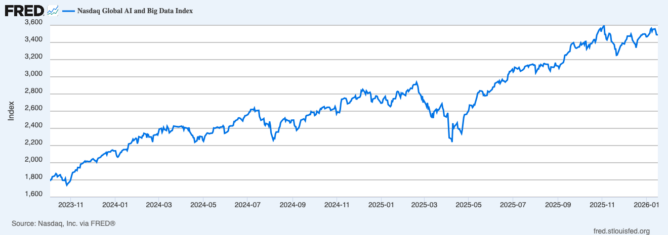
Poking around at the St. Louis Fed’s Fred graphing tool (to come up with a graphic to include for this post), though, led me to the graph at the top, which is of the “Nasdaq Global Artificial Intelligence and Big Data Index,” which “is designed to track the performance of companies engaged in the following themes: Deep Learning, NLP, Image Recognition, Speech Recognition & Chatbots, Cloud Computing, Cybersecurity and Big Data.”
So one option to get what I want would be to just go short on that index.
Turns out Cory Doctorow and I think a lot alike about the AI bubble, but he also has stuff to say about how to speed along the popping of the bubble, which would be a good thing. (Bubbles that pop sooner do less damage when they do.)
so I’m going to explain what I think about AI and how to be a good AI critic. By which I mean: “How to be a critic whose criticism inflicts maximum damage on the parts of AI that are doing the most harm.”
My father was great. This post isn’t really about all that, though. It’s about one (or two) specific things my dad did that have proven to be very beneficial to me.
One was that my dad was big on looking at things. I assume this mostly came from his being an ornithologist, which to a great extent involves looking at little tiny things some distance away.
He was always encouraging me to look for and look at things in the distance. On long car trips he’d often encourage me to watch for things like the water towers with the names of each town we were approaching. I’m sure part of that was just to keep me occupied with something other than complaining about being in the car, but part of it was getting me good at watching for things coming over the horizon, a skill that has proven itself of great value, even though I’m not a fighter pilot, or a lookout in a ship’s crows nest.
The other thing, closely related, was my father’s enthusiasm for praising specific things, of which this was one. Anytime I’d spot something early—especially if it was earlier than he did—he’d say, “Good eye!” He did that a lot when I was a boy, but he never really stopped. I remember just a few years before he died, I spotted a Hooded Warbler outside the house where he was living in Kalamazoo and drew a “Good eye!”
Even though I don’t have kids, I try to do this with other folks around me. A little praise never hurt anyone, and being able to spot things in the distance is always useful.
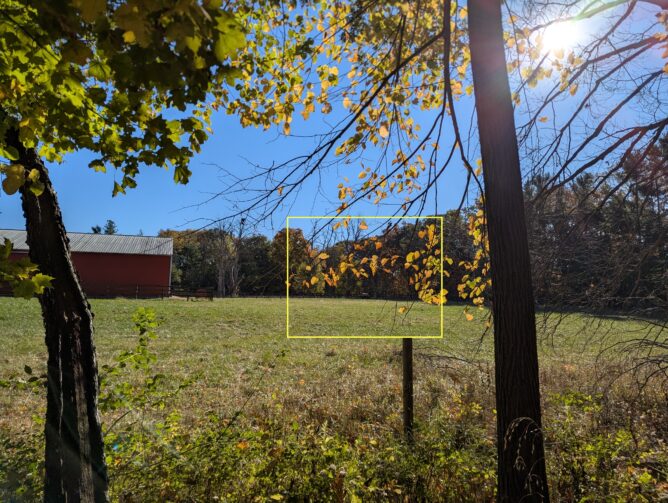
See the horse in the picture at the top? Maybe this will help a little:
Back in May, I wrote an article about AI journaling. The idea (which I had stolen from some YouTuber) was that you write your journal entries as a brain dump—just lists of stuff—into an LLM, and then ask the LLM to do it’s thing.
. . . ask the LLM to organize those lists: Give me a list of things to do today. Give me a list of blind spots I haven’t been thinking of. Suggest a plan of action for addressing my issues. Tell me if there’s any easy way to solve multiple problems with a single action.
Now, I think it’s very unlikely that an LLM is going to come up with anything genuinely insightful in response to these prompts. But here’s the thing: Your journal isn’t going to either. The value of journaling is that you’re regularly thinking about this stuff, and you’re giving yourself a chance to deal with your stresses in a compartmented way that makes them less likely to spill over into areas of your life where they’re more likely to be harmful.
I still think that’s all true, and I still think an LLM might be a useful journaling tool. My main concern had to do with privacy. I didn’t want to provide some corporation’s LLM with all my hopes, dreams, fears, and best ideas, and hope that none of that data would be misused. I mean, bad enough if it was just subsumed into the LLMs innards and used as a tiny bit of new training data. Much worse if it was used to profile me, so that the AI firm could use my ramblings about my cares as an entry way into selling me crap. (And you know that selling you crap is going to be phase two of LLM deployment. Phase three is going to be convincing you to advocate and vote for the AI firm’s preferred political positions.)
Anyway, I figured it wouldn’t be long before local LLMs (where I’d actually be in control of where the data went) would be good enough to do this stuff, and I was willing to wait.
But I didn’t even have to wait that long! A couple of days ago, I saw an article in Ars Technica describing how Moxie Marlinspike of Signal fame had jumped out ahead with a really practical tool: confer.to. It’s a privacy-first AI tool built so that your conversation with the LLM is end-to-end encrypted in a way that keeps your conversation genuinely private.
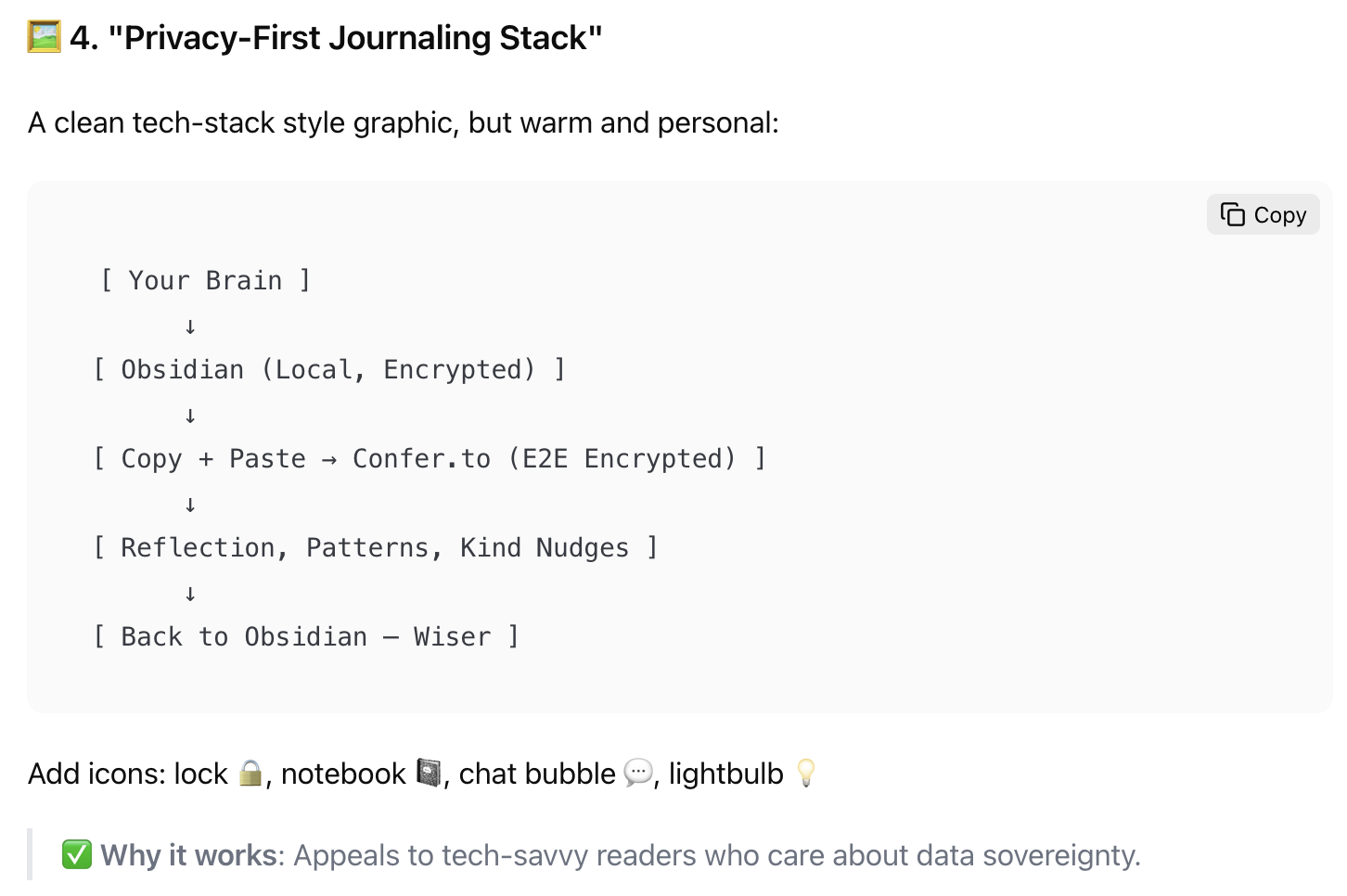
I’ve started using it for journaling exactly as I described. Because of the way the privacy is inherent to Confer, I can’t actually keep my journal within Confer—all the content is lost when I end the session. So, I’m keeping the journal entries in Obsidian, and then copying each entry into Confer when I’m ready to get its take on what I’ve written.
[Updated 2026-01-20: This turns out not to be true. Conversations in Confer do last through browser restarts. Until I delete the key for that session, I can go back and see everything that was in that session.]
I wanted some sort of graphic for the post, and asked Confer to suggest something. It came up with 5 ideas, including this one, which (bonus) actually illustrates my process:
Anyway, I’ve already written three journal entries that I otherwise wouldn’t have, and gotten some mildly entertaining commentary on them—some of which may rise to the level of useful. We’ll see.
(Asked to comment on a previous draft of this post, Confer.to mentioned the “Give me a list of blind spots I haven’t been thinking of,” prompt above, and said, “But LLMs can’t actually know your blind spots — they can only reflect patterns in what you’ve said.” Which I know. And so, of course, once I started using an actual AI tool instead of just an imagined one, that ended up not being something I asked for.)
If I keep doing this (and I think I will), I’ll follow up with more stories from the AI-enhanced journaling trenches.
Next weekend is going to be pretty cold in Minneapolis. Maybe cold enough to convince some ICE goons that they’d be better off on disability in Kentucky.
I mean, every ICE goon has probably slipped on the ice at least once. Probably every one of those falls could be turned into a disability claim.