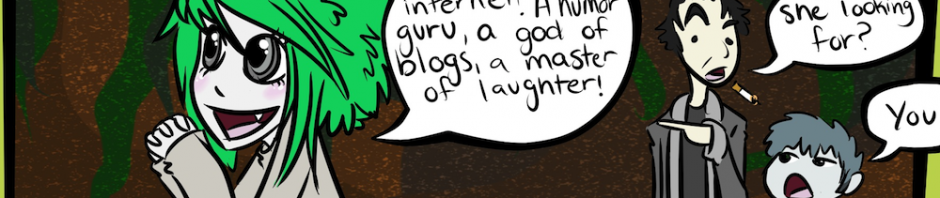
If you’re a fan of anime-influenced art jam-packed with memey goodness, I’ve got a treat for you: Doctor Emery’s Nightmares.
[Update 2013-12-06: Doctor Emery’s Nightmares is back! I’d take the original link down when the site was taken over by some advertising crap. Now Doctor Emery has a new tumblr site, so I’m pointing there.]
When it comes to physical objects, I’m at least a generation behind the cool kids. (I not only still have an iPod, my iPod still has a hard drive.) But when it comes to internet memes, I figure I’m only two or three steps behind. I mean, I read BoingBoing. I have an account on Reddit! Even so, I usually have to visit Know Your Meme two or three times for every one of Emily Mongeau’s comics.
But if that’s not you—if you already know your memes—then you’ll find Emily’s comics great fun. And if, like me, you’re a few steps back on your memes, you can still enjoy the art.
Oh, and I should also mention: Emily drew the picture I’ve been using for my favicon for a while now. It’s a picture of my totemic animal: the sloth.
Here it is in slightly less faviconic form. Have you ever seen such a handsome creature?
I always like poster art. In particular, I like the way poster artists manage to make such effective use of a limited color pallet. Several of these are excellent examples:
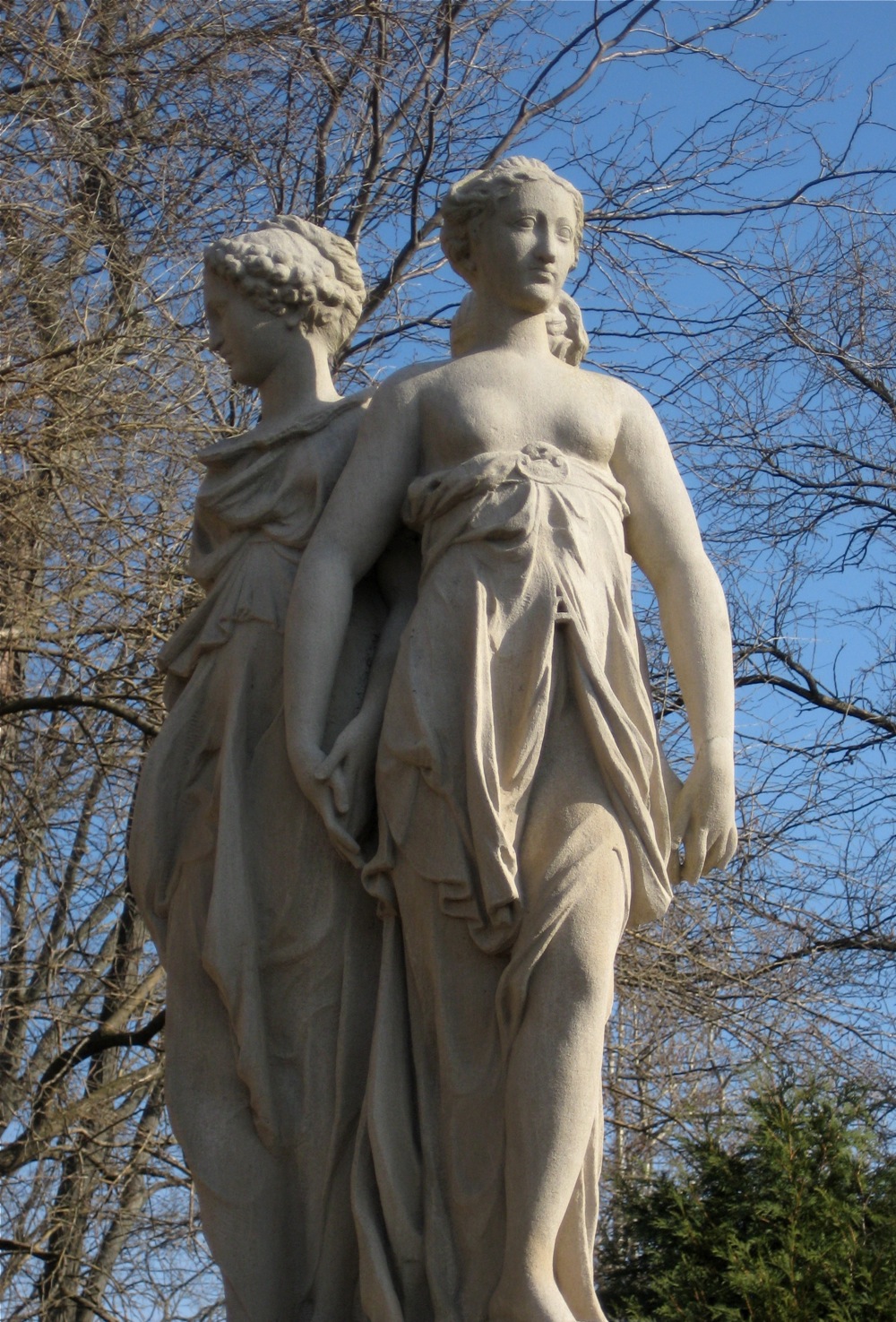
This statue at Allerton Park is called the Three Graces, but I like to think of it as the Three Muses.
I was pretty productive these past two weeks. I finished a major rewrite pass on a short story that the Incognitos had critiqued a while back, and passed the story on to a couple of first readers. I wrote several posts for Wise Bread. I did some preliminary investigation on a tech writing assignment.
I thought that was great, not only because it’s nice to get things done, but because it makes me feel like it’s okay to spend time on various less (or non-) remunerative projects, such as art, poetry, and Esperanto.
I’ve just come to realize, that this is a harmful way to think.
I’ve always had these recurring bouts of unproductivity. The previous several weeks were an instance of it: I sat at my computer and tried to work, but I didn’t get much done.
Back when I worked a regular job, these bouts were always terribly stressful. How do you tell your boss, “Sorry, I just don’t seem to be able to get anything done”?
I had several coping skills. Because of the kind of work I did, my managers never really could know how difficult a task was, so I could just say, “It’s turned out to be tougher than I thought.” Also, even when I couldn’t make any headway on my major tasks, I was almost always able to do something. I got in the habit of seeking out smaller, one-day tasks that I could do. That let me be productive (so I felt better) and gave me an excuse to be late with my main task (so I was less stressed).
Now that I’m not trying to work at a regular job, the stress level is much reduced. There’s no boss whose understanding of my productivity needs to be managed. There’s no job to be lost if that management goes poorly. But that doesn’t mean that I don’t still have these periods of unproductivity.
As I was saying, since this latest surge of productivity, I’ve felt free to spend some time on less remunerative projects, like doing some writing in Esperanto. And that brought me to a realization: It’s dumb to think that I shouldn’t work on stuff that I’m interested in, just because it’s not the most important work I could be doing.
I think part of the reason I’ve been doing it is that I thought it might motivate me to get my important work done. I know some people bribe themselves by withholding permission to play with side projects until they’ve done an appropriate amount of work on the main projects. But it has never been an effective technique for me. Maybe it helps a little when I’m just feeling lazy. But being unproductive is different from being lazy, and it doesn’t work at all for that.
More important, I think I’ve finally figured out that this behavior is actively harmful. These other things I do—drawing, poetry, Esperanto—probably help me be productive. They’re not a waste of time that I could be spending on important projects. Rather, they’re a pathway back into productivity. Being productive—even being productive on something that doesn’t earn any money or advance my career—is still being productive. And experiencing productivity after a period of unproductivity is positive. It leads to more productivity.
In the past, getting started being productive again has always been the hard part. Maybe this will help. Maybe, if I can be productive on some frivolous task (without agonizing too much over the fact that it is frivolous), I’ll be able to bootstrap that experience of productivity into productivity in other areas.
In the meantime, I’m being productive again in a wide range of areas. Go me.
In my family, “brain chemicals” is the shorthand term for unmotivated negative feelings. That is, when you’re feeling sad because something bad happened, that’s normal, but when you’re feeling sad for no particular reason, that’s brain chemicals. (On the theory that you’ve probably got a chemical imbalance or something, and that you should probably see a doctor about it when you’ve got the time.) The same applies to anger, frustration, anxiety, etc.
I mention this because I often suffer from brain chemicals, especially this time of year, when the days get short and dark and cold.
I’m actually doing pretty well this year. I’m doing a bunch of things that help. I’m taking my vitamin D. I’m trying to get outdoors for some actual sunlight, any day that there is any. I’m getting my exercise in. (For many months now, Jackie and I have been lifting weights three times a week and doing an hour of taiji three times a week. I’m trying to get in an hour of walking and at least a few minutes of additional taiji on the other days of the week.) I’m being productive. I’m getting enough sleep.
Still, despite all that, brain chemicals seemed to be setting in yesterday. I was feeling over-busy, under-accomplished, and frustrated. So, I went to level two in the fight against brain chemicals, and scheduled an artist’s date.
I think of it as a date with my muse. A proper artist’s date involves going somewhere and spending time with something that spurs creativity. That could be almost anything, and if I did them more often (and I really should) I’d probably have to broaden the range of places that I go. But I don’t do them very often, so I can usually get away with taking my muse to the same few places.
I started at the Krannert Art Center. Much of their exhibit space today was full of stuff that I had little interest in, but outside the museum proper there’s a changing exhibit of student work that’s often more interesting than the work in the museum itself. Today it had the work of school children. There were a lot of interesting ideas—for example, a low passageway made of cardboard where kids who’d studied ancient cave paintings had painted their own—even if only a few of the actual pieces spoke to me.
Connected to the museum is the school of design building. They often have some student work on display in the hallway, and I rather liked a small group of pieces by students who had apparently had the assignment to create a brand identity for themselves. They produced the same elements that a brand identity package from a marketing firm would provide—a name and logo (provided in a couple of sizes and formats, in both color and black & white), together with some key terms and images that could go into a branded ad campaign.
It was everything an artist’s date needs to be—a reminder that creativity is everywhere, a reminder that there can be joy in art of all sorts.
I was already feeling better today, and expect that I’ll feel even better tomorrow.
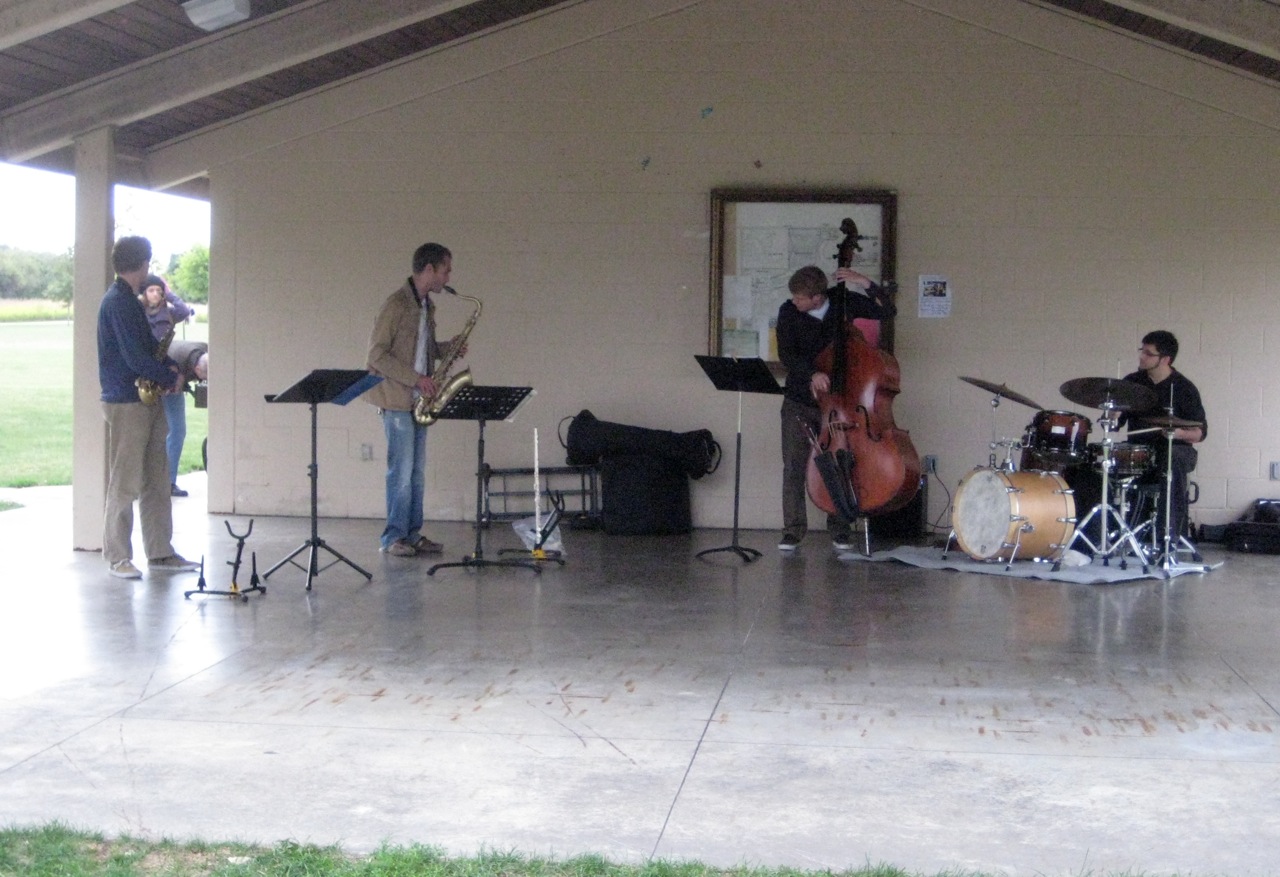
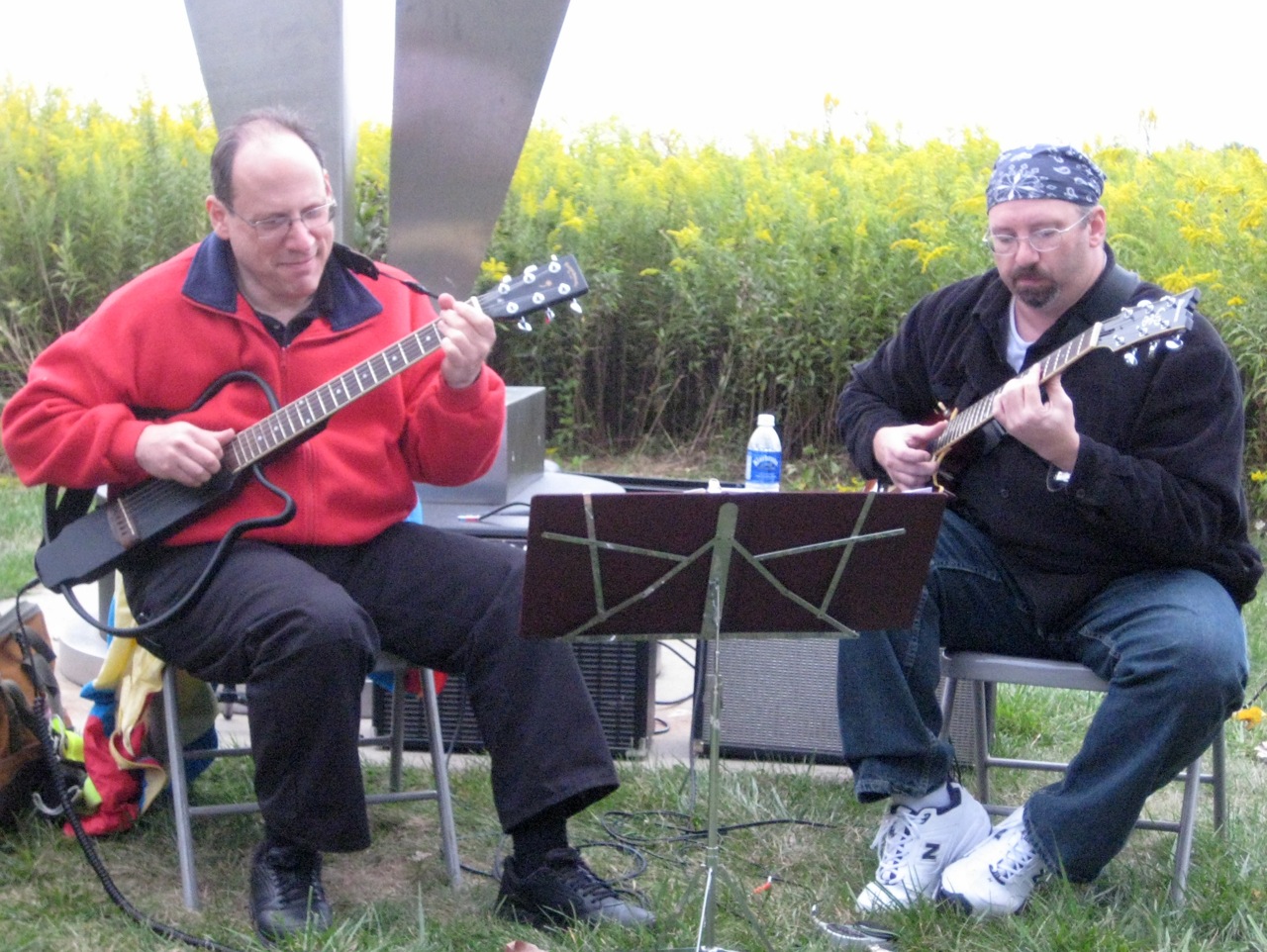
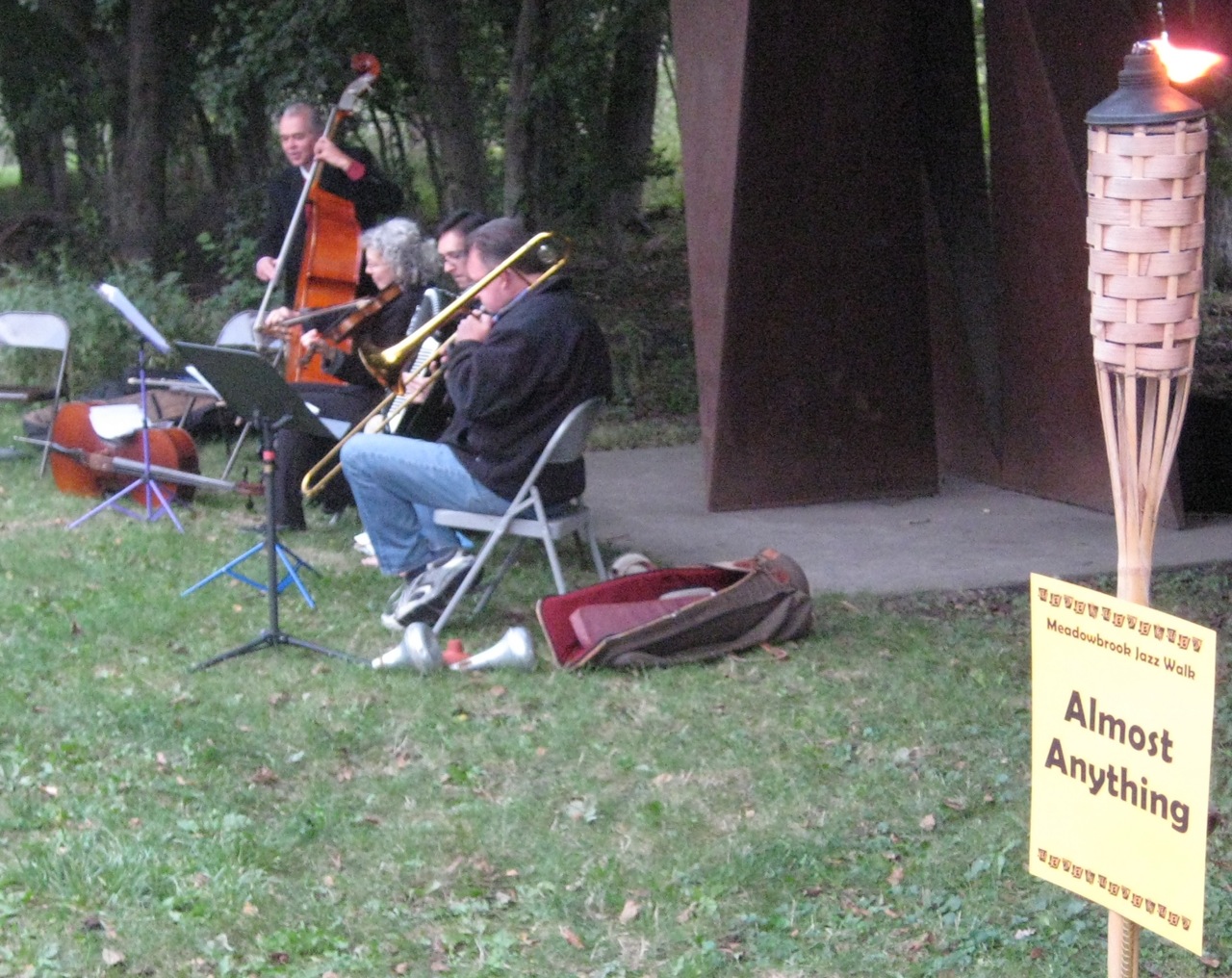
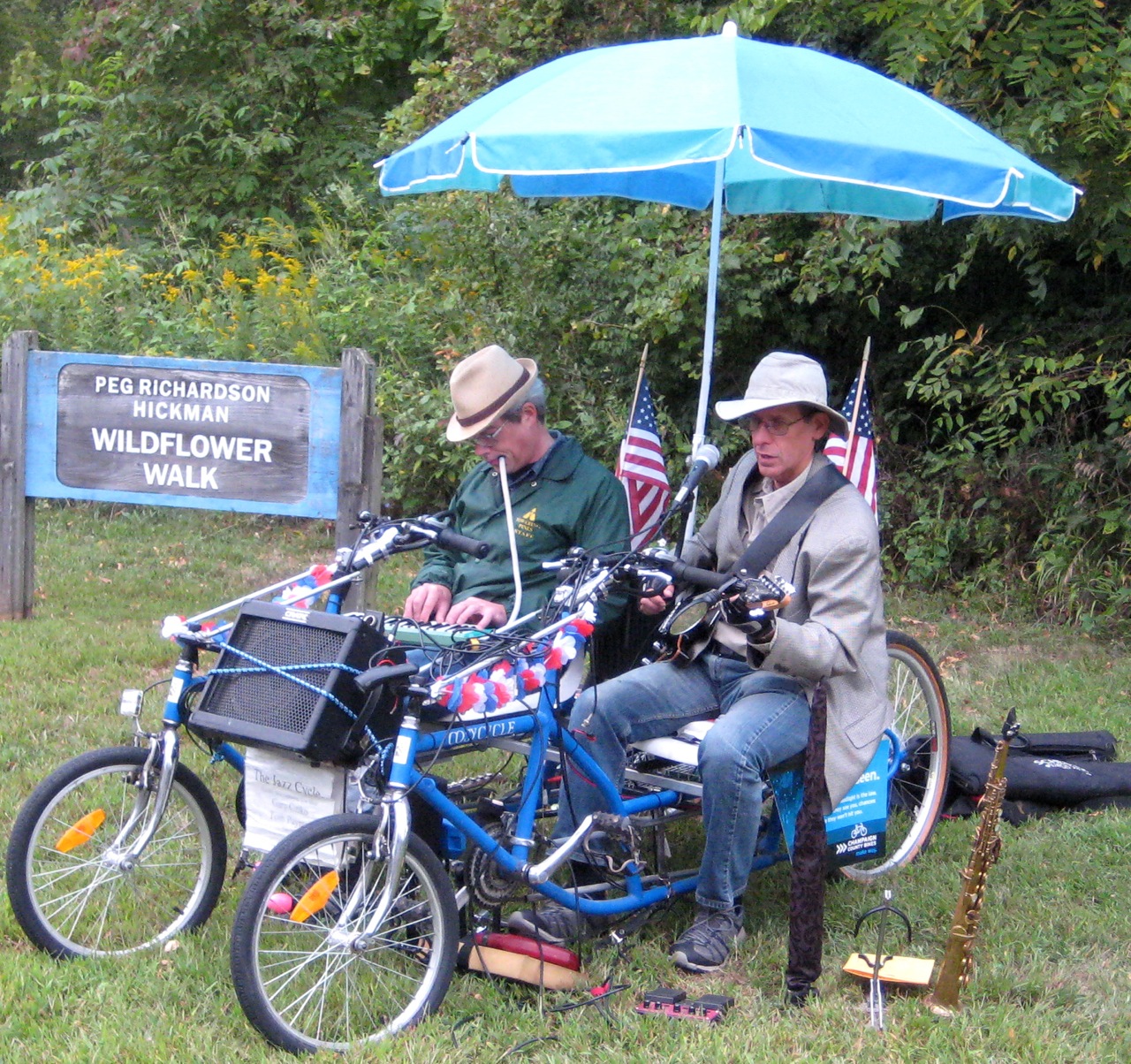
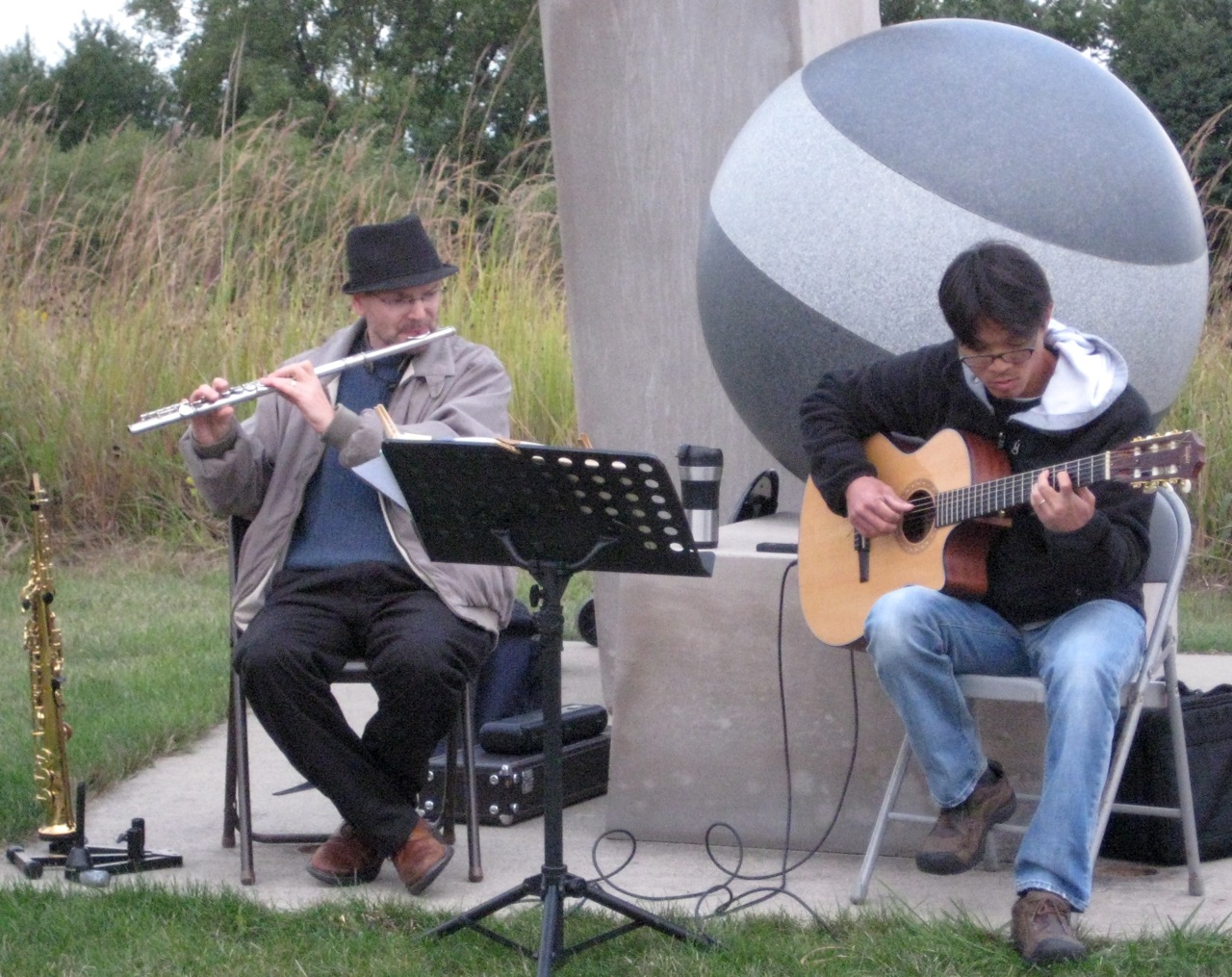
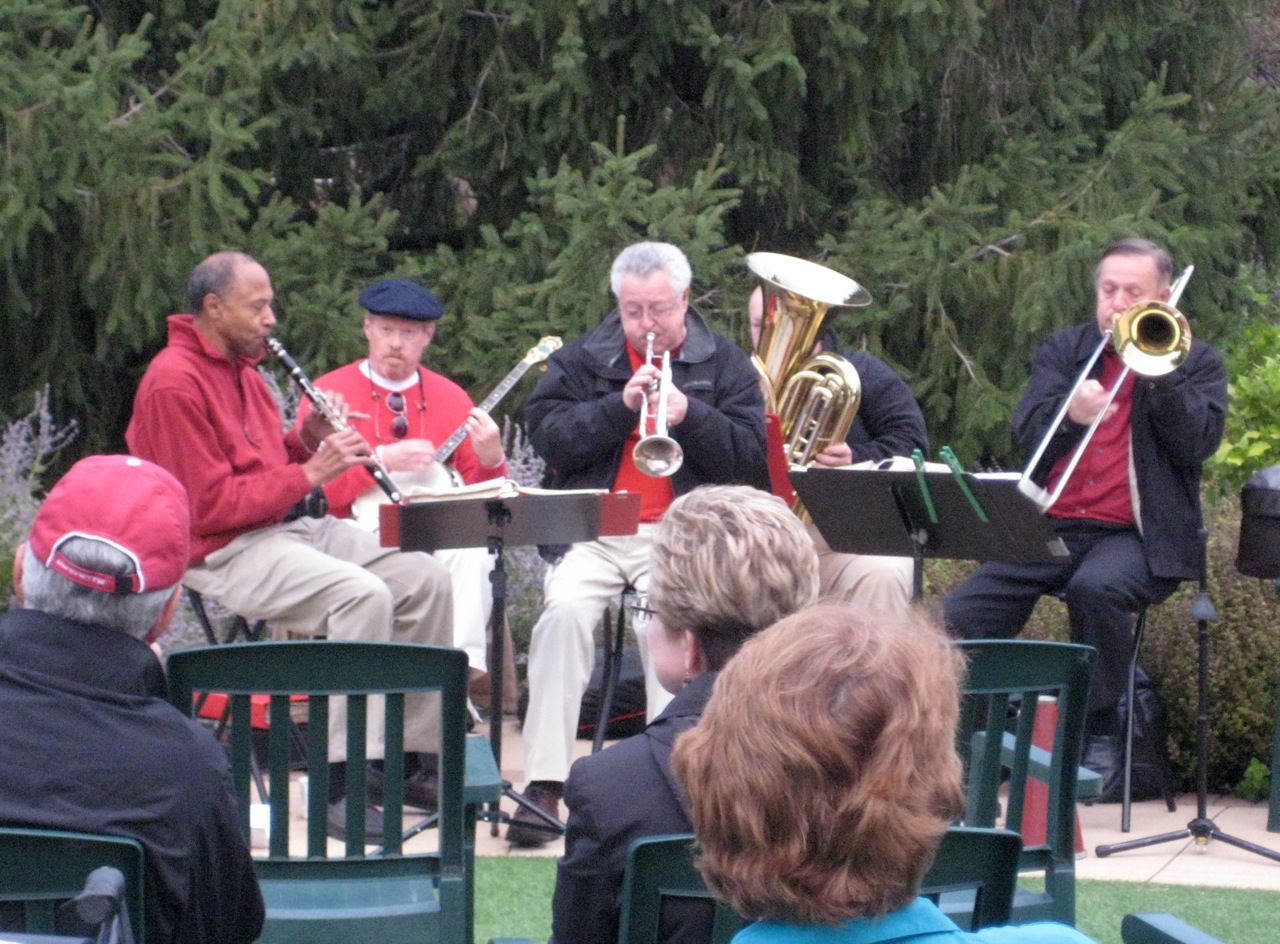
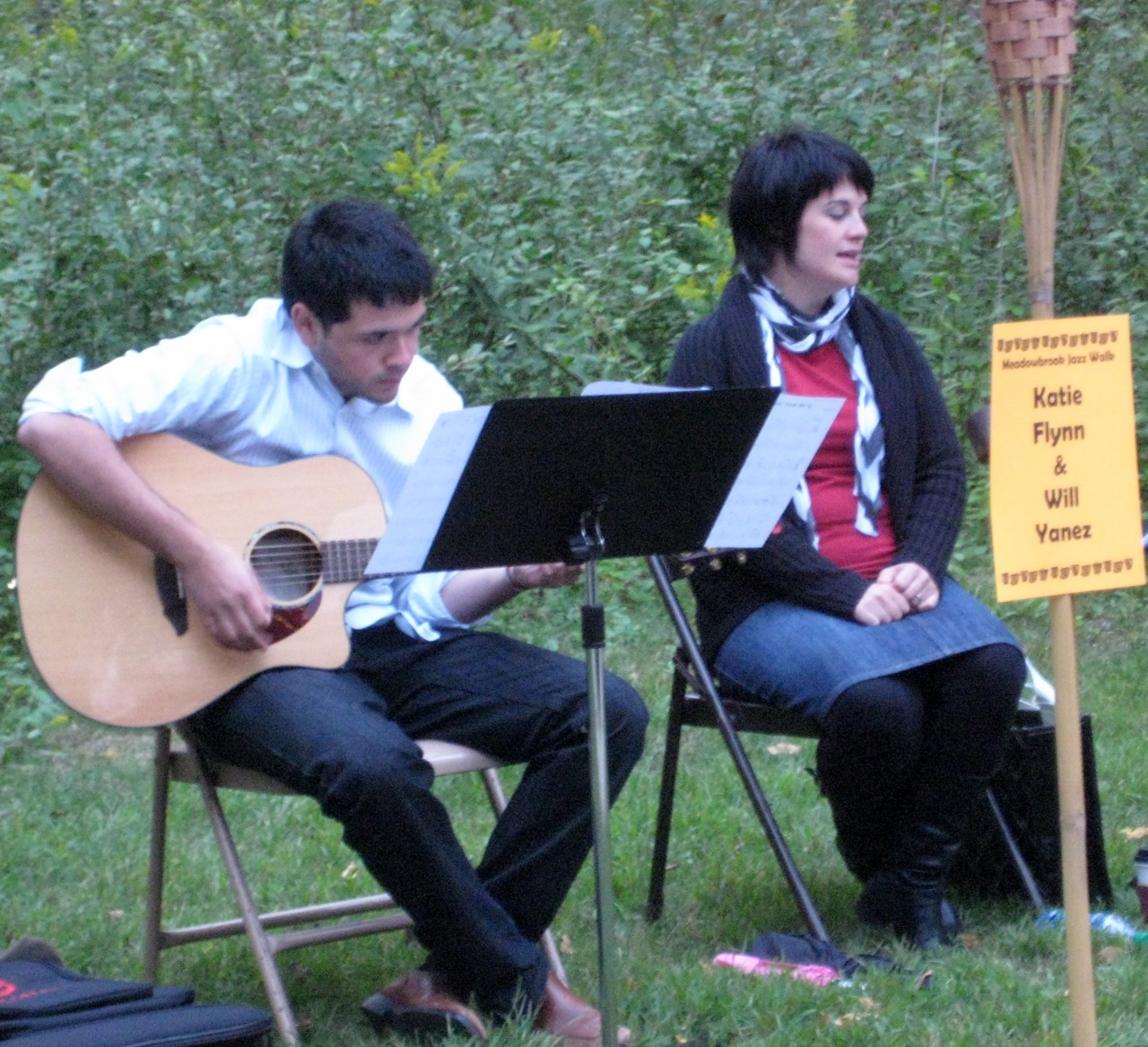
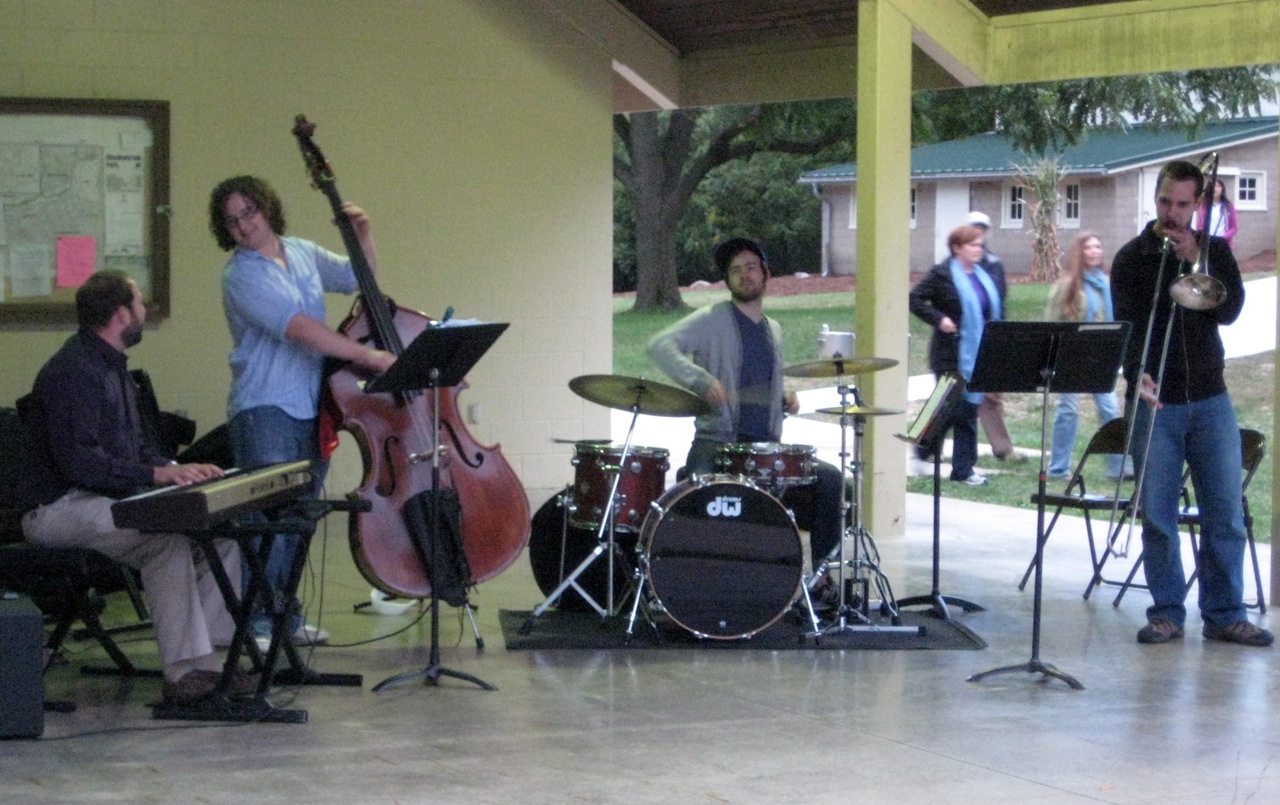
One of the unique events in Champaign-Urbana is the Jazz Walk. Bands (duos and small combos) are scattered across the sculpture garden at Meadowbrook Park, and you walk from one to the next. The result is a series of surprisingly intimate performances. You have each group almost to yourself, sharing one or two or three songs with a shifting mix of perhaps a dozen or so other pedestrians.
You can linger longer if you like, but the event only goes on for two hours, so if you spend too much time with one band it begins to eat into your time to spend with the others.
As a bonus, you get to enjoy the sculpture as well.
I liked all the music, even the groups that didn’t play exactly my sort of jazz had the sort of energy that makes a live performance worth attending.
It was a cool, cloudy evening, and was already getting a little dark for photography, but I thought my camera did pretty well—I got an adequate shot of each group, and a few pretty good ones.
BluesnikMark Smart and Mark GinsbergAlmost AnythingThe Jazz CycleJohnathan Beckett and Young KimNew Orleans Jazz MachineKaty Flynn and Will YanezPeter and the Wolves
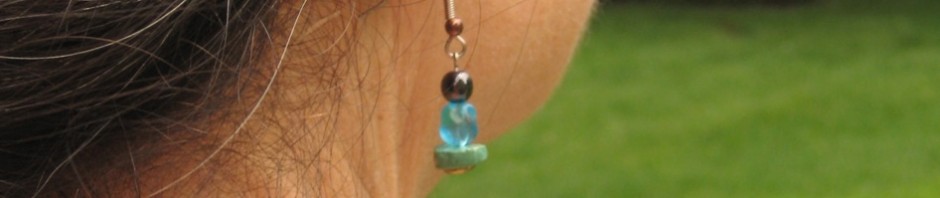
Somebody came to my site after searching for information about the haiku earring parties at WisCon. That reminded me that I’d never gotten around to putting up a picture of Volcanoes on Vacation, the earrings I exchanged a haiku for at WisCon some years back.
So, here’s the picture.
I’ve lost my notes from that haiku earring party, so I don’t have the exact text of the haiku. I could probably recreate it, but the gist of it was one volcano lamenting the fact that they always vacation somewhere on the Pacific rim. I remember that the last line was, “Next year, Michigan!”
Jackie’s other earrings from haiku earring parties were documented here:
Elisem‘s haiku earring parties are always a highlight of WisCon for me. They’re a big part of the reason that I’m always sad when I have to miss a year.
I’m late to the Maker movement. Being very much not handy, I’ve always avoided making things. It’s part of the reason that both writing and software have always appealed to me—you don’t have to actually make anything.
Gradually, though, I’ve been coming around.
For one thing, I’ve come to appreciate two ideas: Getting help, and starting by learning the narrowest possible skill set (which can then be expanded if you enjoy the activity).
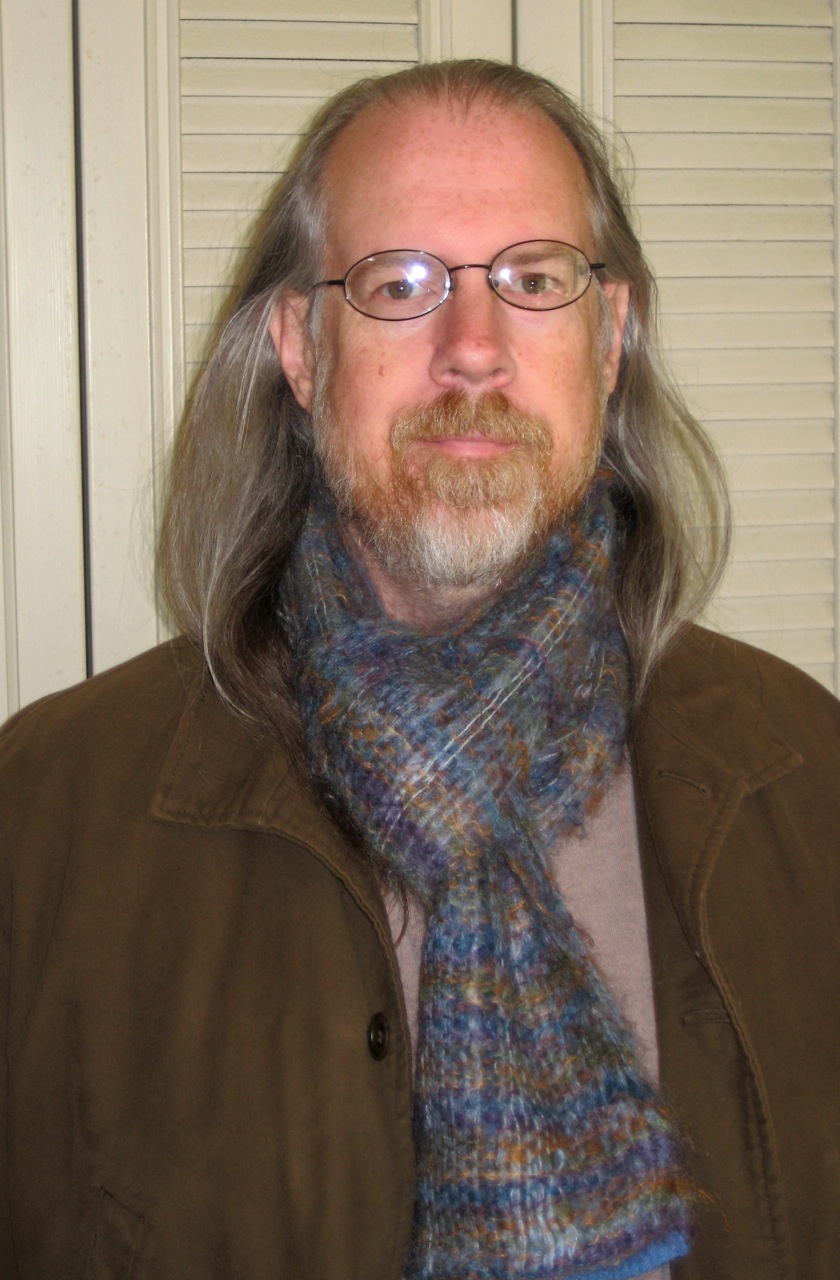
Me wearing the scarf I wove (photo by Jackie Brewer)
For example, a couple of years ago, I wove a scarf. I say I wove it, and that’s technically true: I did all the weaving. However, I had quite a bit of help with the other parts. In particular, Jackie wound the warp and put it on the loom. (I came up with the design myself, based on some scarves that we saw for sale that were surprisingly inexpensive for handwoven. The key to the modest price was that they used fuzzy yarn set very wide—about 4 threads per inch. That meant that it both used less yarn and took less time.)
If I’d had to wind my own warp and put it on the loom myself, I doubt if I’d have made it. I’d have had to learn three new skills, and I’d have had to execute all three without making any unrecoverable errors. Instead I got gentle introductions to two of those skills, and actually learned the third. And I made a scarf.
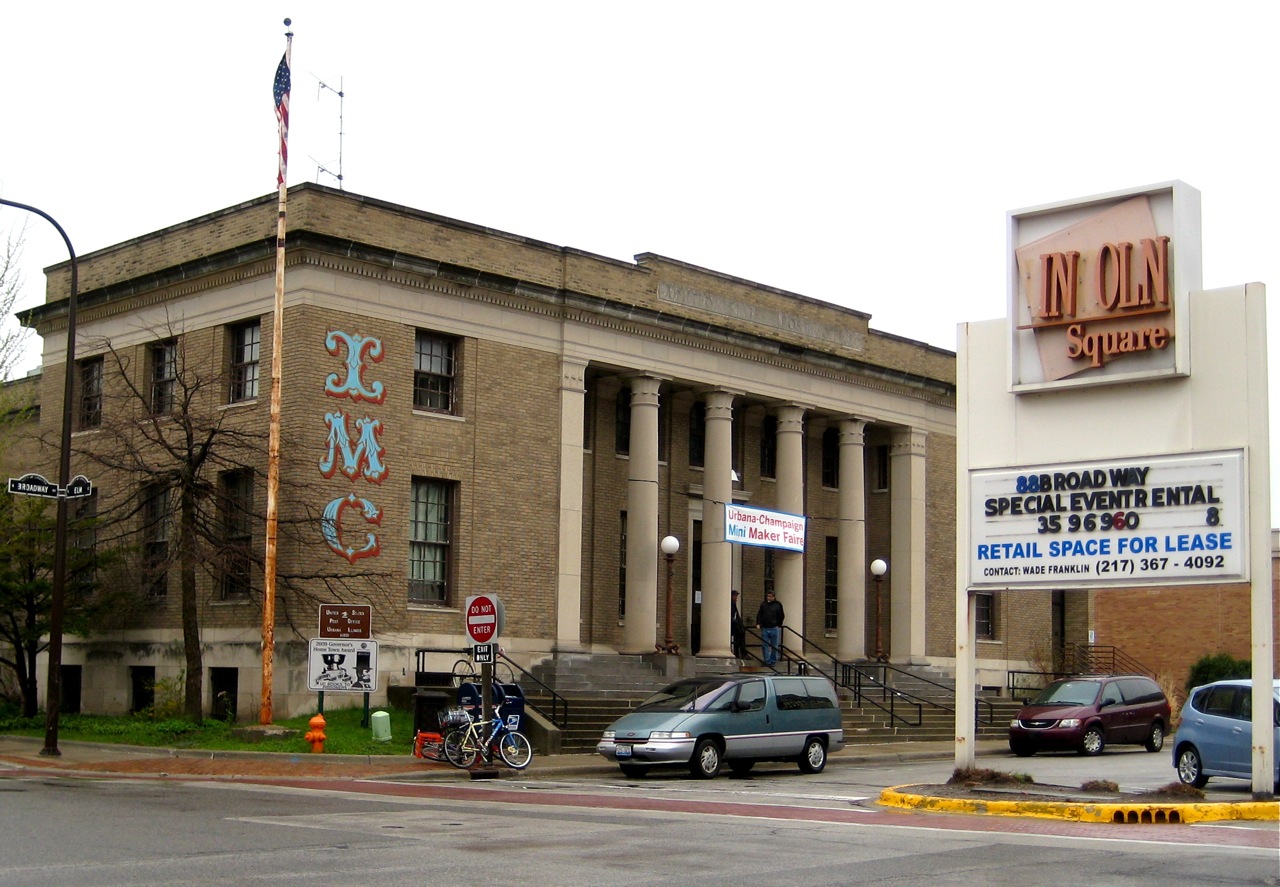
The Maker Fair was great. There’s all kinds of cool stuff going on in Champaign-Urbana. We had great fun talking with Jonathan Manton who was making paper polyhedrons using Inkscape images of the flat shapes of the faces, software he’d written that added tabs and slots, and then a digitally controlled paper cutter to cut out the shapes. He called the whole thing the Large Hedron Collider.
One of the most interesting things that I hadn’t been aware of is the FabLab, a community facility sponsored by the University (and many other organizations) that has various fabrication devices—computer-controlled cutters, routers, engravers—available for use by members of the community. We’re definitely going to spend some time there.
Brian Duggan (one of the organizers, and a guy I know from work) told me that there was a group there working on deploying a meshing networking system, an important technology for protecting our rights. (See my recent post on whether civil unrest would threaten our network connectivity).
Lots of other cool stuff: model rockets, zines, art, music, etc. I’m going to have to get more involved with all this. In particular, I’m planning to start going on Thursday evenings to get involved with the meshing networks project.
Apropos my previous post on public art in Detroit, I just saw that spokesman for the mayor’s office has stated that they’d consider erecting any donated public art, including a statue of Robocop.
As a big fan of public art, I was particularly impressed with the fragments of public art featured in Chrysler’s “imported from Detroit” Superbowl ad:
There’s a lot to like here. There’s a lot of art deco, and I like art deco. There’s a lot of different kinds of art—murals, sculpture, architecture. And the spot features the sort of public spaces that are being phased out these days (in favor of commercial spaces that are technically only open to customers). The public square is important, and neither the mall nor the parking lot of a strip malls is an adequate substitute.
Anyway, one of the good things about public art on display in public places is that it’s available for use in spots like this. It’s part of our culture.
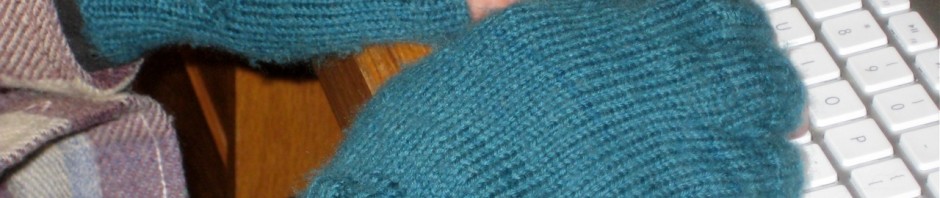
We keep our apartment cool, in the interest of minimizing our contributions to both resource depletion and global warming. Plus, Jackie likes to wear her woollies, which isn’t practical in a warm apartment. The only real downside is that, in a cool apartment, my hands get cold when I write. To address that problem, Jackie offered to knit me some fingerless gloves. (Click any of the pictures for a larger version.)
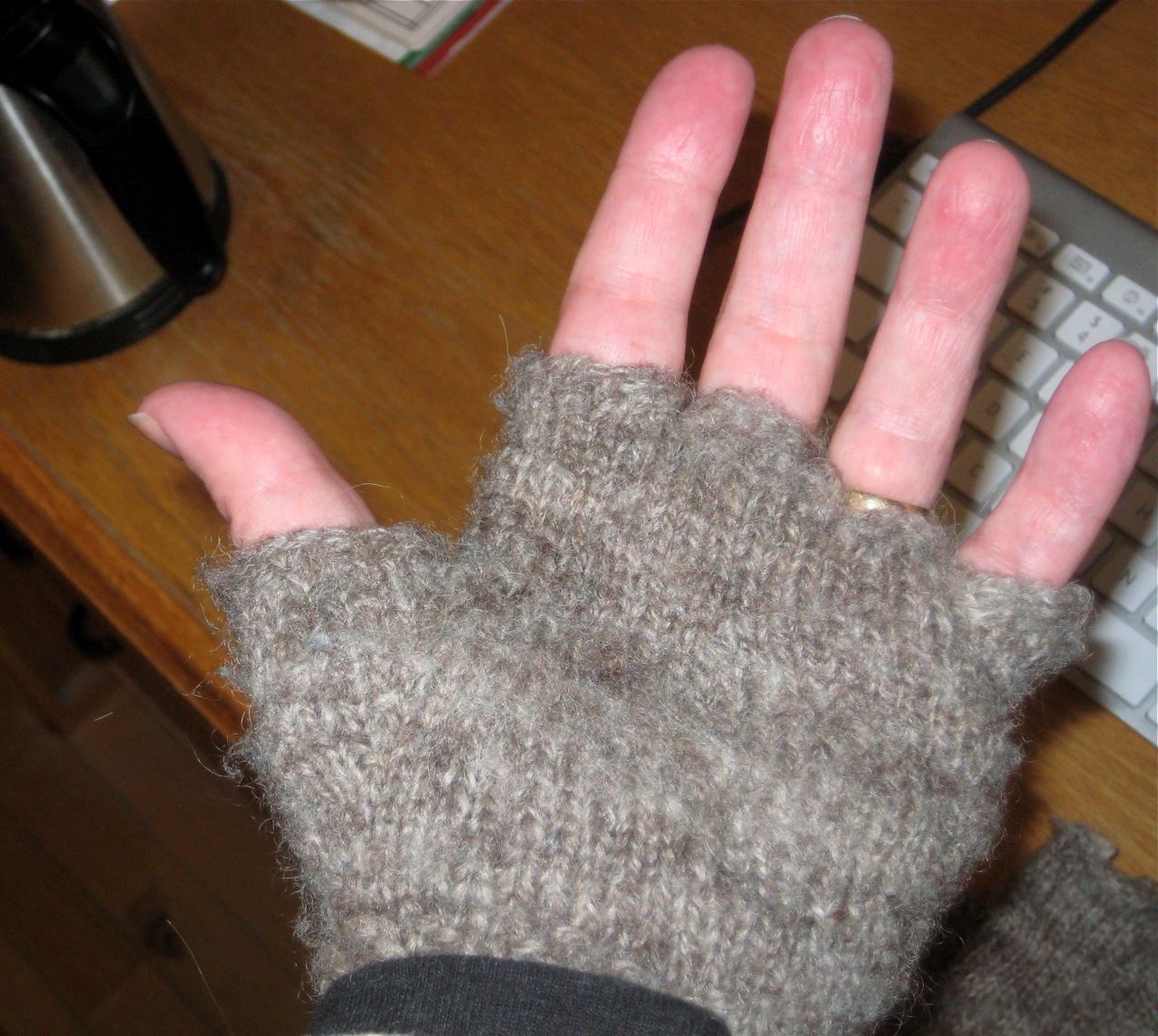
My first fingerless gloves
My first pair of fingerless gloves were knitted to my precise specifications. It’s made of fairly course yarn, which I figured would be fine for my purposes, and it has the fingers truncated almost completely, which I figured would make it easier to type.
Unfortunately, even just the row or two of knitting that formed the finger holes turned out make them a little uncomfortable for typing.
Since those weren’t quite satisfactory, I came up with a new design—fingerless gloves that not only had no fingers, they didn’t even have finger holes.
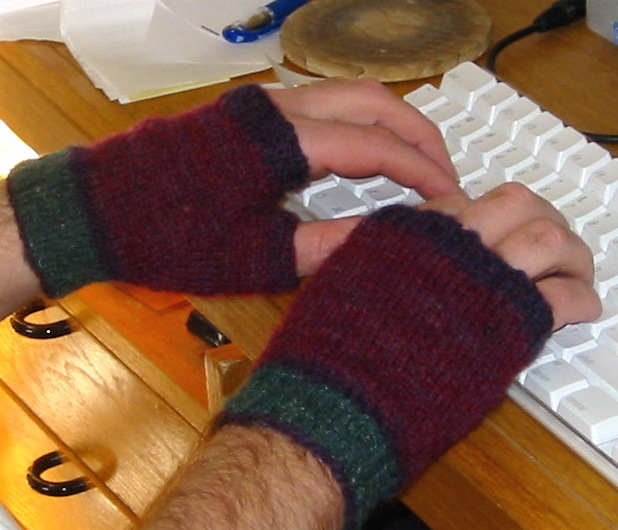
My Rosebud Wristlets
Jackie made these most lovingly. She not only spun yarn by hand, she spun it by hand while attending a science fiction convention (WorldCon in Toronto). The main color was hand dyed as well (with brazilwood). The yarn is wonderfully soft and fine. I got to pick the colors, and I picked these colors so that I could call them Rosebud Wristlets.
My Rosebud Wristlets were a complete success, and they’ve been my main fingerless glove for seven years (they were a Christmas present in 2003).
I liked them so well, I got Jackie to make a second pair that we gave to Kelly Link.
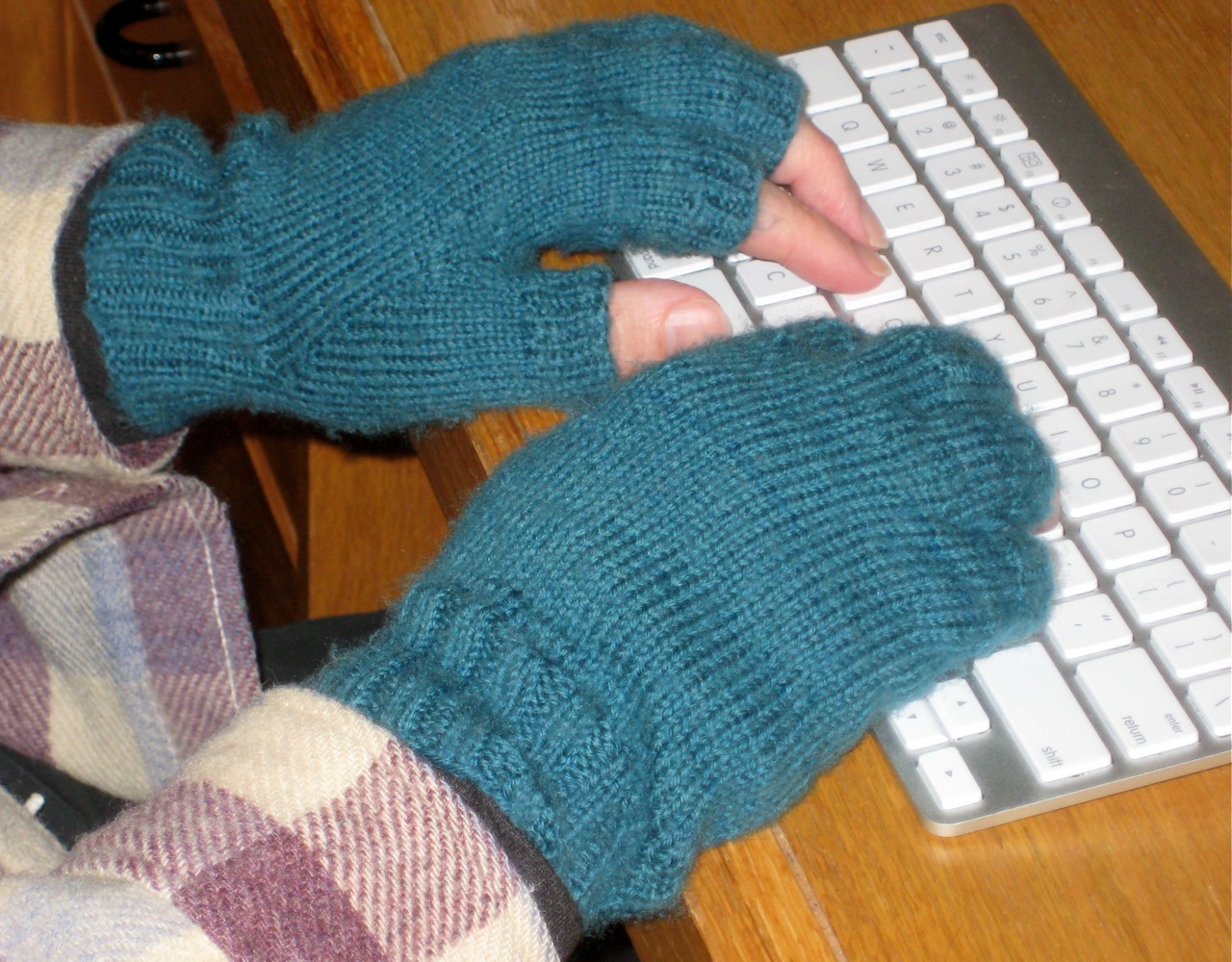
My 2010 fingerless gloves
Not having fingers at all was great for leaving my fingers free for typing, but had a downside: My hands stayed warm, but my fingers sometimes got cold. So, I asked for yet another pair of fingerless gloves, this pair with fingers, but made from yarn so fine that it wouldn’t force my fingers uncomfortably far apart.
So, Jackie knit me this pair of fingerless gloves. Each glove finger extends out to the last knuckle of my finger. They’re made from machine-spun “fingering weight” yarn (perhaps called that because it’s the right weight to use when knitting glove fingers).
They’re wonderful. They’re not more wonderful than my Rosebud Wristlets, but they do keep my fingers warmer. So far I’ve been alternating between them, depending on whether just my hands are cold, or my fingers too.
For a while I’d imagined that I might design the ultimate fingerless glove, but it turns out, as usual, that the best tool for the job really depends not only on the precise details of what you’re trying to do, but also the precise circumstances under which you’re trying to do it.

 If you’re a fan of anime-influenced art jam-packed with memey goodness, I’ve got a treat for you: Doctor Emery’s Nightmares.
 Oh, and I should also mention: Emily drew the picture I’ve been using for my favicon for a while now. It’s a picture of my totemic animal: the sloth.