I’m of two minds about running for exercise. Except when I’m running or wishing I was running; then I’m all for it.

I used to have a lot of reasons I ran for exercise, but they’ve been dropping away.

One reason that I run for exercise is that I want to be able to run. (Sometimes I want to get somewhere reasonably close in a hurry, and running is great for that.) I always figured that, if I wanted to be able to run, I needed to run for exercise—to build and maintain the capability.

Except, twice this month I had to run to catch the bus, and I did—even though I haven’t been running for exercise since last year. These impromptu bus-catching runs weren’t long runs, but I did them flat-out, without warmup or stretching, wearing whatever shoes I had on at the time—and both times were fine. I did them without undue effort and without getting hurt.

So, it seems that my regular fitness activities are enough to maintain at least a minimum capability for running.

Another reason I run for exercise is that it’s wonderfully efficient. All winter, the aerobic portion of my fitness regimen has been to walk for an hour on the four days a week that I’m not lifting and doing taiji. In an hour I walk a bit over 3 miles. If I cover the same distance running, I do it a good bit more quickly, meaning that I don’t have to spend as much of the day exercising.

Except that I’ve found myself fitting the hour of walking in very easily, without scheduling any exercise at all. There are several local errands (grocery store, bank, neighborhood restaurants) that are about a 10 minute walk each way. To run my slightly more distant errands, I take the bus. It’s a similar 10 minute walk to the bus stop, but that’s typically followed by 10 minutes of walking at the other end as well, for a total of 20 minutes walking each way.

So, if I go on one outing by bus plus one neighborhood errand, that’s my 60 minutes already. Running is efficient, but it’s not more efficient than that.

Less important than either of those, but still a reason I run, is that it gives me a sense of health and fitness. If I have an irrational sense that there’s something wrong with me, going for a run will usually take care of it. (Surely, I tell myself, if there were something really wrong with me, I wouldn’t be able to run like this.) I always knew that this was the sort of false comfort that’s only appropriate when I’m really quite sure that my sense of unwellness is, in fact, irrational. Going for a run is a fine way of dealing with, let’s say, a  panic attack. It’s a really dumb way to deal with a heart attack. (I don’t have panic attacks, but I am prone to worrying about my health unnecessarily. Those worries don’t prey on my mind as much when I’m running regularly.)

The problem with running is that I get hurt. Almost every runner I know gets hurt. To the best of my recollection, I’ve never had a walking injury more serious than a blister nor a bicycling injury more serious than a sore butt. But I’ve lost months of exercise time due to running injuries.

Still, despite the problems with running, and despite the loss of some of my rationalizations for running, I’ve started running again. But I’m doing it a little differently, now that I recognize that my reasons for running aren’t as strong as I’d thought they were.

Now I recognize that I run mainly for fun. I run because I really enjoy it. I enjoy the runs themselves. I enjoy the feeling of tiredness in my legs after a run. I enjoy knowing that I can run further and faster than I’m likely to need to.

If my enjoyment is the main reason I do it, that suggests that I should only do the fun part. So, I’ll abandon any effort to make a plan or set a schedule. I used to carefully structure my runs around an idea of stress followed by recovery. (I’ll still include both stress and recovery, but I’ll just decide each day which is appropriate, based on how I feel.) I used to aim to be able to run a particular distance on a particular date, so I could run in a race. I won’t do that any more. (Although I might run a race on a whim, if I feel like it.)

I went on my second run of the year today. It felt great. My first run, a couple of days ago—merely a good run—moved me to haiku. In the original Esperanto, it’s:

spiro laboras, genuoj doloretas… jara ekkuro.

Which in English might be rendered as:

Breathing hard,
Knees a little tender…
Year’s first run.
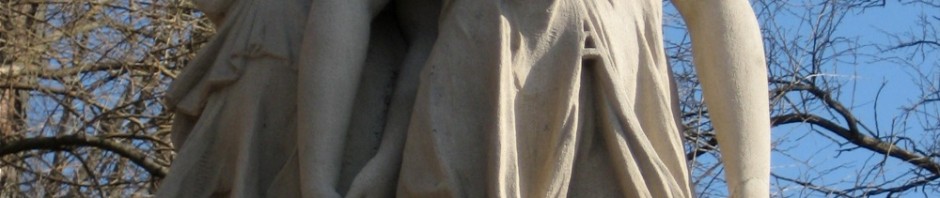
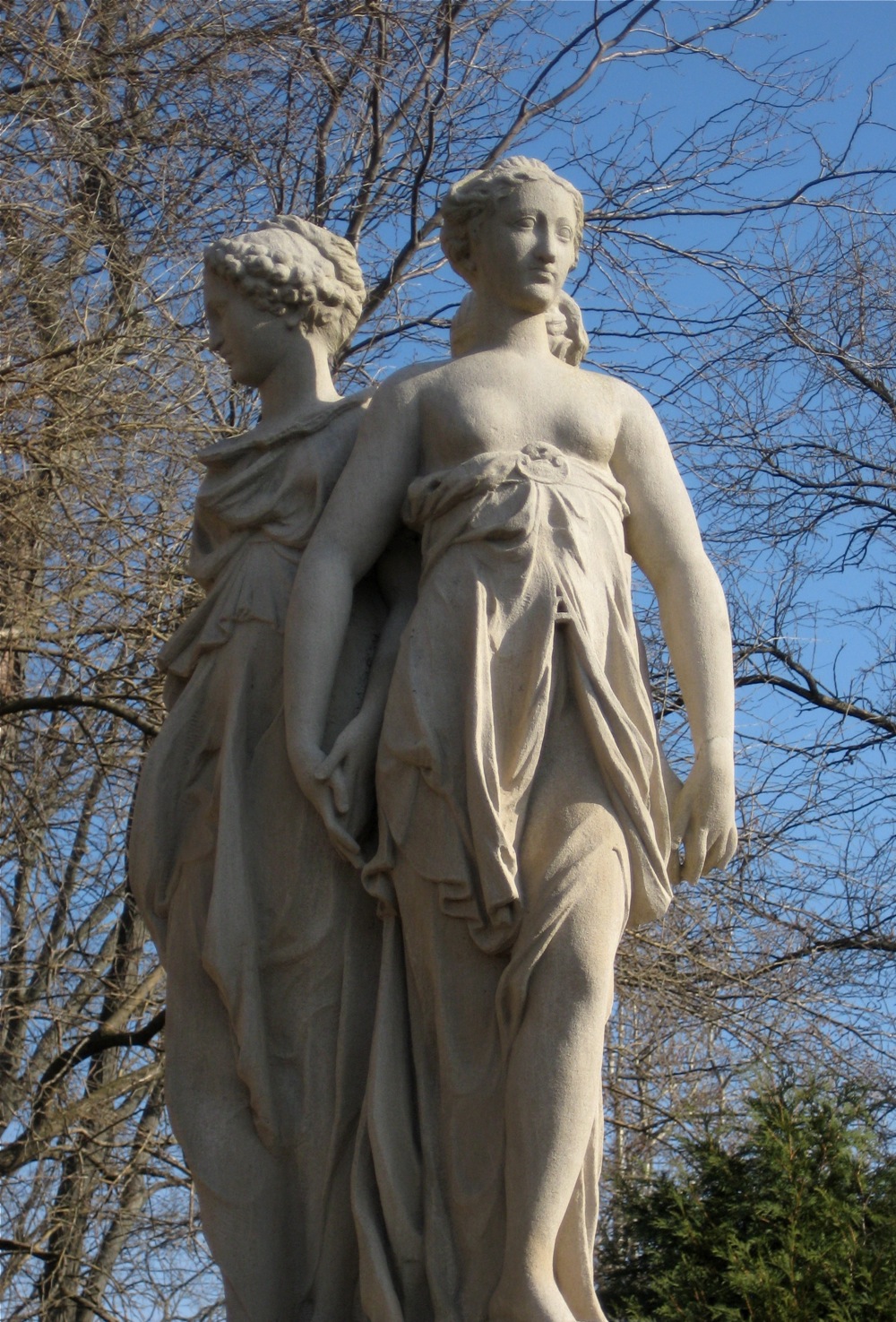
Statue of the Three Graces at Allerton Park
This statue at Allerton Park is called the Three Graces, but I like to think of it as the Three Muses.

I was pretty productive these past two weeks. I finished a major rewrite pass on a short story that the Incognitos had critiqued a while back, and passed the story on to a couple of first readers. I wrote several posts for Wise Bread. I did some preliminary investigation on a tech writing assignment.

I thought that was great, not only because it’s nice to get things done, but because it makes me feel like it’s okay to spend time on various less (or non-) remunerative projects, such as art, poetry, and Esperanto.

I’ve just come to realize, that this is a harmful way to think.

I’ve always had these recurring bouts of unproductivity. The previous several weeks were an instance of it: I sat at my computer and tried to work, but I didn’t get much done.

Back when I worked a regular job, these bouts were always terribly stressful. How do you tell your boss, “Sorry, I just don’t seem to be able to get anything done”?

I had several coping skills. Because of the kind of work I did, my managers never really could know how difficult a task was, so I could just say, “It’s turned out to be tougher than I thought.” Also, even when I couldn’t make any headway on my major tasks, I was almost always able to do something. I got in the habit of seeking out smaller, one-day tasks that I could do. That let me be productive (so I felt better) and gave me an excuse to be late with my main task (so I was less stressed).

Now that I’m not trying to work at a regular job, the stress level is much reduced. There’s no boss whose understanding of my productivity needs to be managed. There’s no job to be lost if that management goes poorly. But that doesn’t mean that I don’t still have these periods of unproductivity.

As I was saying, since this latest surge of productivity, I’ve felt free to spend some time on less remunerative projects, like doing some writing in Esperanto. And that brought me to a realization: It’s dumb to think that I shouldn’t work on stuff that I’m interested in, just because it’s not the most important work I could be doing.

I think part of the reason I’ve been doing it is that I thought it might motivate me to get my important work done. I know some people bribe themselves by withholding permission to play with side projects until they’ve done an appropriate amount of work on the main projects. But it has never been an effective technique for me. Maybe it helps a little when I’m just feeling lazy. But being unproductive is different from being lazy, and it doesn’t work at all for that.

More important, I think I’ve finally figured out that this behavior is actively harmful. These other things I do—drawing, poetry, Esperanto—probably help me be productive. They’re not a waste of time that I could be spending on important projects. Rather, they’re a pathway back into productivity. Being productive—even being productive on something that doesn’t earn any money or advance my career—is still being productive. And experiencing productivity after a period of unproductivity is positive. It leads to more productivity.

In the past, getting started being productive again has always been the hard part. Maybe this will help. Maybe, if I can be productive on some frivolous task (without agonizing too much over the fact that it is frivolous), I’ll be able to bootstrap that experience of productivity into productivity in other areas.

In the meantime, I’m being productive again in a wide range of areas. Go me.

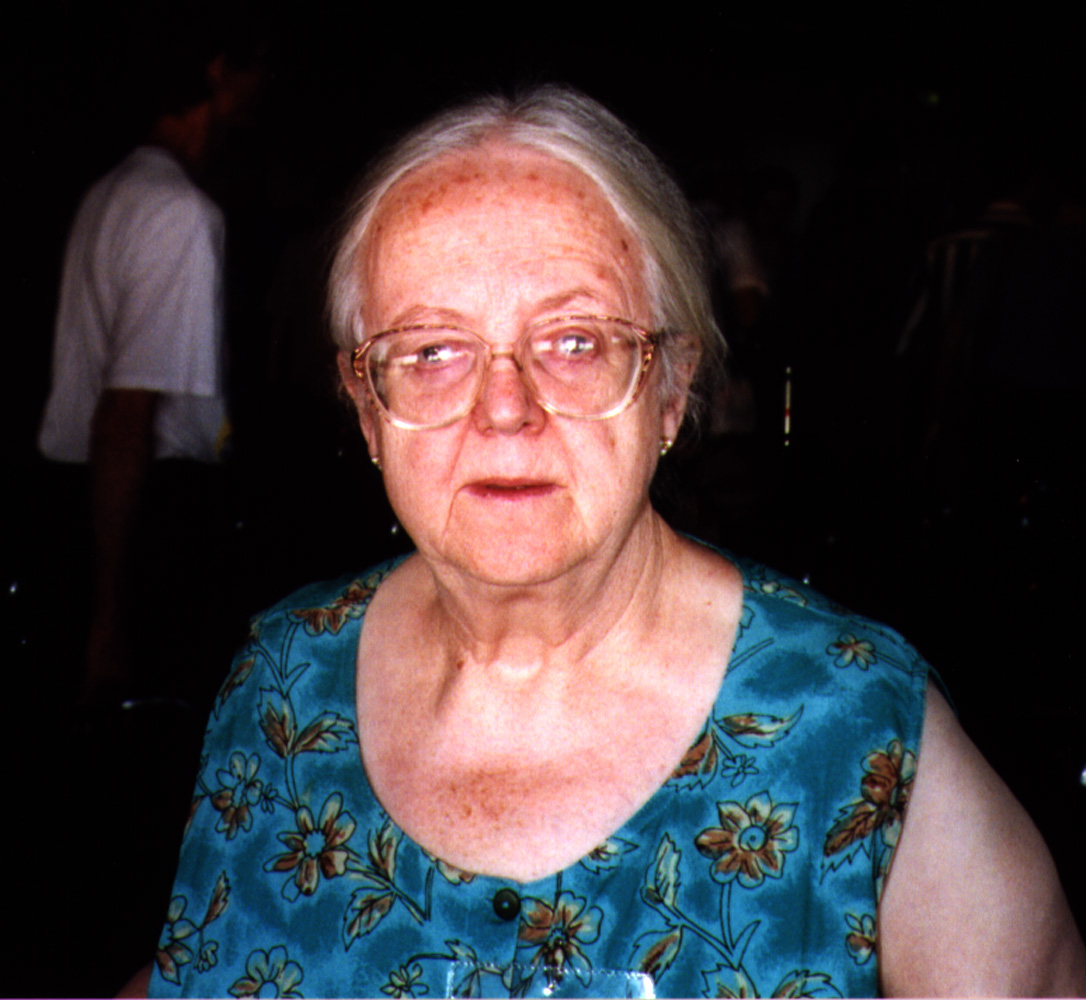
Marjorie Boulton
Marjorie Boulton
Marjarie Boulton in Berlin at the 1999 Universala Kongreso de Esperanto

For our Esperanto group’s discussion circle yesterday, we read a story by Marjorie Boulton from her book Faktoj kaj Fantazioj.

A father, wanting the best husband for his daughter, announces that she has died and requests money for her funeral. Two of the suiters decline, but one opens his purse and hurries to the father to grieve with him. Then the father reveals that it is a ruse and the couple is married.

I found it a odd and disturbing story.

So, I wrote my own version, with what I consider a more likely ending, and shared it with the other members of the Esperanto group. I also sent it to my brother to include with a group of similar little tales that we’ve written (Legends of the Zne Master).

I call it “Legend of a Beauty.” Steve posted it as “The Thrifty Father” and provides an English translation at the bottom of the page.

Still full dark yesterday morning when I ventured out in the bitter cold to make the pre-dawn drive to Normal to give an 8:00 AM presentation on Esperanto.

I dressed for the cold—wool socks, flannel-lined jeans, wool shirt under my Alaska pipeline surplus coat, hand-knit wool hat, scarf, and mittens—so I was comfortable enough. (And it was cold. Official temp when I headed out was just -6℉, but it kept dropping as I drove and was apparently -11℉ by the time I arrived.)

It was a rather pleasant drive. The roads were clear, so I was able to make good time. (When it’s that cold ice isn’t really very slippery anyway.) There was a nearly full moon high in the south-west, so bright I was glad it wasn’t any lower or more westerly—it would have made it hard to see the road. In the rear-view mirror I could see the sky behind me turn pink with the approaching dawn.

I’d been invited by John Baldwin to teach a little Esperanto to one of his classes. He’d just introduced the students to the topic of morphemes, which are hard to teach to native speakers of English. English has morphemes, of course, but they’re largely fossilized—artifacts of the history of the language, rather than active components that speakers use all the time to build words and sentences the way they are in Esperanto.

I taught them a little Esperanto through the direct method—teaching them “Mia nomo estas . . .” and “Mi havas ĉapelon.” Then I went over the grammar of the language, with an emphasis on the morphemes, and then we translated some sentences into and out of Esperanto. I had a good time. The students seemed engaged. The professor said he was pleased with how things went. So, it was all good.

Things wrapped up promptly at 8:50. I got back in my car and drove back home. Not a boring drive, because things looked quite different by daylight. I did some thinking about my next story.

It was warming up—about 0℉ by the time I got home.

Our local group will give a brief presentation on Esperanto this evening. We’ll speak (in English) about the language itself, why you might want to learn it, and about the activities of our group. If you’re local, and interested in Esperanto, consider stopping by.

It’ll take place at 5:30 PM this evening (Thursday, August 26) in the Foreign Language Building on the University of Illinois campus. We’ll gather in the atrium, then move to some free room. (Campus organizations can’t reserve rooms until they get re-certified, which apparently you can’t do in advance.)

If you can’t make this meeting, we’ll be  doing a repeat Wednesday evening next week (September 1st).

And, in any case, if you want to learn Esperanto, join us Thursday evenings all semester for a free beginners class!

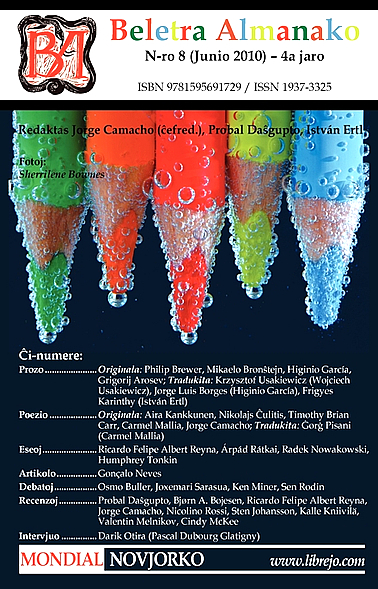
Kovrilo de Beletra Almanako N-ro 8.

Kovrilo de Beletra Almanako N-ro 8.My first Esperanto-language short story “Paŭzo en la stacidomo Union,” appears in the new issue of Beletra Almanako! My contributor’s copy arrived today. I even made the cover.

I am in very good company—a veritable who’s who of current Esperanto literature.

“Tiu,” Emma diris

Otto rigardis kien ŝi kapmontris. “Tiu alta viro en la drelika jako?” Li pripensis. “Filo de riĉaj gepatroj. Eksigita el pli ol unu universitato pro tro da petoloj kaj maltro da studoj. Ricevas iom da mono de la patrino, sed ne sufiĉe por vivteni sin.”

You can get it from Amazon: Beletra Almanako 8 (BA8 – Literaturo en Esperanto) (Esperanto Edition)

Or directly from the publisher.

If you can read Esperanto, pick up a copy today!

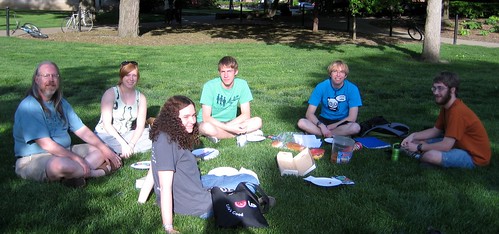
With the end of the semester arriving, about half of the Esperanto group will be heading home for the summer. Before everybody hit the road, we had a little celebratory picnic.

Photographic evidence:

Dum la grupa pikniko

I’m the guy on the edge looking like an aging hippy hanging out with a bunch of college kids.

It looks like enough of us will be in town over the summer to make it worth having meetings. If you’re interested in Esperanto and live in or near Champaign-Urbana, join us!

Esperantists are celebrating today. It’s 150 years since the birth of L.L. Zamenhof, the creator of Esperanto. Celebrating along with them is Google, which is featuring the Esperanto flag in their logo.

Google logo featuring the Esperanto flag

Esperanto has been important to me for twenty years. I’ve traveled overseas with it. I’ve met bunches of cool people, read fascinating books and magazines, and listened to great music.  Most important, I’ve done it on equal terms with the writers, performers, guests, hosts, and other people that I’ve met.  Instead of one of us speaking our native language, we’re both speaking a second language–but one that’s easy to learn.  Easy enough to learn that you don’t need to have any special talent with languages to learn it.

Happy Esperanto Day!

Last August I got email from UK sf writer Gareth D Jones, who was looking for Esperanto magazines that might be interested in translating and publishing his work.

There have been Esperanto-language publications that focused on science fiction (in particular, the Sfero series published by Grupo Nifo), but none of those seem to be active at the moment. (This is not as sad as it might seem, though, because the Esperanto-language literary magazines are not averse to publishing science fiction or fantasy. In particular, a recent issue of Beletra Almanako focused on speculative fiction.)

I told Gareth what I knew about sf in Esperanto, but also reached out to the Esperanto community, asking if anyone knew translators or publishers who would be interested in doing something with Gareth’s work. Pretty promptly, I heard back from Brazilian publisher Luciana F Campos whose publishing house Lusíadas was interested in publishing Gareth’s work.

I’ve heard from Gareth that the publications are now out.  Esperanto translations of two of his stories can be found in I Antologio Luzidoj (link to pdf) as well as Portuguese translations in I Antologia Lusíadas (link to pdf).

Helping make another Esperanto connection in the world is really its own reward, but as a bonus I also got this cool link to Douglas Smith’s Foreign Market List, an annotated list of  publications that buy foreign-language reprint rights to English-language stories.

I’ve been trying to get out for a walk each day, and trying to take a photograph on the walks. I want to do both of these things, and my theory is that these desires will be self-reinforcing: My desire to take a photo will get me out on my walk, and my desire to go out on a walk will prompt me to get out and take a photograph.

With that in mind, I’ve been going ahead and scheduling a chunk of walk/photograph time between my two morning writing sessions. Today, though, I was meeting some friends for lunch, so I postponed the walk until late morning, then did my walking and photography in the neighborhood of the restaurant.

Thursdays are my most social day–I have lunch with one group of friends (a couple of them former coworkers) and then before dinner meet with my local Esperanto group. With all that, plus the fact that I spent a chunk of the afternoon working on a short talk that I delivered to the Esperanto group, meant that my fiction word count was just 500 words. But they’re words I’m happy with.