I’m a student of daily routines. I like to imagine that I’m looking for good models for my own behavior, but that’s only true in an oblique way. By now I understand pretty well the structure of a productive routine; no new routine will be enough better than the routines I’ve already studied to justify the effort of examining them. The value in studying daily routines, for me, is as a reminder to follow my own routine.

For a while there was a great blog called Daily Routines that was very nearly pornography for this inclination of mine to ponder new models. It was there that I found the daily routine for Charles Darwin, which is probably the best model I’ve found so far.

And it is in part because of its similarity to Darwin’s model, that the daily routine of Vestricius Spurinna caught my eye:

At the second hour [after waking] he calls for his shoes and walks three miles, exercising mind as well as body. If he has friends with him the time is passed in conversation on the noblest of themes, otherwise a book is read aloud….

Then he sits down, and there is more reading aloud or more talk for preference; afterwards he enters his carriage [for more private conversation].

After riding seven miles he walks another mile, then he again resumes his seat or betakes himself to his room and his pen. For he composes, both in Latin and Greek, the most scholarly lyrics. They have a wonderful grace, wonderful sweetness, and wonderful humour, and the chastity of the writer enhances its charm.

When he is told that the bathing hour has come—which is the ninth hour in winter and the eighth in summer—he takes a walk naked in the sun, if there is no wind.

Then he plays at ball for a long spell, throwing himself heartily into the game, for it is by means of this kind of active exercise that he battles with old age.

After his bath he lies down and waits a little while before taking food, listening in the meantime to the reading of some light and pleasant book. All this time his friends are at perfect liberty to imitate his example or do anything else they prefer.

Then dinner is served…. The dinner is often relieved by actors of comedy, so that the pleasures of the table may have a seasoning of letters. Even in the summer the meal lasts well into the night, but no one finds it long, for it is kept up with such good humour and charm.

The consequence is that, though he has passed his seventy-seventh year, his hearing and eyesight are as good as ever, his body is still active and alert, and the only symptom of his age is his wisdom.

– (From a public-domain translation of the letters of Pliny the Younger.)

Of course, Spurinna was retired, so one writing session of just an hour or two is probably enough for him. His work when he was younger was as a magistrate and governor, and so probably took place in those conversation sessions that are now just for pleasure.

I think there’s a lot to emulate there. Three walks per day adding up to five miles seems just about right—as long as you include another hour or two of vigorous sport. Of course, he’s in his late seventies. Us younger folk should probably get in a little more than that.
Last month I posted a bit on endocannabinoid production in cursorial mammals, pointing to an article on new research that both supports the hypothesis that endocannabinoids are responsible for runners high, and that the whole system may have evolved to encourage and facilitate long-distance running in mammals whose success depends on it.

I found that I was still quite interested in endocannabinoids and running, and a little more research brought me to this 2004 survey paper by A Dietrich and W F McDaniel in the British Journal of Sports Medicine, endocannabinoids and exercise. It turns out endocannabinoids are involved in a whole range of systems, both centrally in the brain and peripherally in the rest of the body.

Some of the things that endocannabinoids do are entirely to be expected by anyone who has any experience with exogenous cannabinoids: pain relief, sedation, reduced anxiety, euphoria, and a general sense of wellbeing.

But other things were new to me:

  • Anandamide, a particular endocannabinoid, prevents edema and inflammation—probably a very useful mechanism. After all, running is bound to produce minor tissue damage to the feet and legs. Those endocannabinoids probably greatly reduce the need to get clever with ice and elevation and compression and anti-inflammatory drugs.
  • Anadamide also acts as a vasodilator and produces hypotension, perhaps facilitating blood flow during exercise.
  • Although in large doses cannabinoids produce motor inhibition, in low doses they produce increased locomotion. It appears that they make it easier to perform motor skills that have been practiced to the point where performance is automatic, such as running.
  • Cannabinoids act as brochodilators, perhaps facilitating breathing during exercise.

On that last point, I’ve certainly noticed that going for a run produces a profound relaxation of my upper airways. My nasal passages are pretty much permanently inflamed due to allergies—to the point that I spent most of last year needing to use a nasal steroid spray if I wanted to be able to breath through my nose. I have no idea if it’s mediated by endocannabinoids, but my nose is much, much more open after a run than it is before a run, and the effect lasts for hours.

One thing I found particularly interesting was an explanation for why cannabinoids don’t seem to be very addictive. They’re involved in the same dopamine systems that other addictive drugs are, and by rights ought to produce withdrawal symptoms when they’re withdrawn. In fact, you can produce those symptoms (in rats), by habituating the rats to THC and then administering an antagonist that blocks cannabinoid receptors. But mere withdrawal of the drug won’t do it, apparently because the drug hangs around in the system for so long that even abrupt withdrawal ends up resulting in a gradual tapering off.

On the other hand, gradual withdrawal is still withdrawal—even if it’s not drastic enough to produce shakes—and endocannabinoids may explain not only runners high, but also the addictive behaviors reported in runners:

We do not suggest that the addictive aspects of exercise are identical with the addictive properties of exogenous cannabinoids, but that a similarity exists between the desire that some people have for exercise and the desire they may have for exogenous administrations of cannabinoids. The parallels between these results and the subjective experiences associated with exercise abstinence, as discussed previously, are considerable.

What led me to this paper in the first place was a desire to get some data on just how much exercise was necessary to start producing endocannabinoids. On that question, the paper does provide a datapoint:

Using trained male college students running on a treadmill or cycling on a stationary bike for 50 minutes at 70–80% of maximum heart rate, we found that exercise of moderate intensity dramatically increased concentrations of anandamide in blood plasma.

That sounds pretty reasonable, although I wish they had data for exercise for 10 to 40 minutes as well. My guess, based on reports of runners high, is that it does take upwards of 50 minutes to start seeing a significant increase, but it’s just a guess. It’d be nice to have some data.

Most unconditioned people can’t maintain 70–80% of maximum heart rate for 50 minutes, meaning that if it’s true that it takes 50 minutes, most people won’t be able to experience this “dramatic” increase. The typical sedentary person would probably have to train for weeks to achieve this level of performance.

So far this year, my longest run was 26 minutes. But it was a great run (unlike my first long runs of the previous two years, which were not entirely successful). I’m quite optimistic that I’ll be able to ramp up the distance without much difficulty.

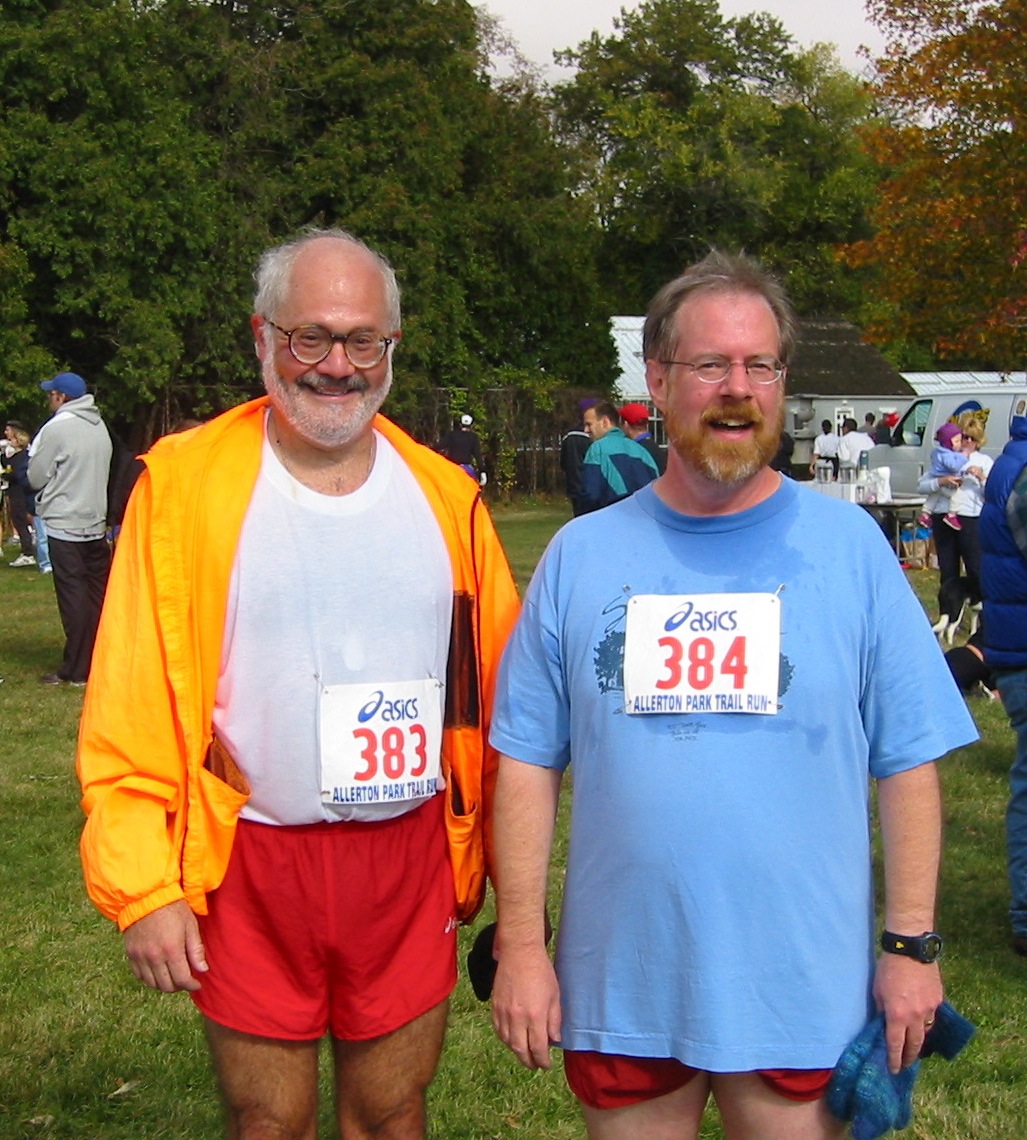
Chuck McCaffery and me, after finishing the Allerton Park Trail Race in 2003
Chuck McCaffery and me, after finishing the 5.5 mile Allerton Park Trail Race in 2003. Photo by Jackie Brewer.

I remember back in the late 1970s and early 1980s people were speculating that endorphins might be the source of runners high—and I remember how disappointed they were when experiments showed that exercise-induced levels of endorphins were much too low to produce the reported levels of euphoria.

They may simply have been looking for the wrong class of euphoria-inducing chemicals—it now looks like runners high may be produced not by endorphins but by endocannabinoids. Further, according to a paper in the Journal of Experimental Biology, there’s reason to believe that this euphoria is important enough in improving reproductive fitness that it is broadly selected for in cursorial mammals (that is, those with bodies suited for running). See Endocannabinoids motivated exercise evolution for an overview. (The paper itself was behind an annoying paywall when I originally posted this, but now seems to be available here: https://doi.org/10.1242/jeb.063677.)

This could explain a lot of otherwise hard-to-explain behavior:

. . . a neurobiological reward for endurance exercise may explain why humans and other cursorial mammals habitually engage in aerobic exercise despite the higher associated energy costs and injury risks, and why non-cursorial mammals avoid such locomotor behaviors.

Sadly, the evolved system does not show much promise for turning couch potatoes into endurance athletes:

. . . couch potatoes are not about to leap suddenly out of their comfy chairs and experience the pleasurable effects of exercise, because they probably cannot produce enough endocannabinoids. . . . Inactive people may not be fit enough to hit the exercise intensity that leads to this sort of rewarding sensation.

This is why I’m so pleased at having come up with an exercise regimen that I can persist with over the winter—I enter spring already able to enjoy the euphoric joys of exercise without having to first get in shape.

The local taiji group that I practice with, Community Tai Chi, recently opened up its formerly closed (password protected) Community Tai Chi student blog.

If you’re local, and you’re interested in studying taiji, the site and the blog together give you a very good idea of what you’d be studying if you studied with us. At the top of the blog are a series of posts with links to videos of the various movements in the 8-movement form we teach beginners (reposted so that they appear in order). Further down is a long post with links to videos of the 24-movement form that the more advanced class is working on (the first 24 of the Chen-style 48 movement form). Further down yet are some older posts with links to taiji resources various other places (including a couple that link back here, to some of my taiji posts).

I’m of two minds about running for exercise. Except when I’m running or wishing I was running; then I’m all for it.

I used to have a lot of reasons I ran for exercise, but they’ve been dropping away.

One reason that I run for exercise is that I want to be able to run. (Sometimes I want to get somewhere reasonably close in a hurry, and running is great for that.) I always figured that, if I wanted to be able to run, I needed to run for exercise—to build and maintain the capability.

Except, twice this month I had to run to catch the bus, and I did—even though I haven’t been running for exercise since last year. These impromptu bus-catching runs weren’t long runs, but I did them flat-out, without warmup or stretching, wearing whatever shoes I had on at the time—and both times were fine. I did them without undue effort and without getting hurt.

So, it seems that my regular fitness activities are enough to maintain at least a minimum capability for running.

Another reason I run for exercise is that it’s wonderfully efficient. All winter, the aerobic portion of my fitness regimen has been to walk for an hour on the four days a week that I’m not lifting and doing taiji. In an hour I walk a bit over 3 miles. If I cover the same distance running, I do it a good bit more quickly, meaning that I don’t have to spend as much of the day exercising.

Except that I’ve found myself fitting the hour of walking in very easily, without scheduling any exercise at all. There are several local errands (grocery store, bank, neighborhood restaurants) that are about a 10 minute walk each way. To run my slightly more distant errands, I take the bus. It’s a similar 10 minute walk to the bus stop, but that’s typically followed by 10 minutes of walking at the other end as well, for a total of 20 minutes walking each way.

So, if I go on one outing by bus plus one neighborhood errand, that’s my 60 minutes already. Running is efficient, but it’s not more efficient than that.

Less important than either of those, but still a reason I run, is that it gives me a sense of health and fitness. If I have an irrational sense that there’s something wrong with me, going for a run will usually take care of it. (Surely, I tell myself, if there were something really wrong with me, I wouldn’t be able to run like this.) I always knew that this was the sort of false comfort that’s only appropriate when I’m really quite sure that my sense of unwellness is, in fact, irrational. Going for a run is a fine way of dealing with, let’s say, a  panic attack. It’s a really dumb way to deal with a heart attack. (I don’t have panic attacks, but I am prone to worrying about my health unnecessarily. Those worries don’t prey on my mind as much when I’m running regularly.)

The problem with running is that I get hurt. Almost every runner I know gets hurt. To the best of my recollection, I’ve never had a walking injury more serious than a blister nor a bicycling injury more serious than a sore butt. But I’ve lost months of exercise time due to running injuries.

Still, despite the problems with running, and despite the loss of some of my rationalizations for running, I’ve started running again. But I’m doing it a little differently, now that I recognize that my reasons for running aren’t as strong as I’d thought they were.

Now I recognize that I run mainly for fun. I run because I really enjoy it. I enjoy the runs themselves. I enjoy the feeling of tiredness in my legs after a run. I enjoy knowing that I can run further and faster than I’m likely to need to.

If my enjoyment is the main reason I do it, that suggests that I should only do the fun part. So, I’ll abandon any effort to make a plan or set a schedule. I used to carefully structure my runs around an idea of stress followed by recovery. (I’ll still include both stress and recovery, but I’ll just decide each day which is appropriate, based on how I feel.) I used to aim to be able to run a particular distance on a particular date, so I could run in a race. I won’t do that any more. (Although I might run a race on a whim, if I feel like it.)

I went on my second run of the year today. It felt great. My first run, a couple of days ago—merely a good run—moved me to haiku. In the original Esperanto, it’s:

spiro laboras, genuoj doloretas… jara ekkuro.

Which in English might be rendered as:

Breathing hard,
Knees a little tender…
Year’s first run.

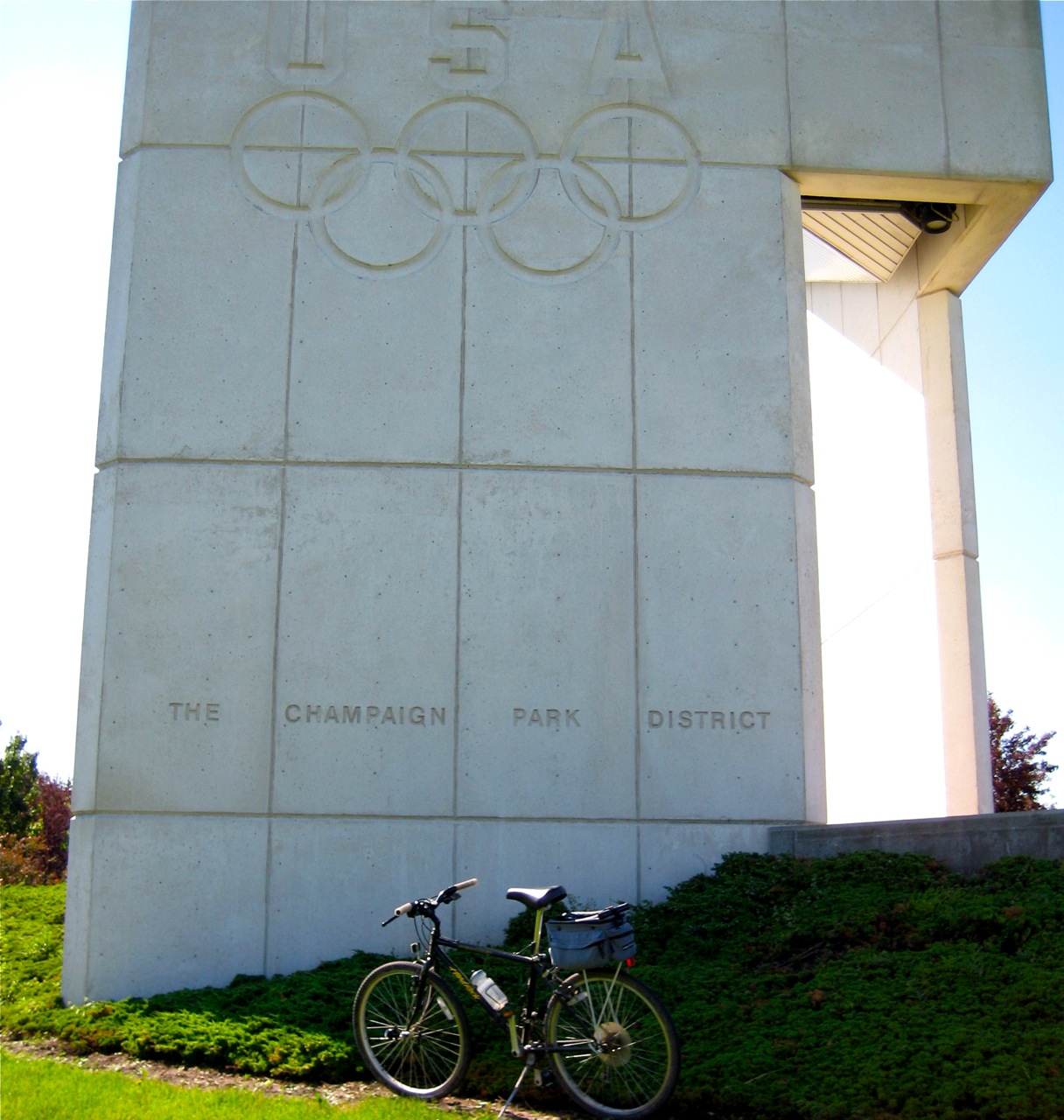
Jackie and I went for our first bike ride of the year. We followed our traditional first-ride route, around Kaufman Lake, past the Olympic Monument, around Parkland College, and then back. This year we went 6.27 miles.

I’d been hearing cardinals for several days, but out on this ride we got definitive expressions of bird spring. The robins are back, as are the red-winged blackbirds. I saw a crow fly up out of Copper Slough with a huge wad of nesting material in its beak.

The ride itself went fine as well. No mechanical problems. No problems with Jackie’s wrist. There had been a couple of previous days when it would have been warm enough to ride, but those days were very windy. It was nice to just wait for today and not have to deal with the headwinds.

I think we’re all set now, to be able to ride whenever we want. In particular, if there’s a day when it’s nice enough to ride first thing in the morning, we could ride to the Fitness Center and then to taiji. (That’s a bit long and complex of a ride to try to combine it with our first “shakedown” ride of the year.)

I first started lifting at a gym that used Nautilus equipment, where the staff promoted a Nautilus-style system of doing one set to failure. (That is, where you pick a weight that you can lift at least 8 times, but that you can’t lift more than 12 times.)

I understood right from the start that the system’s big attraction is for the gym owner: If everybody just did one set, the gym could sell two or three times as many memberships. However, I also found the physiology compelling: lifting as much as you can, and then attempting to lift a little more, is a powerful signal to your muscles that they need to become stronger.

I’ve generally stuck with single-set-to-failure workouts, because I’m lazy and find lifting boring: I want to get my workouts over with as quickly as possible and get on to something else.

Just lately, I’ve been experimenting with multiple sets. The reason is that, in the winter, my knees aren’t warmed up enough to lift a weight heavy enough to produce muscle failure in just 12 reps. If I try to push a weight that heavy, my knees hurt.

So, I’ve rearranged my lower-body workout. I’m now doing a first set of leg extension, leg curl, and leg press with a weight about one notch lower than my target weight, and then do a second set of all three with my target weight.

It’s working great. The first set serves as an excellent warm-up for my knees, getting the synovial fluid warmed up and flowing. The second set works the muscles to failure without knee pain. (On the leg press, I often do a third short set with an even higher weight, but that’s probably just because I’ve long been using too low of a weight, because it was all my knees could handle without a better warm-up.)

It’s working so well, I’m inclined to experiment with multiple sets for my upper body as well. I’m not sure it’s really a parallel situation, because I don’t have a joint issue that’s keeping me from reaching muscle failure, but doing the heavy workout with properly warmed-up joints just feels better, aside from not hurting.

In my family, “brain chemicals” is the shorthand term for unmotivated negative feelings. That is, when you’re feeling sad because something bad happened, that’s normal, but when you’re feeling sad for no particular reason, that’s brain chemicals. (On the theory that you’ve probably got a chemical imbalance or something, and that you should probably see a doctor about it when you’ve got the time.) The same applies to anger, frustration, anxiety, etc.

I mention this because I often suffer from brain chemicals, especially this time of year, when the days get short and dark and cold.

I’m actually doing pretty well this year. I’m doing a bunch of things that help. I’m taking my vitamin D. I’m trying to get outdoors for some actual sunlight, any day that there is any. I’m getting my exercise in. (For many months now, Jackie and I have been lifting weights three times a week and doing an hour of taiji three times a week. I’m trying to get in an hour of walking and at least a few minutes of additional taiji on the other days of the week.) I’m being productive. I’m getting enough sleep.

Still, despite all that, brain chemicals seemed to be setting in yesterday. I was feeling over-busy, under-accomplished, and frustrated. So, I went to level two in the fight against brain chemicals, and scheduled an artist’s date.

I think of it as a date with my muse. A proper artist’s date involves going somewhere and spending time with something that spurs creativity. That could be almost anything, and if I did them more often (and I really should) I’d probably have to broaden the range of places that I go. But I don’t do them very often, so I can usually get away with taking my muse to the same few places.

I started at the Krannert Art Center. Much of their exhibit space today was full of stuff that I had little interest in, but outside the museum proper there’s a changing exhibit of student work that’s often more interesting than the work in the museum itself. Today it had the work of school children. There were a lot of interesting ideas—for example, a low passageway made of cardboard where kids who’d studied ancient cave paintings had painted their own—even if only a few of the actual pieces spoke to me.

Connected to the museum is the school of design building. They often have some student work on display in the hallway, and I rather liked a small group of pieces by students who had apparently had the assignment to create a brand identity for themselves. They produced the same elements that a brand identity package from a marketing firm would provide—a name and logo (provided in a couple of sizes and formats, in both color and black & white), together with some key terms and images that could go into a branded ad campaign.

It was everything an artist’s date needs to be—a reminder that creativity is everywhere, a reminder that there can be joy in art of all sorts.

I was already feeling better today, and expect that I’ll feel even better tomorrow.

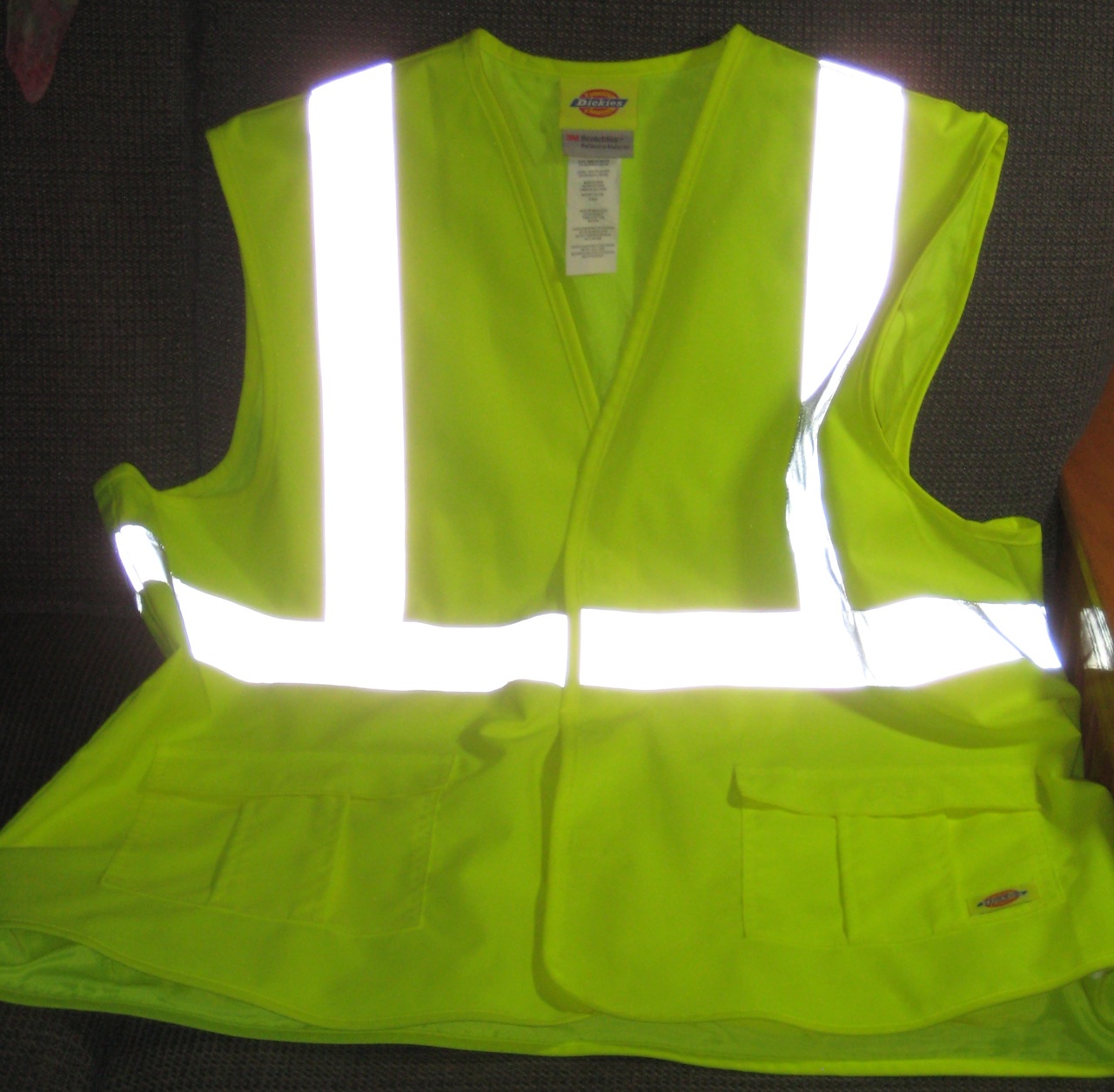
My reflective vest

People treat me differently when I wear my reflective vest.

I bought it four years ago, for when I run after dark. But as long as I’ve got it, I’m inclined to wear it anytime I’m going to be crossing streets on foot after dark.

Last night I was greeted in a friendly fashion by an older black man who called me brother. The last time I can remember that happening was in the 1970s.

My theory, based on that and a few other encounters, is that some people see me and assume that I’m a working-class guy heading out for for some sort of outdoor nighttime physical labor job. If they’re also a working-class guy familiar with outdoor nighttime work, it prompts them to greet me in a comradely fashion.

There’s another common reaction: Many people seem to think I’m “official” in some way. Cars that would have zipped around me in the daytime exercise additional caution, just in case. People make way when I’m going down a hall, in case I’m on my way to some minor emergency. Related to that, surprisingly often people who know me don’t recognize me—they see the vest and don’t imagine that anyone they know might show up in one.

I expect the reaction I’d get would be very different, if I wore a reflective vest designed for runners. I’ve got one of those too, but it won’t fit over a coat.

Yesterday I heard something unique and fascinating: A group cycling class instructor fashioning a story around the cyclists’ workout.

The group cycling classes at the Fitness Center take place in a room that is reached by walking through the room with mats where I do my ab and back exercises and do my stretching. The arrangement is pretty unsatisfactory, because the cycling class’s music is not only far too loud, it’s also a poor match for my cool-down-and-stretch purposes. Still, it gave me the opportunity to hear this.

I only caught the end. Where I came in, the cyclists were carrying a backpack and were being pursued by someone faster but less nimble. They had to ride really hard for 20 seconds, then ease up and make a sharp turn just ahead of the pursuers, who blew on past and had to regroup. The cyclists got a short respite, then had to ride hard for another two minutes to reach the safe house.

I don’t know who the pursuers were—it sounded more like spies than like zombies (which would have been my choice, but then maybe the instructor had used zombies last week). And the cycling instructor sounded more like a coach than like a storyteller—a real writer could have included rather more telling detail and provided better characterization for the bad guys. But it was still cool.

I’ve seen a few attempts to turn exercise equipment into video games, and of course I build stories around my own workouts all the time. (I assume others who exercise do as well.) But this low-tech application of using old-fashioned storytelling to enhance a workout—using what was essentially a paid storyteller—was new to me.

If it catches on, maybe there’ll be some new job opportunities for writers, at least writers who are very fit.