I have always found “deconstructionist” models appealing. For example, I liked the idea that you could “figure out” all the nutrients that you need and then build up a diet that provides the right mix of carbs, proteins, fats (with proper mix between omega-3 and omega-6 fatty acids), the right amounts of fiber, vitamins, minerals, and so on.

Then Michael Pollan came along and (in his book In Defense of Food) completely destroyed that idea. First of all, it’s an impossible problem to solve—the different nutrients interact in the body (and biome) in ways that are intractably complex, plus there are so many micro-nutrients as to make it computationally infeasible (even if we knew what all of them were, which we don’t). More to the point, though, it’s a completely unnecessary problem to solve: our bodies solve it for us, as long as we eat a diet of diverse foods and minimize our consumption of manufactured food-like substances.

I’m not saying this is new news. In fact, this is common knowledge—everybody said this, right from the start. What I’m saying is that, for reasons no doubt having to do with my personality and psychological makeup, I liked the deconstructionist model for analyzing and then constructing a plan for what to eat, despite what everybody said. For some reason, again having to do with my personality and psychological makeup, Michael Pollan’s explanation of how the whole deconstructionist model of designing a plan for eating was fundamentally flawed suddenly made it clear to me (in a way that any number of people—including my third grade health teacher and both my parents—had not managed to do).

All that seems relevant because—I recently realized—for years now I’ve been making the exact same mistake with movement. I’ve been trying to “figure out” an exercise regime that would keep me fit. If you click on the Fitness category over in the sidebar, or the “exercise” tag on this post, you’ll be linked to a long list of my posts on the topic, many of which describe my latest attempt to find the right mix of walking, running, bicycling, lifting, stretching, and taiji to build and maintain optimal levels of aerobic capacity, strength, and flexibility.

Then I ran into the work of Katy Bowman, whose explanations of why exercise is no substitute for movement clicked for me in just the same way, and for roughly the same reason: The problem is intractably complex, and anyway our bodies solve the problem for us—as long as we engage in an ample amount of diverse movement and minimize things like sitting in chairs and wearing bad shoes. (See her book Move Your DNA: Restore Your Health Through Natural Movement.)

Again, this is not really new news; I’m just late to the party because I like the idea of designing an exercise regime that covers all the necessary categories.

However, I think I have come around. Appealing as it is to me to design the perfect exercise regime and then tick off each box as I reach my target for the week, I pretty much have to admit that the whole thing is a fool’s errand. I’d be much better off spending that time walking, stretching, hanging, squatting, climbing, balancing, jumping, throwing, catching, and so on.

I’ll still run (because I enjoy it, probably due to the endocannabinoids, and because being able to run is useful), but I’ll spend a lot less time on things like figuring out how much I can safely add to my weekly mileage. I’ll just run as much as I feel like—while being careful to do so mindfully, and to pay attention to my body, so that enjoying running doesn’t entice me to run more than should.

Still not new news.

I’ve started thinking of my fitness practice more as movement practice. This post is about that shift in my thinking, and if that’s not going to be interesting to you, you’ll probably want to just skip this one.

I have always wanted to be fit, for what I think are mostly ordinary reasons: to be healthy, to look good, to be capable of doing the things that need to be done. For most of my life, my fitness practice fell short of what I thought it ought to be, again for mostly ordinary reasons: I was busy, the weather was bad, I found exercise boring or unpleasant.

I would get my aerobic exercise running and cycling in the summer, and walking year round. When the weather cooperated with a mild spring, I could get in pretty good shape by mid-summer. A couple of years, I even preserved some level of running capability over the winter; one of those years, I ran the Lake Mingo Trail Race, which at 7.1 miles was usually beyond my capability in mid-June when it takes place. But, given the realities of working a regular job (with hours when I needed to be sitting at a computer, rather than out for a run), winter (when I just about don’t cycle or run) and injuries (as my brother likes to say “Running is great exercise, between injuries”), my fitness practice never made me fit for the long term, just fit for a while.

This changed a few years ago, for a couple of reasons.

The less important reason was that my employer closed the site down, and I decided I could get by without a regular job. It means our financial circumstances are a bit straitened, but my hours are my own.

More important, I started practicing taiji.

Taiji gave me balance and control, but much more important, it taught me mindfulness—to be present in my body during my exercise. (I was prompted to write this post at this time because I’ve been reading a blog by Johnathan Mead called Move Heroically, that nicely hits the sweet spot in my evolving interest in fitness. The latest post in particular is on exactly this topic: Embodiment is a Performance Enhancing Drug.)

I like to think of my exercise as building capabilities. I go for long walks because I want to be able to go for long walks. I run because I want to be able to run.

That’s an oversimplification in at least two ways.

For one thing, honesty requires me to admit that I engage in endurance exercise because I like it (perhaps because of the endocannabinoids it generates). A long run at a brisk pace makes me feel good.

More important it’s an oversimplification because specificity of training means that my exercise practice was only building a very narrow slice of the capabilities I imagined. Yes, if I go for a long run every week or two, I do create and maintain the capability to run a long way, but that capability is only barely transferable to other activities. When Jackie and I wanted to go on a century ride, we spent many weeks building up our stamina for long rides. Given how long it’s been since my last long ride, I would not want to stake my life on my capability to bicycle 100 miles without a good bit of training. Maybe fewer weeks because we’re fitter now, but I’d still want weeks of training before attempting another century ride.

It was this realization, in conjunction with my taiji practice teaching me to move more mindfully, that brought me initially to parkour, and more recently to natural movement generally.

Running wasn’t just for fun (although it was fun), and it wasn’t just to be more healthy (although I expect I am). I was explicitly building the capability to run if I needed too. I used that capability sometimes—to catch a bus, to get to an appointment on time—and I imagined that I could use it under other circumstances as well: running away from some danger, running toward someone who needed my help.

But I came to realize that, because of exercise specificity, my capability was a very narrow one indeed. I could run, but I could only barely jump or climb. If I came to a place where I needed to step down I was fine, as long as the drop was only a step or two. But if I needed to jump down by, let’s say, three steps, things got much more problematic. I could climb up a steep path, but am quite daunted if I need to climb up a tree, or cliff, or a wall, or a rope.

That was what brought me to parkour.

Even before I made much progress in the skills of parkour, however, I happened upon natural movement. It shares the roots of parkour, but is less about the specific skills of parkour (vaults and such), and more about basic human movement. Yes, walking and running. Also climbing and jumping and crawling. Balancing. Throwing and catching. Lifting and carrying. Swimming and diving.

So, this is where I’ve come to. I’m very pleased with my walking, and adequately pleased with my running. My climbing skills need considerable broadening. Thanks to taiji, my static balance is okay, but I’m still a beginner when it comes to more dynamic balance. My throwing and catching were never great, and have declined enormously due to a lack of practice since I was a boy. My lifting and carrying skills are deficient, due to too many years lifting weights primarily with machines. If you dropped me in water over my head I could avoid drowning for a while, but unless shallow water or rescue were reasonably close, I would be hard pressed to reach it.

There is a great deal I want to learn (and re-learn) this summer, and I have started in small ways.
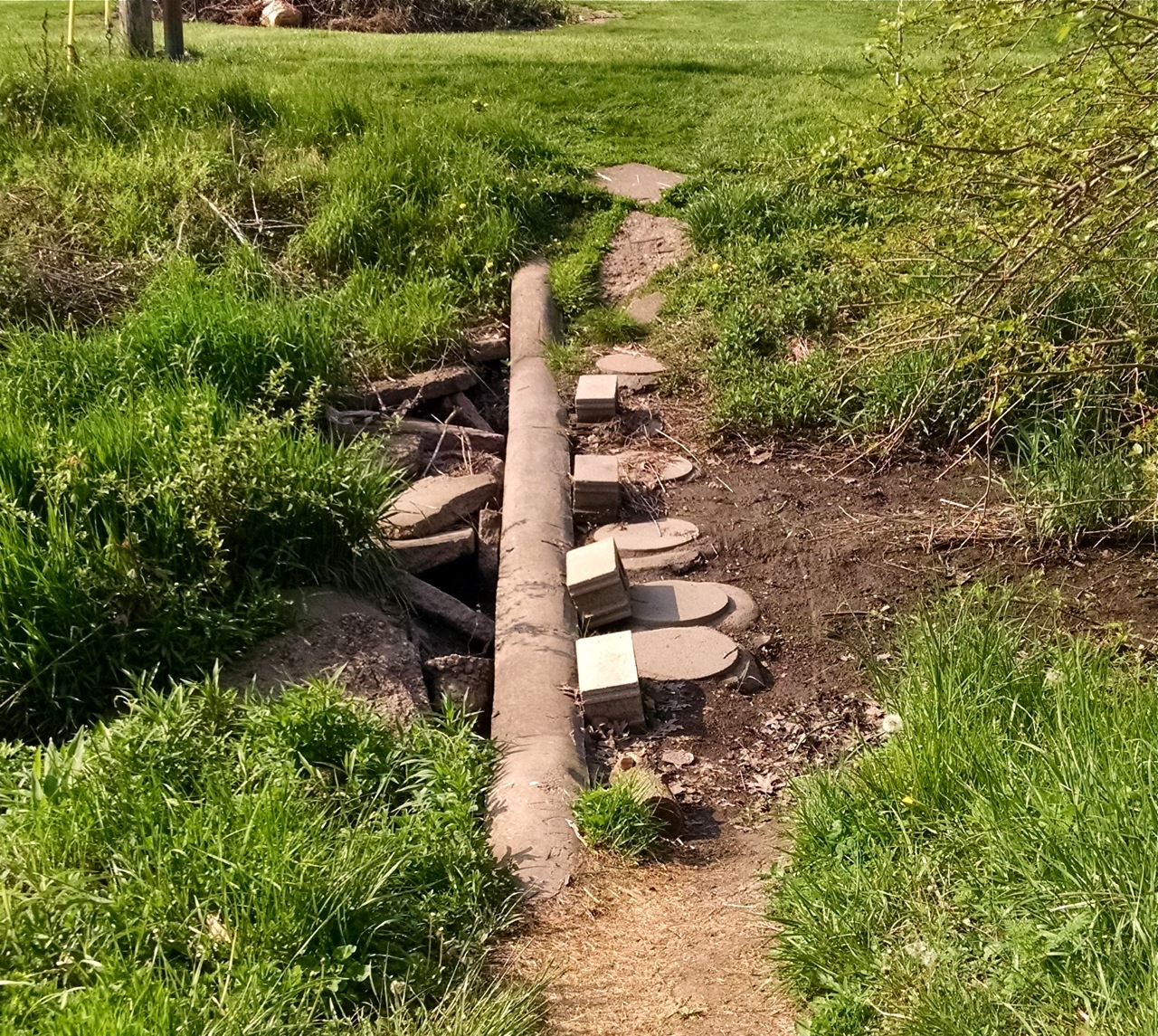
weir-behind-winfield-villageThis weir crosses a ditch that runs behind Winfield Village. It’s concrete, a good 12 inches wide, but curved on top, making it a pretty good imitation of a log put across a river to serve as a bridge. I’ve been including it as part of my running route, initially with some difficulty (needing to use the concrete blocks as additional stepping stones), but now crossing on just the weir, and beginning to pick up the pace.

I’m being very careful—Jackie would be quite peeved with me if I injured myself right before our Kal-Haven Trail walk—so I’m not doing much with jumps or vaults yet. But my concept of fitness has broadened greatly, and I’m no longer satisfied with merely a strong heart and strong muscles. I want the full range of human movement capabilities.
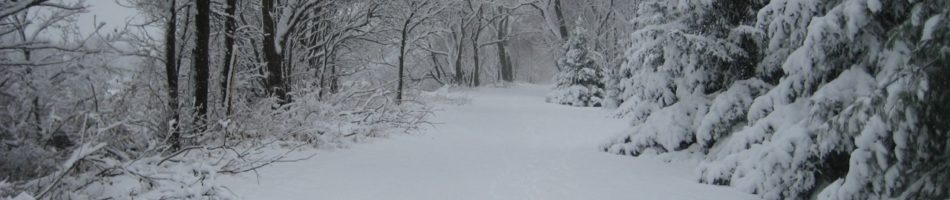
I went for my first outdoor run of the year on Sunday. It was the first day that the paths were clear enough of ice and snow to make it possible.

Although the paths were mostly clear of ice and snow, there was a lot of melt water, flowing across the path in hundreds of rivulets. I found myself integrating into my run hundreds of small leaps, in a (partially successful) effort to keep my feet dry.

I was well aware of the leaps as I did them—I remember making a conscious effort to refrain from favoring one side over the other, trying to execute each leap with the most natural foot leading, based on my current point in my stride as I approached.

For some reason, all those leaps were not the first thing that came to mind the next day, when my calves were as sore as they have ever been. I was just sad at how much more out-of-shape I must be than I had realized, to be so crippled by a simple three-mile run. (They hurt a lot more than when I actually tore a calf muscle a couple years ago.) It was only late Tuesday, when I was heading to teach my taiji class, that I jumped over a similar stream of water in a parking lot—one calf screaming when I launched, the other screaming when I landed—that I realized that it was the leaping that had done such a number on me.

With that reassurance I felt much better, and by Wednesday my calves were feeling much better, which was good because Wednesday Jackie and I went on our first long walk of the year, part of the series of long walks we’re taking to prepare for the 33.5-mile Kal-Haven Trail walk that we’ve been meaning to take for a couple of years now. We’re quite determined that this will be the year.

For our first long walk we walked to taiji, attended our class, and then walked on to downtown Urbana and had lunch at Crane Alley (good beer). After lunch we walked back through campus. Having exceeded our planned distance (we wanted to do 10 miles and got in 11.5), we caught a bus at the south end of campus to go the rest of the way home. (The walk home from the south end of campus isn’t far, but there’s no good footpath. I think during the summer, when it’s possible to walk along the side of the farmer’s fields, it’ll be a fine walking route, but yesterday it would have been too wet and muddy.)

It was warm enough that I was able to expose my forearms to the sun!

My training plan, such as it is, covers just the long walks—we’ll include many shorter walks in our daily activity, and plenty of medium walks as well. But the long walk plan looks like this:

  • first-half March: 10 miles — done
  • second-half March: 15 miles
  • first-half April: 20 miles
  • second-half April: 26.2 miles (because why not?)
  • first-half May: 30 miles

The main event is planned for roughly June 18th, but it will depend on the exact schedule of when we go to visit my dad and what the weather looks like those days. I figure we’ll be fit enough to do a very long walk of the planned distance any time after mid-May, so that gives us a month’s cushion to allow for any glitches.

I’m kind of excited about possible medium-length walks from our new house, here south of town. All of south campus is reasonably close, including, for example, the Arboretum with its cherry trees, which should be in bloom in about a month. It might make sense to walk there several times in early April, to keep up with the progress of the cherry blossoms, and take the opportunity for both haiku and photographs.

The most obvious way to walk (starting with the exact route from south Campus that I rejected yesterday) would be about 3 miles each way, the first half along the sides of country roads. As I say, it should be an entirely satisfactory route anytime the ground isn’t too wet.

Here’s the details for Sunday’s run:

And here’s the details for Wednesday’s walk:

I’ve had a slightly sore foot for a while now.

It hasn’t been a big deal. It doesn’t hurt when I run. It doesn’t hurt when I walk (except sometimes when I walk really fast). It doesn’t hurt when I stand, or when I’m just sitting.

Mostly it hurts when I use my foot as a brace to turn or twist, such as when I brace the side of my foot against the mattress to turn over in bed. Sometimes it hurts when I’m standing on my other foot, and touch just the toe of the sore one down to catch my balance.

It sometimes hurts for the first few minutes right after I get up in the morning, kind of like plantar fasciitis, but a different part of my foot: the medial edge, just posterior to the ball of the foot.

Even then, it doesn’t hurt much.

However, it has been persistently hurting occasionally, just a little, for a long time now. Months.

I had been doing basic, conservative care. I was wearing supportive shoes, avoiding things that hurt it as best I could, and figuring it would eventually get better. But it hasn’t.

So, a couple days ago, I decided to step it up a notch: I decided to treat it with a placebo. (The effectiveness of placebos is well-established. They’re effective even when people know that the treatment is a placebo.)

My initial plan had been to add in some sort of cream or ointment. I thought of something like Aspercreme, but it doesn’t hurt enough to justify the use of even a mild analgesic, so I thought I’d get something like Bengay or IcyHot: just some sort of counter-irritant that would make it clear that I was “doing something” to treat my foot. Then I saw Walter Jon Williams’s recent post on Tiger Balm, and knew that I’d found the right stuff.

Jackie discovered Tiger Balm several decades ago, during her travels in Asia, and it has long been a staple item in our medicine cabinet, but we’d let ourselves run out in the run-up to our several moves, so we didn’t have any. Fortunately, the closest store to our townhouse is a CVS, and they had two varieties of Tiger Balm in stock. They seemed almost identical (a one-percentage point difference in menthol), but the one they were marketing as their “ultra strength” “sports rub” was $1 cheaper, so we got that one.

I’ve been using it for two days now, and I’m imaging that my foot is feeling better.

Perhaps because I’m finally doing something about my foot, I also remembered something else. For years now I’ve been wearing a pair of slip-on Birkinstocks as slippers. I started wearing them when I first got plantar fasciitis, and found that it was crucial to never go barefoot on our hardwood floors. Along with other supportive footwear, they solved the problem.

Usually I only wore them indoors, but very occasionally I’d wear them outdoors for very short trips—if I was only going as far as the mailbox, for instance. One or two summers ago, I tried to wear them for a walk around the block, and found that they really hurt the joint at the base of my big toe. I couldn’t make it even as far as around the block—I had to turn back and hobble home.

They never hurt my foot when I just wore them around the house, which I continued to do.

But now that I was thinking about it, it occurred to me that maybe they were hurting my foot, just not enough to notice unless I did something out of the ordinary.

Since the plantar fasciitis hasn’t bothered me since I started doing taiji, I decided to retire the slip-on Birkinstocks.

I’m also adding some calf-stretching, as well as some calf and shin strengthening activities.

I suspect some combination of those activities will do the trick. But just in case, I’m also rubbing some Tiger Balm two or three times a day into the side of that foot, from ball back almost to the heel.

I’ll keep you posted.

Oh, and by the way—the main reason I haven’t been posting much here is that I’ve been posting most of my exercise-related stuff on my Esperanto language blog, mostly as a way to improve my grasp of the exercise-related vocabulary (which is surprisingly poorly developed in Esperanto). I have a sense that most of my friends and relations have heard about all they want to about my exercise and fitness. And what better way to make sure almost nobody is bothered by my yammering on about it than to do so in a language almost nobody speaks?

I happened upon a post by Ragen Chastain, a writer and activist on size acceptance. She’s also a dancer and an athlete, and I mention her because a recent post on training resonates with my experience, without quite matching it.

She’s training for an IRONMAN race, and the post in question compares the difference between training skills versus training fitness. In training, for example, dancing, you’re learning stuff. It may be really hard, but once you learn a move, you’ve learned it: For a long time it’s hard and you suck, and then you get it and then it doesn’t suck any more. Running (and swimming and bicycling, but especially running) is very different:

One of the things that is interesting about training for the IRONMAN is that it is a process of constantly increasing distance and time (sometimes alternately, sometimes at the same time.) such that “progress” doesn’t necessarily mean that my workouts feel better, but that my general feeling of suckiness remains constant at an increased time and/or distance.

Case in point – Wednesdays are speedwork which means intervals at the highest speed I can manage.  The interval time has increased four minutes, and the speed has increased 5 minutes per mile since I started training.  I still feel like I’m going to die at the end of each workout but I’ve gone farther, faster, for a longer time period.  It’s the stasis of suck.

I totally get where she’s coming from: running as fast as you can (or as far as you can, or as long as you can) is hard. But my experience is different.

Especially when I’ve gotten out of shape, I absolutely feel the massive suckage of starting to get into shape again. Many times I’ve gone trudging around my old 1.5-mile loop near Kaufman Lake, gasping for air, thinking “I’m going to die.”

But after three, four, five runs—such a short time that I can’t possibly have made more than a tiny improvement in my fitness—my perspective is completely different. I’m still trudging around the same loop. I’m still gasping for air. But now I’m thinking, “Wow, I’m getting a great workout!”

Perhaps this is because I don’t have a coach. Maybe if I had someone carefully measuring my performance and matching it to a model of my theoretical maximum performance, that person could arrange for my experience of suckage to remain constant.

But I don’t really think so. A lot of the experience of suckage is in your head. With one mindset I experience the physical sensations of slowly running as far as I can as miserable, because it’s so hard. With a different mindset I experience the exact same physical sensations as wonderful, because I’m doing what I want to do, accomplishing something that’s difficult and yet rewarding.

That doesn’t suck, even if it’s hard and painful.

It was preternaturally warm today, so I seized the opportunity to go for a run outdoors.

I skipped the zombies, figuring I’d save them as an incentive for running on the treadmill. With mild weather, running outdoors is its own reward.

When I’d seen the forecast, I’d imagined that I might run on the trails in the Lake Park prairie and woods. But in the actual event, the warm southern breeze over the cold ground produced enough dew that it might just as well have rained, making it muddier than I thought would be really fun for a trail run. So, instead I just ran down Curtis to Prospect, and then south along the bike path as far as the Savoy Rec Center, and then back again. It came in at 3.13 miles.

It was a great run. It wasn’t even hampered by a stumble right at the end, when I caught my toe on an uneven bit in the pavement. I went down on the wet asphalt, but managed to turn my fall into a credible parkour-style roll, and then come up on my feet ready to keep running. I don’t know how much was pure luck and how much was the time I put in practicing my shoulder rolls back in May, but I’m pretty pleased with the result either way. I have one teeny-tiny scratch on my palm, but am otherwise unhurt. I don’t want to think about how much skin I’d have left on the pavement if I’d slid rather than rolling.

I can’t really expect any more weather this warm until spring, but between fond memories of this run and the zombies, I have high hopes for putting in the necessary treadmill time to be still in shape for running when spring comes.

I went for a treadmill run with “Zombies, Run!” this morning. Despite it seeming like a particularly ineffective way to flee the zombies, it was by a wide margin the easiest 30-minute treadmill run I’ve ever had. I can usually just barely get myself to run 20 minutes on a treadmill.

I’ve gotten in the habit of setting any treadmill to an incline of 1%, because I find that matches my speed on the treadmill with my perceived level of effort. (That is, when I’m running at a 10-minute pace on the treadmill, it feels about like running at a 10-minute pace outdoors, if the treadmill is set at a 1% incline.)

This particular run came out at just over 31 minutes and just over 2.5 miles. I had turned off the GPS on the game and told it to use the accelerometer instead. At the default setting, it suggested that I’d gone 2.31 miles, so I bumped up the stride length by about 8%. Next run I’ll see if the treadmill distance and accelerometer distance aren’t just about the same.

I’ve been playing the game with the zombie chases turned off. That was mainly with the thought that it would increase replayability—I figured once I finished all the missions, I could go back and play them all again with zombie chases turned on for a fresh experience. Since I’m currently in no danger of running out of missions, I might turn them on for treadmill runs, to add a bit more variety.

In a very small way, I’ve been persisting with my parkour training.

I’ve been practicing my shoulder rolls with some success: I can now do shoulder rolls from a kneeling start on both left and right shoulders. With that under my belt, I also did some from a standing start on my right side. I want a little more practice before I do them from the left side.

Next will be to do them at a run, and then to do them after dropping from a height. (Not a high height—I don’t want to hurt my feet, ankles or knees—but I want to develop the ability to drop from a height, absorb the impact of landing, and then go into a roll if necessary. It seems like a useful skill.)

The other thing I’ve started with are what the parkour folks call a precision: a jump to a specific point. You’ve seen them in movies where the actor (or a stunt man) jumps from one beam to another over a gap, or jumps from the top of one wall to the top of the next wall.

In the interests of not killing myself with my practice, I’ve been doing all my jumps at ground level, jumping and then landing on a curb. I’m not jumping very far—I still have no explosive power—but so far I have reasonably good accuracy. (The curb is maybe 6 inches wide, and I’ve managed to land on it, and to not topple over, pretty much every time so far.)

The distance I can jump is growing, which I think is just improving neuromuscular recruitment. (That is, at the level of the muscles, I’m getting better at firing off each phase of muscular contraction at the best moment to launch myself, and at the level of the limbs, I’m coordinating my arm and leg movements so that everything works together to launch me the distance I’m trying to go.)

In other news, packing to move proceeds apace. We’re soon to be at the point where we’re living in our summer place as much as we’re living in our old apartment. And we’ve learned that we’re on the waiting list for Winfield Village

On many of my runs this spring, my ankles have been a little sensitive. I’m not sure why. It may be the last remnants of my ankle injury last summer. It may be that I haven’t been stretching my calves enough. It may be that I’ve been doing too many longish runs and not enough short ones. But whatever the cause, I’ve noticed that it seems much worse when the weather is cold.

Serious runners like to run in cool weather. Running generates a lot of heat. Even someone who runs as slowly as I do generates enough heat to keep warm (even in shorts and a t-shirt) in temps down into the 40s. But my ankles have tended to hurt after any run that I did in temps below the upper 50s. So for the past several weeks, I’ve been holding out for temps in the 60s to go for runs—and there hasn’t been much.

Happily our long, cold spring seems to be finally over. Since the end of winter, there have generally only been a few hours a week that were warm enough for me to run. As of today, it looks like we’re going to have 15 or 16 hours a day that will suit my purposes.

So, today I went out for a medium-ish length run, hoping that the weather and my schedule will let me get out for more runs nearly every day for the next while.

According to Zombies, Run! I went 3.11 miles in 36:18. It went great. No ankle pain (or foot, calf, knee, or hip pain). It was long enough for me to feel like I got in a real run, but short enough that (baring unexpected problems), I hope to be able to run tomorrow as well. And the day after that.

In related news, I’ve become interested in parkour. I’m not really interested in doing anything extreme in the way of climbing or leaping. It’s more that I’m hoping to see places to run differently—to see walls and railings and stairways and rocks as part of the course, rather than as obstacles. I haven’t done much so far, except step up the bodyweight parts of my resistance exercise, but I’ve started to practice jumping and landing where I mean to. (It turns out I have no explosive power at all. It’s really quite sad.) I’m also trying to recover my ability to do shoulder rolls. (Thirty years ago, when I was studying aikido, I could do a perfectly credible shoulder roll, come right to my feet, and then do the same roll on the other shoulder, all the way down the length of the dojo. Now I’m too timid to do a roll from a standing position, and even when I do it from my knee, it’s all clumsy and awkward. Which, come to think of it, is a pretty good reason to be timid about doing them at a run.)

We went to a local storytelling event last night. There were about six storytellers, telling stories over the course of most of two hours (with a 15 minute break). They served beer and wine, but we’d been to Whiskey Wednesday, so we didn’t get further alcohol.

There’s an active community of storytellers in town. As a writer, I’m extremely aware of the difference between writing stories and telling stories, and I’m endlessly fascinated by storytelling. The stories I write in English wouldn’t lend themselves to telling (although they read aloud okay). But the theme of the events (monsters and dragons) reminded me of my first Esperanto story, which was about monsters, and it occurred to me that story would probably work for telling pretty well.

Somebody ought to get some Esperanto storytelling events going.

This event, which was in English, was pretty cool. They had a good number of children in attendance (drawn, I suppose, by the monsters and dragons theme). They’re talking about making a monthly thing out of it, and I just might make my way downtown to listen to stories on a regular basis if they do.

Speaking of storytelling, I’ve been continuing to use Zombies Run when I run, because I enjoy the storytelling aspects. (And I am enjoying hearing the story unfold, quite a bit. I’ve got quite a bit more to listen to, but I’m already looking forward to replaying season one. In particular, I’ve been playing so far without zombie chases, and I’m sure adding those will change things enough to make it extra-replayable.)

Not really related to the storytelling aspect, but interesting to me, is that using the game has had an impact on my training runs.

The game is set up to give you training runs about 30 minutes (or about 60 minutes). The story is divided into 5 or 6 audio clips that dramatize the story. Between each pair of clips, the game plays 1 song (or 2 songs) from your running playlist.

Early in the season like this, my fitness improves almost every run. (Especially because the weather often makes it impossible to run day after day, so I’m getting my recover days in.) Normally what happens is that I’ll find a distance I can run at my current level of fitness, and I’ll run that distance pretty often for a while, until I get fit enough to run further. (Later in the season I mix it up more with a weekly “long” run.)

In years past, at this point in the season, I’d be running my regular 2.2-mile loop for most of my runs, and my times would be gradually improving.

Now, though, all my runs are about 30 minutes. But, as my fitness improves, instead of finishing a standard length sooner, I’m running for a standard period of time and having to run further.

The last two runs there was still story to go when I got back, and I ended up having to run around the apartment complex. In order to be sure I’ll have finished the story by the time I’ve finished my run, I’m going to have to start running a longer route! (The game has a feature for making sure that a route that runs longer than an episode doesn’t leave you bereft. It’s called “radio mode” it goes on playing stuff from your playlist, still alternated with audio clips, but these audio clips don’t try to advance the story. They just provides some local color. So, if you finish a mission, but end up running another 10 minutes to get home, it switches seamlessly to those bits.)

Once the weather improves a tiny bit more, and I’m running more days per week, I’ll probably ease up just a bit on my all-zombie running, which will make it easier to mix up the distance a bit more.

Maybe I’ll also practice telling a story in Esperanto.