
I’ve known since before the inauguration that the economy was facing stagflation. The tax cuts would boost the deficit, raising interest rates. The tariffs would boost prices, producing inflation. Both those things, plus forcing out immigrants, would tank the economy, producing stagnation (at best), yielding stagflation.
I wrote about this more than a year ago, in Our new upcoming stagflation. We are now seeing it, even before the war started.
I’m actually a little surprised we didn’t see it sooner. I credit the delay to a few things. First, Biden had left the economy in really good shape. It took a lot to tank it. Second, even though it seemed to us that Trump was “moving fast and braking things,” it’s just hard to move that fast on things like tax cuts, imposing tariffs, and deporting migrants—even if you’re willing to break laws to do it faster, these things take time. Third, Trump always chickens out, so we didn’t get the threatened tariffs on schedule; we got watered down tariffs after a delay.
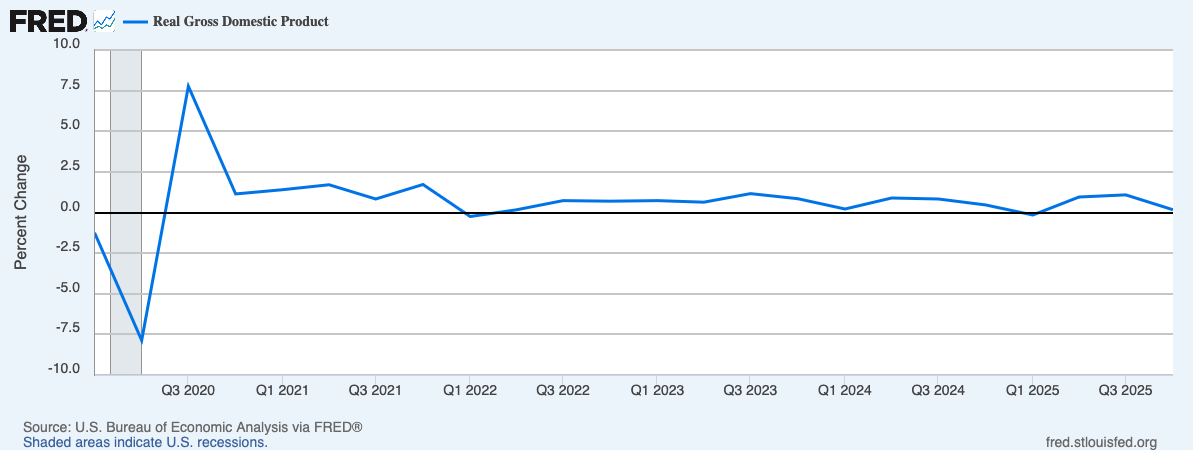
However, the stagflation is here. Check out this graph of Real GDP. As you can see, in Q4 it had fallen almost to zero. The economy wasn’t shrinking, but it was stagnating.
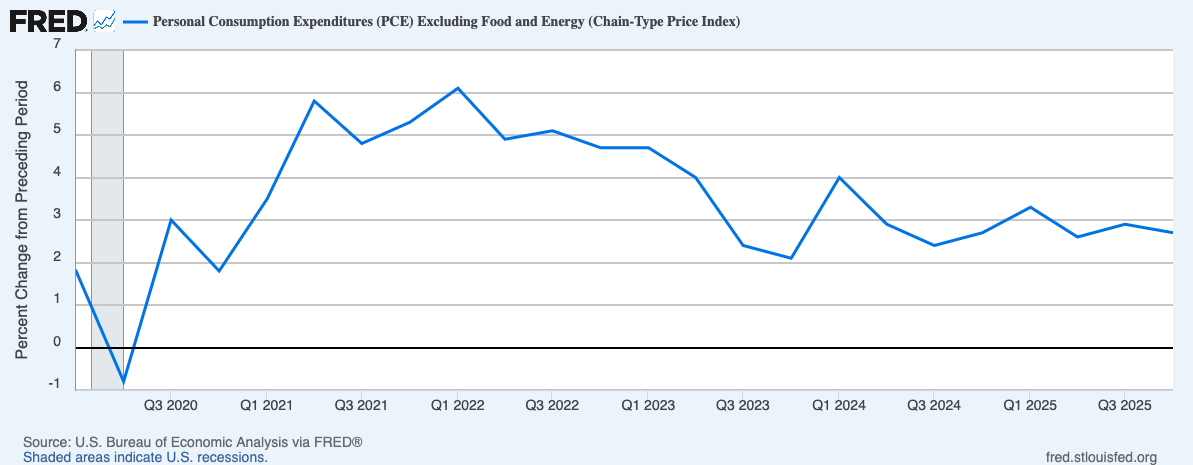
At the same time, inflation had quit coming down. Here’s a graph of Core PCE, the Fed’s preferred inflation index. After getting down almost to 2% (the Fed’s target) about 8 months ago, it reversed course and has been bumping along close to 3% since then.
I think all of these things were about to get worse. Even with the Supreme Court’s ruling that a major part of Trump’s tariffs were illegal, there were plenty of others that aren’t going away. The tax cuts are still in place. Immigration has virtually come to a halt, many immigrants have been detained or deported, and any sensible foreigners with skills that they can apply elsewhere are fleeing the country.
So: Stagflation was already here. But things are about to get much, much worse, because now there’s a war on.
That has already spiked up oil prices. Those won’t feed immediately into Core PCE (which excludes food and energy prices), but will feed in over time, because higher energy prices make everything we produce more expensive. And, of course, wars are fantastically expensive, meaning that the deficit will blow out way worse than it was already going to, which will lead to higher interest rates (soon) and higher taxes (later).
Oh, and don’t expect AI to save us. If you listen to the business news, you know that the only reason the economy isn’t in much worse shape is that businesses have been paying huge amounts on AI infrastructure. As I wrote in my AI bubble post, I think a large fraction of the data centers and model training that that money got paid for will turn out to be worth much less than was paid for it.
So, where are we? Well, about where I thought we’d be, as far as the economy goes—in a modest stagflation that could be fixed pretty quickly, at the cost of a substantial recession, if the Fed had the guts for that. Except that now we’re in a war too.
I can tell you how to arrange your finances to survive a stagflationary period, but I can’t tell you have to survive a war. Wars are very bad, much worse than recessions.
If you know how to survive a war, let me know. If not, good luck.