I’m having pretty good success with my new daily routine.

Things haven’t gone perfectly. One day last week I was coming down with a virus and took a sick day—no fiction writing got done. Yesterday’s bitter cold kept me from getting out to exercise—no walking, no lifting, and no taiji.

Today, things went pretty much according to plan. I had breakfast at 6:30, got to work at 7:00, and wrote until 8:30. Then I bundled up (still pretty darned cold) and walked to the Fitness Center, where I did my usual lifting and stretching, followed by about 25 minutes of qigong and taiji. I deviated from my schedule a bit, having an early lunch before getting back to fiction writing, but I did do two 90-minute sessions, which were both reasonably productive.

The novel’s word count has actually been soaring, because I’ve been slotting back in bits and pieces that I’d pulled out in a previous restructuring effort, now that I’ve got a better idea where they go. I’ve just about finished that phase, and it is almost time to settle in for the next major phase of writing new prose. (Which I’m all excited about, because that’s the fun part.)

One reason I haven’t been more productive these past two years is that I’ve let my fitness activities consume the morning hours that are my prime writing time. I know that, and I want to free that time up for writing, but I’m loath to give up my taiji, because of the way it has been almost miraculous in changing my body for the better.

Five years ago I was starting to feel old. I could still do all the ordinary stuff I needed to do every day, but my spare capacity was shrinking. My balance and flexibility and strength and endurance were all less than they had been—and only just barely good enough. Any unusual stress, such as carrying something heavy up or down stairs, or moving across rough or shifting terrain, seemed dangerous. I had trouble getting a full night’s sleep, because my back would ache after lying still for a few hours.

Taiji (together with lifting) turned that completely around. I feel better than I’ve felt in years. I really don’t want to give that up.

The problem is, I’ve been devoting a huge chunk of each morning to the lifting and the taiji class, and morning is by far my most productive time to write.

Fortunately, I think I’ve figured out a way to deal with that. The key—and I’ve known this for a long time—is to start my writing first. Once I’ve had a solid writing session, taking a break for some exercise is perfect. After that, I can get back to writing. (Whereas I’ve found it very hard to start writing after a long morning of exercise.)

The way we’d been doing it, we’d do our lifting before taiji. We briefly experimented with doing the lifting after taiji, but I found that hurt my knees. (My theory is that the taiji tired out the small muscles that stabilize my knees, making them just a little too wobbly for heavy lifting.) This has been great for actually doing the lifting, but has meant an awfully early start to the day—too early to fit in writing first.

So, during the last week of December and the first two weeks of January, while the taiji class is on break, I’m experimenting with a new daily routine. I’m still tweaking it, but as currently sketched out, it looks like this:

  • At 7:00, right after breakfast, I sit down to write fiction, and work for 90 minutes.
  • At 8:30 I take a break and spend the hour from 9:00 to 10:00 engaging in some fitness activity: lifting or taiji. (Once the class resumes, I’ll do the class on days that it meets, and lift on the other days.)
  • Back home by 10:30, I write fiction for another 90 minutes, then break for lunch at noon.
  • After lunch I get back outside and walk again. Lately I’ve been using this time to play Ingress, but in the summer I may just walk, go for a run, or whatever.
  • In the mid-to-late afternoon, I may do a bit more work on some writing-related activity: Writing non-fiction (such as a Wise Bread post), revising stories, submitting stuff to editors, critiquing work for the Incognitos, etc.

I’m trying to be a bit more careful about social media, because of how easy it is to fritter away a whole morning reading stuff my friends have found interesting, without abandoning it. Right now I’m checking social media briefly before breakfast, then staying away from it until after lunch, then pretty much allowing unlimited checking in the afternoons.

I’ve been doing this for more than a week now (with the modification that on Saturday and Sunday I just do one fiction-writing session, rather than two). It’s going great so far—I’ve gotten several thousand words written on my novel.

I’ll keep you posted.

[The core of this post was originally written as part of my year-end summary of my writing. However, not being about my writing in 2013, it didn’t belong there, so I’ve pulled it out and made it a post of its own.]

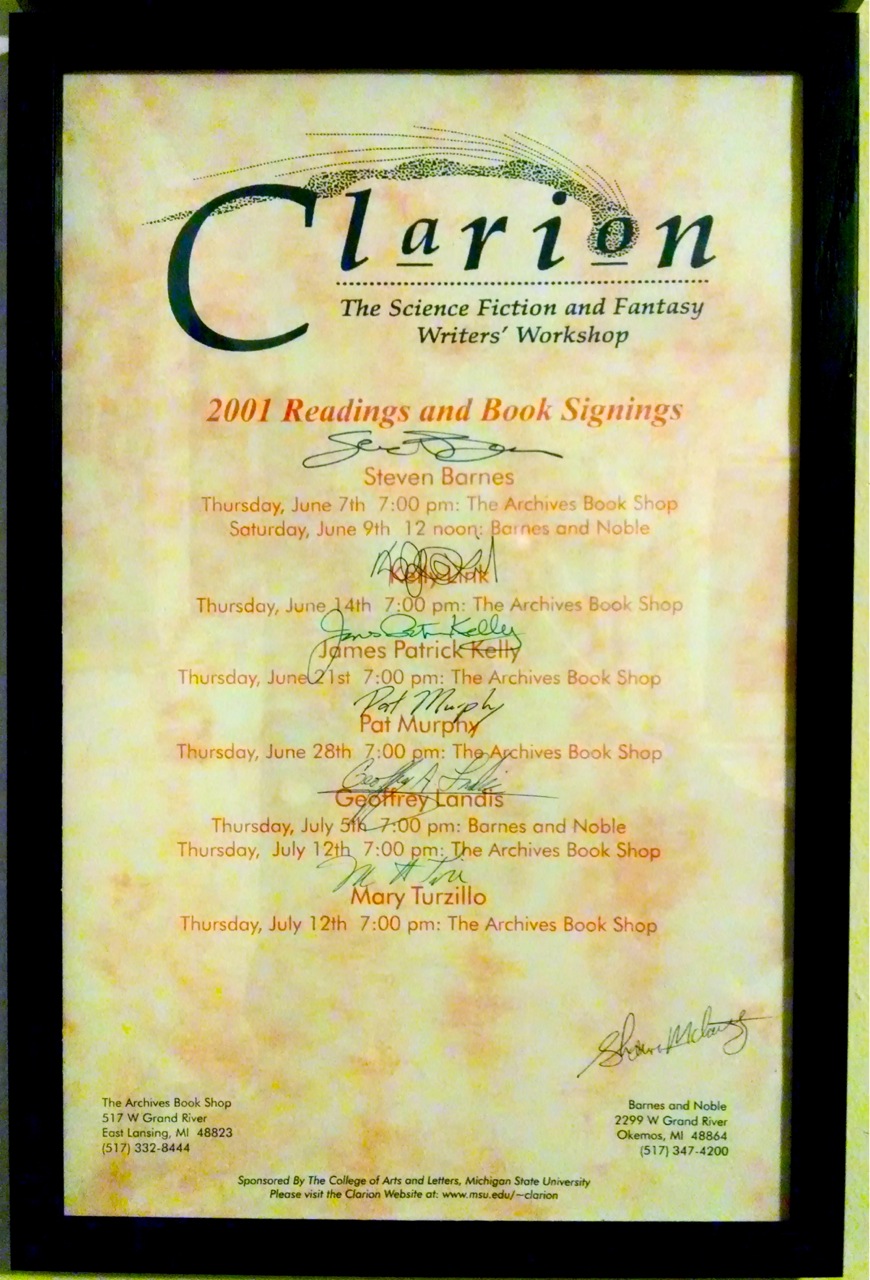
clarion-2001-poster-framedAll the writers who taught at my Clarion did readings at the Archives Book Shop, a local bookstore in East Lansing. To advertise the readings, the Clarion office folks printed up a poster with the names and dates. And, as one of our little perks, we each got a copy signed by all the writers (and by our special guest editor).

I’ve had this poster for more than 10 years now. I always meant to get it framed so I could hang it up, but it was one of many things that I kept not getting around to. But for some reason, this past week it suddenly seemed to be the thing to get around to next, so I did. I measured the poster, went to a local shop that sells ready-made frames in standard sizes, and picked up a frame the right size. It was just what I wanted (simple, black, wood frame), but instead of a proper hanging wire, had some crappy metal bracket for hanging the picture, so I also had to buy a kit with some screw eyes and picture hanging wire, but that was cheap.

It still took a couple of days to get it all put together—picture in frame, screw eyes in frame, wire strung between screw eyes—but now it’s done.

I’m pretty pleased. Maybe having it up will help inspire me to keep at my fiction.

Click through for a picture big enough to read all the details.

I’m kind of disappointed with my writing in 2013. I wrote less this year than any year since I quit working a regular job.

I don’t have any new fictions sales. Worse, I don’t even have any stories out, which is just dumb, because I’ve got some new stories that have not yet made the rounds.

I was less productive at my non-fiction writing as well, only writing 15 articles for Wise Bread. (Actually, I’ve written two more that have been turned in to Wise Bread, and that I assume will be published in due course.)

There are bright spots. I’ve got a novel-in-progess that continues to appeal. (Unlike previous novel attempts that fell apart after ten or twenty thousand words.) In the first half of the year, I completed two short stories (plus one in Esperanto). As the year drew to a close, I was back at work on my novel, writing every morning. It feels good. (I’ve started a new post about my new writing schedule, that I’ll post once I have a bit more experience with how it’s going.)

Here’s the list of Wise Bread posts for this year. I’m pretty pleased with all of these, even though there aren’t as many as I’d like. (Can you spot where the Wise Bread editors started rewriting all my headlines?)


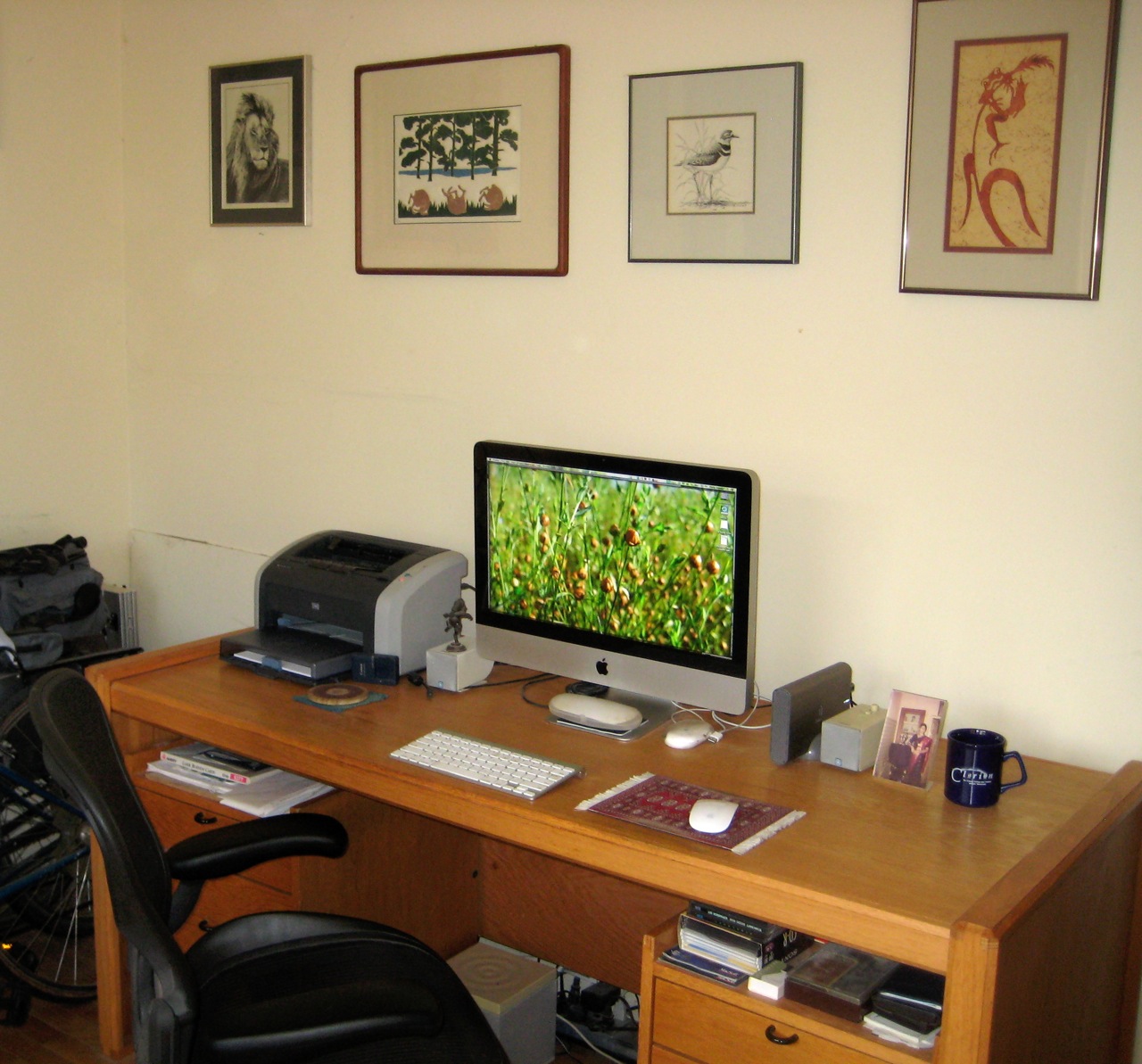
workspace-2013Jackie and I have been working on decluttering the study. We’ve been at it for 3 days now, off and on, and we’re making great progress.

My own focus in the initial phase has been on my workspace. I’m pretty pleased with where I am just now.

I almost didn’t post this picture, as it looks little different from other recent pictures of my workspace, but (on the theory of “pics or it didn’t happen”) I felt like documenting the fact that I’ve actually restored my workspace to its desired uncluttered state.

The area behind me is still not up to being documented. Anyone who had seen it any time before three days ago would be impressed by how much progress we’ve made, but there’s still stacks of boxes, a stack of books, and other clutter.

I think the clutter had been weighing on me, looming up behind me, making it harder to write. Hopefully, this will help.

In an excellent post trying to provide a model for the current e-book market in historical terms, Bruce McFarling suggests that e-books have currently re-invented the dime novel: a publishing unit of a single story, typically of the length that we in the sf world would call a novella (17,500 to 40,000 words). He goes on to suggest that what we need is to reinvent the successor to the dime novel: the pulps.

Tobias Buckell takes issue with this, but I think he’s missed the point. The key feature of the pulps (and McFarling does say this, although he mixes in other issues as well) is not that pulps ran serials. What pulps had was an editor, who provided additional content that fit in well with the anchor story.

The anchor story of a pulp magazine was typically a novella length work very similar to what might have appeared in a dime novel. It was usually by a big-name writer—someone whose name on the cover would drive newsstand sales. And if that’s all it had, it would basically just be a dime novel. But an issue of a pulp had more.

Along with the anchor story, the editor would run three to six short stories, some of which would be by writers who were not big names. They would be the sort of stories that, in today’s e-book market, would sell in single-digit quantities, unless someone with some stature recommended them—which is what the pulp editor was doing by putting them in a magazine with an anchor story. The editor was telling his readers, “Hey—if you like this sort of thing, you’ll probably some of these sorts of things too.”

This was a huge change and a big win for everybody. It meant that new writers had a much better shot at reaching new readers. It also meant that readers had a chance to find new writers whose work they would like. And it did those things at very low cost. The reader paid nothing extra (an issue of a pulp also cost a dime), they got their anchor story, and they got a few extra short stories essentially for free. The extra content was also pretty cheap for the magazine, as the editor didn’t have to pay nearly as much for the short stories by the new writers as he did for the novella by the big-name writer, and each extra name on the cover had some chance of attracting some additional newsstand sales, as those writers made their way from being new to being big names in their own right.

This won’t be easy. One problem is that e-books don’t make as good a format to provide this extra content. It’s very different from a magazine where you can quickly turn to and then read the anchor story you bought it for—and then have the issue as a physical object setting around for a while, giving you any number of chances to pick it up and give some of those other stories  a try.

Maybe if the anchor story is right up front, where the buyer doesn’t have to skip over anything to get to it, then extra stories right after it have a shot at getting read. (Doing it the other way around seems like a terrible idea—does anybody skip over stuff in an e-book and then go back later and read it?)

Of course Toby is right that we don’t need something to be “like” historical forms—they already exist. The e-book is its own thing and people will find their uses for it. But I hope that McFarling’s larger point is well taken by all the smart people working on writing, editing, designing, publishing, and selling e-books. A way to create for e-books something like the value-add that pulps created when they published a longer work by a big-name author together with a few shorter works by new writers that readers would probably like would be a huge win for everybody: readers find new writers that they like (cheap or even for free), writers find new readers—and they (and editors) get paid.

By the way, I discovered along the way to writing this that Stanford has an extensive collection of dime novels available as pdfs.

I’m a huge fan of a particular sort of scenes in stories—the scenes where the hero gets into shape.

I was reminded of this recently, after reading Greg Rucka’s Critical Space, a thriller I read after it was mentioned by Marissa in a recent post, which has an excellent instance of this sort of scene. The getting-in-shape sequence in this book takes the form of a montage (much as you might see in a movie with such a sequence) written in second person. You swim. You run. You do yoga and ballet. You take supplements and you eat lots of fruit. You lift weights. You see the changes in your body. You learn to be an assassin.

I have long been a fan of these scenes, both in books and movies. They’re a key part of the original Rocky movie, of course, and are practically all there is in Rocky III. I’m especially fond of the getting-in-shape sequence in the book Man on Fire by A. J. Quinnell, and I’m still bitter that the movie completely omitted the sequence. (Easily the best part of the book.)

A lot of sf and fantasy stories have versions of these. For example, Steve Miller and Sharon Lee’s Liad books often have characters learning a martial art. In these, as in a lot of fantasy stories, the hero or heroine often turns out to have an especially high level of natural talent for the art. I view this as a negative—it’s more interesting to me when the hero lacks any extraordinary skill, but manages to excel through hard work. Patrick Rothfuss’s Wise Man’s Fear does a particularly good job in the scenes where the hero learns a taiji-like martial art. Instead of the hero having preternatural talents in the area, his success comes from seizing an opportunity (and, of course, having preternatural talents in other areas).

A whole genre of its own is the boot camp story, where the heroes not only become fit and learn a lethal skill, but also learn something about teamwork and camaraderie.

Anybody out there like these sequences as much as I do? Can anybody point to books or movies with particularly good instances?

I think the first advice I ever got from a writer about writing was that I should write every day. It’s also probably the best advice. It’s certainly the most common. In any case, it’s advice that I accept.

Writing daily is good for many reasons.

First of all, it means that you’re making progress. That’s all it takes to eventually get to the end. If you write just one page—250 words—each day, then in less than a year you can write an 80,000 word novel.

Second, you’re making it a habit. I find it a habit that’s easy to keep, if I just do it. Even on the busiest days I can squeeze in a few minutes of writing. But once I decide that it’s okay to skip a day to handle some other major task or allow for some schedule conflict, I find that writing “almost” every day is a much easier habit to let go by the wayside.

Third (and this seems especially the case for writing a novel in particular), you’re inhabiting the world you’re writing about. As long as I’m writing every day, the characters remain fresh, their world remains alive, their situations remain immediate. If I wrote yesterday, I’m vastly more productive today than if there’s been an interruption.

I wrote a while back about the difference between writing every day and exercising every day, because I think they’re very different. Exercise is about stress followed by recovery. You can exercise every day, if you’re smart about making sure that each day’s exercise activities allow for recovery from the previous day’s exertions. In running, alternate long runs with short runs. In lifting, alternate upper-body with lower-body.

It may be that reason number 2 (making it a habit) is a good enough reason to create an exercise schedule that allows for daily exercise, but I don’t think it’s important for creating a successful fitness regimen. It’s perfectly possible to get fit exercising just three or four days a week.

But I think reason number 2 is the least important reason why writing every day is important. Reason number 1 (making progress) is more important. It scarcely applies to fitness. (It’s not like you’re ever going to be done with fitness the way you can be done writing a novel.) And reason number 3 (inhabiting the world of your story) doesn’t even really have an analog in fitness.

This post was prompted by the recent post by my Clarion classmate Beth Adele Long, who has started a public effort to write a novel by writing daily.

But I’d already gotten myself back to daily writing some days ago: since January 21st, I’ve worked on my novel every day. Early on there was day that I only managed to get 41 words written, but I got those words and hundreds more each day since then. All together, I’ve written almost 8000 new words since getting back to daily writing—a tenth of a novel right there.

I’d written the first quarter of a novel some months ago (writing daily most of that time) and then stalled out when I discovered that the middle of the novel was terribly dull. I’ve spent the months since then figuring out where I’d gone wrong, and I don’t think I’m going to have to throw away much of what I wrote. I’ve got most of the already-written part whipped into shape and (I think) I’m ready to jump in on the next part and write the middle of an interesting novel.

So, one question is, if I hadn’t let the fact that I was writing a dull middle of a novel stop me a few months ago, would I be ahead now? After all, I could have written 165,000 words of dull middle in that much time—and very possibly I could have figured out where I’d gone awry sooner than I ended up figuring it out.

On the other hand, in that time I finished two short stories and got them out to markets.

So, I don’t have an answer there. But I am back at work on my novel, and I’m once again writing daily.

For the first time in far too long I finished a draft of a story and sent it out to the Incognitos and a couple other first readers.

The working title of this story is “the demon story” and it is special in that it is by far the oldest story still in my “active” folder. It has its roots in the very first story that I started working on when I started seriously trying to write fiction for the pro markets, back in the 1990s. I have versions of this story dating back to 1995.

It’s also unusual in that it’s the only story that I’ve finished a draft of and then neither submitted nor abandoned.

The usual advice—almost universal advice—is that you not endlessly rewrite the same story. You’re almost always ahead of the game to simply write the best story you can, finish it, start submitting it, and then go on to something new. At some point, if you can’t produce a submittable draft, your time is almost certainly better spent working on a story that you can finish.

For this story, I’ve made an exception. I like it too much to submit a version that doesn’t work.

However, I’m done with it for now. Hopefully, the critiques will tell me that it’s nearly working, and give me a few tips for improving it. If so, it’ll go out to editors very soon.

I didn’t sell any new stories in 2012, but I did have two reprint sales:

I’m a bit dissatisfied with my productivity of new fiction—I scarcely finished a story all year, although I worked on several, as well as on a novel. I will apply myself to both with renewed vigor in this new year. (The novel, in particular, although forward progress stalled out some months ago, is still attractive. That’s different from previous novel efforts, where I discovered structural problems that made them seem too flawed to be worth continuing.)

One member of the Incognitos moved away this year. That, together with the fact that none of us was quite as productive as in years past, has meant fewer meetings, especially in the second half of 2012. However, we’ve recently been in touch to work out plans for including the absent member via Skype, so we’re all set once we start getting stories finished again.

On the non-fiction front I did about as well as last year.

I had a guest post at Asta Lander’s Simply Living blog called Choosing Freedom, about the tradeoff of freedom for a high standard of living.

I was interviewed about my thoughts on personal finance and frugal living for both a podcast and a radio program, specifically:

One of my old Wise Bread posts was featured on the Soldierette blog.

I wrote 27 articles for Wise Bread. I’ve bolded a few where I thought I managed to say just what I was trying to say: