I’ve known for a long time that writing every day is very helpful to my productivity. In the past couple of days, I’ve been reminded that, at least for my fiction writing, it’s also very important to start early in the day.

I’ve always found this a little hard. It’s tough to get going on fiction, even if I’ve got an outline, or have left off writing at a ragged edge where I know just what needs to come next. Faced with that—or, especially, faced with a blank page—it’s very easy to fritter away a few minutes (or a few hours).

Over the past couple of days, I have started early, and have rediscovered a bit of magic: Once I get my brain back into the story space, it solves problems wonderfully well—even when I’m not writing. While I make a mug of tea, I’ll realize that a scene with a phone call should be redrafted as a face-to-face meeting. In the time it takes me to walk to lunch and back, I’ll figure out that two cardboard characters can be combined into one three-dimensional character. As I shower, I’ll figure out how to replace a dull scene with a one-sentence lead-in to the next scene. (But only if I take my shower after the first writing session of the morning.)

This happens all the time, and if I don’t get started writing until late in the day, it becomes a source of frustration. The ideas will start coming, and I’ll still be fresh and anxious to start working on them—but I’ll be out of time. It’ll be evening. I’ll want to spend time with Jackie, doing something together.

So, a reminder to me: If I’m writing fiction, I want to start early. It’s more productive and more fun.
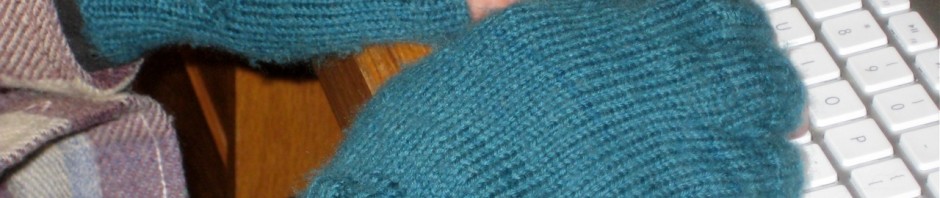
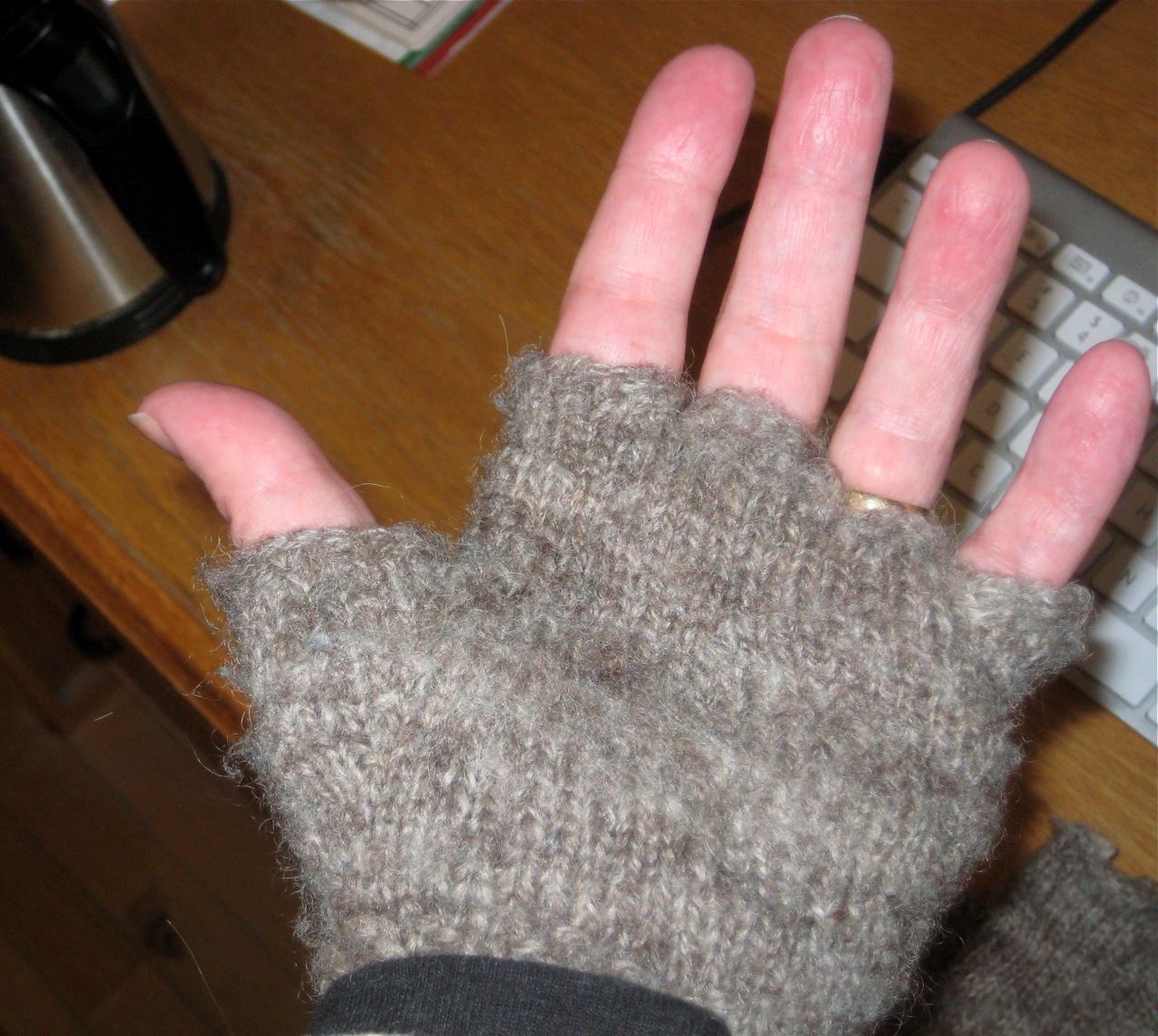
We keep our apartment cool, in the interest of minimizing our contributions to both resource depletion and global warming. Plus, Jackie likes to wear her woollies, which isn’t practical in a warm apartment. The only real downside is that, in a cool apartment, my hands get cold when I write. To address that problem, Jackie offered to knit me some fingerless gloves. (Click any of the pictures for a larger version.)

Fingerless gloves
My first fingerless gloves

My first pair of fingerless gloves were knitted to my precise specifications. It’s made of fairly course yarn, which I figured would be fine for my purposes, and it has the fingers truncated almost completely, which I figured would make it easier to type.

Unfortunately, even just the row or two of knitting that formed the finger holes turned out make them a little uncomfortable for typing.

Since those weren’t quite satisfactory, I came up with a new design—fingerless gloves that not only had no fingers, they didn’t even have finger holes.

My Rosebud Wristlets

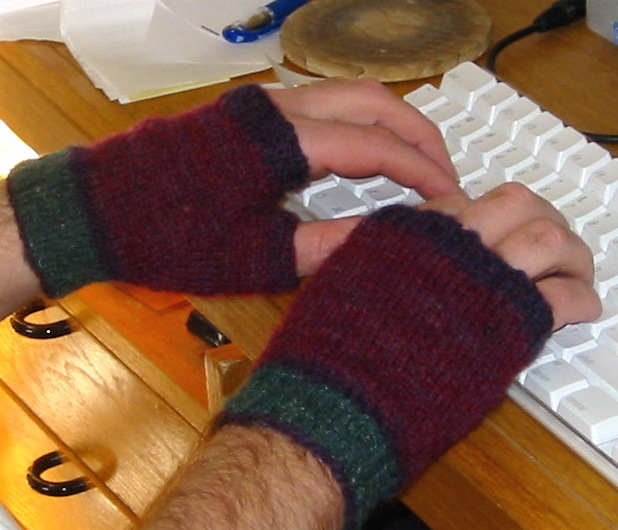
Jackie made these most lovingly. She not only spun yarn by hand, she spun it by hand while attending a science fiction convention (WorldCon in Toronto). The main color was hand dyed as well (with brazilwood). The yarn is wonderfully soft and fine. I got to pick the colors, and I picked these colors so that I could call them Rosebud Wristlets.

My Rosebud Wristlets were a complete success, and they’ve been my main fingerless glove for seven years (they were a Christmas present in 2003).

I liked them so well, I got Jackie to make a second pair that we gave to Kelly Link.

My 2010 fingerless gloves

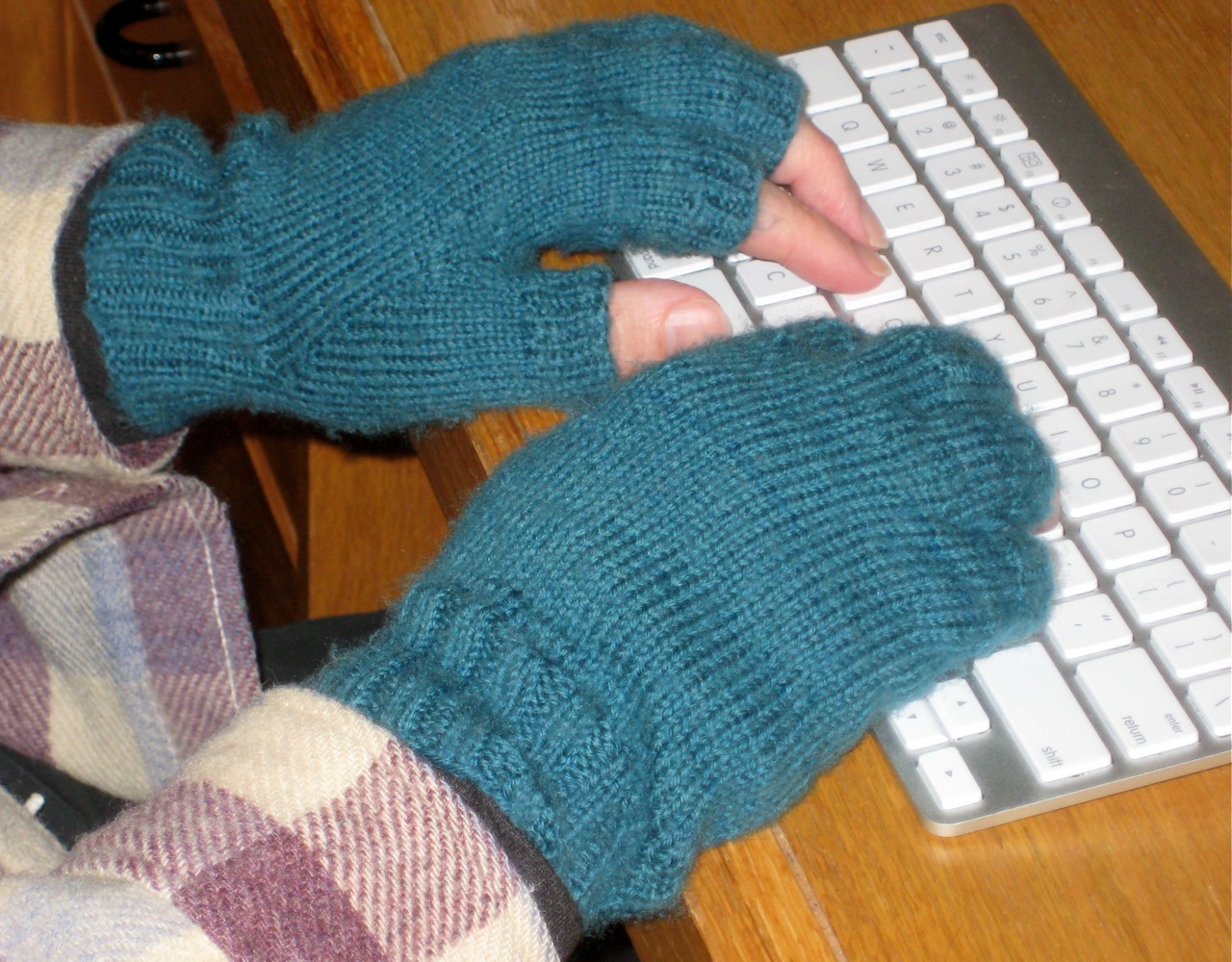
Not having fingers at all was great for leaving my fingers free for typing, but had a downside: My hands stayed warm, but my fingers sometimes got cold. So, I asked for yet another pair of fingerless gloves, this pair with fingers, but made from yarn so fine that it wouldn’t force my fingers uncomfortably far apart.

So, Jackie knit me this pair of fingerless gloves. Each glove finger extends out to the last knuckle of my finger. They’re made from machine-spun “fingering weight” yarn (perhaps called that because it’s the right weight to use when knitting glove fingers).

They’re wonderful. They’re not more wonderful than my Rosebud Wristlets, but they do keep my fingers warmer. So far I’ve been alternating between them, depending on whether just my hands are cold, or my fingers too.

For a while I’d imagined that I might design the ultimate fingerless glove, but it turns out, as usual, that the best tool for the job really depends not only on the precise details of what you’re trying to do, but also the precise circumstances under which you’re trying to do it.

During week two at Clarion, I wrote a story that played to my strengths—one where the story was strengthened by being told from the viewpoint of a character who was almost affectless, so the story didn’t suffer from my limitations at showing a character’s feelings as he suffers.

As I observed at the time, this was probably a mistake:

The thing is, Clarion isn’t a time to stay within your limitations. It is a time to push beyond them. So, I’m a bit disappointed in myself. But only a bit: I didn’t do it on purpose; I was just trying to tell the best story I could. Now that I’ve thought about it, I’ll take more risks with the next one.

And I did. In fact, I’ve taken that particular risk with pretty much every story I’ve written since then. And with practice, I have gotten better at that aspect of storytelling and character development. In fact, I’ve used every story I’ve written since then to try to stretch my abilities, not just in that area, but in every other area where I know I have weaknesses.

That was probably a mistake too.

If you want to sell your stories, they need to be the best stories you can write. But for the past ten years, I have refrained from telling stories in a way that let me keep within my limitations, because I wanted to grow as a writer.

It was great practice. I’ve learned a lot. I’m a stronger fiction writer now. But I’m not quite sure how I fell into the notion that I needed to try to push beyond my limitations with every story I wrote.

Within the context of a workshop, sure. It would be a waste of the opportunity to workshop a story that I’d crafted such that it required only the tools I’d already mastered. But for other stories—for stories that I’m writing to sell—perhaps it wasn’t necessary to make such an effort to showcase my weaknesses.

Why it took me ten years to figure this out, I’m not sure. But I have finally, I hope, learned better. I’ll still try to stretch and grow as a writer. But at least some of the stories I write—for a little while, perhaps many of them—will be crafted to showcase my strengths.

Theodora Goss has a good post about writing every day, comparing it to exercising every day. She makes the point that, when you’re used to exercising every day, missing a day makes you feel crappy.

My own experience has been different, perhaps because my choices of preferred exercise include lifting weights and running, which both tend to wear your body down. They make you fitter, but only if you give your body a chance to recover.

When I exercise several days in a row, I gradually feel more and more beat up. I get sorer and sorer, weaker and weaker. Then, when I take a day off, I feel great. The next day I feel even better. I’ve often joked that it was like the old joke: “Why are you hitting your head on the wall?” “Because it feels so good when I stop.”

It’s actually pernicious. Some stupid bit in the back of my brain notices that feeling great is associated with skipping workouts. It conspires with the parts of my brain that would rather I sleep in and then sit around. It’s not smart enough to understand that I only feel great on a rest day if I had a couple of hard workouts in the days leading up to it.

Despite my particular experience with exercise, though, my opinion on writing matches hers—I do much better when I write every day. It keeps me in the flow of my work. When I write every day, I don’t need to spend as much time warming up, getting started. I definitely don’t need to spend as much time getting back up to speed on an on-going project, but I think it helps even when I’m switching between projects.

Like Dora, I’ve pondered the parallels between daily exercise and daily writing. In some ways they’re the same—there’s a discipline involved that’s definitely self-reinforcing—but in other ways I’m not so sure.

I’ve sometimes overdone the writing—written too many words or for too many hours. When I do that, it’s tough to write the next day. I don’t know what I want to say next, and when I figure it out, it’s harder to find the words. I need to take a day or two off—do some non-verbal work, mull things over for a bit—before I’m ready to get back to work writing. And by then, something has often gone missing. The carefully maintained mental construct of what I’m working on deteriorates very quickly, if I’m not writing every day.

And there, I think, is why exercise is sometimes different. Exercise is all about stress followed by recovery. Writing is about inhabiting the world I’m writing about—something that works best if I do it every day.

I sold one story in 2010 (“Like a Hawk in its Gyre” to Redstone), which I’m expecting to appear in early 2011. I’ll post here when it comes out.

The other big fiction-related news is that I got together with some local friends to start the Incognito Writers Group. We’ve been meeting monthly since July, and having a great time.

I sold a group of articles to Amex Currency, a new personal finance website:

I resold my article Bankruptcy is a Good Thing to Gale Publishing, to use in their book Bankruptcy (Introducing Issues With Opposing Viewpoints).

I wrote two guest posts at other blogs:

I wrote 42 articles for Wise Bread. I’ve bolded a few where I thought I managed to say just what I was trying to say:


If you’re a writer of speculative fiction, you’ve probably already heard of the Clarion Science Fiction and Fantasy Writers’ Workshop—and probably already spent some time wishing you could go. At least, that was my experience. I first heard of the workshop in the late 1970s; I didn’t manage to attend until 2001.

For me, Clarion was a purely positive experience. I learned a lot about writing, wrote several stories (one of which got published in a good market), met a bunch of great writers (both teachers and fellow students), and generally had a blast nearly every day for six weeks.

If you want to know what Clarion was like for me, you’re in luck—I kept a journal of my time at Clarion. (Other possibly useful stuff I wrote about Clarion include my article How I Learned at Clarion, which talks about my surprise at discovering that the activities that I thought would be more or less useful turned out to be just about backwards, and my page on Clarion Costs, which talks about my Clarion expenses.)

But what’s more important is what Clarion will be like for you, which is something that you can’t read about—it’s just something that you’ll be able to write about, if you go.

Here’s the official announcement.

If the idea appeals to you, there’s a button at the bottom of the Clarion page that you can click to start your own application.

As NaNoWriMo ends, I’ve taken down my progress bar. It topped 15,000 around mid-month, but hasn’t moved much since then. I’ve re-learned a lesson I’ve learned before—I can only produce around 1000 words of fiction per day on a sustained basis.

At the end of the first week I managed a 2300-word day to get back on track, but then only hit 300 words each of the next two days. That pretty much put paid to the notion of hitting 50,000 by the end of the month—and the related discouragement made it all the harder to be productive over the second half of the month.

However, I’m by no means giving up. At 1000 words per day, I should be able to finish this novel in just another couple of months.

That’s my plan. I may even put up a non-NaNaWriMo progress bar.

Even with the failure to produce a novel in a month, I’ve found the process to be useful. Two things in particular stand out:

  1. I had a boatload of new novel ideas that I’ve had to push aside to keep working on this one. They all seem particularly shiny. I’m looking forward to picking one of them to work on next.
  2. I’ve learned a lot about structuring a novel, which is very different from structuring a short story. I’ll have more to say about that in the future.

I spent most of the morning making minor revisions to my outline, based on insights into how the novel should be structured. There’ll be some more of that this afternoon—but also, hopefully, some new text generation as well.

A productive day today.

Thursday is my busy day—lifting weights and Taiji in the morning, lunch with friends, and then the weekly Esperanto Club meeting in the evening—so I hadn’t hit my word count that day. On top of that, I’d fallen slightly short on Friday as well, so I got up this morning some 500 words off the pace.

One long day of writing today, though, and I’m back on track with just over 10,000 words. And that progress was despite some minor restructuring of the stuff I’ve already written.

I often find it hard to go on when I’m writing stuff that won’t mesh with what I’ve already written. It helps a lot to take an hour or two and get the earlier stuff to match my current conception of the story. Of course it’s better when I don’t spend my time that way, but sometimes it’s just faster to go ahead and do it than to try and keep track of what I need to fix.

Not only that, but I also finished up a Wise Bread post which will probably go up tomorrow or the next day.

I’ve generally viewed NaNoWriMo as a kind of a stunt. After all, only by lucky coincidence would writing 1667 words a day be the ideal pace for any particular writer to write any particular novel. And yet, I’ve often felt a little left out, watching the NaNoWriMos go by without me. So, I decided to participate this year.

After all, having already made three failed attempts at writing a novel in the past three years, the worst that could happen would be a fourth. Against that rather modest downside, the best-case result—that I produce a completed novel that can be turned into something salable—seems worth shooting for. Even if I fall short of that, I’ll almost certainly learn something new about how I write.

It’s already been useful, actually. I’ve been outlining my novel for about a week, but I find just outlining somewhat tedious. If I’d not been following the rules, I’d have jumped in and started writing some of the bits that are already outlined. But if I’d done that, I’d have run into some serious structural problems. I know, because I’ve run into them as I’ve continued outlining. Fixing them in the outlining phase is a lot easier.

So, I’m doing NaNoWriMo. If you are too, friend me. I’m in the system as bradipo.

Currency, a new personal finance site sponsored by American Express, has just gone live with several articles by me.

On retirement

The main article is How Much Money Will You Need to Retire?

It appears along with sidebars:

On health insurance

The main article is How Freelancers Can Budget for Health Insurance.

It appears along with sidebars:

On financial institutions

The main article is Should You Put Your Money in an Alternative Financial Institution?

It appears along with sidebars:

You may have noticed my posting on Wise Bread was a bit sparse lately. Part of the reason is that I was writing all of those. Enjoy!