
Is there an optimal city size? A lot of it comes down to personal preference, of course. If you want to go to the symphony, you need to live in (or near) a city big enough to support a symphony orchestra.

Putting mere preference aside, though, there are some things that ought to be more generally applicable. I remember back in the late 1970s, playing with some data my dad found that reported a bunch of metrics for all the villages, towns, and cities in Michigan.

My dad had hypothesized that there was considerable benefit to the earliest stages of growth (when a town got big enough to move from a volunteer fire department to a professional one, big enough to move from wells and septic tanks to a municipal water and sewer system), but that further growth beyond that stage came with costs that outweighed the benefits.

The data I looked at did show some support for my dad’s position, but I found it hard to make a good case with just the Michigan data. There was only one big city (Detroit), which was something of a special case even then, and only has become more so. I produced some graphs that seemed to show reasonably linear improvements in various metrics of “goodness” as cities grew, on which Detroit appeared to be an outlier—gaining less-than-linear benefit from its growth. I wrote a brief report of my analysis for an economics class, but didn’t have time to delve any deeper.

Just in the past few days, though, I saw the New York Times magazine article “A Physicist Solves the City,” reporting on the work of Geoffrey West and Luis Bettencourt to produce a model that describes urban performance as a function of population. Very briefly, they have found that both good things (GDP, income, patents) and bad things (traffic, crime) grow super-linearly with population growth: Increase the population by 100% and you get a 115% increase in most of the measurable aspects of urban life.

I looked at West and Bettencourt’s article in the magazine NatureA unified theory of urban living” (article is behind a pay wall), which lays out the case in a little more detail, and offers some references. It shows a graph of crime, GDP, income, and patents versus city population. The log/log graph does look strikingly linear (suggesting a super-linear relationship). However, the data come from just US 360 metropolitan areas. That suggests (assuming that they’re working with the largest US cities), that the authors have excluded cities with populations below about 100,000 people. (The 360th largest metropolitan statistical area from the 2000 census was Ocean City, NJ, with a population of 102,326.)

So, this work doesn’t really test my dad’s hypothesis. I’d be really interested to see what the similar curves look like for smaller metropolitan areas. I wouldn’t be surprised to see that growing your population from 1,000 to 10,000 produced rather more than a 15% boost over linear growth.
I spent the whole decade of the 1990s hoping that the economic upturn would prove that the strategy of letting employees go the instant there wasn’t any work to do was unwise. Surely, I thought, those companies would suffer—missing out on business because they didn’t have the skilled employees to do the work (and screwing up on what business they did get, because rushing to hire new employees would result in picking up some duds).

My hopes remained unfulfilled. Oh, probably plenty of companies did suffer from an inability to hire skilled, reliable workers at reasonable wages. Certainly employers complain that they can’t, especially when they’re lobbying Congress for an expansion of the H1 visa program. But it didn’t matter, because the company’s were profitable. (Profitable companies may do as they please; unprofitable companies must kowtow to the financial markets.)

I’ve written about this before, in a two part series at Wise Bread called “What’s An Employee To Do?” Part 1 laid out the issue in some detail, and part 2 talked about the best strategies for an employee to follow. (There’s actually a lot of opportunity for employees in the current situation, as long as they don’t make the mistake of thinking of themselves as employees.)

Prompted by Tobias Buckell’s recent post Working culture, though, I wanted to talk a little about the broader impacts of the way we’ve come to arrange society, because there were other reasons that employers kept employees on during a business downturn. Business owners kept employees on during a downturn because they cared about them as people, because they were friends and neighbors, because the whole community suffered when one person lost a job.

A small part of the reason that things are different now is that this is less true. Managers are not as likely to live in the same neighborhoods as their employees. They don’t shop in the same stores. Their kids don’t go to the same schools. In any case, the decisions are being made far away. (The local managers were completely out of the loop when the site where I used to work was closed down three years ago.)

But that’s just been an enabler of this shift. The real cause is the behavior of the financial markets, which since 1990 have crushed any employer that tries to resist, by driving its stock price low enough that someone could acquire them and bring in new management—management that would lay off plenty of workers.

This isn’t new, of course. Business owners knew that going public meant putting their business in the jaws of the financial market nutcracker—but they made so much money it was worth it. You occasionally hear about the rare business owner who has declined to go public for just that reason—but you hear about it because it’s rare enough as to be news.

As Toby describes, Germany has structures and institutions in place to support businesses that are small and local. Unions are a big one—including the government support for unions that encourage and enable unions to work together in a block. Also important are rules that lean against market pressures for business consolidation, offshoring employment, etc.

Personally, I used to support a purely market-based approach. That’s why I spent the 1990s waiting for markets to punish the bad actors. I’ve changed my mind. It’s fine to leave the fate of the companies up to the markets, but it unacceptable to leave to the markets the fate of whole communities.

Similarly, I used to support the notion that the right way to address this sort of issue was education (because I believe in free choice). Yes, stuff made by prisoners, slaves, and children costs less. Yes, stuff made by heavy industry costs less if the manufacturers are allowed to wreak environmental destruction all across their supply chain. But surely people would make different purchasing choices if they understood that they’re not only paying to have all this harm done, they’re also putting their friends and neighbors (and themselves) out of work. There again, I’ve changed my mind. It turns out, I simply didn’t understand how much cheaper that stuff was than stuff made locally.

Given the option to have the accoutrements of a middle-class standard of living—clothes, dishes, furniture, gizmos—it’s become clear that most Americans will cheerfully accept any amount of slave labor and environmental destruction (as long as they don’t have to see it) and tolerate the destruction of local businesses and the bankruptcy of their neighbors.

They’ll complain about how it affects property values and how it makes it tough to find a job. But then they’ll take their unemployment check and food stamps and go buy the cheapest stuff they can find at WalMart.

Neither markets nor eduction are going to do the job. The U.S. needs to create institutional support along the lines of what Germany provides.

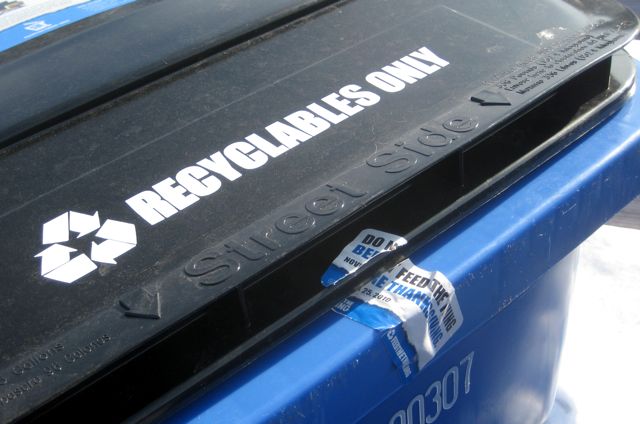
Recycling Bin
Recycling Bin

To me, recycling is kind of a declaration of failure. It’s a statement that that I needed something so badly that I couldn’t just do without it, nor make do with something I already had, and yet didn’t need it so badly that it made sense to buy an item of enduring value—something I’d keep, rather than tossing into the recycling.

Champaign-Urbana, though, is very much a recycling kind of place. Locals in both communities have long had curb-side recycling—but only people who live in houses. For some insane reason, there was no easy way for people in apartments to recycle. (There was a “recycling center,” but it wasn’t satisfactory—it was 3.6 miles away, and really only accessible by car. You could get there by bus, but it took an hour—and you still had to cover a mile of the distance on foot.)

The story, as I understand it, was that apartment dwellers weren’t the sort to take to recycling: They were too lazy, too uninvolved, too low-class. Only house dwellers were the sort of upright people who cared enough about their environment and community.

It’s a story that pisses me off, because apartment living is much more sustainable than vast suburbs of detached homes. To simply dismiss people like me (who chose to live in an apartment on the grounds of simplicity, frugality, and energy efficiency) over an offensive stereotype of apartment dwellers is annoying.

Far more annoying, though, would be to have that stereotype vindicated by my neighbor’s behavior. And the opportunity to find out has arrived here in Champaign. A few weeks ago, recycle bins appeared next to our big dumpsters (sealed shut with a strip of tape asking us not to dump recyclables until Thanksgiving). We all got fliers asking us to feed the thing.

So far, I haven’t seen much use by other residents. We don’t use it a lot, because we don’t produce much recyclable waste, but we have started separating our cans, bottles, paper, and cardboard from the food waste. But even if our neighbors are quite conscientious about reducing and reusing, I’d expect to see more recyclables than I do.

It’s not looking good for team simple-living. Let’s hope it’s just some combination of newness and holiday craziness—that by early next year, my neighbors will be recycling up a storm.

I really don’t want the stereotype of the disengaged apartment dweller to be true.

[Updated 2011-03-11: Once the recycling bins had been in place for a couple of weeks, my neighbors started doing a much better job of putting the recyclables into the recycling. Phew.]

Via Dmitry Orlov, I happened upon America: The Grim Truth, which I think is worth reading, even though I disagree with both the forecast and the prescription.

It’s worth reading because I think it’s actually pretty good descriptively—it nails the split between the reality of the current situation and the average American’s perception of it. I am persistently amazed at the things that Americans just accept.

On food:

Much of the beef you eat has been exposed to fecal matter in processing. Your chicken is contaminated with salmonella. Your stock animals and poultry are pumped full of growth hormones and antibiotics.

On education:

In most countries in the developed world, higher education is either free or heavily subsidized; in the United States, a university degree can set you back over US$100,000. Thus, you enter the working world with a crushing debt. Forget about taking a year off to travel the world and find yourself – you’ve got to start working or watch your credit rating plummet.

On wealth:

America has the illusion of great wealth because there’s a lot of “stuff” around, but who really owns it? In real terms, the average American is poorer than the poorest ghetto dweller in Manila, because at least they have no debts. If they want to pack up and leave, they can; if you want to leave, you can’t, because you’ve got debts to pay.

On freedom:

Why would anyone put up with this? Ask any American and you’ll get the same answer: because America is the freest country on earth. If you believe this, I’ve got some more bad news for you: America is actually among the least free countries on earth. Your piss is tested, your emails and phone calls are monitored, your medical records are gathered, and you are never more than one stray comment away from writhing on the ground with two Taser prongs in your ass.

Even though I agree with just about all of that, I disagree on the prospects for the future.

First of all, the current situation is still an improvement over most of US history. Through our whole first century and a half, the average American lived a life just as dangerous, just as precarious, and just as vulnerable as the one described above. And if the average American didn’t owe just as much money, it was only because he didn’t have access to that much credit.

My point is not that things are okay now, but rather that the fact that things got better serves as an existence proof that getting better is something that can happen.

Second, although the situation in the US is very bad for someone who has gotten caught in the wage-slave/debt-slave trap, it remains possible in the US to opt out. It’s actually pretty easy, as long as you avoid debt. And avoiding debt is pretty easy: just don’t let yourself be sucked into the consumer lifestyle. There’s an awful lot of crap for sale—don’t buy it. There are plenty of big houses for sale—don’t buy one. You can live in a bigger, nicer apartment if you’re willing to live an hour’s drive from where you work—but if you live where you can walk to work, you don’t have to buy a car. With the money you save, join the rentier class.

I think we ought to change things, and I think it would be great if we could get the government to set rules that would encourage those changes—require uncontaminated food, prohibit predatory lending, protect workers from abuse, etc. But individuals can actually make those changes in their own lives without needing the government to act.

So I don’t see a need to flee the country. But that doesn’t mean that I think things are okay—which is why I think that’s a post worth reading.

I don’t want to say that I’m never going to fly again. I’d fly—if it were necessary to hurry to the bedside of a sick relative or to rescue someone. I might, just possibly, fly in order to take the vacation of a lifetime. But routine flying? I’m done with it. I’m simply no longer willing to participate in the system.

Megan McArdle hits almost the right note in this piece in the Atlantic: Dear Airline, I’m Leaving You. She seems to get the ethical aspect of being a willing participant in an immoral system, although she plays it for laughs.

Through most of the past decade, I flew on business a couple times a year. I got to watch as airport security became more and more a kind of shamanistic ritual better suited to deflecting blame in case of a terrorist incident than actually preventing one.

It always annoyed me—the pointlessness, more than the actual inconvenience. But even more than that, the fact that I submitted to it was a blow to my self-image. I take security seriously—all those business trips were for my work on Bluetooth security. As a person who takes security seriously, I really hated my role in the mock security at airports. Each time I submitted to it, simply because it was the only way to get where I needed to go, I thought less of myself.

I also worry about the TSA agents. Where I was only playing a brief role in the security theater, they were doing it as a career. How soul-destroying must it be when your whole career is performing pointless acts of mock security?

And spending your working life doing mock security is nothing compared to what those poor TSA guys and girls are doing now. Spending your days staring through the clothing of the traveling public? Getting paid to grope a steady stream of tourists and business people? No one with good moral character could do the work—which means that any such people will be quickly driven out of the job. Soon the only TSA agents left behind will be degenerates who don’t understand why what they’re doing is wrong.

And that is what I refuse to participate in. It’s not that I worry about people seeing me naked, nor about someone touching me inappropriately. It’s that the whole system is wrong. It mandates behavior that is uncivilized, unethical, harmful to everyone involved.

If I fly again, it will be because I’m doing something so important that it outweighs the harm of participating in the degrading system of mock security our society has foolishly bought into. That’s a pretty high standard.

[Update: After posting this I discovered TSA Enhanced Pat Downs : The Screeners Point Of View, which shows pretty clearly that many of the screeners know what they’re doing is wrong.]

Back in July I got a note from J.D. Roth, who was lining up some guest posts to run on Get Rich Slowly while he and his wife were on vacation in France and Italy. I was pleased to be asked once again, and wrote a piece that I ended up being rather pleased with. It went live this morning: Why Now is the Time to Think Long-Term. (Spoiler alert: low interest rates are the reason that now is the time to think long-term.)

About twenty-five years ago (as an example of long-term thinking), I had a whimsical investment idea: Buy some cheap land and plant hardwood trees. The trees wouldn’t be ready to harvest for 100 years or so, but it would have been a cheap investment with (eventually) a fairly large payoff.

It takes a certain perspective to make such a long-term investment. I call it a whimsical idea because I’d never have been able to enjoy the financial return. I was already in my mid-20s at the time. Even if I’d selected the hardwoods for quick maturity, they wouldn’t have been ready until I was well into my 90s.

It’s a topic I’ve been aware of since the early 1980s, when very high interest rates produced a spate of very short-term thinking. (In particular, my dad’s publisher tried to weasel out of a book contract, because it seemed more profitable to invest their money in the money market at a guaranteed 14% than to invest it in a book that might not make so much.)

When rates are high, it doesn’t make any economic sense to think long-term. But when rates are low, long-term projects are suddenly reasonable. Since just now rates are at multi-generational lows, Now is the Time to Think Long-Term.

I always enjoy James Howard Kunstler’s rants, and the recent revelation of sloppy bank record-keeping gives him a good jumping-off point.

It’s true that this rather seems to be a third strike by the banks. First, they lent money to people without regard to whether the borrower would be able to make the payments. Second, they made loans on houses that were wildly overpriced thanks to the housing bubble. And now, strike three, it turns out they did such a poor job of record-keeping that they may not be able to prove that they own the mortgage on the house!

The value of those mortgages was already somewhat doubtful, given that the banks only option was to foreclose and sell the house for a fraction of its bubble-inflated value. But if their bad record-keeping means that they can’t even foreclose, maybe the paper is worth zero. If the paper is worth zero, Kunstler figures the results will be dire:

With fraud absolutely everywhere in our banking system, like some advanced metastatic cancer, financial metabolism comes to a sickening stop. Nobody can buy or sell property. Nobody can trust any American financial institution. Money can’t circulate. Nobody will be able to get any money.

Personally, I doubt if most of the records are really lost. If the banks are willing to spend the money—hire a bunch of researchers, archivists, and paralegals along with some secretaries and assistents—I expect they can prove most of the mortgages. But it’d be expensive.

My hope is that this will mean, finally, that the banks will have a real incentive to do what they should have been doing right along—renegotiate the mortgages, writing the value of the mortgage down to something under the fair market value of the house, and the interest rate down to current market rates. If they keep proper records of these new mortgages, they can sweep the problem of the old, sloppy records under the carpet.

So, I’m rather more optimistic than Kunstler on this issue. In fact, I think it just might save us.

Currency, a new personal finance site sponsored by American Express, has just gone live with several articles by me.

On retirement

The main article is How Much Money Will You Need to Retire?

It appears along with sidebars:

On health insurance

The main article is How Freelancers Can Budget for Health Insurance.

It appears along with sidebars:

On financial institutions

The main article is Should You Put Your Money in an Alternative Financial Institution?

It appears along with sidebars:

You may have noticed my posting on Wise Bread was a bit sparse lately. Part of the reason is that I was writing all of those. Enjoy!

Around here, most leases have a “failure to deliver possession” clause that says that, if the landlord can’t deliver the apartment at the start of the lease, you don’t have to pay the rent until he does. That seems superficially reasonable, so lots of people sign leases with that clause. Especially lots of students.

What the students don’t understand is that, without that clause, the landlord would be responsible for paying the damages that result from the landlord not honoring the lease. (Typically, the cost of a hotel room and storage fees for your stuff. Also extra money to your movers, since they probably charge extra to unload your stuff into storage, and then load it back up to deliver it when your apartment is finally ready.) Instead, with the clause, the student is just out in the cold—no place to live, no place to store their stuff—for an indefinite amount of time. Plus, they can’t just go find another place to live, because they’ve signed a lease. Once their landlord delivers the keys, they have to start paying the rent.

This is not something that I would have worried about when I was a student. In fact, I was shocked and appalled the first time I heard about a whole apartment building that was supposed to be finished in time for students to move in August 1st, but was still unavailable the day the dorms opened in late August. (The most common version of this clause in contracts around here does give the renter the right to cancel the whole lease if their apartment isn’t available after 30 days. Maybe that’s required by state law, or maybe it’s just that judges found it unconscionable to try to hold a renter to a lease for an apartment that can’t be made available even several weeks late. In any case, it’s kind of meager comfort since all the good and cheap places to live will have been long ago rented out by the time it’s safe for you to sign another lease.)

Over the years, though, I’ve gotten kind of inured to it. It happens year after year. Especially in years that a big new apartment building goes up, the newspapers have a bunch of stories in late August with sad and angry quotes from frustrated students with no place to live. I almost begin to hold it against the students, for being so foolish as to sign such a one-sided lease. And then I remember how surprised I was the first time the real effect of that clause was explained to me. I remember realizing that I could easily have been caught in the same error. Even six or seven years out of college, I didn’t know the ins and outs of that clause. How could the students know? (Actually, I kept a dorm room right through college, partially because I knew that I didn’t want to try to deal with all that stuff.)

I wish I knew a way to prevent this problem. The two obvious ways have both already failed:

  • Education doesn’t work, because there’s simply too many things that someone who’s trying to set up housekeeping for the first time needs to know. The evidence shows that this particular one falls through the cracks. (The local Tenant Union has been warning about this issue forever.)
  • Reasonable rules don’t work, because there are reasonable rules, except that the rules permit the parties to agree to waive them.

I guess what we need are rules that can’t be waived (or, at least, can’t be completely waved) in the lease. But that’s always fraught. Some people really don’t need the protection—local students who can easily enough wait another few weeks to move out of their parents’ house, for example. And the landlords are already taking a risk by investing in constructing a new apartment building. Layering it up with the risk that a minor construction delay could force them to cancel dozens of leases may be asking too much.

But I’m sure that the current scheme is bad. I see the bad results in the newspaper year after year.

In my review of Dmitry Orlov’s book Reinventing Collapse, I talk a bit about how everyone says that the book is funny, but no one ever quotes the funny bits. There’s a reason: The humor sneaks up on you, building on previous bits. All the really funny bits are only funny if you’ve read up to them.

For those of you who want to read something really funny about peak oil, but were unconvinced that such humor was worth shelling out the cost of a book (or taking the time to read it), there is now an alternative: Dmitry Orlov’s latest article at Culture Change, Peak Oil is History.

Once again, it’s tough to quote a sentence or a paragraph that’s funny, but that’s okay: Just click on over and read the article. It’s free, and it’s much shorter than a book.

Whether you’re one of the people who understood peak oil some years ago or one of the people who just figured it out, Orlov wants to make sure that you understand that the reality of life on the declining side of the oil production curve won’t look like the mathematically smooth logistic function that’s usually displayed. Rather, it will look something like the front side of the curve, with spikes and dips that map to wars and recessions and other catastrophes. Further, he wants to make sure that you know those little jerks up and down—especially the jerks down—matter to you.

It would be theoretically possible to ride the downward curve of oil production in a fashion that would look like the reverse of riding it up. In fact, if we’d spent the thirty years since Jimmy Carter warned that our “intolerable dependence on foreign oil threatens our economic independence and the very security of our nation” preparing to do so—improving our rail infrastructure, switching to wind and solar energy, and generally becoming much more efficient—we’d be in a position to do that pretty comfortably.

In practice, though, things are going to suck.

Things will, however, suck rather differently than people expect—which is Orlov’s point. People expect that the rich will go on much as they have, while the poor will get squeezed by high prices—and there will be plenty of that. But after laying out the reasons why it won’t work that way, Orlov concludes by saying, “it becomes difficult to imagine that global oil production could gently waft down from lofty heights in a graceful smooth and continuous curve spanning decades. Rather, the picture that presents itself is one of stepwise declines happening in more and more places, and eventually encompassing the entire planet.” A stepwise decline that quickly results in even rich people having “no access to transportation fuels and severely restricted transportation options.”

Orlov makes doom just about as funny as possible, perhaps even a little funnier.