“Mounjaro and the weight loss drug Zepbound slashed by 94 percent the risk that overweight or obese adults with pre-diabetes would develop diabetes… a lot of those same people could have had a great outcome with lifestyle intervention”
Let me start by saying that, judging from his previous term, most of what the incoming president says has no particular bearing on what he’s going to do. But I think a few trends look likely enough that it’s worth thinking about the results on the dollar’s value.
The things I’m thinking of are tariffs and tax cuts, which I expect to lead to higher inflation and larger deficits, both of which will lead to higher interest rates.
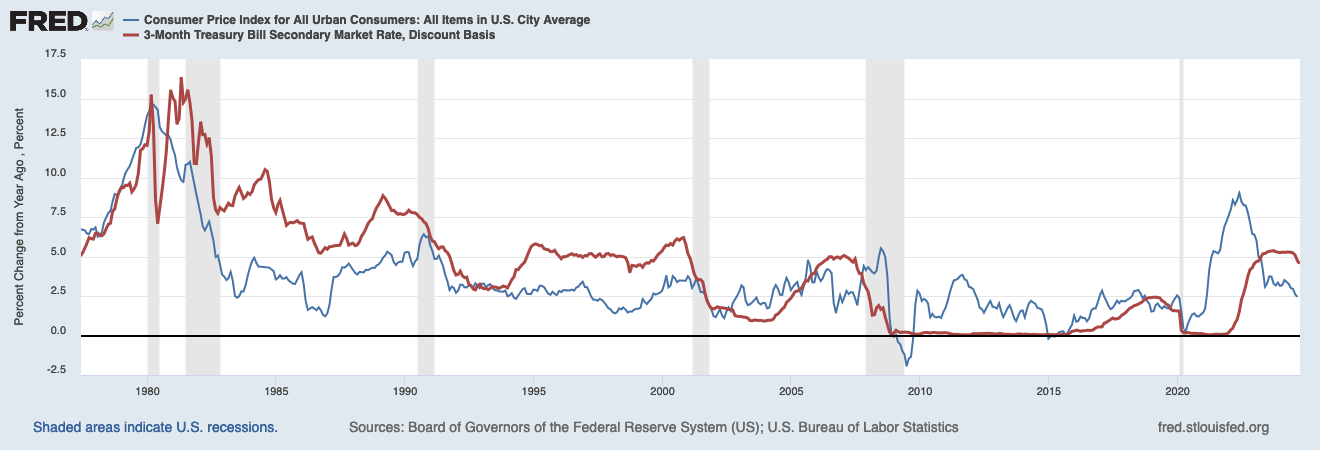
Blue is the historical Inflation rate (CPI vs one year earlier). Red is the historical 3-month T-bill rate (roughly what you could earn in a money market fund). Both are from June, 1977 (when I graduated from high school) through last month.
Tariffs
The president can impose tariffs on his own, with no need for congressional action. Whether we’ll get the proposed 60% tariffs on Chinese goods, or whether that’s just a bargaining chip, I have no idea. But I think some amount of tariff increase will be imposed, which will feed through directly to higher prices.
That’s not to say that tariffs are necessarily bad (although usually they are). But they do feed through to higher prices.
Tax cuts
Tax cuts need to get through Congress. If the Republicans get the House as well as the Senate, it’s highly likely that legislation will preserve the 2017 tax cuts set to expire next year, and probably some additional tax cuts, such as a much lower rate on corporate income. It’s also possible that we’ll see the proposals to cut tax rates on tip income and on overtime pay enacted, although I doubt it. (The incoming president only cares about his own taxes, not about those of random working-class folks.)
The main thing taxes cuts will do is dramatically increase the deficit. The tariffs will bring in some countervailing revenue, but not nearly enough to fill the gap.
Other things that raise inflation and cut revenue
There are all kinds of other proposals that were bandied about during the campaign, such as deporting millions of immigrants, that raise costs both for the government, leading to higher deficits (the labor and logistics both cost money, and not a little) and for employers (they’re employing the immigrants because their wages are lower), which they will try to offset with higher prices.
What this means for our money
Rising costs will feed directly into higher prices, which is going to look like inflation to the Fed, so I think we can expect short-term interest rates (the ones controlled by the Fed) to get stuck as a higher level than we’d otherwise have seen.
At the same time, lower taxes will mean lower government revenues, leading to larger deficits. For years now, the government has been able to get away with rising deficits, but I doubt if the next administration will have as much success in this area. (Why not deserves a post of its own.)
My expectation is that higher deficits will mean higher long-term interest rates, as Treasury buyers insist on higher rates to reward the risks that they’re taking.
So: Higher short rates and higher long rates, along with higher inflation.
What to do
I had already been expecting inflation rates to stick higher than the market has been expecting, so I’d been looking at investing in TIPS (treasury securities whose value is adjusted for inflation). I’m still planning on doing so, but not with as much money as I’d been thinking of, for two reasons.
First, I’d been assuming that money market rates would come down, as the Fed lowered short-term rates. Now that I think short-term rates won’t come down as much or as fast, I’m thinking I can just keep more money in cash, and still earn a reasonable return.
Second, I’d been assuming that treasury securities would definitely pay out—the U.S. has been good for its debts since Alexander Hamilton was the Treasury Secretary. But the incoming president has very odd ideas about bankruptcy. As near as I can tell, he figures the smart move is to borrow as much as possible, and then declare bankruptcy, and then do it again. It worked for him, over and over again. I’m betting that Congress won’t go along with making the United States do the same, but I’m not sure of it.
Of course, if the United States does do that, the whole economy will go down, and my TIPS not getting paid will be the least of my problems.
I’m only surprised this doesn’t happen way more often. Surely a lot of people go into health research precisely to try to cure illnesses they have. If they come up with something very promising, why not try it on themselves?
A scientist who successfully treated her own breast cancer by injecting the tumour with lab-grown viruses has sparked discussion about the ethics of self-experimentation.
After the last 8 or 16 years, I shouldn’t be surprised that racism and misogyny would motivate an actual majority to go to the polls and vote against their own interests. (Not to mention the interests of the United States, the Western world, and all human beings who live on this planet).
I post almost nothing there—basically, just links back to my blog here—but you can go find me there with the other cool kids who are not as clever as Cory Doctorow.
Ashley caught a vole! I wouldn’t let her eat it, because who knows what parasites she’d get from eating a raw wild animal, but she took it very well when I made her drop the vole.
It seemed to have survived being in Ashley’s mouth for several seconds. So Ashley will get to try to catch it again!