I’ve been lifting weights for decades. I was pretty consistent about it for a long time. For years while I was working at a regular job, Jackie and I would go to the Fitness Center and lift before I went to the office at least two, often three times a week, using whatever machines they had (three or four different brands/styles of machines over the years). I saw pretty good gains the first six weeks or so that I was doing this, but they leveled off. I kept at it for years after that, with very little to show for it.
All that time I imagined that the issue was intensity—to make more gains, I needed to lift more and harder. I now think that was wrong. I think the problem was just that machines are a crappy way to build strength or muscle.
Four and a half years ago we moved to Winfield Village, which has a pretty good set of free weights. I’ve been using them—once again without much to show for it. In this case, the issue is not a matter of using the wrong equipment or a lack of intensity—it’s that my consistency has fallen off. I get on a schedule of lifting two or three times a week, but only keep it up for a week or two and then miss a few workouts.
Happily, this month I’m doing pretty well. In 21 days I’ve gotten in 9 lifting sessions, which is just about exactly my target. (I aim for every other day, so when I miss an occasional day it still comes in at 3 times a week.)
I’m seeing some nice strength gains (although after just three weeks I can’t be sure I’m not back in the situation of “anything will build strength for six weeks”). I’m also putting on some weight—probably just because I’ve been eating too many carbs, which I’ll fix here shortly, but in the meantime I’m choosing to imagine that I’m adding some muscle as well.
Understanding that consistency is the key, maybe I’ll be able to keep it up. (Watching my older relatives become frail due to sarcopenia, I’m determined to avoid that fate.)
I’m pretty sure I’ll manage okay until the weather turns and I have to start balancing the lifting with the running and hiking. (I’ve only gotten in one run this month, because of ice and cold.) We’ll have to see after that. But as I say, I’m determined.
Some years back, after I’d finally made some real progress at losing weight and getting in shape, I was thinking of writing a post about it, when an on-line acquaintance posted a stern note to the effect that she didn’t want to see any “weight-loss success stories” from anyone who hadn’t kept the weight off for five years.
It’s a reasonable perspective. Almost any weight loss program will work for six months. Almost nobody who undertakes such a program manages to get down to a normal weight and maintain that weight for five years.
Despite the aforementioned reasonableness, I was somewhat put off by her attitude. Who was she to tell me when and how I could tell my own story? (To be fair, she wasn’t telling me I couldn’t tell my story, just that she didn’t want to see it.)
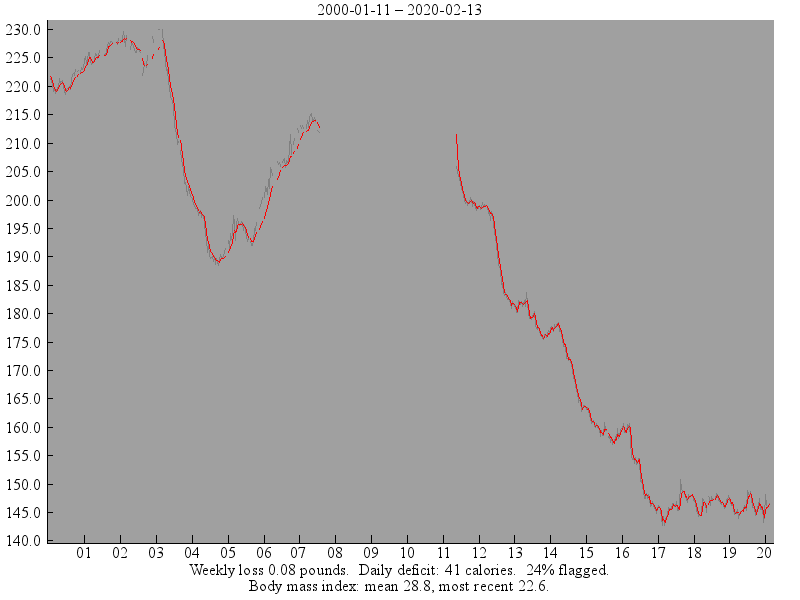
That feeling of being just a tiny bit stifled made the whole thing stick in my mind, such that I’ve kept track: February 14th, 2015 was when my BMI dropped from 25 (overweight) to 24.9 (normal weight). It has now been in the “normal weight” range for five years.
I didn’t stop there. I continued losing weight for almost two more years, until in December 2016 I decided that I didn’t want to get any smaller. At that point I started targeting a stable weight (145 lbs, which gives me a BMI right at the midpoint of the “normal weight” range). I’ve achieved my target pretty well, keeping my weight to within plus-or-minus about 3 pounds of my target.
My weight going back to January 2000. The faint gray shows my actual measured weight. The bolder red line is a logarithmic moving average “trend weight.” The big gap is from when I lost access to the good doctor’s scale at the Motorola office in mid-2007 until I bought a good digital scale in mid-2011.
I wish I had something useful to say about how to lose weight, but I really don’t.
I lost the first fifty pounds the long, slow, hard way—eating less (portion control) and moving more. Because it was hard—I was hungry all the time—I knew that even a slight misstep could easily see me gaining back back all that weight. At that point I did an experiment with low-carb eating, to see if it would address some health issues unrelated to my weight, and quickly peeled off another 15 pounds.
Since then I’ve been eating what I call a “carb-aware whole-foods diet,” meaning that my main focus is on eating food (and refraining from eating industrially produced food-like substances), but purposefully keeping my carbs down in the 100–125 grams per day range, and taking my carbs down lower if my weight gets up above where I want it.
Because eating low-carb worked well for me, I’m modestly inclined to be a booster of the diet, but only modestly. Who am I to say that just because it worked for me it would work for anyone else?
Besides eating actual food and watching my carbs, anybody who reads my blog knows that I spend a lot of time moving. Just click on the “exercise” tag or the Fitness category to see post after post talking about my efforts to get enough exercise (in the old days), and see how they gradually changed into my efforts to keep moving throughout the day. It’s common knowledge that you can’t exercise your way out of a bad diet, but I think it’s also true that moving throughout the day is critical to achieving and maintaining good health.
When you feel sick, you prefer to sit still. This behavior pattern is not only well known, it even has a name: “inflammatory-induced sickness behavior.”
In the modern world this easily leads to a particularly pernicious vicious cycle. Modern lifestyles lead to metabolic syndrome. Metabolic syndrome produces systemic inflammation, which makes you feel like sitting still. Wanting to sit still makes what would otherwise be the most potent tool for reducing systemic inflammation—exercise—tough to bring to bear.
This rather dense article from back in 2010 describes the problem: Inflammatory modulation of exercise salience: using hormesis to return to a healthy lifestyle. It also proposes a category of solutions: hormesis. That is to say, any of a set of mild metabolic stresses that prompt a response greater than “just enough” to stave off the damage produced by the stress itself.
The result is less systemic inflammation, and therefore less inflammatory-induced sickness behavior, hence an increased inclination to move.
Or, as they say:
We therefore propose that exercise salience, the motivation to undertake physical activity, is modulated by the inflammatory status of an animal, decreasing in an inflammatory phenotype, including the metabolic syndrome and increasing in an anti-inflammatory “healthy” phenotype. The type of phenotype may well be determined by the degree of hormesis, as metabolic stressors, such as exercise, plant polyphenols and calorie restriction tend to induce an anti-inflammatory phenotype.
Besides exercise, the article suggests two other broad categories of available hormetins.
One is related to food, and consists of the obvious stuff that everybody knows: Avoid industrially produced edible substances. Consider such modalities as time-restricted eating, calorie restriction, or fasting. Include foods rich in plant polyphenols. (In other words, “Eat food, not too much, mostly plants.”)
The other is related to temperature: Expose yourself to mild cold and/or heat stress. (Spend time outdoors in the winter. Take a cold shower. Spend time outdoors in the summer. Take a sauna.)
Each of these things will produce some mild metabolic stress. As long as you don’t overdo it, that mild stress will produce a stress response greater than necessary to handle the stress itself, with the side-effect of bringing down systemic inflammation. With the systemic inflammation eased, you’ll start feeling like moving again. That puts the potent tool of exercise back on the table.
Nature has a more recent article on all this stuff, which is sadly behind a paywall.
Great advice on the right way to handle fall risk for seniors. Includes an excellent video.
Elliott Royce takes practice falls at least five times every morning. He doesn’t just practice; he preaches, too. He goes to assisted living centers, senior centers and community centers to talk about how to prevent serious injuries if you take a tumble.
Perhaps because I’ve reached an age where I might be considered a senior my own self, I’m becoming increasingly annoyed by the way public health advisors infantilize seniors.
It’s most obvious with fall risk, where “don’t fall” not only is repeated constantly, it almost always comes with a particular sort of blame-the-victim advice—remove tripping hazards, wear supportive shoes, be careful on wet or icy surfaces, always use your assistive devices (canes, walkers, etc.)—the implication being that if you fall it’s your fault for not having made your environment sufficiently fall-proof.
This advice is not merely useless or insulting; it is actively harmful.
It’s harmful first of all because it conflates “senior” with “frail” in a way that will inevitably lead the public to harass seniors just like the public feels free to harass fat people, smokers, pregnant women (especially those with the temerity to drink alcohol), or anyone who isn’t conforming with whatever the current public health fashion is.
Inevitably too, it will have that effect in the minds of seniors who will start to think of themselves as frail simply because everybody says so.
More to the point, it’s is precisely backwards for what you want if your goal is (as I think it should be) to prevent frailty.
Wrong: Remove tripping hazards. Right: Use pillows, empty boxes, rocks, sticks, 2x4s, and whatever else you have handy to make a little obstacle course on which you can practice navigating tripping hazards.
Wrong: Wear supportive shoes. Right: Wear the least supportive shoes you can handle and do foot exercises to gradually strengthen your feet.
Wrong: Be careful on slippery surfaces. Right: Pay attention to the surfaces you’re walking on and exercise due care on all of them.
Wrong: Always use your assistive devices. Right: Work with a physical therapist if necessary, and then do exercises to make yourself strong enough to obviate the need for an assistive device.
This is perhaps not as harmful as the infantalization of children and youth, which works extra harm because adults have more power to impose their conditions on children, whereas seniors mostly have enough autonomy to ignore inappropriate advice. But it hurts seniors in exactly the same way it hurts children, reducing their ability to become or remain robust actors in the wide world.
Now, I don’t want to fall into reverse-blaming the victim. If you are frail, then taking steps to reduce the risk of injury just makes good sense. My go-to activities to prevent frailty might well put an already frail person at serious risk.
I use the weir across the little creek behind Winfield Village for balance practice, when it’s dry and clear of debris.
I try to resist the urge to suggest to seniors that they should do hazardous activities in the name of preventing frailty. But the advice I see from professionals (and random strangers) goes too far in the other direction. Following it is going to doom already frail people to becoming steadily more frail.
I have spent a lot of time following the latest research on all sorts of interventions to increase lifespan and healthspan. I am now ready to say that virtually all this time has been wasted.
I guess it hasn’t technically been wasted, in that I’ve come to understand the latest research, and that’s of some value. But when it comes to choosing interventions that might help me, it turns out there’s nothing new beyond the obvious healthy lifestyle recommendations of 20 or even 30 years ago.
There are a bunch of chemical interventions that are interesting—they have definitely been shown to increase healthspan and lifespan in animal models, and have had some very promising results in humans as well. However, it is becoming clear that virtually all of them are either exercise mimetics or fasting mimetics—drugs that activate (some of) the metabolic pathways activated by exercise or fasting.
From a public health perspective, perhaps this is of some interest. Given a population of sedentary people with poor diets it’s easy to foresee a mix of these drugs delaying mortality and morbidity—people will live longer, and during their extended lifespan they’ll have less disability, less illness, and require less medical care.
From my perspective though, it’s completely uninteresting. I would much rather just exercise than take a drug that provides a subset of the benefits of exercise. Similarly, I’d much rather just eat good food than take a drug that simulates some of the effects of doing so.
Do you want to live a long, healthy life? Here’s an plan for you:
Eat a whole-food diet that’s low in sugar and refined carbs. Try to include a couple servings of salmon (or other fatty fish) per week.
Finish supper at least 3 hours before bedtime, and make sure there’s at least 12 (preferably 13 or 14) hours between the end of supper and the start of breakfast.
Get at least 2 resistance workouts a week where you exercise your big muscles (glutes, quads, hamstrings, pecs, traps, lats) until they are briefly very tired.
Get at least 2 endurance workouts a week where you spend an hour or so exercising at a pace that’s a little more intense than a brisk walk.
Get 1 workout a week where you raise your heart rate to 80% of its maximum for 30 seconds, rest for 30 seconds, and then repeat for a total of 10 rounds.
Spend some time outdoors at least several times a week.
Sleep until you wake up naturally almost every night.
That’s it. Unless you are sick with a diagnosed condition for which there is treatment, I very much doubt there is anything modern medicine—or even bleeding-edge longevity research—can do for you that you won’t get from this plan.
I’m sure my brother is very amused that it has taken me this long to come to this conclusion.
I am a little too prone to use black humor to distance myself from the depressing effects of the long, cold darkness of winter, which sometimes leaves people worrying about me unnecessarily. So I thought I’d mention that despite a bit of anxiety over the inevitable turn of the seasons, my mood is currently pretty great.
Beyond just feeling good right now, I’m hopeful. Over the past decade I’ve been handling winters better and better.
The biggest factor, I think, is that I no longer have a job to lose, so I no longer get into the spiral where seasonal depression makes me less productive, making me anxious about losing my job, making me more depressed, making me even less productivity. Sadly, advising others to take advantage of this strategy is not very useful (although I do and will continue to support and advocate for either a citizen wage or a guaranteed job).
Putting early retirement aside as impractical for most people, I thought I’d briefly summarize my other current practices—mostly ordinary coping strategies—both as a reference for myself any time I start to feel my brain chemicals coming on, and perhaps as a resource for other people. Here’s what’s working for me:
Spending time in nature. I do that all summer, and it may be part of the reason that my mood is generally great in the summer. But I can do it in the winter too. (I don’t seem to have a post on this topic. I’ll be sure to write one this winter. In the meantime you can find various mentions by clicking on the vitamin N tag over on the sidebar.)
Light therapy. I’ve used my HappyLight™ for years, and it does seem to help. Getting outdoors anytime in the first couple of hours after dawn is probably even better—another thing I find easy to do in the summer that would probably help just as much in the winter.
Taking Vitamin D through the winter. The evidence for any benefit is scant, but even if it only helps through the placebo effect, it is at least a safe, cheap placebo. (There’s good evidence that people with high levels of vitamin D are healthier, but very little evidence that supplementing vitamin D makes people healthier. It could easily be purely associational—maybe more time spent outdoors both boosts vitamin D levels and makes people healthier and happier.)
Anything that boosts neurogenesis. That’s most of the things listed above, but lots of other things too, such as engaging in creative work. Also on the list are calorie restriction and adequate consumption of omega-3 fatty acids.
I have a few new possibilities up my sleeve:
There’s recent evidence that sauna bathing is dramatically effective at treating depression, probably through many mechanisms including the activation of heat-shock proteins. (One thing on my to-do list is finding a local fitness center or spa with a sauna and investigating the cost of a three or four month membership.)
Related to heat exposure is cold exposure, which activates many of the same protective proteins that heat exposure does. Cold exposure, of course, is trivially easy to achieve in the winter—just wear a coat or jacket one notch less warm than would be most comfortable.
Obviously sleep is very important, and with my Oura ring I’m tracking my own sleep carefully. This has already been helpful, and I’m hoping to be able to do more to improve my sleep (and thereby my mood) in the winter as well.
That’s what I’ve got at the moment, but I’m always on the lookout for things to alleviate seasonal depression.
I try to emphasize “movement” over “exercise” these days, but sometimes exercise is just what I need. So I was pleased to find this blog post on @rynfrd’s parkour site: six foot exercises that look pretty useful: https://parkouredu.org/six-foot-drills/?learn=11