
It happened this way: I suggested to Jackie that we might hike the full length of the Kal-Haven trail. She’s a long-distance walker from way back, so she said yes.

The Kal-Haven Trail is a rail trail. It runs from Kalamazoo to South Haven. It’s been around for a while. Steven and I bicycled it back when he was a grad student.

The trail has since been expanded into downtown Kalamazoo, but the part I’m thinking of has its eastern terminus just west of US 131 and runs 33.5 miles west to South Haven.

I thought about taking two days to hike the full length of the trail, but that seemed inconvenient. We do a mile in about 20 minutes, so the full length ought to a bit over 11 hours of walking (plus a couple of hours for lunch and breaks). We could probably find a bed and breakfast somewhere around the midpoint, but then what? Hike 6 hours the first day, check into the B&B, and then hang out for the rest of the day? Even if we had a very restful evening, we’d still be a bit tired and sore the next day, when we’d have to hike another 6 hours. Much better to just hike through in one go.

With that thought in mind, we’ve been doing some long walks to get into shape.

We do walks of 3, 4, 5 miles pretty routinely, so I came up with a plan that leaves those ordinary walks alone, but now includes a long walk each week. We started with a 3 hour walk a couple of weeks ago. The plan calls for adding 30 minutes each week. Today’s hike was supposed to be 4 hours and cover around 12 miles.

I find it easier to motivate myself to go for a long hike if there’s a meal near the midpoint, so we came up with a route that gave us a bit more than 2 hours of walking and ended at a favorite restaurant located where we could walk home in a bit less than 2 hours. And our result matched our plan pretty well:

We walked to downtown Champaign and through West Side Park (and stopped for coffee at Pekara Bakery), then meandered through north Champaign to Douglass Park (and visited the Douglass branch of the Champaign Library), then we made our way to Busey Woods and hiked a bit of the trail there (and paused in the Anita Purves Nature Center), after which we turned south and hiked to Crane Alley where we stopped for lunch and beer. From there we pretty much headed straight home, although we did visit Art Mart in Lincoln Square and pause at the Champaign branch of the Champaign library (where we got coffee again, this time at Latte Da) along the way. (Map and workout info from Endomondo. The datapoint with an altitude of 0 is a glitch of some sort from a point where we lost GPS coverage.)

The total distance was 12.1 miles, right on target. It took us just over 6 hours, including a leisurely lunch plus two coffee breaks, so total time walking was probably right about 4 hours, exactly as planned. Our first miles were done at just under a 20-minute pace while our last miles were done at just over a 20-minute pace, so I figure I’ve got the timing about right.

My plan has us adding 30 minutes to our long walk each week for another 8 weeks, after which our long walk will be 8 hours (and cover about 24 miles). I figure once we do that with some degree of ease, we’ll be in adequate shape to push on and cover the whole 33.5 miles. It’s a low-key sort of plan, though. I only want to hike the trail if it’s going to be fun. If the 6 or 7 hour walks start seeming burdensome rather than fun, or if one of us gets injured, we’ll abandon the plan.

This hike, though, was great fun. A companionable way to spend the day with my wife. And it’s good to know that we’re up for walking over 12 miles if we need to (or even if we just want to).

I think the first advice I ever got from a writer about writing was that I should write every day. It’s also probably the best advice. It’s certainly the most common. In any case, it’s advice that I accept.

Writing daily is good for many reasons.

First of all, it means that you’re making progress. That’s all it takes to eventually get to the end. If you write just one page—250 words—each day, then in less than a year you can write an 80,000 word novel.

Second, you’re making it a habit. I find it a habit that’s easy to keep, if I just do it. Even on the busiest days I can squeeze in a few minutes of writing. But once I decide that it’s okay to skip a day to handle some other major task or allow for some schedule conflict, I find that writing “almost” every day is a much easier habit to let go by the wayside.

Third (and this seems especially the case for writing a novel in particular), you’re inhabiting the world you’re writing about. As long as I’m writing every day, the characters remain fresh, their world remains alive, their situations remain immediate. If I wrote yesterday, I’m vastly more productive today than if there’s been an interruption.

I wrote a while back about the difference between writing every day and exercising every day, because I think they’re very different. Exercise is about stress followed by recovery. You can exercise every day, if you’re smart about making sure that each day’s exercise activities allow for recovery from the previous day’s exertions. In running, alternate long runs with short runs. In lifting, alternate upper-body with lower-body.

It may be that reason number 2 (making it a habit) is a good enough reason to create an exercise schedule that allows for daily exercise, but I don’t think it’s important for creating a successful fitness regimen. It’s perfectly possible to get fit exercising just three or four days a week.

But I think reason number 2 is the least important reason why writing every day is important. Reason number 1 (making progress) is more important. It scarcely applies to fitness. (It’s not like you’re ever going to be done with fitness the way you can be done writing a novel.) And reason number 3 (inhabiting the world of your story) doesn’t even really have an analog in fitness.

This post was prompted by the recent post by my Clarion classmate Beth Adele Long, who has started a public effort to write a novel by writing daily.

But I’d already gotten myself back to daily writing some days ago: since January 21st, I’ve worked on my novel every day. Early on there was day that I only managed to get 41 words written, but I got those words and hundreds more each day since then. All together, I’ve written almost 8000 new words since getting back to daily writing—a tenth of a novel right there.

I’d written the first quarter of a novel some months ago (writing daily most of that time) and then stalled out when I discovered that the middle of the novel was terribly dull. I’ve spent the months since then figuring out where I’d gone wrong, and I don’t think I’m going to have to throw away much of what I wrote. I’ve got most of the already-written part whipped into shape and (I think) I’m ready to jump in on the next part and write the middle of an interesting novel.

So, one question is, if I hadn’t let the fact that I was writing a dull middle of a novel stop me a few months ago, would I be ahead now? After all, I could have written 165,000 words of dull middle in that much time—and very possibly I could have figured out where I’d gone awry sooner than I ended up figuring it out.

On the other hand, in that time I finished two short stories and got them out to markets.

So, I don’t have an answer there. But I am back at work on my novel, and I’m once again writing daily.

I’ve been tracking my resting heart rate. As you become more fit, your heart becomes able to pump more blood with each beat, so most people will see their resting heart rate decline with training. Fitness books suggest that there are other insights to be gleaned as well—an unexpected jump in resting heart rate may be a sign of overtraining, for example.

It’s only true in general; it doesn’t mean anything to compare resting heart rates across individuals. But I’m one of those who does see a strong effect, so it’s been fun to watch my resting heart rate decline. It’s up in the low 70s when I’m out of shape, drops into the 60s pretty quickly after I start getting some regular aerobic exercise, then gradually declines into the low 50s.

Yesterday, though, my resting heart rate was 49. Since my resting heart rate tends to get stuck in the low 50s, that was fun to see. It’s also a pretty good indication that I’m recovered from Monday’s long run.

Just two weeks to the winter solstice, so just four weeks until the days are again as long as they are now. Then things start getting better. That provides a ray of hope as I stick with the treadmill running.

We had a few days of mild weather this past week, giving me a chance to get some outdoor exercise. I took advantage by running almost 6 miles on Monday. That’s my longest run in years.

Back in 2004, I ran 8 miles as my last long run before running the 7.1-mile Lake Mingo trail race. But since 2008, which is as far back as my current exercise log goes, this run (5.83 miles in 1:11:35) is my longest.

I started at the Savoy Rec Center after taiji class, and ran all the way home. Here’s the route:

It was probably a bit further than I should have run. It left my knees kind of sore the next day. I’d gone 4.6 miles on Saturday—a much more reasonable distance for my current abilities, and probably part of the reason Monday’s 5.83 was too much. But knowing that I might well not get another chance to run outdoors for months, I couldn’t resist the urge to overdo it.

I never had any particular interest in extreme endurance runs. (I had no ambition to run a marathon, for example.) I ran for two reasons:

  1. Efficiency—I wanted to get enough exercise to develop and maintain a basic level of fitness with the least amount of time, effort, and money devoted to the effort.
  2. Capability—I wanted to develop and maintain the ability to be able to run if it was necessary.

Both those goals are easily satisfied with a weekly mileage of 10 to 12 miles—a long run of 5 or 6 miles together with two or three runs in the 2 to 3 mile range—which is where I’m at right now.

There’s certainly no reason to run further for health. If I wanted to devote extra time and effort to improving my health there are a hundred better things to do (starting with eating better, but including things like improving flexibility and core strength). Running more is probably a negative for health—my chance of injury just goes up from here. The only thing running further would improve is my ability to run further.

Even knowing all that, I find that I always want to run a little further. Once I’ve run five miles, I want to run six. Once I’ve run six, I want to run seven. I hesitate to follow that progression to its logical conclusion. And yet . . . .

I’ve lost a good bit of weight over the past 18 months. I haven’t talked about it much here. It’s bad enough when this starts seeming like an exercise blog; it will not become a weight-loss blog.

That’s partly because the topic is so loaded with cultural baggage. I think there’s pretty good evidence that eating a healthy diet and getting plenty of exercise are both associated with better health. There’s a lot less evidence that being thin is associated with better health—and none at all, as far as I’m aware, that trying to lose weight improves your health, or that exhorting someone else to lose weight improves their health.

Having said all that, my weight is something I’ve been paying attention to, so it seems like something I should talk about here.

What prompts this post at this time is that I’ve reached my lowest adult weight. That is, at 179 pounds this morning, I’ve matched the lowest weight for which I have any record.

I have pretty good data on my weight since 1999. For Christmas that year my brother gave me a Palm III and I installed a weight-tracking app called Eat Watch, which I used fairly regularly from early 2000 until mid 2007. At that point there’s a break in the data, because I lost access to the good doctor’s scale at the Motorola office when the site closed. My bathroom scale wasn’t up to the task. In May of last year I finally bought a good digital scale, and since then I have almost daily data.

Although I’ve been heavier than I’d like pretty much my whole adult life, and have often paid attention to my weight, I’ve largely avoided the curse of yo-yo dieting. Really, there are only two other periods when I’ve lost weight.

The previous one began in 2003. Early that year blood work showed modestly elevated blood sugar levels. The idea that I might break my pancreas was upsetting enough that I took steps: I quit drinking soda and I started running again. From February 2003 through September 2004 I lost 40 pounds, getting my weight down to 188. I kept the weight off for a while; at the end of 2005 it was still around 195, but it was already inexorably rising. By the time the Motorola site closed, it was back up over 200 pounds.

I don’t have much data on my weight from before 2000, but the one exception includes the other period I was losing weight. Back in 1991 I started running, and my running log from that period tracked my weight. I don’t have a value for every week, but I weighed 201 in March that year, and got my weight down to 179 by the end of running season.

In my experience, losing weight is either easy, or else impossible. The easy times are generally summer, when I’m getting plenty of exercise. I’ve tended to blame difficulty in getting exercise for the fact that I gain weight in the winter, but I don’t really have data to show that. It could be other things. Maybe in the dark months I burn fewer calories on incidental movement, such as by fidgeting less. Maybe in the dark months I eat more.

It would only have to be slightly more. One thing the data does make clear is just how few calories it takes to make a large difference. Since May of last year I’ve lost 26 pounds. That corresponds to a daily deficit of just 134 calories. Any little thing—an extra soda, an extra cocktail, an extra beer, an extra snack, an extra serving—would have more than wiped out the deficit. An almost imperceptible change in my amount of fidgeting could easily add or subtract more than 134 calories per day.

It’s pretty much impossible to impose that difference by effort, which is, I think, why diets don’t work. There are extremely complex mechanisms in your body for controlling your weight, which bring to bear powerful forces like appetite and satiety. Making a point of eating less is no more likely to be successful than making a point of breathing less. Losing weight requires changing how you live.

Changes like eating a healthier diet and being less sedentary are likely to lead to weight loss. I used to despair of making such changes. Eating more healthily is tough because (unlike Jackie), I don’t really like vegetables. Being less sedentary was tough because so many hours per day had to be allocated to sedentary activities—sleeping and working.

I’ve improved my diet some. Over the past 20-some years I’ve steadily cut back on the amount of fat and sugar I eat. I’ve also learned to pay more attention to how much food I really want, which lets me get those complex mechanisms for controlling my weight working for me, rather than against me.

Not working at a regular job has helped with being less sedentary—more of my hours are my own. I’ve also made a bit of an attitude adjustment: Before I thought that an hour a day was probably more time than I could afford to devote to exercise; now I figure that 23 hours a day is too much time to spend being sedentary.

Last winter I described a fitness regimen that allowed me to maintain a stable weight. Briefly: Three times a week we lift weights and then do an hour of taiji; the other four days a week I try to walk for an hour. It worked. My weight was stable. (Specifically, from the beginning of September last year though the end of March this year I lost weight at the rate of 0.03 pounds a week, implying a calorie deficit of 17 calories a day. And that right there is a crystal-clear instance of those powerful mechanisms working. Imagine trying to match your calorie intake and activity level within 17 calories by counting calories. It’d be hopeless.)

Maintaining a stable weight over the winter was key. It was perfectly ordinary that I lost weight last summer and this summer. What was different was that I put two summers of weight loss back-to-back.

That’s pretty much the extent of my plan for the rest of this winter as well—a stable weight, so that I’ll be starting from here next summer.

I don’t have much data on which to base a longer-term plan. The National Institutes of Health suggest that the highest healthy weight for a person my height is 164 pounds. That seems like a good medium-term goal.

Looking slightly beyond that, I observe that Jackie is looking very trim these days. To match her body mass index my weight would want to be around 144-151.

That target is supported by my only reasonably specific recollection of my weight from longer ago: When I was a freshman in college, I got mononucleosis. The combination of nausea and a very sore throat resulted in eating a lot less for several weeks, producing considerable weight loss. I don’t have any records, but I’m pretty sure I remember my weight dropping under 150 (which is to say, probably down to 149¾). Despite having gotten there by being sick, I was by no means wasted away at that weight. In fact, I remember looking pretty good.

So, that’s my weight loss story. I don’t expect to talk about it much beyond this. “Let me tell you how I lost so much weight” is just not a useful or interesting story. I only mention it at all because I’ve been paying close attention to it. It would seem to make my own story incomplete to leave it out.

I decided that I wanted to try barefoot running.

Of course, I didn’t want to actually run with bare feet. That seems stupid (although I suppose it’s another capability that might be worth developing, just in case circumstances arise where I might really need to run in bare feet).

No, what I wanted to do—like many people who have read Christopher McDougall‘s book Born to Run—was try running with the stride that one would use if one were barefoot.

The natural running stride, it turns out, is quite different from the walking stride. In walking, you land on your heel, then rock forward and push off with your toes. If you wear cushiony, padded running shoes, you can run like that too, but it’s not the natural way to run.

The natural running stride is easy to experience—just run in place for a few seconds. You’ll land on your forefoot, absorb the impact with the muscles of your calf and thigh, and then launch yourself off again with those same muscles.

I’ve been trying to run with more of a forefoot strike since I started running again this spring, but it’s hard to do if you’re wearing ordinary running shoes. The heel is not only all cushiony, it’s thick. That means that, unless you exaggerate your forefoot strike, you’re still going to land on your heel.

So, I went to the shoe store, meaning to try out one of the many new “minimalist” running shoes with thinner heels and less cushioning that are now on the market.

Happily, we have a great running shoe store in town called Body and Sole. After trying on three pairs of shoes with progressively less padding and structure, I tried on a really minimalist pair, which felt wonderful. I tested them in the concrete parking lot, taking a turn around the outside of the building, and then a second turn, and then a third. I told the salesman, “That first pair was fine, and I would have bought them. But this pair was the pair that made me want to keep running laps around the building.”

So, now I need to adjust to this new stride. It demands a bit more strength and endurance in the calf muscles (and no doubt in the muscles that keep the bones of the foot correctly arranged as well).

The shoes I ended up, a style called the Road Glove, are made by Merrell, which also provides an extensive website on barefoot running. They feel just like you’re barefoot, except that there’s a sole to protect your feet from sharp/hard/abrasive road hazards.

Following their advice, I just ran half a mile yesterday. I certainly feel it in my calves today. They don’t feel bad, though. Just tired and sore like I got a good workout yesterday. And my tendons and joints don’t feel sore at all.

The timing is perfect for doing a few low-mileage days. On Sunday I ran 5.25 miles for my long run (in my old shoes), so Monday and Tuesday would have been light running days anyway.

Plus, on Tuesday we went for a long bike ride. We rode to Philo and met some friends for lunch at the Philo Tavern. That’s a 28-mile round trip, which we did in an even three hours. (I wrote about an earlier bike ride to Philo in my old Clarion journal.)

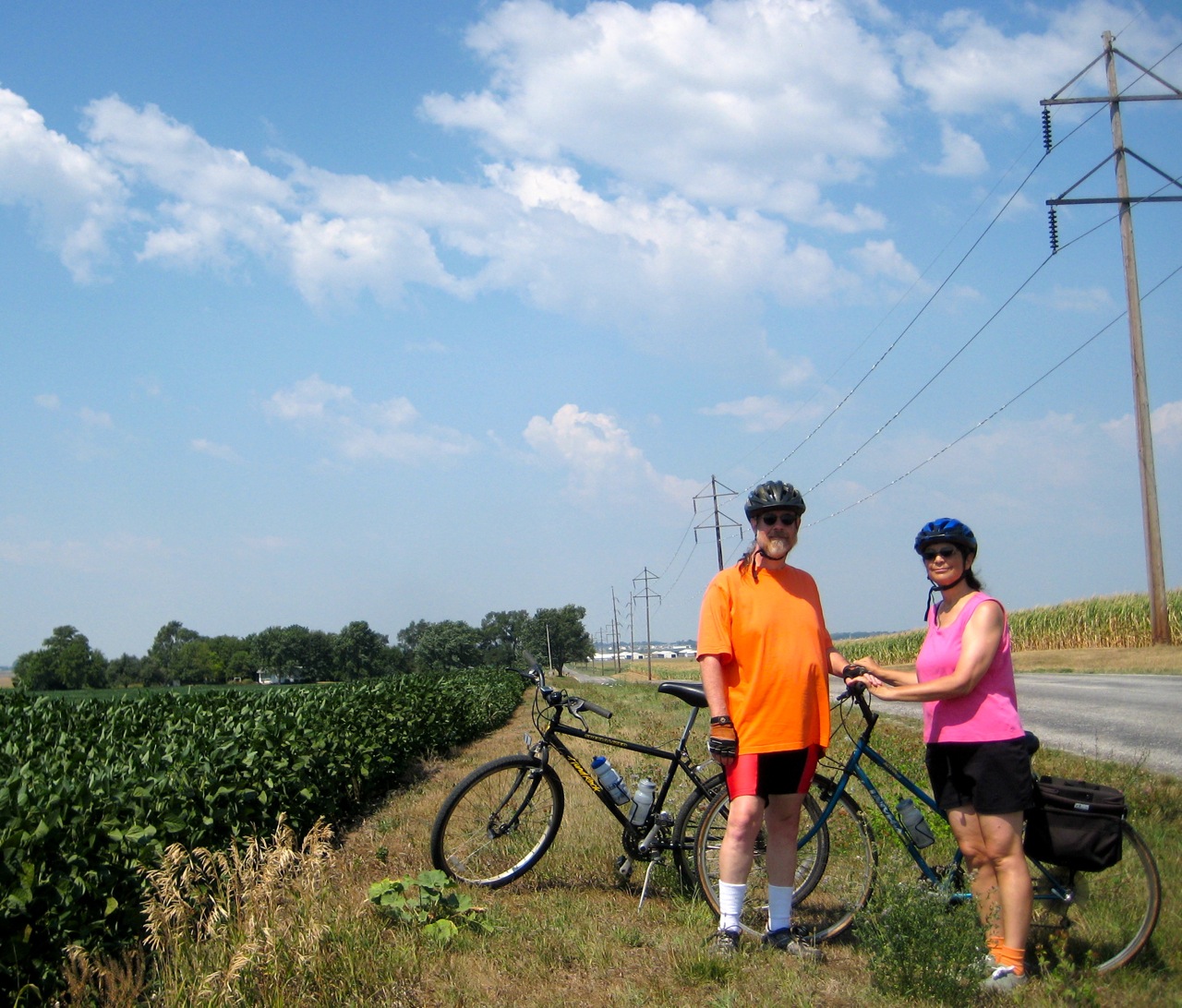
Here’s us, on the road to Philo:

Cyclists on the side of the road
Me and Jackie on the road to Philo

And here’s a pretty ladybug that I noticed while we were paused to get that picture:

Roadside Ladybug

I’ve already sent that picture to the Lost Ladybug Project, which is trying to gather data on the native ladybugs, whose distribution is changing due to the importation of non-native ladybugs and climate change.

Siam Dragon Peppers
Siam Dragon Peppers
We keep harvesting them, but every time we return to the garden a few more of our Siam Dragon Peppers are ripe.

I like to joke that I no longer multitask at more than one thing at a time.

Related to that, I recognized years ago that a certain amount of monomaniacal focus was really useful for successfully completing a large project (such as a novel), but that being able to focus on more than just one thing was important to being more broadly successful.

This is all the more true if you want to accomplish more than just one thing (if you want to, for example, write a series of Wise Bread posts, write an occasional short story, and become physically fit, in addition to writing a novel). And yet, each one of those things requires focus, if I’m to accomplish it.

Basically, I need to be able to be monomaniacal about three or four things at a time.

Like most people, I find that I get caught up in whatever I’m doing, both on a minute-to-minute basis and a day-to-day basis.

On a minute-to-minute basis, when I’m writing something, and especially when the writing is going well, I want to press on. I feel this way, even though I know from both things others have said and personal experience, that it’s always best to stop in the middle of things—to leave a ragged edge, so that I return to the work with a clear entry point, already knowing how the next bit goes. Convincing myself to do this routinely would really help with being monomaniacal about multiple things: I’d be quicker at ending the first thing so I could switch my focus to the second, and I’d be quicker at resuming the first thing when I came back to it.

Just lately, my day-to-day monomaniacal focus has been on running. I don’t run every single day, but I’ve had to make it the first thing I do on the days that I do it, because otherwise it’s too hot to run. It’s been working very well for building fitness, but doing it first has tended to result in it preempting my writing.

I’m not quite sure why. Partly it’s because a good workout leaves me feeling tired. Partly it’s because a good workout leaves me feeling like I’ve accomplished something (so I’m less driven to accomplish something more). Partly it’s just that I’m only at my best first thing in the day, so whatever I do first always ends up being the main thing I do that day.

Once there’s a break in the heat, I want to get back to writing first of all. If I can put that together with taking a fairly early break (leaving the work paused at a ragged edge) and then running (or walking or bicycling or lifting or doing taiji) and then returning for a second session of writing, I think I’ll be more productive at the writing without any loss of success at the fitness thing.

Exactly on topic for the above is Tobias Buckell’s latest meditations on designing a daily routine that provides both writing time and exercise time, while also allowing him to work on different aspects of his work at whatever time of day he’s most effective at that particular thing. Toby is a great writer, but he’s an absolute genius at measuring his productivity and then using that data to tweak his work habits.

I need to improve my own data collection. I already track my productivity at writing, but I need to get a bit more fine-grained about it and track productivity per work session (rather than per day). I’m sure I’m most productive in the first session of the day, but I don’t have any evidence, and I certainly don’t know how much less productive I am during the later sessions, nor to I know whether my productivity declines less if I work on non-fiction (or editing, or research).

The picture, by the way, has nothing to do with this post. I just thought the blog needed another picture, and I’d brought the camera to the garden today.

I have been on-and-off reading about “paleo” diet and exercise programs (also called “primal”).

I think there’s a lot to paleo, on an evolutionary basis. On the other hand, there are an awful lot of post-paleo lifestyles that have proven to be entirely successful, in the sense that generations of people have eaten all manner of particular diets and been healthy. (Native Americans ate corn, beans, and squash. Scots ate oats and kale. Lots of people ate rice and lentils.) Given that, and the fact that paleo diet programs doesn’t match well with what I like to eat, I’ve only paid a bit of attention to them. Basically, I’ve let them reinforce my preconceived notions.

I have a similarly divided appreciation of paleo exercise programs, but there I think I’ve worked out what was bugging me.

The half I agreed with is that very short bursts of very intense activity should be a key part of an exercise program. I’ve only made limited moves to incorporate this insight into my own workouts, but only because those sorts of intense bursts are hard.

I suspect it would be a really good change to compress my current 20-minute lifting workout into 10 minutes, which I could do if I really hustled between machines and counted the first set of the three leg exercises that I do as a warm-up.

To do so would require some additional mental toughness. It’s really hard to jump off the leg extension machine with your quads burning, and then jump on the leg curl machine and make your hamstrings feel the same way, and then hurry on to the leg press. Taking an extra thirty or forty seconds between machines to recover is a lot easier. (Not to mention inevitable, if you’re working out in a fitness center where you have to adjust the seat and set the weights on each machine.)

The half I disagreed with is the half that seems to dismiss endurance exercise.

Now, it may be that my reading of paleo exercise programs has simply been so cursory that I missed the paleo version of endurance exercise. But it sure seems to me like a large fraction of the paleo folks don’t merely dismiss endurance exercise, they actively disdain it.

That puzzled me, because it seems to me that the paleo human was the quintessential endurance machine.

As I say, I think I’ve come to understand the objection, which is that you can’t do high-intensity endurance exercise unless you eat loads of carbs. The paleo folks think you should do endurance exercise, as long as you keep the intensity level at a level where you can perform on a low-carb diet. Further, they seem to think that the appropriate level supports walking or hiking, but doesn’t support endurance running.

That’s crazy, although it’s understandable. The modern way of training to run is all about prompting the body to mobilize glycogen stores, by depleting those stores and then eating a high-carb diet to replenish and boost them.

That is not the only way to run. You can also engage in endurance activity powered mainly by fat stores.

Begin bonus anecdote:

When I was in high school, I decided to bicycle to Saugatuck, see a play, camp out overnight, and ride home the next day. I didn’t have a cyclometer in those days, and have always claimed that the distance was 75 miles each way. Google Maps tells me that my route (or very close to it) is 69.3 miles. Close enough.

I knew nothing about carb or fat metabolism. I made no plans to get food along the way, and in fact ate very little.

I headed out early in the morning, did just fine for a bit more than the 36 mile I was used to riding, and then bonked at about mile 40. (Bonking is what cyclists call it when you exhaust your body’s glycogen stores. It’s the same thing marathoners call “hitting the wall.”)

I was exhausted. My speed dropped from 14–17 mph down to 7–8 mph. And it stayed there.

That’s the important part of this anecdote. It stayed there. I rode another 30 miles or so that way. I rode it at less than 8 mph, but I rode it. I got up the next morning, still exhausted, got back on my bike, and rode a few miles to a breakfast spot and ate my only proper meal of the whole trip. It didn’t help much. I rode the whole way home at 7–8 mph.

End bonus anecdote.

If you haven’t trained your body to use fat stores for endurance activity, you’ll be pretty slow—as I was on my ride. And you’ll never be fast the way someone who has trained to build up glycogen stores can be. But with a modest amount of training, you can be plenty fast enough to run.

There are times when it is convenient to be able to run for an extended period. If you want to have that capability, you need to run—and not just occasional short sprints during your walks.

We don’t have much direct evidence of what paleolithic humans actually did, but I have no doubt that, in addition to walking a lot, they ran a lot. The human body is just too well adapted for long-distance running for it not to have been a key capability over an evolutionarily long period.

Yesterday, I went on my first open-ended run of the season.

On earlier runs, I pretty much knew how far I was going to go and what route I’d follow. Occasionally there’d be a bit of room for variation—I might think, “If I’m feeling good, maybe I’ll add a second lap around Kaufman Lake,” or “Maybe I’ll add the leg out to Bradley and back.” But by and large, I knew to within a few tenths of a mile how far I’d run before I took my first step.

The reason was that every run would take me a large fraction of as far as I could run. There was no chance I’d just decide on a whim to go a few miles further, because I couldn’t run a few miles further.

So, it was a great treat yesterday, to head out for a run with only a general idea of where I’d be running, and with no specific plan how far I’d go.

I knew I’d run halfway down O’Malley’s Alley (the short bit of rail trail that I call McNalley’s Alley), and then cut over into the neighborhood south of there. But I’d had only a vague, somewhat aspirational notion that I’d continue on as far as the trail through Robeson Park. But I knew that the trail would cross several different roads, and that I’d be able to head for home on any one of them, if I decided that I’d run as far as made sense.

In the end, I headed home when I got to Crescent. On some future run, I’ll push on as far as Mattis, and maybe continue on down the Simon trail before heading home.

This run, according to my GPS thingy, came to 4.84 miles, which I ran in 54:15, for an average pace of a bit over 11 minutes per mile. And it was a great run. My feet didn’t hurt, nor did my ankles, knees, hips, or any other bits. I did get pretty tired by the end, but not over-tired. In fact, after a bit of a rest and rehydration, I had enough energy to bicycle 9 miles, lift weights, and do an hour of taiji. (The lifting, I must admit, was a rather feeble effort.)

At over 50 minutes, it was definitely a long-enough endurance effort to produce significant levels of endocannabinoids, which I presume is the reason that my memory of the run is mainly just a strong sense that I was having fun and feeling good. There are only a few spots where specific details are sharp and clear—the spot where I had to back up and run on the grass next to the trail, to avoid a muddy patch, the spot where I thought, “There’s a hill here? How did I not know there was a hill here?” and the spot where I slowed to a walk so I could look back over my shoulder and read a street sign, so I’d be able to make a map.

Speaking of which, here’s a map of the run:

My run on Monday included two laps around Kaufman Lake. Among the people that I encountered more than once was a pair of young black men. I don’t know how old they were—in their twenties, I suppose.

As I passed them the second time, one of them asked how old I was. I told him I was 52. He said, “Wow! You’re in great shape!” I thanked him and ran on.

That brief conversation has stuck with me.

First of all, I don’t think of myself as being in great shape, although I’m getting fitter. That particular run went on to be 2.4 miles at an 11:27 pace. That matches the distance of my longest previous run this year, and was actually the best pace I’d managed at any distance in a very long time. (When I’m estimating time or distance, I generally assume a 12-minute pace.)

Jackie pointed out that, if I was right about the men’s ages, their fathers would probably be just about my age. That might well mean that they have a very specific referent for the default fitness level of a man in his 50s.

There are certainly a lot of men in their 50s that are in pretty poor shape, but that doesn’t mean that I’m in good shape, let alone great shape. I’m still quite overweight (although as of a couple of weeks ago, no longer obese, according to the National Institutes of Health). I’m not in nearly as good shape as I was in 2004, when I was routinely running 6 and 7 miles for my long runs, nor the summer of 2005 when I was working my way up to riding a 100-mile bike ride.

Today’s run was 1.5 miles at an 11:22 pace. I’ve been recording my 1.5 mile runs as “easy” runs in my training log, but this was really the first one this year that qualified. The previous ones, if judged objectively (by heart rate, etc.) would rightly have been classified as “hard” runs. But I’m past that stage. I can run along at a comfortable lope and not be maxing out my aerobic capacity.

This is when running gets fun. And maybe that is the same thing as being in great shape.