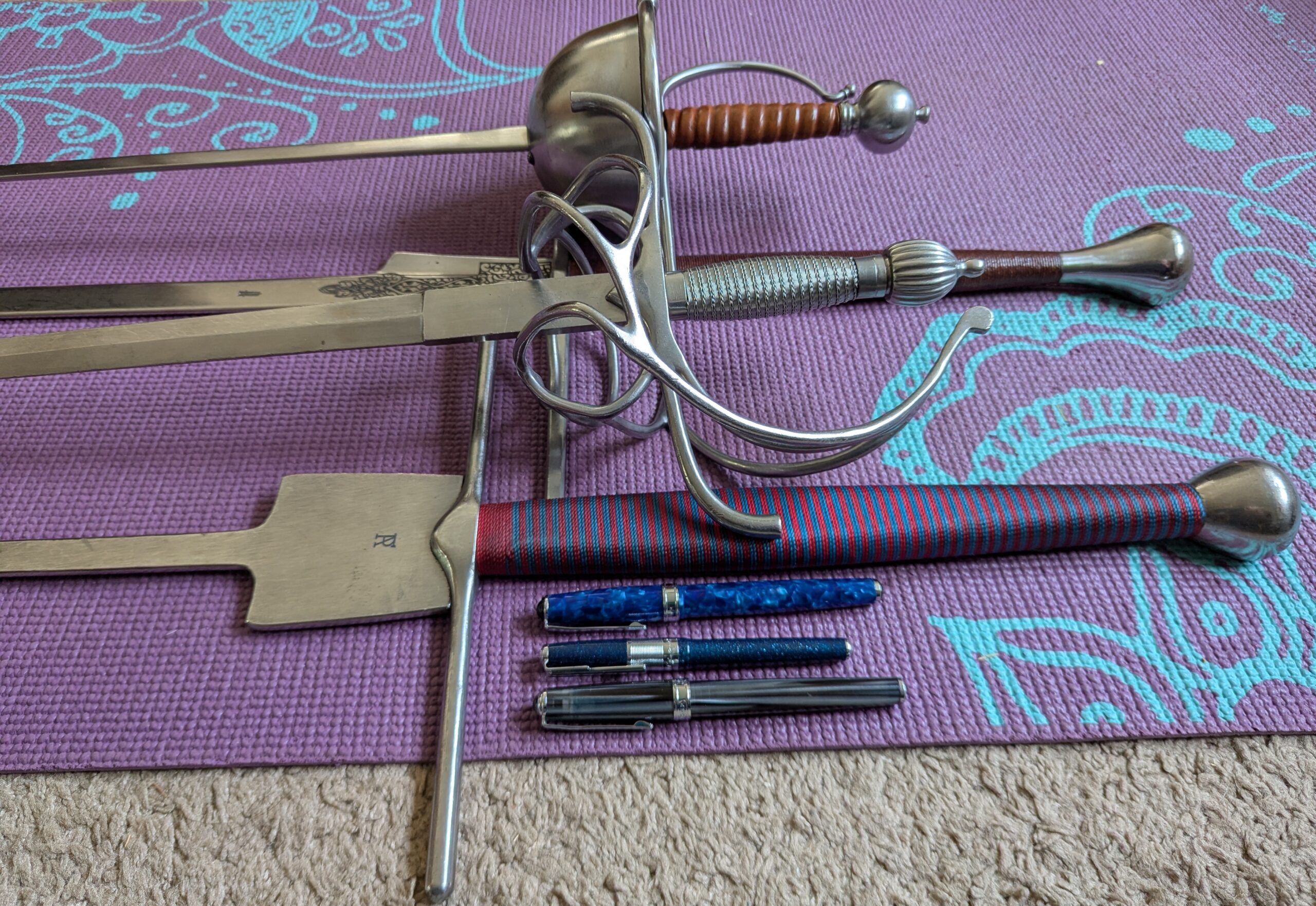
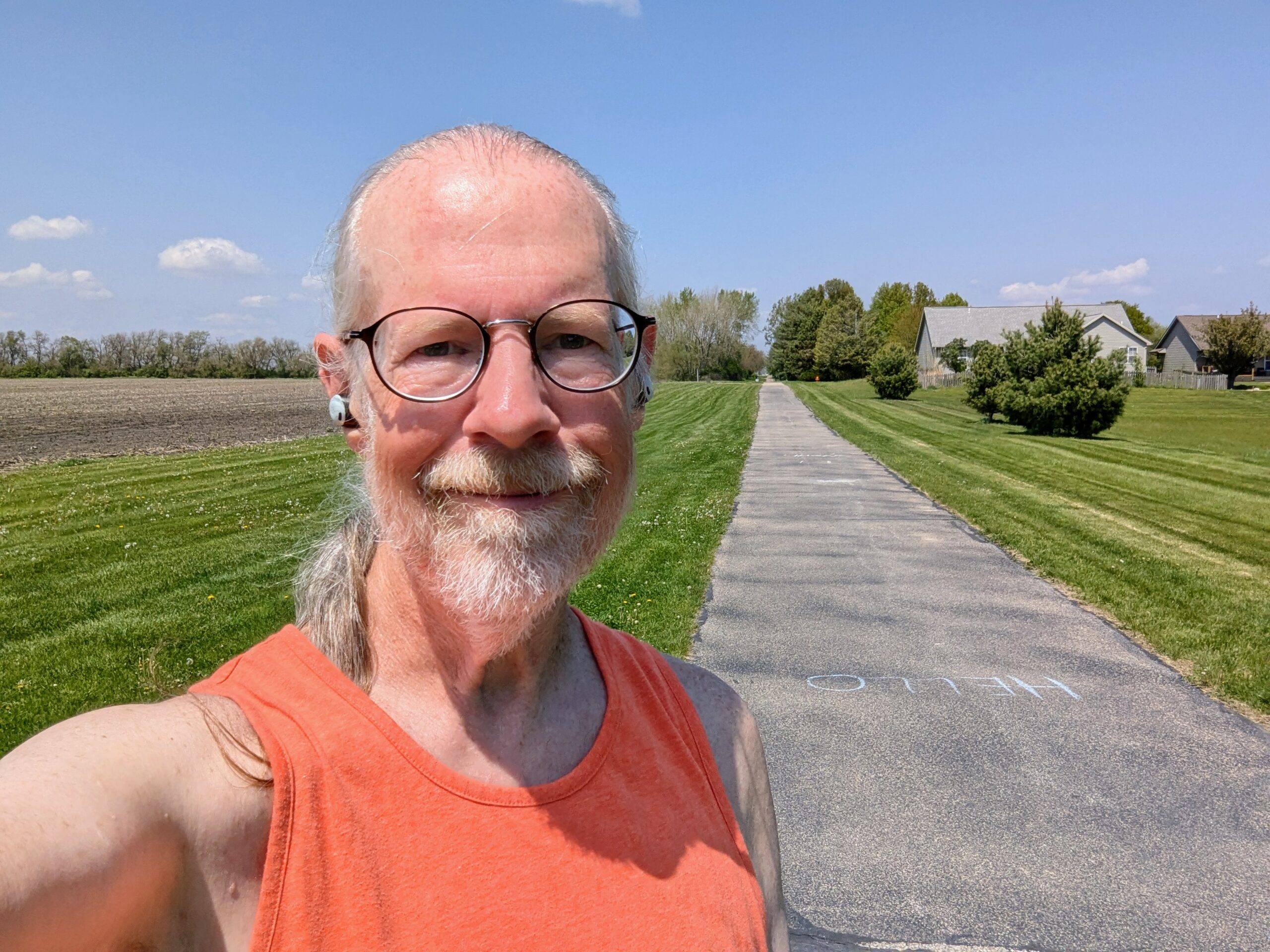
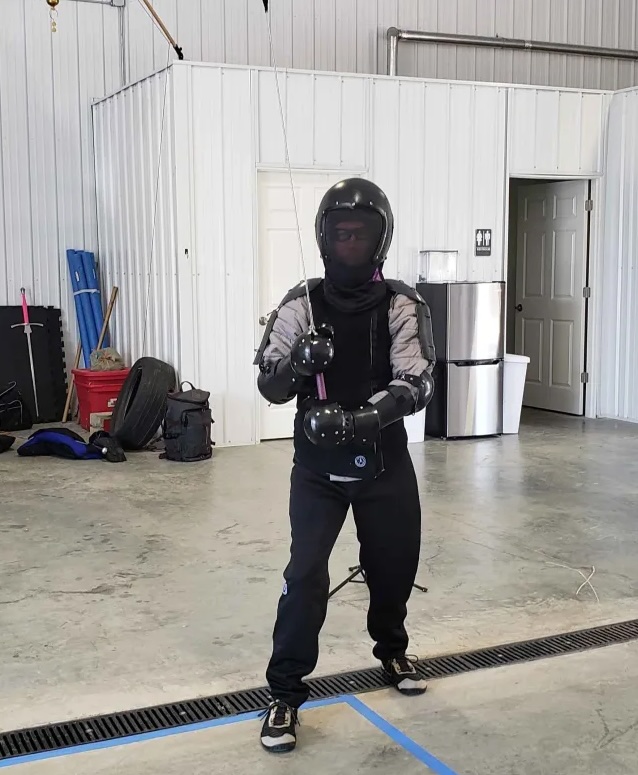
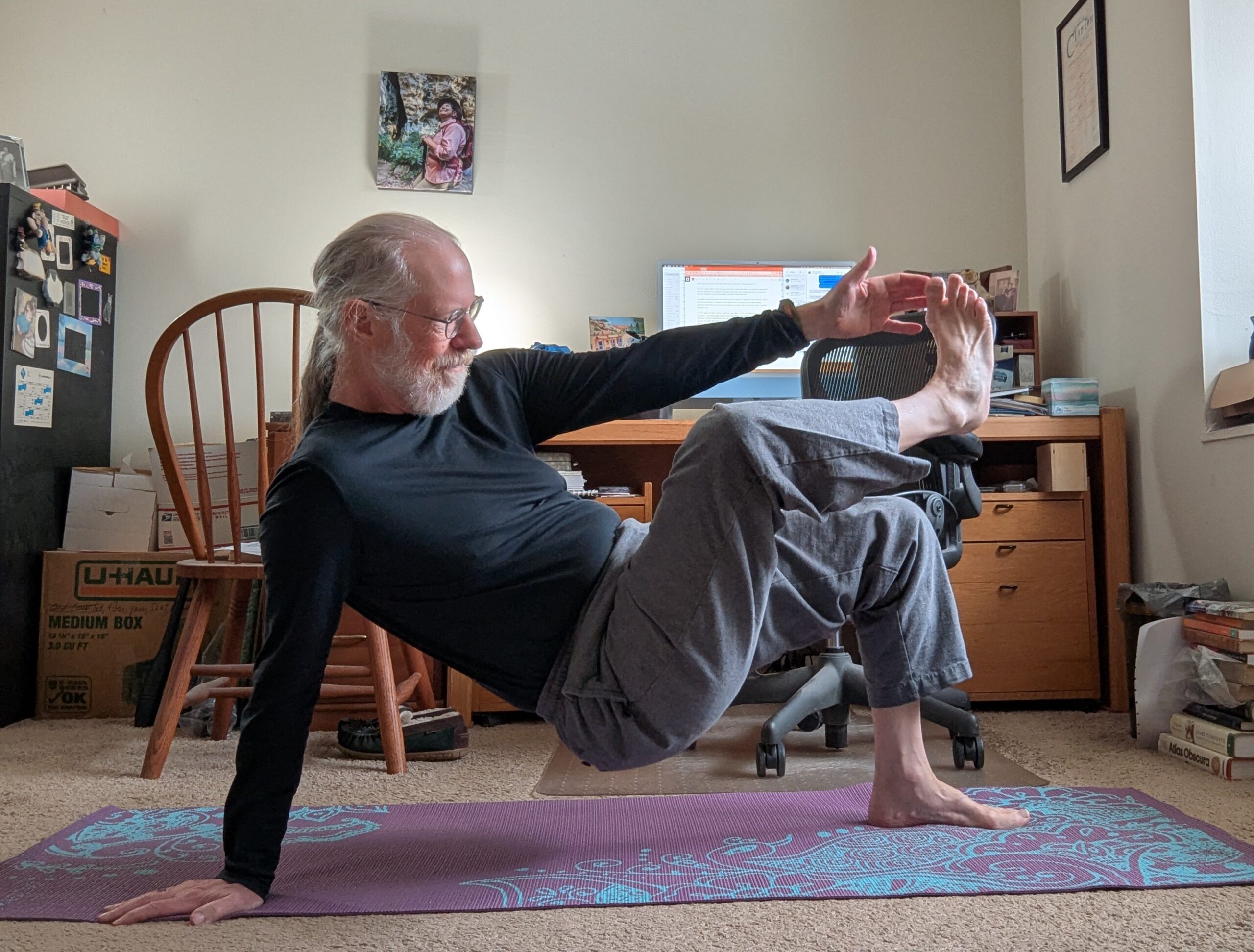
Sundays are the day I still manage to do some HEMA training. I used to go three times a week, but had to cut way back after I hurt my elbow. Now it’s just Sundays, because Sunday is the day my group does a sword-in-one-hand class, which is gentler on my elbow. We usually train dussack or rapier.
My plan for today was to get as much writing done in the morning as I could, then go train sword fighting, and then squeeze in a bit more writing in the late afternoon or evening. But, as often happens, things happened. My brother invited me to attend the kick-off meeting for SFWA’s Winter Worlds of Giving event, so that was most of an hour on zoom. Then my usual cocktail hour with my brother and my mom. Then walking the dog. Then an episode of The Diplomat with Jackie. Then another episode of The Diplomat with Jackie. And now I’m just too tired to get any more writing done.
So, it’s a good thing I got in that morning session, which got me 551 words.
Ashley seems to enjoy going for a run, and she’s a pretty good running companion. She does want to stop and sniff rather more often than I do, and she wants to stop and pee occasionally, which does make it tough for me to hit my best pace for any particular mile. But that’s okay. Enjoying some dog-companionship is a lot better than hitting my best pace.
I had virtually quit running a couple of years ago. I’d gotten a trifle tentative after a fall, and then Jackie was out of town (and therefore not on-hand to rescue me if necessary), and then the weather got cold and the running routes icy. And by the time the weather improved, I’d just fallen out of the habit. For a few months now I’ve been working to reestablish the habit. I haven’t accomplished that yet, but I am getting in an occasional run.
The Fitbit software in my Pixel watch estimates my VO2Max. My estimated VO2Max has long been excellent for my age, but it had gradually dropped some, which was part of the reason I wanted to start running again. These past few runs have produced a modest increase, so as of today it’s in the 95th percentile for people my age. (I think Peter Attia suggests that the minimum acceptable VO2Max is the 95 percentile for someone a decade younger than you, which I’m still a bit below, although it seems perhaps doable.)
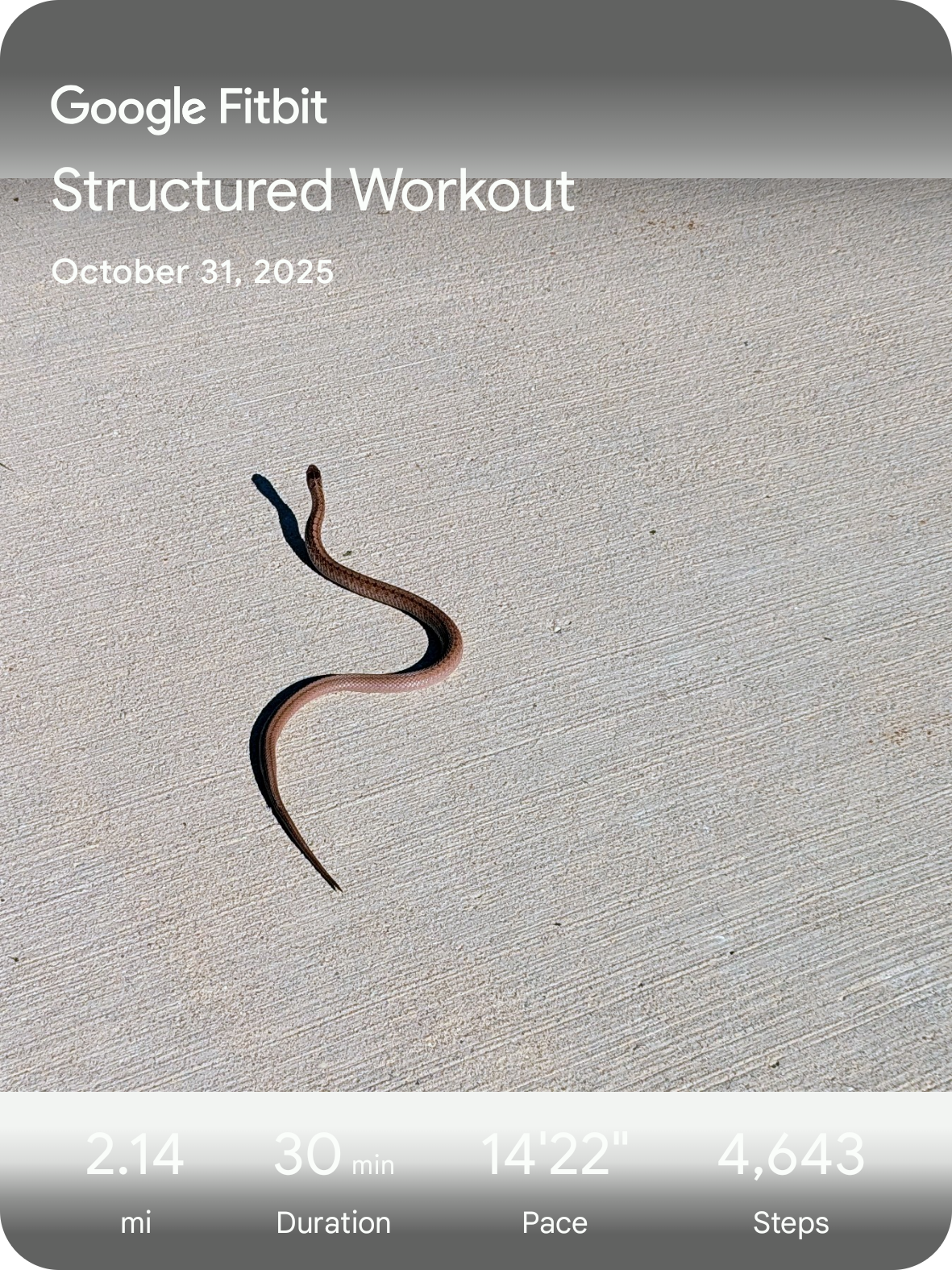
I’m afraid I failed to get a photo of Ashley or myself running (or better, the two of us running together), but I did get a picture of a cool little snake friend who was crossing the sidewalk where I was running.
I got in one writing session in the morning. Now that I’ve finished my run, I very much hope to get in some more writing (and most especially some more plotting) before the end of the day.
One of the things I haven’t done well in learning sword fighting has been “getting in the reps.” We’ll learn a move—a particular cut or thrust or parry—and I’ll work on it until I can do it correctly once (or a few times), but then I’ll quit. I don’t “get in the reps” that it would take to really learn the thing.
This is about 80% my own fault, of course. (It’s about 20% the fault of the instructors, who always want to move on and teach the next cool thing.) Clearly, having done something correctly once (or a few times) should put me in the position of being able to practice it more, either alone or with a training partner. And it’s totally on me that I hardly ever do that.
Anyway, I occasionally remind myself that I should get in the reps of whatever we’ve just learned. Sometimes I do better or worse, but I rarely forget. (I just get tired or busy or forget all the things we learned except the last one or find some other reason to fail to get in my reps.)
The reason I’m thinking about this today is simply that I’ve been writing more just lately, and of course writing is the same way. If you want to get better at writing, you need to get in the reps.
Add your own “pen is mightier than the sword joke here.”
More specifically, you need to engage in “deliberate practice.” So it’s not just getting in the reps. You need to get in one rep, monitor your performance, evaluate your success, and then figure out how to do it better. Then repeat.
This is true at every level. In sword fighting there’s the cuts, thrusts, and parries, of course. But there’s also footwork to go with each one of those things. Then there’s postures that you might pass through along the way. There’s distance management. There’s watching your opponent’s postures for clues as to what he might be about to do. There’s figuring out what you might do in response.
Writing has its own levels, but it’s still the same. Word choice. Sentence structure. Paragraphs. Telling a story.
After decades of practice, I’m pretty good with words, sentences, and paragraphs. My skills with telling a story still need some work.
I haven’t been running enough, so I went for a run today. The metrics are kinda funny, by which I mean my Fitbit thought it was an insanely hard run. I thought it was interesting enough to post about.
Fitbit calculates heart rate zones based on your “heart rate reserve,” which is your maximum heart rate minus your resting heart rate.
Your resting heart rate (roughly what you’d get if you checked your heart rate right after you woke up, before you started moving around) the device actually measures. My resting heart rate, according to the Fitbit, was 56 bpm. (It actually hit 44 bpm at some point while I was asleep, but your lowest resting heart rate is a different number.)
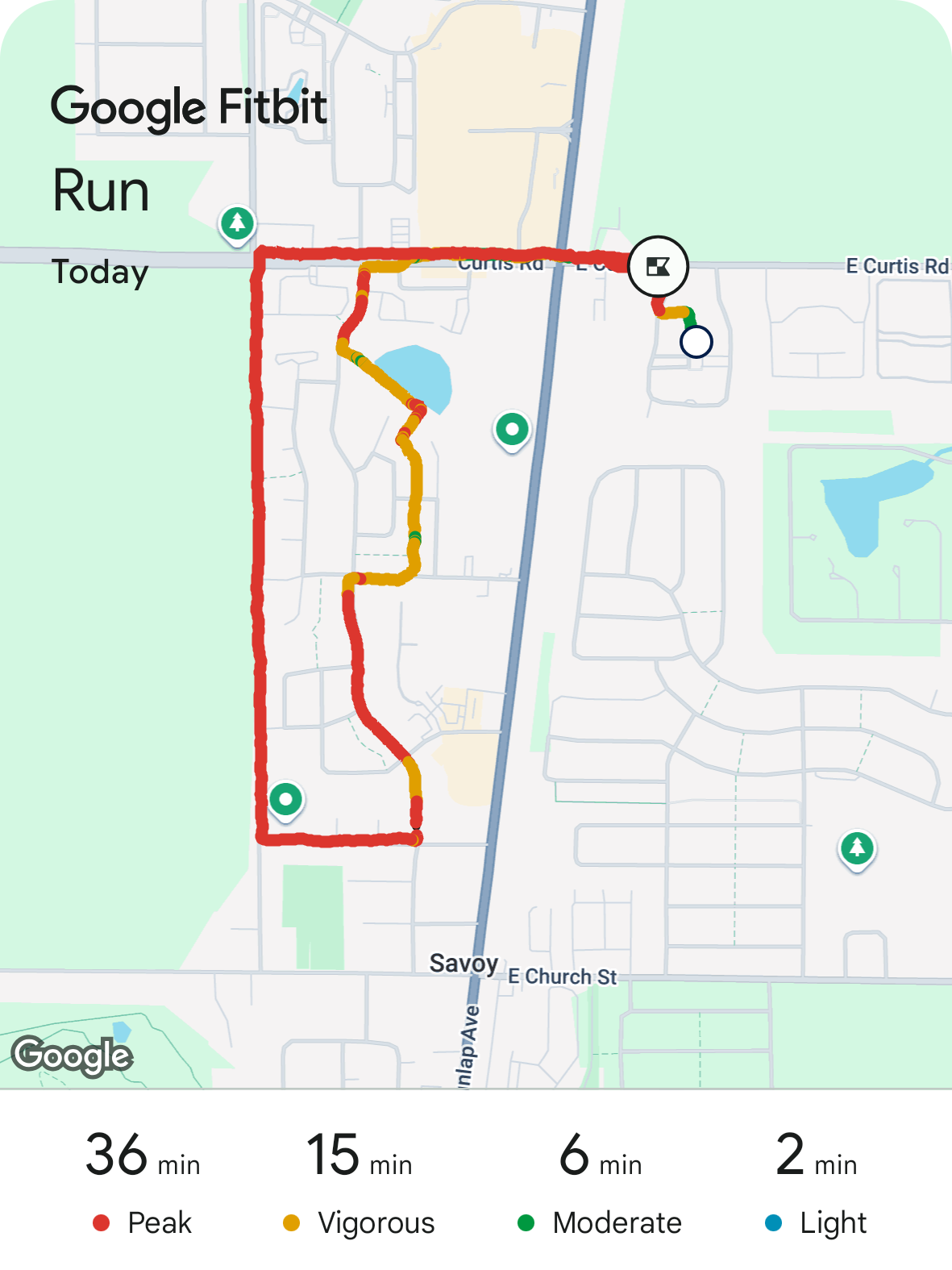
Your maximum heart rate, though, isn’t measured. Instead, it’s estimated as 220 minus your age. I’m 66, so that comes to 154. So my heart rate reserve is 154 minus 56 equals 98. Then my various zones are calculate as a fraction of the reserve plus the resting rate. Zone 5 (peak activity) begins at 85%, so my zone 5 begins at (0.85 ✖️ 98) + 56, which comes to 83 + 56 = 139. All the parts of my run shown in red in the map above were run at a heart rate at or above 139.
In fact though, my maximum heart rate is way higher than that estimate. I have in the past been somewhat dubious of the maximum readings shown by my Fitbit during a run, because all the wrist-worn devices sometimes sync up at your foot-strike rate, so you get anomalous readings around 180 (a common foot-strike rate). But I also check my heart rate doing other exercises, such as kettlebell swings, where foot-strike rate doesn’t matter. Plus, I get heart rate readings from my Oura ring, which is not wrist-worn, and which doesn’t seem to have the same syncing-with-foot-strike problem. So I know my max heart rate is much higher.
On this run, for example, the maximum heart rate as measured by my fitbit was 169. My Oura ring thinks the peak was 166 (but it averages over 5-minute periods, which smooths out the peaks quite a bit).
Anyway, if you take 166 as my actual maximum heart rate, then my heart rate reserve is 110, 85% of it comes to 94, so my zone 5 range ought to begin at a heart rate of 150, rather than 139.
I find that a lot more plausible. If the Fitbit is right, then I just spent 36 minutes in zone 5, which seems very unlikely. It was kind of a hard run, because I haven’t been running enough, but I not only could have talked while I was running, I actually did sing, which is one of the markers for being in zone 1. (I was listening to and singing along with some Kpop songs.)
So, I think much of that run, even some of the bits shown in red above, were in zone 2 or 3, not zone 5.
Whatever the heart rate metrics, it was a rather slow, rather short run: 3.15 miles in 58min 10s.
Much better than not running.
Updated next morning: I slept great after my run, and woke up feeling great. Legs not sore at all. Overnight heart rate right back down to my current baseline.
I’ve finally started getting invited to fitness influencer events! I got email today offering me a chance to get early access to a new line of athleisure clothing if I attend their event!
Sadly, their event is in Los Angeles. And, based on the images, their clothing line is for women. I’d look funny wearing their short skirts and tight tops for skinny girls.
Still, once I show up on one brand’s radar, surely other brands will start noticing me.
Note: I have no interest in being a fitness influencer or a brand ambassador, or getting early access to athleisure clothing. I don’t even really have any interest in free athleisure clothing, although I’m not sure I’d turn it down, because that’s just the sort of ethically ambiguous guy I am.
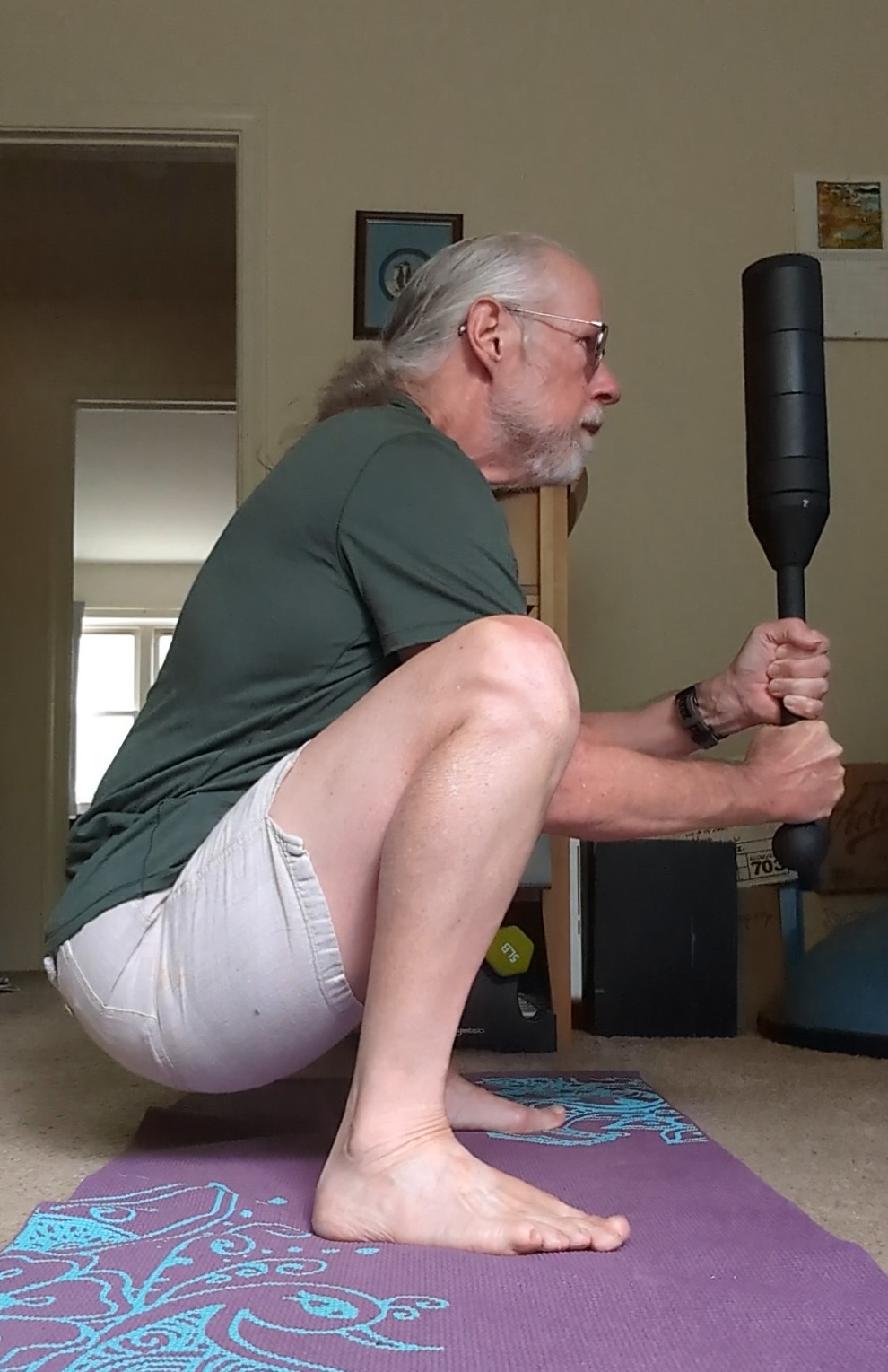
Pictures of me in exercise clothing, so that future firms know what they might get:
If that doesn’t make you want me wearing your athleisure clothing in my content, well, I guess you probably don’t want me wearing your athleisure clothing in my content.
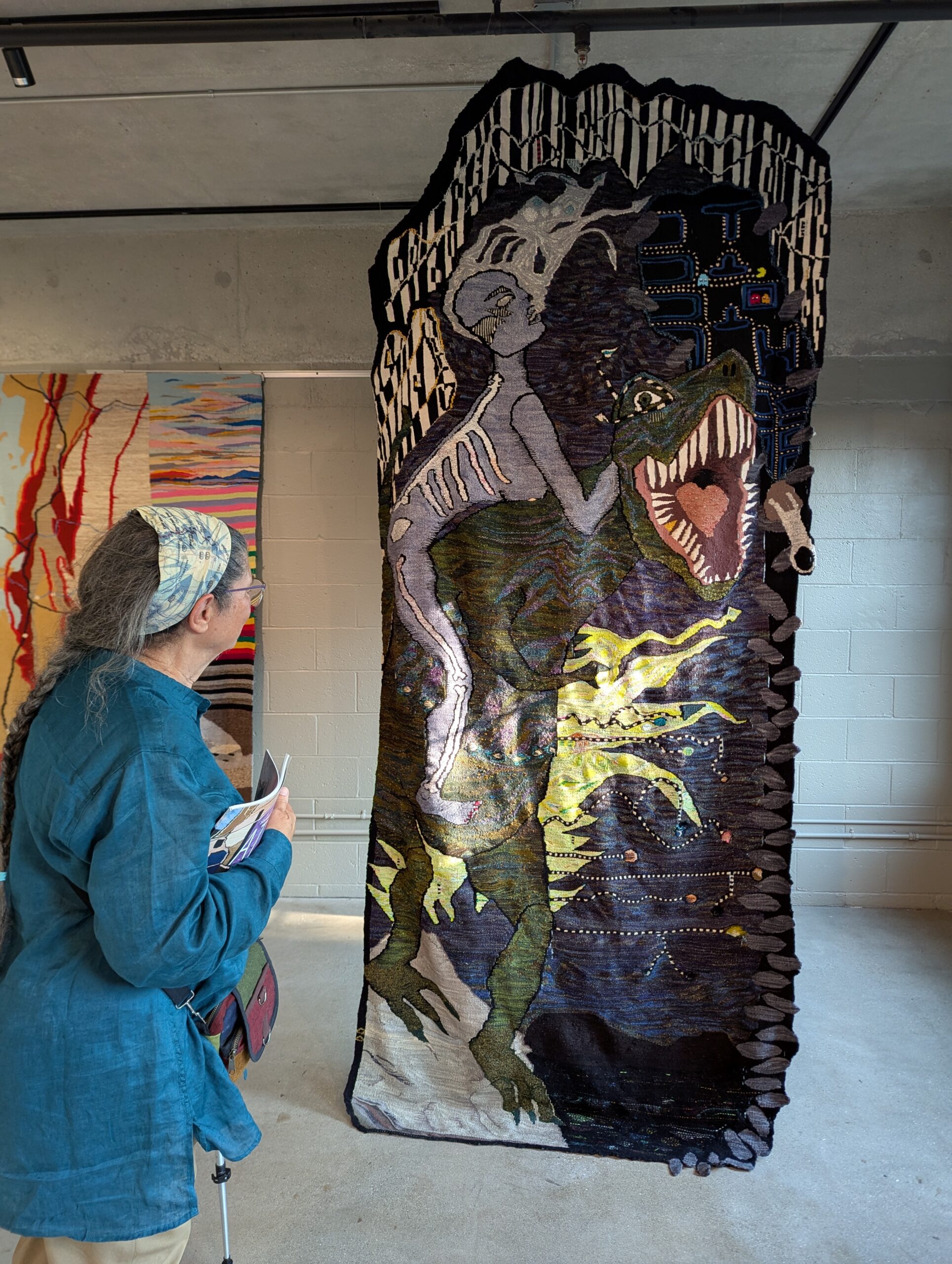
Jackie and I are in Chicago for the weekend, staying in the Palmer House. We came to attend the opening of a tapestry exhibit at an art center in the West Loop, put on by the American Tapestry Association. The exhibit includes a piece by one of Jackie’s teachers, So Jackie particularly wanted to see it.
Jackie looking at a different tapestry, this one showing a woman with a dinosaur
After a period where I was being a bit casual about them, for the past few months I’ve been doing pretty well at getting my workouts in, and I didn’t want to let that go, so I went to the fitness center here at the Palmer House. It’s pretty good!
I cranked through a slightly reduced version of my usual morning exercises, then went to the main room of the fitness center for the workout proper. They had an adequate set of kettlebells, so I did two exercises with those:
With a 35 lb (16 kg) kettlebell I did 10 x 20 swings emom
With a 20 lb (9 kg) kettlebell I did 4 x 5/5 clean&press reverse ladder
Then I found a barbell and loaded it up with a pair of 45 lb plates and did 2 x 5 deadlifts. I’m super out-of-practice with deadlifts, and would not have wanted to do more weight or more reps, but that much was okay.
Having done the tapestry thing, we’re looking to do some other Chicago stuff. Probably the Art Institute. Maybe one of the boat tours where they talk about the architecture. Maybe the Field Museum. Maybe something else! We’ll just see.
I’m watching a video on how chronic stress reduces your adaptation to things like exercise. It’s down on passive coping strategies, such as “seeking out alcohol, watching TV, procrastinating, talking to friends, [and] moaning about the problem.” Instead the video recommends “active coping strategies, such as “actually deal[ing] with the problem,” and recommends such things as “if you have a problem with somebody, talk to them.”
And I’m like, “Okay, that’s a big nope.”
I mean, it’s not wrong… “This is what the stress energizes you to do. So you want to take advantage of that fight-or-flight mode? Seek out what the root cause of your problem is, what it is that is giving you stress, and then tackle the problem head on.”
Except I do not want to take advantage of that fight-or-flight mode, except that I do want to flee if at all possible.
And those passive coping strategies? I’m all-in. I mean, moaning about the problem is like 90% of my whole personality.
Ashley, on the other hand, is totally down with both fight and flight responses:
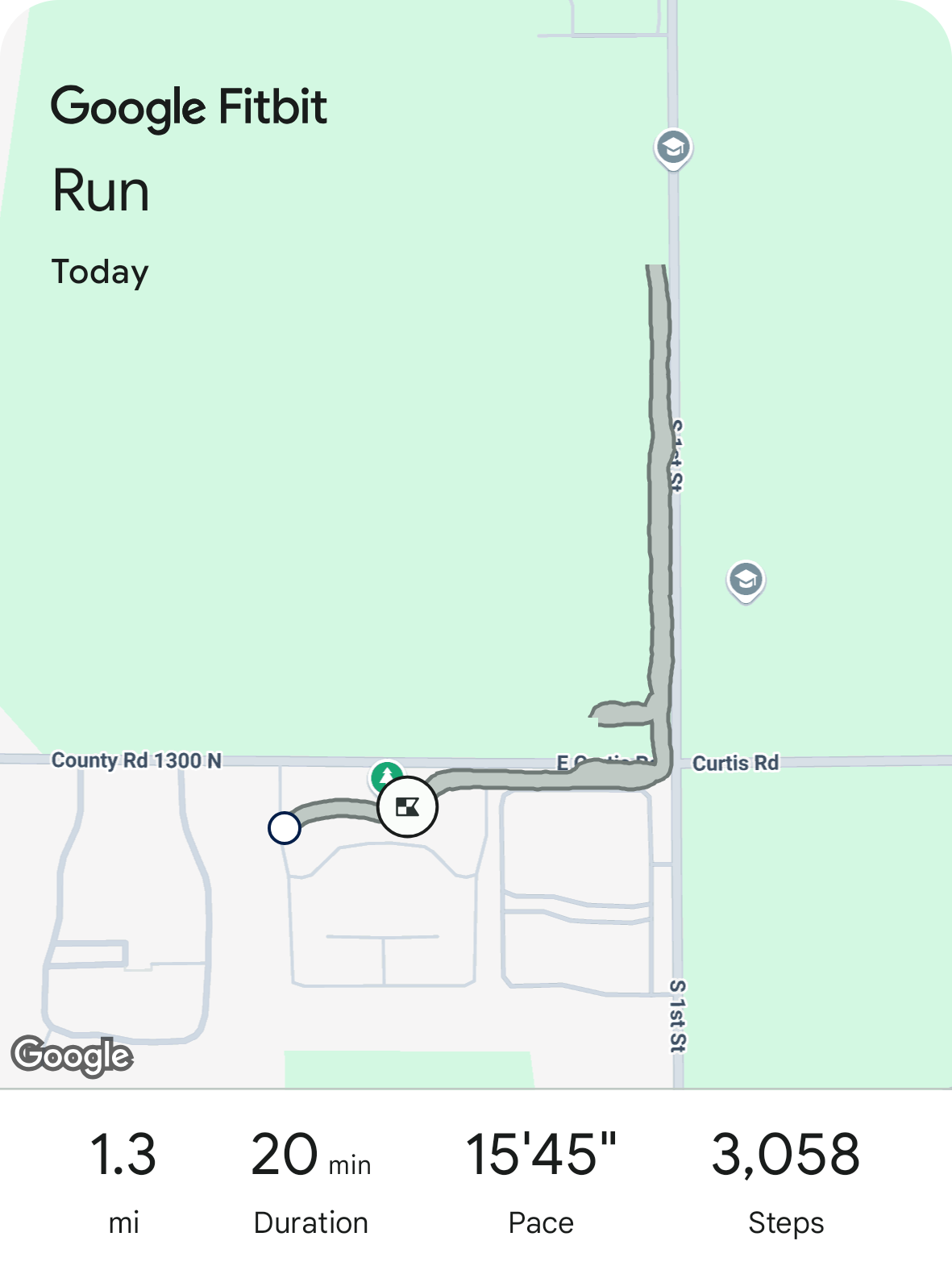
My run was already supposed to be pretty short—about 2.5 miles, across Dohme Park, up First Street to Windsor and then back—but it ended up being even shorter than that, because Ashley wasn’t up to running even that far in the heat of the day.
According to my weather app it was already 75℉ when I got home, and I’ve noticed previously that starting at about 72℉ the dog starts to suffer.
You can see on the map a short spur off to the west just after I started north on First Street. That was where we saw a groundhog, and Ashley really wanted to chase it. I indulged her for a minute, hoping the groundhog would quickly find a place to hide, but it wasn’t to be, and I eventually had to drag Ashley back to the First Street path very much against her will.
Anyway, 1.3 miles is a very short run indeed, but I still spent most of 20 minutes with my heart rate up (average was 141, peak was 169). So, a good workout.
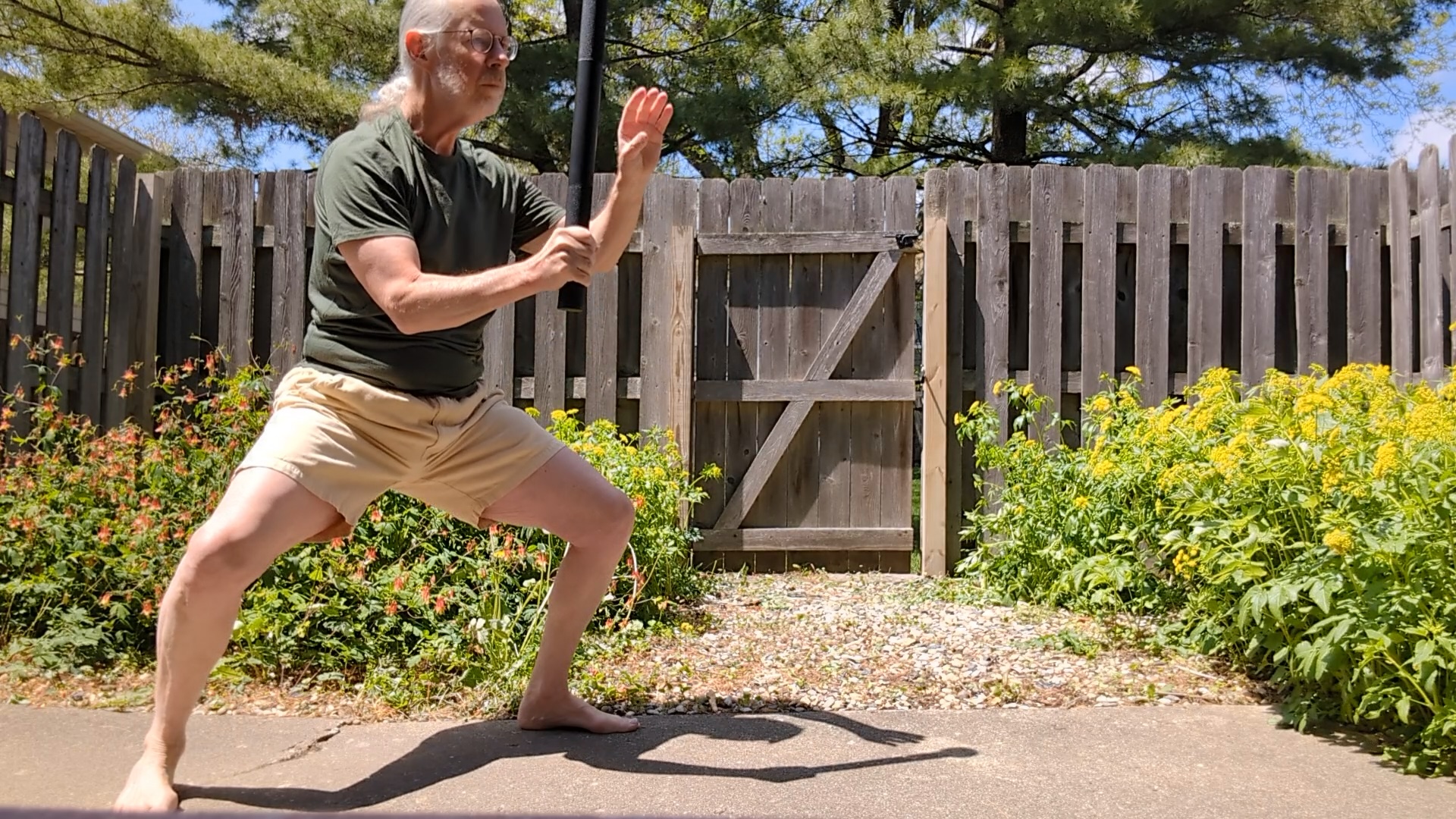
I wanted a workout to practice my Meyer fencing stance—a workout more interesting than just standing in the stance for a minute or two.
Mark Wildman, in one of his a live Q&A videos, suggested the mace drop swing as a useful exercise for someone doing longsword. (It was in response to a question I asked about improving arm strength and endurance for holding your arms forward and overhead at full extension for extended periods, as one does in longsword.) He had suggested doing it in Warrior 2, but specifically mentioned that you could do it in whatever stance went with your longsword style; it just got harder as your stance got wider.
Besides being boring, just standing in a Meyer stance for a minute or two seemed like a missed opportunity; even a modest challenge to your stability in the stance seemed like it might pay off in strength, flexibility, and control of your stance.
So here’s the workout I came up with:
Get in your best Meyer stance, with your mace in your front hand. Execute 5 drop swings, checking your stance after each rep. Shift the mace to your rear hand and repeat. Take one passing step forward. (Your mace will now be in your front hand.) Repeat five swings with the front hand and five swings with the back hand.
That’s one set.
Here it is as a video:
My plan is to gradually add sets until I can comfortably stay in the Meyer stance for 5 or 10 minutes, to build the habit and capability of keeping a good stance while it is challenged by a shifting weight.
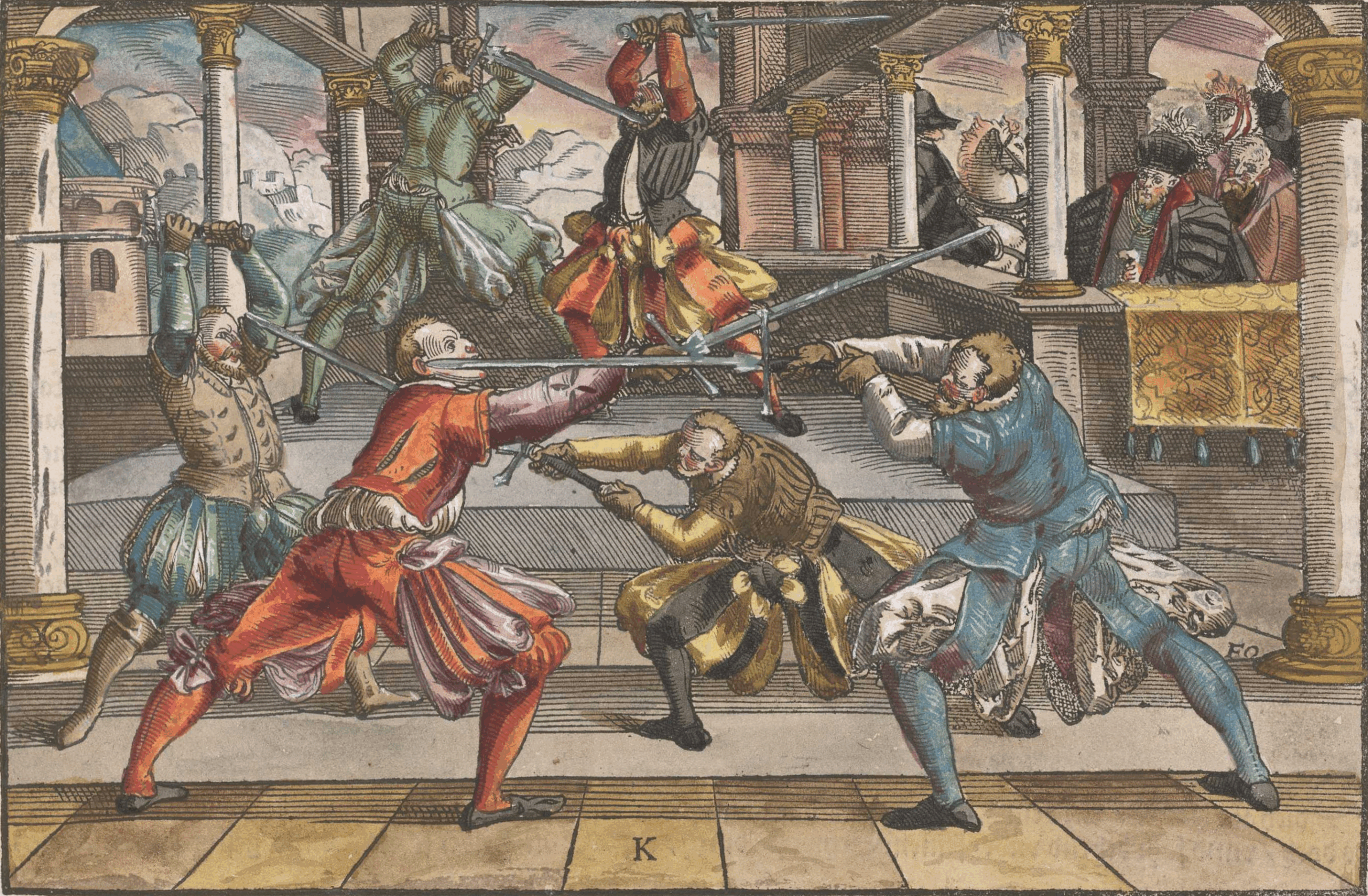
I think my stance is okay here. Of course, there isn’t just one Meyer stance. This image from Meyer’s treatise show the range pretty well:
The front two figures are both in what I think of as a basic Meyer stance. The two figures behind them are also in Meyer stances, the one on the right in something of a lunge, the one on the left in a more upright stance.
My drop swings clearly need a lot of work (do not copy mine!), but that basically comes along for free as I do the stance workouts. (I wrote a post called Fitness training for longsword, Mark Wildman style that embeds two Mark Wildman videos of the Warrior 2 stance mace drop swing, if you want to see someone doing it better.)
I’m doing the swings with my 5 lb mace. I have a 10 lb mace that I’ll want to move up to, once I have the drop swings a bit more under control.