I’ve started thinking of my fitness practice more as movement practice. This post is about that shift in my thinking, and if that’s not going to be interesting to you, you’ll probably want to just skip this one.

I have always wanted to be fit, for what I think are mostly ordinary reasons: to be healthy, to look good, to be capable of doing the things that need to be done. For most of my life, my fitness practice fell short of what I thought it ought to be, again for mostly ordinary reasons: I was busy, the weather was bad, I found exercise boring or unpleasant.

I would get my aerobic exercise running and cycling in the summer, and walking year round. When the weather cooperated with a mild spring, I could get in pretty good shape by mid-summer. A couple of years, I even preserved some level of running capability over the winter; one of those years, I ran the Lake Mingo Trail Race, which at 7.1 miles was usually beyond my capability in mid-June when it takes place. But, given the realities of working a regular job (with hours when I needed to be sitting at a computer, rather than out for a run), winter (when I just about don’t cycle or run) and injuries (as my brother likes to say “Running is great exercise, between injuries”), my fitness practice never made me fit for the long term, just fit for a while.

This changed a few years ago, for a couple of reasons.

The less important reason was that my employer closed the site down, and I decided I could get by without a regular job. It means our financial circumstances are a bit straitened, but my hours are my own.

More important, I started practicing taiji.

Taiji gave me balance and control, but much more important, it taught me mindfulness—to be present in my body during my exercise. (I was prompted to write this post at this time because I’ve been reading a blog by Johnathan Mead called Move Heroically, that nicely hits the sweet spot in my evolving interest in fitness. The latest post in particular is on exactly this topic: Embodiment is a Performance Enhancing Drug.)

I like to think of my exercise as building capabilities. I go for long walks because I want to be able to go for long walks. I run because I want to be able to run.

That’s an oversimplification in at least two ways.

For one thing, honesty requires me to admit that I engage in endurance exercise because I like it (perhaps because of the endocannabinoids it generates). A long run at a brisk pace makes me feel good.

More important it’s an oversimplification because specificity of training means that my exercise practice was only building a very narrow slice of the capabilities I imagined. Yes, if I go for a long run every week or two, I do create and maintain the capability to run a long way, but that capability is only barely transferable to other activities. When Jackie and I wanted to go on a century ride, we spent many weeks building up our stamina for long rides. Given how long it’s been since my last long ride, I would not want to stake my life on my capability to bicycle 100 miles without a good bit of training. Maybe fewer weeks because we’re fitter now, but I’d still want weeks of training before attempting another century ride.

It was this realization, in conjunction with my taiji practice teaching me to move more mindfully, that brought me initially to parkour, and more recently to natural movement generally.

Running wasn’t just for fun (although it was fun), and it wasn’t just to be more healthy (although I expect I am). I was explicitly building the capability to run if I needed too. I used that capability sometimes—to catch a bus, to get to an appointment on time—and I imagined that I could use it under other circumstances as well: running away from some danger, running toward someone who needed my help.

But I came to realize that, because of exercise specificity, my capability was a very narrow one indeed. I could run, but I could only barely jump or climb. If I came to a place where I needed to step down I was fine, as long as the drop was only a step or two. But if I needed to jump down by, let’s say, three steps, things got much more problematic. I could climb up a steep path, but am quite daunted if I need to climb up a tree, or cliff, or a wall, or a rope.

That was what brought me to parkour.

Even before I made much progress in the skills of parkour, however, I happened upon natural movement. It shares the roots of parkour, but is less about the specific skills of parkour (vaults and such), and more about basic human movement. Yes, walking and running. Also climbing and jumping and crawling. Balancing. Throwing and catching. Lifting and carrying. Swimming and diving.

So, this is where I’ve come to. I’m very pleased with my walking, and adequately pleased with my running. My climbing skills need considerable broadening. Thanks to taiji, my static balance is okay, but I’m still a beginner when it comes to more dynamic balance. My throwing and catching were never great, and have declined enormously due to a lack of practice since I was a boy. My lifting and carrying skills are deficient, due to too many years lifting weights primarily with machines. If you dropped me in water over my head I could avoid drowning for a while, but unless shallow water or rescue were reasonably close, I would be hard pressed to reach it.

There is a great deal I want to learn (and re-learn) this summer, and I have started in small ways.

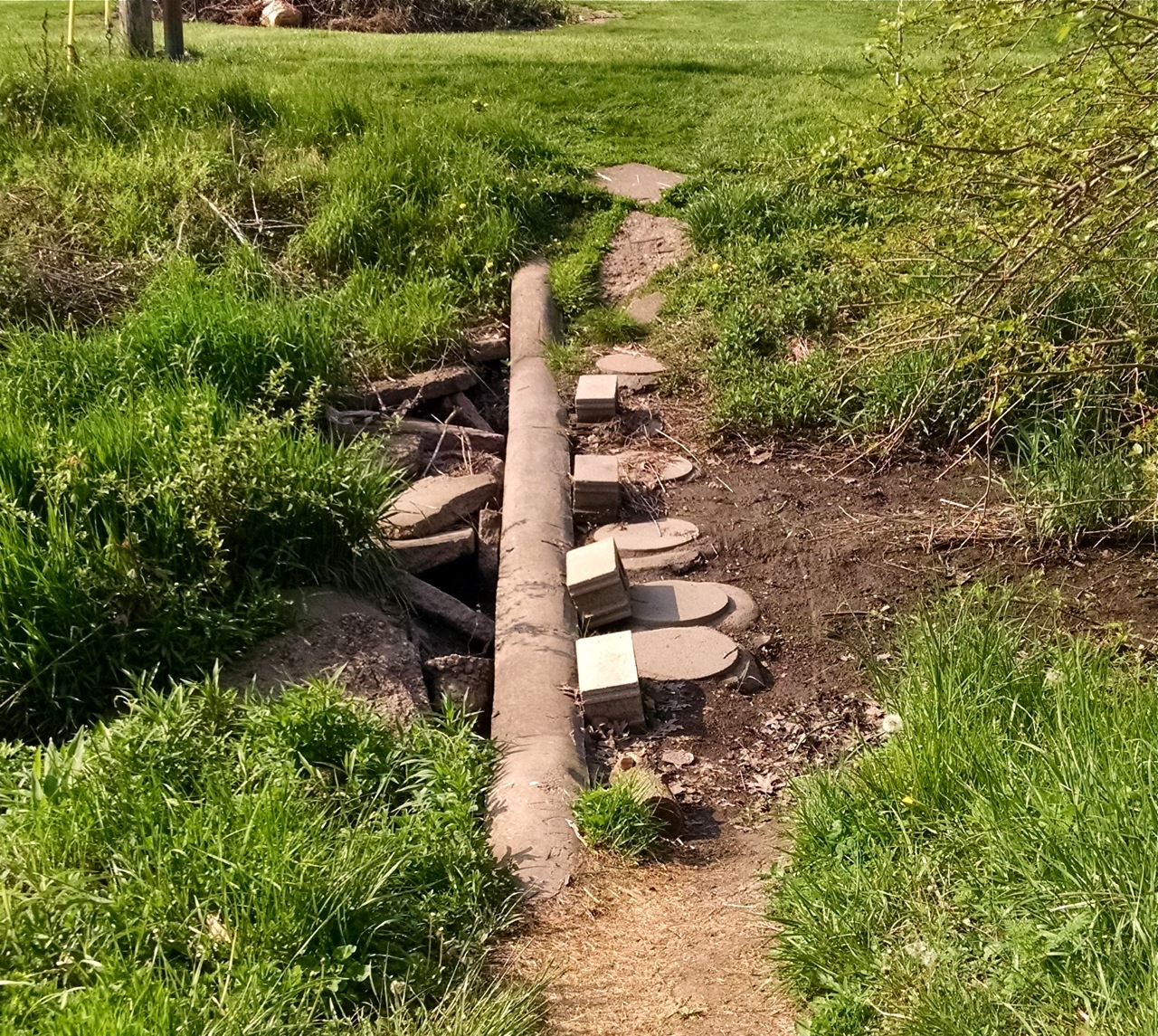
weir-behind-winfield-villageThis weir crosses a ditch that runs behind Winfield Village. It’s concrete, a good 12 inches wide, but curved on top, making it a pretty good imitation of a log put across a river to serve as a bridge. I’ve been including it as part of my running route, initially with some difficulty (needing to use the concrete blocks as additional stepping stones), but now crossing on just the weir, and beginning to pick up the pace.

I’m being very careful—Jackie would be quite peeved with me if I injured myself right before our Kal-Haven Trail walk—so I’m not doing much with jumps or vaults yet. But my concept of fitness has broadened greatly, and I’m no longer satisfied with merely a strong heart and strong muscles. I want the full range of human movement capabilities.

Over the past three years, Jackie and I have done a lot of walks where the distance came in at around 20 miles, but we’d never actually reached 26.2. Yesterday we did.

In many ways, this was just another training walk for our planned Kal-Haven trail walk—which is why we hadn’t hit this distance before: We’re much more concerned with not hurting ourselves before the big walk than we are with hitting any arbitrary distance in advance.

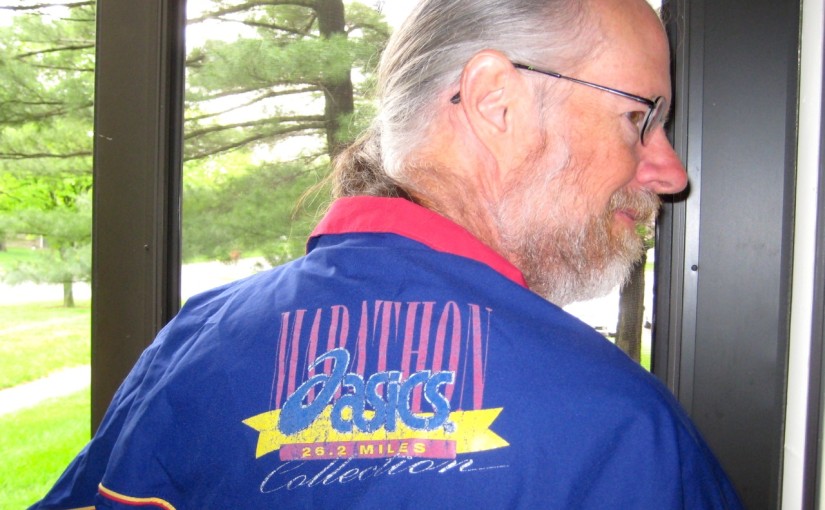
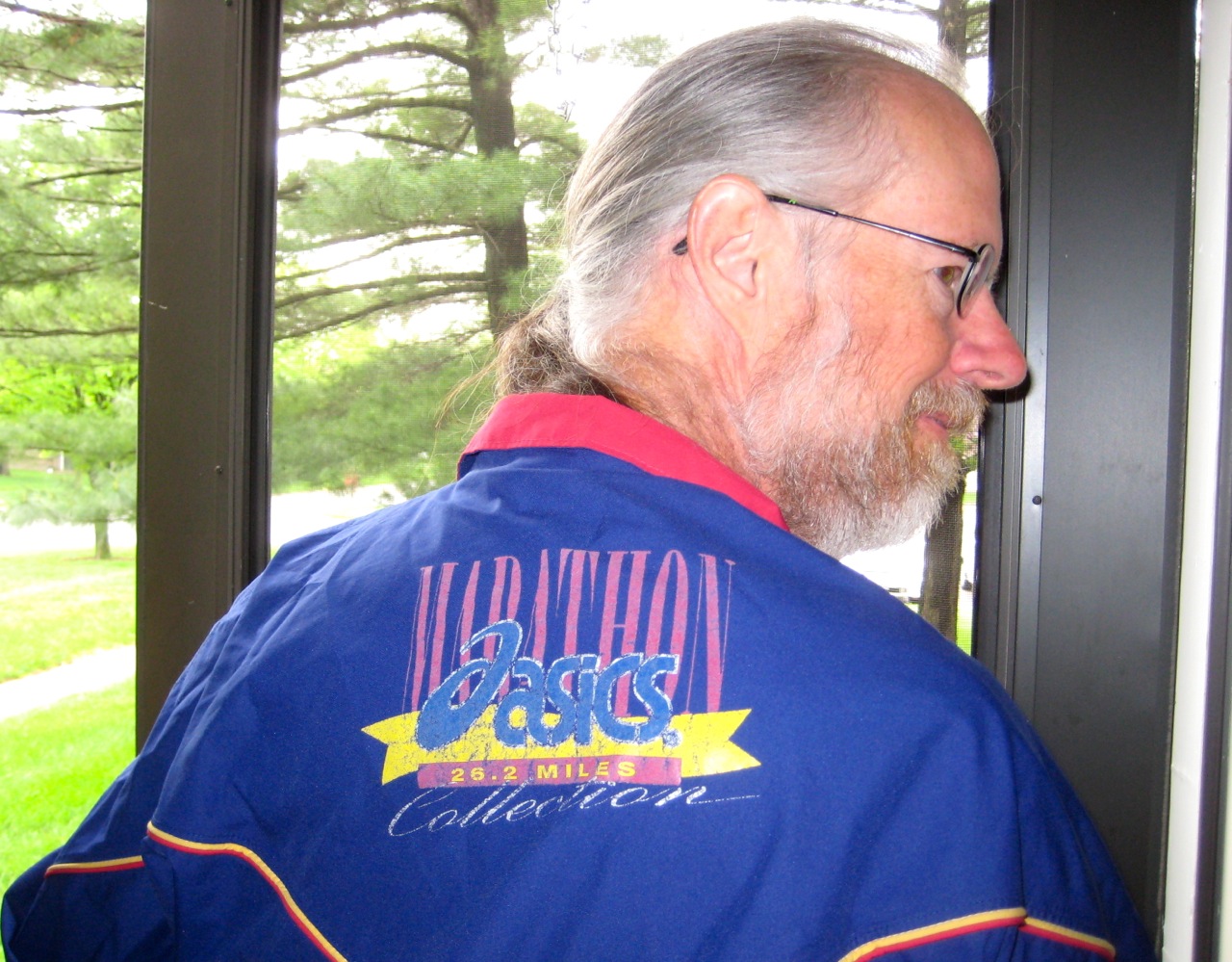
Still, I’m glad to have finally walked 26.2 miles, because now I don’t have to feel like an imposter when I wear my rain jacket:

me-in-marathon-rain-jacket
Me in my marathon rain jacket. Photo by Jackie Brewer.

I got this jacket long ago—at least 15 years ago, maybe longer. I remember finding a gore tex rain jacket in the Sierra Trading Post catalog at about an 80% discount. I think it was so cheap mostly because it doesn’t have a hood, which is a deficiency for a rain jacket, but the large marathon graphic on the back may also have put off some people who were not marathoners.

I snapped one up immediately. Only after I had secured mine did I share the catalog with a friend at work who I thought would also be pleased with a cheap gore tex jacket. (He bought one too. For years we were occasional twinsies on warm rainy days.)

All these years it has been my main rain jacket, and all that time I’ve been just a little uncomfortable wearing a jacket so prominently marked as being for marathoners. Now, finally, I can quit worrying about it.

We were walking rather than running, so we were on the road a long time—almost ten and a half hours. (The people who win marathons run them in a little over 2 hours; middle-of-the-pack runners tend to finish in 3–4 hours.)

It was a great walk, although we were feeling pretty tired the last few miles. We went up to our old neighborhood and walked around our old apartment complex. (It looks a bit more empty than when we were there.) We walked up the Greenbelt Bikeway, then headed east to our summer place. (It looks exactly the same as it did when we lived there last year.) Then we walked through the water amenities at Second Street, and onward to Busey Woods. Then down Race Street to Orchard Downs and across through the arboretum and the research park. We went north to Florida to cross the railroad tracks, then headed south along the Boulware Trail and on into Savoy. We went west just a bit to take the path along Prospect down to Curtis and thence to home, taking a slightly long route through Winfield Village (with a tiny diversion into our prairie) to be sure we hit the target mileage.

In the end we went 26.4 miles. Here’s the Endomondo data:

Jackie used to go to Greencastle, Indiana for the Fiber Event every year. (I think it was under different management back in those days; they called it a fleece fair.) We hadn’t gone the past couple of years, but Jackie wanted to go again this year, so we went.

Although a lot of what Jackie would buy there would sit in her stash for years, it was also a place for great finds—one year I spotted some roving made from a baby camel/merino blend that was on sale cheap because (so the vendor said) it had short fibers that made it hard to spin. But knowing that Jackie has no trouble spinning short fibers, and seeing that it was a beautiful camel-colored roving, I pointed it out and Jackie bought a bunch of it.

This year, Jackie got some yak/merino, and the vendor insisted on giving her a sample of some yak/silk blend as well.

Before coming home, having made it to that part of Indiana, Jackie and I visited Turkey Run State Park.

This time of year is a great time to visit. For one thing, there are wildflowers:

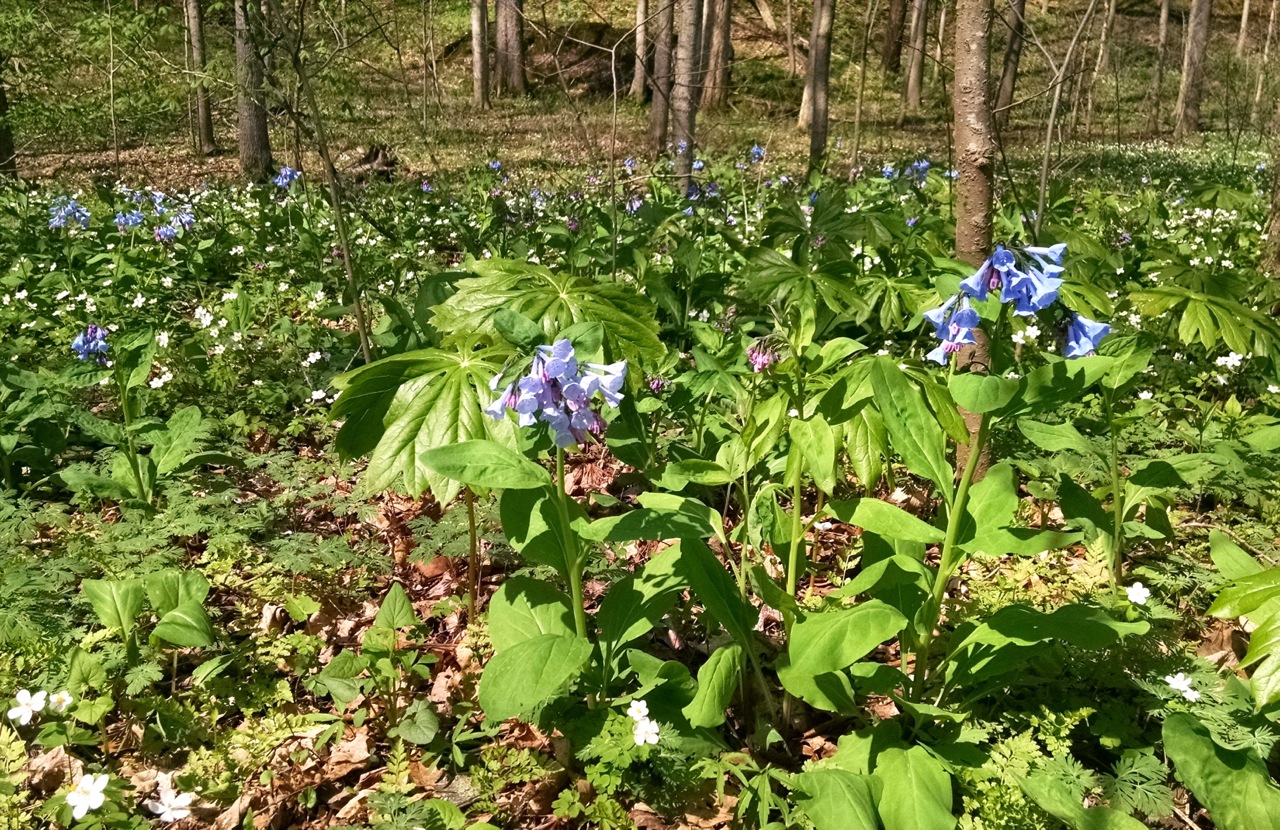
turkey-run-flowers
Bluebells, spring beauties, and may apples (not yet in bloom)

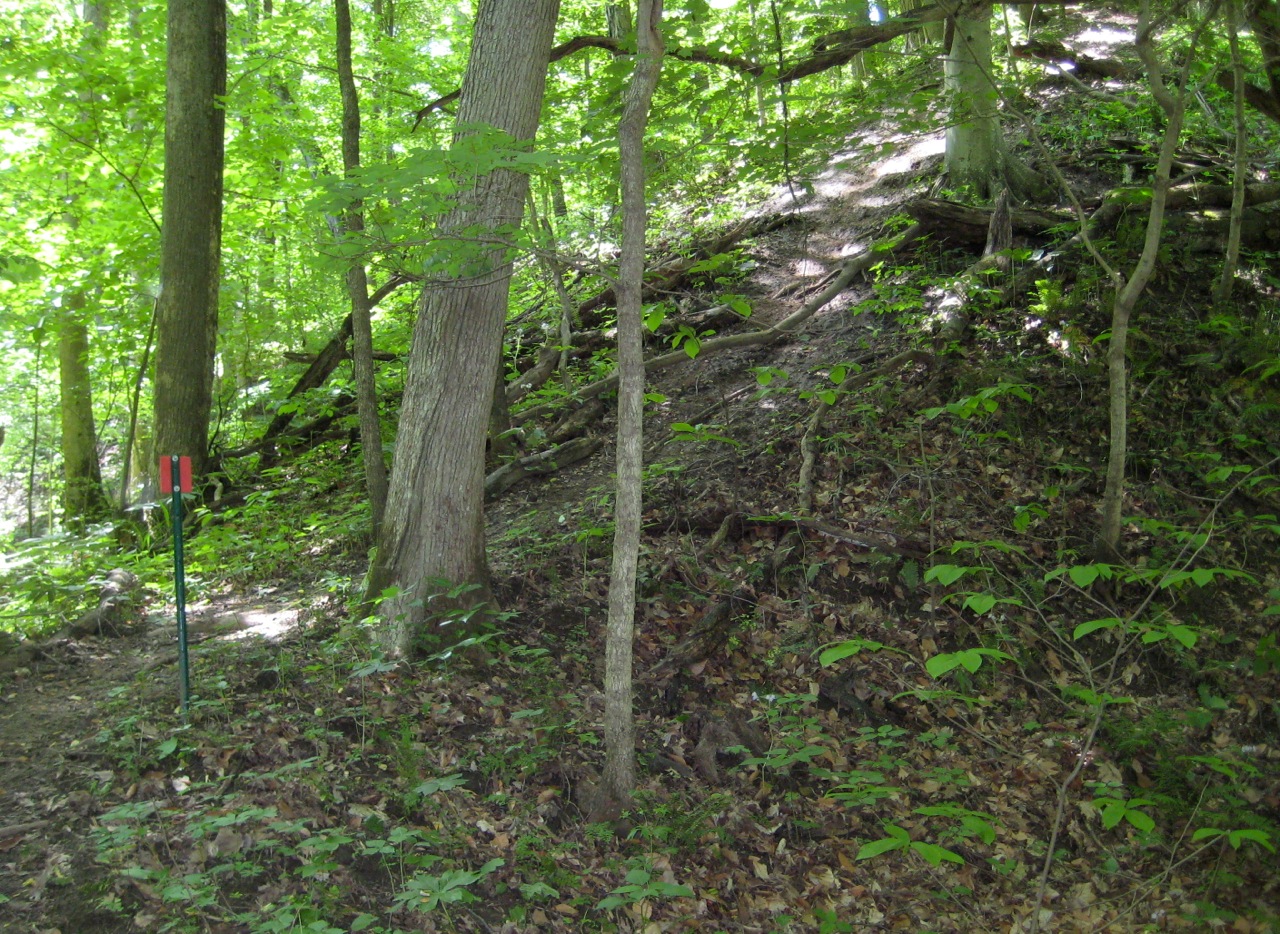
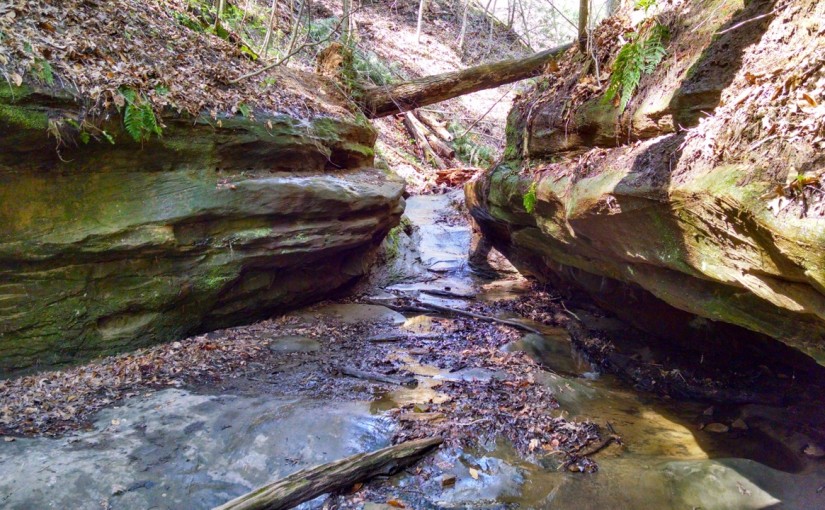
It’s a great place. My family has a long history with it—the first visit I remember was when I probably only 7 or 8 years old, and I’ve been back many times. I’ve stayed in the lodge, stayed in the cabins, and camped in the campground. And always, I’ve hiked the trails.

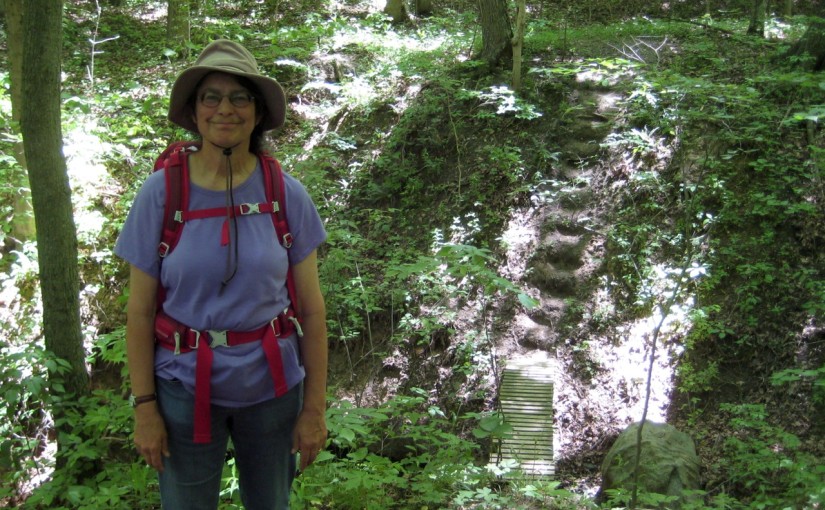
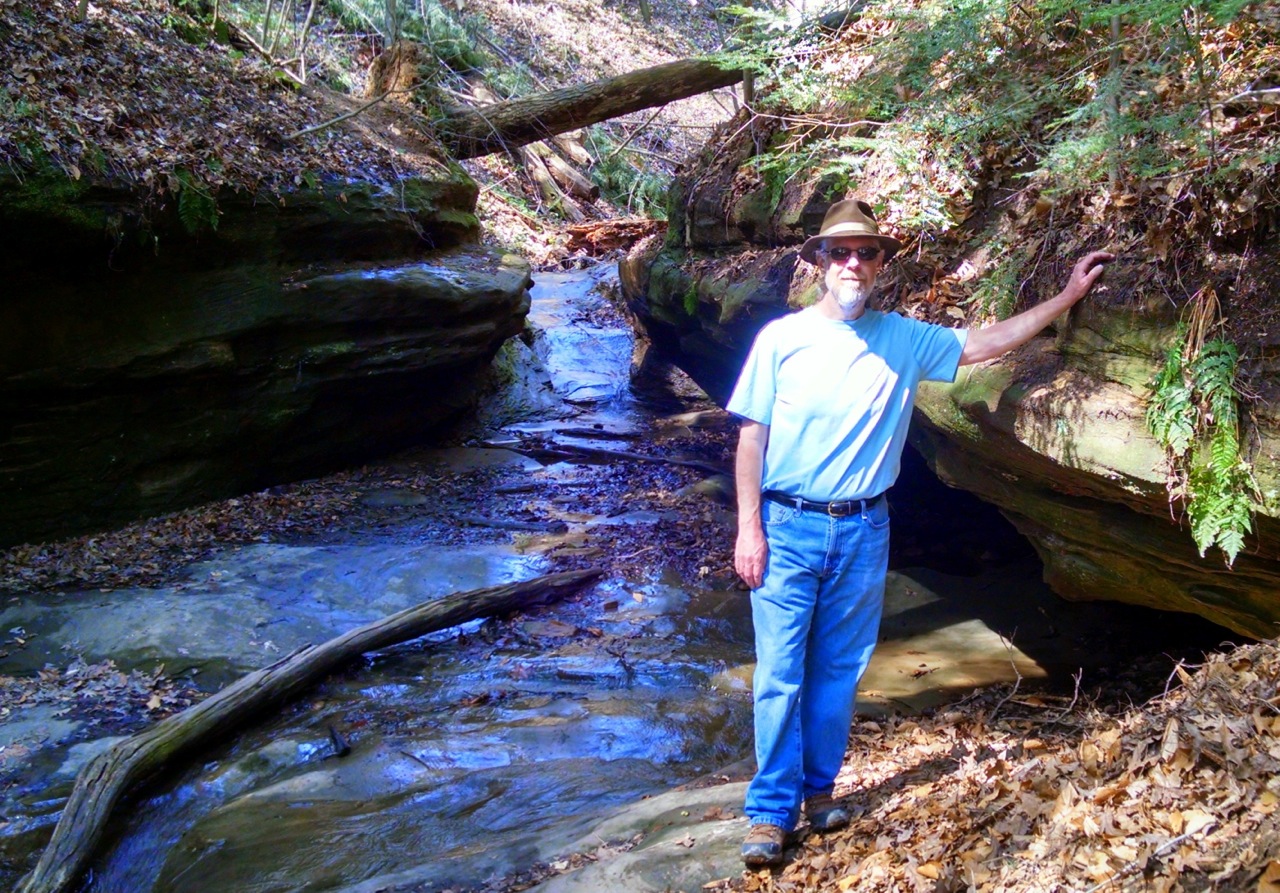
So, here’s a picture of me on one of the trails:

pb-in-turkey-run
Philip Brewer at Turkey Run State Park (photo by Jackie Brewer)

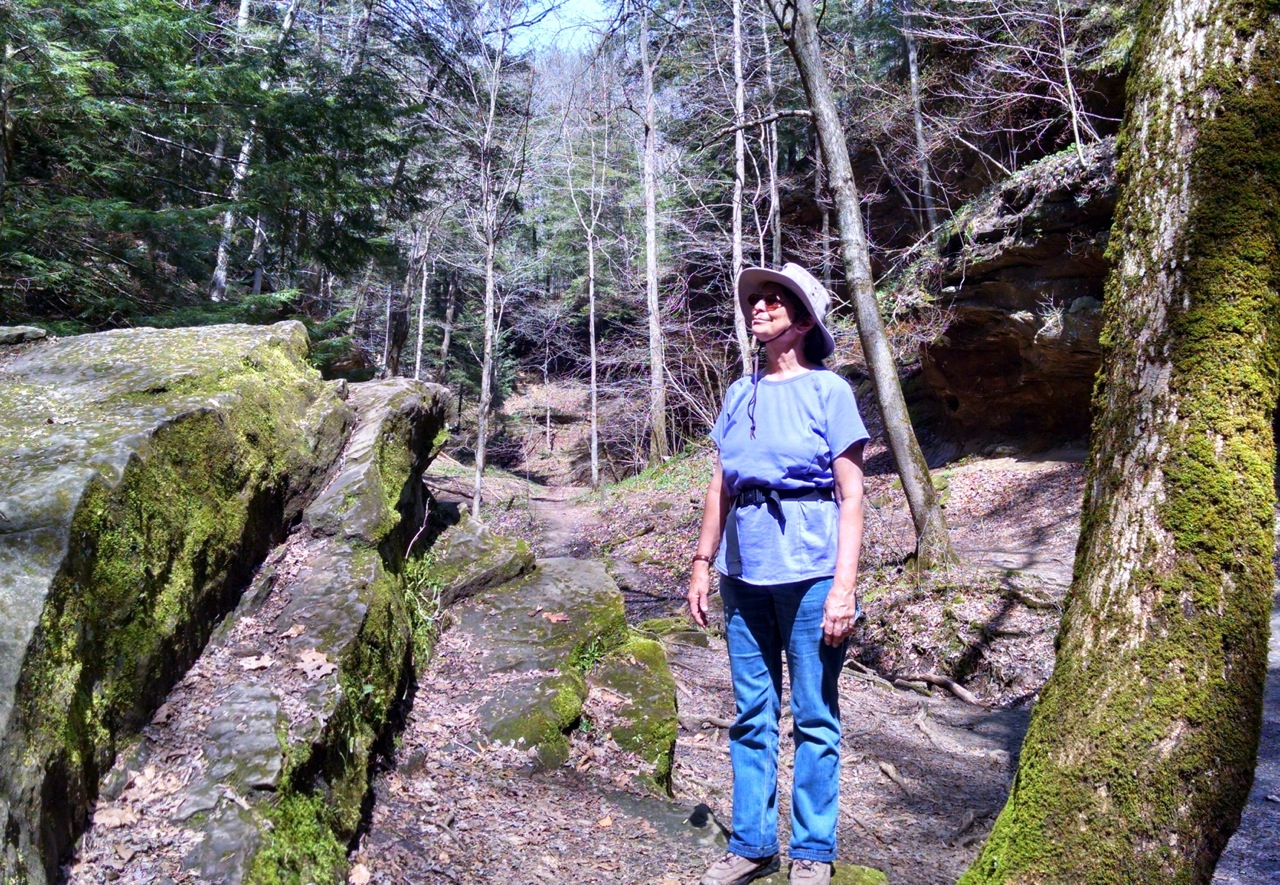
Here’s a picture of Jackie, taken not too far from there:

jb-in-turkey-run
Jackie Brewer at Turkey Run

Jackie and I have continued to work up toward being able to take our planned very long walk in mid-June.

Our previous outing was planned for 15 miles, but we actually did about 17. For yesterday’s outing we came closer to hitting our target distance—planned for 20 miles and came in at 20.61 miles.

It was a pretty good walk. The temperature was a bit cool, but stayed steady for the duration, so we weren’t having to adjust clothing repeatedly.

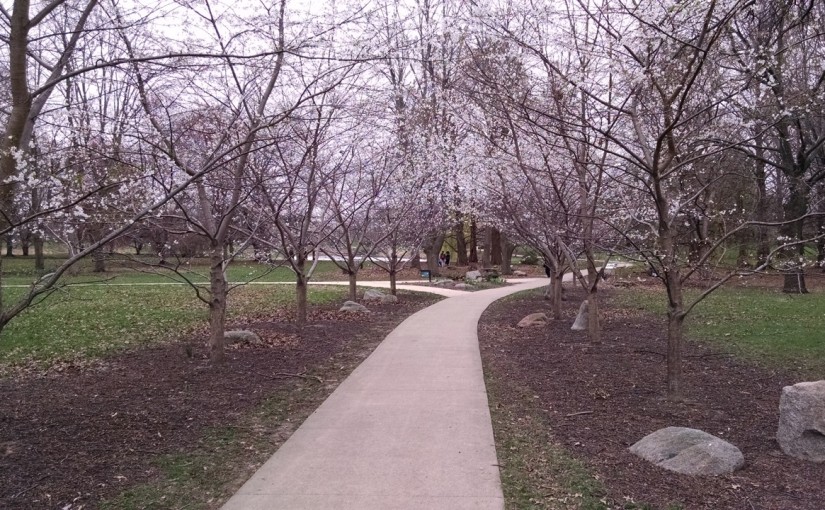
We walked through Robeson Park and then to our old neighborhood where we had lunch at El Toro. Then we went up the Greenbelt Bikeway and visited our old garden plot near Parkland College. Then we angled our way to downtown Champaign, passing near both our summer place and our winter palace, pausing for coffee at Pekara Bakery. Finally, we walked to the University of Illinois Arboretum (where the cherry trees were just blooming) and then headed home through south campus and the research park.

We held up pretty well, perhaps because the distance was only 3 miles beyond our previous long walk. My plan is that we’ll do 26.2 miles for our next walk, sometime towards the end of April, but we’ll see how things go. We have time in our schedule if we want to take that jump in two steps.

We haven’t been getting in as many of the medium walks as I’d hoped, mostly because of problematic early-spring weather. With the weather shifting to more of a late-spring pattern, I’m hoping that won’t be a problem going forward.

One thing I’d like to do is start including some faster miles in those medium-length walks. We can walk fast enough, but we tend to slow down late in the walk. That’s fine, but if we have very many miles at 20+ minutes per mile, it will make for a very long day on the Kal-Haven trail.

Here’s the details on this walk:

And here are the details for the previous one:

Jackie recently expressed a concern related to my expanding interest in fitness: “We were both nerds together at Motorola, but now you seem to be turning into a jock.”

I assured her that she was mistaken, pointing out that I have no new interest in team sports, nor in spectator sports—two key markers for jocks in my mind.

But I did see how she might be concerned. I was putting a lot of time, effort, and attention into this fitness stuff. I was also writing about it and taking about it a lot. (Enough that I felt I had to move some of the writing to my Esperanto-language blog, where it would bore fewer people.)

Most recently, I’ve been looking at some Natural Movement stuff, in particular at MovNat. They have roots in the same source as parkour, but without the urban bias. They also have a broader perspective—parkour is all about getting from point A to point B, dealing with obstacles as efficiently as possible. MovNat is about rediscovering a broader range of human movement skills—not just running, jumping, climbing and balancing, but also throwing and catching and swimming and diving and fighting.

Aware of the fact that I’m in that brief phase where some new thing is all shiny and interesting, I try not to spend all my time talking about it, but I still talk about it enough to bore any ordinary person. (Jackie recently let me go in for some minutes about one of these things and then said, “You should write something about this on your Esperanto blog!”)

Yesterday, while we were out on our long walk, I was once again going on about this or that aspect of movement skills. Jackie listened patiently, then said, “I take it back. You’re not turning into a jock. You’re becoming a geek about parkour.”

We were both reassured.

Today was our nicest day of the year so far, and Jackie wanted to do another long walk, so that’s what we did.

It seemed kinda early for a long walk, just 4 days after our last long walk. It was also kinda soon after my little parkour adventure yesterday. But the weather was great.

I had rather expected to be too sore after yesterday’s parkour—and I had noticed in the night that my core muscles were pretty sore.

Did you know that your core muscles are critical to turning over in bed? If not, I invite you to spend an hour on quadrupedal motion, precisions, and vaults, after which (unless you’re already a highly trained traceur) I’m confident you’ll be able to observe the fact for yourself. But when I got up, I discovered that I was otherwise fine. My feet, ankles, knees and hips were all fine, as were my calves and thighs. So, if Jackie wanted to do a long walk, I was okay with that.

We did it on kind of a whim, so we didn’t have a route planned, but that was fine: We just winged it. Today was a taiji day, so we started by walking to taiji. After taiji we walked to campus, where we decided to eat at Ambar India on campus—it’s a buffet, so we wouldn’t have leftovers to deal with. Then we walked to the Nutritional Food Store, the only place we know of to get freshly ground peanut butter. Then we walked home.

It came in at just under 13 miles, but we were tired enough and sore enough to not want to walk another couple of miles around home just to hit the 15-mile mark. We’ll do that later in the month, closer to the planned time. (Instead we sat out on the patio and drank beers. It was the first day warm enough for patio sitting this year, and we enjoyed it a lot.)

Here’s the details on the walk:

I went for my first outdoor run of the year on Sunday. It was the first day that the paths were clear enough of ice and snow to make it possible.

Although the paths were mostly clear of ice and snow, there was a lot of melt water, flowing across the path in hundreds of rivulets. I found myself integrating into my run hundreds of small leaps, in a (partially successful) effort to keep my feet dry.

I was well aware of the leaps as I did them—I remember making a conscious effort to refrain from favoring one side over the other, trying to execute each leap with the most natural foot leading, based on my current point in my stride as I approached.

For some reason, all those leaps were not the first thing that came to mind the next day, when my calves were as sore as they have ever been. I was just sad at how much more out-of-shape I must be than I had realized, to be so crippled by a simple three-mile run. (They hurt a lot more than when I actually tore a calf muscle a couple years ago.) It was only late Tuesday, when I was heading to teach my taiji class, that I jumped over a similar stream of water in a parking lot—one calf screaming when I launched, the other screaming when I landed—that I realized that it was the leaping that had done such a number on me.

With that reassurance I felt much better, and by Wednesday my calves were feeling much better, which was good because Wednesday Jackie and I went on our first long walk of the year, part of the series of long walks we’re taking to prepare for the 33.5-mile Kal-Haven Trail walk that we’ve been meaning to take for a couple of years now. We’re quite determined that this will be the year.

For our first long walk we walked to taiji, attended our class, and then walked on to downtown Urbana and had lunch at Crane Alley (good beer). After lunch we walked back through campus. Having exceeded our planned distance (we wanted to do 10 miles and got in 11.5), we caught a bus at the south end of campus to go the rest of the way home. (The walk home from the south end of campus isn’t far, but there’s no good footpath. I think during the summer, when it’s possible to walk along the side of the farmer’s fields, it’ll be a fine walking route, but yesterday it would have been too wet and muddy.)

It was warm enough that I was able to expose my forearms to the sun!

My training plan, such as it is, covers just the long walks—we’ll include many shorter walks in our daily activity, and plenty of medium walks as well. But the long walk plan looks like this:

  • first-half March: 10 miles — done
  • second-half March: 15 miles
  • first-half April: 20 miles
  • second-half April: 26.2 miles (because why not?)
  • first-half May: 30 miles

The main event is planned for roughly June 18th, but it will depend on the exact schedule of when we go to visit my dad and what the weather looks like those days. I figure we’ll be fit enough to do a very long walk of the planned distance any time after mid-May, so that gives us a month’s cushion to allow for any glitches.

I’m kind of excited about possible medium-length walks from our new house, here south of town. All of south campus is reasonably close, including, for example, the Arboretum with its cherry trees, which should be in bloom in about a month. It might make sense to walk there several times in early April, to keep up with the progress of the cherry blossoms, and take the opportunity for both haiku and photographs.

The most obvious way to walk (starting with the exact route from south Campus that I rejected yesterday) would be about 3 miles each way, the first half along the sides of country roads. As I say, it should be an entirely satisfactory route anytime the ground isn’t too wet.

Here’s the details for Sunday’s run:

And here’s the details for Wednesday’s walk:

I’ve had a slightly sore foot for a while now.

It hasn’t been a big deal. It doesn’t hurt when I run. It doesn’t hurt when I walk (except sometimes when I walk really fast). It doesn’t hurt when I stand, or when I’m just sitting.

Mostly it hurts when I use my foot as a brace to turn or twist, such as when I brace the side of my foot against the mattress to turn over in bed. Sometimes it hurts when I’m standing on my other foot, and touch just the toe of the sore one down to catch my balance.

It sometimes hurts for the first few minutes right after I get up in the morning, kind of like plantar fasciitis, but a different part of my foot: the medial edge, just posterior to the ball of the foot.

Even then, it doesn’t hurt much.

However, it has been persistently hurting occasionally, just a little, for a long time now. Months.

I had been doing basic, conservative care. I was wearing supportive shoes, avoiding things that hurt it as best I could, and figuring it would eventually get better. But it hasn’t.

So, a couple days ago, I decided to step it up a notch: I decided to treat it with a placebo. (The effectiveness of placebos is well-established. They’re effective even when people know that the treatment is a placebo.)

My initial plan had been to add in some sort of cream or ointment. I thought of something like Aspercreme, but it doesn’t hurt enough to justify the use of even a mild analgesic, so I thought I’d get something like Bengay or IcyHot: just some sort of counter-irritant that would make it clear that I was “doing something” to treat my foot. Then I saw Walter Jon Williams’s recent post on Tiger Balm, and knew that I’d found the right stuff.

Jackie discovered Tiger Balm several decades ago, during her travels in Asia, and it has long been a staple item in our medicine cabinet, but we’d let ourselves run out in the run-up to our several moves, so we didn’t have any. Fortunately, the closest store to our townhouse is a CVS, and they had two varieties of Tiger Balm in stock. They seemed almost identical (a one-percentage point difference in menthol), but the one they were marketing as their “ultra strength” “sports rub” was $1 cheaper, so we got that one.

I’ve been using it for two days now, and I’m imaging that my foot is feeling better.

Perhaps because I’m finally doing something about my foot, I also remembered something else. For years now I’ve been wearing a pair of slip-on Birkinstocks as slippers. I started wearing them when I first got plantar fasciitis, and found that it was crucial to never go barefoot on our hardwood floors. Along with other supportive footwear, they solved the problem.

Usually I only wore them indoors, but very occasionally I’d wear them outdoors for very short trips—if I was only going as far as the mailbox, for instance. One or two summers ago, I tried to wear them for a walk around the block, and found that they really hurt the joint at the base of my big toe. I couldn’t make it even as far as around the block—I had to turn back and hobble home.

They never hurt my foot when I just wore them around the house, which I continued to do.

But now that I was thinking about it, it occurred to me that maybe they were hurting my foot, just not enough to notice unless I did something out of the ordinary.

Since the plantar fasciitis hasn’t bothered me since I started doing taiji, I decided to retire the slip-on Birkinstocks.

I’m also adding some calf-stretching, as well as some calf and shin strengthening activities.

I suspect some combination of those activities will do the trick. But just in case, I’m also rubbing some Tiger Balm two or three times a day into the side of that foot, from ball back almost to the heel.

I’ll keep you posted.

Oh, and by the way—the main reason I haven’t been posting much here is that I’ve been posting most of my exercise-related stuff on my Esperanto language blog, mostly as a way to improve my grasp of the exercise-related vocabulary (which is surprisingly poorly developed in Esperanto). I have a sense that most of my friends and relations have heard about all they want to about my exercise and fitness. And what better way to make sure almost nobody is bothered by my yammering on about it than to do so in a language almost nobody speaks?

We have a bunch of things we’re hoping to do this year, and most of them require some amount of preparation—preparation which will have to occur in the winter and spring.

My plans stretch out to the end of July, because the last week of July I’ll be in Lille, France to attend the 100th Universala Kongreso de Esperanto.

As preparation for that, I really want to spend half an hour almost every day practicing my Esperanto. That should be plenty—I already read and write the language and I’ve attended international Esperanto gatherings in the past. But just a bit of practice listening to spoken Esperanto (podcasts and such) and a bit of practice actually conversing (with my local Esperanto group, and such other folks as I can find) will go a long way toward making attending this kongreso a rich and satisfying experience.

About a month before that will be the solstice, and right around then—second half of June or very early July—is the only good chance do the Kal-Haven trail walk that we’ve hoped to do each of the last two years. (In those weeks because only then are the days long enough to finish the walk in daylight.)

As preparation for that, we need to go on several walks each week, including a very long walk roughly every other week, working our way up to being able to walk the 33.5 mile trail.

Several months earlier—just one month from now—we’re going to have a little party for people to come see our townhouse. We’ve fixed the date as February 1st, and are thinking of it as a celebration of Groundhog’s Day Eve, or  Imbolc, if you prefer. Invitations are forthcoming. If you don’t get one, it is surely an oversight—let me know.

As preparation for that, we need to finish unpacking!

Without a specific deadline, but very soon now, I want to finish revising my novel so I can get it out to first readers.

As preparation for that, I need to spend an hour or two every morning writing.

Normally at this time of year we’d also be planning our garden, but Jackie has convinced me that working a garden plot this summer will be more than we can manage.

Jackie and I rode the yellow bus into campus yesterday evening and attended a reception for and talk by Rick Bell about Active Design—using architecture to encourage people to move more, to eat better, etc.

We enjoyed it, and found the ideas very interesting, even though the talk itself was only fair—a long series of slides with pictures of places that exemplified one or another aspect of what he’s talking about, arranged geographically rather than according to the principles he’s suggesting. (The talk would have been more interesting for me if it had been organized by idea, rather than by place.)

One focus throughout the talk was on staircases. Of course any multilevel public space needs to have elevators (to make the space available to people who can’t climb stairs) and perhaps other things as well—ramps, escalators, and so on. But stairs are required too (for fire safety, if nothing else) and Bell points out that staircases can be done well or badly. In a bare concrete box closed in behind fire doors, they’re pretty uninviting. Brought out front and center, they can be wonderful. They can be beautiful design elements—glass stairs can float in the space, mirrored risers can reflect the space, etc. Staircases—if they’re broad enough—can also be places where people gather in small groups to stand or sit together. He had a photo of what I guess is a famous red staircase being used that way. (The talk was for architecture students, and was full of references to famous architecture and architects that mostly meant very little to me.)

He also had some photos of places where these things had been done badly, such as a second-floor fitness center with escalators to the entrance, and no sign of where the stairs might be, even if you wanted to use them.

There’s a lot to Active Design besides staircases—walkable spaces, bicycling infrastructure, creating (often re-creating) multimodal transportation infrastructure (like having bike paths and foot paths lead to and from the bus station, and having the bus station co-located with the train station and a bicycle rental place), seasonally appropriate spaces (like skating rinks), bringing food production into the city center, etc.

I’m glad we went. I’m glad we went by bus, rather than driving.