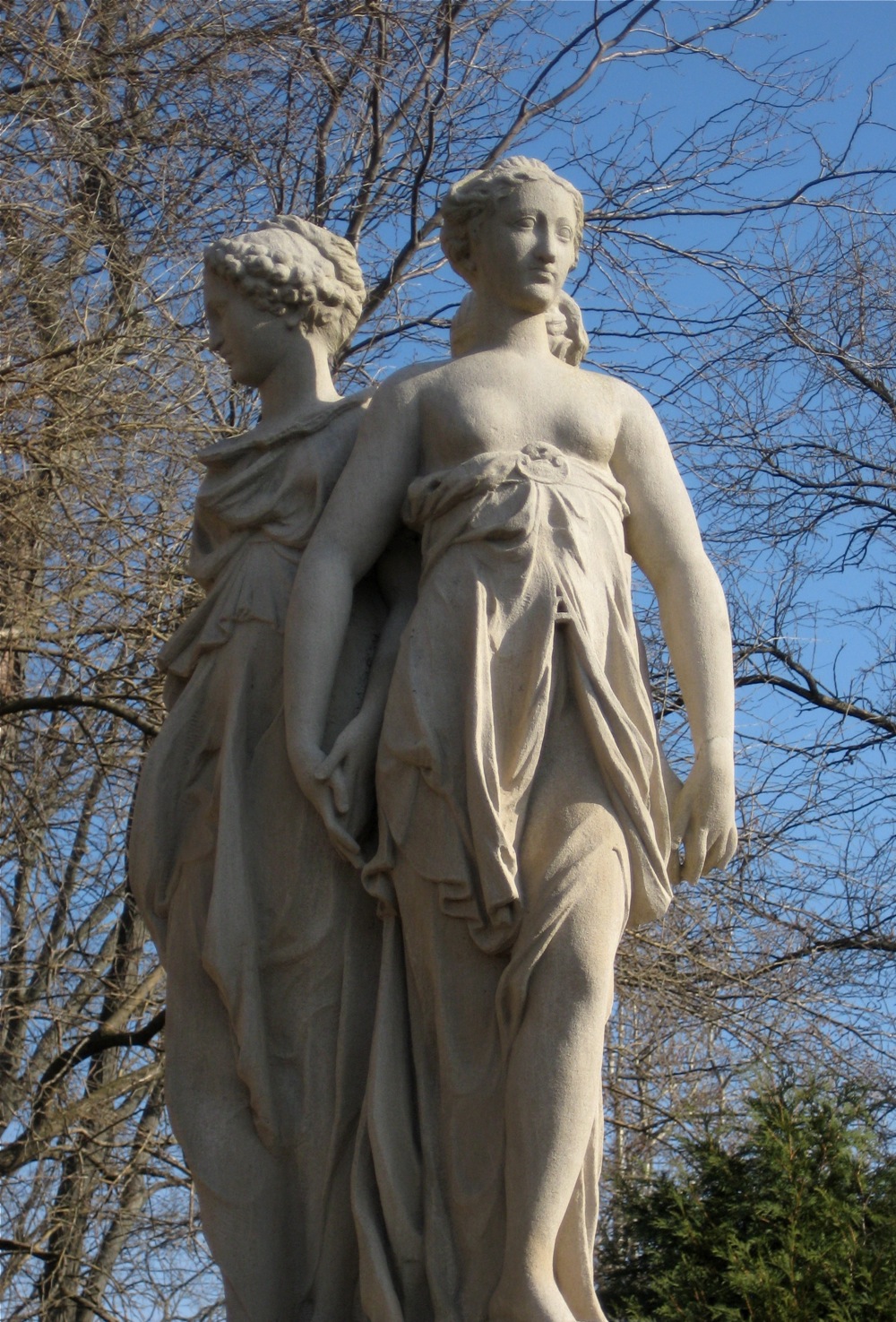
Statue of the Three Graces at Allerton Park
This statue at Allerton Park is called the Three Graces, but I like to think of it as the Three Muses.

I was pretty productive these past two weeks. I finished a major rewrite pass on a short story that the Incognitos had critiqued a while back, and passed the story on to a couple of first readers. I wrote several posts for Wise Bread. I did some preliminary investigation on a tech writing assignment.

I thought that was great, not only because it’s nice to get things done, but because it makes me feel like it’s okay to spend time on various less (or non-) remunerative projects, such as art, poetry, and Esperanto.

I’ve just come to realize, that this is a harmful way to think.

I’ve always had these recurring bouts of unproductivity. The previous several weeks were an instance of it: I sat at my computer and tried to work, but I didn’t get much done.

Back when I worked a regular job, these bouts were always terribly stressful. How do you tell your boss, “Sorry, I just don’t seem to be able to get anything done”?

I had several coping skills. Because of the kind of work I did, my managers never really could know how difficult a task was, so I could just say, “It’s turned out to be tougher than I thought.” Also, even when I couldn’t make any headway on my major tasks, I was almost always able to do something. I got in the habit of seeking out smaller, one-day tasks that I could do. That let me be productive (so I felt better) and gave me an excuse to be late with my main task (so I was less stressed).

Now that I’m not trying to work at a regular job, the stress level is much reduced. There’s no boss whose understanding of my productivity needs to be managed. There’s no job to be lost if that management goes poorly. But that doesn’t mean that I don’t still have these periods of unproductivity.

As I was saying, since this latest surge of productivity, I’ve felt free to spend some time on less remunerative projects, like doing some writing in Esperanto. And that brought me to a realization: It’s dumb to think that I shouldn’t work on stuff that I’m interested in, just because it’s not the most important work I could be doing.

I think part of the reason I’ve been doing it is that I thought it might motivate me to get my important work done. I know some people bribe themselves by withholding permission to play with side projects until they’ve done an appropriate amount of work on the main projects. But it has never been an effective technique for me. Maybe it helps a little when I’m just feeling lazy. But being unproductive is different from being lazy, and it doesn’t work at all for that.

More important, I think I’ve finally figured out that this behavior is actively harmful. These other things I do—drawing, poetry, Esperanto—probably help me be productive. They’re not a waste of time that I could be spending on important projects. Rather, they’re a pathway back into productivity. Being productive—even being productive on something that doesn’t earn any money or advance my career—is still being productive. And experiencing productivity after a period of unproductivity is positive. It leads to more productivity.

In the past, getting started being productive again has always been the hard part. Maybe this will help. Maybe, if I can be productive on some frivolous task (without agonizing too much over the fact that it is frivolous), I’ll be able to bootstrap that experience of productivity into productivity in other areas.

In the meantime, I’m being productive again in a wide range of areas. Go me.

It’s common in novels to have scenes where a character who is known to the reader is observed by another character who lacks that knowledge. To indicate that fact, the writer sometimes refrains from using the character’s name (and generally from mentioning anything that the other character can’t know).

That’s fine, except when (for story purposes) it’s important that the reader recognize that the character being observed is the character that they know.

Many writers use some physical tag that, I guess, is supposed to clue the reader in as to who the character is, and here’s where my bad reading capabilities come to the fore: I read right past that stuff.

When the story talks about someone seeing “the tall man in the black coat,” I do not automatically assume that this guy must be the main character (whom I’ve long ago forgotten was described in the first chapter as being tall and some time later as owning a black coat).

I can’t count how many novels I’ve found utterly befuddling because I never realized that “the guy in the cowboy hat” was not just some guy in a cowboy hat, but rather was the main character (whose choice of chapeau had no doubt been mentioned, but without the important caveat “by the way, in the world of this novel, nobody else ever wears a cowboy hat”).

Now, it’s possible to make this work. I remember a novel that described one character as walking “with the outsides of his feet making first contact with the ground.” When someone with that particular gait was referred to later, I never once thought that maybe this was some other guy who happened to walk on the outsides of his feet.

So, how about you guys? When a book you’re reading references “the bald man” or “the guy with the red beard,” do you immediately know that the author means you to understand that this is the character described three chapters earlier as having that trait? Is it just that I’m a bad reader?

I woke up this morning to email from Alexander Shalganov, Editor-in-Chief of ESLI, an sf and fantasy magazine in Russia, saying that he wanted to buy reprint rights for my story “Watch Bees,” which appeared in the August issue of Asimov’s! (The name ESLI apparently means “IF” or perhaps “What if” in Russian.)

This ticks off a couple of firsts for me: First reprint sale and first translation into a foreign language.

One cluster of particularly good bits of advice that I got at Clarion came from James Patrick Kelly. (That link goes to my Clarion journal entry for the day I wrote about it.) Among other things, he suggested that we should:

  1. Save all our rewrites until after Clarion (as a way of carrying some of the energy of Clarion forward),
  2. Do the rewrites in order of salability (and perhaps not bother rewriting any that didn’t seem salable), and
  3. Write a new story for every story that we rewrote. (Otherwise we could easily find ourselves at the end of the summer with five or six nicely polished stories, but totally out of the habit of writing.)

More recently, having gotten several stories critiqued by the Incognitos, I decided to put that advice into practice again. I made a plan to start revising and submitting those stories, in between writing new ones. But I decided that I’d write one more new story before getting going on to revisions.

I made that plan rather longer ago than I’d like to admit, because for quite some time now I’ve had real trouble getting a new story finished.

After two or three attempts at new stories stalled, I should have just gone ahead and gotten going on a rewrite. But, no. Without really thinking about it, I just pushed ahead on a plan A, even though it wasn’t working. That wasted a lot of time, I’m afraid. It was also really frustrating.

But, good news: I’ve finally finished a new story! I’ve sent it out to the Incognitos, and it’ll be critiqued at the next meeting.

And now, finally, it’s time to look at the stories they’ve already critiqued, pick the most salable, and get to work revising it.

Refrigerator Interior

Refrigerator InteriorA former coworker, Brian Marick, complained about a lack of creative commons licensed photos of refrigerators. (He wanted an image to illustrate the concept of “code smell.”)

I happened to have a free moment, so I grabbed this quick snap of our refrigerator, and posted it it to flickr under an attribution license.

Now, first of all, it turns out that Brian was wrong. Apparently there’s a whole genre of refrigerator interior photos (see the pool “fridge fetish“) and mine is not the only one with a creative commons license.

But what’s struck me is that people seem drawn to the image. It’s already picked up 2 favorites.

It just goes to show that one is a poor judge of one’s own work. I have other photos that I spent a lot more time on—photos where I was trying to make a point or capture the beauty in a scene or document a moment in time—and how well I think I succeeded doesn’t really predict whether other people seem to find the image interesting or not.

It’s a lesson that I need to apply more to my writing. Just because I’m not sure a story is my best work is no reason to stick it in a drawer. That’s not to excuse slipshod work, but once I’ve done the best I can I need to be a little more willing to get the story out to editors. Maybe they’ll be drawn to it.

Ten years ago today was the first day of class at the 2001 Clarion. Steve Barnes talked about plot. (The stuff he talked about that day, together with some some ideas I got a few weeks later from Geoff Landis and some earlier instruction from Bruce Holland Rogers at his Flatiron Fiction Workshop, served as the basis for the article on story structure that I sold later that year to Speculations.)

Those six weeks at Clarion were great—only a handful of times in my life have I had that much fun. Clarion also had a huge impact on my life—everything I’ve done since then has been colored by the things I learned there.

I wouldn’t want to do Clarion again—it only works that way one time—but I would like to do another intensive workshop. Probably one aimed at novels, if I can get a novel written.

That’s for the future, though. Right now I need to write one more short story for my local writers group, then start revising some of the stories that they’ve already critiqued.

This is part 6—the final post—of a series on what to do if you can’t go to Clarion. I’ve talked about my thoughts on how you can capture part of the magic of Clarion—even if you can’t attend. This post is on my big misconception of Clarion, on some of the things that you can’t get from blog posts, and on applying these lessons.

What about getting critiques?

Before I went to Clarion, I assumed that the most important thing would be the critiques of my stories. I was wrong.

It’s actually a good thing that I was wrong. After all, the goal of Clarion isn’t to send you home with six critiqued stories that you can polish up and get published. The goal is to make you a better writer. You can only get so much better in six weeks, but six weeks is enough time to give you the tools you need to continue improving your own writing through practice.

A critique (better, several critiques) can help you improve a story. A good critique can help you find the good stuff in your story (so you don’t accidentally lose it when revising). A good critique can tell you that a story has problems.

It’s pretty rare for even a great critique to tell you how to fix a story that’s broken. But when several critiques all have complaints, there’s probably a problem somewhere, and the details of the complaints will often provide a clue as to where that is.

More important—and probably the biggest thing you’re missing out on by doing Clarion at home (aside from some of the fun) is that getting critiques can help you develop your skills in critiquing your own work.

Critiquing your own work is much harder than critiquing other people’s. If there’s some trick to doing it well, I haven’t learned it yet. In particular, getting critiques helps you learn about your blind spots. When critiquers point out flaws in your own work that you should have seen—and especially when they point out the same kinds of flaws in the next story, and the one after that—it can begin to sink in. That may be a quicker way to learn not to make the same mistakes, but the important part is to learn to see the mistakes. Then you can fix them, even if you can’t avoid making them.

Other stuff

Of course, there was a lot of other stuff at Clarion:

  1. A little dorm room with a little bed and a little desk.
  2. A weekly BBQ with that week’s departing teacher.
  3. A session with an editor on the difference between a perfectly good story and a story that sells.
  4. Several different perspectives on the career arc of a speculative fiction writer.
  5. Learning to play Mafia—and being there when John Gonzales invented his varient The Thing.
  6. Practice for doing public readings of our work in front of a small, friendly audience. (I’m still grateful to Rick Polney for organizing these.)
  7. Late evenings on the Owen balcony drinking beer and doing impersonations of the teachers. (You should have been there. It was hilarious.)
  8. Some very specific advice on what to do after Clarion. (That page also has a look at the life cycle of a story.)

All those things (and many others) were great fun; some have been really helpful in various ways. But what helped my writing was the stuff I’ve talked about here.

Once you develop enough skill at critiquing that you can evaluate your own work, you’re in a position to improve it through practice. Then it’s just a matter of putting in the time writing—and monitoring, evaluating, and trying to do it better.

Clarion is great fun, but you can improve your writing even if you can’t go.

See the Clarion at home page for links to all the posts in this series.

This is part 5 of a series on what to do if you can’t go to Clarion, which provides my thoughts on how you can capture part of the magic of Clarion—even if you can’t attend. This post is on developing expertise.

Acquisition of expert performance

The process of developing expertise has been studied. Expertise is developed through practice. It has to be good practice, though. One of the researchers into the acquisition of expert performance uses the term “deliberate practice” to distinguish it from other (bad) kinds of practice.

Deliberate practice is:

  1. Performing your skill
  2. Monitoring your performance
  3. Evaluating your success
  4. Figuring out how to do it better

Obviously your medium-term goal is to improve your performance of your skill (point ), but a teacher can’t really help much there—only practice will improve your skill. Where a teacher can help is with points #2–4. And that is what Clarion is all about.

Everything at Clarion is focused on improving those skills:

  1. The time spent reading is to help you with point (monitoring).
  2. The time spent preparing critiques, together with—especially—the time spent in class listening to your classmates’ critiques of the same stories, is to help you with point (evaluating).
  3. The classroom instruction—the part that Clarion-at-home replaces with a book on fiction writing—is to help you with point #4 (figuring out how to do it better).

Developing expertise in fiction writing is exactly like developing expertise in anything else—like playing the violin or playing tennis. An instructor will spend some time early showing you how to hold your bow or racket, but most instructional time is not spent on how to do your skill better. Most instructional time is spent on points and #3—because once you can monitor and evaluate your own performance, you’re in a position to develop expertise through practice on your own.

In tennis, for example, beginners often evaluate their performance based on whether the ball makes it over the net and lands in the court. With instruction, however, they learn to evaluate their performance at a finer level: Did they anticipate where the ball was going? Did they move there? Did they turn sideways to the net? Did they prepare their racket correctly? Did they swing correctly? Did they follow-through?

The Clarion process is the equivalent for fiction writing. There are a thousand little questions like that to ask yourself about each scene (potentially each line): Does every character in the scene want something? Is every action in the scene motivated by those wants? Are changes in the characters reflected in changes in how they try to achieve their wants—and in what they want?

That’s really the core of what Clarion offers. Read stories, critique them, and then compare your critique to other critiques of the same story. From that process, learn how to monitor and evaluate your own work. Once you can do that, you’re in a position to improve your work through practice on your own.

Part 6 of this series is about my big Clarion misconception, about applying these lessons to your own work, and talks a little more about the cool stuff that you miss out on if you have to do Clarion at home.

See the Clarion at home page for links to all the posts in this series.